Woolwich: South Africa’s present is Britain’s future

I have just tweeted: “What goes around comes around. Britain supported terrorism against South Africa in 1980s, now they have it at home.” I feel sorry for the British people about the gruesome murder of a British soldier in Woolwich. However, the problematic ideology is not Islam but political correctness. There are almost worse horrors happening every day in South Africa, yet the media do not even talk about it because it is not politically correct, being attacks by blacks upon whites. In the 1980s, there were 240 terrorist attacks on Wimpy Bars and other public places in South Africa, as well as the Church Street bomb in Pretoria in which 19 people died. Yet British popstars were collecting money for the perpetrators of these acts! Nelson Mandela gave the order for the Church Street bomb from his prison cell and the City of London erected a monument to him which was unveiled by the then prime minister, Gordon Brown.

The problem is not the terrorists; it is the media. They thrive on these horrors, yet they carefully select what they show and what they do not. This statement by Cameron already shows his immense fear of the media. He is grovelling in front of Islam and multiculturalism. He is managing the “outcry” of the ordinary British people.

In South Africa, the BBC and its South African counterparts have now progressed so far that when incidents like this happen, the victims have to blame themselves. That will be the next step: the British people will be blamed for multicultural violence. Extremist acts like this will be seen as “caused by” white British racism.

The worst is: as in Orwell’s dystopian novels, people ultimately get used to it. They worry about their mortgages and car payments and are just glad to have survived another day of violence on the streets. It always happens to someone else.

Our present in South Africa is your future.

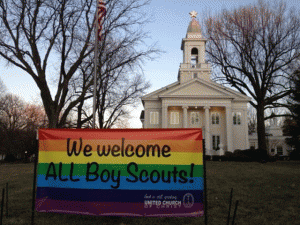
Boy Scouts to accept gays

After lengthy and wrenching debate, local leaders of the Boy Scouts of America have voted to open their ranks to openly gay boys for the first time, but heated reactions from the left and right made clear that the BSA’s controversies are far from over.

The Scouts’ longstanding ban on gay adults remains in force, and many liberal Scout leaders – as well as gay-rights groups – plan to continue pressing for an end to that exclusion even though the BSA’s top officials aren’t ready for that step.

Meanwhile, many conservatives within the Scouts are distraught at the outcome of the vote and some are threatening to defect. A meeting is planned for next month to discuss formation of a new organization for boys.

The vote was conducted by secret ballot Thursday during the National Council’s annual meeting at conference center not far from Boy Scout headquarters in suburban Dallas. Of the roughly 1,400 voting members of the council who cast ballots, 61 percent supported the proposal drafted by the governing Executive Committee. The policy change takes effect Jan. 1.

“This has been a challenging chapter in our history,” the BSA chief executive, Wayne Brock, said after the vote. “While people have differing opinions on this policy, kids are better off when they’re in Scouting.”

However, the outcome will not end the membership policy debate, as was evident in the reactions of leaders of some of the conservative religious denominations that sponsor Scout units.

“We are deeply saddened,” said Frank Page, president of the Southern Baptist Convention’s executive committee. “Homosexual behavior is incompatible with the principles enshrined in the Scout oath and Scout law.”

The Assemblies of God said the policy change “will lead to a mass exodus from the Boy Scout program.” It also warned that the change would make the BSA vulnerable to lawsuits seeking to end the ban on gay adults.

John Stembeger, a conservative activist and former Scout from Florida, founded a group called OnMyHonor.net to oppose the policy change. He assailed the BSA executive committee for its role in gaining a “Yes” vote.

“What kind of a message are we sending to young people about being brave when its top adult leaders don’t even have the courage to stand up to the pressure of a militant lobby when the bullies in Washington D.C., Hollywood or even some of their own renegade councils start pressuring and harassing them?” he asked.

He said OnMyHonor.Net and other like-minded organizations and individuals would meet in Louisville, Ky., next month to discuss the creation of “a new character development organization for boys.”

Texas Gov. Rick Perry also expressed dismay.

“While I will always cherish my time as a Scout and the life lessons I learned, I am greatly disappointed with this decision,” he said.

The result was welcomed by many liberal members of the Scouting community and by gay-rights activists, though most of the praise was coupled with calls for ending the ban on gay adults.

“I’m so proud of how far we’ve come, but until there’s a place for everyone in Scouting, my work will continue,” said Jennifer Tyrrell, whose ouster as a Cub Scout den leader in Ohio because she is lesbian launched a national protest movement.

Tyrrell recalled having to tell her son she had been forced out as den mother.

“He doesn’t deserve to be told that we’re not good enough,” she said. `’We’re not going to stop until this is over.”

Pascal Tessier, an openly gay 16-year-old Boy Scout from Maryland, had mixed emotions after the vote.

“I was thinking that today could be my last day as a Boy Scout,” he said. “Obviously, for gay Scouts like me, this vote is life-changing.”

Tessier is on track to receive his Eagle Scout award – he only needs to complete his final project – but said he is troubled that on his 18th birthday he could transform from someone holding Scouting’s highest rank to someone unfit to be a part of the organization.

“That one couple hours (between 17 and 18) will make me not a good person,” he said.

Tessier has been an exception – an openly gay Scout whose presence was quietly accepted by local Scout leaders. In general, the Scouts’ policy has been to avoid any questioning of would-be Scouts as to their sexual orientation, but to dismiss boys who did speak openly about being gay.

For example, Scout officials refused to grant the Eagle Scout rank to Ryan Andresen, an 18-year-old Californian, after he came out as gay last year.

The vote followed what the BSA described as “the most comprehensive listening exercise in Scouting’s history” to gauge opinions, including a survey sent out starting in February to members of the Scouting community.

Of the more than 200,000 leaders, parents and youth members who responded, 61 percent supported the current policy of excluding gays, while 34 percent opposed it. Most parents of young Scouts, as well as youth members themselves, opposed the ban.

The proposal approved Thursday was seen as a compromise, and the Scouts stressed that they would not condone sexual conduct by any Scout – gay or straight.

“The Boy Scouts of America will not sacrifice its mission, or the youth served by the movement, by allowing the organization to be consumed by a single, divisive and unresolved societal issue,” the BSA said in a statement.

Among those voting for the proposal to accept openly gay youth was Thomas Roberts, of Dawsonville, Ga., who serves on the board of a Scout council in northeast Georgia.

“It was a very hard decision for this organization,” he said. “I think ultimately it will be viewed as the right thing.”

The BSA’s overall “traditional youth membership” – Cub Scouts, Boy Scouts and Venturers – is now about 2.6 million, compared with more than 4 million in peak years of the past. It also has about 1 million adult leaders and volunteers.

Of the more than 100,000 Scouting units in the U.S., 70 percent are chartered by religious institutions.

Those include liberal churches opposed to any ban on gays, but some of the largest sponsors are relatively conservative denominations that have previously supported the broad ban – notably the Roman Catholic Church, the Church of Jesus Christ of Latter-day Saints and Southern Baptist churches.

While the Southern Baptists were clearly upset by the vote to accept openly gay youth, the Utah-based Mormon church – which has more Scouting troops than any other religious denomination – reacted positively.

“We trust that BSA will implement and administer the approved policy in an appropriate and effective manner,” an LDS statement said.

Utah’s largest Boy Scout councils supported the change.

“This is a win for youth and a win for the community,” said John Gailey, spokesman for the Utah National Parks Council, which covers central and southern Utah. “It gives all youth the opportunity to take advantage of the values instilled by Scouting.”

The National Catholic Committee on Scouting responded cautiously, saying it would assess the possible impact of the change on Catholic-sponsored Scout units. – AP

Swedish race riots: ‘They don’t want to integrate’

Youth gang riots in the Swedish capital Stockholm have entered fifth straight night. Hundreds of mostly immigrant teenagers tore through the suburbs, smashing windows and burning cars in the country’s worst outbreak of violence in years.

At least six vehicles were torched throughout the city late on Thursday while the police called for reinforcements from other Swedish cities bracing for further unrest.

Firefighters were putting out flames that engulfed several cars and a school in immigrant-dominated areas of Stockholm.

The night before, the fire brigades were called to some 90 different blazes. On the fourth night of violence, youths torched over 30 cars in 15 neighborhoods along with a restaurant in Skogas, south of Stockholm. Three law enforcement officers were injured, police spokesperson Kjell Lindgren reported.

Stockholm firefighters were busy throughout the night, saying they had “never before seen so many fires raging at the same time.” Some 90 blazes were reported in total, most of them reportedly caused by the rioters. Still, the fourth night of violence was relatively quiet compared to the previous three, RT’s Peter Oliver reported from Stockholm.

Leaders of immigrant communities were out on the streets in a bid to stop young people from rioting. Despite their efforts, as soon as the night fell, groups of arsonists took to the streets to set cars on fire. RT’s Peter Oliver witnessed rioters throwing stones at police and journalists alike.

Civil disorder in Stockholm started on Sunday, when police shot and killed a 69-old-man in his apartment after he confronted officers with a machete; the unrest has since continued throughout week.

Community leaders insist that a main reason for the violence is the high rate of unemployment in immigrant communities, particularly in the suburb of Husby near central Stockholm, one of the worst affected by the nighttime violence, Peter Oliver reported.

Although Sweden’s unemployment rate is below the EU average, joblessness among those under 25 has reached nearly 25 percent. The RT crew in Stockholm noted that a majority of those taking part in the violence are young.

Parents of the rampaging teenagers and community religious leaders are now spending sleepless nights on the street in an effort to prevent their children from wreaking havoc.

Meanwhile, the Swedish Prime Minister Fredrik Reinfeldt blamed the violence on “hooligans” and said they did not represent the majority in the rioting neighborhoods.

“I think it’s dangerous to draw a picture of Sweden with a capital separated from its suburbs. I don’t think that’s true. I think the dividing line runs straight through Husby, with a majority population and then a small group of troublemakers,” Reinfeldt said.

But the Husby youth taking part in riots told Reuters they are indeed divided from the rest of Stockholm, struggling to find a full-time job with their Husby address. Most of the interviewed rioters were reportedly unemployed.

The claims of social exclusion in immigrant-dominated suburbs have been partly conceded by Sweden’s Integration Minister Erik Ullenhag, who said the ministry is aware of “discrimination in these areas.” But the riots “don’t improve the image of these areas, where there is a lot of positive stuff going on,” he added.

For years, Sweden – one of Europe’s most tranquil countries, famous for its attractive immigration policies and generous welfare system – has been accepting an influx of immigrants, which now make up about 15 per cent of its population. These migrants have failed to integrate into Swedish society, and are only in the country to enjoy the country’s social benefits system, Swedish journalist Ingrid Carlqvist told RT.

“The problem is not from the Swedish government or from the Swedish people,” the editor in chief of Dispatch International said. “The last 20 years or so, we have seen so many immigrants coming to Sweden that really don’t like Sweden. They do not want to integrate, they do not want to live in [Swedish] society: Working, paying taxes and so on.”

“The people come here now because they know that Sweden will give them money for nothing. They don’t have to work, they don’t have to pay taxes – they can just stay here and get a lot of money. That is really a problem,” Carlqvist added.

“The police could do so much, [instead] they have told the public that they mean to do as little as possible. But they could go there and use water cannons, they could not let people out onto the streets at night. There are so many things they could do within the law – but they don’t do it,” she said.

Young Muslims who enjoy tolerance, social institutions and welfare while living in Sweden nevertheless refuse to integrate into the West, Gerolf Annemans told RT. Annemans is the parliamentary leader of Vlaams Belang (‘Flemish Interest’), a Belgian far-right nationalist political party.

“They [Muslim youths] have always sought excuse to show that they are not agreeing with the basic values of Western society,” Annemans said, pointing to the recent cases of the Boston Marathon bombing in the US and yesterday’s beheading of a British soldier in the UK.

“It’s always the same problem. There is a massive refusal by Muslim youngsters of the basics of Western society…  and they take any excuse whatsoever to show that with violence – that is where the problem is,” he said. – RT

Firemen extinguish a burning car parked in an indoor garage in the Stockholm suburb of Tureberg after youths rioted in several different suburbs for a fourth consecutive night on May 24, 2013 (AFP Photo / Jonathan Nackstrand)The night before, the fire brigades were called to some 90 different blazes. On the fourth night of violence, youths torched over 30 cars in 15 neighborhoods along with a restaurant in Skogas, south of Stockholm. Three law enforcement officers were injured, police spokesperson Kjell Lindgren reportedStockholm firefighters were busy throughout the night, saying they had “never before seen so many fires raging at the same time.” Some 90 blazes were reported in total, most of them reportedly caused by the rioters. Still, the fourth night of violence was relatively quiet compared to the previous three, RT’s Peter Oliver reported from Stockholm.


Another Marikana?

Continuing wildcat strikes and tension in the mining industry could impoverish South Africa, President Jacob Zuma warned on Thursday.

“If the workers demand higher wages and that becomes a point of conflict, so sharp a conflict it could produce another Marikana, then there’s something wrong in our society,” he said in response to debate in the National House of Traditional Leaders.

Deviating from his prepared speech, the president called on traditional leaders to “engage” workers.

“The tension in the industry will not help the economy…. We could impoverish our country. That’s why the leaders ought to engage workers, so that workers understand exactly what are the consequences of their actions.

“I’m not saying workers must not strike. That is a right that is enshrined in the Constitution. The question is how do you do it? Do we do it to make others lose their jobs, or do we do it so that others can get more jobs?”

Zuma said the labour unrest in the mining sector was a contradiction.

“If we say we need more jobs, and… in the process, those that are working are engaged in strikes that cause some of… the mines… to close, it is a contradiction.

“We are contradicting ourselves because we need more jobs, [but] we are creating a situation where the very jobs that are there, are actually lessened.”

The more workers lost jobs, the more they engaged in actions that cost more jobs.

“It’s a contradiction. We are likely to run the economy of the country into a serious problem, and… there will be more people unemployed. And there will therefore be an extension of poverty,” he said.

Zuma also warned on investors’ perceptions of South Africa.

“These people who put in money; unfortunately, at times, they don’t rely on facts, they rely on perceptions. And perceptions can at times be more dangerous than real facts.”

Earlier, Zuma told traditional leaders that while South Africa’s economy had proved “resilient”, its capacity to develop “with greater speed” was lower than it would otherwise have been.

It was important that even as the country strove to obtain a more equitable distribution of national wealth, this was done in a manner that enhanced, rather than destroyed it.

“Wildcat strikes of the type happening in the mining industry and other sectors are hardly the way to advance the interests of marginalised sections of our people in a democratic dispensation such as we have.

“We should demand better salaries and working conditions, but we may not wreck the economy.”

Zuma told the House that the task of leadership required “that we all draw the line between anarchy and constructive engagement”.

He reminded traditional leaders that he had once been a trade unionist.

“Going for a strike took a lot of debate, because we understood the consequences. It was not something where, one day, you wake up angry and call a strike.”

What was happening gave an impression that the understanding of trade unionism among workers was “one-sided”, or very narrow.

He said trade unionism was about “how do you protect your members, how do you make sure they continue working”, he said. – SAPA

DA Youth will demonstrate against Afrikaner settlement at Kleinfontein

Mbali Ntuli, leader of the Democratic Alliance Youth

The reported racial exclusion policies of Kleinfontien farm settlement, near Pretoria, will be the target of a Democratic Alliance Youth protest on Thursday.

The settlement, which reportedly only accepts “white, Afrikaans Protestants who abide by the Blood River Covenant” as residents or workers, had no place in a democratic South Africa, DA Youth leader Mbali Ntuli said on Wednesday.

“We cannot allow racial nationalists on the extreme fringes of South African politics to try and bring apartheid back.”

The protest aimed to liberate Kleinfontein residents from their “apartheid mindsets”.

“While others divide, we will unite,” Ntuli said.

“Tomorrow we will show South Africa what a reconciled and prosperous nation looks like.”

Details of the planned protest would be released later.

Earlier, government expressed dismay that there were still citizens who did not want to integrate into a democratic South Africa.

“This disintegration is extremely disappointing, as it perpetuates the ills of the apartheid era,” acting government spokeswoman Phumla Williams said.

“Such acts were the main causes of a divided South Africa,” she said.

She was reacting to a report in The Times that residents of Kleinfontein settlement had vowed that only Afrikaners would be allowed to live there.

According to the newspaper, all the settlement’s residents, from the security guards at the gate to the gardeners, were Afrikaans.

Williams said all South Africans were governed by the Constitution, which catered for people of all races and religions. She said Kleinfontein residents benefited from government services.

“We strongly discourage them from lobbying for the town to be declared independent from the Tshwane municipality, as this will be contrary to the Constitution of this country.”

The Times reported that Kleinfontein’s controlling body chairman Jan Groenewald said it would lobby the Tshwane municipality for the settlement to be declared independent.

“Eventually, the African National Congress government will have to approve what we are doing here,” he was quoted as saying.

Groenewald told the newspaper a resident had to be “an Afrikaner with Voortrekker heritage, a Protestant Christian, and abide by the Blood River covenant”.

“We do not think in terms of race, we think in terms of culture… (but) you cannot ignore the fact that we have different races. That is the reality,” he reportedly said.

Residents included the leaders of several rightwing groups, but the community’s directors kept them in line, he said.

“We do not fly the South African flag because (South Africa) is a unitary state – the reason we find ourselves in this situation.” – Sapa

South African government ‘shocked’ by Kleinfontein

The school children of Kleinfontein

The government expressed dismay on Wednesday that there were still citizens who did not want to integrate into a democratic South Africa.

“This disintegration is extremely disappointing as it perpetuates the ills of the apartheid era,” Government Communication and Information System CEO Phumla Williams said.

“Such acts were the main causes of a divided South Africa,” she said.

She was reacting to a report in The Times that residents of a settlement on the farm Kleinfontein, near Pretoria, had vowed that only Afrikaners would be allowed to live there.

According to the newspaper, all the settlement’s residents, from the security guards at the gate to the gardeners, were Afrikaans.

Williams said all South Africans were governed by the Constitution, which catered for people of all races and religions. She said Kleinfontein residents benefited from government services.

“We strongly discourage them from lobbying for the town to be declared independent from the Tshwane municipality, as this will be contrary to the Constitution of this country.”

The Times reported that the Kleinfontein’s controlling body’s chairman Jan Groenewald said it would lobby the Tshwane municipality for the settlement to be declared independent.

“Eventually, the African National Congress government will have to approve what we are doing here,” he was quoted as saying.

Groenewald told the newspaper a resident had to be “an Afrikaner with Voortrekker heritage, a Protestant Christian and abide by the Blood River covenant”.

“We do not think in terms of race, we think in terms of culture… [but] you cannot ignore the fact that we have different races. That is the reality,” he reportedly said.

Residents included the leaders of several rightwing groups, but the community’s directors kept them in line, he said.

“We do not fly the South African flag because [South Africa] is a unitary state — the reason we find ourselves in this situation.” – Sapa

No South African flag

The Care Centre, Kleinfontein

The people of Kleinfontein vow that no one other than an Afrikaner will ever live among them.


That was until last year when the Gauteng legislature’s portfolio committee on community safety was told that black police officers were not allowed inside the enclave.

Everybody in the settlement – from a camouflage uniform-clad security guard at the gate to the gardener in 71-year-old resident Marike Fourie’s yard – is a white Afrikaner.

Asked if a black person could ever be allowed to live there, the chairman of the property’s controlling body Jan Groenewald said a resident must be “an Afrikaner with Voortrekker heritage, be a Protestant Christian and abide by the Blood River covenant… we do not think in terms of race, we think in terms of culture… [but] you cannot ignore the fact that we have different races, that is the reality”.

He dismissed suggestions that it was an apartheid-style whites-only enclave, saying anybody was allowed to enter provided they had an appointment – but only Afrikaners were allowed to live there.

“It is private property and you have to make an appointment like with any other private property.”

He conceded that residents included Afrikaner extremists who were leaders of right-wing groups but pointed out that they were kept in line by the community’s directors.

“They are stronger in their feelings for Afrikaner self-determination but here the authority is the board of directors. We do not allow any form of racism … this is a place where we can neutralise these extremist views,” he said.

He said the ultimate goal of the community was self-determination as Afrikaner people, as enshrined in article 235 of the constitution.

“We do not fly the South African flag because [South Africa] is a unitary state – the reason we find ourselves in this situation,” he said.

Groenewald said the community will lobby the Tshwane municipality for the town to be declared independent from the municipality .

“Eventually, the ANC government will have to approve what we are doing here.”

Within the boundaries of the settlement are the graves of British soldiers killed in the Anglo-Boer War. Game, including antelope and zebra, roam the area.

Housewife Corne Beetge, 38, said the settlement was a “safe haven” for her family and about 1000 other Afrikaners, 450 of whom are shareholders in the property.

Beetge, her businessman husband, and their four-year-old son Waldo moved into a two-bedroom house on Visvanger Laan, in Nedersetting, the working-class section of the enclave, over a year ago from Krugersdorp on the West Rand, where they felt “unsafe”.

Their R4500 monthly rent covers electricity, water, waste and rubbish removal and 24-hour security.

Most of Kleinfontein residents are retired people and professionals such as scientists, engineers, geologists, pharmacists, accountants, nurses and business people.

It has its own bank, grocer’s and insurance offices. timeslive.co.za


French intellectual commits suicide in Notre Dame cathedral – ‘a political gesture’?

Dominique Venner

Dominique Venner committed suicide on Tuesday in front of the altar of Notre Dame Cathedral in Paris. The death of the 78-year-old essayist and historian sparked numerous reactions from French nationalists.

Several executives and members of the country’s National Front party took to Twitter to praise Venner. Directly referencing Venner’s last blog post, National Front party leader Marine Le Pen called the writer’s act an “eminently political” gesture destined to “awaken the people of France.”

“All our respect to Dominique Venner whose last gesture, an eminently political one, attempted to awaken the people of France. MLP”

In a blog post published on the same day as his suicide, Venner talked about “new gestures, spectacular and symbolic ones, to rattle lethargies, to shake anaesthetised consciences and awaken the memory of our origins.”

Louis Aliot, vice-president of the National Front and Marine Le Pen’s partner, also paid his respects, calling Venner an “intransigent and courageous defender of our civilisation’s values.”

“My emotional thoughts go out to the tragic disappearance of D.Venner, intransigent and courageous defender of our civilisation’s values.”

Bruno Gollnisch, another figure of the National Front, saw Venner’s suicide as a “protest against the decadence of our society.” Gollnisch argued that Venner “experienced” the approval of the law on gay marriage “as it should have been experienced, as a promotion of decadence and a defacement of marriage.”

Gollnisch added that “it wasn’t his only fight, he also protested against the programmed disappearance of the French people, the progressive substitution with other populations.”

Julien Rochedy, the president of the National Front youth group tweeted:

“It’s with immense sadness that I hear about Dominique Venner’s suicide. He will be reunited with the heroes from the Iliad he loved so much.”

According to some members of the National Front, Venner was considered as a potential candidate to head the party when it was founded in 1972.

Honorary president Jean-Marie Le Pen commented on the suicide to the AFP by comparing it to the death of Pierre Drieu La Rochelle, a writer who collaborated with the Nazis during WWII and who committed suicide in 1945. “An intellectual suicide, which testifies with death,” declared the founder of the National Front.

On Tuesday night, thousands of militants gathered in front of Notre Dame Cathedral, carrying torches and national flags. According to Le HuffPost, an unidentified speaker said: “We ignored the deep causes of his gesture. We are here to pay tribute to his last fight (…) He always defended France, beautiful, strong and proud of itself.”

This piece has been translated from French and originally appeared on HuffPost France.

Max du Preez’s fantasies on Zimbabwe

'Fast-track land reform' of the Zimbabwean style, as sought by Max du Preez

by TAU Bulletin

Anti-apartheid journalist and apologist for South Africa’s democratic dispensation Max du Preez has been caught short with his latest efforts to justify the unjustifiable. In a Natal Mercury piece (30.4.13), Du Preez tells us we can “learn from Zimbabwe’s flourishing farms”, and goes on to laud a new book by three London (where else?) left wingers: London School of Economics’ Joseph Hanlon, an anti-apartheid and commonwealth sanctions activist in the 1980’s; Jeanette Manjengwa, Deputy Director, Institute for Environmental Studies, University of Zimbabwe; and Teresa Smart, visiting fellow at the University of London.

Du Preez says the book “Zimbabwe Takes Back its Land” shows that Zimbabwe’s radical land grab “has worked” and that “agricultural production is on levels comparable to the time before the process started.”  What is meaningful, says Du Preez, is that these production levels were achieved by 245,000 black farmers on land previously worked by some 6 000 white farmers. He clearly does not see the irony in this – does it take 245 000 Africans to produce the same as 6 000 white farmers?

(It is interesting that euphemisms such as “the process”, “land redistribution” and “fast track land reform” are used in the book and by Mr. Du Preez to describe one of Africa’s most haunting and terrifying attacks on any country’s productive agricultural sector. Who can forget the horrifying television footage of mobs of so-called war veterans storming white farms, destroying farm animals, beating to death family dogs trying to defend their owners’ properties, while farm families who couldn’t flee fast enough met sometimes gruesome fates at the hands of these thugs, all in the name of land reform. Ironically, these destructive mobs received few farms at all – the choicer properties were taken by Mugabe’s cronies for, in some cases, weekend parties.)

From the book, Du Preez says lessons South Africans can learn is that new black farmers can actually farm successfully and commercially if given enough time and help, and that an “ambitious land redistribution programme (in South Africa) can play a role in alleviating poverty and providing employment and dignity to large numbers or marginalized people”.  (It is reported that the London team spent one month in Zimbabwe before writing the book, and that they used a simplistic method based on a very small section of agriculture – they used three farms that were “taken back” while more than five thousand farms were stolen by the Mugabe government.)

It is further common cause that many “flourishing” farms are owned by the Chinese, and that the few still owned by white farmers operate at the grace and favor of President Mugabe.(He, his courtiers and his army have to be fed after all!).  We are also told that when certain farms are targeted by the ubiquitous war veterans, all the owner has to do is phone the Chinese Embassy and nothing more is heard from the mob. Sizeable tobacco contracts have been signed with the Chinese government.

 What is to be gleaned from this puff piece by someone who clearly feels the need to continue defending South Africa’s current dispensation?

Millennia

Black South Africans have existed in Africa for millennia. They never developed anything better than subsistence farming – maybe  food for today but little for tomorrow. They had no written language, and it was left to early Christian missionaries to formalize and put into script African languages which had been solely an oral tradition. Thus there was no recorded title to land – it is a non-African concept – so to entitle a book “Zimbabwe Takes its Land Back” is disingenuous. One commentator declared: Zimbabwe takes back its land from whom? It was taken back from Zimbabweans, seventy percent of whom had bought their farms after President Mugabe came to power and whose agricultural skills were the bedrock of a country that had been a savannah until they came.

Yes, in another way, land in Zimbabwe was “taken back” – it was plundered and stolen from white productive farmers whose accomplishments showed up the incompetence and inability of others to produce a surplus, let alone enough to eat for themselves. This highway robbery was based on racial resentment, fuelled by a tyrant afraid of losing an election and who used white achievement as a scapegoat to foster black pique.

The United Nations

Before Mr. Du Preez decided to wax unctuous about Zimbabwe’s “flourishing farms”, he could have visited the websites of the United Nations World Food Programme (WFP), the Food and Agricultural Organization (FAO) in Rome, the World Bank and a few other organizations trying to keep Zimbabwe afloat. According to WFP director Felix Bamezon (14.3.13), Zimbabwe’s current food insecurity levels are “the worst in four years.” The WFP is presently providing food aid to 1,58 million people in 37 districts of the country. In March this year, the WFP said approximately 19% of the population of Zimbabwe was estimated to be in need of food assistance.

If a government cannot even feed its people, let alone have surplus production, this can hardly be termed “flourishing”. The Japanese government recently provided nearly $6 million for flood, drought and food relief to Zimbabwe. This contribution allowed the WFP to purchase maize for 215,000 people and pulses for 835 000 people for two months. During the last decade, Japanhas provided more than $29 million to the WFP’s operations in Zimbabwe.

In January of this year, the Zimbabwean finance minister admitted to journalists the country only had $217 in its bank account!  David Smith of the London Guardian wrote on 30 January of this year that “from 2000 the seizure of white-owned farms led to chaos in the agriculture sector and the economy shrank by half. In 2008 hyperinflation of 231,000,000% broke the national currency and left millions of people hungry.” (Emphasis ours)

Where did the money go? The opposition Movement for Democratic Change (MDC) says that income from diamond sales is being stolen by President Mugabe’s Zanu/PF party to finance the forthcoming election. The watchdog “Partnership Africa Canada” said last November that at least $2 billion of diamonds form the Marange fields has been stolen by Mugabe’s ruling elite.

What flourishing really means!

In the October 2009 edition of THE ROSARIAN, a publication distributed by the Flame Lily Foundation (created to secure the interests of former residents of Rhodesia/Zimbabwe), Dr. Mick Gammon writes a lengthy piece on the destruction of Zimbabwe under President Robert Mugabe, with particular emphasis on agriculture. (Dr. D.M. Gammon was a former specialist in the Department of Conservation and Extension in the Rhodesian Ministry of Agriculture.)

“The first white traders and missionaries who came to the region in the 19th century found a land devoid of infrastructure. The wheel was not yet in use. Travelers went for days without seeing any human habitation. With a population of around 250 00 at the time, most of the land was not occupied. Commercial farming started in the 1890s on what was for the most part, virgin land. There were no roads or railways, no electricity or telephones, no fences, boreholes, pumps, windmills, dams, irrigation schemes; no cattle dips, barns or any other farm buildings.

“These first farmers had to discover how to contend with predators that killed their livestock and other animals that consumed their crops; how to control diseases, pests and parasites of livestock and crops that were foreign to them. Knowledge and experience built up over generations in the developed world had limited application, since the local climate, oil and vegetation was vastly different.

“From this starting point, agriculture developed faster than it had anywhere else in the world. Soon the country became self-sufficient in most agricultural products. In many cases yields per hectare and quality equalled and bettered those in the developed world.

“The United Nations Food and Agriculture Year Book 1975 ranked the then Rhodesia second in the world in terms of yields of maize, wheat, soya beans and ground nuts, and third for cotton. In the combined ranking for all these crops, Rhodesia ranked first in the world.

Rhodesia’s Virginia tobacco was rated the best in the world in yield and quality, while maize entries in world championships were consistently placed in the first three places.

“The world’s largest single citrus producer was developed early in the country’s history. The indigenous cattle were developed through breeding and selection to highly productive breeds. Wild life was incorporated into farming systems to develop a highly successful eco-tourism industry, and endangered species found their most secure havens on farm conservancies.

“Zimbabwe was the world’s second largest exporter of flue-cured tobacco. This together with exports of maize, soya beans, cotton, sugar, coffee, tea, fruit, vegetables, flowers and beef, made agriculture the major source of foreign currency. It was the largest employer of labor, providing employment for about a third of the country’s work force.

“The country’s state departments of veterinary services, tobacco research, plant and seed research, livestock and crop management were world class.  Each farm was, to a large extent, an outpost of civilization and many farms established schools for the children of their workers. Every farm was a clinic and dispensary and ambulance service for the surrounding areas.”

What happened to these farmers has been splashed around the world. It is a tragic history. From prosperity to a government balance sheet of just $217; to perennial food aid, to a tyrannical dictatorship, corruption and government theft; to poverty and large-scale emigration. From a  bread basket to a basket case. The only thing flourishing in this scenario is the scary imagination of Mr. Du Preez.

Complaint to the BBC – media release by PRAAG

COMPLAINT FILED ONLINE WITH THE BBC

At the beginning of the programme and also on the BBC’s website at http://www.bbc.co.uk/news/magazine-22554709 John Simpson states: “Apartheid South Africa looked after white people and nobody else. Now some of its white communities face a level of deprivation, or of violence, which threatens their future in the country.” The first sentence is factually incorrect because so-called “Apartheid South Africa” (National Party rule from 1948 to 1994) supplied social and educational services to all inhabitants of the country, albeit at differential rates, from budgets tabled in parliament and therefore widely available. Schools, universities for the use of non-whites were built, as well as hospitals, including the Baragwanath Hospital in Soweto where medical students from the University of the Witwatersrand also trained.

The programme and website article then establish a causal link between such “lack of care” for non-whites under the previous dispensation with the deprivation and violence currently suffered by poor whites. Or at least this is how the viewer/reader will interpret it as they are seen to be “getting their just deserts”.

Although the rest of the programme is not unsympathetic to the current plight of Afrikaners, the factual inaccuracy concerning so-called “apartheid” is but one in a general, systematic, ethnocentric bias against Afrikaners on the BBC, intended to incite world-wide hatred against an essentially powerless minority in South Africa.

END OF COMPLAINT TEXT

PRAAG, as well as Dr. Dan Roodt in his personal capacity, reserves the right to lodge further complaints against the BBC, either with the relevant bodies in South Africa or with the Council of Europe for promoting intolerance and hate speech against Afrikaners.


Toronto mayor facing allegations of smoking crack

Rob Ford

The mayor of Canada’s largest city, facing allegations that he smoked crack cocaine, and made racial and homophobic slurs on video, must either refute the accusations or step down, fellow city politicians say.

“If the allegations are false, then the mayor is owed some apologies,” said Councillor Josh Matlow, who has clashed with Ford on transit issues, but who usually takes a centrist line in a polarized city council.

“If the allegations are proven true beyond a reasonable doubt, then the mayor should resign.”

An editor from U.S. media outlet Gawker and two reporters from the Toronto Star said separately they saw a cellphone video that appeared to show Mayor Rob Ford smoking crack cocaine.

Ford, who is no stranger to controversy, was elected mayor of Toronto more than two years ago after serving as a councillor for 10 years. He called the allegations “ridiculous” on Friday and suggested they were part of a broader campaign against him by the left-leaning Toronto Star newspaper.

Dennis Morris, Ford’s lawyer, told Reuters on Monday that it was still too early to consider legal action over the allegations and that if there is a video, it needs to be made public so that Canadians can judge the content for themselves.

“We’re all waiting to see whether there’s anything within this video and whether or not it’s been doctored, edited, altered, that type of thing,” he said.

Reuters was unable to independently verify the existence of the video or its contents.

Ford’s brother, Doug, his closest ally on City Council, broke a brief and uncharacteristic silence on Saturday, telling local radio station Newstalk 1010, “I have never seen my brother involved with anything like coke.”

The brothers canceled their regular Sunday appearance on a radio show at the same station.

The controversy made headlines across Canada and around the world, although some focused as much on Ford’s crude remarks as the allegations of crack use.

“The allegations that have been leveled at Mayor Ford are not just serious, but they are also criminal,” Councillor Kristyn Wong-Tam told CBC News. “I would encourage the mayor to resign and to seek help as soon as possible should this be true.”

The Toronto Star reporters who watched the video said Ford calls Liberal leader Justin Trudeau a “fag” and derisively refers to players on the high school football team he coaches as “minorities”.

“If the mayor the of world’s most diverse city is proven to have uttered racial and homophobic slurs, then he’s not fit for the office,” Councillor Matlow told Reuters.

Toronto City Council contains both left-leaning councilors, mostly from the city’s core, and right-leaning candidates like Ford, who are mostly from suburban areas like Etobicoke.

The two groups tend to take different approaches on issues from transit to unionized labor, with often comical policy flip flops. In one example, City Council imposed a 5-cent fee on plastic grocery bags, then ignored Ford’s plea to remove the fee and voted to ban the bags completely.

They then reversed that decision, leaving the issue exactly where it was before the whole debate started.

Elected on a platform to stop the gravy train at City Hall, Ford has courted controversy on many occasions; the Toronto Star on Friday published a list of 42 “extraordinary moments” in his political career.

(http://www.thestar.com/news/city_hall/2013/05/17/rob_ford_42_remarkable_moments_from_toronto_mayors_career.html)

The list includes accusations that Ford skipped City Council meetings to coach high-school football and engaged in a confrontation outside his home with a reporter.

He was briefly ordered out of office in 2012 after he was found guilty of conflict of interest, but won an appeal and was allowed to finish his four-year term as mayor.

In 2008, assault charges brought against Ford by his wife Renata were withdrawn by the Crown because of inconsistencies in Renata’s story. The couple later reconciled.

The rumblings of scandal have eroded Ford’s popularity, although polls conducted before the reports of the video still enjoyed support from some 50 percent of the population, most of them from in Toronto’s suburbs.

Both Gawker and the Star say the video is being shopped around by people with connections to the drug trade.

In an effort buy the video and post it online, Gawker launched a “Crackstarter” campaign last week to raise $200,000. It has so far raised more than $76,000. – Reuters

Swedish police ‘resorted to racial slurs’

One of a 100 vehicles torched in Stockholm

Police officers on hand during the Husby riot in northern Stockholm stand accused of using racist language towards people on the ground, with one youth worker in the area claiming it is “not the last time” such scenes will occur.

The officers on the scene allegedly used words like “monkeys”, “rats”, and “niggers” to people in Husby on Sunday night, when at least one hundred cars were torched and three police officers were injured after stones were thrown at them.

A local youth leader, who along with a small group of teens was out on the street on Sunday, told local newspaper editor Rouzbeh Djalaie that he was called a nigger when he asked the police if they needed any help. The teens were called “monkeys”.

“I can understand the police officers were stressed, but this language is unacceptable, and unfortunately nothing new,” Rami al-Khamisi, law student and founder of youth organization Megafonen, told The Local.

Megafonen is a community-based organization in the area that aims to organize residents of Stockholm’s northern suburbs to fight for social justice. Al-Khamisi, the founder of the organization, said the riots were a “reaction to police brutality against citizens, our neighbours”.

“Last week, the police shot an old man who was holding a knife. How can they do this without taking responsibility? I can understand the reaction,” he said.

Last Monday, police officers stormed the home of a 69-year-old Husby man who was brandishing a machete and shot him dead.

“You have to see what happened from a wider point of view. It’s not the first time something like this has happened, and it’s not the last. This is the kind of reaction when there isn’t equality between people, which is the case in Sweden,” he added.

Al-Khamisi said that the crowd was reacting to a “growing marginalization and segregation in Sweden over the past ten, 20 years” from both a class and a race perspective.

“Out in the suburbs the majority of people aren’t white, and from a political perspective we’re seen as a problem that politicians want to solve by sending more police. This is not a solution we agree with,” he said.

Stockholm police, meanwhile, would not disclose whether any arrests had been made in relation to the incident, which continued from around 10pm on Sunday night until 5.30am on Monday morning.

“I cannot make a statement at present because the police investigation is under way,” western Stockholm police spokesman Daniel Mattsson told the Dagens Nyheter newspaper.

He said that the police were tipped off about potential vandalism by concerned Husby residents who saw people with masks carrying cans containing some kind of liquid, and that just minutes later a car was burning.

Police have, however, filed 18 reports, ranging from violent rioting, causing damages, aggravated damages, attempted arson, and assault of an official.

Stockholm police officer Jörgen Karlsson said the accusations of racial slurs were “unfortunate”.

“It’s unfortunate if someone perceives they have been called that. But people can either make a police report or contact the local police,” he told the TT news agency.

Al-Khamisi, meanwhile, said that it’s unlikely that rioting in Sweden will stop any time soon.

“This kind of thing isn’t only happening in Husby, it’s happening all over Sweden. People are tired of politics not working in our favour, they’re tired of the current situation,” he told The Local.

“These people feel they have to take matters into their own hands.” The Local

Race riots in Stockholm

Gangs of youth angered by the police shooting death of an elderly man in a mainly immigrant neighborhood hurled rocks at police and set cars and buildings on fire in a Stockholm suburb early Monday, forcing the evacuation of an apartment block.

Around 50 youths were involved in the riots in the suburb of Husby, police spokesman Lars Bystrom said.

The youths set light to a parking garage, compelling police to evacuate residents from an adjacent apartment block, Bystrom said. Residents were allowed to return home after a couple of hours.

Around 80 percent of the roughly 11,000 people living in Husby – a drab, low-income neighborhood of apartment blocks west of Stockholm – are first or second generation immigrants.

“Youth” in European news stories is a euphemism for black hooligans. The euphemism “Asian” wasn’t used and is an indication that they are black Africans, probably Somalis. The area where this occurred is 80% non-Swedish.

Bystrom said police responded to calls of burning cars and were met by masked youths hurling rocks at them.

One policeman was attacked by youths kicking him and two others were injured by rocks, local police officer Jorgen Karlsson said. He added around 10 cars were set ablaze, and windows were smashed at two schools and several local businesses.

Karlsson said the dead man was “European,” but couldn’t specify his nationality.

Residents said they had gathered to protest against the shooting death and that police responded by sending in SWAT teams that cordoned off the area.

“I understand that people react like this,” said Rami Al-Khamisi from the organization Megafonen, which represents citizens in Stockholm’s suburbs.

The organization said police had used excessive violence against the youths and also attacked passers-by with batons and dogs.

Police have launched an internal probe to investigate the shooting death on May 13 of a 69-year-old man in Husby. They say they shot the man in self-defense because he had attacked police with a knife when they broke down the door to an apartment, where he had locked himself up with a woman.

However, Megafonen has criticized police for initially releasing a faulty report saying the man was taken to a hospital. The group said residents had seen his dead body being transported from the scene hours after the shooting in a hearse, which police later admitted was correct. SAPA/AP

So a TV presenter dies and the country gasps in shock?

So a TV presenter dies and the country gasps?

Firstly let me say – rest in peace Vuyo, I have become very accustomed to sharing my lounge with you in the mornings, and your “sharp sharp” always seemed to put a positive spin on my day. My sincerest condolences to his family and friends as they have lost a loved one who was far too young to die.

But – is this a symptom of our society that the entire country sits up and gasps when a TV personality dies of what seems to be a heart attack or something similar? Was this unfortunate death that much more important than the many people who had died violently in the last couple of weeks? People who were beaten to death, shot, raped and tortured? Little old ladies in their seventies raped and beaten? So many farm attacks in the last couple of weeks and yet I have not heard a collective gasp or witnessed any outrage at these terrible crimes and the horrible deaths that go hand in hand with them?

Are they somehow less important? Do they not warrant our outrage and disgust? Should there not have been a collective gasp at these heinous crimes? Why are they not worthy of decent media coverage? Is it perhaps because they are perpetrated against white people? Does the fact that the victims are white make it ok? Or less important because they somehow deserved what they got? This really makes me mad! These people have died horrible deaths and nobody seems to care? They were not famous or important but they were somebody’s family, a beloved husband or wife, a mother or father, a son or daughter who did not deserve to be tortured to death! Our infamous government claims there is no problem and that crime in our country is under control; they deny that the white people are being systematically eradicated form our society.

I too will miss Vuyo, but it disgusts me that all the people who were killed in farm attacks and robberies will remain faceless and nameless and we will go about our business never having spared a thought for them and their grieving families! It is time to start getting angry, and time to start demanding action from our useless leaders. What does it say about us as a people that we just keep trudging on amid this wholesale slaughter of our countrymen? I am tired of seeing the crosses on the hill on the highway to Pietersburg multiply overnight without any end in sight! So please people, every time you hear of another senseless killing, spread the word so the world will sit up and cry out in disgust, seeing as we as a people are not willing to do so, maybe the world will be so shocked and disgusted that they will intervene in our situation and save us from our bloodthirsty government and our punch-drunk apathy.

It really is scary what we as a people have come to accept as normal and acceptable conditions to live in. If this were Libya or Egypt, heads would roll, but not here – no we just “kyk noord en fok voort”.

Also visit Shane’s blog.