Key affirmative action case to be decided this month

The controversial issue of affirmative action will be decided this month by the US Supreme Court and will set a precedent in how colleges and universities accept students. It is not expected to have significant impact on the current admissions policies of Utah’s colleges and universities, however.

The case, Fisher v. University of Texas, which has been on a legal track toward the top court since 2008, centers on a woman who claims she was denied admission to the University of Texas at Austin despite being equally or more qualified than minority students who were admitted under the university’s policy of considering family circumstance and race in its application process.

University officials claim Abigail Fisher, a white student from the Houston area with a 3.59 grade-point average, the plaintiff in the case, was not qualified to attend the school and said her race was not the reason she was not accepted into the school. Officials at the school also argued that schools have the right to assemble a diverse student body, a position upheld by the court in a 2003 case (Grutter v. Bollinger) focused on affirmative action admissions decisions at the University of Michigan.

Prior to reaching the U.S. Supreme Court, a district court in 2009 ruled in favor of the University of Texas at Austin. The case was then appealed to a three-judge panel from the 5th Circuit Court of Appeals, which also ruled in favor of the university.

Supreme Court Justice Elena Kagan has recused herself from hearing the case. Five of the remaining eight judges would need to rule against the university’s policy, as a tie would uphold the lower courts’ decisions. A decision is expected by the end of June, possibly as early as Monday.

A ruling in favor of Fisher would give legal precedent to individuals challenging affirmative action admission policies, which are sometimes cited as perpetuating racial divisions, and the dispute has been among the key cases the court is ruling on this month.

Utah’s standards

Pamela Silberman, spokeswoman for the Utah System of Higher Education, said the court’s decision, while impactful nationally and precedent-setting, will have little immediate impact either way on Utah’s public colleges and universities. It could certainly impact Utah students seeking education out of state, particularly in hard-to-get-into programs making use of affirmative action policies.

Of the eight schools in the Utah public system, five are open enrollment, meaning all applicants are accepted based on a basic entrance requirement. The remaining three schools — the University of Utah, Utah State University and Southern Utah University — determine enrollment by a minimum index score combining high school grade-point averages and ACT or SAT exam scores.

“There’s really not any sort of consideration of race or ethnicity or other demographic standards there,” Silberman said. “It’s going to have almost no impact in the state of Utah because there hasn’t been a strong history of those kinds of policies anyway.”

Because Utah’s schools determine admission based on academic criteria, it is not likely that a decision against the University of Texas would lead to Utah students challenging their denied admission applications, she said.

“I think that if the criteria for entrance are really clear, then you’re going to avoid that,” Silberman said. “We want all students to be prepared so they can meet those criteria, and I think that’s the focus we have.”

The U. recently transitioned to a holistic application process, which considers extracurricular factors like creative endeavors and community service in addition to GPA and test scores.

Octavio Villalpando, associate vice president for equity and diversity at the U., said the policy is still being fine-tuned, but because it does not give special consideration to race or demographics, he does not foresee it running into conflict with the court’s decision on Fisher.

Villalpando said U. officials have studied the effects of anti-affirmative action laws in other states to avoid conflict.

“We don’t anticipate any significant changes here at the campus,” he said. “Looking across the country in states where a version of this law passed, the flagship campuses didn’t have to change much of their admissions process.”

Of the 33,291 students enrolled at the University of Utah in the fall of 2012, about 70 percent were white, 7 percent were Hispanic and 4 percent were Asian, according to data from the Utah System of Higher Education. Statewide, 14 percent of public college and university students in Utah were minority students in 2012.

Villalpando said the University of Utah, as well as other institutions in the Utah System of Higher Education, have focused on collaborating with K-12 education to prepare students for college, rather than implementing admissions policies to address perceived racial imbalances.

He also said the relatively recent diversification of Utah’s student body has allowed educators to observe the best practices of areas in the country with larger minority populations.

“I think the fact that Utah is just now beginning to see this large demographic change is really helping higher ed in many ways,” Villalpando said. “It’s allowing us to learn from other strategies states have adopted.”

Political action

But the controversy surrounding affirmative action is not unknown to the state. In 2010, Utah lawmakers considered a resolution calling for a constitutional amendment prohibiting affirmative action in state agencies and higher education.

The pre-emptive resolution, sponsored by Rep. Curt Oda, R-Clearfied, stated that public entities could not “grant preferential treatment to any individual or group on the basis of race, sex, color, ethnicity or national origin.”

The resolution received a favorable recommendation during its House committee hearing but was moved by the House Rules Committee, where it languished until the session expired without coming up for a vote.

David Jones, education division chief for the Utah Attorney General’s Office, said affirmative action is not a pervasive issue in Utah’s courts. Historically, the number of cases on the issue has been minimal, Jones said, and he does not expect the Supreme Court’s decision on Fisher v. University of Texas to change that.

He also agreed with Silberman and Villalpando’s assessment that the index score admission process of Utah’s schools would be largely unaffected by the outcome of the case.

“The ACT scores and the grade-point averages aren’t going to be affected by the Supreme Court decision,” Jones said. – Salt Lake City, Deseret News

Trump says we must stop being so politically correct

Donald Trump added to his portfolio of race-based insults, citing figures provided by Fox News Channel anchor Bill O’Reilly as proof that “the overwhelming amount of violent crime in our major cities is committed by blacks and Hispanics.”

“We must stop being so politicially correct,” he tweeted. “Must tell it like it is.”

His first tweet on the subject said this: “According to Bill O’Reilly, 80% of all the shootings in New York City are blacks-if you add Hispanics, that figure goes to 98%. 1% white.”

Indeed, O’Reilly did reference that statistic Tuesday during a panel discussion about violence in a Philadelphia school on his O’Reilly Factor show,  noting “In New York City, 80 percent of all the shootings in the nation’s largest town are blacks. If you add Hispanic shooters, 98 percent of all the shootings in New York City are minority, less than one percent are white. So you’re seeing not only violence in the schools, but then it translates out into the streets almost exclusively from the minority precincts.”

O’Reilly seemed to be referencing a report from the New York City Police Department titled “Crime and Enforcement Activity in New York City.” Tabulating crimes in New York City by race, listing shootings suspects as black 74.7% of the time, 21.9% were Hispanic, and 2.7% were white.

Of course, New York City’s population is a bit more diverse than the nation; 25% black, 27.5% Hispanic, 2.1% multiethnic and 44.6% white. Also, these are crime suspects, not those who have been convicted of any crime, and their race was likely determined by police, with no guarantee of total accuracy.

One expert suggested police released the figures to show why their controversial stop-and-frisk policy so often targets people of color. But some experts say police create animosity in communities with an aggressive stop-and-frisk policy, which make it less likely law enforcement can get information from residents.

“Our major cities” and violent crime is a black and Hispanic problem. It’s also likely true that a overwhelming amount of white collar crime in New York is committed by white people.

There is no doubt that violent crime is a serious problem in communities of color. But connecting it to race in such a blunt and unfair fashion seems more about blaming certain kinds of people than solving the problem.

As always, it remains puzzling that NBC continues to offer a platform to someone so willing to pass along prejudice disguised as political speech. – Tampa Bay Times

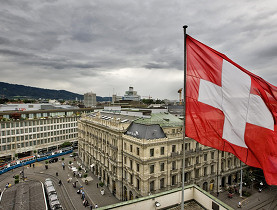
Swiss parliament stalls banking secrecy bill

The legislation to disclose client names and data to resolve an ongoing tax-evasion spat between Switzerland and the US, was met with sharp critique by the lower house of parliament in Bern, who halted the vote.

The legislation, which has been dubbed by some Swiss media outlets as ‘American dictate’, is a strong demand by the US in a step for Switzerland to end their banking secrecy regime and bring transparency to their shady practices.

The accord, if enacted into law by Swiss parliament, aims to better track tax evasion in the alpine nation. Last week, Finance Minister Eveline Widmer-Schlumpt told reporters that her cabinet had approved the bill.

The Swiss news agency, ATS, reported 90 votes were in favor, and 100 opposed to debate the new law, which is expected to decided upon during the summer parliament session, which began on Monday and will come to a close on June 21.

Before voting, members from various political parties voiced concerns over the details of the deal to hand over sensitive data to Washington.

A committee, supported by elected members of the Swiss People’s Party, the Christian Democrats and the Ticino League, have until December 4th 2014 to collect 100,000 signatures to put the proposal to a national vote.

On Tuesday, the right-wing Swiss People’s Party launched a campaign to kill the bill and said the package was too ‘vague’ and could create trouble for Swiss bankers.

The bill is vague because Washington and Bern are keeping mum about the details and conditions of the deal, and plan to keep quiet until after the Parliament approves it. Once approved, Parliament will not be able to amend the accord. – RT

‘They can watch your ideas form as you type’

The National Security Agency and the FBI in the US are tapping directly into the central servers of nine leading U.S. Internet companies, extracting audio and video chats, photographs, e-mails, documents, and connection logs that enable analysts to track foreign targets, according to a top-secret document obtained by The Washington Post.

The program, code-named PRISM, has not been made public until now. It may be the first of its kind. The NSA prides itself on stealing secrets and breaking codes, and it is accustomed to corporate partnerships that help it divert data traffic or sidestep barriers. But there has never been a Google or Facebook before, and it is unlikely that there are richer troves of valuable intelligence than the ones in Silicon Valley.

Equally unusual is the way the NSA extracts what it wants, according to the document: “Collection directly from the servers of these U.S. Service Providers: Microsoft, Yahoo, Google, Facebook, PalTalk, AOL, Skype, YouTube, Apple.”

PRISM was launched from the ashes of President George W. Bush’s secret program of warrantless domestic surveillance in 2007, after news media disclosures, lawsuits and the Foreign Intelligence Surveillance Court forced the president to look for new authority.

Congress obliged with the Protect America Act in 2007 and the FISA Amendments Act of 2008, which immunized private companies that cooperated voluntarily with U.S. intelligence collection. PRISM recruited its first partner, Microsoft, and began six years of rapidly growing data collection beneath the surface of a roiling national debate on surveillance and privacy. Late last year, when critics in Congress sought changes in the FISA Amendments Act, the only lawmakers who knew about PRISM were bound by oaths of office to hold their tongues.

The court-approved program is focused on foreign communications traffic, which often flows through U.S. servers even when sent from one overseas location to another. Between 2004 and 2007, Bush administration lawyers persuaded federal FISA judges to issue surveillance orders in a fundamentally new form. Until then the government had to show probable cause that a particular “target” and “facility” were both connected to terrorism or espionage.

In four new orders, which remain classified, the court defined massive data sets as “facilities” and agreed to certify periodically that the government had reasonable procedures in place to minimize collection of “U.S. persons” data without a warrant.

In a statement issue late Thursday, Director of National Intelligence James R. Clapper said “information collected under this program is among the most important and valuable foreign intelligence information we collect, and is used to protect our nation from a wide variety of threats. The unauthorized disclosure of information about this important and entirely legal program is reprehensible and risks important protections for the security of Americans.”

Clapper added that there were numerous inaccuracies in reports about PRISM by The Post and the Guardian newspaper, but he did not specify any.

Jameel Jaffer, deputy legal director of the American Civil Liberties Union, said: “I would just push back on the idea that the court has signed off on it, so why worry? This is a court that meets in secret, allows only the government to appear before it, and publishes almost none of its opinions. It has never been an effective check on government.”

Several companies contacted by The Post said they had no knowledge of the program, did not allow direct government access to their servers and asserted that they responded only to targeted requests for information.

“We do not provide any government organization with direct access to Facebook servers,” said Joe Sullivan, chief security officer for Facebook. “When Facebook is asked for data or information about specific individuals, we carefully scrutinize any such request for compliance with all applicable laws, and provide information only to the extent required by law.”

“We have never heard of PRISM,” said Steve Dowling, a spokesman for Apple. “We do not provide any government agency with direct access to our servers, and any government agency requesting customer data must get a court order.”

It is possible that the conflict between the PRISM slides and the company spokesmen is the result of imprecision on the part of the NSA author. In another classified report obtained by The Post, the arrangement is described as allowing “collection managers [to send] content tasking instructions directly to equipment installed at company-controlled locations,” rather than directly to company servers.

Government officials and the document itself made clear that the NSA regarded the identities of its private partners as PRISM’s most sensitive secret, fearing that the companies would withdraw from the program if exposed. “98 percent of PRISM production is based on Yahoo, Google and Microsoft; we need to make sure we don’t harm these sources,” the briefing’s author wrote in his speaker’s notes.

An internal presentation of 41 briefing slides on PRISM, dated April 2013 and intended for senior analysts in the NSA’s Signals Intelligence Directorate, described the new tool as the most prolific contributor to the President’s Daily Brief, which cited PRISM data in 1,477 items last year. According to the slides and other supporting materials obtained by The Post, “NSA reporting increasingly relies on PRISM” as its leading source of raw material, accounting for nearly 1 in 7 intelligence reports.

That is a remarkable figure in an agency that measures annual intake in the trillions of communications. It is all the more striking because the NSA, whose lawful mission is foreign intelligence, is reaching deep inside the machinery of American companies that host hundreds of millions of American-held accounts on American soil.

The technology companies, whose cooperation is essential to PRISM operations, include most of the dominant global players of Silicon Valley, according to the document. They are listed on a roster that bears their logos in order of entry into the program: “Microsoft, Yahoo, Google, Facebook, PalTalk, AOL, Skype, YouTube, Apple.” PalTalk, although much smaller, has hosted traffic of substantial intelligence interest during the Arab Spring and in the ongoing Syrian civil war.

Dropbox, the cloud storage and synchronization service, is described as “coming soon.”

Sens. Ron Wyden (D-Ore.) and Mark Udall (D-Colo.), who had classified knowledge of the program as members of the Senate Intelligence Committee, were unable to speak of it when they warned in a Dec. 27, 2012, floor debate that the FISA Amendments Act had what both of them called a “back-door search loophole” for the content of innocent Americans who were swept up in a search for someone else.

“As it is written, there is nothing to prohibit the intelligence community from searching through a pile of communications, which may have been incidentally or accidentally been collected without a warrant, to deliberately search for the phone calls or e-mails of specific Americans,” Udall said.

Wyden repeatedly asked the NSA to estimate the number of Americans whose communications had been incidentally collected, and the agency’s director, Lt. Gen. Keith B. Alexander, insisted there was no way to find out. Eventually Inspector General I. Charles McCullough III wrote Wyden a letter stating that it would violate the privacy of Americans in NSA data banks to try to estimate their number.

Roots in the ’70s

PRISM is an heir, in one sense, to a history of intelligence alliances with as many as 100 trusted U.S. companies since the 1970s. The NSA calls these Special Source Operations, and PRISM falls under that rubric.

The Silicon Valley operation works alongside a parallel program, code-named BLARNEY, that gathers up “metadata” — technical information about communications traffic and network devices — as it streams past choke points along the backbone of the Internet. BLARNEY’s top-secret program summary, set down in the slides alongside a cartoon insignia of a shamrock and a leprechaun hat, describes it as “an ongoing collection program that leverages IC [intelligence community] and commercial partnerships to gain access and exploit foreign intelligence obtained from global networks.”

But the PRISM program appears to more nearly resemble the most controversial of the warrantless surveillance orders issued by President George W. Bush after the al-Qaeda attacks of Sept. 11, 2001. Its history, in which President Obama presided over exponential growth in a program that candidate Obama criticized, shows how fundamentally surveillance law and practice have shifted away from individual suspicion in favor of systematic, mass collection techniques.

The Obama administration points to ongoing safeguards in the form of “extensive procedures, specifically approved by the court, to ensure that only non-U.S. persons outside the U.S. are targeted, and that minimize the acquisition, retention and dissemination of incidentally acquired information about U.S. persons.”

And it is true that the PRISM program is not a dragnet, exactly. From inside a company’s data stream the NSA is capable of pulling out anything it likes, but under current rules the agency does not try to collect it all.

Analysts who use the system from a Web portal at Fort Meade, Md., key in “selectors,” or search terms, that are designed to produce at least 51 percent confidence in a target’s “foreignness.” That is not a very stringent test. Training materials obtained by The Post instruct new analysts to make quarterly reports of any accidental collection of U.S. content, but add that “it’s nothing to worry about.”

Even when the system works just as advertised, with no American singled out for targeting, the NSA routinely collects a great deal of American content. That is described as “incidental,” and it is inherent in contact chaining, one of the basic tools of the trade. To collect on a suspected spy or foreign terrorist means, at minimum, that everyone in the suspect’s inbox or outbox is swept in. Intelligence analysts are typically taught to chain through contacts two “hops” out from their target, which increases “incidental collection” exponentially. The same math explains the aphorism, from the John Guare play, that no one is more than “six degrees of separation” from any other person.

A ‘directive’

In exchange for immunity from lawsuits, companies such as Yahoo and AOL are obliged to accept a “directive” from the attorney general and the director of national intelligence to open their servers to the FBI’s Data Intercept Technology Unit, which handles liaison to U.S. companies from the NSA. In 2008, Congress gave the Justice Department authority for a secret order from the Foreign Surveillance Intelligence Court to compel a reluctant company “to comply.”

In practice, there is room for a company to maneuver, delay or resist. When a clandestine intelligence program meets a highly regulated industry, said a lawyer with experience in bridging the gaps, neither side wants to risk a public fight. The engineering problems are so immense, in systems of such complexity and frequent change, that the FBI and NSA would be hard pressed to build in back doors without active help from each company.

Apple demonstrated that resistance is possible when it held out for more than five years, for reasons unknown, after Microsoft became PRISM’s first corporate partner in May 2007. Twitter, which has cultivated a reputation for aggressive defense of its users’ privacy, is still conspicuous by its absence from the list of “private sector partners.”

Google, like the other companies, denied that it permitted direct government access to its servers.

“Google cares deeply about the security of our users’ data,” a company spokesman said. “We disclose user data to government in accordance with the law, and we review all such requests carefully. From time to time, people allege that we have created a government ‘back door’ into our systems, but Google does not have a ‘back door’ for the government to access private user data.”

Microsoft also provided a statement: “We provide customer data only when we receive a legally binding order or subpoena to do so, and never on a voluntary basis. In addition we only ever comply with orders for requests about specific accounts or identifiers. If the government has a broader voluntary national security program to gather customer data we don’t participate in it.”

Yahoo also issued a denial.

“Yahoo! takes users’ privacy very seriously,” the company said in a statement. “We do not provide the government with direct access to our servers, systems, or network.”

Like market researchers, but with far more privileged access, collection managers in the NSA’s Special Source Operations group, which oversees the PRISM program, are drawn to the wealth of information about their subjects in online accounts. For much the same reason, civil libertarians and some ordinary users may be troubled by the menu available to analysts who hold the required clearances to “task” the PRISM system.

There has been “continued exponential growth in tasking to Facebook and Skype,” according to the PRISM slides. With a few clicks and an affirmation that the subject is believed to be engaged in terrorism, espionage or nuclear proliferation, an analyst obtains full access to Facebook’s “extensive search and surveillance capabilities against the variety of online social networking services.”

According to a separate “User’s Guide for PRISM Skype Collection,” that service can be monitored for audio when one end of the call is a conventional telephone and for any combination of “audio, video, chat, and file transfers” when Skype users connect by computer alone. Google’s offerings include Gmail, voice and video chat, Google Drive files, photo libraries, and live surveillance of search terms.

Firsthand experience with these systems, and horror at their capabilities, is what drove a career intelligence officer to provide PowerPoint slides about PRISM and supporting materials to The Washington Post in order to expose what he believes to be a gross intrusion on privacy. “They quite literally can watch your ideas form as you type,” the officer said. – Washington Post

We’ll spy on you through your dishwasher

More and more personal and household devices are connecting to the internet, from your television to your car navigation systems to your light switches.

Gen. Petraeus former CIA chief mused about the emergence of an “Internet of Things” — that is, wired devices — at a summit for In-Q-Tel, the CIA’s venture capital firm. “‘Transformational’ is an overused word, but I do believe it properly applies to these technologies,” Petraeus enthused, “particularly to their effect on clandestine tradecraft.”

All those new online devices are a treasure trove of data if you’re a “person of interest” to the spy community. Once upon a time, spies had to place a bug in your chandelier to hear your conversation. With the rise of the “smart home,” you’d be sending tagged, geolocated data that a spy agency can intercept in real time when you use the lighting app on your phone to adjust your living room’s ambiance.

“Items of interest will be located, identified, monitored, and remotely controlled through technologies such as radio-frequency identification, sensor networks, tiny embedded servers, and energy harvesters — all connected to the next-generation internet using abundant, low-cost, and high-power computing,” Petraeus said, “the latter now going to cloud computing, in many areas greater and greater supercomputing, and, ultimately, heading to quantum computing.”

Petraeus allowed that these household spy devices “change our notions of secrecy” and prompt a rethink of “our notions of identity and secrecy.” All of which is true — if convenient for a CIA director.

The CIA has a lot of legal restrictions against spying on American citizens. But collecting ambient geolocation data from devices is a grayer area, especially after the 2008 carve-outs to the Foreign Intelligence Surveillance Act. Hardware manufacturers, it turns out, store a trove of geolocation data; and some legislators have grown alarmed at how easy it is for the government to track you through your phone or PlayStation.

That’s not the only data exploit intriguing Petraeus. He’s interested in creating new online identities for his undercover spies — and sweeping away the “digital footprints” of agents who suddenly need to vanish.

“Proud parents document the arrival and growth of their future CIA officer in all forms of social media that the world can access for decades to come,” Petraeus observed. “Moreover, we have to figure out how to create the digital footprint for new identities for some officers.”

It’s hard to argue with that. Online cache is not a spy’s friend. But Petraeus has an inadvertent pal in Facebook.

Why? With the arrival of Timeline, Facebook made it super-easy to backdate your online history. Barack Obama, for instance, hasn’t been on Facebook since his birth in 1961. Creating new identities for CIA non-official cover operatives has arguably never been easier. Thank Zuck, spies. Thank Zuck. – Wired

Judge Edith Jones in the firing line for race and crime remarks

Judge Edith Jones

Civil rights groups filed a complaint this week against a federal judge in Houston after she allegedly said during a lecture that some minorities are prone to violence.

Judge Edith Jones, who serves on the 5th U.S. Circuit Court of Appeals and was a Bush-era Supreme Court frontrunner, allegedly made the comment while speaking on the death penalty to The Federalist Society at the University of Pennsylvania in February.

The Federalist Society describes itself on its website as “a group of conservatives and libertarians interested in the current state of legal order.”

In her remarks, Jones also is alleged to have said race plays no role in the administration of the death penalty, but certain ethnic groups commit certain types of crimes more often than others.

Civil rights groups, including the J.L. Turner Legal Association, say Jones’ comments reveal a strong ethnic bias. They are pushing for an investigation that could lead to her removal from the bench.

The J.L. Turner Legal Association is an African-American bar association in Dallas. Its president, Mandy Price, told CNN that some attendees were shocked at what they heard and later complained.

“The reaction in the room when she made these remarks was one of shock, surprise, and offense,” according to one account that the legal association collected from some of the attendees.

The Federalist Society itself, however, called the allegations “frivolous accusations.”

ACLU: Blacks busted for marijuana at much higher rates than whites

According to the some of the accounts in the complaint, the judge said, “Racial groups like African- Americans and Hispanics are predisposed to crime.”

They are “‘prone to commit acts of violence,” she said, according to the complaint.

When challenges to her comments arose, she allegedly countered them by saying that “blacks and Hispanics” outnumber “Anglos” on death row.

Price says such comments reveal strong predispositions sitting judges should not harbor.

“We expect that they’re going to be fair, impartial, not that they have predetermined their case,” she said.

A representative from the court, which is headquartered in New Orleans, declined to comment to CNN, and said Jones also is “not making any comment regarding the matter.”

Jones was on President George W. Bush’s short list for the U.S. Supreme Court in 2005, though legal observers remarked at the time that her reputation has a staunch conservative — firmly upholding the death penalty and vocally critical of the Roe v. Wade decision, among other issues — hurt her odds.

“The decision for which Judge Jones is really best known is her opinion saying, ‘While I’m a lower court judge, I will apply Roe v. Wade, but I think it was wrongly decided and should be overruled,'” Supreme Court expert Tom Goldstein told CNN. “That really typifies her role as a lower court judge but signals what she would do if she became a Supreme Court justice.” – CNN.COM

China benefits most from Iraq oil

China already buys nearly half the oil that Iraq produces, nearly 1.5 million barrels a day, and is angling for an even bigger share, bidding for a stake now owned by Exxon Mobil in one of Iraq’s largest oil fields.

“The Chinese are the biggest beneficiary of this post-Saddam oil boom in Iraq,” said Denise Natali, a Middle East expert at the National Defense University in Washington. “They need energy, and they want to get into the market.”

Before the invasion, Iraq’s oil industry was sputtering, largely walled off from world markets by international sanctions against the government of Saddam Hussein, so his overthrow always carried the promise of renewed access to the country’s immense reserves. Chinese state-owned companies seized the opportunity, pouring more than $2 billion a year and hundreds of workers into Iraq, and just as important, showing a willingness to play by the new Iraqi government’s rules and to accept lower profits to win contracts.

“We lost out,” said Michael Makovsky, a former Defense Department official in the Bush administration who worked on Iraq oil policy. “The Chinese had nothing to do with the war, but from an economic standpoint they are benefiting from it, and our Fifth Fleet and air forces are helping to assure their supply.”

The depth of China’s commitment here is evident in details large and small.

In the desert near the Iranian border, China recently built its own airport to ferry workers to Iraq’s southern oil fields, and there are plans to begin direct flights from Beijing and Shanghai to Baghdad soon. In fancy hotels in the port city of Basra, Chinese executives impress their hosts not just by speaking Arabic, but Iraqi-accented Arabic.

Notably, what the Chinese are not doing is complaining. Unlike the executives of Western oil giants like Exxon Mobil, the Chinese happily accept the strict terms of Iraq’s oil contracts, which yield only minimal profits. China is more interested in energy to fuel its economy than profits to enrich its oil giants.

Chinese companies do not have to answer to shareholders, pay dividends or even generate profits. They are tools of Beijing’s foreign policy of securing a supply of energy for its increasingly prosperous and energy hungry population. “We don’t have any problems with them,” said Abdul Mahdi al-Meedi, an Iraqi Oil Ministry official who handles contracts with foreign oil companies. “They are very cooperative. There’s a big difference, the Chinese companies are state companies, while Exxon or BP or Shell are different.”

China is now making aggressive moves to expand its role, as Iraq is increasingly at odds with oil companies that have cut separate deals with Iraq’s semiautonomous Kurdish region. The Kurds offer more generous terms than the central government, but Iraq and the United States consider such deals illegal.

Late last year, the China National Petroleum Corporation bid for a 60 percent stake in the lucrative West Qurna I oil field, a stake that Exxon Mobil may be forced to divest because of its oil interests in Iraqi Kurdistan. Exxon Mobil, however, has so far resisted pressure to sell, and in March the Chinese company said it would be interested in forming a partnership with the American company for the oil field.

If the United States invasion and occupation of Iraq ended up benefiting China, American energy experts say the unforeseen turn of events is not necessarily bad for United States interests. The increased Iraqi production, much of it pumped by Chinese workers, has also shielded the world economy from a spike in oil prices resulting from Western sanctions on Iranian oil exports. And with the boom in American domestic oil production in new shale fields surpassing all expectations over the last four years, dependence on Middle Eastern oil has declined, making access to the Iraqi fields less vital for the United States.

At the same time, China’s interest in Iraq could also help stabilize the country as it faces a growing sectarian conflict.- NYT

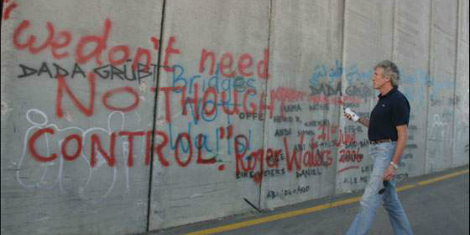
Pink Floyd member urges Israel boycott

Roger Waters protests against Israel

Roger Waters and Alice Walker have penned open letters asking singer Alicia Keys to call off a forthcoming concert in Tel Aviv. Walker, the author of The Color Purple, invited Keys to join a cultural boycott of Israel, visiting “the children in Gaza” instead of supporting “a system that is cruel, unjust and unbelievably evil”.

“Dear Alicia Keys,” Walker wrote on the website for the US Campaign for the Academic & Cultural Boycott of Israel. “I have learned today that you are due to perform in Israel very soon. We have never met, though I believe we are mutually respectful of each other’s path and work. It would grieve me to know you are putting yourself in danger (soul danger) by performing in an apartheid country that is being boycotted by many global conscious artists.”

In his own letter, Waters admitted that Keys may not know who he is. “I used to be in a band called Pink Floyd and, believe it or not, I still work,” he wrote. The English musician implored Keys to “join the rising tide of resistance” and refuse “to give legitimacy to the Israeli government policies of illegal, apartheid, occupation of the homelands of the indigenous people of Palestine.”

Keys is due to appear at Tel Aviv’s Nokia Arena on 4 July, as part of her ongoing Girl On Fire tour. It will be her first appearance in Israel. As the concert approaches, activists have begun ramping up their Facebook and Twitter campaign, asking the long-time HIV/Aids activist to consider dropping the gig in solidarity with the Palestinian rights movement.

“I have kept you in my awareness as someone of conscience and caring, especially about the children of the world,” Walker went on. “A cultural boycott of Israel and Israeli institutions (not individuals) is the only option left to artists who cannot bear the unconscionable harm Israel inflicts every day on the people of Palestine, whose major ‘crime’ is that they exist in their own land, land that Israel wants to control as its own.”

Elvis Costello, Santana, the Pixies and Gil Scott-Heron are among the other artists to have boycotted Israel in recent years, while acts including Madonna and Paul McCartney have dismissed calls to cancel shows. Earlier this month, physicist Stephen Hawking announced he was joining the movement, adding his name to a list of supporters that includes dozens of Nobel laureates.

Keys has yet to respond to activists’ requests. – The Guardian

Boy Scouts to accept gays

After lengthy and wrenching debate, local leaders of the Boy Scouts of America have voted to open their ranks to openly gay boys for the first time, but heated reactions from the left and right made clear that the BSA’s controversies are far from over.

The Scouts’ longstanding ban on gay adults remains in force, and many liberal Scout leaders – as well as gay-rights groups – plan to continue pressing for an end to that exclusion even though the BSA’s top officials aren’t ready for that step.

Meanwhile, many conservatives within the Scouts are distraught at the outcome of the vote and some are threatening to defect. A meeting is planned for next month to discuss formation of a new organization for boys.

The vote was conducted by secret ballot Thursday during the National Council’s annual meeting at conference center not far from Boy Scout headquarters in suburban Dallas. Of the roughly 1,400 voting members of the council who cast ballots, 61 percent supported the proposal drafted by the governing Executive Committee. The policy change takes effect Jan. 1.

“This has been a challenging chapter in our history,” the BSA chief executive, Wayne Brock, said after the vote. “While people have differing opinions on this policy, kids are better off when they’re in Scouting.”

However, the outcome will not end the membership policy debate, as was evident in the reactions of leaders of some of the conservative religious denominations that sponsor Scout units.

“We are deeply saddened,” said Frank Page, president of the Southern Baptist Convention’s executive committee. “Homosexual behavior is incompatible with the principles enshrined in the Scout oath and Scout law.”

The Assemblies of God said the policy change “will lead to a mass exodus from the Boy Scout program.” It also warned that the change would make the BSA vulnerable to lawsuits seeking to end the ban on gay adults.

John Stembeger, a conservative activist and former Scout from Florida, founded a group called OnMyHonor.net to oppose the policy change. He assailed the BSA executive committee for its role in gaining a “Yes” vote.

“What kind of a message are we sending to young people about being brave when its top adult leaders don’t even have the courage to stand up to the pressure of a militant lobby when the bullies in Washington D.C., Hollywood or even some of their own renegade councils start pressuring and harassing them?” he asked.

He said OnMyHonor.Net and other like-minded organizations and individuals would meet in Louisville, Ky., next month to discuss the creation of “a new character development organization for boys.”

Texas Gov. Rick Perry also expressed dismay.

“While I will always cherish my time as a Scout and the life lessons I learned, I am greatly disappointed with this decision,” he said.

The result was welcomed by many liberal members of the Scouting community and by gay-rights activists, though most of the praise was coupled with calls for ending the ban on gay adults.

“I’m so proud of how far we’ve come, but until there’s a place for everyone in Scouting, my work will continue,” said Jennifer Tyrrell, whose ouster as a Cub Scout den leader in Ohio because she is lesbian launched a national protest movement.

Tyrrell recalled having to tell her son she had been forced out as den mother.

“He doesn’t deserve to be told that we’re not good enough,” she said. `’We’re not going to stop until this is over.”

Pascal Tessier, an openly gay 16-year-old Boy Scout from Maryland, had mixed emotions after the vote.

“I was thinking that today could be my last day as a Boy Scout,” he said. “Obviously, for gay Scouts like me, this vote is life-changing.”

Tessier is on track to receive his Eagle Scout award – he only needs to complete his final project – but said he is troubled that on his 18th birthday he could transform from someone holding Scouting’s highest rank to someone unfit to be a part of the organization.

“That one couple hours (between 17 and 18) will make me not a good person,” he said.

Tessier has been an exception – an openly gay Scout whose presence was quietly accepted by local Scout leaders. In general, the Scouts’ policy has been to avoid any questioning of would-be Scouts as to their sexual orientation, but to dismiss boys who did speak openly about being gay.

For example, Scout officials refused to grant the Eagle Scout rank to Ryan Andresen, an 18-year-old Californian, after he came out as gay last year.

The vote followed what the BSA described as “the most comprehensive listening exercise in Scouting’s history” to gauge opinions, including a survey sent out starting in February to members of the Scouting community.

Of the more than 200,000 leaders, parents and youth members who responded, 61 percent supported the current policy of excluding gays, while 34 percent opposed it. Most parents of young Scouts, as well as youth members themselves, opposed the ban.

The proposal approved Thursday was seen as a compromise, and the Scouts stressed that they would not condone sexual conduct by any Scout – gay or straight.

“The Boy Scouts of America will not sacrifice its mission, or the youth served by the movement, by allowing the organization to be consumed by a single, divisive and unresolved societal issue,” the BSA said in a statement.

Among those voting for the proposal to accept openly gay youth was Thomas Roberts, of Dawsonville, Ga., who serves on the board of a Scout council in northeast Georgia.

“It was a very hard decision for this organization,” he said. “I think ultimately it will be viewed as the right thing.”

The BSA’s overall “traditional youth membership” – Cub Scouts, Boy Scouts and Venturers – is now about 2.6 million, compared with more than 4 million in peak years of the past. It also has about 1 million adult leaders and volunteers.

Of the more than 100,000 Scouting units in the U.S., 70 percent are chartered by religious institutions.

Those include liberal churches opposed to any ban on gays, but some of the largest sponsors are relatively conservative denominations that have previously supported the broad ban – notably the Roman Catholic Church, the Church of Jesus Christ of Latter-day Saints and Southern Baptist churches.

While the Southern Baptists were clearly upset by the vote to accept openly gay youth, the Utah-based Mormon church – which has more Scouting troops than any other religious denomination – reacted positively.

“We trust that BSA will implement and administer the approved policy in an appropriate and effective manner,” an LDS statement said.

Utah’s largest Boy Scout councils supported the change.

“This is a win for youth and a win for the community,” said John Gailey, spokesman for the Utah National Parks Council, which covers central and southern Utah. “It gives all youth the opportunity to take advantage of the values instilled by Scouting.”

The National Catholic Committee on Scouting responded cautiously, saying it would assess the possible impact of the change on Catholic-sponsored Scout units. – AP

New Orleans mass murderer is 19-year old black man

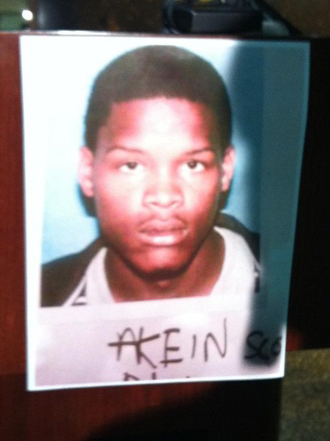
Akein Scott

During a press conference Monday night investigators said they had secured an arrest warrant for Akein Scott, 19, and pleaded with the public to help bring the alleged shooter to justice.

City law enforcement officials publicized a mug shot of the young man, who they say was released from jail on a bond on April 29, according to WWL-TV in New Orleans.

Police also advised that a New Orleans SWAT team will patrol the streets until Scott is found. They urged him to turn himself in multiple times, and admitted they’re still investigating whether he acted alone. Three search warrants were executed to no avail in the hours before the press conference.

“The important thing for Akein Scott now is to turn himself in,” said Police Superintendent Ronal Serpas.

He added that multiple tips have identified Scott as the perpetrator who opened fire on a crowd and injured 19 people during a Mother’s Day parade. Most of the victims have since been released from the hospital. Police have also offered a $10,000 reward and posted blurry surveillance camera images earlier in the day Monday.

“The people chose to be on the side of the young innocent children shot instead of on the side of a coward who shot into the crowd,” Sepas said.

Gunfire erupted in the Seventh Ward neighborhood at around 2:00pm local time (1900 GMT) during an annual Mother’s Day parade attended by up to 400 people. Based on a preliminary investigation, the FBI confirmed that the shooting was likely related to street violence, not terrorism.

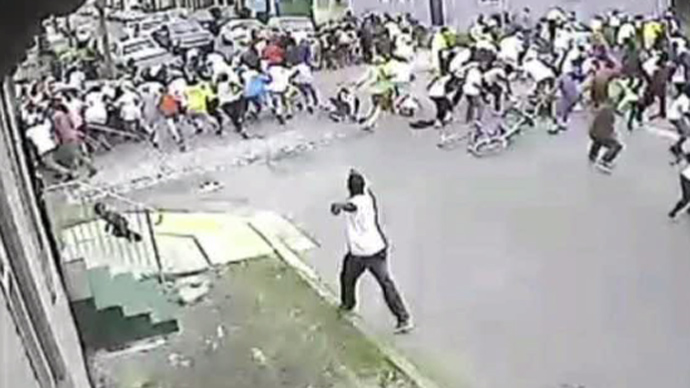
Cellphone video obtained by police and released in the aftermath shows the parade crowd suddenly scattering, and some falling to the ground, in front of a man wearing a white T-shirt and dark pants. He is seen running away from the crowd while shooting at people.

Scott was previously arrested for illegal possession of a stolen firearm, illegal carrying of a weapon, resisting an officer, contraband to jail, illegal carrying of a weapon while in possession of a controlled dangerous substance and possession of heroin, according to a police statement as quoted by CBS News.

Sepas praised law enforcement’s handling of the case so far and told reporters three gunshot victims are still in critical condition but are expected to survive. He would not speculate as to whether Scott was the only person to fire a weapon at the parade Sunday.

In a Monday afternoon press conference, police said they were making headway in the investigation.  Police and local media had called for anyone who recognizes or may know the possible suspect to contact crime stoppers in the hope of tracing the gunman, or gunmen. Up to three gunmen are believed to be at large.

“There were hundreds of people there, and somebody saw something,” New Orleans Mayor Mitch Landrieu said in a public appeal.

Screenshot from video of New Orleans shooter/ courtesy of YouTube user NOPD8th

A $2,500 cash reward was initially offered, which was later raised to $10,000 amid a massive manhunt. The reward is being offered to anyone who can provide information that leads to an arrest.

Former CIA agent Glenn Carle told RT that the violence did not resemble a terror attack: “It doesn’t have any of the hallmarks or modus operandi of terrorist groups that I ever worked against, that we know about in the intelligence community in the United States. It seems – knowing nothing more than the media reports – to have been either astoundingly amateurish by a terrorist, and I don’t think that’s the case, or more likely a gang-related kind of violent act.”

The shooting victims – 10 men, seven women, a boy and a girl, both 10 years old – were taken to hospitals for non-life-threatening wounds; three remain in critical condition. – RT.COM

Free shotguns in major US cities?

In an experimental bid to determine whether wider gun ownership could lead to a decline in crime, a University of Houston graduate student and the Armed Citizens Project is looking to give away shotguns to residents of fifteen cities.

Kyle Coplen, 29, is the founder of the Armed Citizens Project, a group which announced that it will seek to expand its program into the Chicago Metropolitan Area at a recent National Rifle Association convention in Houston, Texas.

According to Coplen, the idea is to give out free, 20-gauge single-barrel shotguns to residents living in mid- to high-crime neighborhoods to see whether the presence of armed homes would cause a drop in crime.

“Gun-control advocates often argue that an increase in guns in an area will lead to an increase in crime, while gun-rights advocates often believe that fewer guns result in more crime. While both sides often argue that their opponents’ policies will result in more crime, gun-control proponents have largely been the victors when it comes to policy implementation,” explains the Armed Citizens Project’s website.

New measures in Congress to enact federal background checks for gun owners and the defeat of various other gun control measures indicate that in reality, gun control supporters do not have the upper hand in policy implementation.

While states such such as Connecticut and Colorado have recently passed new controls on assault weapons and high-capacity magazines, elsewhere, such as in Texas and South Carolina, state legislatures are lobbying to attract gun industry investment and working on legislation to further bolster access to guns.

One Texas bill that would ban state and local police from working with federal authorities on new gun control regulations was recently passed by the state House.

As for the Armed Citizens Project, according to Coplen the group intends to both screen participants for its shotgun give-away project and provide training for those selected.

“We’re not just tossing a bunch of shotguns into a community and walking away,” Coplen told Fox 26.

“What we’re doing is finding residents who are interested in protecting themselves. we’re not forcing guns on anyone,” he added.

In addition to offering free guns, the Armed Citizens Project is setting its sights on local gun buyback programs. The group hopes to dissuade those looking to hand over their guns with training sessions, or even have those weapons traded in for 20-gauge shotguns.

City and county-sponsored gun buybacks have recently become a point of contention for gun rights advocates. In Arizona, for example, Governor Jan Brewer recently signed a bill prohibiting cities and counties in that state from destroying guns collected through such programs, instead mandating that they be sold to licensed dealers.

The Armed Citizens Project hopes to distribute guns to hundreds of people living in major American cities by the end of the year. The program is already active in Houston and Tucson, Arizona, and in addition to Chicago they are also setting their sights on New York and Detroit. In Houston, local news channel WGN reports that 100 people have already signed up for the project.

Despite early success, Copley anticipates that getting his project started in a city such as New York, where Mayor Michael Bloomberg is a staunch proponent of gun regulation, will be a hurdle.

“I really don’t care what [Bloomberg] thinks. I can’t think of one thing he’s ever done besides being a successful businessman that I can agree with,” said Coplen to the NY Daily News.

New York Police Commissioner Raymond Kelly has already shown skepticism of Copley’s project.

“You need a permit … so obviously you won’t be able to do it here,” Kelly told the Daily News on Monday.

In addition to broad discretion over gun permits, the New York Police Department requires a $140.00 shotgun permit fee, in addition to a fingerprinting charge of $91.50.

Coplen intends to request donations to help low-income city applicants secure the necessary permits.

“I guess the Bloomberg administration doesn’t want poor people to be able to defend themselves. I guess that right is left to the elites,” Coplen told Daily News.

There’s a Nazi under your bed…

One thousand Holocaust survivors and World War II vets joined with former President Bill Clinton and Nobel Peace Prize laureate and Holocaust activist Elie Wiesel to mark the U.S. Holocaust Memorial Museum’s 20th anniversary. Organizers chose not to wait for the 25th milestone because many survivors and vets may not be alive in another five or 10 years.

“We felt it was important, while that generation is still with us in fairly substantial numbers, to bring them together,” said Museum Director Sara Bloomfield.

Washington has many monuments and memorials that offer something special for visitors from around the world, “but the Holocaust memorial will be our conscience,” Clinton said.

Since the museum opened 20 years ago, the world has made huge scientific discoveries, including the sequencing of the human genome, which proved humans are 99.5 percent genetically the same, Clinton said.

“Every non age-related difference … is contained in one half of 1 percent of our genetic makeup, but every one of us spends too much time on that half a percent,” Clinton said. “That makes us vulnerable to the fever, the sickness that the Nazis gave to the Germans. That sickness is very alive across the world today.”

Focusing only on fanatical Nazis would be a serious misunderstanding of the Holocaust, Bloomfield added.

“The Holocaust wouldn’t have been possible, first of all, without enormous indifference throughout Germany and German-occupied Europe, but also thousands of people who were, say, just doing their jobs,” she said, such as a tax official who collected special taxes levied against Jews.

In an opening film, some survivors recall being turned over to Nazi authorities in front of witnesses who did nothing. “The whole town was assembled … looking at the Jews leaving,” one survivor recalls.

Steven Fenves was a boy at the time. He recalled how in 1944, the government of Hungary, allied with Nazi Germany, forced his family out of its apartment. The family was deported to Auschwitz, where Fenves’ mother was gassed.

“One of the nastiest memories I have is going on that journey and people were lined up, up the stairs, up to the door of the apartment, waiting to ransack whatever we left behind, cursing at us, yelling at us, spitting at us as we left,” he said in an interview with the museum.

The museum located images of bystanders looking on as Jews were detained, humiliated and taken away.

The federally funded museum’s theme for its 20th anniversary is “Never Again: What You Do Matters.” The museum devotes part of its work and research to preventing future genocides. A study released by the museum last month found that the longer the current conflict in Syria continues, the greater the danger that mass sectarian violence results in genocide.

Much more is still being learned about the Holocaust, as well, Bloomfield said. The museum is compiling an encyclopedia of all incarceration sites throughout Europe. When the project began, scholars expected to list 10,000 such sites. Now the number stands at 42,000.

Since opening, the museum has had more than 35 million visitors. – AP


Boston blank: No suspects, no motives

The FBI says they have no suspects nor anyone in custody over the deadly Boston blasts. Police are calling on witnesses to assist the investigation which has been called “the most complex crime scene” in the history of the Boston PD.

While the investigation has yielded no results, with no one claiming responsibility, more details have emerged on the nature of the explosives.

According to a person close to the Boston Marathon investigation, the explosives were in 6-liter pressure cookers and placed in black duffel bags. The person, who spoke on the condition of anonymity, said investigators have some of the bomb components but did not yet know what was used to set off the explosives.

The statement echoes the Massachusetts General surgeon’s words that given the injuries they treated, “most of [the metallic fragments in the patients] were in the bomb.”

The General surgeon addressed the media Tuesday. He said that the shrapnel was consistent in size, and included nail-like fragments.

“There were people who had 10, 20, 30 of them in their body,” he said.

Earlier, FBI and Boston city authorities declined to comment on the nature of the explosives that were triggered 12 seconds apart in the late hours of the race, when most of the top runners had finished and ordinary participants were completing the event.

Massachusetts Gov. Deval Patrick stressed that “only two explosive devices were found yesterday”, rejecting reports that earlier suggested five explosives were found.

Addressing the public the morning after the tragedy, FBI, Boston city authorities and police said that they are still seeking public assistance, calling for witnesses to come forward.

“We are processing the most complex crime scene in the history of our department,” Police Commissioner Edward Davis said.

People who captured amateur photos and videos are being asked to submit their footage as it might help with the investigation into the double blasts which have killed three and left more than 170 people injured.

“We have received voluminous tips over the last 18 hours since the incident,” FBI special agent in charge, Rick DesLauriers said.

The police gave no details on the going investigation.

Police called on citizens to be patient as they will see a “continued, heightened police presence”.

Police are searching the 26.2 mile route of the race. Currently the crime scene has been scaled down to12 blocks. FBI special agent in charge, Rick DesLauriers, said that there is currently “no known physical threat.”

US Homeland Security Secretary Janet Napolitano said Tuesday there was no indication that the bomb blasts in Boston were part of a broader plot.

“While there is no current indication to suggest that the events in Boston are indicative of a broader plot,” she said in a written statement. “Out of an abundance of caution, DHS continues to keep in place enhanced security measures at transportation hubs, utilizing measures both seen and unseen.”

The FBI special agent DesLauriers also declined to comment saying he is “not going to say who might or might not be in custody right now.”

Earlier on Tuesday reports said police are seeking a suspect in the deadly Boston blasts described as a “darker-skinned or black male” with a backpack, media reports. They are also looking for a yellow van.

The suspect, who is said to possibly have a foreign accent, was seen trying to enter a restricted area five minutes before the first explosion, CNN reported.

As he was not allowed to do so, the man reportedly walked away and pulled his sweatshirt hood over his head.

When asked about a bomb placed in a trash can, Police commissioner Ed Davis said there was no evidence of that. – RT

Bird flu or the American flu? Chinese allege ‘biological warfare attack’

A Chinese Air Force officer on Saturday accused the U.S. government of creating the new strain of bird flu now afflicting parts of China as a biological warfare attack.

People’s Liberation Army Sr. Col. Dai Xu said the United States released the H7N9 bird flu virus into China in an act of biological warfare, according to a posting on his blog on Saturday.

The charge was first reported in the state-run Guangzhou newspaper Southern Metropolis Daily and then picked up by several news outlets in Asia.

State Department spokesman Jason Rebholz dismissed the claim. “There is absolutely no truth to these allegations,” he told the Washington Free Beacon.

Seven deaths from the bird flu outbreak were reported as of Tuesday in state-run Chinese media. As many as 24 people reportedly were infected by the disease in Shanghai, Jiangsu, Zhejiang, and Anhui.

Chinese authorities are trying to calm public fears of a major epidemic, claiming there is no evidence the virus can be transmitted between humans.

The government also is claiming that the outbreak is not related to the recent discovery of thousands of dead pigs floating in a river in China.

The accusation of U.S. biological warfare against China comes as the Pentagon is seeking closer military relations with China. Army Gen. Martin Dempsey, chairman of the Joint Chiefs of Staff, is set to travel to China for talks with Chinese military leaders later this month.

Dai is a military strategist who in the past has been outspoken in seeking to foment conflict between China and the United States. He told the Global Times in August that China should go to war over U.S. support for Japan’s claims to the disputed Senkaku Islands.

Writing on Sina Weibo, a Chinese microblogging site akin to Twitter, Dai stated that the new bird flu strain was designed as a biological weapon similar to severe acute respiratory syndrome (SARS), which he also claimed was developed as a U.S. bio-weapon, that affected the country in 2003.

According to Dai’s posting, the new flu outbreak should not be a cause for concern. “The national leadership should not pay too much attention to it,” the PLA lecturer at the National Defense University wrote. “Or else, it’ll be like in 2003 with SARS!”

“At that time, America was fighting in Iraq and feared that China would take advantage of the opportunity to take other actions,” he said. “This is why they used bio-psychological weapons against China. All of China fell into turmoil and that was exactly what the United States wanted. Now, the United States is using the same old trick. China should have learned its lesson and should calmly deal with the problem.”

Dai said that even if “a few may die” from the flu outbreak, it will not equal one-thousandth of the deaths caused by vehicle accidents in China.

Dai in the past has called for China to punish the United States for U.S. arms sales to rival Taiwan, by selling arms to U.S. enemies. “China recognizes that a few perfunctory protests will not have any effect,” Dai said in 2010. “China can’t directly sanction American arms companies since they did not do business with China … but China can sanction companies that are doing business with China directly, like Boeing or General Electric.”

Dai also has said the United States has used crises with North Korea and offers of cooperation on the issue as a plot to drive a wedge between Beijing and its fraternal communist ally.

Dai also has said U.S. efforts to counter Chinese espionage and intelligence-gathering were part of a U.S. “plot theory” of “western countries threatening others by [releasing] information gained through spying in order to damage the reputations of other countries.”

A State Department official said China notified the World Health Organization (WHO) on March 31 about its first detected human cases of H7N9 infection. Fourteen cases were confirmed by the WHO by April 5, of which six were fatal. The organization said there is no evidence of human-to-human transmission.

“U.S. Embassy Beijing and U.S. Consulate Shanghai are monitoring the situation, working closely with counterparts at the U.S. Centers for Disease Control, and the Beijing and Shanghai municipal governments,” the official said.

The colonel’s accusation provoked a widespread response on Chinese websites. One post in reaction joked that Dai’s comment about auto deaths must mean that the United States and Germany are responsible for a conspiracy to produce cars, according to a report in Hong Kong’s South China Morning Post.

Luo Changping, deputy editor of Caijing, said most PLA soldiers would not support Dai’s comments and he urged the colonel to resign and apologize to those who have died from the current bird flu outbreak.

A defiant Dai then said in a new posting Sunday that “it is common knowledge that a group of people in China have been injected with mental toxin by the United States.”

“Now, a group of fake American devils are attacking me,” he wrote in another post. “I will not retreat even half a step.”

Analysts say the colonel’s remarks are a reflection of the growing xenophobic atmosphere within the Chinese military that views the United States as its main enemy.

Former State Department intelligence analyst John Tkacik said China’s military was largely to blame for mishandling the 2003 outbreak of SARS. Tkacik said there was speculation when the epidemic began that “the PLA suspects SARS had emanated from its own biological laboratories and was all the more eager to keep it secret.” China is known to have a covert biological arms program.

“Col. Dai Xu is a shameless liar when he accuses the United States of using bio weapons,” Tkacik told the Free Beacon. “He’s probably motivated by a desire to exculpate the PLA for their mishandling of the epidemic—no doubt most Chinese have happily forgotten the episode—as much as by a cynical xenophobia. But, that’s what passes for deep strategic thought at China’s National Defense University these days.”

The Pentagon has been trying with varying success to develop closer ties to the Chinese military as part of a strategy aimed at building trust. However, China’s military leaders believe the U.S. offers of closer ties are a ruse designed to contain China’s growing military buildup.

Defense Secretary Chuck Hagel spoke by phone with China’s Defense Minister Gen. Chang Wanquan on April 2. Chang is the No. 4 defense official after Chinese President Xi Jinping and two other generals who run the Central Military Commission, the Communist Party’s ultimate power organ.

“The leaders both expressed their intention to work together to continue to build a military-to-military relationship that serves the vision of both President Obama and President Xi,” Pentagon press secretary George Little said in a statement after the call.

“The secretary discussed the importance of focusing on areas of sustained dialogue, practical areas of cooperation, and risk reducing measures,” he said.

U.S. ties with China are strained due to China’s reluctance to rein in neighboring North Korea.

China provides North Korea with large amounts of fuel oil and other goods. However, Beijing has not taken steps to pressure Pyongyang using its economic leverage during the ongoing crisis.

The flu has lit up China’s thriving Internet, according to analysts. Over 945,600 microblog postings addressed the flu between April 8 and 9. Since the outbreak began some seven days ago, between 1.3 million and 3 million postings were put online on outlets including Sina Weibo and QQ Weibo.

Tens of thousands of users expressed doubts about the official Shanghai municipal government’s denial of any link between the dead pigs found floating last month in the region’s Huangpu River.

The proximity to the initial outbreak in Shanghai and the river has led to speculation that the pig deaths may have been linked to the flu virus jumping from animals to humans.

That speculation was fueled by reports that one of the victims of the flu was a pig butcher.

The avian flu strain is similar to an earlier outbreak with a significant difference: The current strain does not kill the birds it infects, making it more difficult to identify infected poultry.

The Shanghai government waited 20 days before announcing the first H7N9 infection on March 31. – The Washington Free Beacon