PHILADELPHIA (AP) — A woman who calls herself the “Black Madam” could face charges in the death of a London tourist who received illegal buttocks-enhancement injections last year in a Philadelphia hotel, police said Thursday.
Padge Victoria Windslowe, 42, was arrested Wednesday night as she prepared to host a “pumping party” where she was to illegally inject clients, according to police. She faces charges including aggravated assault and deceptive practices after one of her clients, an exotic dancer, suffered serious lung problems after an injection, Philadelphia police Lt. John Walker said. Windslowe was arraigned Thursday and was being held on $10 million bail, prosecutors said.
Windslowe is a “person of interest” in the death of the 20-year-old London woman who last year received injections at a hotel near Philadelphia International Airport, Walker said.
He said she will likely be charged with murder in that case if the medical examiner rules Windslowe’s injection caused the death of Claudia Aderotimi, who complained of chest pain and difficulty breathing following the procedure. No charges have been filed.
“We knew she was the injector back in the 2011 (Aderotimi) case,” Walker said, adding that the investigation has lingered as police awaited a ruling on the cause of Aderotimi’s death.
Delaware County Medical Examiner Fredric Hellman has been in communication with prosecutors and is “striving to bring the investigation into the death of Claudia Aderotimi to as speedy a resolution as possible,” a spokeswoman said in a prepared statement. Hellman is awaiting results from a Food and Drug Administration lab, the statement said.
A message left for an attorney who has represented Windslowe was not returned Thursday. She declined to comment as police escorted her to a waiting cruiser Wednesday night.
In recent years, cases of illegal cosmetic injections causing death, disfigurement and health problems have been reported from New York City to Los Angeles and beyond. Solange Magnano, a 38-year-old model and former Miss Argentina, died in Buenos Aires in 2009 from complications after having cosmetic injections on her buttocks.
The Centers for Disease Control and Prevention and the FDA do not keep data on injuries or deaths caused by illicit cosmetic injections.
In Windslowe’s case, investigators describe an operation in which she had “recruiters” who went out in search of people who wanted buttocks enhancement, reaching out to potential clients via email, blogs and conversations, Walker said.
Then, they would set up a time and place to meet, usually at a hotel or private residence, Walker said. The procedures cost anywhere from $700 to $1,800 in cash. Windslowe allegedly moved her operation around to avoid detection. Overall, police believe Windslowe has injected about 14 people dating to November 2011, mostly advertising through word of mouth, Walker said, with the operation moving all around the Philadelphia area.
“The operation moves,” Walker said. “They don’t want to get caught.”
As part of the procedures, authorities said, Windslowe would clean the site and then inject a substance she described as silicone into the client’s buttocks. When the procedure was done, she would cover the wound with glue, Walker said.
During the arrest, police seized vials of superglue, needles, gloves, bottles and other items. Walker said police are conducting tests on the material that Windslowe was allegedly injecting into her clients, trying to determine what it is. In the most recent case, the victim is currently on oxygen and at home in Philadelphia but had to spend seven days in the hospital, Walker said.
Windslowe’s next court appearance is scheduled for March 13.
DES MOINES, Iowa (AP) — The Iowa House approved two gun-rights measures Wednesday night that sparked Democrats to stage a walkout earlier in the day, stalling action for six hours.
One bill would allow people to use deadly force to protect themselves and the other called for writing gun rights protections into the Iowa Constitution. The second measure would have to be approved by another legislative assembly next year and then be referred to voters.
House Minority Leader Kevin McCarthy of Des Moines said the chamber’s 40 Democrats decided to return after deciding they’d made their displeasure clear regarding a lack of notice about the bills and concerns the proposals would gut the state’s gun laws. He said he feared the votes would turn Iowa into the Wild, Wild West.”
“It would eliminate all gun laws,” he said. “This issue is very, very extreme. This proposal is not a mainstream proposal.”
Backers argued for the change in the Constitution, warning judges are eager to limit the rights of gun owners.
“For far too long, we’ve seen judicial abuse of our Second Amendment,” said Rep. Matt Windschitl, R-Missouri River, the main backer of the effort.
Critics argued the measure would largely pre-empt virtually all of the state’s gun control laws, a charge Windschitl rejected as “simply false.”
Both measures were approved largely along party lines in the GOP-led chamber where Republicans have a 60-40 margin.
Republicans could have technically debated the bills without Democrats in attendance. The Iowa rules are different than in Wisconsin and Indiana, where similar Democrat walkouts stretched on for weeks. More than half the lawmakers must be on hand to conduct business in those states, though Wisconsin Republicans eventually used a procedural move to approve legislation opposed by Democrats.
House Speaker Kraig Paulsen, R-Hiawatha, said he decided not to press the issue while Democrats were missing because that would have poisoned the atmosphere around an issue that’s already emotionally charged.
“Right now I’m trying to be patient,” Paulsen said. “Part of my job is to protect the institution.”
The future of the measures is unclear as they move to a Senate where Democrats have a 26-24 margin. Majority Leader Michael Gronstal, D-Council Bluffs, says he has no plans to bring the issue up for debate.
Gronstal said he wasn’t warned in advance of the walkout.
“I know nothing about what happened,” he said.
Tim Albrecht, a spokesman for Republican Gov. Terry Branstad, said the governor would have no comment.
Mitt Romney’s narrow but campaign-saving primary victory in Michigan lost some of its luster when the final outcome showed that his top rival, Rick Santorum, still won half of the state’s delegates, muddying the race ahead of 10 key state contests next Tuesday.
A win in Michigan was crucial for Romney, who was born there and whose father was governor of the state, to affirm his contention that he is his party’s best choice to defeat Democratic President Barack Obama in November.
He overcame the religious conservative Santorum by a slim margin – 41 percent to 38 percent – in the vote Tuesday by sticking to his core and mainstream Republican message of fixing the economy and reducing unemployment in a country still recovering from the worst recession in decades.
Romney is favored by much of the Republican establishment, and enjoys more campaign funds and a stronger organization than his primary rivals. But Santorum has electrified the party’s conservative base, which trusts his views on social issues such as abortion and gay rights, and considers Romney too moderate and inconsistent.
Santorum remains on solid ground heading into Super Tuesday, a day next week when 419 delegates are up for grabs in 10 states. The day could go a long way in determining who will win the state-by-state race for delegates that yields the party’s nomination at its national convention in August.
Santorum is leading the polls in Ohio, possibly the most important contest on Super Tuesday. It is a big industrial state with 8.1 percent unemployment, 63 convention delegates at stake and a long history as a battleground in general election campaigns. Santorum also is keeping an eye on two other big prizes among the 10 Super Tuesday states: Oklahoma and Tennessee.
Romney is all but assured of victories in at least two of next Tuesday’s states – Massachusetts, where he was governor and faces little or no competition in the primary, and Virginia, where neither former House speaker Newt Gingrich nor Santorum qualified for the ballot. Those two contests offer 84 delegates combined.
News that Santorum’s narrow loss in Michigan would yield him as many delegates as the winner – 15 each – enabled him to label the results a success on Romney’s home turf, putting some wind in his sails ahead of the big contests next week.
The other two candidates in the race, Gingrich and Texas Rep. Ron Paul, did not campaign in Michigan and got no delegates.
“We had a much better night in Michigan than maybe was first reported. This was a really great race to go into, in a sense, the belly of the beast, the hometown of my chief rival here in the Republican primary,” Santorum said Wednesday during a campaign stop in Tennessee.
Romney was campaigning in Ohio, where he kept on the economy, promising “more jobs, less debt and smaller government” if he’s elected in November. Romney was headed next for North Dakota, which holds caucuses Tuesday.
Gingrich and Paul made little effort in either of Tuesday’s contests in Michigan or Arizona, focusing instead on Super Tuesday. Gingrich campaigned in Georgia, the state he represented in the House of Representatives for 20 years. Paul appears to be contesting Romney in Vermont, which carries 17 delegates.
In the Associated Press tally, Romney now has 167 delegates, including all of Arizona’s 29 delegates, which he won easily on Tuesday in the day’s second race. Santorum has 87, Gingrich has 32 and Paul has 19.
It will take 1,144 delegates to win the Republican nomination for president.
The next vote happens Saturday, when Washington state holds its caucuses.
WASHINGTON (AP) — Mitt Romney scored a hard-won, home state triumph in Michigan and powered to victory in Arizona Tuesday night, gaining a two-state primary sweep over Rick Santorum and precious momentum in the most turbulent Republican presidential race in a generation.
“We didn’t win by a lot, but we won by enough,” Romney told cheering supporters in Michigan. He also tweeted his delight – and his determination: “I take great pride in my Michigan roots, and am humbled to have received so much support here these past few weeks. On to the March contests.”
Santorum was already campaigning in Ohio, one of the Super Tuesday states, when the verdict came in from Michigan.
“A month ago they didn’t know who we are, but they do now,” he told his own supporters, vowing to stay the conservative course he has set.
The two other candidates, Newt Gingrich and Ron Paul, made little effort in either state, pointing instead to next week’s 10-state collection of Super Tuesday primaries and caucuses.
Romney’s Arizona triumph came in a race that was scarcely contested, and he pocketed all of the 29 Republican National Convention delegates at stake in the winner-take-all state.
Michigan was as different as could be – a hard-fought and expensive battle in Romney’s home state that he could ill afford to lose and Santorum made every effort to win.
Returns from 82 percent of Michigan’s precincts showed Romney at 41 percent and Santorum at 38 percent. Paul was winning 12 percent of the vote to 7 percent for Gingrich. In Arizona, with votes counted from 52 percent of the precincts, Romney had 48 percent, Santorum 26, Gingrich 16 percent and Paul 8 percent.
In Michigan, 30 delegates were apportioned according to the popular vote. Two were set aside for the winner of each of the state’s 14 congressional districts. The remaining two delegates were likely to be divided between the top finishers in the statewide vote.
With his victory in Arizona, Romney had 152 delegates, according to The AP’s count,, compared to 72 for Santorum, 32 for Gingrich and 19 for Paul. It takes 1,144 to win the nomination at the Republican National Convention in Tampa next summer.
In interviews as they left their polling places, Michigan voters expressed a notable lack of enthusiasm about their choices. Just 45 percent said they strongly favored the candidate they voted for, while 38 percent expressed reservations and 15 percent said they made the choice they did because they disliked the alternatives.
The lengthening GOP nomination struggle has coincided with a rise in Democratic President Barack Obama’s prospects for a new term. A survey released during the day showed consumer confidence at the highest level in a year, and other polls show an increase in Americans saying they believe the country is on the right track.
Along with the improving economy, the long and increasingly harsh campaign, in which Gingrich and Santorum have challenged Romney as insufficiently conservative, has prompted some officials to express concern about the party’s chances of defeating Obama in the fall.
Exit polling showed a plurality of Republican voters in both Michigan and Arizona saying the most important factor to them in the primaries was that a candidate be able to beat Obama in November. Romney won that group in Michigan, where it mattered most, and also prevailed among voters in the state who said experience was the quality that mattered most.
Santorum ran particularly well among voters who cited a desire for strong conservatism or strong moral character.
The polls surveyed both primary day and absentee or early voters. Interviews were conducted at 30 polling places in each state. Early results from Arizona’s poll included interviews with 1,617 voters, including 601 absentee or early voters interviewed by phone. In Michigan it was 2,133 interviews including 412 absentee or early voters interviewed by telephone. The margin of sampling error for both polls was plus or minus 4 percentage points.
Not even the opening of polls on Tuesday brought an end to the squabbling between the two leading Republicans.
Romney accused Santorum of trying to hijack a victory in Michigan by courting Democratic votes through automated telephone calls and suggested his rival was appealing to conservatives by making the kind of “incendiary” statements he would not.
“I’m not willing to light my hair on fire to try and get support,” Romney said. “I am what I am.”
Santorum brushed aside the allegations of hijacking, saying Romney had appealed for support from independents in earlier states.
“We’re going to get voters that we need to be able to win this election. And we’re going to do that here in Michigan today,” Santorum said, referring to blue collar voters with a history of swinging between the parties.
The exit poll said about 10 percent of the day’s Michigan primary voters were Democrats.
If nothing else, the unexpected clash on Romney’s home field dramatized that two months into the campaign season – after nearly a dozen primaries and caucuses – the GOP race to pick an opponent for President Barack Obama remains unpredictable.
Unopposed for renomination, Obama timed a campaign-style appearance before United Auto Workers Union members in Washington for the same day as the Michigan primary. Attacking Republicans, he said assertions that union members profited from a taxpayer-paid rescue of the auto industry in 2008 are a “load of you know what.”
All of the Republicans running for the White House opposed the bailout, but even in the party’s Michigan primary a survey of voters leaving polling places showed about four in ten supported it.
Michigan loomed as a key test for Romney as he struggled to reclaim his early standing as front-runner in the race. The first of the industrial battleground states to vote in the nominating campaign, it is also the place where the former Massachusetts governor was born and where he won a primary when he first ran for the party nomination four years ago.
But Santorum, a former Pennsylvania senator, rolled into the state on the strength of surprising victories on Feb. 7 in caucuses in Minnesota and Colorado plus a non-binding primary in Missouri. He quickly sought to stitch together the same coalition of conservatives and tea party activists that carried him to a narrow victory in the Iowa caucuses that opened the campaign nearly two months ago.
The Michigan primary was open to Republicans or any voter who declared they were Republican for the purpose of voting, and there was precedent for an influx of outsiders influencing the outcome.
A dozen years ago, John McCain defeated the heavily favored George W. Bush, relying on the support of Michigan independents and Democrats. Exit polls then showed that Bush won 66 percent of Republican votes, while McCain won 82 percent of self-described Democrats and 67 percent of independents. Together, the non-Republican voters accounted for more than half the electorate.
In a measure this year of the state’s importance to the battle for the nomination, the two leading candidates and the super PACs that support them spent about $6 million on television advertisements, and Romney and Santorum spent much of the past 10 days crisscrossing the state in search of support.
Arizona was Romney’s to lose, judging by the behavior of his rivals, who spent little time campaigning in the state and no money advertising on its television airwaves.
In all, there were 59 delegates at stake in the two states.
Arizona awarded all 29 of its delegates to the winner of the statewide vote.
In Michigan, by contrast, 30 delegates were apportioned according to the popular vote. Two were set aside for the winner of each of the state’s 14 congressional districts. The remaining two delegates were likely to be divided between the top finishers in the statewide vote.
Romney entered the night the delegate leader in The Associated Press count.
He had 123, compared to 72 for Santorum, 32 for Gingrich and 19 for Paul. It takes 1,144 to win the nomination at the Republican National Convention in Tampa next summer.
There are 40 delegates at stake in Washington caucuses on Saturday, followed by 419 on Super Tuesday, including big state primaries in Ohio and Georgia.
Already, the television advertising wars were under way. Romney and restore Our Future, the super PAC that supports him, have spent more than $3 million combined on ads in Ohio.
In Michigan, Santorum campaigned heavily for the support of tea party activists and other non-establishment Republicans, appearing in churches at times and often dwelling on social issues, as is his custom. In a string of attention-gathering remarks in the race’s final days, he said Obama was a snob who wanted everyone to attend college, said he nearly threw up over a speech that candidate John F. Kennedy gave in 1960 about the separation of church and state, and said Romney was uniquely unqualified to defeat Obama because the two men shared so much in common on issues like health care.
The former Massachusetts governor made a play for tea party support, too, at a pair of appearances, but for the most part campaigned on his pledge to use his background as a successful businessman to help create jobs and fix the economy. Last week, he issued a call for 20 percent across-the-board cuts in personal income tax rates.
But he was hampered by off-the-cuff comments that reinforced his difficulty in reaching out to struggling voters in a state with 9.3 percent unemployment. He said at one point that his wife drives a couple of Cadillacs, and at another that he was friends with some of the owners of NASCAR teams.
At a rare news conference after the polls opened on Tuesday, he conceded that his own mistakes had hurt his campaign.
The primaries in Michigan and Arizona were the first contests since Romney squeaked out a victory over Paul in the Maine caucuses on Feb. 11, a lull of two and a half weeks.
Except for a debate in Arizona last Wednesday and a brief burst of campaigning in the hours before and after, Romney and Santorum have focused their time and campaign money on Michigan.
Polls showed Santorum racing to a large advantage after his victories on Feb. 7, before the weight of attack ads by a Romney-aligned super PAC and the candidate himself began to narrow and finally erase the gap in many surveys.
In the end, the combination of Romney and the outside group accounted for about $3.8 million in TV ads, compared to about $2.2 million for Santorum and a super PAC supporting him.
While that gave Romney an advantage, it wasn’t nearly as lopsided as in some of the earlier states.
ESPN has fired one employee and suspended another for using the same racist word in connection to New York Knicks’ guard Jeremy Lin.
In both cases, an employee used the word “chink” in reference to Lin, a Palo Alto native of Chinese descent.
“We again apologize, especially to Mr. Lin,” ESPN wrote. “His accomplishments are a source of great pride to the Asian-American community, including the Asian-American employees at ESPN. Through self-examination, improved editorial practices and controls, and response to constructive criticism, we will be better in the future.”
One employee used the word in a mobile headline — “Chink in the Armor” — after the Knicks lost to the New Orleans Hornets Friday night.
The headline was only up from 2:30 a.m. ET to 3:05 a.m., but an SB Nation employee captured it.
A few days earlier, Max Bretos, an anchor on ESPN News used the same phrase while speaking with Knicks legend Walt Frazier. A radio commentator on ESPN’s airwaves also used the word, but the person is not an ESPN employee.
ESPN first apologized on Saturday, then issued the following statement:
“”We are conducting a complete review of our cross-platform editorial procedures and are determining appropriate disciplinary action to ensure this does not happen again. We regret and apologize for this mistake.”
The Asian American Defense League also issued a statement on Saturday calling the phrase “racist and inexcusable.” The organization called on ESPN to issue an apology “aired prominently on ESPN’s television programs,” and also offered to meet with ESPN employees to prevent future racism.
ESPN’s employees are not alone in demonstrating poor judgment when it comes to Lin. MSG, which owns the Knicks, aired an image of Lin popping out of a fortune cookie while Fox Sports columnist Jason Whitlock posted an offensive tweet about basketball’s newest star last weekend.
Whitlock soon apologized, saying he surrendered to the “immature, sophomoric, comedic” part of his personality.
Lin, a Harvard graduate, has come out of nowhere the past few weeks to lead the Knicks to respectability.
Sunday, Lin led the Knicks over the NBA champion Dallas Mavericks at Madison Square Garden, 104-97. He scored 28 points and had 14 assists.
His instant popularity has landed him a spot in the NBA’s All-Star Weekend — in the events Saturday Feb. 25 but not the game Feb. 26 — and also helped MSG and Time Warner Cable resolve a dispute. The two sides had been warring over fees, robbing New Yorkers of local sports programming.
His ascendance has also led to a great deal of discussion about his race and whether it inspired greater fan support.
EAST MACHIAS, Maine (AP) — Ron Paul has gained 83 votes on Mitt Romney following a Republican presidential caucus in eastern Maine, where voting last week had been postponed due to bad weather. Romney still holds a 156-vote lead over Paul in statewide totals.
Paul received 163 votes in Saturday’s Washington County caucus, where Republicans from more than two dozen towns gathered to cast their votes. Romney received 80 votes. Rick Santorum got 57 votes and Newt Gingrich received four votes.
The Maine Republican Party last week declared Romney the winner of the state’s GOP caucuses, but Washington County Republicans were angered their votes weren’t counted after their caucus was postponed last Saturday because of a snowstorm.
County Chairman Chris Gardner says the state party should include the caucus tally in the final results.
The Republican State Committee will consider the request next month.
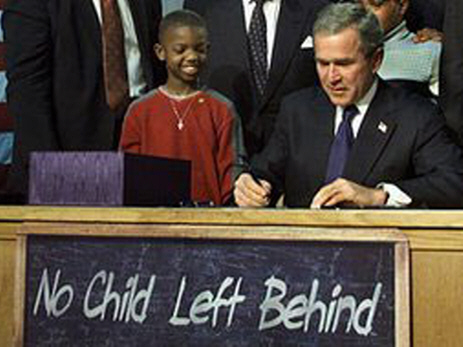
President Bush signing 'No Child Left Behind' into law
It could be the beginning of the end for No Child Left Behind.
The goal was lofty: Get all children up to par in math and reading by 2014. But the nation isn’t getting there, and now some states are getting out.
In a sign of what’s to come, President Barack Obama on Thursday freed 10 states from some of the landmark law’s toughest requirements. Those states, which had to commit to their own, federally approved plans, will now be free, for example, to judge students with methods other than test scores. They also will be able to factor in subjects beyond reading and math.
“We can combine greater freedom with greater accountability,” Obama said from the White House. Plenty more states are bound to take him up on the offer.
While many educators and many governors celebrated, congressional Republicans accused Obama of executive overreach, and education and civil rights groups questioned if schools would be getting a pass on aggressively helping poor and minority children – the kids the 2002 law was primarily designed to help.
The first 10 states to be declared free from the education law are Colorado, Florida, Georgia, Indiana, Kentucky, Massachusetts, Minnesota, New Jersey, Oklahoma and Tennessee. The only state that applied for the flexibility and did not get it, New Mexico, is working with the administration to get approval.
Twenty-eight other states, the District of Columbia and Puerto Rico have signaled that they, too, plan to flee the law in favor of their own plans.
The government’s action on Thursday was a tacit acknowledgement that the law’s main goal, getting all students up to speed in reading and math by 2014, is not within reach.
The states excused from following the law no longer have to meet that deadline. Instead, they had to put forward plans showing they will prepare children for college and careers, set new targets for improving achievement among all students, reward the best performing schools and focus help on the ones doing the worst.
Obama said he was acting because Congress had failed to update the law despite widespread agreement it needed to be fixed.
“We’ve offered every state the same deal,” Obama said. “If you’re willing to set higher, more honest standards than the ones that were set by No Child Left Behind, then we’re going to give you the flexibility to meet those standards.”
The executive action by Obama is one of his most prominent in an ongoing campaign to act on his own where Congress is rebuffing him.
No Child Left Behind was one of President George W. Bush’s most touted domestic accomplishments, and was passed with widespread bipartisan support in Congress. It has been up for renewal since 2007. But lawmakers have been stymied for years by competing priorities, disagreements over how much of a federal role there should be in schools and, in the recent Congress, partisan gridlock.
The law requires annual testing, and districts were forced to keep a closer eye on how students of all races were performing – not just relying on collective averages. Schools that didn’t meet requirements for two years or longer faced increasingly harsher consequences, including busing children to higher-performing schools, offering tutoring and replacing staff.
Over the years, the law became increasingly unpopular, itself blamed for many ills in schools. Teachers and parents complained it led to “teaching to the test.” Parents didn’t like the stigma of sending their kids to a school labeled a failure when requirements weren’t met. States, districts and schools said the law was too rigid and that they could do a better job coming up with strategies to turn around poor performance.
A common complaint was that the 2014 deadline was simply unrealistic.
As the deadline approaches, more schools are failing to meet requirements under the law, with nearly half not doing so last year, according to the Center on Education Policy. Center officials said that’s because some states today have harder tests or have high numbers of immigrant and low-income children, but it’s also because the law requires states to raise the bar each year for how many children must pass.
The current law requires schools to use standardized tests in math and reading to determine student progress. The waivers announced Thursday do not excuse states from those requirements but instead give them the freedom to use science, social studies and other subjects in their measures of student progress.
The 10 states also now can include scores on college admission exams and other tests in their calculation of how schools are performing. They can be excused from penalties included in the federal law but had to come up with their own set of sanctions for low-performing schools.
For example, Georgia will replace the law’s pass-or-fail with a five-star rating system and will use end-of-course tests and Advanced Placement performance in its measure of students.
In Oklahoma, schools are to be taken over by the state if they consistently fail to meet standards.
Kentucky – the first state to formally ask the federal government to be excused from some requirements when Gov. Steve Beshear sent a letter to Washington last summer – will use ACT college-entrance exams and other assessments by that company in its measures.
The schools still have to focus on the subgroups of students outlined in the federal law, such as English language learners and students with disabilities.
Not everyone applauded Thursday’s announcement.
While No Child Left Behind isn’t perfect, said Jeanne Allen, president of the Center for Education Reform, it’s thrown a valuable spotlight on problem schools. She said giving districts and states more flexibility “without firm consequence” is not reform.
“If school district power were the answer to our education woes, our nation would be soaring high above the rest of the world in achievement. It is not, and it will not, until our leaders – just as the people they serve – face both rewards and sanctions for the education systems they govern,” Allen said.
Nancy Zirkin, executive vice president of the Leadership Conference on Civil and Human Rights, said, “Our coalition will continue to play an active role in holding all 10 of these states and the Department of Education accountable for our children.”
But some educators also said Obama’s plan gives states flexibility with more clear and attainable goals.
Gene Wilhoit, executive director of the Council of Chief State School Officers, said under the waiver plan states essentially have a contractual relationship with the federal government to deliver on the approved plan.
“I think there is a legitimate concern or fear out there on the part of people that by giving these waivers, states might be `let off the hook’ in terms of accountability, and I think what you’ll find is just the opposite,” Wilhoit said. “They have raised the standards. They have put in place much more focused attention to the lowest performing, they have put in place professional development activities that didn’t exist prior, and they are holding those schools much more accountable.”
In Colorado, Bridget Cole, a 4th grade teacher who was eating an egg salad sandwich with a group of student on a field trip to the Colorado state Capitol, said she was relieved to hear the news out of the White House.
“No Child Left Behind never changed how I taught. I know what my kids need. It’s easier for me to see where my kids need to be rather than pay attention to what the federal government tells me my kids need to be,” Cole said.
While the president’s action marks a change in education policy in America, the reach is limited. The populous states of Pennsylvania, Texas and California are among those that have not said they will seek waivers, although they could still do so.
Some states might wait to see if Obama wins re-election November, said Jeffrey Henig, professor of political science and education at Teachers College, Columbia University. Others might bet the administration “won’t be in a position to strongly clamp down on them for failure to meet progress goals that the administration has indirectly indicated it admits are unrealistic,” Henig said.
Education Secretary Arne Duncan said states without waivers will be held to the standards of No Child Left Behind because “it’s the law of the land.”
Until now, the issue of education has stayed largely out of the presidential race.
But Sen. Mike Enzi, R-Wyo., ranking member of the Senate committee with jurisdiction over education, said Obama was using education as a “political poker chip.”
“This action clearly politicizes education policy, which historically has been a bipartisan issue,” Enzi said. “It is time for the president to work with Congress on important issues like this instead of acting unilaterally.”
And when Rep. John Kline, R-Minn., the chairman of the House Education and the Workforce Committee, released new legislation Thursday that would rewrite No Child Left Behind, it included a provision that prohibits the education secretary from coercing states into adopting specific academic standards in exchange for a waiver.
Duncan maintained this week that the administration “desperately” wants Congress to fix the law.
In an election year in a divided Congress, action on Capitol Hill appears unlikely.
(Reuters) – A bill to legalize gay marriage in Washington state won final legislative approval on Wednesday in a largely party-line vote that moved the state to the cusp of becoming the seventh in the nation to recognize same-sex nuptials.
Washington’s Democratic Governor Christine Gregoire said she looked forward to signing the measure and “putting into law an end to an era of discrimination” even as opponents, led by religious conservatives, vowed to seek its repeal at the polls in November.
The approval in the state House of Representatives came a day after gay marriage advocates won a key legal victory in California when a federal appeals court declared a voter-approved gay marriage ban in that state unconstitutional.
The Washington legislation cleared the state House of Representatives by a vote of 55-43, a week after the state Senate passed it by a 28-21 vote. Democrats, accounting for the lion’s share of support for the bill, control both legislative bodies in Olympia.
Several prominent Washington-based companies employing tens of thousands of workers in the state also endorsed the bill, including Microsoft, Amazon and Starbucks.
Supporters of same-sex marriage are pushing similar statutes in Maryland and New Jersey, and a referendum to legalize gay marriage in Maine has qualified for the November ballot there.
Six other states already recognize gay marriage — New York, Massachusetts, Connecticut, Vermont, New Hampshire and Iowa — as does the District of Columbia.
But neither Tuesday’s legal ruling in San Francisco nor the statehouse action in Olympia will immediately alter the status quo for gay couples. The outcome of the court challenge in California is likely to remain stayed until the appeals process finishes running its course, and the Washington state measure cannot go into effect before early June.
HEATED DEBATE
Wednesday’s floor action began with lawmakers quickly rejecting a series of amendments, most of them relatively technical in nature, that would have slowed the bill’s momentum by forcing it back to the Senate for further consideration.
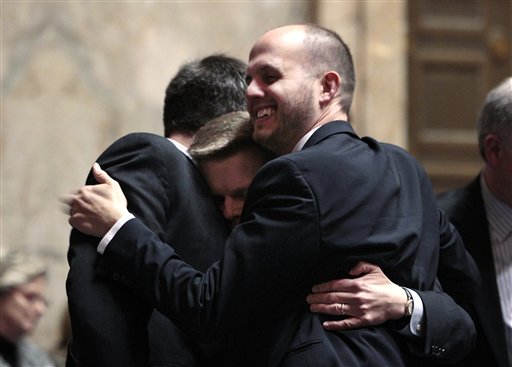
Debate grew emotional at times, with the bill’s chief House sponsor, Representative Jamie Pedersen, a Democrat who has four young children with his gay companion of 10 years, arguing that the state’s domestic-partnership law falls short.
“I would like our four children to understand … that their daddy and their papa have made that lifelong commitment to each other,” he said. “Thousands of same-sex couples in our state deserve the respect and protection from our government that only marriage can convey.”
Representative Jay Rodne, a Republican who said he was guided by his Roman Catholic faith to oppose gay marriage, decried the bill as tantamount to “progressive reengineering in its most extreme and damaging form.”
“This bill is about validation. This bill is about acceptance … Marriage is not about self-actualization, validation or acceptance,” he said. “Marriage is about life.”
In the end, two Republicans joined 53 Democrats in voting for the bill in the House, while two Democrats sided with 41 Republicans in opposition. It passed unchanged from its Senate version.
Gregoire, in a statement issued after the vote, said Washington state would “no longer deny our citizens the opportunity to marry the person they love.”
“We tell every child of same-sex couples that their family is every bit as equal and important as all other families in our state,” she said.
VALENTINE’S DAY
The bill is to be formally delivered to the governor’s desk by week’s end, and Gregoire will then have five days to sign it, not including Sunday. Aides said enactment was expected to come on or before next Tuesday, Valentine’s Day. Still, the measure would not take effect before June 7, three months after the conclusion of the legislative session.
In the meantime, opponents of same-sex matrimony said they would seek to overturn the legislation via one of two ballot measures — a referendum for repeal or an initiative defining marriage as the exclusive domain of heterosexual couples.
The initiative would need 241,153 signatures of registered voters by July 6 to secure a place on the November ballot. A repeal would need just half the number of signatures by June 6.
If a repeal referendum qualifies for the November ballot, the gay marriage law would be suspended until the election and certification of returns, meaning December 6, before it is either repealed or goes into effect.
One amendment rejected in both the Senate and House would have submitted the issue directly to voters in a referendum, bypassing the need for a petition.
Also left unchanged were provisions allowing gay couples from out of state to get married in Washington and permitting religious organizations to refuse to rent out their chapels or other facilities as venues for same-sex weddings.
Should gay marriage opponents pursue an initiative to define matrimony as being restricted to one man and one woman, gay marriages under the newly passed statute could proceed on June 7, regardless of ballot-qualification efforts.
But it was unclear whether gay weddings performed in the interim would be nullified if an initiative restricting marriage to male-female unions were to pass in November.
There is precedent in California for handling such a situation. California’s Supreme Court legalized gay marriage in 2008, only to see voters approve a state constitutional amendment banning same-sex matrimony six months later.
The state’s high court later upheld the gay marriage ban, known as Proposition 8, but ruled that 18,000 same-sex weddings officiated between May and November 2008 were still legal.
A federal judge later ruled Prop 8 unconstitutional, a decision upheld on Tuesday by the 9th U.S. Circuit Court of Appeals.
Legal experts said that ruling, while narrowly tailored to California, could ease the way for a successful court challenge in Washington state should voters ban gay marriage at the polls.
Republican Newt Gingrich vowed on Sunday to press ahead with his struggling presidential bid after a big loss in Nevada, saying he will focus on drawing a contrast with “timid” rival Mitt Romney.
Romney, the Republican front-runner, easily thumped Gingrich in Nevada on Saturday for his second consecutive win and third in the first five contests in the state-by-state battle to pick a challenger to face Democratic President Barack Obama in the November election.
The victory gave Romney growing momentum as the race turns to the next round contests on Tuesday – in Minnesota, Colorado and Missouri – and Maine’s weeklong caucuses that conclude next Saturday.
It also raised questions about Gingrich’s future, but the former House of Representatives speaker appeared on two national morning talk shows to repeat his vow to stay in the race despite big losses in Nevada and last week in Florida.
Gingrich, a former Georgia congressman, hopes his campaign can last until 10 “Super Tuesday” contests on March 6 and several later contests in March, when votes will be taken in southern states where he expects to do well.
“My goal over the next few weeks is to draw a very sharp distinction between Romney’s positions, which are very – the Wall Street Journal described them as timid – and in terms of tax policies, being like Obama,” he said on NBC’s “Meet the Press.”
“I hope by the time we get to Super Tuesday that I will have made the case that a genuine conservative is a dramatically better choice to defeat Barack Obama,” he said on CBS’s “Face the Nation.”
Gingrich said he hoped to pull close to even with Romney in delegates for the nomination after the Texas primary in early April.
First he will have to survive February. New polls on Sunday showed Gingrich could face a challenge from Rick Santorum, who has been vying with Gingrich to be the conservative alternative to the more moderate Romney.
A Public Policy Polling survey showed Romney with a comfortable 14-point lead in Colorado over Santorum, a former U.S. senator from Pennsylvania, with Gingrich in third. In Minnesota, Santorum had a slight 2-point edge on Romney with Gingrich in third.
In Missouri, which is a non-binding primary that does not award delegates, Gingrich is not even on the ballot.
‘BIG DAY FOR SANTORUM’
“Tuesday has the potential to be a big day for Rick Santorum,” the Public Policy Polling memo said.
Santorum said he believed he would pick up steam in the race as it moves beyond the first five contests and broadened to states where Romney, the former Massachusetts governor, has not spent as much time organizing and campaigning.
“I think we’re going to show improvement. This race is a long, long way from being over,” he said on “Fox News Sunday.” “We believe that if you look at the national polls, our numbers are moving up.”
The Romney campaign went on the attack against Santorum on Sunday, issuing a statement to reporters renewing criticism of his record in the Senate backing spending bills and local spending projects known as earmarks.
“Rick Santorum is part of the big-spending Washington establishment that ran up the national debt by trillions and stuck our grandchildren with the bill,” Romney spokeswoman Andrea Saul said.
Santorum finished a distant fourth in Nevada, behind Romney, Gingrich and U.S. Representative Ron Paul, whose third-place showing was a disappointment after spending time and building a campaign organization in the state.
Paul said on ABC’s “This Week” he was not sure where he might score a victory in the race. Santorum and Gingrich have each won one state, Iowa and South Carolina respectively, while Romney has won New Hampshire, Florida and Nevada.
“It’s hard to say exactly when, but we have three or four caucus states that we believe our numbers are doing pretty good, so we have to just wait and see and continue to do exactly what we’re doing,” Paul said.
Romney took command of the Republican race with his victory in Nevada, where he won a broad cross-section of Republican voters including conservatives, moderates and Tea Party movement supporters.
But while vote totals were not complete on Sunday afternoon, Romney’s 48 percent showing was slightly short of the 51 percent he received when he won Nevada during his failed 2008 presidential campaign.
Gingrich and Santorum said Romney had failed to seal the deal with Republican voters and there was still room for another candidate to confront him.
“The challenge is to say, do you really want to go into a fall election with a moderate candidate?” Gingrich said. “The difference between timidly trying to manage at the margins a system that has to be profoundly changed and boldly taking it on, is a very, very big difference.”
Gingrich and Romney both took the day off the campaign trail on Sunday, when many Americans were more focused on the Super Bowl football championship than on politics.
One of the world’s most eminent scientists was embroiled in an extraordinary row last night after he claimed that black people were less intelligent than white people and the idea that “equal powers of reason” were shared across racial groups was a delusion.
James Watson, a Nobel Prize winner for his part in the unravelling of DNA who now runs one of America’s leading scientific research institutions, drew widespread condemnation for comments he made ahead of his arrival in Britain today for a speaking tour at venues including the Science Museum in London.
The 79-year-old geneticist reopened the explosive debate about race and science in a newspaper interview in which he said Western policies towards African countries were wrongly based on an assumption that black people were as clever as their white counterparts when “testing” suggested the contrary. He claimed genes responsible for creating differences in human intelligence could be found within a decade.
The newly formed Equality and Human Rights Commission, successor to the Commission for Racial Equality, said it was studying Dr Watson’s remarks ” in full”. Dr Watson told The Sunday Times that he was “inherently gloomy about the prospect of Africa” because “all our social policies are based on the fact that their intelligence is the same as ours – whereas all the testing says not really”. He said there was a natural desire that all human beings should be equal but “people who have to deal with black employees find this not true”.
His views are also reflected in a book published next week, in which he writes: “There is no firm reason to anticipate that the intellectual capacities of peoples geographically separated in their evolution should prove to have evolved identically. Our wanting to reserve equal powers of reason as some universal heritage of humanity will not be enough to make it so.”
The furore echoes the controversy created in the 1990s by The Bell Curve, a book co-authored by the American political scientist Charles Murray, which suggested differences in IQ were genetic and discussed the implications of a racial divide in intelligence. The work was heavily criticised across the world, in particular by leading scientists who described it as a work of ” scientific racism”.
Dr Watson arrives in Britain today for a speaking tour to publicise his latest book, Avoid Boring People: Lessons from a Life in Science. Among his first engagements is a speech to an audience at the Science Museum organised by the Dana Centre, which held a discussion last night on the history of scientific racism.
Critics of Dr Watson said there should be a robust response to his views across the spheres of politics and science. Keith Vaz, the Labour chairman of the Home Affairs Select Committee, said: “It is sad to see a scientist of such achievement making such baseless, unscientific and extremely offensive comments. I am sure the scientific community will roundly reject what appear to be Dr Watson’s personal prejudices.
“These comments serve as a reminder of the attitudes which can still exists at the highest professional levels.”
The American scientist earned a place in the history of great scientific breakthroughs of the 20th century when he worked at the University of Cambridge in the 1950s and 1960s and formed part of the team which discovered the structure of DNA. He shared the 1962 Nobel Prize for medicine with his British colleague Francis Crick and New Zealand-born Maurice Wilkins.
But despite serving for 50 years as a director of the Cold Spring Harbor Laboratory on Long Island, considered a world leader in research into cancer and genetics, Dr Watson has frequently courted controversy with some of his views on politics, sexuality and race. The respected journal Science wrote in 1990: “To many in the scientific community, Watson has long been something of a wild man, and his colleagues tend to hold their collective breath whenever he veers from the script.”
In 1997, he told a British newspaper that a woman should have the right to abort her unborn child if tests could determine it would be homosexual. He later insisted he was talking about a “hypothetical” choice which could never be applied. He has also suggested a link between skin colour and sex drive, positing the theory that black people have higher libidos, and argued in favour of genetic screening and engineering on the basis that ” stupidity” could one day be cured. He has claimed that beauty could be genetically manufactured, saying: “People say it would be terrible if we made all girls pretty. I think it would be great.”
The Cold Spring Harbor Laboratory said yesterday that Dr Watson could not be contacted to comment on his remarks.
Steven Rose, a professor of biological sciences at the Open University and a founder member of the Society for Social Responsibility in Science, said: ” This is Watson at his most scandalous. He has said similar things about women before but I have never heard him get into this racist terrain. If he knew the literature in the subject he would know he was out of his depth scientifically, quite apart from socially and politically.”
Anti-racism campaigners called for Dr Watson’s remarks to be looked at in the context of racial hatred laws. A spokesman for the 1990 Trust, a black human rights group, said: “It is astonishing that a man of such distinction should make comments that seem to perpetuate racism in this way. It amounts to fuelling bigotry and we would like it to be looked at for grounds of legal complaint.”
Postscript: A week after this report was published in 2007, Professor Watson was forced to retire from this post amid an international scandal over his remarks. According to him, “I turned against the left wing because they don’t like genetics, because genetics implies that sometimes in life we fail because we have bad genes. They want all failure in life to be due to the evil system.”
This website uses cookies to improve your experience. We'll assume you're ok with this, but you can opt-out if you wish. Cookie settingsACCEPT
Privacy & Cookies Policy
Privacy Overview
This website uses cookies to improve your experience while you navigate through the website. Out of these cookies, the cookies that are categorized as necessary are stored on your browser as they are essential for the working of basic functionalities of the website. We also use third-party cookies that help us analyze and understand how you use this website. These cookies will be stored in your browser only with your consent. You also have the option to opt-out of these cookies. But opting out of some of these cookies may have an effect on your browsing experience.
Necessary cookies are absolutely essential for the website to function properly. This category only includes cookies that ensures basic functionalities and security features of the website. These cookies do not store any personal information.
Any cookies that may not be particularly necessary for the website to function and is used specifically to collect user personal data via analytics, ads, other embedded contents are termed as non-necessary cookies. It is mandatory to procure user consent prior to running these cookies on your website.