Liberian doctor defends ebola treatment with HIV drug

Desperate for a cure and frustrated at the massive death toll from Ebola, Dr. Gabriel; Gorbee Logan turned to a rare unconventional method, trying lamivudine, a drug used to treat HIV patients in Ebola patients under his care. The results, according to Dr. Logan, County Health Officer, Tubmanburg Hospital, has been impressive.

Word of Dr. Logan’s method is generating buzz and some suspicions even as international drug makers race the clock in search of a drug capable of beating the menacing virus. To date, the trial drug ZMAPP has been tested on some patients, but it is still uncertain whether it has been effective in treating cases it was tested on. Dr. Logan is quick to dismiss the belief of many concerned that Tubmanburg Hospital is using Anti Retrovirus Drugs (ARD) that is used to treat HIV/AIDS to treat the Ebola survivors.

Says Dr. Logan: “There is a particular type tablet that forms part of ARD referred to as Lamivudine and it is a 150 mg tablets. This medication has been doing well for some of the patients that I have treated.”

Dr. Logan’s recovery rate has been impressive as he cautions that his method only works if the patients turn themselves in on time. “When the patients come early, and they are put on this medication, they recover within three to five days. This medication is not specifically for HIV/AIDS, I want this to be clear, but an Anti Retrovirus agent that is used to treat other virus illnesses like hepatitis ‘B’. It is one of those medications that are combined with two or three other medications to treat HIV/AIDS, so it should not really be called an HIV/AIDS drugs,” He says.

Dr. Logan explains that he got the idea to try Lamivudine on Ebola patients when he read in scientific journals that HIV and Ebola replicate inside the body in much the same way. “Ebola is a brainchild of HIV,” he said. “It’s a destructive strain of HIV.”

Dr. Logan says he first tried an HIV drug called acyclovir without success. Later, he said, he tried Lamivudine on a health care worker who had come down with the virus, but showed signs of improvement and survived in only a few days.

Hopeful ‘Promise’

CNN reported recently that Dr. Anthony Fauci, Director of the National Institute of Allergy and Infectious Diseases gave thumbs up to Dr. Logan’s method because Lamivudine is a nucleotide analog, and other drugs in this class are being studied to treat Ebola. Promise Galakimene, 26, one of thirteen patients who have been successfully treated by Dr. Logan told FrontPageAfrica that she owes her life to the doctor after losing a good portion of her entire family.

Source: FrontPageAfrica
Largest Liberian newspaper accuses US of creating ebola

The Liberian Daily Observer, which is the largest newspaper in Liberia, just published an article on their front page with the headline, “Ebola, AIDS Manufactured By Western Pharmaceuticals, US DoD?” The article accuses the US of manufacturing the Ebola outbreak in a scheme to use Africa as a testing ground for bioweapons.

SITES AROUND AFRICA, AND IN WEST AFRICA, HAVE OVER THE YEARS BEEN SET UP FOR TESTING EMERGING DISEASES, ESPECIALLY EBOLA

The World Health Organization (WHO) and several other UN Agencies have been implicated in selecting and enticing African countries to participate in the testing events, promoting vaccinations, but pursuing various testing regiments. The August 2, 2014 article, West Africa: What are US Biological Warfare Researchers Doing in the Ebola Zone? by Jon Rappoport of Global Research pinpoints the problem that is facing African governments.

Obvious in this and other reports are, among others:

(a) The US Army Medical Research Institute of Infectious Diseases (USAMRIID), a well-known centre for bio-war research, located at Fort Detrick, Maryland;

(b) Tulane University, in New Orleans, USA, winner of research grants, including a grant of more than $7 million the National Institute of Health (NIH) to fund research with the Lassa viral hemorrhagic fever;

(c) the US Center for Disease Control (CDC);

(d) Doctors Without Borders (also known by its French name, Medicins Sans Frontiers);

(e) Tekmira, a Canadian pharmaceutical company;

(f) The UK’s GlaxoSmithKline; and

(g) the Kenema Government Hospital in Kenema, Sierra Leone.

Reports narrate stories of the US Department of Defense (DoD) funding Ebola trials on humans, trials which started just weeks before the Ebola outbreak in Guinea and Sierra Leone. The reports continue and state that the DoD gave a contract worth $140 million dollars to Tekmira, a Canadian pharmaceutical company, to conduct Ebola research. This research work involved injecting and infusing healthy humans with the deadly Ebola virus. Hence, the DoD is listed as a collaborator in a “First in Human” Ebola clinical trial (NCT02041715, which started in January 2014 shortly before an Ebola epidemic was declared in West Africa in March. Disturbingly, many reports also conclude that the US government has a viral fever bioterrorism research laboratory in Kenema, a town at the epicentre of the Ebola outbreak in West Africa. The only relevant positive and ethical olive-branch seen in all of my reading is that Theguardian.com reported, “The US government funding of Ebola trials on healthy humans comes amid warnings by top scientists in Harvard and Yale that such virus experiments risk triggering a worldwide pandemic.” That threat still persists.

UN Security Council declares ebola security threat

The UN Security Council has declared the outbreak of the Ebola virus in West Africa a “threat to international peace and security”.

The council unanimously adopted a resolution calling on states to provide more resources to combat the outbreak.

UN Secretary General Ban Ki-moon warned an emergency meeting of the council that the number of Ebola infections was doubling every three weeks.

More than 2,600 people have now died in the worst Ebola outbreak on record.

Cases doubling
Mr Ban said the “gravity and scale of the situation now require a level of international action unprecedented for a health emergency”.

He announced the establishment of an “emergency UN mission” working with the World Health Organization (WHO) to combat the crisis, saying he would convene a “high-level meeting” next week.

The council heard that the international response had to be three times bigger than it was now to contain the crisis – the number of cases is doubling every two weeks in west Africa.

The resolution attracted 130 co-sponsors – a UN record – and calls on countries to provide urgent aid, such as medical staff and field hospitals.

The resolution also calls for travel bans imposed by some states to be lifted, saying the countries need to have access to aid instead of being isolated.

Council members heard that the international response would need to be 20 times greater than it was now, if the outbreak were to be controlled.

The Security Council has never previously met to confront a public health crisis, reports the BBC’s Nick Bryant from New York.

It is only the second time that a public health issue has been addressed at the council, the first instance being HIV/Aids, our correspondent adds.

A doctor appearing via video link from Liberia warned that if the international community did not step up its response, “we would be wiped out”.

Officials in Guinea searching for a team of health workers and journalists who went missing while trying to raise awareness of Ebola have found several bodies.

A spokesman for Guinea’s government said the bodies included those of three journalists in the team.

They went missing after being attacked on Tuesday in a village near the southern city of Nzerekore.

Meanwhile Sierra Leone President Ernest Bai Koroma said the disease would be soon be a thing of the past within the next couple of weeks.

Smiling broadly, the president said the international community “are not only in the fight but also involved in the preparation work”.

He said Britain was establishing an Ebola treatment centre at Kerry Town on the Freetown peninsula, the Chinese were setting up one at Jui just outside Freetown and the Americans had “increased their presence” through the Centres for Disease Control.

“I will say that their presence has improved” he said, and the collaboration would continue to “ensure that [by] the next couple of weeks we will be able to contain Ebola”.

“I am sure that we will get Ebola behind us very soon” he said, assuring the country would get back to “normalcy in December”.

By normalcy, he explained, Ebola would be contained and his government would return to implementing those “development programmes we were carrying out before the May outbreak” .

He said Ebola would be a thing of the past earlier than the six-month timeframe given by the French charity MSF and other agencies.

World War E

As the unprecedented Ebola outbreak in West Africa, dubbed “World War E,” rages out of control, the United Nations is admitting the approximately 6,000 peacekeepers still in Liberia are not trained in health-care operations.

The acknowledgement comes after a top German virologist told reporters Friday he does not expect the Ebola virus to burn out in Liberia or Sierra Leone until it infects half the population of the two countries and kills 5 million people.

Confirmed cases of Ebola have increased 57 percent in the past three weeks, with the death toll currently at 1,296 and no end in sight, according to updated World Health Organization statistics.

Jones Schmidt-Chanasit, the director of viral diagnostics at the Bernhard Nocht Institute of Tropical Medicine in Hamburg, told the international press Friday he and his colleagues have lost all hope of halting the spread of the virus in Sierra Leone and Liberia.

“We lost the possibility of controlling this Ebola outbreak in those two countries back in May or June,” Schmidt-Chanasit said.

The Ebola outbreak in Liberia has not been slowed by the more than 8,000 U.N. personnel currently in Libya, including 6,000 uniformed peacekeepers. According to U.N. records, there are 4,460 troops, 126 military observers and 1,434 police forces, with an approved budget from July 2014 through June 2015 of $427.3 million.

Last week, Under-Secretary-General for Peacekeeping Hervé Ladsous addressed media in the Liberian capital, Monrovia, vowing the U.N. will continue to stand by Liberia as it battles an “unprecedented” Ebola outbreak. He said the peacekeepers will be “standing by Liberia through good and bad times.”

Some 95 percent of the expatriate doctors left when the Ebola outbreak began in March, leaving 50 physicians to treat the country’s 4.3 million population.

Ladsous, according to the U.N. News Center, emphasized that a peacekeeping mission is not a public health mission, stressing that handling the Ebola outbreak is “not something we are trained for.”

“It is true that we, the international community, have invested a lot over the years to bring back peace and security to Liberia, and, more generally, to West Africa. And it is even more true that we do not want to jeopardize that patient work,” stated Ladsous.

He added that while the UNMIL, the United Nations Mission in Liberia, is not a public health operator, the mission and the wider U.N. system would be on hand to ensure Liberia overcome the crisis.

“You have seen the very public and proactive position taken by the secretary-general … who has given orders to the entire U.N. system to mobilize in comprehensive, strategic [and] concrete ways to support efforts to stem the epidemic,” he said.

The civil war that raged from 1989 to 2003 left Liberia with 250,000 dead, the country in economic ruin and overrun with weapons, the capital city without electricity or running water, and the presence of some 15,000 United Nations peacekeepers, one of the most expensive peacekeeping efforts in U.N. history.

The fourth poorest nation in the world, Liberia suffers unemployment estimated to be as high as 85 percent, with 90 percent of the population earning less than $410 a year.

The population of Monrovia doubled to an estimated 1.5 million as a result of the civil war, with most of the residents crowded into shantytown slums lacking sanitation, such as West Point, Buzzi Quarter, Clara Town and Sawmill. About two-thirds of the population lacks access to clean toilets, with cholera rampant and the two leading child killers listed as malaria and diarrhea.

Source: WND

Sierra Leone: China to send ebola mobile lab

Mr. Xu Zhou, spokesman of the Chinese Embassy announced in Freetown on Monday, 15th September that China will send a China Center for Disease Control (CDC) medical expert team comprising of 59 personnel and a mobile laboratory to Sierra Leone on Wednesday, 17th September by chartered airplanes to strengthen Sierra Leone’s endeavour to contain Ebola.

He indicated that this was a decision made in consideration of the continuous spread of Ebola in the country and upon the request of the Sierra Leonean government, and it is another veritable gesture of solidarity of the Chinese government and people to the Sierra Leonean government and people.

He noted that this is the third batch of China’s humanitarian aid to support Sierra Leone in fighting against Ebola. Previously, China provided two batches of emergency medical materials valued at RMB 11 million Yuan (equally 1.8 million USD) to Sierra Leone and sent two teams of medical experts to the country.

He added that China announced on 12th September a further 200 million Yuan (equally 32.54 million USD) package of humanitarian aid including food, supplies for disease control, emergency treatment facilities and capital support to African countries and international organizations to help control Ebola. In addition, China will also promote long-term medical cooperation with African countries to help them raise their disease control and response abilities and improve public health systems.

China’s ebola drug obtains manufacturing approval

China’s first drug against Ebola has recently obtained manufacturing approval as a special medication for the People’s Liberation Army. The drug named “JK-05” has been developed by the Institute of Microbiology Epidemiology under Academy of Military Medical Sciences.

For the last five years, Professor Wang Hongquan, led a research team, studying the prevention and treatment of the Ebola virus—one of the most virulent viral diseases known to humankind.

“JK-05 is a micro-molecular chemical, and its pharmacological mechanism is to selectively contain the RNA polymerase of the Ebola virus so as to inhibit virus replication,” Academy of Military Medical Sciences Prof. Wang Hongquan said.

According to Wang’s study JK-05 resisted the replication of Ebola cells during cell experiments and testing on animals.

It has also completed both pre-clinical testing and clinical safety evaluation.

Wang stressed that the application of the drug for Ebola treatment is only allowed in emergency situations at the present time. But the war against the epidemic is one fought on many other fronts.

“Countries bordering the affected countries are more likely to have people moving across. So they have to be extra aware. But the WHO has asked all countries in the world to be prepared in the event of an Ebola case,” WHO Spokesman Nyka Alexander said.

Over 1,500 people in West Africa have already lost their lives to the virus. No Ebola cases have been reported in China so far, but authorities are on guard taking every measure possible, to shield the country from this virulent epidemic.

Source: english.cntv.cn

New ebola cases unrelated to West African strain

The World Health Organization has just confirmed that the newly-identified cases of Ebola Virus Disease (EVD) in the Democratic Republic of Congo is genetically unrelated to the strain currently circulating in Liberia, Guinea, Sierra Leone, and Nigeria.

A WHO collaborating research center in Franceville, Gabon, the Centre International de Recherches Médicales, had previously identified six Ebola positive samples sent to the laboratory. They report today that, “the virus in the Boende district is definitely not derived from the virus strain currently circulating in west Africa.”

The WHO amplified that finding:

“Results from the virus characterization, together with findings from the epidemiological investigation, are definitive: the outbreak in DRC is a distinct and independent event, with no relationship to the outbreak in west Africa.”

The finding is worthy of such emphasis because of concerns that the west African outbreak had somehow spread to the DRC, formerly Zaire. The viruses in each outbreak are genetically distinct, but they are both of the Zaire species of Ebola virus, a fact that might be confused as meaning the outbreaks are related.

The form of the Zaire virus currently circulating in the DRC is most closely related to one responsible for an outbreak in 1995 in the city of Kikwit. Ebola virus first emerged in the DRC and South Sudan in 1976. The current outbreak in the DRC is the seventh on record.

The index case has been clearly identified as a pregnant woman from Ikanamongo Village who died on August 11 after preparing bushmeat that her husband had hunted.

The means of viral spread, as reported by the WHO, is typical of most Ebola outbreaks: “Local customs and rituals associated with death meant that several health-care workers were exposed and presented with similar symptoms in the following week.”

Thus far, the WHO has identified 53 cases consistent with a diagnosis of Ebola, including 31 deaths. Seven of the dead were healthcare workers.

But the WHO stressed that the outbreak is primarily occurring in a remote region of the DRC, about 750 miles from the capital of Kinshasa.

Source: Forbes

Suspected Ebola patient hospitalized in Sweden

A patient suspected to have Ebola has been hospitalized in the Swedish capital of Stockholm, Reuters reported, citing local media sources.

It is reported, that a man has recently returned from a country that is included in the “risk zone,” one of the countries with previously reported cases of fatal disease.

The patient was taken to Karolinska University Hospital, where doctors put him in a detention center to run the necessary tests.

The Ebola virus has claimed 1,552 lives from 3,069 cases since December, according to the World Health Organization.

The worst Ebola epidemic in history and the first to have occurred in West Africa began in southern Guinea and soon spread to Liberia, Sierra Leone and Nigeria.

A separate outbreak in the Democratic Republic of Congo has killed 13 people.

The WHO says it could infect some 20,000 people before it is brought under control.

Historically, the disease has a mortality rate of about 90 percent, although the current outbreak has so far recorded fewer deaths per infection. Ebola is transmitted through direct contact with the blood or bodily fluids of the infected.

Scotts airline passengers in major Ebola scare

Airline passengers in Scotland were at the centre of an Ebola scare after their plane was quarantined at Aberdeen airport

Passengers on a British Airways flight from London were kept on the aircraft for over two hours after a young African girl complained of feeling unwell on the flight.

Medics in chemical suits boarded the plane while anxious passengers watched on in horror.

Passengers on a British Airways flight from London were kept on the aircraft for over two hours after a 10-year-old girl, believed to be of Nigerian descent, was “violently sick” onboard the BA1314 service.

Environmental Health and trained infectious diseases medics immediately quarantined the aircraft until the sick passenger could be safely removed. It’s understood the girl travelled from infected regions in Africa.

One man, whose pregnant daughter was on the flight, said: “We tried to get information but nobody was returning our calls.

“The passengers weren’t being told anything other than the girl was sick and quarantine measures were put in place.”

It is understood the woman has now been transferred to the infectious diseases unit at Aberdeen Royal Infirmary where further tests will be carried out.

Source: Daily Record

Ebola czar has disastrous biosecurity record

Newly appointed UN Ebola Czar, David Nabarro, has warned of an explosion of Ebola cases.

Nabarro, a UKIP politician, was the senior UN system Co-ordinator for Avian and Human Influenza when WHO supplied the bird flu virus which contaminated 72 kilos of seasonal flu in Baxter’s biosecurity 3 facilities in Austria in 2009.

Biologist Richard Ebright recommended civil and criminal proceedings be instituted over another comparatively tiny breach with thebird flu virus when he testified before Congress last month on CDC lapses, Reuters reports.

A U.S. government scientist working with bird flu rushed through lab procedures in order to get to a staff meeting, setting off what could have been a fatal mishap, health officials said.

They said the U.S. Centers for Disease Control and Prevention (CDC) lab worker, who was not identified, allotted only about half the time necessary to carry out the procedures safely, and as a result samples of mild avian flu were tainted with a highly deadly strain and sent from CDC to researchers at the U.S. Department of Agriculture.

CDC released the report of its investigation of the avian flu incident and said disciplinary action is under consideration. The agency is under congressional scrutiny over repeated safety lapses, including the potential exposure of scores of its workers to live anthrax bacteria in June.

As serious as the sample mix-up, which occurred in January, was the failure to report it as required by federal law when the contamination became clear in May, according to biosafety experts. CDC did not report the incident until July.

“The matter needs to be referred for civil and/or criminal investigation,” said biologist Richard Ebright of Rutgers University, an expert in biosafety who testified before Congress last month on the CDC lapses.

According to the report, CDC shipped the avian flu sample from its Atlanta campus to a USDA poultry lab in Athens, Georgia, in March, and scientists there began using it in research in May.

When the supposedly non-lethal viruses killed an entire flock of chickens, a USDA scientist sequenced the genome of the virus. That revealed it was not low-pathogenicity H9N2, as CDC said, but highly pathogenic H5N1, which has killed hundreds of people since 2013.

USDA scientists, out of an abundance of caution, handled the sample under stringent biosafety conditions, including with gloves, suits, and respirators, and no one was infected.

On May 23, USDA scientists told the CDC flu lab about the mix-up. CDC scientists did not report it to managers, or file a form required when dangerous pathogens are mishandled, until July 9, just as CDC officials were completing a report on the anthrax breach that occurred in June.

LACK OF JUDGMENT

Failure to report reflected “a lack of sound professional judgment by those aware of the contamination,” the CDC investigators wrote. Among those aware of the release were the head of the flu lab and the Virology Surveillance and Diagnostics Branch Chief, the report said.

The CDC investigators concluded that the failure to report the breach was not deliberate, which Rutgers’ Ebright said in an interview “strains credulity.”

How the original mix-up of flu strains occurred is unclear, the report said, because the CDC scientists said they could not recall everything they did and did not keep a lab notebook or other written documentation.

As best the investigators could tell, however, a flu lab scientist transferred H9N2 virus received from Hong Kong, and H5N1 from Vietnam, into cell cultures on the same morning.

Based on card-key readers that record entries and exits, the investigators concluded that the scientist rushed through a procedure that required 90 minutes to ensure safety – basically, putting enough time between working with H9N2 and then with H5N1 – in just 51 minutes in order to make a noon meeting. That included time to shower and change.

In addition, the report found, there was no approved procedure for what the scientist was doing, colleagues who might have noticed a breach were frantically rushing to finish experiments ahead of a February scientific meeting, and the lab director had a “heavy work load”.

The flu lab scientists told CDC investigators they did not realize they were required to file a ‘Form 3’ about the accidental release of a dangerous pathogen. A USDA spokeswoman did not respond to a question about whether the poultry lab scientists were required to file the form.

CDC said it is reviewing existing laboratory protocols, taking steps to improve record-keeping and compliance, testing for cross-contamination before samples are transferred within or outside CDC, and “providing additional extensive training” of lab staff, including reporting requirements.

WHO pandemic business plan states goal is to vaccinate world’s population

A WHO business plan to increase the supply of pandemic vaccines says the goal is to produce enough pandemic vaccine to inject 6.7 billion people – or the world’s entire population.

The WHO documents says the capacity to produce pandemic vaccines with adjuvants would reach 6.2 billion doses in 2010.

“This business plan evaluates the short to medium-term (2007–2017) options available to pursue the Global pandemic influenza action plan to increase vaccine supply (GAP) goal of developing enough pandemic vaccine to immunize the world’s population (6.7 billion people).”

Meanwhile a video showing the bodies of ebola victims dumped in the source of a river by the Liberian government, currently partnering with WHO, has fueled fears that Ebola is being spread through rivers.

Locals describe how the wetlands where the bodies of at least 45 ebola victims were dumped is the source of a major river located northwest of a city. Householders close by express fears that their well could be contaminated with Ebola.

The government of Sierra Leone said in a press release on August 6th, that it had overturned a WHO plan to build Ebola treatment centers in built up areas. Treatment centers are to be relocated to communities away from where people dwell or reside,” says the press release. An Ebola center already under construction is to be moved.

Violence errupts in Ebola quarantine zone as deaths surge

Violence erupted in an Ebola quarantine zone in Liberia’s capital Wednesday when soldiers opened fire and used tear gas on protesting crowds as they evacuated a state official and her family.

Four residents were injured in the clashes that flared in Monrovia’s West Point slum which has been sealed off as part of new security measures aimed at containing the deadly virus.

The death toll from the Ebola oubreak in West Africa has risen to 1,350, the World Health Organization said on Wednesday, with 106 new deaths reported between August 17-18 in three countries.

The U.N. health agency said that 221 new suspected, probable and confirmed cases of the deadly fever were reported across Guinea, Liberia and Sierra Leone over the two-day period.

The crackdown in Liberia comes as authorities around the world scramble to stem the worst-ever outbreak of Ebola, which has killed at least 1,350 people across west Africa this year.

Liberian President Ellen Johnson Sirleaf quarantined West Point and Dolo Town, to the east of the capital, and imposed a night-time curfew as part of new drastic measures to fight the disease.

Residents of West Point, where club-wielding youths stormed an Ebola medical facility on Saturday, reacted with fury to the crackdown, hurling stones and shouting at the security forces.

“It is inhumane,” resident Patrick Wesseh told AFP. “They can’t suddenly lock us up without any warning, how are our children going to eat?”

Deaths from the epidemic that has swept through west Africa since March now stand at 1,350 after a surge of 106 victims in just two days, according to the World Health Organization.

Fears that the virus could spread to other continents have seen flights to the region cancelled, and authorities around the world adopting measures to screen travellers arriving from affected nations.

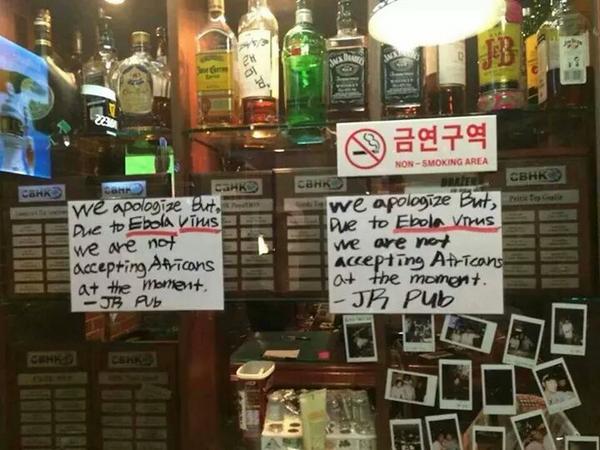
Africans unwelcome as Ebola threat

Ebola gives pub excuse to bar black people

With ethnic relations once again making headlines in America, racism elsewhere can sometimes make discrimination appear relatively minor by comparison. Consider what those of African origin face when living or traveling in Asia, for example.

Today’s illustration comes from Twitter, where one restaurant in South Korea is refusing to serve black people due to fears over Ebola!

Imagine the outrage were this sign to appear anywhere in the United States:ebolakorea

Given that many American soldiers stationed in Korea are African-American, it’s hard to believe this isn’t generating more attention.

Shoot-on-sight order against Ebola

Liberia’s armed forces have reportedly been given orders to shoot people trying to illegally cross the border from neighbouring Sierra Leone, which was closed to stem the spread of Ebola.

Soldiers stationed in Bomi and Grand Cape Mount counties, which border Sierra Leone, were to ‘shoot on sight’ any person trying to cross the border, said deputy chief of staff, Colonel Eric Dennis, according to local newspaper the Daily Observer.

The order comes after border officials reported people continued to cross the porous border illegally.

Grand Cape Mount county had 35 known ‘illegal entry points,’ according to immigration commander Colonel Samuel Mulbah.

Illegal crossings were a major health threat, said Mulbah, ‘because we don’t know the health status of those who cross at night’.

Liberia closed its borders with Sierra Leone weeks ago in an attempt to contain the Ebola outbreak, which killed more than 1100 people in west Africa.

The announcement came after residents of a slum near the capital broke into an isolation centre and freed up to 30 Ebola patients, local newspaper Front Page Africa reported.

‘As I speak the police station is deserted. There is no security now in West Point,’ resident Moses Teah was quoted as saying.

The break-in to protest poor conditions at Ebola quarantine centres has raised fears that the deadly virus will spread in the slum.

Source: Skynews