Bob Geldof: World will end in 2030

bobtony
Blair and Geldof

Sir Bob Geldof has declared we ALL have less than 17 years to live.The musician-turned-activist reckons the world will end in 2030 – leading to the extinction of humankind.

Sir Bob, 61, based his miserable prediction on the effects of climate change.

“The world can decide in a fit of madness to kill itself,” he told a group of youngsters at a summit in Johannesburg, South Africa.

“We may not get to 2030. We need to address the problem of climate change urgently”

The former Boomtown Rats singer also warned “the next war will not be a World War One or a World War Two, it will be the end.”

He added: “We may not get to 2030. We need to address the problem of climate change urgently.”

Sir Bob is best-known for his attempts in helping to fight famine in Africa, staging Live Aid at Wembley Stadium in 1985.

He finished his speech by apologising for being “bloody miserable”, but added: “just get on with it”.

Despite the dire warnings on climate change, it emerged last month that a million square miles of Arctic seas have frozen in the past year as a new environmental trend takes hold, dubbed “global cooling”.

The extraordinary “reverse” of global warming has led to a 60 per cent rise in ice-covered ocean. Just six years ago, some scientists were predicting that all of this ice would have melted away by 2013.

The big chill has persuaded some experts that temperatures will keep falling for decades and throws fresh doubts on claims that global warming will devastate the planet.

Bob Geldof claims man-made climate change has wrecked the planet

Details of the latest twist in the debate emerged in a secret memo to the United Nations Intergovernmental Panel on Climate Change.

It says that a chillier-than-usual summer has left a thick ice layer stretching from the Canadian islands to the northern coast of Russia.

The ice prevented dozens of yachts and a cruiser getting through America’s North-West Passage.

The shock memo surfaced just days before the Arctic freeze is about to begin and six years after warnings that global warming would melt the ice by this winter.

An ice-free Arctic was boldly predicted in a 2007 by Professor Wieslaw Maslowski, of the Naval Postgraduate School in Monterey, California.

He said his grim but conservative estimate was provided by the most realistic computer models. Cambridge University expert Professor Peter Wadhams added: “This is not a cycle, not just a fluctuation. In the end, it will all just melt away quite suddenly.”

On the back of the dire warnings, billions of pounds were invested in green measures to combat agents of climate change such as greenhouse gas emissions.

But the secret UN memo revealed that the ice has spread quickly following the smallest ever frozen surface area, this time last year.

It also shows how governments who fund the panel are terrified at the implications of the new predictions. – dailystar.co.uk

South African police ‘abuse sex workers’

prostitutesOf 80 sex workers based in Johannesburg, 52 (65 percent) had been abused by police, the Tshwaranang Legal Advocacy Centre (TLAC) said on Thursday.

“The most common forms of abuse experienced by sex workers are emotional violence such as swearing, insults, spitting, and being chased away, at least one incident of physical abuse, and unlawful arrests,” the TLAC said in a statement, citing a recent study of 80 street-based sex workers.

Sixteen percent of the sex workers surveyed indicated they had experienced physical abuse, and a further five percent experienced sexual assaults from police officers.

Such treatment went against the police’s code of ethics. Although their role was to serve and protect, many police officers acted unlawfully.

“Engagements with the police have shown that some officers struggle to execute their roles due to the difficult nature of policing sex work,” the centre said.

“As a result they are forced to utilise municipal by-laws of loitering to arrest sex workers and remove them from their places of work.”

Of the 80 sex workers, 12 (15 percent) said they had been arrested, with 10 percent stating they were held in holding cells without appearing in court.

“Where we have assisted sex workers to lay charges against errant police, all these cases never proceeded to court because of sex workers’ fear of harassment and intimidation from police,” the centre said.

It would also have a negative impact on their ability to make a living.

The study found sex workers continued to be vulnerable to abuse from both police and clients, which limited their human rights and affected their income.

This in turn prevented them from accessing services such as health care, social and legal services.

“A legal opinion obtained shows that using loitering by-laws to ‘police’ sex workers is illegal and open to various legal challenges,” the TLAC said.

“The findings of the research study, conducted with Sisonke, the sex worker’s rights movement, once again proves why decriminalisation of adult sex work is necessary.”

It would compel police to focus on serious crime, and support sex workers to realise their rights to safety and security, dignity, and other critical services.

Police were not immediately available for comment. – Sapa

Concourt places Rivonia Primary’s admissions under state control

Rivonia Primary School

The education department has the power to override a school’s admission policy, the Constitutional Court found on Thursday.

It upheld, in part, an appeal against a judgment of the Supreme Court of Appeal (SCA), holding that the head of the education department in Gauteng had the power to admit a pupil in excess of Rivonia Primary School’s admission policy.

The matter came before the Constitutional Court after a Grade One pupil was refused a place at the Johannesburg school for the 2011 academic year, and placed on a waiting list.

The child’s mother lodged a complaint with authorities, and the head of department in Gauteng instructed that the child be admitted.

The school brought an application in the High Court in Johannesburg, seeking a declaration that it had the power to set admission policy, and admit pupils in accordance with that policy. The court dismissed the application.

The school then approached the SCA, which held that the department did not have the power to override the school’s admission policy. The matter was then escalated to the Constitutional Court.

On Thursday, the court’s majority judgment was that the head of department had the power to admit the pupil.

The Constitutional Court granted leave to appeal, and set aside and replaced the SCA’s order.

“It is declared that the head of department of education in the province of Gauteng was empowered to issue an instruction to the principal of Rivonia Primary School to admit the learner in excess of the limit in its admission policy.”

However, the court found that in exercising its power to instruct a principal of a public school to admit a pupil, the department had to act in a procedurally fair manner.

“It is declared that the head of department of education in the province of Gauteng did not act in a procedurally fair manner when he issued instructions to the principal of Rivonia Primary School to admit the learner and when he placed the learner in the school.”

In an explanatory statement issued after the judgment, the court said a school governing body’s power to determine capacity as part of its admission policy was subject to other provisions of the Schools Act, including that the department maintained “ultimate control over the implementation of admissions decisions”.

Further, provincial regulations afforded the head of department the power to overturn a principal’s rejection of a pupil’s application for admission. – Sapa

Hyena spotted in white Johannesburg suburbs

hyenaTwitter erupted on Thursday morning with tweets claiming that a brown hyena was spotted first in Northcliff, then in the Delta Park and Blairgowrie suburbs of Randburg, Johannesburg.

“Listener just called in saying a hyena spotted this morning in Northcliff!” Tweeted Talk Radio 702 host John Robbie.

Conservationist and former game ranger John de Jager said that spotted hyenas travel in packs, while brown hyenas are usually solitary and quite rare to see.

“I have only spotted one brown hyena in my five years as a game ranger,” Said De Jager. – M&G

Cape Town has twice the murder rate of Johannesburg

Cape Town, danger lurks here...
Cape Town, danger lurks here…

According to an analysis of the latest crime stats by the Istitute for Security Studies, the murder rate in Cape Town is almost twice as high as that of Johannesburg.

Lizette Lancaster, a researcher at the Institute, writes: “Between April 2011 and March 2012, police recorded more murders in Cape Town than in Johannesburg and Pretoria combined. This means that, taking population into account, Cape Town residents are 1,8 times more likely to be murdered than Johannesburg residents. Yet this information is potentially misleading because the likelihood of being a crime victim depends in large part on race, gender, age, economic profile and where in a city a person lives.”

For example, almost two-thirds of the Cape Town murders took place in just ten of the 60 police station precincts in the city, according to an analysis of crime hotspots by the Institute for Security Studies (ISS). For years, the Coloured area of Mitchells Plain has experienced the highest violence and property crime rates in the country.

Black areas in Cape Town show ‘abnormally high murder rates’

Although surpassed by Coloured (mixed-race) areas regarding general violent crime, black townships in Cape Town showed the highest murder rates. According to Lizette Lancaster, “Nyanga, Khayelitsha, Gugulethu and Harare remain the most murderous in the peninsula, according to an analysis that takes population size into account. These areas have experienced abnormally high murder rates for more than a decade.”

Similarly, a countrywide analysis of police precinct statistics suggests that income levels matter. Residents in low-income areas are far more likely to be murdered than their middle- and high-income counterparts. Half of South Africa’s murders occurred in only 13% of police precincts (or in 143 out of 1 127).

The focus tends to fall on South Africa’s national murder rate, which is almost five times higher than the global average of 6,9 murders per 100 000 people. However, about 13% of police precincts in South Africa had lower murder rates than this, including affluent areas such as Brooklyn (Pretoria), Garsfontein (Pretoria), Camps Bay, Claremont, Rondebosch (Cape Town), Edenvale and Linden (Gauteng). Over 10% of South African policing precincts – more than 115 stations – experienced no murders, while three in four murders occurred in just a quarter of the country’s police precincts. Suburbs like Sandton, Parkview (Johannesburg), Durban North, Table View and Woodstock (Cape Town) had a murder rate of just under 10 per 100 000 people.

Although murder is often used as the main indicator to support arguments that South Africa is a violent country, it makes up only 2,5% of all violent crime. While there were 16 259 murders in 2012/13, over 600 000 other violent crimes were also reported to the police, including attempted murder, rape, robbery and assault.

Most murder victims are young black men

A vast majority of the murders that take place daily do not make the news. They happen in areas where crime and violence are the norm, and where residents already feel marginalised and forgotten. The majority of murders are neither premeditated nor committed as part of a crime, but occur when an argument leads to physical assault. Research shows that most victims are killed by acquaintances, friends or family members during disputes fuelled by alcohol or drug abuse.

Victimisation surveys, police docket surveys and mortuary surveillance studies reveal that most South African murder victims are young black men. These studies also reveal that most murdered women are killed by their intimate partners, and that men are six times more likely to be killed than women. However, violence affects all South Africans, and the resultant trauma has lasting physical, emotional and often financial consequences.

Read Lizette Lancaster’s entire report here.

‘White widow’ rented property in South Africa

Samantha Lewthwaite and Germaine Lindsay pose with their son.

A British woman thought to be linked to the Nairobi mall attacks used an assumed South African identity to take out bank loans and rent property in Johannesburg, local media reported Wednesday.

Samantha Lewthwaite — wanted by Kenyan police for alleged involvement in a separate terror plot — used the known alias Natalie Faye Webb to rent at least three properties and run up debts of $8,600 (6,400 euros), according to the eNews Channel Africa (eNCA).

The 29-year-old Muslim convert — nicknamed the “White Widow” because her husband was among the 2005 London suicide bombers — signed rental leases around Johannesburg, but it was unclear whether she lived at any of the premises.

According to credit records released by eNCA, she was listed as living in the city’s predominantly South Asian neighbourhood of Mayfair for four years.

Kenya’s foreign minister has said a British woman was among the Islamist attackers who shot dead dozens of people at a Nairobi shopping mall from Saturday.

President Uhuru Kenyatta later said the reports could not be confirmed.

But Kenyan authorities issued a wanted notice for Lewthwaite after she entered the country from Tanzania’s northeastern Lunga and Namanga border posts in February and August 2011 using a South African passport in the name of Webb.

Two months later South African clothing stores signalled debt defaults worth almost $2,700.

In August 2012 a Johannesburg court issued an order against her for defaulting on $2,800 debt with South Africa’s First Rand Bank.

Lewthwaite was married to Germaine Lindsay, one of four suicide bombers who attacked the London transport network in July 2005, killing 52 people.

A local terror expert and academic said earlier this week that she regularly travels to South Africa and stayed in South Asian suburbs of Johannesburg earlier this year.

However residents either denied Lewthwaite had lived at the cited addresses or could not remember having seen her.

Close to a bustling street with shops where women dressed in headscarves walked with their children, the structure of a new building now stands in the yard where two houses were demolished over a year ago.

“I have not seen her here before,” said a neighbour who has lived across the road for seven years, speaking on condition of anonymity.

A man who identified himself only as Junaid, and said he was redeveloping the property — bought from a 65-year-old owner two years ago — denied an English woman had lived there.

On the other side of the city in the leafy suburb of Bromhof, neighbours who have lived since 2008 across the road from the house Lewthwaite was said to have rented, also could not recall her living there. – AFP

South Africa’s criminal state: 13 000 crimes committed by Johannesburg policemen in just one precinct

SAPS_badgeInvolvement of police officers in criminal activities is cause for concern in Gauteng, premier Nomvula Mokonyane said on Friday.

Releasing the 2012/13 provincial crime statistics in Johannesburg, Mokonyane said a number of law enforcement officers were evidently involved in crime.

“A worrisome statistic shows that 18 out of 50 provincial policing precincts were reported as crime-infested dens that recorded police collusion and outright corruption,” she said.

“The Johannesburg central police precinct tops the list with approximately 13,000 criminal cases that were perpetrated by officers in uniform.”

She also revealed that vehicle hijackings in Gauteng had risen in the past financial year.

“Vehicle hijackings have increased by two percent,” Mokonyane told reporters.

She said the country’s most populous province had intensified efforts to counter the hijackings.

“Officers have now shifted focus from vehicle and driver fitness only, but have also included apprehending criminals that use road networks to escape from scenes of crime.”

Increases were also recorded in stock theft, which rose by 5.1 percent.

Robberies at residential premises had also gone up by 3.6 percent.

Mokonyane said robberies at business premises, murder, and motor vehicle theft had diminished in the province. Sexual offences had also declined by 10 percent.

She remained upbeat that crime was under control in Gauteng.

“What is heartening is that the apprehension of [corrupt officers] was not done by a nurse, a doctor or a journalist. It was done by members of the SA Police Service and other law enforcement agents,” the premier said.

“We still have the confidence, as the provincial government, in the capacity of the police to fight crime.”

A bleak picture emerged on Thursday when Police Minister Nathi Mthethwa released the national crime statistics in Pretoria.

The national figures indicate that serious crime such as murder, burglary, aggravated robbery, and hijackings are on the rise.

Mthethwa said the number of murders increased by 0.6 percent in the past financial year. However, it was down 16.6 percent over the past four years, and 27.2 percent over the past nine years.

There was also a 6.5 percent increase in attempted murder in the year under review. This was in contrast to the 16.8 percent decline over the past four years and the 51.7 percent decline over the past nine years. – Sapa

Two people injured in Johannesburg shootout

Johannesburg's central business district where the shooting took place
Johannesburg’s central business district where the shooting took place

Two people were injured when a group fleeing from security guards opened fire in the Johannesburg central business district on Wednesday afternoon, police said.

“An Audi Q7 was chasing a blue BMW M1 when the occupants of the BMW started shooting at the Audi Q7 which was driven by security guards at the corner of Anderson and Sauer streets,” said spokesman Warrant Officer Xoli Mbhele on Thursday.

“The security guards then returned fire and shot the BMW’s tyre,” he said.

Mbhele said the five got out of their car and fled on foot while they were shooting at the security guards, hitting two passengers in a stationary Quantum taxi at the corner of Broad and Loveday Streets.

“The group then hijacked a white Nissan Tiida and sped off from the scene,” Mbhele said.

The car was later recovered at Turffontein.

“The injured, a man and a woman, were treated at the scene but the woman was taken to hospital with a wound in the neck,” Mbhele said.

The security guards gave chase to the group’s car when it failed to stop as it was driving towards on-coming traffic, Mbhele said.

He said the police were searching for the criminals. – Sapa

Protests errupt in Zuurbekom

zuurbekomProtests erupted in Zuurbekom, between Lenasia and Protea, in Johannesburg on Wednesday morning, said metro police.

Chief Superintendent Wayne Minnaar said protesters were burning tyres and had obstructed Impala road and the N12.

“This will affect traffic going to and from Westonaria and the Protea area,” said Minnaar.

He advised motorists to use alternative routes.

It was unclear what the protests were about. – Sapa

Power restored in some parts of Johannesburg

city power logoPower was restored in Lawley and Lenasia South on Friday while other parts of Johannesburg could be left in the dark over the weekend, City Power said.

“It will take a maximum of two to three days to restore power to all effected areas,” City Power said.

It gave the same prediction on Thursday, but on Friday stressed that on-going work would see suburbs gradually restored over this period.

The power supply to parts of the West Rand and northern Johannesburg was disrupted when a few hundred City Power staff downed tools on Wednesday afternoon. City Power said the strike was not union-led.

The workers were unhappy about a new shift system the power distributor was implementing.

It was believed that the striking workers had sabotaged the infrastructure causing the widespread blackouts, which impacted on traffic flow and affected some businesses’ operations.

One substation appeared to have been tampered with and at another the power equipment appeared to have been manually put down.

Police were investigating and security guards had been appointed to watch the stations.

City Power was using contractors to try and fix the problems.

It said that electricity had not yet been restored to Houghton Estate, where former president Nelson Mandela is recuperating, in a medical facility set up at his home, after his discharge from hospital at the weekend.

City Power provided a back-up generator to the vicinity of Mandela’s home on Wednesday night, and this remained in place on Friday morning.

City Power’s engineering operations director Louis Pieterse said in an interview on Radio 702 on Friday that the new shift system, which sparked the strike, was intended to cut costs associated with overtime.

“Seventy-eight percent of the year falls outside normal working hours,” he said.

As overtime was expensive. City Power believed that the funds saved through implementing a shift system could be better used, for example more people could be employed.

Pieterse said workers were not yet ready to negotiate on the matter.

“If staff were willing to talk, we could get to a solution.”

On Thursday, Democratic Alliance spokesman on infrastructure services in Johannesburg Denis Hunt said City Power’s new shift system would result in a decrease in workers’ take-home pay.

He also raised concerns that City Power was understaffed.

“The members of the DA sitting in the section 79 oversight committee have for months drawn attention to the perilously low level of staffing at City Power, in many areas being below the full complement by 50 percent and more.

“… In a market where competing for skills has become the norm and finding qualified people willing to work in these conditions is difficult, to introduce a working structure which reduces what the workers have come to expect is suicidal.”

Hunt said the power problems could lead to economic losses in the city.

On Thursday afternoon, power had been restored to the Hursthill and Mayfair substations which supply Auckland Park, Bosmont, Crosby, Emmarentia, Mayfair, Northcliff, Rosebank, Riverlea and the Westdene areas; and to the Cydna and Alexandra and Gresswold substations which supply Athol, Alexandra, Bramley, Hyde Park, Melrose, Riverpark, Tsutsumani and the Wynberg areas.

On Friday morning, however, City Power said the supply to residents’ homes in areas such as Northcliff was yet to be restored, despite progress towards this having been made. – Sapa

Power cuts cause road chaos in and around Johannesburg

Cars-held-up-in-a-traffic-006Traffic was affected by power outages on the West Rand and parts of northern Johannesburg on Thursday morning, Johannesburg metro police department (JMPD) said.

“We are experiencing power outages in the West Rand: Roodepoort, Florida, Constantia Kloof. Also, as well as in Rosebank, and along William Nicol in the Fourways area,” said Inspector Edna Mamonyane.

Traffic lights usually fail during power outages.

“We advise motorists to please be patient and respect one another as we know that people are going to be edgy and late for work,” she said.

“JMPD and the Outsurance points people are going to do the best they can under the circumstances but unfortunately will not be able to cover each and every affected intersection.” – Sapa

Blacks hack off safety barriers in Johannesburg to sell for scrap metal

M1 motorway in Johannesburg

Four men have been arrested for allegedly stealing steel safety barricades from the M2 freeway, at the Joe Slovo offramp, Johannesburg metro police said on Monday.

“Metro police were alerted of four men cutting and removing the steel safety barricades [on Sunday]…Officers went to that area and found the men pushing the barricades in a trolley down the offramp,” said Chief Superintendent Wayne Minnaar.

“Officers also found them with tools that were used to remove the barricades.”

The men were arrested and taken to the Johannesburg central police station. They are due to appear in the city’s magistrate’s court soon facing charges of theft of municipal property. – Sapa

Fake police car used in 35 crimes found near Jhb

SA police squad car (this could be a real one)

Police recovered a fake Gauteng flying squad vehicle that may have been used in more than 35 crimes in and around Johannesburg, The Star reported on Friday.

Police received a call on Thursday that a house in Alberton had been robbed. When they arrived on the scene, they drove past a flying squad vehicle, with an unmarked GTI Golf in tow.

Police spoke to the occupants of the flying squad vehicle and even co-ordinated how to track down the robbers.

Lt-Col Katlego Mogale told the newspaper that officers realised by the way the men spoke that they were speaking to impersonators.

The men sped away after realising that they had been discovered and a chase ensued.

The flying squad vehicle went into Glenanda, and was found parked inside a garage. Its four occupants had fled.

The unmarked GTI Golf was lost during the chase which lasted an hour.

According to the newspaper, the vehicle was found at a house which was being rented out. Police would not say whether the owners of the house had anything to do with the crimes.

Mogale said the vehicle was believed to be the same one reported in 35 separate cases of robbery, hijacking and theft.

A police-issued, but unlicensed pair of handguns, a rifle and a bullet proof vest were found in the vehicle. – Sapa

Bees Roux returns to rugby while black family forgives him

Bees Roux
Bees Roux

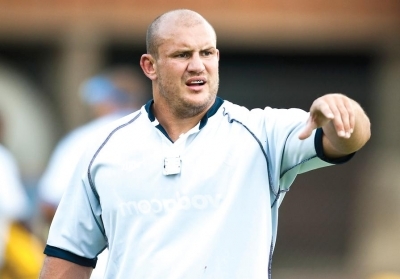
Bees Roux will soon join the Golden Lions rugby team, while the family of the black metro policeman he had killed in Pretoria, Johannes Nshimane Mogale, had “forgiven him unconditionally”.

In 2010 the rugby player beat the 38-year old sergeant to death in Hatfield and the following year he received a suspended sentence of 5 years in prison. Among the conditions of his plea bargain was as payment of R750 000 in compensation to the Mogale family.

Lions coach Johann Ackermann confirmed on Monday that Roux (31) would most likely be included as prop in the team during the coming Currie Cup season. According to Manie Booysen, the chief executive of the Golden Lions Rugby Union (GLRU), there was “technically no impediment to choosing Bees. It will be a pity if people saw his involvement in the wrong light. The chap has shown remorse.”

“We are selecting him for rugby and no other reason. He is a prop that is available coming back from abroad,” Ackermann said.

“We are in a tight spot as there are no other players that are not under contract, so we’ll pull him into the group and see how he goes.”

The Lions coach said letters in which the Mogale family offered their forgiveness to Roux had made the decision easier to look at the player.

“We have two letters dating to 2011 and 2013 where the parents and the family personally give their blessing to him to play rugby and they even want him to play for South Africa,” Ackermann said.

“This gave us somewhat of a positive outlook because they (the family) are willing to forgive and forget and to give him a second chance in life.”

A month after he pleaded guilty the Blue Bulls Rugby Union sacked Roux for breach of contract and he later took up a contract with French club the Bordeaux Eagles.

In 2012 he joined Italian team Treviso until the end of the European season this year, while he also featured in the South African Barbarians team in a match against Saracens in May.

Fresh off securing their place in the 2014 Super Rugby competition through a superior points difference to the Southern Kings in their two leg promotion-relegation matches, the Lions are facing a crisis at prop.

Captain JC Janse van Rensburg, who was the main anchor in the front row for the Lions has left the team for Bayonne in France, while Julian Redelinghuys suffered a long-term injury over the weekend.

“We are looking to borrow another prop from somewhere as we actually only have three fit props in Ruan Dreyer, Jacques van Rooyen and CJ van der Linde,” Ackermann said. – Sapa and praag