US Immigration tracked African with ‘chip in his anus’

trackingchipA Nigerian, Jacob Ajomale, who alleged that he was maltreated by the United States’ Immigration and Customs Enforcement, ICE, officers, by forcefully inserting a tracking device (chip) in his body through his anus, has petitioned the United Nations Council on Human Rights over alleged inhuman treatment meted to him.

Ajomale through his lawyer, Mr Femi Falana, SAN, claimed that the chip was inserted in him in December 2010.

Falana in the petition to the UN, is urging the world body to direct the United States to remove the tracking device from Ajomale’s body with immediate effect.

Besides, Ajomale has also sued United Airlines and the Nigerian Minister of Internal Affairs before a Federal High Court sitting in Lagos, demanding $100 million and N100 million damages for the violation of his fundamental rights to dignity of human person and right to mental and physical health as guaranteed by Sections 35 and 41 of the Constitution and Articles 6 and 12 of the African Charter on Human and Peoples’ Rights (Ratification and Enforcement) Act.

His arrest

Ajomale had averred in an affidavit that he has been living in the United States since April 12, 1997 with a visiting visa and became a permanent resident in February 2008, and never had any criminal record all through the period.

According to him, on January 22, 2009, he travelled to Nigeria for his father’s burial and on his way back, he was arrested on February 5, 2009 by one officer, Derrick, at the BWI Airport in Baltimore, Maryland, kept in a cold room for nine hours, where he was tortured in order to make an incriminating statement of using falsified passport in 2001.

He was subsequently arraigned, tried, convicted and sentenced to six months imprisonment at the DC jail and Rivers Correction Centre, all in North Carolina.

Second arrest

According to Ajomale, he was released back to the community on August 11, 2009 at 7pm, after being cleared by Immigration and Customs Enforcement, ICE, but surprisingly, he was arrested again by the same officer, Derrick, on August 15, 2009 on the ground that his release from detention was a mistake.

He said: “While in detention at Worchester Detention Centre Snow Hill, Maryland, an ICE officer, William Malone told me I could be released but it was going to cost me money. I told my lawyer about it who reported to senior ICE officers. Investigation was carried out and Officer Michelle Rawlings interrogated me and promised to get back to me, which she never did. Afterwards I became the target of all the officers.

“I was hospitalised on July 12, 2010 at Atlantic hospital for sinusitis and body weakness, but was discharged without adequate treatment. I was maltreated by three officers, who flung me on an empty steel bed, and I put in a grievance report concerning the issue. In August, 2010, I was moved to Frederick Detention Centre, Maryland, and the same aggression continued against my person. I felt some vibration on my bed and reported to the authorities but no action was taken.” – Vanguard

Kim Kardashian denies racist tweet about Nigerians

American reality TV star, Kim Kardashian, has denied tweeting hate words about Nigeria and her women.

A “photoshopped” image of a parody twitter handle had shown how Kardashian tweeted about Nigeria being such a disgusting country with women who look like apes.

“I see there is a photo shopped tweet floating around, supposedly something I said about Nigeria. That was not me or my feelings,” she said.

“The fake tweet is very disturbing and I will never ever tweet something like that,” she added.

Kim Kardashian recently visited Nigeria for a valentine show and left a love-hate relationship with her Nigerian fans after reports went round she was paid half a million dollars to show up at the event and hardly stayed or made any significant contribution to the show. – WENN.com

Africa doesn’t need mediocre white coaches

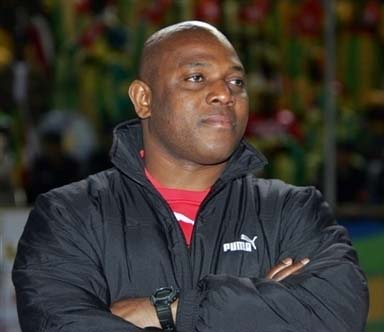
Stephen Keshi

Nigeria soccer coach Stephen Keshi has spoken out against the appointment of “mediocre” European coaches by African teams, ahead of his side’s tie with Mali

“I am never against white coaches in Africa,” said Keshi. “I am happy to work with a quality, experienced white coach, who is better than me, so that I can learn from him.

“But what I don’t accept is when you bring in a mediocre ‘carpentry’ coach from Europe, and tell me that he’s better than me. I won’t accept that. Meanwhile we have quality African former players, who can do the same thing, but you don’t give them the opportunity because they’re just black dudes. I don’t like that,” said Keshi, who has previously coached Mali and Togo.

Keshi qualified Togo for the 2006 World Cup, but was replaced before the finals by German Otto Pfister, who lost all three games.

Should Nigeria and James Kwesi Appiah’s Ghana prevail in Wednesday’s semifinals, the final will be the first to be contested by two African coaches since 1998, when Jomo Sono’s Bafana lost to Mahmoud El-Gohary’s Egypt. It’s been even longer since two sub-Saharan coaches squared off for the continental trophy.

Keshi will have great insight into Frenchman Patrice Carteron’s Malian side, having coached most of the players. “We need to realise that Mali is a footballing nation. They have great talent – I was there. Whatever they are doing, they should be doing it, because of the calibre of the players. Wednesday’s game will be as tough as the game against Côte d’Ivoire.”

‘Emotional fuel’
He said the civil war raging in Mali would provide emotional fuel for the Eagles.”It’s a shame what is going on in Mali, it’s a great country with wonderful people. It’s a place I love. But what is going on in the country is not something we should be proud of. The players are thinking about that, that’s where their force is coming from.”

The former Super Eagles captain also claimed he was indifferent to public criticism in Nigeria. “It doesn’t really matter what people think about what Stephen Keshi is doing. You can’t force someone to love you.”

Keshi, who has been his job since 2011, said this promising Nigerian side needed time to mature. “The progress is coming gradually. It’s a team in the making. But to build a very good team, you need three years. We just have to be patient to see the team grow. Some of us don’t have patience.”

But he also said he was open to offers beyond these finals. “If God grants me the tournament, the next day I could join another country. I’m a professional. It’s the same with Jose Mourinho, if he gets a call from a rich team, he goes. I’m here for now, but we’ll see if there’s anyone out there who wants me.”

Shale gas boom visible from space

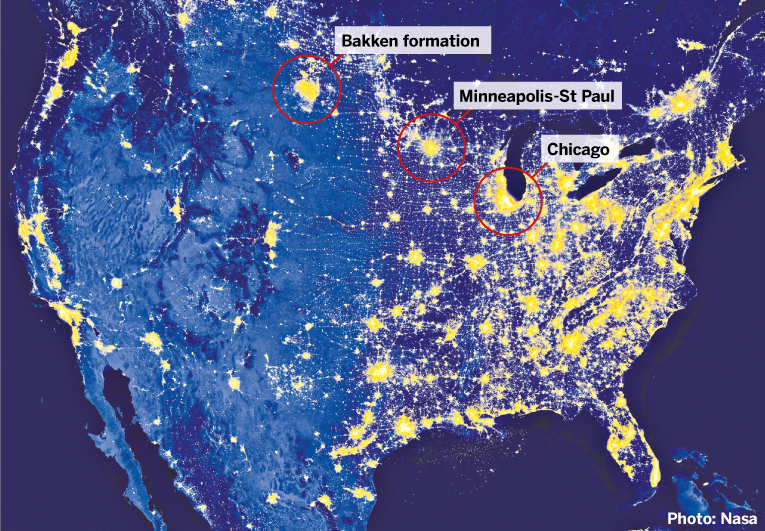
Oil companies at the heart of the US shale oil boom are burning off enough gas to power all the homes in Chicago and Washington combined in a practice causing growing concern about the waste of resources and damage to the environment.

The volume of unwanted gas being flared off in North Dakota, the state leading the shale revolution transforming the outlook for US energy, rose about 50 per cent last year. The surge at the state’s Bakken formation is being replicated in other shale regions with the Texas state regulator issuing 1,963 permits to flare in 2012, more than six times the number of 306 in 2010.

The rapid increase has made the US one of the world’s worst countries for gas flaring. The volume of gas flared in the US has tripled in just five years, according to World Bank estimates and is now fifth highest in the world, behind Russia, Nigeria, Iran and Iraq.

The flaring is a result, in large part, of the low price of natural gas in North America, which can make it uneconomic to build pipelines and tanks to handle the gas released by oil production. Flaring is often the safest way to dispose of it.

The lights of the flares burning in the Bakken and Texas’ Eagle Ford shale fields can clearly be seen in night-time satellite photography.

Flaring has been attracting attention from investors and environmental campaigners because of the waste of gas and its consequences for greenhouse gas emissions, local air pollution and disturbance to nearby communities.

Flaring in North Dakota increases by about 20 per cent the greenhouse gas emissions resulting from the state’s oil production, refining and transport, compared with the US average, according to Financial Times analysis of official data.

Investors managing a total of $500bn last year wrote to oil companies including ExxonMobil, Chevron, Statoiland US independents urging them to do more to cut their flaring. They warned that “excessive flaring, because of its impact on air quality and climate change, poses significant risks for the companies involved.”

Since then, flaring in the US and concerns over it have only increased.

The North Dakota legislature is considering a bill to encourage flaring reduction through tax breaks. The state is also pushing producers to use gas to power drilling rigs.