CCTV captures xenophobic Cape cops

saps4A Cape Town man says he’s been unnecessarily harassed by police – and he’s demanding to know why.

Several dozen policeman burst into Anelechi Sideny’s home in the early hours of Friday morning. They were caught on his CCTV ransacking his home, and allegedly assaulted him without confiscating anything.

The Nigerian national is accusing police of xenophobia.

Police scaled Sideny’s walls, bursting through the kitchen door with firearms in hand.

Sideny  was made to lie face down as the officers searched the premises. With no search warrant, it was unclear what they were looking for.

“When I say can I call 10111, the other one took me up, stood up and took me to the corridor. He showed me a police car. He said you can see this road, left and right is filled with police cars, so we are police. We don’t need search warrant,” Sideny said.

Sideny says this is not the first time he and his South African fiancée have been victimised. He installed CCTV cameras to capture what he and his family regularly have to endure.

Even his five-year-old daughter has started questioning why the family is being targeted.

“I told her, Blessing, it’s because your daddy’s a foreigner, a Nigerian for that matter. Buying a big house, that’s the crime I committed.”

A medical report shows that Sideny suffered soft-tissue injuries to his chest after allegedly being beaten by police in a room where there was no camera.

He now has to pay for the damage to his property,  but he says no amount of money can pay for the trauma his family has experienced.

Police say they were searching for suspects in the recent cop killings in Cape Town. They confirmed that they are investigating, among others, a criminal case of malicious damage to property against the officers involved in this raid. – eNCA

Tutu’s Cape Town home burgled

Milnerton, near Cape Town

The Cape Town home of Archbishop Emeritus Desmond Tutu was broken into, Eyewitness News reported on Thursday.

Tutu and his wife were asleep when intruders entered their Milnerton home on Wednesday morning, the broadcaster reported.

Western Cape police said some small items were stolen, including keys and remotes.

Tutu and his wife were not harmed. – Sapa

Cape Town child killed by bull due to be sacrificed

Ritual animal sacrifice

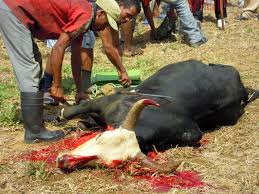
A bull due to be slaughtered ran amok and gored a 10-year-old boy to death in Cape Town, according to a report.

Ayanda Mfenku was attacked by the bull while standing in his yard in Philippi East on Sunday morning, the Cape Argus newspaper reported on Tuesday.

The bull was reportedly to have been used in the funeral ritual of Jackson Ntandiso, who died last week, but it broke loose.

“The raging bull shoved and injured an old man who was trying to force it into the yard, and it ran off frantically down the street, knocking over everyone who tried to get close to it,” Ntandiso’s daughter Yandiso was quoted as telling the newspaper.

“As it ran down the street, people moved out of the way and shouted for kids and drunken people to get out of its way.”

According to the Cape Argus, the bull entered Mfenku’s yard, gored him in the back and threw him against a wall. He died later in hospital.

The bull reportedly died overnight from shock and stress. – Sapa

Pagad: We are being framed

pagadAnti-drug group Pagad, a Muslim organisation, says the bombs detonated in Athlone in Cape Town on Wednesday night were probably placed by people who want to frame the organisation and derail it.

A motor dealership and a house were bombed within five minutes of one another. It was the second bombing this month near a Pagad event.

A Pagad motorcade was travelling through Athlone when the bombs when off on Wednesday night.


But Pagad spokesman Haroon Orrie said the motorcade was peaceful, and he denied any prior knowledge of the bombings.


He said Pagad had worked hard to shed the negative image of a violent vigilante group, to increase transparency and to rebuild trust and support within communities.

Asked about the possibility of rogue members carrying out attacks without a Pagad mandate, he said: “That scenario is impossible. Our motorcades are peaceful attempts at engaging communities affected by the scourge of drug dealing and gangsterism.

“We use loud-hailers to get our message across, and the response from the community has been very positive. We condemn the use of violence.”

Pagad has admitted it has increased its activities during the month of Ramadaan, with a “Ramadaan Awareness Programme”.

Pagad said on Thursday night that the police knew Pagad was not to blame.

“The police was with Pagad on the motorcade on every route we took through the streets of Bokmakierie (and) can therefore verify and testify that the Pagad motorcade had nothing to do with the blasts,” another spokesman, Cassiem Parker, charged.

“In the past the police were quick to link Pagad to incidents which they could never prove.”

Pagad also denied any involvement in the recent blasts.

Instead, Parker said: “The South African government must take full responsibility on the rise of anti-gangsterism and anti-drug groups who are striving to protect communities.

“The government, the SA Police Services and the minister of safety and security have once again failed to protect law-abiding citizens against gangsters and drug dealers.

“Communities are also fed-up with the thousands of shebeens and liquor outlets on our doorsteps. It’s a known fact these places give rise to crime and other social ills…

“It is a shame that communities are forced to organise themselves in movements like Pagad, the Mayitshe Group and others to patrol their streets against gangsterism and drug dealers.

“It is a shame that people in Manenberg, Bonteheuwel, Ocean View and many other areas are living in fear because gangsters have the free reign to shoot and kill them.”

Motorcades on Wednesdays after evening prayers during Ramadaan, form part of the programme.

In the first motorcade, on July 10 in Belgravia Estate and Rondebosch East, Pagad members picketed outside the homes of two alleged drug dealers, letting off firecrackers and using loud-hailers to issue “verbal warnings to stop their illegal activities”.

A house in Rondebosch East, near to the official convoy and police escort, was petrol-bombed, but Pagad national chairman Abdus-Salaam Ebrahim denied involvement in the attack.

No arrests have been made in that incident, police said.

Pagad has since lashed out at the police for showing “its full strength” at Pagad events.

The bomb thrown at Velocity Motors on Klipfontein Road on Wednesday night damaged nine cars. Two cars were written off. The blast caused R600 000 damage, said Niyaaz Jainoodian, the Velocity franchise’s director. He had “no idea” why it had been targeted, or by whom.

In the second bombing, of a home on Taurus Road, windows were shattered, but no was was injured. The owner declined to be interviewed.

Meanwhile, Athlone residents are trying to make sense of the attacks.

We were preparing to sleep, right after our evening prayer, and then we just heard a loud bang, saw some light flashes and assumed it was an accident. But when we got out to look the whole street was filled with smoke,” said Shireen Devous.

Devous, who lives next door to the Taurus Road house, said it had been targeted before: there had been a bomb threat last year, but police found no explosive devices.

A few houses away, another resident, who declined to be named, said the owner no longer lived there but the the owner’s mother and sister did.

“When the bomb happened the granny was still in the house. Whoever is targeting him would have known he doesn’t live there anymore.” – IOL

Policeman shot dead on patrol in black township Nyanga

Nyanga, one of the famous black townships in Cape Town

A policeman was shot dead and another was wounded while on patrol in Nyanga, Western Cape police said on Tuesday.

The policeman was shot in the head by two men he and a partner stopped to search on Monday night, said Captain Frederick van Wyk. He died later in hospital.

The other policeman was wounded in the hand and shoulder in an exchange of fire with the two gunmen, who shot at them while they were getting out of their police car at the corner of Zwelitsha and Hlathe roads.

Two members of the public were also wounded in the crossfire and were taken to hospital, said Van Wyk.

“Several shots were fired and SA Police Service members returned fire as the suspects fled the scene on foot,” he said.

The men stole a service pistol from one of the policemen before fleeing.

An officer was shot in the head and died later in hospital.

No arrests had been made.

“This attack on police officers will not be tolerated and every endeavour will be made to bring those responsible to book,” Van Wyk said. – Sapa

Obama to Africa: Don’t trust foreign powers

obamacapetownPresident Obama pledged $7 billion in aid Sunday to provide electricity to sub-Saharan Africa, as he warned Africans to be wary of exploitation by other countries, including the U.S.

“I’m calling for America to up our game when it comes to Africa,” Mr. Obama said in a speech at the University of Capetown in South Africa, midway through his weeklong tour of the continent. “We want to unleash the power of entrepreneurship and markets to create opportunity here in Africa.

Funds from the electricity initiative, dubbed Power Africa, will be distributed over the next five years to six countries: Ethiopia, Ghana, Kenya, Liberia, Nigeria and Tanzania. Mr. Obama said the U.S. wants to help Africa without interfering like colonial powers did in the past.

“You will always find the extended hand of a friend in the United States of America,” he said.

But on his three-nation tour, the president also has been warning Africans not to automatically trust foreign powers offering help, including the U.S.

“When we look at what other countries are doing in Africa, I think our only advice is make sure it’s a good deal for Africa,” Mr. Obama told reporters in Johannesburg.

“If somebody says they want to come build something here, are they hiring African workers? If somebody says that they want to help you develop your natural resources, how much of the money is staying in Africa? … Don’t just assume that folks come here and they’re automatically benefiting Africans. And that includes the United States. Ask questions in terms of what we do.”

Although Mr. Obama has been emphasizing initiatives such as food security and international funding to combat AIDS, much of his African trip has been overshadowed by his inability to meet over the weekend with the critically ill Nelson Mandela, 94, hospitalized with a lung infection.

The president and his aides held out the possibility of a meeting with Mr. Mandela until Saturday, when Mr. Obama decided to meet instead with several members of the civil rights icon’s family, saying he didn’t want to intrude at the hospital. He praised Mr. Mandela as a “hero for the world” and said America’s prayers were with him.

Mr. Obama told the audience at the University of Capetown that Mr. Mandela inspired his first political act, when he was a 19-year-old student at Occidental College in California.

He said he was motivated to give a short speech about divesting from South African companies after learning about Mr. Mandela and other political prisoners fighting for equality in South Africa.

“My own government in the United States was not standing on their side,” Mr. Obama said. “That’s why I got involved in what was known as the divestment movement in the United States. It was the first time I ever attached myself to a cause.

“I know now that something inside me was stirring at that time, something important,” he said. “And that was the belief that I could be part of something bigger than myself, that my own salvation was bound up with those of others.”

Earlier Sunday, Mr. Obama and his family toured the South African prison that held Mr. Mandela. The president wrote in a visitors log that they were “deeply humbled” by the experience, although this was Obama’s second visit to the prison.

Mr. Obama, first lady Michelle Obama, daughters Malia and Sasha, and the Obamas’ niece Leslie Robinson arrived on Robben Island after a five-minute helicopter flight from Capetown on Marine One. They were accompanied by a press helicopter and a contingent of Secret Service agents.

They got a tour of the prison, where Mr. Mandela spent 27 years as a political prisoner, from 83-year-old former inmate Ahmed Kathrada. They also saw the small cell that Mr. Mandela once occupied.

The president and first lady paused at the prison’s logbook, and Mr. Obama wrote the following entry:

“On behalf of our family we’re deeply humbled to stand where men of such courage faced down injustice and refused to yield. The world is grateful for the heroes of Robben Island, who remind us that no shackles or cells can match the strength of the human spirit. Barack Obama and Michelle Obama, 30 June 2013.” – Washington Times

Cape Town rapist of 4 girls appears in court

scalesofjusticeA man has appeared in the Cape Town Magistrate’s Court in connection with the rape of four girls, the Cape Argus reported on Wednesday.

The 49-year-old’s case was reportedly postponed on Tuesday until August 14, for the public prosecutions director to decide whether the matter should be heard in the Western Cape High Court or Cape Town Regional Court.

The Salt River man reportedly stands accused of raping four girls between the ages of eight and 11, between April and August last year.

He was arrested in September and released on R5000 bail two months later, on condition he live at an alternate address and not contact the girls. – Sapa

Pretoria, Jhb, Durban, CT are ‘critical crime threats’, says US govt.

Cape Town, danger lurks here...
Cape Town, danger lurks here…

A warning issued to tourists by the United States says Pretoria, Johannesburg, Durban, and Cape Town are “critical crime threat spots”, The New Age reported on Wednesday.

The warning was released in a document by the US state department’s Bureau of Diplomatic Security.

It states: “Violent and confrontational crime is a major concern [in South Africa]. Such crimes include home invasion robberies, burglaries, car-jackings, street muggings, smash-and-grabs, organised attacks on commercial and retail centres, bombings of ATM’s, as well as attacks on cash-in-transit vehicles and personnel.”

The report warns visitors that South African criminals do not hesitate to use lethal weapons and that townships should be avoided.

“Foreigners are not specifically targeted, but several have been the victims of rape,” the report said, according to the newspaper.

US Embassy spokesman Jack Hillmeyer said safety and security reports were standard practice in all countries where the US foreign affairs department provided consular services to its citizens, and were not limited to South Africa.

“The majority of US citizens who travel to South Africa generally make it back without incident,” he told the publication.

US president Barack Obama is due to visit Pretoria and Cape Town at the end of June. – Sapa

Faecal wars: ANC threatens to make Cape Town ungovernable

ANC Youth League protest a few days ago, telling DA leader Helen Zille to go back to her country, Germany

The African National Congress (ANC) in the Western Cape has threatened to bring Cape Town to a standstill in what it refers to as a bid to get the ear of Premier Helen Zille so the Democratic Alliance (DA) can deliver “better services” to poor people in the province.

In what could be seen as a drive by the provincial ANC to pile pressure on the DA ahead of the 2014 national elections, the party on Thursday led hundreds of protesters in a march to the provincial legislature and demanded that Ms Zille collect their memorandum of grievances.

Among other things, the protesters demanded better sanitation, housing and “more comfort”. They said the controversial portable flush toilets that were being rolled out in some Cape Town townships showed that the DA did not care about black people.

It was the second day in a row that the ANC had protested outside the provincial legislature against the DA, although Wednesday’s protest by ANC members of the legislature against “DA power abuse” was minor in comparison to Thursday’s march.

Addressing the crowd outside the legislature on Thursday, ANC provincial secretary Songezo Mjongile said Ms Zille’s “refusal” to come out and collect the memorandum showed that she was “scared of the people”. DA provincial leader and cultural affairs and sport MEC Ivan Meyer was sent out to collect the memorandum but Mr Mjongile said the document would only be handed to Ms Zille.

“The next time (when we come to hand over the document), we will bring Cape Town to a standstill … we will bring a crowd of 10,000,” he said.

ANC provincial leader Marius Fransman said that communities “can march all they want but Zille will never listen”.

“She does not even accept our memorandums … the only way is by voting,” he said. “We have to vote for transformation in this province … come 2014, Zille will be a refugee.”

While the Cabinet on Thursday condemned the dumping of human waste in Cape Town by protesters opposing portable flush toilets, Mr Fransman said the protests had actually raised “real issues” around service delivery in the Western Cape.

Earlier in the day during a press conference, ANC Youth League national task team co-ordinator Magasela Mzobe said the Western Cape government had failed to ensure “the very rudimentary levels of sanitation for the people (in township areas such as) Philippi and Kosovo”.

“This speaks to the DA’s total disregard of the dignity of the poor and black majority in the province,” he said. “Poor people in the Western Cape remain of a lesser status and not entitled to the very basic rights to sanitation that today accrue to those in the leafy suburbs of Rondebosch, Camps Bay and many others.”

Ms Zille’s spokesman, Zak Mbhele, said on Thursday that the premier had not been available to collect the memorandum and that is why Mr Meyer was sent to receive it on her behalf. He also said the ANC had nothing “of substance or truth to say”.

“While it’s clear that the ANC has good grassroots machinery to mobilise lots of people for marches and demonstrations, it’s also the case that it has nothing of substance or truth to say,” Mr Mbhele said.

“It’s all a great spectacle and lots of rhetoric but there is no basis for the accusations they make against the Western Cape government. Undoubtedly there is more to come in the run-up to the 2014 elections.” – BDLive

Cape Town DA wants to erect statue for Mandela

Existing statue of Nelson Mandela on Sandton Square

A statue of former president Nelson Mandela may be erected in front of the Cape Town city hall where he delivered his first speech after being released from prison, the Cape Times reported on Thursday.

Democratic Alliance councillor Leonore van der Walt reportedly proposed at a council meeting on Wednesday that a naming committee be formed to discuss the process to be followed and funding.

Councillor Andre Fourie warned that proper consultation should happen to avoid a “debacle” like that of the freedom of the city award given to United States president Barack Obama and his wife Michelle, which drew criticism from some parts.

“That should not happen with a person with the stature of Mandela,” he was quoted as saying.

According to the report, ANC leader in the council Tony Ehrenreich called for a “coherent national policy” in honouring Mandela, otherwise the statue in Cape Town would be a DA “gimmick”, he said.

The process would reportedly cost about R1 million. – Sapa

Three Cape Town policemen appear for theft and extortion

Three policemen accused of theft and extortion appeared in the Bellville Specialised Commercial Crime Court on Thursday.

They allegedly kicked down Anton Pillay’s door last February and confiscated a plastic bank bag containing 15 sachets of tik and R1650, he told the court.

He said the policemen remarked that he had a lot of money, and said they would let him go if he gave them R100 each. He did so and was allowed to leave.

Pillay was testifying in the trial of Constable Nkosinathi Mdiya, Warrant Officer Mogamat Meniers and Sergeant Heinrich Gordon, all of whom have plead not guilty.

Mdiya is charged with two counts of theft, two of robbery and one of extortion; Meniers is charged with one count of theft and one of corruption; and Gordon faces three theft counts, two of corruption, two of extortion, and two of robbery.

Pillay told the court he lived in an informal settlement in Diep River, and that his girlfriend went to the police after an argument.

He said he was asleep, and groggy from drugs, when the police knocked on his shack door, then smashed it down.

Asked by prosecutor Xolile Jonas what happened to the drugs, he said: “I don’t know, and did not care. I just wanted to be out of the police station.”

He said no investigation docket was opened against him.

Asked why he laid charges against Meniers and Gordon, he said: “They had arrested me before on other charges, and I thought it wrong of them to take my money like that”.

Defence attorney Shantell Morgan said Meniers would tell the court that Pillay’s girlfriend went to the police because he was holding her child hostage, and that their visit to his home had nothing to do with drugs or money.

“My client will say that when they arrived at your shack they heard a child screaming behind the locked shack door and that they kicked down the door because Pillay refused to open it.”

Pillay denied taking the child hostage.

The case was postponed until September 16. – Sapa

A racist application form

White, English and racist

CAPE BAR COUNCIL

 NOTICE TO ALL MEMBERS AND APPLICANTS FOR PUPILLAGE IN 2013

TRANSFORMATION BURSARIES

SCHOLARSHIPS FOR AFRICAN WOMEN

2013

Applications are hereby invited for the Cape Bar’s transformation bursaries and scholarships for African women for 2013.

Transformation bursaries

The persons who are eligible for the transformation bursaries are financially needy black or female persons (a) who have been accepted for pupillage at the Cape Bar in 2013, (b) who are currently pupils and will be commencing practice at the Cape Bar in late 2012 or early 2013 or (c) who are juniors at the Cape Bar and will have less than 2 years’ standing on 1 January 2013.  The value of each bursary will be determined by the Cape Bar Council.  It will be up to R7 500 per month for twelve months depending on the person’s financial needs.

Scholarships for African women

The persons who are eligible for the scholarships for African women are suitably qualified African women who have been accepted for pupillage at the Cape Bar in 2013, who are committed to practising as advocates at the Cape Bar and who require financial assistance during the term of pupillage and during their first year of practice.  The value of each scholarship is R7 500 per month during 2013.  Thereafter, each scholarship holder who has successfully completed the National Bar Examination and taken up chambers at the Cape Bar, receives a contribution, determined by the Cape Bar Council, towards the running expenses for the first year of practice. It will be up to R7 500 per month for twelve months depending on the person’s financial needs.

Application form

All applications must be made using the accompanying application form.

Applications must be made by 30 November 2012.  They must be sent to:

Andrew Breitenbach SC

16th Floor Huguenot Chambers

40 Queen Victoria Street

CAPE TOWN 8001

Email: breitenb@law.co.za

Fax: 021 424 4919

If you have any queries, please contact Adv. Breitenbach on 021 424 3906.

SHELLEY WITTEN

Secretary

Cape Bar Council


Necklace killing in black township

A man was stoned and necklaced in a playground in Khayelitsha, Cape Town, it was reported on Wednesday.

The Cape Times reported that Zukisani Ndzanga, 28, was attacked on Monday night in SST informal settlement, allegedly by members of a security patrol.

The community had been looking for a man who raped and murdered a teenager at the start of the month, and found out he knew Ndzanga.

Ndzanga was confronted and asked where his friend Zola was, but he apparently refused to point out where he was hiding and stabbed a man.

The group then dragged him to the playground where he was stoned and a necklaced.

Necklacing is the placing of a tyre around someone’s neck, dousing it with petrol and setting it alight to burn the person to death.

In a similar incident on Monday, Bongi Ntlathi, 26, was stoned and beaten to death by residents in Harare 35 Block for allegedly stealing a cellphone from a house in the area.

According to The Cape Times, two suspects had been arrested in connection with his death.

Western Cape Premier Helen Zille has set up a commission of inquiry to investigate the breakdown of the criminal justice system in the area. – Sapa

Black area has highest crime rate in Western Cape

Nyanga, one of the famous black townships in Cape Town

The most likely place to be murdered in the Western Cape is the black township of Nyanga, especially over a weekend and after dark, provincial community safety MEC Dan Plato said on Wednesday.

The township, situated near the Cape Town International Airport, recorded the highest number of reported murders last year, based on forensic pathology data, he said.

Plato was speaking at the release of the first “Shadow Crime Report”, which used mortuary statistics — from 2008 to 2012 — to give detailed information on provincial crime, in addition to the police’s annual crime statistics.

The report revealed that 10 police stations, all in Cape Town, contributed to just under half of the province’s 2290 reported murders.

These were Nyanga, Khayelitsha, Harare, Gugulethu, Kraaifontein, Delft, Mitchell’s Plain, Philippi East, Bishop Lavis and Mfuleni.

A typical murder victim was most likely to have been stabbed; to have drank alcohol beforehand; and to be a black man aged between 18 and 35.

The report revealed that 87 percent of murder victims were men. Half of those murdered were stabbed, a quarter were shot, and about 17 percent died of severe assault or blunt trauma.

Seventy percent of those killed tested positive for alcohol.

In areas known for gang violence, the number of people killed by gunshots was significantly higher than the provincial norm of 26 percent.

About 85 percent of murders reported to the Belhar police station were gunshot-related.

Steenberg, Bishop Lavis and Elsie’s River were the next highest.

Plato said the purpose of the report was not to criticise police, but to move away from a “one-size-fits-all” approach to crime.

The department planned to release a report every six months, and use the information to create “localised responses” to specific community crime trends. – Sapa