Australian hullabaloo over ‘racist Facebook page’

The logo of 'Abo Memes' on Facebook

The creators of a racist Aboriginal Memes Facebook page – described as a potential breach of Australia’s Racial Discrimination Act – have removed all of the controversial images.

All of the page’s content was removed earlier today after repeated complaints to Facebook and after confirmation that the Australian Communications and Media Authority was investigating.

Race Discrimination Commissioner Helen Szoke said the page, which targeted Aborigines, could be a breach of the Act and earlier called on the social network’s operator to take the page down.

Communications Minister Stephen Conroy said today the page was “offensive”, “not appropriate” and “denigrates our indigenous community extensively” but stopped short of demanding that Facebook take it down, saying “I think it should be taken down”.

“Pretending its humour doesn’t really change [things],” Conroy said.

The Coalition on the other hand has vowed to repeal racial vilification laws.

ACMA is also investigating the page following a campaign condemning Facebook over its claims that the page is not considered hate speech. The racist “Aboriginal memes” page portrayed Aboriginal people as inferior drunks who sniff petrol and bludge off welfare.

“My view is that the material is offensive and it goes over the line of humour and even controversial humour because what it’s doing is depicting a whole race of people in a way that’s negative, that’s ridiculing them, that’s mocking them and is offensive,” Szoke said in a phone interview.

Boxer Anthony Mundine said it was “appalling” that Facebook had refused to remove the page.

It appears that Facebook tolerates hate-mongering but refuses to allow mothers to post images of themselves breastfeeding their babies.

Facebook’s community standards page forbids “hate speech” but Facebook has responded to those who complained about the Aboriginal Memes page, saying it was “not able to confirm that the specific page you reported violates Facebook’s statement of rights and responsibilities”.

The page, which has 4183 “likes”, was briefly taken offline last night before reappearing with the words “Controversial Humor (sic)” next to the page’s title. It consisted of various images – usually of an indigenous person – each with racist text over the top of it.

Facebook says on its website that content which attacks people based on their perceived race, ethnicity, national origin, religion, sex, gender, sexual orientation, disability or disease “is not allowed”.

“We do, however, allow clear attempts at humour or satire that might otherwise be considered a possible threat or attack,” the website states. “This includes content that many people may find to be in bad taste.”

Chris Graham of the NSW Aboriginal Land Council’s Tracker magazine said that while Facebook may have a policy on what is and isn’t hate speech, “the fact is that Facebook page is illegal”. “It is a clear breach of the Racial Discrimination Act. Is Facebook genuinely suggesting it is above the law?”

Approached for comment this morning, a Facebook spokesman in Australia said: “At this point in time, we’ve not got anything we can give you on this.”

Szoke said while she had yet to receive a formal complaint – required before an investigation takes place – she believes “this could constitute discrimination under the Race Discrimination Act”.

She urged Facebook to remove the page and said now was a good opportunity for the site to revisit its guidelines and “test whether they are in tune with community opinion”.

“If someone chose to lodge a complaint at the commission then what we would do is attempt to conciliate that complaint and get an appropriate outcome,” she said.

“That may be to remove the material, review guidelines about what the threshold is on racism and how racism is depicted on the Facebook site, to putting a public apology about the harm that’s been created.”

This conciliation process may not be possible under a future Coalition government as Tony Abbott has said he would repeal laws prohibiting statements that offend people on racial or ethnic grounds. At a press conference today Senator Conroy took a different view, saying “we don’t want to live by those [Facebook’s] standards”.

ACMA has referred the content to the Classification Board. But it is understood that it is unlikely that the content would fall under “prohibited content” as defined by the Act, which prevents content such as child and terrorism material.

“So as long as you have a pretence of being funny about it you can vilify Aboriginal people? Really? If that’s their [Facebook’s] policy they need to have a serious re-look at it,” Graham said.

“Racist doesn’t even begin to describe the images. They’re so offensive it beggars belief.”

Graham said that while Facebook could take the page down today, tomorrow it would be back up somewhere else. But that didn’t excuse Facebook from its responsibility not to spread “this sort of hateful, disgusting material”.

“There’s a certain amount of futility in all this. It’s never going to stop because the people creating it know there’s a big market for it in Australia. And that’s the problem,” he said.

“What this does is celebrate the destruction of a people. It celebrates the fact that Aboriginal people feel so hurt and so disempowered that they petrol sniff to forget their problems … I don’t think Mark Zuckerberg had this in mind when he invented what is otherwise a fantastic social networking platform.”

Mundine said: “It just goes to show how behind we are, how racist this country is. A lot of people that ain’t as strong as me it plays with their emotions … but shit like that just motivates me really to do the best ever and that’s what I’m going to do, I’m going to be the best ever and they’ll have to say a black man was the best ever full stop period.”

Andrew P Street has been part of a Facebook campaign to get the racist page removed from the site.

“I got sent the link by a friend … dutifully shared and reported it, and that would have been that if FB’s bot response had been ‘a human will look at this shortly and report back’,” he said.

“But because their response implied that nothing was going to be done, I got strident – and then when the page went down and then reappeared, with the new URL and descriptor suggesting ‘this WAS racist, but now we’ve told you it’s totally hilarious it’s all OK!’, I got f—ing livid.”

Ben Gertz, a national Aboriginal and Torres Strait Islander officer with the National Union of Students, said the page was unquestionably racist and portrayed indigenous people as “a bunch of inferior petrol sniffers”.

“I think social media gives people an outlet to promote their racist and discriminatory views because on social media a lot of profiles can be very faceless so it gives people that option to cower behind a faceless screen,” he said.

Tiphereth Gloria, social media planner at VML, said the page was racism hiding under “humour”. Since it uses visual meme generators, contributors are able to stay anonymous.

“Facebook likes to stay out of these controversies. The last time they took photos down it was women’s personal photos of themselves breastfeeding their children,” she said. “They eventually reinstated these. How racism is allowed to stay up versus breastfeeding is anyone’s guess.”

James Griffin of social media monitoring firm SR7 said anonymity on the web was a double-edged sword – it allows people to speak out in support of good without condemnation but it also allows people to say terrible things without consequence.

“Two contrasting examples for retaining anonymity [on Facebook pages] would be disgusting pages like this, where it makes sense to remove it, however alternatively, social media played such a large role in facilitating the Arab Spring and helping shed light on the plight of people in dire situations,” he said. “In that respect anonymity is vital.”

In a position paper on a national anti-racism partnership and strategy, released in June, the National Congress of Australia’s First Peoples identified cyber-racism as one of its four major priorities.

“Congress has identified increasing concern around the prevalence of racist commentary and imagery on the internet and in social media, and recognises the destructive potential this material can have in spreading falsehoods, reinforcing racist stereotypes and undermining social cohesion,” it wrote.

“Congress believes it is particularly important to identify effective strategies to combat the existence and expansion of cyber-racism. Congress notes that social media is an important tool for effective contemporary campaigns.”

–Sydney Morning Herald

USA has spent $3.2 billion on South Africa’s AIDS programme

US Secretary of State Hillary Clinton on Wednesday signed a new deal supporting efforts to fight AIDS in South Africa, which has the world’s biggest population of people with HIV.

“South Africa and the entire region has a brighter and healthier and more secure future,” she said while visiting a clinic in the Cape Town township of Delft.

“Even as we take a moment to say ‘well done’, we cannot make the mistake of thinking that our job is done,” she said. “The disease is still very dangerous.”

The United States has spent $3.2 billion since 2004 supporting South Africa’s fight against AIDS. The new five-year agreement gives South Africa’s government more control over the spending.

“Some people may hear ‘South Africa is in the lead’ and think that it means that the US is bowing out,” Clinton said. “Let me say this clearly: the US is not going anywhere.”

“The partnership is changing for the better,” she said. “Our goal is no new patients — zero.”

The agreement highlights South Africa’s shift from an international pariah on AIDS, under former president Thabo Mbeki, who refused to believe the scientific evidence that AIDS is caused by a virus — to a celebrated one.

Now the country runs the world’s largest AIDS treatment programme, with more than 1.3 million people receiving drugs, out of a total infected population of 5.6 million.

The rate of newborns catching the disease from their mothers during childbirth has fallen from 8 percent in 2008 to 2.7 percent last year. – SAPA

Coal India to acquire South African coal assets

Coal India, the world’s biggest coal miner, moved ahead on Wednesday with plans to acquire mines abroad by beginning the process of forming a subsidiary in South Africa.

The development follows state-run Coal India Ltd (CIL) signing a pact with the Limpopo province of South Africa to identify and develop coal mines as the Indian company grapples with an acute coal shortage.

The public sector firm invited bids for appointing consultants to help it form a wholly-owned subsidiary in Africa, the semi-official news agency Press Trust of India said.

“Coal India intends to select South Africa based consultant(s) to assist its venture of formation of a wholly-owned subsidiary company,” CIL said in the bids document, according to the news agency.

The step comes as India recovers from last week’s massive power outage — the worst in the history of the country, which runs a peak-hour electricity shortfall of around 12 percent.

Last year, the government of Limpopo, the northern province of South Africa, approached Coal India to set up a joint venture.

Coal India has earmarked 60 billion rupees ($1.1 billion) for acquisition of mines overseas in this financial year from its cash reserves of nearly $11 billion.

CIL, which accounts for more than 80 per cent of domestic coal production, missed its revised 2011-12 production target. It achieved only 435.84 metric tonnes as against the targeted 447 metric tonnes.

The demand-supply gap for coal was 161.5 million tonnes in the last fiscal year to March 2012 and it is expected to be around 114 million tonnes this year.

CIL has agreed to a government demand that it sign fuel supply agreements to meet a minimum of 80 percent of the needs of some 48 new power projects.

The company will have to pay penalties to electric utilities in the event of a shortfall in supply.

It wants to improve coal availability both by increasing domestic production and also through overseas sources.

Coal India produces more than 80 percent of India’s coal at close to 500 mines across eight states.

It holds the largest extractable coal reserves in the world, with over 22 billion tonnes, but has struggled to boost output due to failure to get environment and regulatory clearances.

Coal accounts for more than half of India’s energy use and consumption is set to increase as development accelerates in energy-intensive sectors such as steel and cement manufacturing.

India has been adding power station capacity to meet its needs, but some plants are idle because of fuel shortages.

The government sold off a 10 percent stake in Kolkata-based Coal India in 2010, raking in $3.4 billion. – SAPA

Follow Mandela, says Hillary Clinton

US Secretary of State Hillary Clinton urged South Africa to build on icon Nelson Mandela’s legacy and flex its growing influence on the global sticking points of Syria, Iran and Zimbabwe.

“The man who did so much to shape the history of a free South Africa has never stopped thinking about the future of South Africa,” she said in a speech at a Cape Town university.

“Because of your history, South Africa has an obligation to be a constructive force in the international community,” she added.

Washington’s top diplomat said strong African partners were needed to tackle the world’s challenges and urged the continent’s biggest economy to do more.

“There cannot be a strong global network unless there are strong African partners. Now I’ve often heard it said that African problems need African solutions. Well I’m here to say that some of our global problems need African solutions too,” said Clinton.

“And few nations on this continent can carry as much weight or be as effective partners and leaders as South Africa. You are a democratic power with the opportunity to influence Africa and the world.”

On her sixth stop of a continent-crossing mission, Clinton noted differences between Washington and Pretoria, particularly on recent conflicts in the Ivory Coast and Libya, but said this should not obscure common goals.

“We welcome South Africa’s support last week with the resolution at the UN General Assembly condemning Syria and the Assad regime’s brutal reign of terror,” she said.

“I hope this vote can be the foundation for a new level of cooperation.”

Clinton called on South Africa to lead efforts at the United Nations human rights council to protect global human rights.

“When old friends in power become corrupt and repressive, a decision by South Africa to stand on the side of freedom is not a sign that you are giving up on old allies, it’s a reminder to yourselves and the world that your values don’t stop at your borders.”

Drawing out neighbouring Zimbabwe, she urged leaders in the region to push for progress for new polls that will end a troubled power-sharing deal that pulled the country out of election chaos five years ago.

“Now the same leaders can help accelerate progress for finalising and adopting that constitution through a credible referendum and holding a free and fair election monitored by the international community,” she said.

“And if Zimbabwe’s leaders meet these commitments, the United States is prepared to match action for action.”

The US has insisted that Zimbabwe take more steps to curb political violence before agreeing to ease sanctions against veteran President Robert Mugabe and his inner circle.

In a speech that blended praise and encouragement, Clinton called on South Africa to use its “rare authority” as the first country to have voluntarily given up its nuclear weapons to discourage armaments.

“You can help ensure that any country that pursues nuclear weapons programmes will invite only more pressure and isolation,” she said.

“This means South Africa can play an even greater role on issues like curbing Iran’s pursuit of nuclear weapons from preventing nuclear materials from falling into the hands of terrorists.”

Clinton reserved parts of her speech to pay homage to Mandela’s example of humanity by reaching out to his former apartheid jailers.

“That is the true legacy of president Mandela — calling all of us to complete the work he started. To overcome the obstacles, the injustices, the mistreatments that everyone, every one of us will encounter at some point in our lives.”

Earlier, she signed a new deal supporting efforts to fight AIDS in South Africa, which has the world’s biggest population of people with HIV.

‘Racist and Islamophobic attack’ by alleged white Afrikaans-speakers

Mohammed Fayaz Kazi, died after brawl in Magaliesburg, allegedly with white Afrikanersby SAPA and Praag

The North West Premier Thandi Modise on Thursday condemned the killing of a Muslim man in Magaliesburg, reports the South African Press Association.

“There is no place in our diverse society for those who harbour racism and religious intolerance,” she said in a statement.

Modise called on police to ensure those responsible for the death of Muhammad Fayaaz Kazi, 27, were arrested.

The attack was both racist and Islamophobic, she said. She called on residents to help the police in their investigation and to exercise restraint.

Former intelligence minister Ronnie Kasrils said on Wednesday the “savage” attack on Kazi and another Muslim man carried “the stench of Islamophobia”.

“My heartfelt condolences and solidarity to the family of Fayaaz Kazi, whose brutal killers must be hunted down and brought to justice,” Kasrils said in a statement.

Kazi was beaten to death in Magaliesburg, allegedly by two people who insulted him because of his beard, according to a family friend.

Kazi, from Ventersdorp, and his father’s friend Anser Mahmood, were attacked at a Chicken Licken outlet in the town on Monday.

“Two white people… they called him [Osama] bin Laden in Afrikaans because of his beard…and then they called us kaffirs,” Mahmood told Sapa by telephone on Wednesday.

“Fayaaz, he understood Afrikaans, and was arguing with them.”

All four were thrown out of the fast food shop, and the fight continued outside.

“I asked why they were troubling him and he punched me,” Mahmood, 33, said.

“I don’t know what he hit me with. I was unconscious.”

Mahmood was mostly hit in the face, while Kazi was beaten over the head. Mahmood said he did not know what object was used to attack Kazi.

“Nobody helps us. They wanted me dead also, but I survived.”

North West police said a murder docket had been opened.

“After purchasing food from a fast food outlet an argument allegedly broke out between Kazi and two unknown Afrikaner males. It further alleged that the two suspects were mocking Kazi about his long beard,” said Brigadier Thulani Ngubane.

The two men fled the scene after the assault.

Ngubane said Mahmood refused to open a case and the two left for Ventersdorp.

“Upon arriving on Ventersdop, Kazi became weak and was transported to the Ventersdorp Hospital where he was treated and transferred to Potchefstroom Hospital after his condition became worse,” Ngubane said.

Kazi died in hospital at Potchefstroom. His funeral was held on Tuesday.

The murder case was registered at the Potchefstroom police station. It was expected to be transferred to the Magaliesburg police.

The Media Review Network, a Muslim advocacy group on human rights, called on Police Minister Nathi Mthethwa to ensure a speedy investigation.

Researcher Ibrahim Vawda said there was widespread anger across the Muslim community.

“We strongly urge all members of our community to exercise restraint and patience and to allow the normal process of the law to take its course.”

Bin Laden was the founder of al-Qaeda, which the US claimed was responsible for the September 11, 2001, suicide attacks on the country. US soldiers killed him in Pakistan on May 2, 2011.

In her comments, Netherlands-based blogger Adriana Stuijt wrote:

“While this is a horrific incident, I would ask why there  wasn’t a similar outrage when four Afrikaner dads, unarmed, were mowed down in Umbilo by two South African Muslim policemen who had taunted the Afrikaners about their ‘penis size’. That was just as much a hate crime, yet the SA news media have kept very silent about this. There was no ‘brawl’ until the Muslims had insulted the Afrikaners, who were in their usual pub watching a football game in Umbilo. Three of the Afrikaner men died instantly at the scene – Nick Janse van Rensburg, 57, Shawn Strydom, 33, and Rory Menzies, 40. Two others, Shawn and Bruce Edwards, were injured. Bruce Edwards later died in hospital. All were family men. It does not help to keep sweeping up emotions and polarising people like this.”

Syrian rebel group claims it ‘killed Russian general’

(Reuters) – A Syrian rebel group said on Wednesday it had killed a Russian general working as an adviser to Syria’s ministry of defense in an operation in the western Ghouta region on the outskirts of the capital Damascus.

A video statement from a group calling itself the “Hawks Special Operations Battalion…a division of the Military Leadership of Damascus City and Province”, gave the name of the general as Vladimir Petrovich Kochyev. The video, sent to Reuters, showed what the rebels said was a copy of his ID, as issued by the Syrian military.

The same group claimed responsibility for the assassination of four of President Bashar al-Assad’s top lieutenants in Damascus last month.

There was no immediate comment from the Russian authorities.

Russia, which has an estimated several hundred military personnel in Syria, is one of the few countries still backing Assad diplomatically since a popular uprising against his rule erupted 17 months ago.

$54,8m fine for South Africa’s Telkom

Telkom headquarters in Pretoria, as seen from Church Square Photo: Wikipedia

The Competition Tribunal of South Africa has fined Telkom, the one-time monopoly state telephone company, with a $54.8 million fine over unfair competition, according to an Associated Press report this morning.

The tribunal issued the fine Tuesday morning as part of a decade-long look at the company’s practices.

The case began in 2002, with Internet service providers alleging Telkom charged its competitors high prices for using its services, while charging much lower fees to its subsidiaries and its customers.

The South African government still owns part of Telkom SA Ltd., once an entirely state-run company. The company, with operations in other African nations, has had financial troubles in recent years. Subscribers also have increasingly dropped fixed telephone lines, the backbone of Telkom’s business, for mobile phones.

Telkom has also practised a blacks-only employment policy and has lost a significant percentage of its skilled personnel as whites have either been retrenched or resigned of their own accord.

Sikh temple shooter Wade Michael Page was ‘white supremacist’

Wade Michael Page

OAK CREEK, Wis. (AP) — Before he strode into a Sikh temple with a 9mm handgun and multiple magazines of ammunition, Wade Michael Page played in white supremacist heavy metal bands with names such as Definite Hate and End Apathy.

The bald, heavily tattooed bassist was a 40-year-old Army veteran who trained in psychological warfare before he was demoted and discharged more than a decade ago.

A day after he killed six worshippers at the suburban Milwaukee temple, fragments of Page’s life emerged in public records and interviews. But his motive was still largely a mystery. So far, no hate-filled manifesto has emerged, nor any angry blog or ranting Facebook entries to explain the attack.

Oak Creek Police Chief John Edwards suggested Monday that investigators might never know for certain why the lone attacker targeted a temple full of strangers.

“We have a lot of information to decipher, to put it all together before we can positively tell you what that motive is — if we can determine that,” Edwards said.

Page, who was shot to death by police, joined the Army in 1992 and was discharged in 1998. He was described Monday by the Southern Poverty Law Center as a “frustrated neo-Nazi” who had long been active in the obscure underworld of white supremacist music.

Page wrote frequently on white supremacist websites, describing himself as a member of the “Hammerskins Nation,” a skinhead group rooted in Texas that has offshoots in Australia and Canada, according to the SITE Monitoring Service, a Maryland-based private intelligence firm that searches the Internet for terrorist and other extremist activity.

In online forums, Page promoted his music while interacting with other skinheads. He posted 250 messages on one site between March 2010 and the middle of this year, and appeared eager to recruit others. In March 2011, he advertised for a “family friendly” barbeque in North Carolina, exhorting those online to attend.

“If you are wanting to meet people, get involved and become active, then you really need to attend,” he wrote, according to SITE. “Stop hiding behind the computer or making excuses.”

In November, Page challenged a poster who indicated he would leave the United States if Herman Cain were elected president.

“Stand and fight, don’t run,” he replied.

In an April message, Page said: “Passive submission is indirect support to the oppressors. Stand up for yourself and live the 14 words,” a reference to a common white supremacists mantra.

Mark Potok, a senior fellow at the law center, a nonprofit civil rights organization in Montgomery, Ala., said Page played in groups whose often sinister-sounding names seemed to “reflect what he went out and actually did.” The music talked about genocide against Jews and other minorities.

In a 2010 interview, Page told a white supremacist website that he became active in white-power music in 2000, when he left his native Colorado and started the band End Apathy in 2005. The band’s MySpace page listed the group as based in Nashville, N.C.

Page joined the military in Milwaukee in 1992 and was a repairman for the Hawk missile system before switching jobs to become one of the Army’s psychological operations specialists assigned to a battalion at Fort Bragg, N.C.

As a “psy-ops” specialist, Page would have trained to host public meetings between locals and American forces, use leaflet campaigns in a conflict zone or use loudspeakers to communicate with enemy soldiers.

He never deployed overseas in that role, Army spokesman George Wright said.

Page was demoted in June 1998 for getting drunk while on duty and going AWOL, two defense officials said, speaking on condition of anonymity because they were not authorized to release information about the gunman.

Page also received extra duty and was fined. The defense officials said they had no other details about the incident, such as how long Page was gone or whether he turned himself in.

Outside Fayetteville, N.C., a brick ranch house Page bought in 2007 with help from a Veterans Administration mortgage stood boarded up Monday with knee-high weeds in the yard. A notice taped to the front indicated the home was in foreclosure and had been sold to a bank in January.

Before buying the home, Page lived with Army soldier Darren Shearlock, his wife and young children in a doublewide trailer in a rural community near Fort Bragg, records show.

Shearlock, dressed in his military fatigues, declined to comment about Page or the shooting when approached Monday by The Associated Press.

Page’s former stepmother said she was devastated to learn of the bloodshed.

“He was a precious little boy, and that’s what my mind keeps going back to,” said Laura Page of Denver, who was divorced from Page’s father around 2001.

In Wisconsin, Page responded to a recent online ad seeking a roommate in Cudahy, a small city outside Milwaukee.

He rented a room in Kurt Weins’ house in June, telling Wein he had recently broken up with his girlfriend and needed a place to stay.

Weins said Page stayed in that room all the time, declining invitations to watch TV with him. Several weeks later, Page rented an apartment in a duplex owned by Weins across the street. Page explained that he wanted to bring some belongings out of storage.

“We talked, but it was really about nothing,” Weins said. “He seemed pretty calm. He didn’t seem like the type to raise his voice.”

After the FBI searched the apartment in the duplex, Weins returned and found only a computer desk, chair and an inflatable mattress.

Suburban Milwaukee police had no contact with Page before Sunday, and his record gave no indication he was capable of such intense violence.

The FBI was leading the investigation because the shooting was considered domestic terrorism. The agency said it had no reason to believe anyone other than Page was involved.

Page entered the Sikh Temple of Wisconsin as several dozen people prepared for Sunday services. He opened fire without saying a word.

The president of the temple died defending the house of worship he founded.

Satwant Singh Kaleka, 65, managed to find a simple butter knife in the temple and attempted to stab the gunman before being shot twice, his son said Monday.

Amardeep Singh Kaleka said FBI agents hugged him, shook his hand and told him his father was a hero.

“Whatever time he spent in that struggle gave the women time to get cover” in the kitchen, Kaleka said.

With their turbans and long beards, Sikhs are often mistaken for Muslims or Arabs, and have inadvertently become targets of anti-Muslim bias in the United States.

Federal officials said the gun used in the attack had been legally purchased. Page was issued five pistol-purchase permits in 2008 in North Carolina, paying a $5 fee for each.

On Sunday, the first officer to respond was shot eight to nine times as he tended to a victim outside the temple. A second officer then exchanged gunfire with the suspect, who was fatally shot.

The six dead ranged in age from 39 to 84 years old. Three people were critically wounded, including the police officer.

Online records show Page had a brief criminal history in other states, including pleading guilty to misdemeanor criminal mischief after a 1994 arrest in El Paso for getting drunk and kicking holes in the wall of a bar. He received six months’ probation.

Page also pleaded guilty to driving under the influence in Colorado in 1999 but never completed a sentence that included alcohol treatment, records show.

Page was arrested on suspicion of drunk driving again in 2010 in North Carolina after running his car off the side of a highway. The case was dropped a year later for lack of evidence, according to court records.

Judgment in Boeremag treason trial continues today

Johannesburg – Judgment in the treason trial of a group of Afrikaner right-wingers is expected to continue in the Pretoria High Court in Pretoria on Tuesday.

Boeremag leader Tom Vorster on Monday became the 10th accused to be convicted of treason.

Judge Eben Jordaan found that Vorster, who owned a security company, had played a leading role in planning a right-wing coup.

Vorster took over as leader of the organisation when the author of the original war plan, Mike du Toit, went on the run from the police early in 2002.

Vorster had taken part in reconnaissance missions to identify targets to be blown up during the planned coup. He also presided when numerous new members swore an oath of allegiance to the Boeremag and its cause, making it clear that traitors would be shot, and handed out ranks to members.

The judge rejected Vorster’s evidence that he and others had gathered at a farm near Warmbaths in September 2002 as an “exercise” in self-defence.

The trial was previously postponed after Vorster’s advocate objected to judgment continuing in his absence.

Vorster was not in court last week after apparently suffering from an upset stomach.

The 20 men have been charged with treason, murder, attempted murder, and alternative charges including sabotage, terrorism, manufacturing explosives and the illegal possession of firearms. – Sapa

Swimmers seek exposure besides the Olympics

Michael Phelps with his hoard of medals

Michael Phelps has always talked about changing the sport of swimming. He certainly made it more exciting by collecting more Olympic medals than any other athlete in history. But where does the sport go now that its most visible star is retiring?

Swimming doesn’t have an established worldwide circuit, so the biggest chance its athletes have to be in the spotlight is at the games. Some top competitors feel it’s time to capitalize on the window of opportunity Phelps’ success and the games created.

“It is hard for swimmers, just because it’s every four years and we only really get one time to shine,” Phelps’ American rival Ryan Lochte told The Associated Press. “(A full-time circuit) is what we need if we want to make the sport bigger than what it is or what it was.”

In between Olympics and the biannual world championships, swimmers compete in a hodgepodge of international events such as the Pan Pacific championships, Asian Games, Pan American Games, Asian championships, European championships and Commonwealth Games.

“The calendar is so full that it’s impossible for coaches to understand how to accommodate the preparation, priorities and obligations of the athletes,” Cornel Marculescu, the executive director of swimming governing body FINA, said Monday.

The closest thing swimming has to an international regular season is the World Cup series – eight meets over six weeks starting in October with stops in Dubai, Doha, Stockholm, Moscow, Berlin, Beijing, Tokyo and Singapore.

The circuit pales in comparison to winter sport World Cups like the one in Alpine skiing, or even the Diamond League in athletics. It’s held in short-course venues that are half the size of Olympic pools, often failing to draw the top athletes.

During last year’s series, Phelps competed in just two World Cups, while Lochte has never been to one. Americans usually prefer to compete in USA Swimming’s Grand Prix series, but even in those events they’re not necessarily racing to win.

At a Grand Prix meet in Charlotte, North Carolina, in May, backstroker Nick Thoman swam with a beard, Phelps had a scruffy face and an unshaven body, while Lochte competed in a skimpy brief. Not exactly what you saw in London, where sleek, shaven swimmers competed in the latest compression racing suits.

Why so much disregard for these meets? Because swimming is a training-based sport, and for many countries the Olympics are all that really matters.

“Swimming is not cycling or tennis where you go from one circuit to another. It takes a long time to prepare for a very short moment and that’s the nature of the sport,” Australia head coach Leigh Nugent said.

More high-level competition could change the way athletes approach training. Many Olympic swimmers train nonstop for two, three or four years leading up to a games, with daily workouts of up to 10 miles (15 kilometers). That may turn out to be rewarding for the very best, but most of the nearly 1,000 swimmers who compete at an Olympics go home without a medal.

There’s also a worry that more racing won’t produce the routine record-breaking swims that an event like the Olympics does, because it’s impossible to train to reach that level of performance all the time.

“I say you just appreciate great racing. It doesn’t necessarily have to be a world record,” said American breaststroker Eric Shanteau, a cancer survivor who won a gold medal with the U.S. 4×100-meter medley relay squad. “It’s more about following the story of any one of us. It’s pretty interesting to see how we train and how we race during those years, not just how we race at the Olympics.”

Sponsorship plays a role, too. Current prize money at World Cup meets is just $1,000 for race winners, $500 for second place and $250 for third. Overall points leaders for men and women over the course of the series win prizes of $100,000 each.

Cameron van der Burgh of South Africa, who set a world record to win the 100 breaststroke at these games, suggested allowing swimmers to wear personal sponsors – even non-swimming brands – on their caps. That’s not allowed right now, but such sponsorship is common in other sports, such as skiing, where athletes sport logos on their headgear.

“Most sponsors come and go, ‘We would love to sponsor you, but how are we going to get the (exposure)?'” he said. “You can’t say, ‘OK when I hit the wall and win and they take my photo I’ll put your logo on my cap.’ That’s what’s stopping people.”

Total prize money for the U.S.-based Grand Prix series this year was about $20,000, although USA Swimming plans to multiply that by five or six times for the next edition.

“There’s kind of this sweet spot between having enough money to attract good athletes and from our financial team perspective of not having so much money involved that the top athletes are chasing the money at the expense of their training,” USA Swimming executive director Chuck Wielgus said. “The ultimate goal is the performance at the Olympics and everything works backward from there.”

Coaches met with FINA on Sunday to discuss possible changes to the World Cup.

While the World Cup is now based exclusively in Europe, the Middle East and Asia, not too long ago there were also stops in New York and Sydney. One of the problems for swimming organizers is finding pools with enough seating to host big events. In the U.S., Olympic trials, which draw thousands of spectators, are held in a temporary pool.

“The World Cup circuit is not a bad thing,” Swimming Canada CEO and coach Pierre Lafontaine said. “We have to figure out a way to make it more exciting, maybe a regional approach to meets and the winners of the regional go up to super series and so forth.”

Still, USA Swimming is content with its Grand Prix series, and doesn’t show any interest in the World Cup.

How about a drastic move like linking World Cup results to Olympic or world championship qualifying? That would certainly spice up the series.

“We sure hope not,” Wielgus said. “Part of our swimming culture in the United States is that we want to have the opportunity to select our Olympic team based on trials, not over a series of meets. … We’ll fight very hard to protect our right to do that.” – AP

British police ‘shackled by racism charges’, so Asians may rape girls

Jon Gower Davies

A new book being published in Britain, Mind-forg’d Manacles: Murder, Macpherson and the (Metropolitan) Police by Jon Gower Davies, is set to explode some of the myths around white racism in that country.

The pending publication of the book has already led to newspaper artilcles, notably in the Daily Mail, exposing how police have failed to act against gangs of Asians raping British girls.

According to the London Daily Mail, “This year a gang from Rochdale were jailed for plying teenage girls with alcohol before raping them.

“All but one gang member was of an Asian Pakistani background.

The court heard up to 47 vulnerable girls were passed around the group and forced to have sex several times a week, but two years before action was finally taken, police missed an opportunity to stop the gang when a 15-year-old girl told them she had been raped.

A former Labour MP, Ann Cryer, said the police failed to investigate properly because they were ‘petrified’ of being branded racist.

Former MP Ann Cryer, said police failed in their investigation of the Rochdale sex gang because they were too afraid of being branded racist

Mr Davies, a former Labour councillor, describes the lack of investigation into sex crimes as a case of ‘reverse’ institutional racism in which the views of victims, vulnerable white girls, were not taken seriously.”

The publisher of Mind-forg’d Manacles: Murder, Macpherson and the (Metropolitan) Police, Waterstones has the following to say about the coming book:

The Macpherson Report into the handling of the murder of Stephen Lawrence became a defining moment in British political history. It accused the Metropolitan Police of ‘institutional racism’, an ambiguous phrase that has been regularly confused with overt racism. The concept was used not only to condemn the Metropolitan Police, but also to condemn all British police forces. For many commentators, it condemned Britain as a whole as a racist society.

In Mind Forg’d Manacles, Jon Gower Davies argues that the charge of institutional racism was ill-founded and that reforms designed to address it have introduced negative and unintended consequences for British policing. It has bogged down the police with unnecessary and counter-productive bureaucratic demands. It has paralysed the investigation of some crimes that involve ethnic minority suspects, frequently exposing vulnerable victims to greater harms. Davies presents an alternative, optimistic perspective on British society. Racism is, in fact, a rarity and its occasional appearance rightly condemned. The police are generally respected and trusted by British people of all ethnic origins.

Imputing institutional racism to a whole society unfairly smears the majority of fair-minded people while removing moral responsibility from the minority of people who fail to measure up to British standards of equality. Davies concludes: ‘Macpherson – not only obviated the need to make a realistic if less flamboyant analysis of the limitations of the policing of the murder of Stephen Lawrence, but also led an over-anxious police leadership to make a fool of itself by adopting policies which are neither operationally nor socially nor ethically sound and proper.’

Irish investigate banana on pitch, racism alleged

Gael Clichy

LIMERICK, Ireland — An investigation has been launched after Manchester City defender Gael Clichy claimed he was the victim of racism after a banana was thrown onto the pitch during his side’s friendly win over Limerick.

Police and stadium officials are studying CCTV footage in an attempt to identify a spectator alleged to have thrown the missile onto the pitch during the Premier League champions’ 4-0 pre-season friendly victory at Thomond Park on Sunday.

A statement from Limerick FC and Thomond Park Stadium said: “The Gardai (Irish police) and stadium officials are reviewing the CCTV recordings to attempt to identify an individual involved in the throwing of an offensive object onto the playing field.

“Any individual identified as being involved in an incident of this nature will be banned from future attendance and the matter will be handed over to the Gardai.

“All those involved with the friendly game fully condemn all forms of unacceptable behaviour of this nature.”

It is understood Manchester City made no formal complaint over the incident, which was mentioned by Clichy via his Twitter account.

The French player tweeted: “How sad to see ‘bananas thrown on the pitch’ tonight… Knowing people around the world need food. £nowordsforthis.”

The incident came as Newcastle asked Den Haag to investigate reports of racist chanting from sections of home fans during the friendly game between the two clubs at the Kyocera Stadium the previous day. – AFP

Hillary Clinton pays respects to Nelson Mandela

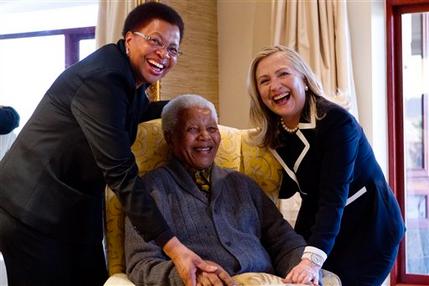
Graça Machel, Nelson Mandela and Hillary Clinton

U.S. Secretary of State Hillary Rodham Clinton visited with Nelson Mandela at his home on Monday to pay her respects to the aging South African icon.

Clinton and a small group flew to the 94-year-old Mandela’s home village of Qunu, where they reminisced and had a small private lunch.

Clinton and Mandela’s wife, Graca Machel, talked as photographers snapped pictures and Mandela looked on smiling from his wingback chair.

“That’s a beautiful smile!” Clinton said.

“Madiba’s smile is a trademark,” Machel said, affectionately referring to Mandela by his Xhosa clan name.

Afterwards, Clinton, Machel and the others went into the main dining room for lunch. Mandela remained in the living room with his medical attendants.

The former president of South Africa has homes in Johannesburg and Qunu. In recent years, he has spent more and more time in Qunu and in May, it was announced that he would stay there indefinitely.

Mandela, a Nobel peace laureate who spent 27 years in prison for fighting racist white rule, has retired from public life. – Associated Press

Clive Derby-Lewis to apply for medical parole

Former Conservative Party MP Clive Derby-Lewis will apply for medical parole because he is ill, his wife Gaye Derby-Lewis told Eyewitness News on Monday.

She planned to file the papers in the next few weeks and hoped the attempt would succeed as her husband was suffering from cancer and from gangrene in one leg.

This was the first time Derby-Lewis would apply for medical parole. He was denied normal parole last year.

The leader of the apartheid-era Conservative Party, and an MP, Derby-Lewis was sentenced to 25 years in prison for his part in the murder of SA Communist Party general secretary Chris Hani in 1993.

He arranged a firearm for triggerman Janusz Walus, who is serving the same prison term.

Both were initially sentenced to death. This was commuted to life in prison after the abolition of the death penalty.

Derby-Lewis is 76-years-old. – Sapa

Sign the petition for his release here.