The job that Americans were destined to do: get paid to eat a lot of food while other people watch on the internet. Reuters is reporting on “gastronomic voyeurism,” a trend growing in popularity in South Korea.
34-year-old Park Seo-yeon used to work for a consulting firm but has left that job. Why? She’s earning more than $9,000 a month to eat on camera.
Going by the name, “The Diva,” she sits down to a table of food and eats for up to three hours. Her viewers chat with her and send her “virtual balloons,” which Reuters says, “translate into cash.”
So, what’s the deal? The Diva thinks it’s about enjoying something through someone else, “People enjoy the vicarious pleasure with my online show when they can’t eat that much, or don’t want to eat food at night, or are on a diet.”
One of The Diva’s fans, 26-year-old Park Sun-Young says it’s about approximating the feeling of having company. “It’s comforting for people who eat alone,” says Park.
Apparently, eating alone is something that is happening more and more in South Korea. Reuters points out that within 15 years, a third of the nation’s population could be comprised of one-person households, the fastest rate amongst developed countries.
The National Security Agency is involved in industrial espionage and will take intelligence regardless of its value to national security, the former NSA contractor Edward Snowden has told a German television network.
In a lengthy interview broadcast on the public broadcaster ARD TV on Sunday, Snowden said the NSA did not limit its espionage to issues of national security and cited the German engineering firm Siemens as one target.
“If there’s information at Siemens that’s beneficial to US national interests – even if it doesn’t have anything to do with national security – then they’ll take that information nevertheless,” Snowden said in the interview conducted in Russia, where Snowden has claimed asylum.
Regime gunmen assassinated celebrated Thai protest leader Sutin Taratin Sunday, during a brazen broad-daylight drive by shooting amid a melee between protesters and armed “red shirt” regime enforcers. Protests were held across the country at polling stations in opposition to advance voting.
Forty-five out of fifty polling stations were closed in Bangkok alone.
The assassination of Sutin Taratin came after the regime and its supporters made explicit threats of armed violence against any who opposed upcoming elections.
TIME magazine on January 16 reported in their article, “Bangkok Shutdown: Yingluck Supporters Prepare to Fight for Democracy,” that: “As Thailand’s anti-government protests enter their fourth day, observers say prospects for violent confrontation are increasing, with reports of government supporters stockpiling weapons in case of Prime Minister Yingluck Shinawatra’s ouster.
“According to the Bangkok Post, radical members of the Red Shirts — diehard champions of Yingluck and her notorious brother Thaksin Shinawatra — are readying a cache of arms in case the 46-year-old premier is forced from office by either military or judicial intervention.”
The paper quoted a Red Shirt source as saying “There are strong anti-coup and anti-court sentiments among the red-shirt mavericks who are familiar and experienced with weapon use.”
The very next day, the attacks began. The first was a grenade attack on peaceful marches lead by protest leader Suthep Thuangsuban, which killed one and injured 39. Suthep Thuangsuban was only 30 meters away from the blast, indicating it was a likely assassination attempt.
Protesters would then storm the abandoned building where the attack originated to uncover what appeared to be a weapons cache and a safehouse, just as TIME described.
Another twin grenade attack took place at Bangkok’s Victory Monument, along with nightly drive-by shootings up until the regime announced a “state of emergency” citing their own terror campaign as justification.
After a conversation with Chareon Laothamatas, president of Thai Rice Exporters Association, reporter Michael Yon notes:
“Many people realize by now that the rice scheme in Thailand, under Yingluck, is ravaging rice farmers and seriously damaging the economy. I had a long talk with Chareon this morning in his office. What he explained was even worse than what appears in the papers. In retrospect I should have requested to set up a video camera; what he said should be more widely heard. The devastation to that sector is long-term and could take years to regain Thai dominance in rice exports.
An important aspect of the devastation is that the quality of rice also has been damaged, reducing its value. For instance, for various reasons related and unrelated to the scheme, fragrant rice has been losing its fragrance.
Meanwhile, Chareon explained that India and Vietnam have taken the lead, but that India has its own rice scheme that could similarly wreck their progress, while Vietnam is the smartest with its plan.
And so now with millions of tons of rice still sitting in Thai warehouses, the first crop of 2014 is now starting to come in. Chareon’s suggestion was not to worry about the rice in the warehouses at this moment, but to move the new crop out the door and then get back to the stored rice, which he suggested should be used in the domestic market.
I asked if the rice farmers will fight the government if they are not paid. He said they will not fight so much right now because they are in their fields working to bring the first harvest in, which will be over in February. He said that if the farmers decide to do something serious, the post-harvest window of March-April is the most likely window.
I call these “farmers wars” – not that this is a war in Thailand. Farmers wars typically revolve around the crop cycles and seasons. Thailand — the world’s number one rice exporter — produces one-third of the world’s supply.
Eric Lawson, who portrayed the rugged Marlboro man in cigarette ads during the late 1970s, has died of a smoking-related disease. He was 72.
The Marlboro Man is the macho cowboy in the Old West. This is how Phillip Morris markets its Marlboro cigarattes.
The Marlboro Man was conceived by the advertising firm, Leo Burnett in 1954.
Well, the advertising campaigns worked successfully, at least in the past. Due to heightened antismoking sentiment and health concerns, the public living in developed countries no longer yearn to be the Marlboro Man.
Lawson died Jan. 10 at his home in San Luis Obispo of respiratory failure, his wife, Susan Lawson said Sunday.
Lawson later appeared in an anti-smoking commercial that parodied the Marlboro man and an “Entertainment Tonight” segment to discuss the negative effects of smoking. Susan said her husband was proud of the interview, even though he was smoking at the time.
“He knew the cigarettes had a hold on him,” she said. “He knew, yet he still couldn’t stop.”
A few actors and models who pitched Marlboro brand cigarettes have died of smoking-related diseases. They include David Millar, who died of emphysema in 1987, as well as Dick Hammer and David McLean, who both died of lung cancer.
Wayne McLaren, an American actor who portrayed The Marlboro Man in Marlboro’s advertisements in the 1970s, also died of lung cancer in 1992.
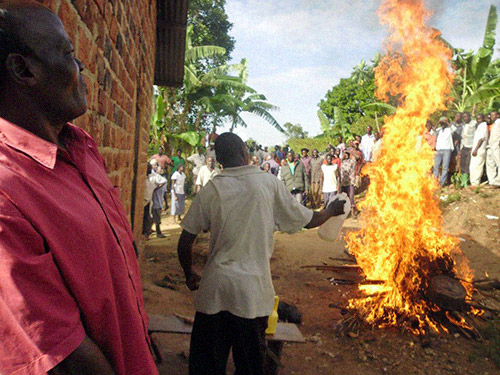
A teenage boy was shot during a protest in Bolobedu at the weekend — the sixth person to be killed by police this year, a spokesman said on Monday.
Saturday’s shooting comes after the body of a woman was found about 8km away in Mandlakazi, Brigadier Hangwani Mulaudzi said.
The woman was found on Friday with her hands cut off, and her cellphone and keys placed inside her open stomach. Two men were taken in for questioning on Saturday.
“While we were busy with the questioning, the community mobilised and went and started to burn the houses of those two men, including one house that belonged to the boyfriend of the deceased woman,” he said.
“During that time, police went in to try and stop them from burning those houses. It is alleged that during that moment, one of our members [officers] shot at the protesting villagers, which led to the death of a 15-year-old boy.”
Mulaudzi said police also received information that villagers were planning to mobilise and burn down a police satellite station on Sunday because of the shooting.
“But that did not happen because police intervened.”
Provincial police had since instructed that all police officers who were at the shooting scene on Saturday hand in their firearms.
Ballistic tests would be carried out to determine who shot the boy.
“We are still waiting for the results from the ballistic test. No officer has been suspended or arrested yet,” he said.
No villagers had been arrested for the mob justice, but a case of arson had been opened.
Mulaudzi said the two men who were questioned were later released as they could not be linked to the murder of the woman.
Police were presently searching for the woman’s boyfriend for questioning.
“We don’t know where he is at this point”.
The Independent Police Investigative Directorate was investigating the matter.
Since January, at least five others have been killed by police officers.
On January 13, a photographer and protester were killed in clashes with police in Brits during a protest for running water.
A third man died the following day from injuries sustained when jumping off a moving Nyala, according to police.
Police said a fourth person died on January 19 of injuries sustained in the clashes. Residents claim the 36-year-old man was shot in the head.
On January 23, a 28-year-old man was shot dead by a police officer during a protest in Durban Deep, Roodepoort, over housing.
The Arab Spring, and to a lesser extent the overthrow of Saddam Hussein, were touted as the catalysts for a major historic shift in the region. From Egypt to Syria to Iraq, the Middle East’s dictatorships would be succeeded by liberal, democratic regimes. Years later, however, there is very little liberality or democracy to show. Indeed, what these upheavals have bequeathed to history is a baleful, and barely noticed legacy: The near-annihilation of the world’s most ancient communities of Christians.
The persecution of Christians throughout the Middle East, as well as the silence with which it has been met in the West, are the subject of journalist Ed West’s Kindle Single “The Silence of Our Friends.” The booklet is a brisk and chilling litany of horrors: Discriminatory laws, mass graves, unofficial pogroms, and exile. The persecuted are not just Coptic and Nestorian Christians who have relatively few co-communicants in the West, but Catholics, Orthodox, and Protestants as well.
Throughout the Middle East the pattern is the same. Christians are murdered in mob violence or by militant groups. Their churches are bombed, their shops destroyed, and their homes looted. Laws are passed making them second-class citizens, and the majority of them eventually leave.
The world’s most ancient Christian communities are being destroyed.
In Egypt, a rumor that a Muslim girl was dating a Christian boy led to the burning of multiple churches, and the imposition of a curfew on a local Christian population. Illiterate children were held in police custody for urinating in a trash heap, because an imam claimed that pages quoting the Koran were in the pile and had been desecrated. Again, the persecution resulted in Christian families leaving their homes behind.
In Syria, the situation is even worse. In June 2013, a cluster of Christian villages was totally destroyed. Friar Pierbattista Pizzaballa reported that “of the 4,000 inhabitants of the village of Ghassanieh… no more than 10 people remain.”
Two Syrian bishops have been kidnapped by rebel groups. Militants expelled 90 percent of the Christians in the city of Homs. Patriarch Gregorios III of Antioch says that out of a population of 1.75 million, 450,000 Syrian Christians have simply fled their homes in fear.
In Iraq, the story is the same but more dramatic. According to West, between 2004 and 2011 the population of Chaldo-Assyrian Christians fell from over a million to as few as 150,000. In 2006, Isoh Majeed, who advocated the creation of a safe haven for Christians around Nineveh, was murdered in his home. The number of churches in Iraq has declined to just 57, from 300 before the invasion. The decline of Iraq’s Christian population since the first Gulf War is roughly 90 percent, with most of the drop occurring since the 2003 invasion.
The U.S. and the U.K. bear the responsibility in this catastrophe, since they oversaw the creation of Iraq’s postwar government and did little to protect minority faiths.
The clueless and callous behavior of Western governments in these episodes are obvious. U.S. reconstruction aid to Iraq is distributed according to Iraqi laws that discriminate against Christian Iraqis. The U.S. pours billions of foreign aid into Egypt, and yet the Christians in that country are not allowed to build churches (or even so much as repair toilets in them) without explicit permission from the head of state, almost never granted. Last September, the U.S and Britain attempted to make their support of Syrian rebel groups explicit and overt, but at the same time some of these militias were executing a pogrom against Christians.
A Christian shopkeeper in Ma’loula summed it up in a quote to the BBC: “Tell the EU and the Americans that we sent you Saint Paul 2,000 years ago to take you from the darkness, and you sent us terrorists to kill us.”
In an intelligence driven operation, members from the national Crime Intelligence office, the Organized Crime Unit in Johannesburg and a local dog unit arrested two men and recovered a rocket head last night.
Intelligence operatives responded to information that a sale of explosives was taking place in the Johannesburg Central Business District where they found a South African and a Mozambican seated in a grey Mercedes Benz. Upon searching the vehicle the head of a rocket, valued at approximately R8 million, was found.
While at the scene, our officers were attracted to a second vehicle, a double cab Colt bakkie which they searched and found three men carrying diamonds which are believed to be of foreign origin. The three men were taken in for questioning and the diamonds confiscated for now.
It is unknown at this stage if the two groups are related in any way.
The two suspects in connection with the rocket head is likely to appear in the Johannesburg Magistrates Court on Monday on charges of unlawful possession of explosives.
The investigation is continuing and more arrests are likely in connection with the rocket head.
Talking at a US Army demonstration of autonomous weaponized robots at Fort Benning, Georgia, experts said that “ten years from now, there will probably be one soldier for every 10 robots. Each soldier could have one or five robots flanking him, looking for enemies, scanning for land mines.”
Those are the words of Scott Hartley, co-founder of 5D Robotics, who demonstrated his companies’ machines along with Northrop Grumman, QinetiQ, HDT Robotics and other robotics corporations catering to the US military. Harley also added that “robots can save lives.” And indeed they can, helping soldiers survive in a hostile environment and making their lives easier. But, obviously, they are also making them to kill.
According to the organizers, the main core of the event were the live fire demonstrations:
The Armed UGV Live Fire Demonstration will provide selected technologies an opportunity to demonstrate their ability to remotely fire a M240 accurately at stationary targets. These are highly anticipated demonstrations which will draw significant interest from Soldiers and within the U.S. Army Research communities.
The systems that participated in the demo were both autonomous and remote controlled. The robots had to demonstrate their ability to accurately fire the M240 machine gun at targets 800 meters away.
US Army robots will outnumber human soldiers 10 to 1 by 2023
Other demonstrations included firing weapons like the M2 Browning 0.50cal machine gun, theMK19 grenade launcher or the FGM-148 Javelin, a “man-portable fire-and-forget anti-tank missile.”
We are not anywhere near having Terminators with artificial intelligence now. The initial implementations are mostly human-dependent, but we are certainly going in that direction.Talking to ComputerWorld, Lt. Col. Willie Smith—chief of Unmanned Ground Vehicles at Fort Benning—said that “robots allow [soldiers] to be more lethal and engaged in their surroundings. I think there’s more work to be done but I’m expecting we’ll get there.”
It’s true that military robots—both weaponized or support units—will protect soldiers. But they will also make war even more horrible by taking away the human life loss component. If we can send platoons made of robots to war, people will not fear death in wars. There will be no dead bodies getting home in flag-covered coffins. Like aerial drones, this will inevitably trivialize wars.
Is the American Federal Government into concert promotion?
Two members of the unusually lame Russian punk rock band Pussy Riot, who seem to have a unusually strong media promotion team behind them, were recently released from prison and will appear at an Amnesty International concert in Brooklyn February 5th, WNYC reports.
Nadezhda Tolokonnikova and Maria Alyokhina are scheduled to appear during the Bringing Human Rights Home concert at the Barclays Center in New York.
It is not certain which human right they had wished to defend when they were caught trespassing in a church in Moscow. The whole episode has an air of being manufactured, as if they might appear alongside the US Federal Turds next.
Musically it is hard to understand their large global following, but politically less so.
Tolokonnikova and Alyokhina were released from prison last month after serving 21 months for hooliganism after a March 2012 arrest for giving an unauthorized offensive performance in Christ The Savior Cathedral.
It is not known whether they might do an unauthorized offensive performance in front of the Federal Reserve.
Vaccines aren’t dangerous, according to Bill Gates. It’s the belief that they can cause autism that poses a serious threat to the health of children.
The 58-year-old billionaire philanthropist spoke to “AMERICA with Jorge Ramos” in an interview that will air on Tuesday.
“Nothing has saved more lives than vaccines, and nothing has been more disproven than any link between vaccines and negative things like autism,” Gates told Ramos.
The Bill and Melinda Gates Foundation released its annual letter on Tuesday, with Gates outlining his vision for eradicating the world’s worst poverty in the next 20 years.
Global health initiatives and vaccines are a major part of achieving that goal. The foundation website says that “vaccines are among the most cost-effective investments in global health, saving about 2.5 million lives each year.”
Gates spoke with Ramos about his foundation’s investment in research to create a thinner, stronger condom. The foundation awarded more than $1 million in grants toward the goal in November.
“The common analogy is that wearing a condom is like taking a shower with a raincoat on,” Dr. Papa Salif Sow, a senior program officer on the HIV team at the Gates Foundation told The New Republic at the time of the announcement. “A redesigned condom that overcomes inconvenience, fumbling, or perceived loss of pleasure would be a powerful weapon in the fight against poverty.”
Ramos asked Gates why he decided to experiment with improving condoms.
“In general, if women want to have contraception, we think it should be available to them,” Gates said on Tuesday. “So whatever new ideas there are to make it more convenient, less side effects…we’re a big funder of innovation in that area, as well.”
Zurich air traffic controllers may have inadvertently succeeded where diplomats have failed for decades: to bring Israelis and Iranians together.
As the jets of Iranian President Hassan Rouhani and Israeli Prime Minister Benjamin Netanyahu arrived in Switzerland today to take their leaders to the World Economic Forum, their planes were parked side-by-side under cloudy skies.
Rouhani, the first Iranian leader in a decade to visit Davos for the World Economic Forum, will be looking for deals to boost an economy that shrank more than 5 percent in the last fiscal year through March under the weight of international sanctions. He’s due to address the forum in the ski resort tomorrow during a session called “Iran in the World.”
Netanyahu, among the most outspoken critics of the Iranian government, is seeking to keep the sanctions in place. He has called Rouhani a “wolf in sheep’s clothing” and urged the world to be wary of his “charm offensive.”
Africa’s oldest leader, president Robert Mugabe from Zimbabwe, appeared in public again after he had not been seen for weeks
Mugabe, who turns 90 on February 21, spoke at the burial of his younger sister Bridget.
Belying recent rumours of ill health and even death, he spoke for an hour at a graveside in Zvimba, some 100km west of the capital Harare.
The old ruler who wiped out his political oppostion in a genocide in the 1980’s, is now the only survivor among six siblings. Bridget died in hospital on Saturday, aged 78.
“Zimbabwe’s land, its natural resources, belong to the people of Zimbabwe,” Mugabe eulogized.
“It is a relationship which is natural, God-given and which makes you owners of your wealth and therefore masters of your destiny,” he said.
The poverty-stricken people of the former Rhodesia is being ransacked by criminal mobs, aided by Mugabe, in the Marenge diamond fields, a scenario often seen in Africa and portrayed in the film The Ambassador (2011).
In the film, a Danish journalist uncovers chilling corruption linked to diplomatic title brokerage and blood diamonds in the CAR. Observers say it is similar to what is happening in Zimbabwe.
“Sure, we will need partners, but we need partners who do not become our masters,” Mugabe said at the funeral.
Mugabe’s health has been the subject of speculation in recent years, with some media suggesting he sought medical treatment in countries including Malaysia and Singapore.
More than a dozen family members of China’s top political and military leaders are making use of offshore companies based in the British Virgin Islands, leaked financial documents reveal.
The brother-in-law of China’s current president, Xi Jinping, as well as the son and son-in-law of former premier Wen Jiabao are among the political relations making use of the offshore havens, financial records show.
The documents also disclose the central role of major Western banks and accountancy firms, including PricewaterhouseCoopers, Credit Suisse and UBS in the offshore world, acting as middlemen in the establishing of companies.
The Hong Kong office of Credit Suisse, for example, established the BVI company Trend Gold Consultants for Wen Yunsong, the son of Wen Jiabao, during his father’s premiership — while PwC and UBS performed similar services for hundreds of other wealthy Chinese individuals.
The disclosure of China’s use of secretive financial structures is the latest revelation from “Offshore Secrets”, a two-year reporting effort led by the International Consortium of Investigative Journalists (ICIJ), which obtained more than 200 gigabytes of leaked financial data from two companies in the British Virgin Islands, and shared the information with the Guardian and other international news outlets.
In all, the ICIJ data reveals more than 21,000 clients from mainland China and Hong Kong have made use of offshore havens in the Caribbean, adding to mounting scrutiny of the wealth and power amassed by family members of the country’s inner circle.
As neither Chinese officials nor their families are required to issue public financial disclosures, citizens in the country and abroad have been left largely in the dark about the elite’s use of offshore structures which can facilitate the avoidance of tax, or moving of money overseas. Between $1tn and $4tn in untraced assets have left China since 2000, according to estimates.
Income inequality is a mounting issue in China, a consequence of the country’s rapid growth. A Beijing university study suggests that income at the richest 5th percentile are 34 times higher than those of the bottom 5th percentile.
China’s rapid economic growth is leading to a degree of internal tension within the nation, as the proceeds of the country’s newfound prosperity are not evenly divided: the country’s 100 richest men are collectively worth over $300bn, while an estimated 300m people in the country still live on less than $2 a day. The Chinese government has made efforts to crack down citizens’ movements aimed at promoting transparency or accountability among the country’s elite.
Source: The Guardian
This website uses cookies to improve your experience. We'll assume you're ok with this, but you can opt-out if you wish. Cookie settingsACCEPT
Privacy & Cookies Policy
Privacy Overview
This website uses cookies to improve your experience while you navigate through the website. Out of these cookies, the cookies that are categorized as necessary are stored on your browser as they are essential for the working of basic functionalities of the website. We also use third-party cookies that help us analyze and understand how you use this website. These cookies will be stored in your browser only with your consent. You also have the option to opt-out of these cookies. But opting out of some of these cookies may have an effect on your browsing experience.
Necessary cookies are absolutely essential for the website to function properly. This category only includes cookies that ensures basic functionalities and security features of the website. These cookies do not store any personal information.
Any cookies that may not be particularly necessary for the website to function and is used specifically to collect user personal data via analytics, ads, other embedded contents are termed as non-necessary cookies. It is mandatory to procure user consent prior to running these cookies on your website.


 The job that Americans were destined to do: get paid to eat a lot of food while other people watch on the internet. Reuters is reporting on “gastronomic voyeurism,” a trend growing in popularity in South Korea.