The 56-year-old Pennsylvania man received an online money transfer from PayPal on Friday, making his balance more than $92 quadrillion. Reynolds, who spends around $100 per month on the site, was shocked.
“I’m just feeling like a million bucks,” Reynolds told the Philadelphia Daily News. “At first, I thought that I owed quadrillions. It was quite a big surprise.”
In a monthly statement from PayPal, Reynold’s account had an ending balance of $92,233,720,368,547,800. But when he logged onto his PayPal account, he saw his balance listed as $0, correcting the balance error. Still, the Delaware County man said he would have been responsible with the cash.
“I would pay the national debt down first. Then I would buy the Phillies, if I could get a great price,” he told the United Press International. He did manage to donate $30 to the Democratic candidate for Delaware County Council, Reynolds said. “I was moved to be really generous by good fortune.”
The father of three said he has been a loyal PayPal customer for 10 years, using the site to buy and sell items on eBay, including vintage car parts. A PayPal spokeswoman said she could not comment on the incident since it would violate the site’s privacy policies.
Soon after receiving the news, Reynold received another notice from PayPal. “The sad part is that I got word that they still need me to renew the credit card that’s attached to this account,” he said. “So, even though I have 90 quadrillion dollars, they still don’t trust me.” – ibtimes.com
The Central Intelligence Agency is funding a scientific study that will investigate whether humans could use geoengineering to alter Earth’s environment and stop climate change. The National Academy of Sciences (NAS) will run the 21-month project, which is the first NAS geoengineering study financially supported by an intelligence agency. With the spooks’ money, scientists will study how humans might influence weather patterns, assess the potential dangers of messing with the climate, and investigate possible national security implications of geoengineering attempts.
The total cost of the project is $630,000, which NAS is splitting with the CIA, the National Oceanic and Atmospheric Administration, and NASA. The NAS website says that “the US intelligence community” is funding the project, and William Kearney, a spokesman for NAS, told Mother Jones that phrase refers to the CIA. Edward Price, a spokesman for the CIA, refused to confirm the agency’s role in the study, but said, “It’s natural that on a subject like climate change the Agency would work with scientists to better understand the phenomenon and its implications on national security.” The CIA reportedly closed its research center on climate change and national security last year, after GOP members of Congress argued that the CIA shouldn’t be looking at climate change.
The goal of the CIA-backed NAS study is to conduct a “technical evaluation of a limited number of proposed geoengineering techniques,” according to the NAS website. Scientists will attempt to determine which geoengineering techniques are feasible and try to evaluate the impacts and risks of each (including “national security concerns”). One proposed geoengineering method the study will look at is solar radiation management—a fancy term for pumping particles into the stratosphere to reflect incoming sunlight away from the planet. In theory, solar radiation management could lead to a global cooling trend that might reverse, or at least slow down, global warming. The study will also investigate proposals for removing carbon dioxide from the atmosphere.
The National Academies has held two previous workshops on geoengineering, but neither was funded by the intelligence community, says Edward Dunlea, the study director for the latest project. The CIA would not say why it had decided to fund the project at this time, but the US government’s apparent interest in altering the climate isn’t new. The first big use of weather modification as a military tactic came during the Vietnam War, when the Air Force engaged in a cloud seeding program to try to create rainfall and turn the Ho Chi Minh Trail into muck, and thereby gain tactical advantage. Between 1962 and 1983, other would-be weather engineers tried to change the behavior of hurricanes using silver iodide. That effort, dubbed Project Stormfury, was spearheaded by the Navy and the Commerce Department. China’s “Weather Modification Office” also controversially seeded clouds in advance of the 2008 Beijing Olympics, hoping to ensure rain would fall in the Beijing suburbs instead of over the Olympic stadiums.
Although previous efforts to manipulate weather and climate have often been met with mockery, many geoengineering proposals “are fundamentally doable, relatively cheap, and do appear to be able to reduce climate risk significantly, but with risks,” explains David Keith, a Harvard researcher and top geoengineering proponent.
But if geoengineering is cheap and “fundamentally doable,” as Keith claims, that suggests foreign countries, or even wealthy individuals, could mess with the climate to advance their own ends. “This whole issue of lone actors: Do we need to be concerned about China acting unilaterally? Is that just idle chatter, or is that something the US government should prepare for?” asks Ken Caldeira, a geoengineering researcher at the Carnegie Institution’s Department of Global Ecology and a member of the current National Academy of Sciences panel.
At least one individual has already tried modifying the climate. Russ George, the former head of Planktos, a company that works to develop technology to deal with global warming, seeded the Pacific Ocean off western Canada with iron to generate a plankton bloom that, in turn, was supposed to suck up carbon dioxide from the air. George’s effort was widely condemned, but at present there’s little to stop other individuals or countries from trying it or something similar. That’s part of what has the US intelligence community interested.
The CIA’s decision to fund scientific work on geoengineering will no doubt excite conspiracy theorists. The last time the government tried to do cutting-edge research related to the atmosphere—with the High Frequency Active Auroral Research Program (HAARP), which aimed to protect satellites from nuclear blasts—people speculated that it might be a death ray, a mind control weapon, or, worst of all…a way to control the weather. – Mother Jones
When the Obama administration discusses matters of sensitive diplomacy, it isn’t always a model of clarity.
But this week reporters have struggled to get a direct answer to what would seem to be a simple question: Is President Barack Obama still planning to attend a summit meeting with Russian President Vladimir Putin in Moscow in early September?
What’s become increasingly evident is the planned summit meeting is now entangled in the delicate negotiations between Messrs. Obama and Putin over the fate of former NSA contractor Edward Snowden.
Let’s back up to mid-June.
Mr. Obama was in Northern Ireland, meeting with various counterparts, including Mr. Putin. The two men held a private session, at which they agreed to take part in a summit meeting in Moscow prior to a separate Group of Twenty meeting in St. Petersburg, Russia.
Ben Rhodes, deputy national security adviser for strategic communications, said in a press briefing at the time: “So we’ll be going to Moscow before we go to St. Petersburg for the G-20.”
But the following week, Mr. Snowden left his hiding place in Hong Kong and showed up in Russia. Since then, the Obama administration has been imploring Russia to return Mr. Snowden to the U.S. to face criminal charges. So far, Mr. Putin hasn’t complied.
Now the summit may be a casualty of the Snowden negotiations.
In his daily briefings this week, White House Press Secretary Jay Carney has been giving careful answers to questions about whether the Obama-Putin summit is still on.
On Wednesday, he was asked if Russia’s handling of the Snowden case has any bearing on Mr. Obama’s decision to attend the scheduled summit meeting with Mr. Putin.
Mr. Carney replied that “the president intends to travel to Russia for the G20 Summit. And I have no further announcements to make beyond what we’ve said in the past about the President’s travel to Russia in the fall.”
Can he definitively say whether Mr. Obama will go to Moscow?
“I can say that the president intends to travel to Russia for the G20 Summit. I don’t have anything to add to what we’ve said in the past about that trip,” Mr. Carney said.
Later in the briefing, another reporter asked him to clarify that answer.
Mr. Carney replied that he “might have been deliberately vague, so I’m not sure I can clarify.”
He went on to say that “I have no further announcements on our travel to Russia. The President intends to go to Russia in September.”
“But you won’t say Moscow?” the reporter said.
“I just have nothing else to say on it,” Mr. Carney said.
All this seems to leave open the possibility that Mr. Obama might call off the summit. In any case, the White House statements may be a signal to Moscow that Mr. Snowden’s status and the summit’s future are now linked, one foreign policy expert said.
“I do think it is a signal,” said Heather Conley, director of the Europe Program at the Center for Strategic & International Studies.
The White House, she said, is “having to rethink [the Moscow summit] right now. This is going to be a very fluid situation.” – WSJ
According to author and Fox News contributor Deneen Borelli and her husband, Tom Borelli, black conservatives have been blacklisted from the NAACP’s national conferences for years. When the Borellis, who are employees of the conservative group FreedomWorks, attempted to pay for booth space at this year’s 104th National NAACP conference in Florida, they were told there was no room for them despite plenty of exhibit space remaining open.
The NAACP website states that the mission of the organization is to, “ensure the political, educational, social, and economic equality of rights of all persons and to eliminate race-based discrimination.” The objectives of the NAACP include ensuring “the political, educational, social, and economic equality of all citizens,” and removing “all barriers of racial discrimination through democratic processes.”
Mrs. Borelli has been an outspoken critic of the Obama administration and the Democratic Party. In March her book, Blacklash: How Obama and the Left Are Driving Americans to the Government Plantation, came out in paperback. – Townhall.com
A former SA Defence Force surgeon general has refused to divulge details of meetings and discussions he had with former president Nelson Mandela.
Dr Niel Knobel told Wouter Basson’s unethical conduct hearing at the Health Professions Council of South Africa (HPCSA) on Wednesday there was information he could not disclose as it was top secret.
“I may not refer to documents that are top secret and that could jeopardise South Africa’s position internationally, as well as compromise … Mandela.
“Please understand my position as an officer who retains my ranks until the day I die and my commission stands. I am not going to jeopardise it and I’m certainly not going to make any remarks about [former] president Mandela,” Knobel said.
The council’s professional conduct committee is holding a hearing into allegations of unethical conduct against Basson, a Cape Town cardiologist.
Earlier, Knobel said he had meetings with Mandela and noted there was a lot of interest among the South African Defence Force (SADF) members when he returned from the meetings, wanting to know what they had discussed.
An affidavit made by Knobel during the Truth and Reconciliation Commission proceedings was presented before the committee.
The affidavit is a statement regarding the chronology of events around the SADF’s chemical and biological weapons programme, with special reference to Basson’s role.
Cross-border kidnappings
Knobel argued that he could not give evidence on the affidavit as some of the appendices which were supposed to be attached to it were not available.
The charges against Basson arise from his involvement in the apartheid government’s chemical and biological warfare programme in the 1980s and early 1990s.
He is accused of acting unethically by being involved in the large-scale production of Mandrax, cocaine and teargas, of weaponising teargas, and of supplying it to Angola’s Unita rebels leader Jonas Savimbi.
Basson is also accused of acting unethically by providing disorientating substances for cross-border kidnappings, and making cyanide capsules available for distribution to operatives for use in committing suicide.
In 2002, Basson was acquitted by the North Gauteng High Court of criminal charges arising from his conduct.
The HPCSA reviewed the judgment to establish if there were grounds to continue with an inquiry against him.
The state appealed the high court decision in the Supreme Court of Appeal, but the appeal was dismissed. The state then went to the Constitutional Court to appeal the decision. That was also dismissed in September 2005.
Unlawful and biased
In 2006, the HPCSA started its own process of investigating Basson’s conduct. A charge sheet was drawn up and the inquiry began in November 2007.
However, the inquiry was delayed when the HPCSA’s main expert witness fell ill. The inquiry resumed again in September 2008.
During the November 2008 hearing, Basson’s lawyers argued that the case brought against him was unlawful and biased.
Basson’s legal team then went to the High Court in Pretoria to stop the inquiry. The matter was heard in the high court in 2010. The court dismissed Basson’s application in May 2010. The next month, Basson appealed the decision in the same court, but lost.
The hearing then resumed officially in September 2011. In January 2012, Basson brought another application before the HPCSA’s professional conduct committee to dismiss the matter. However, this application was also dismissed.
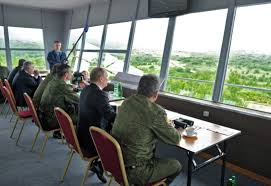
Russia is in the midst of its biggest war games since Soviet times, with 160,000 troops, 130 planes, 70 ships and thousands of tanks and armored vehicles participating in the country’s Far East, according to media reports.
Russian President Vladimir Putin ordered the drills last Friday and they began that night, according to reports from the RIA Novosti news agency. Putin flew to Sakhalin island off the eastern coast to oversee the games on Tuesday, Russia’s presidential press service reported.
“The main purpose of the activities is to check the readiness of the military units to perform assigned tasks and evaluate of the level of personnel’s training and technical preparation as well as the level of equipment of units with arms and military equipment,” the Russian Defense Ministry said in a statement reported by Russian Television.
“The Sakhalin part of the maneuvers was intended to simulate a response to a hypothetical attack by Japanese and U.S. forces,” Konstantin Sivkov, who is retired from the Russian military’s General Staff, told the Nezavisimaya Gazeta newspaper, according to a report from the BBC.
But Russia’s deputy defense minister, Anatoly Antonov, said the games were designed to “enhance the army’s combat readiness” and were not directed against any specific nations, the BBC reported.
Some of the units involved in the exercises moved more than 3,000 kilometers (1,800 miles) from their bases to participate, according to the Russian media reports.
The current drills, which are expected to last through the week, are the latest in a series of snap exercises conducted by the Russian military this year, Russian Television reported. Similar drills have been conducted in the country’s west, south and central military districts, the report said. – CNN
Nelson Mandela has made “dramatic progress,” and may be going home “anytime soon,” said his daughter Zindzi on the eve of his 95th birthday.
“I visited him yesterday and he was watching television with headphones,” said Zindzi Mandela in an interview with Britain’s Sky TV. “He gave us a huge smile and raised his hand … He responds with his eyes and his hands.”
Mandela is gaining “energy and strength,” said his daughter. “I should think he will be going home anytime soon.”
The latest description by Zindzi – who is one of Mandela’s daughters by his second wife, Winnie Madikizela-Mandela – is a significant improvement from court documents filed by the family earlier this month which said he was on life support and near death.
Mandela has been in a Pretoria hospital since June 8 and officials say his condition is critical but stable.
The news of the improvement in Mandela’s health will boost his supporters in South Africa and around the world who are preparing to celebrate his 95th birthday on Thursday, a day declared by the United Nations as a way to recognize the Nobel Prize winner’s contribution to reconciliation.
Interest in Nelson Mandela International Day has ignited as a result of the former South African president’s hospitalization in Pretoria and people find ways to honor his ideals.
A Johannesburg-based foundation named after Mandela and numerous other groups have asked people to volunteer 67 minutes to charity to match what they say are the 67 years that Mandela served his community. Mandela led South Africa through a tense transition from apartheid to democracy and became president in the country’s first all-race elections in 1994.
President Jacob Zuma will mark the birthday by overseeing the donation of houses to poor white families in the Pretoria area, in line with his Cabinet’s theme to commemorate Mandela’s birthday this year by focusing on food security, shelter and literacy.
In Cape Town, labor activists are holding an event at St. George’s Cathedral on Thursday, in remembrance of Mandela’s years of service and to encourage people to donate food to charity while leaving messages of support for the former leader’s family.
Mandela, who is in critical but stable condition, has been hospitalized since June 8, and hundreds of well-wishers have left prayers and messages of hope at his Johannesburg home and at the hospital where he is being treated. Legal documents have said Mandela’s breathing is machine-assisted.
The anti-apartheid leader has also inspired artists and graphic designers who celebrate his life through paintings and posters.
A group of young South African designers created a poster project to offer a global perspective of Mandela with submissions from around the world. The group whittled down 700 posters submitted by designers from more than 70 countries, to 95 for each day of Mandela’s life.
The posters will be unveiled Wednesday and a single special edition auctioned off to raise money for a proposed children’s hospital that will be named after Mandela, the group said.
“He carries across this concept of humanity and selflessness,” said Mohammed Jogie, co-founder of the project.
South African artists John Adams and Paul Blomkamp have painted two of the largest Mandela paintings to honor the man who spent 27 years imprisoned during the system of white minority rule known as apartheid.
Blomkamp said his painting was inspired by Mandela’s energy, which he described as exceptional. Blomkamp said an image of his painting will be featured in a display in New York’s Times Square Thursday in honor of Mandela’s birthday. SAPA/AP
African Americans benefit from Florida’s “Stand Your Ground” self-defense law at a rate far out of proportion to their presence in the state’s population, despite an assertion by Attorney General Eric Holder that repealing “Stand Your Ground” would help African Americans.
Black Floridians have made about a third of the state’s total “Stand Your Ground” claims in homicide cases, a rate nearly double the black percentage of Florida’s population. The majority of those claims have been successful, a success rate that exceeds that for Florida whites.
Nonetheless, prominent African Americans including Holder and “Ebony and Ivory” singer Stevie Wonder, who has vowed not to perform in the Sunshine State until the law is revoked, have made “Stand Your Ground” a central part of the Trayvon Martin controversy.
Holder, who was pressured by the National Association for the Advancement of Colored People (NAACP) and other progressive groups to open a civil rights case against acquitted neighborhood watchman George Zimmerman in the 2012 shooting death of 17-year-old Martin, criticized Florida’s “Stand Your Ground” self-defense law in a speech Tuesday before the NAACP.
The law was not invoked by Zimmerman’s defense team but was included in instructions to the jury.
“We must confront the underlying attitudes, the mistaken beliefs and the unfortunate stereotypes that serve too often as the basis for police action and private judgments. Separate and apart from the case that has drawn the nation’s attention, it’s time to question laws that senselessly expand the concept of self-defense and sow dangerous conflict in our neighborhood,” Holder said to applause in his speech before the NAACP Tuesday.
“These laws try to fix something that was never broken. There has always been a legal defense for using deadly force if — and the ‘if’ is important — if no safe retreat is available. But we must examine laws that take this further by eliminating the common-sense and age-old requirement that people who feel threatened have a duty to retreat, outside their home, if they can do so safely. By allowing and perhaps encouraging violent situations to escalate in public, such laws undermine public safety,” Holder said.
“The list of resulting tragedies is long and, unfortunately, has victimized too many who are innocent. It is our collective obligation; we must stand OUR ground to ensure — (cheers, applause, music) — we must stand our ground to ensure that our laws reduce violence, and take a hard look at laws that contribute to more violence than they prevent,” Holder said.
But approximately one third of Florida “Stand Your Ground” claims in fatal cases have been made by black defendants, and they have used the defense successfully 55 percent of the time, at the same rate as the population at large and at a higher rate than white defendants, according to a Daily Caller analysis of a database maintained by the Tampa Bay Times. Additionally, the majority of victims in Florida “Stand Your Ground” cases have been white.
African Americans used “Stand Your Ground” defenses at nearly twice the rate of their presence in the Florida population, which was listed at 16.6 percent in 2012. – dailycaller.com
Attorneys for the Electronic Frontier Foundation (EFF, not to be confused with Julius Malema’s Economic Freedom Fighters) have sued the Obama administration and are demanding the White House stop the dragnet surveillance programs operated by the National Security Agency.
Both the White House and Congress have weighed in on the case of Edward Snowden and the revelations he’s made by leaking National Security Agency documents. Now the courts are having their turn to opine, and with opportunities aplenty.
Day by day, new lawsuits waged against the United States government are being filed in federal court, and with the same regularity President Barack Obama and the preceding administration are being charged with vast constitutional violations alleged to have occurred through the NSA spy programs exposed by Mr. Snowden.
The recent disclosures made by Snowden have generated commotion in Congress and the White House alike. The Department of Justice has asked for the 30-year-old former Booz Allen Hamilton worker to be extradited to the US to face charges of espionage, and members of both the House and Senate have already held their share of emergency hearings in the wake of Snowden’s series of disclosures detailing the vast surveillance programs waged by the US in utmost secrecy. But with the executive and legislative branches left worrying about how to handle the source of the leaks — and if the policies publicized should have existed in the first place — the courts could soon settle some disputes that stand to shape the way the US conducts surveillance of its own citizens.
Both longstanding arguments and just-filed claims have garnered the attention of the judicial branch in the weeks since the Guardian newspaper first began publishing leaked NSA documents attributed to Snowden on June 6. But while the courts have relied previously on stalling or stifling cases that challenge Uncle Sam’s spy efforts, civil liberties experts say the time may be near for some highly anticipated arguments to finally be heard. Now on the heels of lawsuits filed by the likes of the American Civil Liberties Union and the Electronic Privacy Information Center, groups are coming out of the woodwork to wage a legal battle against the White House.
The most recent example came this week when a coalition of various organizations filed suit together against the Obama administration by challenging “an illegal and unconstitutional program of dragnet electronic surveillance, specifically the bulk acquisition, collection, storage, retention and searching of telephone communications information.” Represented by attorneys from the EFF and others, the plaintiffs in the latest case filed Tuesday in San Francisco federal court include an array of groups, such as: First Unitarian Church of Los Angeles; Bill of Rights Defense Committee; Calguns Foundation; California Association of Federal Firearms Licensees; Council on Islamic Relations; Franklin Armory; Free Press; Free Software Foundation; Greenpeace; Human Rights Watch; Media Alliance; National Organization for the Reform of Marijuana Laws; Open Technology Institute; People for the American Way, Public Knowledge; Students for Sensible Drug Policy; TechFreedom; and Unitarian Universalist Service Committee.
Cindy Cohn, the legal director of the EFF, told the Washington Post that the NSA leaks credited to Snowden have been a “tremendous boon” to the plaintiffs in recently filed court cases challenging the surveillance state. The courts are currently pondering at least five important cases, Cohn told the Post, which could for once and for all bring some other issues up for discussion.
Since June 6, the American Civil Liberties Union, a Verizon Wireless customer and the founder of conservative group Judicial Watch have all filed federal lawsuits against the government’s collection of telephony metadata, a practice that puts basic call records into the government’s hands without a specific warrant ever required and reported to the media by Mr. Snowden. Larry Klayman of Judicial Watch has also sued over another revelation made by Snowden — the PRISM Internet eavesdropping program — and the Electronic Privacy Information Center, or EPIC, has asked the Supreme Court to vacate the order compelling Verizon Business Network Services to send metadata to the feds.
Perhaps most important, however, is a California federal court’s recent decision to shutdown the government’s request to stop the case of Jewel vs. NSA from proceeding. That debate first began in 2008 when Jewel, a former AT&T customer, challenged the government’s “illegal and unconstitutional program of dragnet communications surveillance” as exposed by a whistleblower at the telecom company. That case has seen roadblock after roadblock during the last five years, but all that changed earlier this month. The government long argued that Jewel v. NSA can’t go up for discussion because the issues at hand are privileged as ‘state secrets’ and can’t be brought into the public realm.
“[T]he disclosure of sensitive intelligence sources and methods . . . reasonably could be expected to cause exceptionally grave harm to national security,” the government wrote in one earlier filing. “The very purpose of these cases is to put at issue whether the NSA undertook certain alleged activities under presidential authorization after 9/11, and whether those activities continue today. At every stage, from standing to the merits, highly classified and properly privileged intelligence sources and methods are at risk of disclosure. The law is clear, however, that where litigation risks or requires the disclosure of information that reasonably could be expected to harm national security, dismissal is required.”
Following Snowden’s recent disclosures, though, Judge Jeffrey White of the Northern District of California ruled on July 8 that there’s a way for those cases to still be heard.
“The court rightly found that the traditional legal system can determine the legality of the mass, dragnet surveillance of innocent Americans and rejected the government’s invocation of the state secrets privilege to have the case dismissed,” the EFF’s Cohn, who is working on the case, said in a statement issued at the time of the ruling. “Over the last month, we came face-to-face with new details of mass, untargeted collection of phone and Internet records, substantially confirmed by the Director of National Intelligence. Today’s decision sets the stage for finally getting a ruling that can stop the dragnet surveillance and restore Americans’ constitutional rights.”
Weighing in weeks later to the Post, Cohn said that outcome could have more of an impact than many might imagine. “It’s tremendous, because anything that allows these cases to proceed is important,” she said.
Speaking to the New York Times this week, American Civil Liberties Union attorney Jameel Jaffer said that until now the government has operated a “shell game” to shield it’s surveillance programs from litigation. “[T]he statute has been shielded from judicial review, and controversial and far-reaching surveillance authorities have been placed beyond the reach of the Constitution,” he said.
Should Cohn’s prediction come true, though, the courts could decide to weigh in and reshape the way the government currently conducts surveillance.
According to University of Pittsburgh law professor Jules Lobel, a victory there could come in more than one way. “There is a broader function to these lawsuits than simply winning in court,” he told the Post. “The government has to respond, and forcing them to go before a court might make them want to change aspects of the programs.”
“The government does things to avoid embarrassment,’’ he added, “and lawsuits are a key pressure point.’’
Interviews to the Post and the Times come just days after Sen. Ron Wyden (D-Oregon), a long-time member of the Senate Intelligence Committee, said he thought the revelations made by Snowden may influence the White House to reconsider their surveillance practices before the courts can even have their chance.
“I have a feeling that the administration is getting concerned about the bulk phone records collection, and that they are thinking about whether to move administratively to stop it,” Sen. Wyden told the Times.
A Marine who was fined and demoted for urinating on Taliban corpses in Afghanistan in 2011 says he would do it again.
“I regret maybe any repercussions it might have had on the Marines. But do I regret doing it? Hell no,” Sgt. Joseph Chamblin told WSOC-TV in Charlotte, N.C., adding that he would do it again.
The infamous incident was videotaped and uploaded to YouTube last year, becoming international news and raising fears of retaliation by Afghan troops against their coalition trainers.
“These were the same guys that were killing our family, killing our brothers,” said Sgt. Chamblin, who was on a mission to stop Taliban insurgents from making roadside bombs.
One of his sniper team members, Sgt. Mark Bradley, was killed by a buried bomb days before the incident.
“We’re human,” he said. “Who wouldn’t if you lost your brother or mother? Wouldn’t you want revenge?”
Sgt. Chamblin said he didn’t consider endangering other troops by the act, but considered the psychological effect it would have on the enemy “because if an infidel touches the body, they’re not going to Mecca or paradise.”
“So now these insurgents see what happens when you mess with us,” said Sgt. Chamblin, adding that he is planning to retire in September and is writing a book.
The Marines court-martialed nine troops for the incident. Sgt. Chamblin, a 15-year veteran, pleaded guilty for urinating on the bodies and dereliction of duty and was fined $500 and demoted, WSOC reported.
“Do you want the Marine Corps to be a group of Boy Scout pretty boys or do you want guys that will go out and kill the people trying to take advantage of your country and kill Americans?” he said. “Which do you want? Because you can’t have both.” – Washington Times
Goldman Sachs Group Inc (GS.N) said quarterly profit doubled, boosted by investment gains and a lower tax rate.
Lower taxes help Goldman Sachs
Goldman’s investing and lending segment, which tracks its investments in private equity deals, publicly traded stocks, loans and bonds, produced nearly seven times as much revenue in the second quarter as in the same period last year, much more than analysts expected.
Investors questioned how much revenue growth the bank can generate by investing its own capital under new regulations. The Volcker rule, part of the 2010 Dodd-Frank financial reform law, limits banks’ market wagers with their own money. But the industry has years to comply with the law, and Goldman believes most of its investing and lending activities already do.
Goldman’s effective tax rate dropped to 27 percent from 32 percent in part because the bank is electing to keep more of its international income permanently offshore, and because it earned more money overseas. Chief Financial Officer Harvey Schwartz told analysts on a conference call that the lower tax rate was not likely to be repeated.
“It’s tough to get too excited about these numbers because they’re potentially unsustainable,” said Tom Jalics, senior research analyst at Key Private Bank, whose clients own bank shares.
The results underscore the difficulties Goldman and its rivals face in navigating the post-crisis world. With regulators pressing banks to boost capital levels, many of Goldman’s most profitable businesses are earning less. The bank’s return on equity, a measure of how effectively it wrings profit from shareholders’ money, was just 10.5 percent in the second quarter, a hair above what it would pay for equity funding.
Overall, Goldman’s net income rose to $1.86 billion, or $3.70 per share, in the quarter, from $927 million, or $1.78 per share, a year earlier.
Analysts on average had expected $2.82 per share, according to Thomson Reuters I/B/E/S.
Net revenue rose 30 percent to $8.61 billion.
The biggest contributor to revenue was fixed income, currency and commodities (FICC) trading, which reflects trading with clients. Revenue there rose 12 percent to $2.46 billion.
Goldman’s results echoed similar trends in the investment banking units of JPMorgan Chase & Co (JPM.N) and Citigroup Inc (C.N), whose fixed-income trading businesses also benefited from improvements in trading and underwriting revenue in the second quarter. – Reuters
A prominent gay rights activist in Cameroon was tortured and killed just weeks after issuing a public warning about the threat posed by “anti-gay thugs,” Human Rights Watch said.
Friends discovered the body of Eric Ohena Lembembe at his home in the capital, Yaounde, on Monday evening after he was unreachable for two days, the rights group said in a statement Tuesday.
One friend said Lembembe’s neck and feet looked broken and that he had been burned with an iron.
Lembembe was among the most prominent activists in one of Africa’s most hostile countries for sexual minorities. First as a journalist and later as executive director of CAMFAIDS, a Yaounde-based human rights organization, he documented violence, blackmail and arrests targeting members of Cameroon’s gay community. He was also a regular contributor to the Erasing 76 Crimes blog, which focuses on countries where homosexuality is illegal, and he wrote several chapters of a book released in February on the global gay rights movement titled “From Wrongs to Gay Rights.”
Lembembe is the most high-profile African gay rights activist to be killed since 2011, a year that saw the deaths of Uganda’s David Kato and South African lesbian activist Noxolo Nogwaza.
Homosexuality is punishable by prison terms of up to five years in Cameroon, and the country prosecutes more people for gay sex than any other in sub-Saharan Africa, according to Human Rights Watch.
In a statement, a U.S. State Department deputy spokeswoman deplored Lembembe’s murder. “We condemn this terrible act in the strongest terms and urge the Cameroonian authorities to thoroughly and promptly investigate and prosecute those responsible for his death,” Marie Harf said.
Lembembe was among the first activists in the country to mobilize following a sharp increase in anti-gay prosecutions beginning in 2005, said Yves Yomb, executive director of Alternatives-Cameroon, a gay rights group based in Cameroon’s largest city, Douala. A local office of the group was set on fire June 26, Harf said in her statement. – AP
Ah, German hypocrisy! During the cold war, you marched waving “Ami, Go Home” placards, but still let us protect you against the Soviets. Now you moan self-righteously about the National Security Agency and GCHQ reading your emails and listening to your mobile phone. You don’t acknowledge that – unlike the US or the UK – you have had no domestic terror attack in the past 10 years. That’s because we gave you information to prevent them; guess where we got it? Anyway, your Federal Intelligence Service snoops as much as it can. Except it can’t do that much. Whereas we – oh yes, we scan! Could it be that you’re jealous?
That about sums up the American and British response to the uproar about alleged US and UK spying activities in Germany revealed by the whistleblower Edward Snowden.
Sorry, friends: things are not that simple. This topic touches on historical sensitivities here. Our grandparents’ generation feared the early-morning knock of the Gestapo. During the cold war, West and East Germans alike were aware that their divided country was crawling with spooks of all denominations. We recognised that mutually assured espionage helped prop up the bipolar balance of power. (It also made for some superb spy thrillers.) Still, no one misses the sombre paranoia, reinforced in and after the 1970s by the ramping up of West Germany’s domestic intelligence services in response to homegrown terrorism.
Germans who were born east of the Berlin Wall were careful to give the organs of the Staatssicherheit a wide berth. But it was only after the fall of the Wall in 1989, when the citizens who had brought down their government stormed the secret police’s headquarters and realised the full horror of the web woven by the Stasi: neighbours spying on neighbours; husbands spying on wives. Joachim Gauck, our current president, was the first head of the Stasi Archives, the government agency that, 20 years on, continues to painstakingly piece together a full record of East Germany’s surveillance of its citizens.
Yes, we Germans have better cause than many of our allies to abhor the secret state. It’s why we don’t like closed-circuit television cameras. It’s also why our constitutional court enshrined a fundamental right of data privacy, and declared it illegal for Germany to implement an EU directive on preventive data storage.
That said, we understand that our liberal societies have enemies – and we need some surveillance to protect ourselves and preserve our way of life. We remember that some of the September 11 attackers were based in Hamburg. Like you, we’ve done a lot since then to improve our domestic intelligence capabilities. We haven’t heard many complaints about our ability to co-operate, whether in Europe or in Afghanistan. And, fair enough, this story has become fodder for an opposition desperate to unseat a seemingly unbeatable chancellor.
Rattled at first, Angela Merkel snapped: “Friends don’t treat each other like this.” Now, with her standing in the polls unharmed, Ms Merkel is calling for an EU-wide data privacy initiative.
The truth of Mr Snowden’s allegations has yet to be proved; they remain disturbing. Germany a target on the level of Iraq and Afghanistan? 500m intercepts a month? Embassies and EU representations bugged? You could try harder to dispel our misgivings. For all we know, no abuse of power was involved. But it is surely clear the intelligence services wield an excess of power. And, as we know, “power corrupts; and absolute power corrupts absolutely”.
It is not always easy to understand where our British friends draw the line between freedom and security. But it was Barack Obama who vowed on May 23 to end the war on terror, quoting James Madison: “No nation can preserve its freedom in the midst of perpetual warfare.”
Tell us about it. The phrase “perpetual warfare” reminds Germans that the most influential theorist of war without end – and of an untrammelled executive – was Carl Schmitt, Hitler’s lawyer-in-chief. It’s time for all of us to turn back the tide of executive power.
The writer is a senior transatlantic fellow with the German Marshall Fund. Her article appeared in the Financial Times
In the 20-day period of the George Zimmerman trial, four black minors – three teens and a five-year-old boy – were gunned down in Chicago, according to Homicide Watch Chicago, a Chicago Sun-Times publication, which details every murder that takes place in the city.
On June 28, five-year-old Sterling Sims was killed in a double murder that also claimed the life of his mother, 31-year-old Chavonne Brown. Both were shot in their apartment, and police believe the motive was robbery.
On July 1, 16-year-old Antonio Fenner was gunned down on the sidewalk next to the body of a 32-year-old man who had gang ties. No arrests were made, and no suspects have been named. Fenner’s mother believes her son was in the wrong place at the wrong time, because no one in her family knew the other victim or what Fenner’s association was to him.
On July 3, 14-year-old Damani Henard was murdered outside a high school. His body was found next a bicycle.
On July 9, 15-year-old Ed Cooper was shot and killed while spending time with friends at the park. A gunman got out of a black van and began firing as the boys ran away. Cooper was shot in the street and continued running to a vacant lot where he died.
Zimmerman was charged with killing Trayvon Martin, an unarmed black teenager in Sanford, Fla., who was walking through a gated community on his way home from the convenience store. Zimmerman argued that he acted in self-defense.
The trial began on June 24 and ended on July 13 with Zimmerman’s acquittal. See more
This website uses cookies to improve your experience. We'll assume you're ok with this, but you can opt-out if you wish. Cookie settingsACCEPT
Privacy & Cookies Policy
Privacy Overview
This website uses cookies to improve your experience while you navigate through the website. Out of these cookies, the cookies that are categorized as necessary are stored on your browser as they are essential for the working of basic functionalities of the website. We also use third-party cookies that help us analyze and understand how you use this website. These cookies will be stored in your browser only with your consent. You also have the option to opt-out of these cookies. But opting out of some of these cookies may have an effect on your browsing experience.
Necessary cookies are absolutely essential for the website to function properly. This category only includes cookies that ensures basic functionalities and security features of the website. These cookies do not store any personal information.
Any cookies that may not be particularly necessary for the website to function and is used specifically to collect user personal data via analytics, ads, other embedded contents are termed as non-necessary cookies. It is mandatory to procure user consent prior to running these cookies on your website.


 The 56-year-old Pennsylvania man received an online money transfer from PayPal on Friday, making his balance more than $92 quadrillion. Reynolds, who spends around $100 per month on the site, was shocked.