Zimmerman family suspects Obama is tapping their phones

Robert Zimmerman
Robert Zimmerman

In a media appearance Tuesday morning, the brother of the recently acquitted George Zimmerman said that he and his family have concerns that the Obama administration is tapping their communications.

Appearing on Fox News, Robert Zimmerman said “We do have concerns and always have of having our phones tapped, having our phones listened to by the administration or whomever.”

“A lot of the things that we do are connecting in person—that’s how we’ve managed to stay hidden for so long. It’s kind of old school, but it works…We’re back to what we were doing in March of 2012, because it’s right in everybody’s mind right now.” he added, referring to staying safe in the wake of several threats and acts of violence related to last week’s “Not Guilty” decision.

Zimmerman’s brother also stated that the family is worried that the Department of Justice is being pressured by certain white special interest groups to open a federal investigation into the case.

“I think Eric Holder is being pressured by some groups who were calling for, initially, just an arrest. These same groups keep moving around the goal posts: the NAACP, Al Sharpton, the Rainbow Push Coalition with Jesse Jackson.” Zimmerman noted.

“First they wanted just a simple arrest and that’s it, have his fair day in court and whatever the verdict is, we’ll respect it. Then when the verdict was coming they wanted him to be found guilty. But the verdict isn’t what they wanted, so now they’re moving the goal post again, and calling on the Department of Justice to investigate him more.” the brother added.

“I understand the Justice Department’s responding to pressure,” Zimmerman continued. “But I think that the American people need a little bit of time to digest those two words ‘Not Guilty.’ It doesn’t mean nothing happened. I think most of the people who were upset with that outcome didn’t actually pay attention to the trial.”

Tiger felt ‘different energy’ with Mandela

Tiger meets Mandela
Tiger meets Mandela

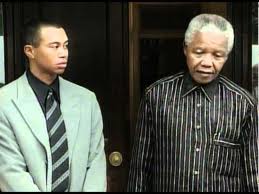
Black golf star Tiger Woods has remembered how his first meeting with Nelson Mandela 15 years ago was an experience like no other.

“I went down there to play [at] Sun City, and he [Mandela] invited us to his home. And my father and I went to have lunch with him. It still gives me chills to this day, thinking about it,” Woods told journalists at Muirfield in Scotland on Tuesday, where the start of the British Open on Thursday coincides with Mandela’s 95th birthday.

Woods became a poster boy for multiracial America in 1997 when, at just 21, he became the first black golfer to win a major, a feat all the more startling as he did it on a course that up until seven years previously had been off limits to African-Americans.

He described his private lunch the following year with Mandela, South Africa’s anti-apartheid hero, as unforgettable.

“We walked in the room and my dad and I were just kind of looking around. And I said, ‘Dad, do you feel that?’ And he says, ‘Yeah, it feels different in this room.’ And it was just like a different energy in the room,” Woods said.

“And maybe, I’m guessing probably 30 seconds later, I heard some movement behind me and it was [former] president Mandela folding up the paper. And it was pretty amazing.

“The energy that he has, that he exudes, is unlike any person I’ve ever met. And it was an honour to meet him at his home. And that’s an experience that I will never, ever forget.”

Mandela, who overcame 27 years in jail to become South Africa’s first black president and bring an end to decades of whites-only rule, is confined to his Pretoria hospital bed on life-support as the world prepares to mark his birthday with a raft of celebrations and charity events.

Defending British Open champion and South African sporting legend Ernie Els, also paid tribute to Mandela at Muirfield and said it would be “wonderful” if a South African player could win this week and give his sports-mad nation a much-needed morale boost.

“Obviously sport has been a key factor in bringing South Africa together into a democratic place and state,” Els said on Monday. “And president Mandela played such a big part in that; also back in the early 1990s, and the World Cup and … African Nations Cup.”

Els is one of 10 South Africans competing at Muirfield, along with Thomas Aiken, Richard Sterne, Tim Clark, George Coetzee, Charl Schwartzel, Branden Grace, Louis Oosthuizen, Justin Harding and Darryn Lloyd. – AFP

Major victory for Wouter Basson

Wouter Basson
Dr. Wouter Basson

The Health Professionals’ Council of South Africa (HPCSA) has excluded court testimony from the TRC (Truth an Reconciliation Commission) against Wouter Basson, nicknamed by leftwingers as Apartheid’s “Doctor Death”.

Basson is said to have had the support of Nelson Mandela, however.

On Monday, Basson won another victory in yet another hearing against him. Previous evidence which Basson himself presented in his own defence would not be considered in this week’s new hearing into whether he upheld the ethical standards required of a doctor, the council decided on Monday.

Basson’s supporters claim that he has been unfairly treated and has suffered for long enough, arguing that it is time to abandon the witchhunt against the respected cardiologist.

The Health Professions Council of South Africa’s lengthy hearing into the conduct of Dr Wouter Basson, the former head of the apartheid government’s chemical and biological warfare programme, which is now in its third year, was supposed to test the ethical standards to which medical doctors, including military doctors, are held accountable.

If found guilty by the HPCSA, Basson’s enemies say he should be barred from practising as a doctor in South Africa. Basson owns a private cardiology practice in Durbanville near Cape Town.

A “specialist” in reconciliation has suggested – without irony – that if Basson is not scrapped from the council’s doctors’ role, he should be forced to serve in public hospitals in underresourced areas, where “knowledge such as his is scarce”.

According to the director of the University of the Witwatersrand’s Steve Biko centre for bioethics, Ames Dhai, however, South Africa’s Constitution will be reduced to a “mockery of human rights” if Basson is not found guilty of “gross professional misconduct”.

In a marathon criminal trial that ran from 1999 to 2002, Basson was acquitted of the many charges the state brought against him. The council’s hearing is the only remaining forum that may hold Basson to account for his actions as head of Project Coast, the apartheid chemical and biological weapons programme.

The judge in the criminal trial found that Basson was head of a programme that was both offensive and defensive, in other words its purpose was to develop defences against chemical and biological weapons and to develop (among other things) chemical crowd-control agents.

It was also revealed both at the TRC and Basson’s criminal trial that scientists working for the programme under his leadership developed chemical and biological assassination weapons.

Scientific records from the Roodeplaat Research Laboratories, the facilities where chemical and biological agents were tested on animals, showed that scientists there conducted many experiments on baboons, dogs and rats in an apparent search for substances that could kill without leaving any trace.

Basson says: “I closed this chapter of my life about 20 years ago and now work as a dedicated medical practitioner helping hundreds of thousands of patients. This case is politically motivated. I just wish I could get on with my life.”

A witness, former surgeon general Dr Niel Knobel, testified this month, after an United States medical ethics expert Steven Miles previously testified that Basson violated the laws of humanity and various World Medical Association declarations and regulations.

In contrast, Knobel said Basson was a soldier and not a doctor when he headed the country’s chemical and biological warfare programme.

Knobel disagreed with Miles’s view, that once someone was a doctor they remained a doctor and that Basson made use of his medical knowledge and skills when he headed the programme.

Basson argued the surgeon general at the time was in charge of the programme and that he carried out orders as a soldier. – Sapa/M&G

Malema to sue over ‘drunkard and womaniser’

Julius Malema
Julius Malema

Julius Malema has considered taking legal action over a scathing attack on him by the ANC’s Gauteng chairperson Lebongang Maile.

At the press conference on Tuesday, the ANC Youth League’s Gauteng chairperson, Lebogang Maile, blamed the league’s former president, Julius Malema, for the youth league’s financial problems.

“Where is the money of the ANC Youth League? The ANC Youth League owes [creditors] more than R50-million.”

He also accused Malema of being a “drunkard and a womaniser”.

Malema said he planned to sue Maile, as his veiled allegation that Malema embezzled youth league funds bordered on defamation.

He demanded that Maile retract the statement and apologise, and denied that he was a womaniser.

“I am not a womaniser; I am a 32-year-old man with one child. I do not have a girlfriend,” he was quoted as telling the newspaper.

“Maile is 33-years old or more with no less than six children. He is expecting twins as we speak.” – Sapa

It’s all about race: Zimmerman has an Anglo name

hammercaseEstablishment-encouraged anti-White hatred is at the core of the current ”Trayvon Martin killing” trial of mestizo George Zimmerman, as evidenced by the clear and obvious racial undertones and hypocrisy surrounding nonwhite crime.

The controlled media, encouraged by white-hating black “community leaders,” have hyped up Zimmerman as some type of “white racist” who murdered the “unarmed black youth” Martin in an unprovoked shooting.

The reality of the situation—namely that neighborhood watch patrolman Zimmerman is a mestizo Hispanic, and that Martin was a large black thug carrying burglary equipment and who violently attacked Zimmerman—has been completely covered up in yet another bout of frenzied anti-white hatred.

The fact is that if George Zimmerman had been named “Juan Garcia” or “Emilio Estefan,” the media would have paid the shooting only passing attention and he would be a free man today, and not facing a lifetime behind bars after a modern-day public lynching by the rodent press.

Instead, because this unfortunate mestizo has a German-sounding name, the media latched onto him as an example of “white racism” and even now, many of the major news networks refer to the shooting as an example of “whites shooting blacks.”

Yet nonwhites kill each other with monotonous regularity all over America, all the time—and these shootings only make it as far as local news stations

For example, concurrent to the time that the Martin shooting occurred, Fox News Chicago reported that there had been 38 shootings, and three fatalities in that city—all within a single weekend. Everyone of the shooters and almost all the victims were either black or Hispanic.

Yet the international media just ignored that outbreak of violence—because they could not twist it to try and blame “white racism.”

Even more telling of the anti-white hatred which underlays the media’s controllers, is the Mark Slavin case.

Not one person in ten million knows who Mark Slavin is, even though he was the victim of a brutal attack just a few miles away from where the Martin shooting took place.

Slavin, a 50 year old Caucasian, was attacked by two teenage blacks, one just a year older than Martin. The two black thugs beat Slavin with a hammer, and then took him into a nearby woods in his car, where they continued the senseless racial assault.

Investigators said a witness called 911 after hearing the victim’s cries for help and seeing the beating.

The two blacks, named Yahaziel Israel and Julius Bender, drove away in the victim’s vehicle before deputies arrived and they abandoned it nearby.

Deputies said they found the victim in the woods, barely conscious and with severe head injuries.
The two blacks were charged with attempted homicide, burglary with assault or battery, and armed burglary. Slavin’s injuries were reported as “life-threatening” and he was hospitalized at Orlando Regional Medical Center in critical condition.

Despite this brutal attack occurring at exactly the same time and nearly the same location as the Martin shooting, the controlled media has seen fit to cover up the incident completely—to the point of not reporting on the resultant trial or even what happened to the victim.

How different it would be if two whites had beaten a black man nearly to death with a hammer! By now, the whole world would have been informed, hundreds of times over, of the “evil racist attack” and blacks all over America would have been rioting and demonstrating against “white violence” etc.

Even now, despite Zimmerman being a mestizo, and not a white, the controlled media is still trying to incite blacks to engage in anti-white riots should he actually be acquitted of the outrageous charges against him.

The use of numerous anti-white racial epithets by witnesses in the Zimmerman trial (see Prosecution’s Star Witness In Zimmerman Trial Refuses to Say Term ‘Creepy-Ass Cracker’ Is Racial or Offensive” The Blaze, Jun. 27, 2013), even though reported on, passed without comment from the controlled media.

This contrasts dramatically with the same rodent press’s public lynching of Southern Belle cookery celebrity Paula Deen, who dared to use the word “nigger” 30 years ago, leading to the destruction of her career and sacking by all her major sponsors. – The New Observer

Unrest continues in LA after Zimmerman verdict

Burning the symbol of liberty...
Burning the symbol of liberty…

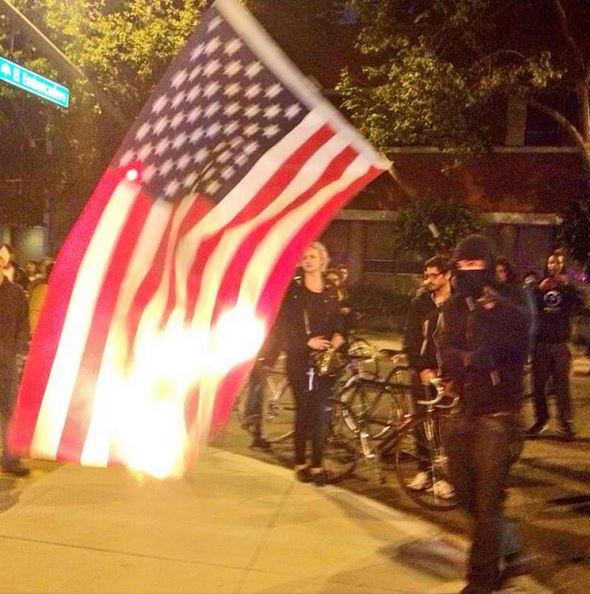
Unrest continued for the third night in Los Angeles as protesters against the Zimmerman verdict stormed a Wal-Mart, attacked bystanders and stomped on cars.

“People protesting George Zimmerman’s acquittal marched along Crenshaw Boulevard on Monday night, stomping on cars, chasing bystanders and storming a Wal-Mart,” reports the LA Times.

“Several protesters made their way into the Wal-Mart as guards scrambled to close security gates. A short while later, Los Angeles Police Department officers wearing helmets and carrying batons swarmed the store as others marched through the parking lot.”

Footage shows demonstrators attacking moving vehicles, as well as stationary police cars, in a flashback to scenes witnessed during the 1992 LA riots. Protesters also lit fireworks in the middle of the road and threw rocks at store fronts while lashing out randomly at people in the street.

Some of the protesters were seen wearing t-shirts featuring an image of George Zimmerman which read “Wanted Dead or Alive” with the last word crossed out.

Although such scenes have largely been limited to Oakland and different areas of Los Angeles, media networks have ignored them for the most part.

Yesterday we highlighted how the LAPD were being ordered to stand down and allow the disorder to escalate despite the fact that innocent bystanders were being assaulted. Police are now promising to make more arrests if the unrest continues.

Employees of businesses in Oakland lined up outside stores to prevent ‘protesters’ from smashing their windows. There were also reports that a waiter was attacked with a hammer. – Prison Planet.com

Brain scans of inmates predict reoffenders

brainscanIt began with a casual question that neuroscientist Kent Kiehl posed to a postdoctoral fellow in his laboratory who had been conducting brain scans on New Mexico prison inmates.

“I asked, ‘Does ACC activity predict the risk of reoffending?'” Kiehl recalls, using the scientific shorthand for the anterior cingulate cortex, a brain structure associated with error processing.

The postdoctoral fellow, Eyal Aharoni, decided to find out. When he compared 96 inmates whose brains had been monitored while they performed a test that measures impulsiveness, he discovered a stark contrast: Those with low ACC activity were about twice as likely to commit crimes within four years of being released as those with high ACC activity.

“We cannot say with certainty that all who are in the high-risk category will reoffend — just that most will,” Kiehl says. “It has very big implications for how we think about treatment and rehabilitation.”

Currently most reoffenders are black. Lifetime incarceration is already three times higher for blacks in the US. As reported on BBC Radio 4 on 2 September 2005, the recidivism rates for released prisoners in the United States of America is roughly 60%.

The recidivism rate for prisoners released from prison within one year is 44.1%; this number rises to 67.5% within three years of being released from prison. Sixty-seven percent of the people who were rearrested were charged with 750,000 new crimes, which include property offenses, drug offenses, public-order offenses, other offenses, unknown, and over 100,000 of these crimes were violent crimes.

The study is the latest paper from Kiehl’s lab reporting on experiments performed in a powerful functional magnetic resonance imaging scanner mounted in a semi-trailer. Kiehl and his team at the nonprofit Mind Research Network have used the scanner to study the brains of nearly 3,000 convicted criminals at facilities in New Mexico and Wisconsin since 2007.

Each inmate who volunteers for testing is paid a small hourly stipend and receives a copy of the brain scan, Kiehl says. But the scan is just part of a lengthy process in which Kiehl’s assistants interview the inmates, review their prison files and assign scores on the Psychopathy Checklist-Revised, a standard test for measuring psychopathy.

The MRI trailer is parked in a secure area of the prison compound, but no guards are present during the testing, Kiehl says. “Our staff are trained in prison security protocols,” he says.

The trove of data they have gathered has revealed telltale abnormalities in the structure and functioning of psychopaths’ brains. On the whole, they have less gray matter in the paralimbic system — believed to help regulate emotion — which may help account for their characteristic glibness, pathological lying, lack of empathy and tendency to act impulsively.

Kiehl often briefs judges and legal groups on his findings and has consulted in more than 100 criminal cases where, for example, psychopathy might be raised as a mitigating factor to account for a defendant’s impaired self-control.

The mere suggestion that it might be possible to predict future criminal behavior may conjure up such futuristic films as “Minority Report,” but Kiehl cautioned that the new study merely averages test results from a large group and cannot at this point predict whether any particular individual will reoffend.

But with further refinement, he says, brain imaging might one day be considered in civil commitment proceedings, where convicted sexual offenders can be held indefinitely if it is believed they have a propensity to reoffend.

Predictions about whether an offender poses an ongoing danger to society “already play roles in a variety of legal contexts, such as in deciding whether to sentence a criminal offender to a mental health facility, deciding whether to grant parole and the like,” said Owen D. Jones, a Vanderbilt University professor of law and biology and director of the MacArthur Foundation Law and Neuroscience Project, which helped fund Kiehl’s study.

Describing the study as interesting and well-designed, Jones said the neuroscience of criminal behavior was evolving so rapidly that courts and lawmakers could barely keep up. “Although there are efforts underway to help the legal system close that gap, the gap remains,” he said. “This poses challenges to the fair and effective administration of justice.”

After hundreds of encounters with psychopaths, Jones has come to view their distinctive lack of empathy as a missing skill, akin to a dyslexic’s inability to read.

Some experts see psychopathy as an incurable defect, but Kiehl cites neuroplasticity — the brain’s lifelong ability to remold itself in the face of new stimuli — as cause for optimism: New therapies might be developed to bolster the psychopathic brain’s underactive empathy circuits, he says.

Selling that idea to judges and lawmakers, however, is likely to be an uphill battle. “The problem is, people don’t think about empathy as an ability,” he said. “They take it for granted.”

Kiehl, who has received inquiries from neuroscientists throughout North America and Europe about using his mobile MRI for data collection, is hard at work adding to the existing database of New Mexico and Wisconsin inmates.

“There are also other opportunities where it could be leased commercially,” Kiehl says. “We’re going to go international.” – LA Times/Wikipedia

Costly ambitions of NDP not discussed

fastfactsThe National Development Plan (NDP) tries to do too much and its costly ambitions are not discussed, the South African Institute of Race Relations said on Monday.

“It reads as if various government departments have provided wish-lists without much attempt to pull them all together,” it said in the July edition of its monthly magazine Fast Facts.

“But one thing the NDP does not do is put a price tag on all the wish lists it incorporates and endorses.”

These included an extension of tertiary education, faster land reform, national health insurance, racial preferencing in procurement contracts, and guaranteed minimum living standards subsidies of various kinds.

There was no chapter in the 500 page document discussing how all of this would be paid for, the SAIRR said.

Here and there were reference to taxpayers having to fund things where there were no user charges, and that raising taxes might reduce profitability.

It was assumed that if the economy grew more than five percent a year, government revenue and the profit of private firms would more than double over the next 20 years, but whether this would be enough to fund all the plans in the NDP was not discussed.

“There are employment scenarios, but no scenarios about tax revenue, or the budget deficit, or public debt,” the SAIRR said.

“To endorse the NDP amounts to giving government a blank cheque for more taxation and more borrowing and probably for both.”

The institute said there were many internal contradictions within the document, but it was also undermined by external contradictions.

There was also no “command centre” to implement the plan.

“The nominally responsible [Minister in the Presidency for National Planning Commission] Trevor Manuel, has no executive authority.

“But Ministers who are actually running departments do as they please, since President Jacob Zuma fails to exercise any leadership over his government,” the SAIRR said.

It said departments which were key to the success or failure of the NDP were headed by ministers, some of them SA Communist Party members, who believed in more state control and were busy extending it.

These departments were trade and industry, mineral resources, energy, communications, economic development, agriculture, public enterprises, public works, higher education and labour.

“For them, in fact, the NDP is the perfect smokescreen.

“While the attention of the country is focused on the NDP… these ministers can steadily introduce dirigiste legislation in mining, energy, employment equity, black economic empowerment, labour, business licensing, land, and property rights.”

Dirigiste legislation is directed by a central authority and controlled by the state. – SAPA

Zimmerman’s parents in hiding from ‘enormous amount of death threats’


The Zimmermans
The Zimmermans

George Zimmerman immediately went back into hiding after being acquitted of murder in the shooting death of Trayvon Martin, his parents told Barbara Walters in an exclusive interview with ABC News, adding that they haven’t seen him since he left the courthouse.

The Zimmermans said that because of “an enormous amount of death threats,” they, too, have remained in hiding and still don’t feel safe enough to return to their home in Orlando, Fla.

Two days after a Florida jury found their 29-year-old son not guilty of second-degree murder and manslaughter charges in the death of Martin, 17, Zimmerman’s parents, Robert Zimmerman Sr. and Gladys Zimmerman, sat down for their first television interview. They opened up about how their son’s murder trial has affected their family and how he and they are struggling to cope with the aftermath.

“Under the circumstances, we have not been able to talk to him,” Gladys Zimmerman told Walters. “To tell you the truth, we don’t trust anything, not even the phones.”

“We have had an enormous amount of death threats. George’s legal counsel has had death threats, the police chief of Sanford, many people have had death threats,” Robert Zimmerman said.”‘Everyone with Georgie’s DNA should be killed’ — just every kind of horrible thing you can imagine.”

George Zimmerman was accused of second-degree murder for shooting Martin on Feb. 26, 2012 inside a gated community in Sanford, Fla. While he admitted to shooting the unarmed teenager, Zimmerman maintained that Martin attacked him and he acted in self defense.

A jury made up of six women found Zimmerman not guilty of both second-degree murder and manslaughter charges Saturday after deliberating for more than 16 hours over two days.

But the family’s celebration of George Zimmerman’s new freedom has been short-lived. His parents said that their son has no job and no health insurance. Gladys Zimmerman said her son has been living off small monthly stipends from his legal defense fund.

“Even for us, we have not been living a normal life for the past months, it is hard,” she said. “We have lost everything, everything — the whole family, not only George. The whole family. We have lost everything.”

When asked if her son could ever live a normal life again, Gladys Zimmerman said, “Only time will tell.”

In the wake of Martin’s death, the case quickly developed racial overtones when Sanford law enforcement declined to arrest Zimmerman, who is a white Hispanic — his father is white and his mother is originally from Peru. Trayvon Martin is black.

George Zimmerman was arrested nearly two months after the incident when the state appointed Angela Corey as a special prosecutor and she brought second-degree murder charges against him.

Outrage and protests have reignited across the country since the not-guilty verdict was announced, something George Zimmerman’s mother said was “hurtful.”

“This is America, and we went through all of this with the judicial system,” Gladys Zimmerman said. “They wanted an arrest for my son. They got an arrest. Now lets, you know, find a verdict … now they have a verdict. … He went through the whole process they were pushing for, and now they are not happy with the verdict, and I pray. I pray for them, for God to touch their heart.”- ABC


Putin: Snowden will leave Russia as soon as he is able to

snowdenagentRussia’s President Vladimir Putin says Edward Snowden, who has been stuck in a Moscow airport for weeks, will leave Russia as soon as he is able to.

Putin on Monday also accused Washington of preventing the fugitive, US intelligence leaker Edward Snowden, from leaving Russia after he arrived from Hong Kong on June 23. “He arrived on our territory uninvited, he did not fly to us,” Russian news agencies quoted Putin as saying.

“They themselves [Washington] scared off all the other countries, no one wants to take him, and therefore they essentially themselves trapped him on our territory,” added the president, according to the agencies.

Meanwhile, Putin said on Monday that he saw signs that Snowden was shifting towards stopping “political activity” directed against the United States.

Putin, who previously refused to hand Snowden over to the US authorities, said the fugitive’s situation remained unresolved after Washington had blocked his further movements.

Asked on an island in the Gulf of Finland about Snowden’s future, Putin said: “How do I know? It’s his life, his fate.”

Putin has stated Snowden should stop activity harmful to the United States if he wanted refuge in Russia, and said he saw signs that the former contractor with the National Security Agency was moving in this direction.

“As soon as there is an opportunity for him to move elsewhere, I hope he will do that. The conditions for granting political asylum are known to him. And judging by his latest actions, he is shifting his position. But the situation has not been clarified yet,” Putin said.

Breaking weeks of silence, Snowden on Friday said at a Moscow airport where he has been camped since late June that he was seeking temporary asylum in Russia before he can safely travel to Latin America. Venezuela, Bolivia and Nicaragua have offered him asylum. – AFP, Reuters

Plan for single African coastal policy

fishingAfrican leaders are looking seriously at an integrated maritime domain around the continent.

Such a domain would include an exclusive economic zone that would be key to the development of a sustainable “blue economy” for the continent. Today, each country with a coastline manages its 200 nautical mile zone, where it has full fishing and gas and mineral exploitation rights

Speaking at a symposium at UCT this week, Professor Patrick Vrancken of the Nelson Mandela Metropolitan University in Port Elizabeth, said this vision was contained in the 2050 African Integrated MaritimeStrategy presented to the second conference of African ministers responsible for maritime-related affairs in Addis Ababa, Ethiopia, in December.

The strategy recognised that fish made a vital contribution to the food and nutritional security of more than 200 million Africans and that there was an urgent imperative to develop a “blue economy”, he said.

He understood that the document was a draft that would be formally adopted by the AU Assembly of Heads of State and Government, “hopefully still this year”.

Vrancken was speaking at a Fisheries Crime Symposium organised by the Institute of Marine and Environmental Law and the Marine Research Institute, both at UCT.

The one-day academic symposium was a warm-up for a two-day closed workshop between Interpol and law enforcement officials from the national Department of Agriculture, Forestry and Fisheries, other Southern African Development Community fisheries departments and such South African agencies as the police, revenue service and maritime safety authority.

The thinking behind the proposal of an integrated maritime domain appeared to be that it would be easier to achieve than the mooted US of Africa, Vrancken suggested.

The strategy proposes a common fisheries policy for the conservation, management and exploitation of the continent’s marine resources. The draft urges all AU members to try to deter illegal, unregulated and unreported fishing, as well as other criminal activities in the maritime domain, such as piracy and robbery at sea, human trafficking, illegal oil bunkering and crude oil theft, and illegal arms and drug trafficking.

Among the measures recommended for reducing and containing illegal fishing are:

l Effective licensing and control of vessels allowed to fish by flag states.

l Real-time positional reporting by licensed vessels.

l Surveillance and interception of irresponsible fishing by patrols.

Regional economic communities have been asked to develop a common strategy that would warrant “24/7 patrolling of the seas” involving effective communications and rapid response capabilities with offshore patrol vessels and fast inshore boats, maritime patrol aircraft, unmanned aerial vehicles or drones, and helicopters for surveillance and deterrence.

Vrancken said the aim was to have the strategy in place by 2050. – Cape Argus

DRC conflicts have worsened since passage of Dodd-Frank 1502 Act

Genl Amisi
Genl Amisi

One of the leading advocacy groups for the conflict minerals campaign Global Witness, a British NGO, published a report last week detailing the massive failure of the Dodd-Frank 1502 Act to achieve any of its intended goals.

The report documents how the conflicts have worsened since passage of the law and the SEC’s promulgation of the implementing regulations. And it reveals how, by driving the trade underground, the law has benefited the very worst elements in the Kivus: rogue military groups and armed militia.

Other NGOs had already revealed their fealty to the US Chamber of Commerce by publishing reports highly critical of Dodd Frank 1502, but none had previously positioned itself as a leader in the campaign.

Here are some of the report’s highlights:

Up to 10 tonnes of gold from South Kivu is being laundered each year through Burundi and exported to Dubai–with an “almost complete absence of checks” on the trade;

FARDC forces redeployed to fight M23 rebels left a security void filled by armed groups moving in on the mineral trade;

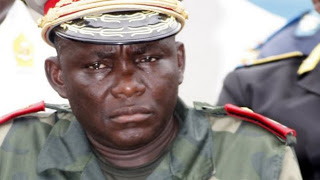
General Gabriel Amisi, who was fired last year as the army chief of staff for selling arms to the M23 rebels, controls one of the richest gold mines in South North Kivu;

Changes in security dynamics in the past year have provided rebels and FARDC with opportunities to take control of mining sites previously considered candidates for conflict-free sourcing;

Formal exports of the three Ts–tin, tantalum, and tungsten–are low in South Kivu and virtually non-existent in North Kivu. The majority of these minerals are smuggled out of eastern Congo, laundered through Rwandan tagging system, and exported as domestic Rwandan product.

The financial incentives to smuggle Congolese tin ore across the border outweigh the risks of getting caught, since “tagged” tin sells for $9/kilo, compared to a mere $3 or $4/kilo for untagged ore.

The government-led initiative to certify mining sites initiated in 2011 is already out of date and defunct;

The conflict-free tin initiative at Kalimbi in Nyabibwe, widely viewed as a test case for responsible sourcing, is being exploited by a military-led smuggling racket.

To be sure, the report concludes with the standard advocacy-based recommendations, to wit: that companies implement OECD due diligence procedures in full; that the Congolese government enforce domestic due diligence law, remove and prosecute army officers involved in the mineral trade, and formalize the gold trade; and that the donor governments support capacity building for mining authorities.

But the report convincingly demonstrates that the government has neither the will nor the capacity to bring the illicit trade to heel, and provides overwhelming evidence that Dodd-Frank has exacerbated the very problems it was meant to resolve. The sparse recommendations tacked on to the conclusion of the report tacitly acknowledge the nature of the problem: A government capable of making the recommended reforms would not need to be told to undertake them in the first place. To put it another way: A government that is unable and unwilling to govern its territory or protect its people is not a likely candidate to administer a complex and dynamic mineral trade regime.

With the publication last month of the Pole Institute’s highly critical No Kivu, No Conflict report, which concluded that the Kivus are “being asphyxiated” economically by Dodd-Frank 1502, this leaves The Enough Project as the law’s sole remaining cheerleader. In late February, Enough’s co-founder and public face,  John Prendergast, wrote this about the mineral campaign:

“For decades all of the benefits of eastern Congo’s vast mineral resource wealth have gone to those with the biggest guns — the Congolese army, local militias or neighboring countries. These minerals include, among others, gold, cobalt, copper, tin, industrial diamonds and coltan, used in cell phones, laptops and other electronic devices.

But U.S. and European consumer demands for a conflict-free minerals trade, congressional legislation, International Monetary Fund aid suspensions, U.N. experts’ reports, responsible investors and other influential voices are making it harder to profit violently and illegally from mineral smuggling.”

Further analysis from the Pole Institute:

“Thus, a pattern is emerging in which Kivu’s mining sector is being asphyxiated in the name of reform. Before 2010, Kivu’s mineral traders had willingly participated in moves to strengthen formal and legal channels and to safeguard Kivu livelihoods by creating “conflict-free” production and trading chains within Eastern Congo. The mining ban killed this off, and today the focus has moved to Katanga and Maniema, increasingly apparently favouring a nexus of mining firms closely linked to the power-holders in Kinshasa. Because they do not finance armed groups, these firms are seen as “conflict‐free,” but no criteria exists to judge the wider political ramifications of their activities, their benefits for local development and the possible exacerbation of local conflict caused by favouring certain firms in collusion with international partners to the detriment of others.”

– David Aronson

SA troops caught between fighting factions in DRC

Hercules C-130 with Monusco cargo

South African soldiers are caught between M23 rebels and government forces in the Democratic Republic of the Congo.

Fighting erupted anew in the war-torn east of the DRC on Sunday and continued yesterday after about 100 armed men disguised in women’s clothing entered the country from Rwanda, said local sources.

Soldiers of 6 SA Infantry Battalion have been deployed in the DRC in a United Nations “intervention brigade”.

The intervention brigade consists of 2069 soldiers, of whom 850 are South African, and falls under the authority of the UN’s broader 19000-strong Monusco peacekeeping mission in the Congo.

Unlike the peacekeeping force, the brigade, which also has Tanzanian and Malawian contingents, has been mandated to engage any group that tries to destabilise the region.

Lieutenant-Colonel Felix Prosper Basse, a spokesman for the Monusco force, said yesterday that the South Africans were ”in the middle” of the fierce fighting around Goma, the provincial capital.

“The [Monusco] operational base in Monigi has always been a South African base. It is on a hill dominating Goma,” said Basse.

The South African troops have been involved in two other clashes in the past week, sparked when another rebel group, the Mai Mai, attacked a nearby M23 base.

“The M23 repelled the attack and the Mai Mai turned and started to shoot at civilians and the blue helmets [UN soldiers] to intimidate them. The blue helmets fired warning shots but when they kept on coming we engaged them,” said Basse.

One rebel was killed in the fighting and two others were wounded.

Heavy calibre weapons were used, including multiple-rocket launchers, mortars and artillery. DRC government forces have been involved in heavy fighting against the M23 rebels since Sunday.

SA Defence Ministry spokesman Siphiwe Dlamini said the fighting was taking place in the areas where the South African troops are deployed.

“We are not involved,” he said.

The South African base was formerly held by M23 rebels but was taken by Monusco after the two M23 factions started fighting each other, leaving a gap for the UN force to move in. – Sapa-AP, AFP

Fire in Kruger Park not controlled burning

knpfireA blaze that led to the death of an elephant in the Kruger National Park was not a controlled fire, SA National Parks said on Monday.

It was responding to rumours about the fire last week on social networking sites.

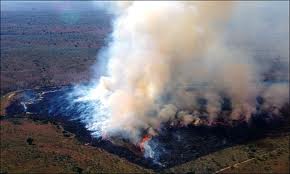
“This was as a result of a runaway fire that jumped over the border from Mozambique into the KNP,” said Freek Venter, KNP general manager of conservation.

“A south-easterly wind created adverse conditions which resulted in a fast-moving fire on the day,” he said in a statement.

Venter said the smoke from “this type of fire sometimes overcomes animals and confuses them”. The elephant sustained serious burns and was put down.

“With regards to controlled fires, SANParks has a strict fire danger index guideline, which indicates when it is safe to administer controlled burns and KNP is no exception,” he said.

There were claims on Facebook and other social platforms that a rhino was also injured in the fire. This could not be confirmed.

Venter said an investigation was underway. – SAPA