US census to change its racial classification system

WASHINGTON (AP) — To keep pace with rapidly changing notions of race, the Census Bureau wants to make broad changes to its surveys that would treat “Hispanic” as a distinct category regardless of race, end use of the term “Negro” and offer new ways to identify Middle Easterners.

The recommendations released Wednesday stem from new government research on the best ways to count the nation’s demographic groups. Still it could face stiff resistance from some racial and ethnic groups who worry that any kind of wording change in the high-stakes government count could yield a lower tally for them.

“This is a hot-button issue,” said Angelo Falcon, president of the National Institute for Latino Policy in New York City and a community adviser to the census. “The burden will be on the Census Bureau to come up with evidence that wording changes will not undermine the Latino numbers.”

Arab-Americans said they strongly support the Census Bureau’s efforts. “The Census Bureau’s current method for determining Arab ancestry yields a significant undercount of the actual size of the community, and we’re optimistic that the new form should be significantly better at capturing ancestry data,” the Arab American Institute said in a statement.

The research is based on an experiment conducted during the 2010 census in which nearly 500,000 households were given forms with the race and ethnicity questions worded differently. The findings show that many people who filled out the traditional form did not feel they fit within the five government-defined categories of race: white, black, Asian, Pacific Islander and American Indian/Alaska Native; when questions were altered to address this concern, response rates and accuracy improved notably.

For instance, because Hispanic is currently defined as an ethnicity and not a race, some 18 million Latinos — or roughly 37 percent — used the “some other race” category on their census forms to establish a Hispanic racial identity. Under one proposed change to the census forms, a new question would simply ask a person’s race or origin, allowing them to check a single box next to choices including black, white, or Hispanic.

The other changes would drop use of “Negro,” leaving a choice of “black” or African-American, as well as add write-in categories that would allow Middle Easterners and Arabs to specifically identify themselves.

Census director Robert Groves, who leaves his position Friday to become provost at Georgetown University, described the research findings as an important first step toward making changes in future censuses.

“As new immigrant groups came to this country decade after decade, how we measure ethnicity changed to reflect the changing composition of the country,” Groves said. “Since that change is never ending and America gets more and more diverse, how we understand and tabulate the information has to be continually open to change.”

“It’s critical that race and ethnicity reflect how people identify themselves,” he said.

The issue isn’t just semantic. Some African-Americans in 2010, for instance, criticized a question asking if a person was “black, African- American or Negro,” saying the government’s continued use of the term “Negro” was demeaning and offensive.

“We believe the proposed changes are consistent with the way most people do choose to self-identify and will enable census to more accurately capture the growing racial/ethnic diversity in the U.S.,” the National Urban League said Wednesday in a statement.

The wording in census surveys can also be highly political: census data are used to distribute more than $400 billion in federal aid and draw political districts and thus can elicit concern if a change were to yield a lower response.

While individual Hispanics have expressed dissatisfaction with census forms that don’t count Latino as a race, Latino political groups have been reticent about pushing for a change. The main reason: Past research has sometimes shown that treating Latinos as a mutually exclusive group on survey forms leads to a lower Hispanic count.

“Why would Latinos want to give up their own question on the census form that specifically asks if they are of Hispanic, Latino or Spanish origin?” asks Falcon of the National Institute for Latino Policy. He notes that the current wording, which first asks people if they are of Latino origin and then prompts them to fill in their race, fostered a strong count in 2010 that yielded a new census milestone for Latinos of 50 million, or 1 in 6 Americans.

Nicholas Jones, chief of the racial statistics branch at the Census Bureau, said the government’s more recent research found that Latino response rates were similar under both the current and the new proposed format. Across all race and ethnic groups, the nonresponse rates dropped notably to 1 percent under the proposed change, compared with nonresponse rates of roughly 4 to 5 percent with the traditional form.

Jones said the research identified ways to improve responses that will be used to discuss any survey changes with members of the Latino, black, Asian and other communities leading up to the 2020 census.

The government definitions of race groups are set by the White House Office of Management and Budget. Currently, Hispanics are an ethnic group, which means although they share a common language, culture and heritage, they do not share a common race. They can be black, white, Asian, American Indian or descended from original peoples of a place colonized by Spain.

Changes to questions on census forms also must be approved by Congress.

Other research findings:

—Removing the term “Negro” from the census form did not hurt the response rates of African-Americans. While some people in 2000 indicated that the term still had relevance to them, this number has steadily declined since then.

—Under the proposed changes, the number of people who reported multiple races increased significantly. The multiracial population is currently one of the nation’s fastest growing demographic groups.

—When provided write-in lines, as much as 50 percent of people who checked their race as “white” wrote in an ethnicity such as Italian, Polish, Arab, Iranian or Middle Eastern. More than 76 percent of black respondents also wrote in an ethnicity, such as Jamaican, Haitian or Ethiopian.

—Based on focus groups, many people supported creating a separate racial category for those who identify as Middle Eastern or North African.

Many demographers predict a wider range of responses on census forms and blurring of racial categories over the next 50 years as the minority population grows and interracial marriage becomes more common. In the case of Hispanics, the nation’s largest minority group, the label as an ethnicity to date has created particular confusion.

For instance, the Census Bureau describes Asian-Americans as the nation’s fastest-growing race group from 2000 to 2010; their rate of growth is actually equal to that of Hispanics, an ethnic group. On the other hand, Hispanics are typically treated as a race for purposes of counting “interracial” marriages in the U.S.

Terry Minnis, director of census and voting programs at the Asian American Justice Center, said more tests are needed to ensure that Asian-Americans are fully counted under a new question format. Recent tests by the Census Bureau show some decreases in responses when there were fewer check boxes available for the various Asian-American groups, which include among others Asian Indian, Chinese, Japanese, Filipino and Vietnamese.

“As the Census Bureau looks to develop new strategies that maximize measurement and reporting on race and ethnicity, it must ensure that nothing compromises the quality and detail of data on Asian Americans,” Minnis said.

Australian hullabaloo over ‘racist Facebook page’

The logo of 'Abo Memes' on Facebook

The creators of a racist Aboriginal Memes Facebook page – described as a potential breach of Australia’s Racial Discrimination Act – have removed all of the controversial images.

All of the page’s content was removed earlier today after repeated complaints to Facebook and after confirmation that the Australian Communications and Media Authority was investigating.

Race Discrimination Commissioner Helen Szoke said the page, which targeted Aborigines, could be a breach of the Act and earlier called on the social network’s operator to take the page down.

Communications Minister Stephen Conroy said today the page was “offensive”, “not appropriate” and “denigrates our indigenous community extensively” but stopped short of demanding that Facebook take it down, saying “I think it should be taken down”.

“Pretending its humour doesn’t really change [things],” Conroy said.

The Coalition on the other hand has vowed to repeal racial vilification laws.

ACMA is also investigating the page following a campaign condemning Facebook over its claims that the page is not considered hate speech. The racist “Aboriginal memes” page portrayed Aboriginal people as inferior drunks who sniff petrol and bludge off welfare.

“My view is that the material is offensive and it goes over the line of humour and even controversial humour because what it’s doing is depicting a whole race of people in a way that’s negative, that’s ridiculing them, that’s mocking them and is offensive,” Szoke said in a phone interview.

Boxer Anthony Mundine said it was “appalling” that Facebook had refused to remove the page.

It appears that Facebook tolerates hate-mongering but refuses to allow mothers to post images of themselves breastfeeding their babies.

Facebook’s community standards page forbids “hate speech” but Facebook has responded to those who complained about the Aboriginal Memes page, saying it was “not able to confirm that the specific page you reported violates Facebook’s statement of rights and responsibilities”.

The page, which has 4183 “likes”, was briefly taken offline last night before reappearing with the words “Controversial Humor (sic)” next to the page’s title. It consisted of various images – usually of an indigenous person – each with racist text over the top of it.

Facebook says on its website that content which attacks people based on their perceived race, ethnicity, national origin, religion, sex, gender, sexual orientation, disability or disease “is not allowed”.

“We do, however, allow clear attempts at humour or satire that might otherwise be considered a possible threat or attack,” the website states. “This includes content that many people may find to be in bad taste.”

Chris Graham of the NSW Aboriginal Land Council’s Tracker magazine said that while Facebook may have a policy on what is and isn’t hate speech, “the fact is that Facebook page is illegal”. “It is a clear breach of the Racial Discrimination Act. Is Facebook genuinely suggesting it is above the law?”

Approached for comment this morning, a Facebook spokesman in Australia said: “At this point in time, we’ve not got anything we can give you on this.”

Szoke said while she had yet to receive a formal complaint – required before an investigation takes place – she believes “this could constitute discrimination under the Race Discrimination Act”.

She urged Facebook to remove the page and said now was a good opportunity for the site to revisit its guidelines and “test whether they are in tune with community opinion”.

“If someone chose to lodge a complaint at the commission then what we would do is attempt to conciliate that complaint and get an appropriate outcome,” she said.

“That may be to remove the material, review guidelines about what the threshold is on racism and how racism is depicted on the Facebook site, to putting a public apology about the harm that’s been created.”

This conciliation process may not be possible under a future Coalition government as Tony Abbott has said he would repeal laws prohibiting statements that offend people on racial or ethnic grounds. At a press conference today Senator Conroy took a different view, saying “we don’t want to live by those [Facebook’s] standards”.

ACMA has referred the content to the Classification Board. But it is understood that it is unlikely that the content would fall under “prohibited content” as defined by the Act, which prevents content such as child and terrorism material.

“So as long as you have a pretence of being funny about it you can vilify Aboriginal people? Really? If that’s their [Facebook’s] policy they need to have a serious re-look at it,” Graham said.

“Racist doesn’t even begin to describe the images. They’re so offensive it beggars belief.”

Graham said that while Facebook could take the page down today, tomorrow it would be back up somewhere else. But that didn’t excuse Facebook from its responsibility not to spread “this sort of hateful, disgusting material”.

“There’s a certain amount of futility in all this. It’s never going to stop because the people creating it know there’s a big market for it in Australia. And that’s the problem,” he said.

“What this does is celebrate the destruction of a people. It celebrates the fact that Aboriginal people feel so hurt and so disempowered that they petrol sniff to forget their problems … I don’t think Mark Zuckerberg had this in mind when he invented what is otherwise a fantastic social networking platform.”

Mundine said: “It just goes to show how behind we are, how racist this country is. A lot of people that ain’t as strong as me it plays with their emotions … but shit like that just motivates me really to do the best ever and that’s what I’m going to do, I’m going to be the best ever and they’ll have to say a black man was the best ever full stop period.”

Andrew P Street has been part of a Facebook campaign to get the racist page removed from the site.

“I got sent the link by a friend … dutifully shared and reported it, and that would have been that if FB’s bot response had been ‘a human will look at this shortly and report back’,” he said.

“But because their response implied that nothing was going to be done, I got strident – and then when the page went down and then reappeared, with the new URL and descriptor suggesting ‘this WAS racist, but now we’ve told you it’s totally hilarious it’s all OK!’, I got f—ing livid.”

Ben Gertz, a national Aboriginal and Torres Strait Islander officer with the National Union of Students, said the page was unquestionably racist and portrayed indigenous people as “a bunch of inferior petrol sniffers”.

“I think social media gives people an outlet to promote their racist and discriminatory views because on social media a lot of profiles can be very faceless so it gives people that option to cower behind a faceless screen,” he said.

Tiphereth Gloria, social media planner at VML, said the page was racism hiding under “humour”. Since it uses visual meme generators, contributors are able to stay anonymous.

“Facebook likes to stay out of these controversies. The last time they took photos down it was women’s personal photos of themselves breastfeeding their children,” she said. “They eventually reinstated these. How racism is allowed to stay up versus breastfeeding is anyone’s guess.”

James Griffin of social media monitoring firm SR7 said anonymity on the web was a double-edged sword – it allows people to speak out in support of good without condemnation but it also allows people to say terrible things without consequence.

“Two contrasting examples for retaining anonymity [on Facebook pages] would be disgusting pages like this, where it makes sense to remove it, however alternatively, social media played such a large role in facilitating the Arab Spring and helping shed light on the plight of people in dire situations,” he said. “In that respect anonymity is vital.”

In a position paper on a national anti-racism partnership and strategy, released in June, the National Congress of Australia’s First Peoples identified cyber-racism as one of its four major priorities.

“Congress has identified increasing concern around the prevalence of racist commentary and imagery on the internet and in social media, and recognises the destructive potential this material can have in spreading falsehoods, reinforcing racist stereotypes and undermining social cohesion,” it wrote.

“Congress believes it is particularly important to identify effective strategies to combat the existence and expansion of cyber-racism. Congress notes that social media is an important tool for effective contemporary campaigns.”

–Sydney Morning Herald

USA has spent $3.2 billion on South Africa’s AIDS programme

US Secretary of State Hillary Clinton on Wednesday signed a new deal supporting efforts to fight AIDS in South Africa, which has the world’s biggest population of people with HIV.

“South Africa and the entire region has a brighter and healthier and more secure future,” she said while visiting a clinic in the Cape Town township of Delft.

“Even as we take a moment to say ‘well done’, we cannot make the mistake of thinking that our job is done,” she said. “The disease is still very dangerous.”

The United States has spent $3.2 billion since 2004 supporting South Africa’s fight against AIDS. The new five-year agreement gives South Africa’s government more control over the spending.

“Some people may hear ‘South Africa is in the lead’ and think that it means that the US is bowing out,” Clinton said. “Let me say this clearly: the US is not going anywhere.”

“The partnership is changing for the better,” she said. “Our goal is no new patients — zero.”

The agreement highlights South Africa’s shift from an international pariah on AIDS, under former president Thabo Mbeki, who refused to believe the scientific evidence that AIDS is caused by a virus — to a celebrated one.

Now the country runs the world’s largest AIDS treatment programme, with more than 1.3 million people receiving drugs, out of a total infected population of 5.6 million.

The rate of newborns catching the disease from their mothers during childbirth has fallen from 8 percent in 2008 to 2.7 percent last year. – SAPA

Coal India to acquire South African coal assets

Coal India, the world’s biggest coal miner, moved ahead on Wednesday with plans to acquire mines abroad by beginning the process of forming a subsidiary in South Africa.

The development follows state-run Coal India Ltd (CIL) signing a pact with the Limpopo province of South Africa to identify and develop coal mines as the Indian company grapples with an acute coal shortage.

The public sector firm invited bids for appointing consultants to help it form a wholly-owned subsidiary in Africa, the semi-official news agency Press Trust of India said.

“Coal India intends to select South Africa based consultant(s) to assist its venture of formation of a wholly-owned subsidiary company,” CIL said in the bids document, according to the news agency.

The step comes as India recovers from last week’s massive power outage — the worst in the history of the country, which runs a peak-hour electricity shortfall of around 12 percent.

Last year, the government of Limpopo, the northern province of South Africa, approached Coal India to set up a joint venture.

Coal India has earmarked 60 billion rupees ($1.1 billion) for acquisition of mines overseas in this financial year from its cash reserves of nearly $11 billion.

CIL, which accounts for more than 80 per cent of domestic coal production, missed its revised 2011-12 production target. It achieved only 435.84 metric tonnes as against the targeted 447 metric tonnes.

The demand-supply gap for coal was 161.5 million tonnes in the last fiscal year to March 2012 and it is expected to be around 114 million tonnes this year.

CIL has agreed to a government demand that it sign fuel supply agreements to meet a minimum of 80 percent of the needs of some 48 new power projects.

The company will have to pay penalties to electric utilities in the event of a shortfall in supply.

It wants to improve coal availability both by increasing domestic production and also through overseas sources.

Coal India produces more than 80 percent of India’s coal at close to 500 mines across eight states.

It holds the largest extractable coal reserves in the world, with over 22 billion tonnes, but has struggled to boost output due to failure to get environment and regulatory clearances.

Coal accounts for more than half of India’s energy use and consumption is set to increase as development accelerates in energy-intensive sectors such as steel and cement manufacturing.

India has been adding power station capacity to meet its needs, but some plants are idle because of fuel shortages.

The government sold off a 10 percent stake in Kolkata-based Coal India in 2010, raking in $3.4 billion. – SAPA

Follow Mandela, says Hillary Clinton

US Secretary of State Hillary Clinton urged South Africa to build on icon Nelson Mandela’s legacy and flex its growing influence on the global sticking points of Syria, Iran and Zimbabwe.

“The man who did so much to shape the history of a free South Africa has never stopped thinking about the future of South Africa,” she said in a speech at a Cape Town university.

“Because of your history, South Africa has an obligation to be a constructive force in the international community,” she added.

Washington’s top diplomat said strong African partners were needed to tackle the world’s challenges and urged the continent’s biggest economy to do more.

“There cannot be a strong global network unless there are strong African partners. Now I’ve often heard it said that African problems need African solutions. Well I’m here to say that some of our global problems need African solutions too,” said Clinton.

“And few nations on this continent can carry as much weight or be as effective partners and leaders as South Africa. You are a democratic power with the opportunity to influence Africa and the world.”

On her sixth stop of a continent-crossing mission, Clinton noted differences between Washington and Pretoria, particularly on recent conflicts in the Ivory Coast and Libya, but said this should not obscure common goals.

“We welcome South Africa’s support last week with the resolution at the UN General Assembly condemning Syria and the Assad regime’s brutal reign of terror,” she said.

“I hope this vote can be the foundation for a new level of cooperation.”

Clinton called on South Africa to lead efforts at the United Nations human rights council to protect global human rights.

“When old friends in power become corrupt and repressive, a decision by South Africa to stand on the side of freedom is not a sign that you are giving up on old allies, it’s a reminder to yourselves and the world that your values don’t stop at your borders.”

Drawing out neighbouring Zimbabwe, she urged leaders in the region to push for progress for new polls that will end a troubled power-sharing deal that pulled the country out of election chaos five years ago.

“Now the same leaders can help accelerate progress for finalising and adopting that constitution through a credible referendum and holding a free and fair election monitored by the international community,” she said.

“And if Zimbabwe’s leaders meet these commitments, the United States is prepared to match action for action.”

The US has insisted that Zimbabwe take more steps to curb political violence before agreeing to ease sanctions against veteran President Robert Mugabe and his inner circle.

In a speech that blended praise and encouragement, Clinton called on South Africa to use its “rare authority” as the first country to have voluntarily given up its nuclear weapons to discourage armaments.

“You can help ensure that any country that pursues nuclear weapons programmes will invite only more pressure and isolation,” she said.

“This means South Africa can play an even greater role on issues like curbing Iran’s pursuit of nuclear weapons from preventing nuclear materials from falling into the hands of terrorists.”

Clinton reserved parts of her speech to pay homage to Mandela’s example of humanity by reaching out to his former apartheid jailers.

“That is the true legacy of president Mandela — calling all of us to complete the work he started. To overcome the obstacles, the injustices, the mistreatments that everyone, every one of us will encounter at some point in our lives.”

Earlier, she signed a new deal supporting efforts to fight AIDS in South Africa, which has the world’s biggest population of people with HIV.

‘Racist and Islamophobic attack’ by alleged white Afrikaans-speakers

Mohammed Fayaz Kazi, died after brawl in Magaliesburg, allegedly with white Afrikanersby SAPA and Praag

The North West Premier Thandi Modise on Thursday condemned the killing of a Muslim man in Magaliesburg, reports the South African Press Association.

“There is no place in our diverse society for those who harbour racism and religious intolerance,” she said in a statement.

Modise called on police to ensure those responsible for the death of Muhammad Fayaaz Kazi, 27, were arrested.

The attack was both racist and Islamophobic, she said. She called on residents to help the police in their investigation and to exercise restraint.

Former intelligence minister Ronnie Kasrils said on Wednesday the “savage” attack on Kazi and another Muslim man carried “the stench of Islamophobia”.

“My heartfelt condolences and solidarity to the family of Fayaaz Kazi, whose brutal killers must be hunted down and brought to justice,” Kasrils said in a statement.

Kazi was beaten to death in Magaliesburg, allegedly by two people who insulted him because of his beard, according to a family friend.

Kazi, from Ventersdorp, and his father’s friend Anser Mahmood, were attacked at a Chicken Licken outlet in the town on Monday.

“Two white people… they called him [Osama] bin Laden in Afrikaans because of his beard…and then they called us kaffirs,” Mahmood told Sapa by telephone on Wednesday.

“Fayaaz, he understood Afrikaans, and was arguing with them.”

All four were thrown out of the fast food shop, and the fight continued outside.

“I asked why they were troubling him and he punched me,” Mahmood, 33, said.

“I don’t know what he hit me with. I was unconscious.”

Mahmood was mostly hit in the face, while Kazi was beaten over the head. Mahmood said he did not know what object was used to attack Kazi.

“Nobody helps us. They wanted me dead also, but I survived.”

North West police said a murder docket had been opened.

“After purchasing food from a fast food outlet an argument allegedly broke out between Kazi and two unknown Afrikaner males. It further alleged that the two suspects were mocking Kazi about his long beard,” said Brigadier Thulani Ngubane.

The two men fled the scene after the assault.

Ngubane said Mahmood refused to open a case and the two left for Ventersdorp.

“Upon arriving on Ventersdop, Kazi became weak and was transported to the Ventersdorp Hospital where he was treated and transferred to Potchefstroom Hospital after his condition became worse,” Ngubane said.

Kazi died in hospital at Potchefstroom. His funeral was held on Tuesday.

The murder case was registered at the Potchefstroom police station. It was expected to be transferred to the Magaliesburg police.

The Media Review Network, a Muslim advocacy group on human rights, called on Police Minister Nathi Mthethwa to ensure a speedy investigation.

Researcher Ibrahim Vawda said there was widespread anger across the Muslim community.

“We strongly urge all members of our community to exercise restraint and patience and to allow the normal process of the law to take its course.”

Bin Laden was the founder of al-Qaeda, which the US claimed was responsible for the September 11, 2001, suicide attacks on the country. US soldiers killed him in Pakistan on May 2, 2011.

In her comments, Netherlands-based blogger Adriana Stuijt wrote:

“While this is a horrific incident, I would ask why there  wasn’t a similar outrage when four Afrikaner dads, unarmed, were mowed down in Umbilo by two South African Muslim policemen who had taunted the Afrikaners about their ‘penis size’. That was just as much a hate crime, yet the SA news media have kept very silent about this. There was no ‘brawl’ until the Muslims had insulted the Afrikaners, who were in their usual pub watching a football game in Umbilo. Three of the Afrikaner men died instantly at the scene – Nick Janse van Rensburg, 57, Shawn Strydom, 33, and Rory Menzies, 40. Two others, Shawn and Bruce Edwards, were injured. Bruce Edwards later died in hospital. All were family men. It does not help to keep sweeping up emotions and polarising people like this.”

Syrian rebel group claims it ‘killed Russian general’

(Reuters) – A Syrian rebel group said on Wednesday it had killed a Russian general working as an adviser to Syria’s ministry of defense in an operation in the western Ghouta region on the outskirts of the capital Damascus.

A video statement from a group calling itself the “Hawks Special Operations Battalion…a division of the Military Leadership of Damascus City and Province”, gave the name of the general as Vladimir Petrovich Kochyev. The video, sent to Reuters, showed what the rebels said was a copy of his ID, as issued by the Syrian military.

The same group claimed responsibility for the assassination of four of President Bashar al-Assad’s top lieutenants in Damascus last month.

There was no immediate comment from the Russian authorities.

Russia, which has an estimated several hundred military personnel in Syria, is one of the few countries still backing Assad diplomatically since a popular uprising against his rule erupted 17 months ago.

The ‘Great Leader’ Mandela

by Karin Roodt

This week South Africa, and seemingly the entire planet, celebrated Nelson Mandela’s birthday.  Around Mandela a personality cult has been built that exceeds that of a Stalin, a Mao, a Kim Jong Il and a Hitler. In a global survey it was found that Mandela was a more famous brand than Coca-Cola.

The Soviet author A.O. Avdienko wrote the following:

“Thank you, Stalin. Thank you because I am joyful. Thank you because I am well. No matter how old I become, I shall never forget how we received Stalin two days ago. centuries will pass, and the generations still to come will regard us as the happiest of mortals, as the most fortunate of men, because we lived in the century of centuries, because we were privileged to see Stalin, our inspired leader. Yes, and we regard ourselves as the happiest of mortals because we are the
contemporaries of a man who never had an equal in world history.

“The men of all ages will call on thy name, which is strong, beautiful, wise and marvelous. Thy name is engraven on every factory, every machine, every place on the earth, and in the hearts of all men.

“Every time I have found myself in his presence I have been subjugated by his strength, his charm, his grandeur. I have experienced a great desire to sing, to cry out, to shout with joy and happiness. And now see me–me!–on the same platform where the Great Stalin stood a year ago. In what country, in what part of the world could such a thing happen.

“I write books. I am an author. All thanks to thee, O great educator, Stalin. I love a young woman with a renewed love and shall perpetuate myself in my children–all thanks to thee, great educator, Stalin. I shall be eternally happy and joyous, all thanks to thee, great educator, Stalin. Everything belongs to thee, chief of our great country. And when the woman I love presents me with a child the first word it shall utter will be : Stalin.”

The consecration of Stalin as a kind of divine human, was supposed to overcome the ethnic and geographic divisions within the Soviet Union. The entire exercise was seen as necessary, as building unity and consensus in those days perhaps posed the biggest challenge to the Soviet government.

The end result was a cult of the “Great Leader”, a deliberate project to focus dedication and loyalty on the omnipotent leader, whose persona had to show the way in creating the ideal socialist man or woman out of the diverse ethnic groups that found themselves within the same territory.

The parallels with South Africa are obvious: a country of eleven official languages, tribes, races and religions grappling with the oft-repeated governmental wish of “nation building”.

Stalin was not the only “Big Leader” in history. Hitler and Mao were two other well-known examples of successful personalities that attained cult status, incarnating immense power. The tentacles and violations that resulted from such power, are also known today, unfortunately.

Political analysts believe that China’s present success is partially due to the dismantling or deconstruction of the Maoist personality cult which led to the Cultural Revolution.

In April 2003 a train in North Korea caught fire, with the fire spreading to nearby buildings. Several people died because they had tried to rescue portraits of their “Great Leader”, Kim Jong Il, from the flames. A few dubious pictures of the puffy dictator were saved while people, not photos, were consumed by the fire.

The familiar soap opera of the “Great Leader” greets every North Korean opening his daily newspaper over breakfast. If he is having breakfast at all, that is. For North Korean communism causes food shortages, like elsewhere.

To those who believe in slavery and the subjugation of people, cults of personality may make perfect sense. To the propagandists creating and maintaining such cults, so much more so. It is sometimes amusing to contemplate their ridiculousness, if it were not so tragic that people’s souls are stripped of all meaning.

In Togo and Turkmenistan there exists a similar devotion to the “Big Leader”. The Western media like to laugh at such grotesque celebrities, but strangely they do not practise introspection when it comes to their own “Great Leader”, Nelson Mandela.

He is presented as without blemish, without sin, the ideal man, the personification of the only political ideal worth aspiring to; he typically displays all the qualities of the “Great Leader”.

World leaders, the most influential among the influential, fell over each other in the Western media this week to confess their devotion to the Xhosa, to sing the praises of his political ideals and purity.

Worrying, to say the least. Never in history has a personality cult led to anything worthwhile. The smiling “Great Leader” has always brought death and destruction, as well as the worst misery and slavery.

Translated from the Afrikaans by Dan Roodt.

Affirmative Action premium: black females receive 36% more than whites

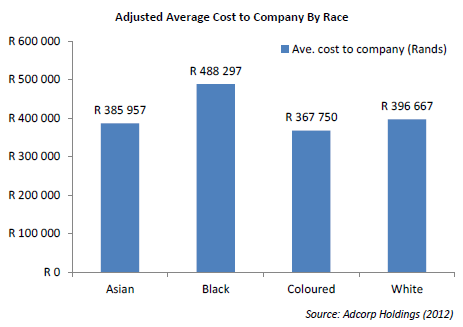
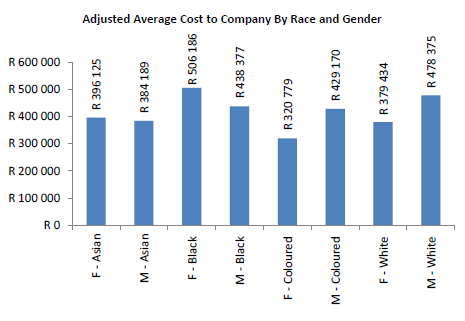
Data from the Adcorp Employment Index suggest that – all else being equal – black females receive 36,4% more than whites in South Africa.

This month, we take a closer look at the wage premium of affirmative action candidates in South Africa. The premium for blacks is now 23.1% – and for black females is now 36.4% – above their white counterparts.

One of the most important labour market indicators in South Africa is the “affirmative action premium” – the wage premium of affirmative action candidates over their non-affirmative action counterparts, holding constant the level of skills, qualifications, experience, on-the-job performance and other pertinent information so as to reflect purely the race-linked pay discrepancies between candidates. Since much of the required information is not recorded or readily available, Adcorp was able to obtain the required information for only 1,604 permanent placements for the 12-month period June 2011 to May 2012, on which the following analysis is based.

As indicated in the figure, Asians and coloureds earn 2.7% and 7.3% less than whites respectively, whereas blacks earn 23.1% more than whites, for equivalent levels of skills, qualifications, experience and on-the-job performance.

Interestingly, when the figures are dissected further by gender, Asian and black females earn 3.1% and 15.5% more than their male counterparts; whereas coloured and white females earn 25.2% and 20.6% less than their male counterparts.

The data is not consistently available over time, so it is impossible to say for the moment whether the affirmative action wage premium – which applies exclusively to blacks, and most notably to black females – has been rising or falling over time. But Adcorp will track and report on these figures in coming editions of the Adcorp Employment Index.

This is an edited extract from the Adcorp Employment Index for June 2012, July 10 2012

Angola marks 10 years since end of civil war

Savimbi
Jonas Savimbi

Angola marked the 10th anniversary of the end of its three-decade civil war on Wednesday as President Jose Eduardo dos Santos unveiled a monument near the site where a long-time rebel leader was killed.

The 27-year war was one of the longest and most brutal in Africa and Dos Santos praised the country’s accomplishments since a peace deal was signed on April 4, 2002.

“Over the past 10 years we’ve been proud to see that many things have changed in (the province of) Moxico as well as in the rest of the country and our goal is to keep changing to develop the country,” said Dos Santos, in power for 32 years.

He spoke in Moxico’s capital Luena, where UNITA rebel chief Jonas Savimbi was killed while battling government soldiers on February 22, 2002, paving the way for the peace deal less than two months later.

Dos Santos, 69, was greeted at the airport by supporters wearing shirts branded with his image before unveiling the peace monument in a city park, named after Russian revolutionary Lenin, images broadcast on national television showed.

The Angolan conflict became a Cold War proxy battle, with the Soviet Union and Cuba backing Dos Santos’ MPLA, while the United States and apartheid South Africa assisted Savimbi’s UNITA rebels.

Since the war ended, oil exports have fuelled massive economic growth and billions of dollars have been poured into repairing roads, railways and airports.

Dos Santos trumpeted the successes of his ruling Popular Movement for the Liberation of Angola (MPLA) party.

“After the 2008 general election, we made a promise to work to improve the situation in the country, and I think, little by little, we are succeeding,” the veteran leader said.

UNITA, still the main opposition party, was roundly beaten in the 2008 polls amid accusations that the vote was stacked in the MPLA’s favour.

Some have voiced concern that fraud could taint an election expected in September, which would be only the third vote in Angola since independence from Portugal in 1975.

“We have no need to cheat because we are very big and very strong party,” said Dos Santos, who is Africa’s second-longest serving president.

In the capital Luanda, residents wore white and marched to music, while children joined a street race across the city. A concert with several prominent local artists was set for later on Wednesday.

Dos Santos has been hailed as peacemaker who steered the oil-fueled economic boom but has through the past year faced criticism amid signs of mounting corruption within his regime.

Authorities have also stamped out a series of youth-led protests calling for reform.

Despite boasting one of the world’s fastest growing economies, poverty is still rampant in the country of 18.4 million people.

Nearly 2.4 million people still live in areas riddled with landmines, according to the International Campaign to Ban Landmines.

– AFP

Facebook saves Afrikaner family during robbery

A Pretoria mother who was attacked by two armed robbers in her home on Friday night managed to summon help by updating her Facebook status, it was reported on Monday.

Lizette Langeveld, 43, was confronted by two armed men who broke into her Centurion home around 7.30pm, physically assaulted her and threatened to rape her, the Beeld reported.

They tied her up in her bedroom together with her 10-year-old son, took her cellphone and told her they would wait for her husband to come home and kill him.

She managed to free both her son and herself and they hid inside her wardrobe with her laptop computer.

She updated her Facebook status, saying “Please help! We have an armed robbery, they’re waiting for Hennie at the gate, please phone him, don’t let him come inside.”

A second message was posted a few minutes later, saying “Help! Call Hennie. We’ve managed to untie ourselves. They said they would come back to rape me. Armed.”

One of Langeveld’s friends saw the message on Facebook, and alerted Hennie Langeveld immediately.

Police and security guards arrived on the scene within minutes, but the robbers had fled. – Sapa