“Your guess is as good as mine,” David Montoya, the inspector general of the Department of Housing and Urban Development, says of $700 million in missing taxpayer money that Louisiana homeowners were given in the wake of Hurricane Katrina to elevate and protect their homes from future storms.
A new report released from the inspector general’s office shows that more than 24,000 homeowners who received grants of up to $30,000 to elevate their homes either misspent or pocketed the money.
“The fact of the matter is that the money they received was for a specific purpose and the specific purpose was to elevate these homes to avoid future catastrophes,” Montoya tells Power Players.
He rates the home elevation program as little more than a complete failure.
“Considering there was just under $1 billion earmarked for this particular program and there’s $700 million that wasn’t used for that, I’d give it a very low D,” he says.
But the lessons learned from the failed home elevation project provides a useful roadmap as Congress moves to offer recovery funds to victims of Hurricane Sandy.
“Clearly, to give money out on the front end right after a disaster, when many of these people lost everything, with a promise to do something down the road, I think is counterproductive to what the program was designed to do,” says Montoya.
Montoya says his office will recommend that, for future disaster relief programs, funds are disbursed to individuals only after the project has been completed.
To hear more of the interview with the inspector general, including his explanation of why the government likely will never get the money back, check out this episode of Power Players. – YahooNews
British Chief of Defence Staff Gen. Sir David Richards
In what is believed to be the first time since the 1940s, the entire British defense staff will be here March 25 to discuss long-range strategy and the impact of budget cuts with their U.S. counterparts, according to U.S. and British sources.
The meeting is reminiscent of the Combined Chiefs of Staff, when British and American military leaders joined forces during World War II. Both nations are undergoing significant budgetary reductions and will continue to rely on each other in future years for support. Understanding what capabilities will survive and won’t is essential to long-term strategic planning.
“The relationship military to military is very strong. We have common interest in how we meet the financial constraints placed on both nations, but also on issues like how we manage the drawdown in Afghanistan and also how we reconfigure post Afghanistan,” said Sir Gerald Howarth, a member of parliament and the ex-defense minister responsible for international security affairs from 2010 to 2012.
“We have a huge amount of strategic issues to discuss where we have a very large level of common interest,” he said.
A Defence Ministry spokesman characterized the meeting as private and declined further comment.
In the U.S., spokesmen for the Office of the Secretary of Defense and the Joint Chiefs of Staff did not respond to questions.
U.S. and British military leaders regularly discuss ongoing issues. What’s different about this series of meetings is they will focus not on immediate budget, program or operational issues, but the strategic future of the Anglo-American alliance, including deepening cooperation.
In addition to the U.S. Joint Chiefs, British attendees are expected to include Gen. Sir David Richards, chief of the Defence Staff; Gen. Sir Nicholas Houghton, vice chief of the Defence Staff, who will take over as chief when Richards retires later this year; Air Chief Marshal Sir Stephen Dalton, chief of the Air Staff; Adm. Sir George Zambellas, incoming Navy first sea lord; Gen. Sir Peter Wall, chief of the General Staff; and Air Chief Marshal Sir Stuart Peach, commander of Joint Forces Command, sources said.
The U.S. and U.K. regularly share the most sensitive military intelligence, technology and equipment, including submarine-launched nuclear ballistic missiles. Britain over the past decade in particular has shaped its capabilities to dovetail with U.S. forces.
The British are the leading developmental partner on the U.S.-led F-35 fighter program with Lockheed Martin and have in their inventory Boeing C-17 transports, Chinook and Apache helicopters and Lockheed C-130 cargo aircraft. In addition, the Royal Air Force is buying highly sensitive RC-135 Rivet Joint intelligence planes produced by L-3 Communications in the U.S., making London the only international customer for that program.
The meeting comes as the Pentagon faces $500 billion in spending cuts over the coming decade, which will force senior leaders to make difficult choices. The British delegation arrives with particular experience in that area, having faced even deeper budget cuts — in percentage terms — over the past several years, forcing major reforms to force structure, organization and acquisition programs in that time.
U.S. and British forces routinely train together and have fought side-by-side over the past decade in Afghanistan and Iraq. In Afghanistan, British Lt. Gen. Nick Carter serves as the deputy commander to U.S. Marine Gen. Joseph Dunford, commander of NATO forces.
“On the day-to-day business of military cooperation, the relationship between the U.S. [NATO] commander and the British second in command is another good example of working in partnership,” Howarth said.
The two militaries regularly participate in personnel exchanges. – Defence News
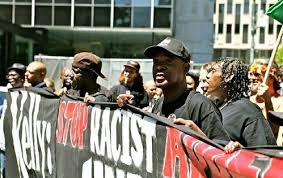
A New York State Senator testified in federal court Monday that New York City Police Commissioner Ray Kelly explained the city’s controversial stop-and-frisk program as a means of instilling fear in young African American and Hispanic men.
Twenty-two year NYPD veteran and State Senator Eric Adams told the court that in 2010 he traveled to Albany to voice his support to a bill that would forbid the NYPD from keeping a database of information pulled from stop-and-frisks that did not lead to an arrest. That bill would ultimately pass, but Adams testified on Monday that, upon telling Kelly the program disproportionately targeted young black and Latino men, the commissioner was far from concerned.
The new testimony follows evidence from more than one New York cop indicating that the department has set, officially or unofficially, quotas for stop-and-frisks. There has also been recent testimony from those officers that the program specifically targets people of color.
Kelly “stated that he targeted and focused on that group because he wanted to instill fear in them that every time they left their homes they could be targeted by police,” Adams said.
He said Kelly justified his reasoning by asking, “How else would we get rid of guns?”
“I was amazed,” Adams said in court. “I told him that was illegal.”
Under Kelly and New York Mayor Michael Bloomberg the NYPD has stopped an estimated 4.4 million people, most of whom have been in the demographic Kelly allegedly described to Adams. The policy allows officers to stop pedestrians on the street if they perceive that person is on the way to committing a crime, is in the process of committing a crime, or leaving the scene of a crime. Roughly 94 per cent of the stops result in no charges.
The program has come under attack in recent months as civil rights lawyers try to prove stop-and-frisk is a violation of the 4th and 14th amendments. Adams’ testimony comes after previous witnesses told the court that NYPD officers have acted with impunity since the program began in 2002.
Adams said stop-and-frisk is a “great tool” to stopping crime but mentioned that “nowhere” does it empower the NYPD to “use the tool to instill fear. Nowhere.”
City attorney Heidi Grossman questioned Adams’ recollection of the conversation while claiming Kelly meant officers should “instill belief” in young men of minority backgrounds, not “instill fear,” though she did not specify what such a belief would be in.
“I don’t think anyone in their right mind would believe the police commissioner would say the police department is targeting, just for targeting, blacks and Hispanics,” Grossman said.
She also tried to read from a written statement from Kelly denying the claim before being stopped by Manhattan Federal Judge Shira Scheindlin.
“If he’d like to come here, he’s welcome in this courtroom,” Scheindlin said, regarding Grossman’s attempted “backdoor” testimony from Kelly.
Outside the courthouse Adams told reporters that because his Brooklyn district has one of the highest crime rates in the city, it is also heavily policed. He said his constituents find themselves trying to stay away from crime as well as overbearing law enforcement.
“They feel trapped,” he said, adding that “Cops don’t want to do this. Cops are so frustrated they are wearing wires to roll call.” – RT
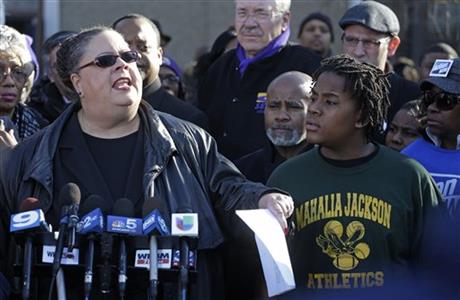
Karen Lewis of the Chicago Teacher's Union during a protest against the closure
CHICAGO (AP) — Tens of thousands of Chicago students, parents and teachers learned Thursday their schools were on a long-feared list of 54 the city plans to close in an effort to stabilize an educational system facing a huge budget shortfall.
Mayor Rahm Emanuel says the closures are necessary because too many Chicago Public School buildings are half-empty, with 403,000 students in a system that has seats for more than 500,000. But opponents say the closures will further erode troubled neighborhoods and endanger students who may have to cross gang boundaries to attend school. The schools slated for closure are all elementary schools and are overwhelmingly black and in low-income neighborhoods.
CPS officials say money being spent to keep underutilized schools open could be better used to educate students elsewhere as the district deals with a $1 billion budget deficit. About 30,000 students will be affected by the plan, with about half that number moving into new schools.
“Every child in every neighborhood in Chicago deserves access to a high quality education that prepares them to succeed in life, but for too long children in certain parts of Chicago have been cheated out of the resources they need to succeed because they are in underutilized, under-resourced schools,” said district CEO Barbara Byrd-Bennett. “As a former teacher and a principal, I’ve lived through school closings and I know that this will not be easy, but I also know that in the end this will benefit our children.”
As word of the closures trickled out, parents and teachers reacted with anger and shock, some even crying. Sandra Leon said she got a tearful call from her grandchildren’s kindergarten teacher saying the school was on the list to be closed. Her two grown children also attended the school, and Leon wiped her eyes as she waited outside for her grandchildren.
“It’s been so good for our kids,” Leon said. “This school is everything.”
Chicago officials have moved to close schools in the past, but never anywhere near the number designated at one time by the Emanuel administration. Former Mayor Richard M. Daley’s administration spread school closings over a number of years. CPS, the nation’s third-largest school district, now has 681 schools.
Chicago is among several major U.S. cities, including Philadelphia, Washington and Detroit to use mass school closures to reduce costs and offset declining enrollment. Detroit has closed more than 130 schools since 2005, including more than 40 in 2010 alone.
The issue has again pitted Emanuel against the Chicago Teachers Union, whose 26,000 members went on strike early in the school year, idling students for seven days. It has also put Emanuel and Byrd-Bennett at odds with parents, civic leaders and lawmakers, who have blasted the pair during highly charged community meetings throughout the city and at a legislative hearing earlier this week.
Union President Karen Lewis criticized Emanuel, who is out of town with his family, for being on vacation on the day of the announcement. She called the closings “an abomination.”
“This is cowardly and it is the ultimate bullying job,” Lewis said. “Our mayor should be ashamed of himself.”
The vast majority of the 54 schools are in overwhelmingly black neighborhoods that have lost residents in recent years. Chicago’s black population dropped 17 percent in the last census as African-Americans moved out to the suburbs and elsewhere. The other few schools are majority Hispanic or mixed black and Hispanic. Overall, 91 percent of Chicago public school students are minorities.
Many of the schools identified for closure are in high-crime areas where gang violence contributed to a marked increase in Chicago’s homicide rate last year. The district plans to have community groups help students get to their new locations safely.
Among the critics is Eular Hatchett, who lives in the violence-plagued neighborhood of North Lawndale and walks her 13-year-old nephew DaVontay Horace to school.
“Our parents know about this area,” she said. “They don’t know about those other areas. If they send him way north or way south, I’m not going to do that. It’s too dangerous.”
Because some schools have more than one building, a total of 61 structures will be closed. In addition to the closures, students at 11 other schools will be “co-located” with existing schools. Six schools have been targeted for academic interventions known as “turnaround.”
CPS says the plan will save the district $560 million over 10 years in capital costs and an additional $43 million per year in operating costs.
The district plans to invest $233 million into what it calls the “welcoming” schools, or the buildings that students in closed schools will be moving to. Those funds will be used for air conditioning, upgraded technology and security and to ensure every school has a library.
District officials said they couldn’t calculate how many teachers will be laid off as a result of the cuts because school leaders will make decisions about their own budgets.
Many teachers and parents expressed anger and frustration at how the news of the closures trickled out, leaving some to agonize over rumor and conjecture.
“In a word, the approach was brutal. It’s certainly not deserved by these parents and these kids,” said Mary Visconti, the director of the Better Boys Foundation, a youth organization in the Lawndale neighborhood.
At Lafayette Elementary, where 95 percent of its 483 students come from low-income families, teacher Rosemary Maurello said the principal read teachers a letter from the district Thursday morning saying the school is among those it plans to close. The letter said a final decision would be made in May after more community meetings are held and budget plans are reviewed.
But Maurello said letters and information packets were already being sent to parents and the district’s message to teachers included a mention of specific plans to move the Lafayette students to another school about 10 blocks away.
“It sounds like a done deal to me,” Maurello said.
In one of the fastest-growing areas in psychology, researchers are gaining insight into the mental processes of subjects that are barely able to communicate: babies. In recent years, innovative and playful experimental setups have suggested that infants as young as six months old have a sense of morality and fairness, and that 18-month-olds are capable of altruistically helping others.
Some of this research, though, has also shed light on racial preferences. A new study published in Psychological Sciencesuggests that 9- to 14-month-olds exhibit a preference for their own — in watching a puppet show, at least, they seem to prefer their own kind, and support puppets that pick on those who are different from them.
Because babies can’t communicate verbally, J. Kiley Hamlin of the University of British Columbia has pioneered the use of puppet shows to probe their psychology and better understand how they see the world. In this study, her research team put on an show in which 52 infant participants were led to identify themselves as similar to one of the characters in the show and different from the other.
To accomplish this, the researchers started off by asking the infants to pick a food, either graham crackers or green beans (a little surprisingly, a full 42 percent chose the vegetables). Then, the infants were shown a pair of rabbit puppets, one who liked graham crackers and one who liked green beans:
Once they’d solidly demonstrated each rabbit’s choice, one of them — either the one with the same preference as the infant observer, or the one with an opposite preference — would be randomly chosen to encounter a pair of new characters: one dog, termed a “helper,” and another, called a “harmer.” As the rabbit played with a ball and dropped it, the nice “helper” dog threw it back, but the mean “harmer” dog (below) held onto the ball:
After both of the scenes were over, both dogs were presented to the infant, and the particular dog that the baby first reached for was interpreted as the character it preferred.
The results were a bit startling: When the infants had watched a play involving a rabbit with a food choice that matched theirs, 83 percent preferred the “helper” dog. When they’d watched a play with a rabbit who liked a different food, 88 percent chose the “harmer” dog. This held true regardless of the babies’ original food choices — the only thing that mattered was whether the rabbit’s identity, it terms of food choice, matched their own.
To further parse the motivations underlying the infants’ choices, the researchers conducted a similar experiment that involved a neutral dog that neither help nor harmed the rabbit.
In this part of the study, the older infants’ preferences revealed that when watching rabbits who had different favorite foods than them, they not only liked “harmer” dogs more than neutral dogs, but strongly preferred even neutral dogs when compared to “helpers” (this was true among the 14-month-olds, but not the 9-month-olds). In other words, it seemed that they not only wanted to see the rabbit treated poorly, but also would rather see it treated neutrally than get some help.
Of course, when designing experiments for subjects that can’t use words to communicate, the simplest of variables could potentially throw off the results. It’s unclear, for example, if the researchers alternated which side the “helper” and “harmer” puppets appeared on, so the babies could have been influenced by their emerging sense of handedness.
In the past, critics of such puppet show experiments have also charged that a baby merely reaching for one puppet or another might be an impulsive reflex, rather than reflecting an underlying moral judgment.
What’s clear, though, is that this experiment demonstrated a consistent reflex across the babies tested. While extrapolating this to mean that the babies are racist or bigoted is probably a step too far — for one, they were merely considering individual puppets, not groups of puppets with similar characteristics — it does raise interesting questions about the origins of xenophobia in an individual’s lifetime. – Smithsonian.com
The Wisconsin Department of Public Instruction runs several programs that emphasize racial issues.
One of those programs – an Americorps operation called VISTA (Volunteers in Service to America) – encourages white students to wear white wristbands that serve “as a reminder about your (white) privilege?”
The program for high school students “seeks to build capacity in schools and districts serving low-income families to develop an effective, sustainable, research-based program of family-school-community partnerships,”according to its Facebook page.
That sounds reasonable enough. However, the program becomes a bit suspect when one notices the Gloria Steinem quote on the top of their webpage: “The first problem for all of us, men and women, is not to learn, but to unlearn.”
The webpage list a series of suggestions for high schools students to become more racially sensitive. The suggestions include:
• Wear a white wristband as a reminder about your privilege, and as a personal commitment to explain why you wear the wristband.
• Set aside sections of the day to critically examine how privilege is working.
• Put a note on your mirror or computer screen as a reminder to think about privilege.
The Wisconsin DPI also sponsors CREATE Wisconsin, an on-going “cultural sensitivity” teacher-training program that focuses largely on “whiteness” and “white privilege.” – WTMJ
China is building one of the world’s largest drone fleets aimed at expanding its military reach in the Pacific and swarming U.S. Navy carriers in the unlikely event of a war, according to a new report.
The Chinese military — known as the People’s Liberation Army (PLA) — envisions its drone swarms scouting out battlefields, guiding missile strikes and overwhelming opponents through sheer numbers. China’s military-industrial complex has created a wide array of homegrown drones to accomplish those goals over the past decade, according to the report released by the Project 2049 Institute on March 11.
“The PLA now fields one of the world’s most expansive UAV [unmanned aerial vehicle] fleets,” said Ian Easton and L.C. Russell Hsiao, researchers at the Project 2049 Institute and authors of the new report.
U.S. military forces still operate the largest drone fleet, with at least 679 drones in 2012, according to data from the International Institute for Strategic Studies reported by the Guardian. But the new Project 2049 Institute report estimates that China had 280 military drones as of mid-2011 — a number that has likely grown since then.
Chinese military drones have already entered the frontlines of China’s territorial disputes with neighboring countries such as Japan by flying maritime patrols over disputed areas. The Project 2049 Institute report warned that China could be tempted to use drones more aggressively without risking human lives, or even consider “plausibly deniable” drone attacks blamed upon mechanical failure or cyberhackers.
Chinese strategists have also discussed using swarms of drones to overwhelm the U.S. Navy’s carrier groups in the unlikely possibility of a shooting war. The drones could act as decoys, use electronic warfare to jam communications and radar, guide missile strikes on carriers, fire missiles at U.S. Navy ships or dive into ships like kamikaze robots.
“In particular, numerous authoritative studies indicate a strong emphasis on developing UAVs for locating, tracking and targeting U.S. aircraft carriers in support of long range anti-ship cruise and ballistic missile strikes,” the Project 2049 Institute report says.
All the main branches of the Chinese military field operational drone units. The new report identifies those military units along with major academic, industry and military organizations involved in building Chinese drones.
The report goes on to examine the state of Chinese drone technology. China is developing drones such as the rumored “Dark Sword” stealth drone that have low radar profiles to escape radar detection. It also wants to build “space” drones that could loiter at heights of 31 miles (50 kilometers) above the Earth to provide constant surveillance. (Scientists typically consider 62 miles (100 km) to mark the boundary for the edge of space.)
Chinese engineers have even begun working on drones that have the software brains to fly in formation, do aerial refueling and takeoff and land autonomously — capabilities that the U.S. military has also developed or begun testing for its own drones.
The risk of war between the U.S. and China remains low. But the report cautions that the U.S. military could prepare for the worst-case scenario by hardening its existing air bases in Asia and developing energy weapons (such as lasers) for better air and missile defense. – TechNewsDaily
Congressional Black Caucus Chairwoman Marcia L. Fudge is escalating her campaign to urge President Barack Obama to pick African Americans for his cabinet, publicly releasing a letter that slams the first black president for a lack of diversity among his closest advisers.
“The people you have chosen to appoint in this new term have hardly been reflective of this country’s diversity,” the Ohio Democrat said in the March 11 letter.
Fudge adds that CBC members’ offices have received phone calls from angry constituents questioning why Obama hasn’t nominated anyone with the ability “to speak to the unique needs of African Americans. Their ire is compounded by the overwhelming support you’ve received from the African American community.”
By releasing the letter, Fudge is escalating a campaign by the CBC to push Obama on his cabinet diversity and continuing to demonstrate her willingness to push Obama aggressively to embrace her group’s priorities.
The Ohio Democrat previously moved to promote three CBC members for open Cabinet positions, highlighting a long-standing sore spot in the relationship between the CBC and the president, who was a member of the group during his one Senate term.
Obama, in turn, dispatched top aide Valerie Jarrett for her first Capitol Hill meeting of the second term to meet with the CBC for a State of the Union preview and listening session with members.
White House officials have assured CBC leaders that they will be pleased with future decisions. But Fudge apparently has lost patience, hence the letter Monday.
In the letter to Obama, Fudge said the CBC “looks forward to meeting with you to discuss this and other pressing issues.” CBC spokeswoman Ayofemi Kirby said a meeting with Obama has been requested, but no answer has yet come back from the White House.
Privately, the relationship between Obama and the CBC has been complicated for a long time, with members complaining about social snubs and Obama’s reluctance to address the high black unemployment rate head on.
The rift over Obama’s Cabinet is a case in point. For example, there was some jealousy in Obama’s first term that a member of the Congressional Hispanic Caucus, then-Rep. Hilda L. Solis, D-Calif., was chosen to lead the Labor Department but that no member of the CBC was even vetted for a Cabinet slot. Rep. Sanford D. Bishop Jr. of Georgia was discussed for Agriculture secretary but not formally vetted. – Roll Call Staff
After years in the shadows, the administration’s secret drone program burst into very public view Wednesday with lawmakers grilling the attorney general over legal justification for targeted killings and Sen. Rand Paul launching an old-style one-man filibuster to demand answers from President Obama.
The Kentucky Republican held the floor for hours, effectively blocking a vote on the nomination of John O. Brennan, whom Mr. Obama has tapped to be CIA director. He said he would relent only if the administration publicly vowed not to target Americans on U.S. soil.
“This is a long, drawn-out day, but it’s to try to get some answers,” Mr. Paul said after he crossed the eight-hour mark late Wednesday evening. “It’s to try to shame the president into doing the right thing.”
Democrats, who control the chamber, were forced to delay a vote on the Brennan nomination until at least Thursday, and it could go into the weekend, depending on what other blockades Republicans erect.
At issue is the administration’s argument that it can kill those it suspects have ties to terrorism, including U.S. citizens, without having to put them on trial.
The fulcrum of the debate is the drone program, started under President George W. Bush and expanded by Mr. Obama, which many lawmakers said gives too much power to the executive branch — and raises tricky questions about whether drones could be used to execute Americans in the United States.
The administration has only recently acknowledged the drone program and says it is seeking a public debate in order to find common ground on what Americans are ready to accept.
“I think there is going to be a greater effort at the transparency. A number of steps are going to be taken. I expect you will hear the president speaking about this,” Attorney General Eric H. Holder Jr. told the Senate Judiciary Committee on Wednesday morning.
But he faced bipartisan demands for more information and more clarity on what is and what isn’t allowed.
“You can hear almost unanimous concern about transparency and wrestling with how to move forward here in a way that protects both our constitutional liberties and our security as a nation,” Sen. Christopher A. Coons, Delaware Democrat, told Mr. Holder.
Under close questioning by Sen. Ted Cruz, Mr. Holder repeatedly said American citizens on U.S. soil were not “appropriate” targets for extrajudicial executions.
Mr. Cruz said that wasn’t good enough.
“You keep saying ‘appropriate.’ My question isn’t about propriety. My question is about whether something is constitutional or not,” the Texas Republican said.
“Let me be clear: Translate my ‘appropriate’ to ‘no.’ I thought I was saying no, all right? No,” Mr. Holder said.
Mr. Holder also said he is not sure Congress could ban the president from using drones to kill Americans on U.S. soil. – Washington Times
Farrakhan holds up his book called 'The Secret Relationship Between Blacks and Jews'
Nation of Islam leader Louis Farrakhan says white people are promoting birth control for black women because they fear becoming a minority in the United States.
Farrakhan spoke Saturday at Fountain Street Church in Grand Rapids, invited by the Grand Rapids Community College Black Student Union.
He says white Americans will lose their majority by 2050 and says they’ve introduced birth control to black women “because they don’t want no more black babies.”
MLive.com reports Farrakhan says he opposes same-sex relationships. He says he isn’t “homophobic” and isn’t “afraid of people who choose a lifestyle that’s different” but rather is afraid for them.
The Chicago-based Farrakhan says women’s role is to stay home and raise children with strong moral values.
He also says he isn’t anti-Semitic. – www.freep.com
Starting this week, Internet Service Providers will start throttling connection speeds for customers alleged to be pirating copyright-protected materials.
Months after a controversial “six-strike” program was slated to be rolled out by the biggest ISPs in the United States, the Copyright Alert System (CAS) confirmed on Monday that the initiative has gone live.
The program, critiqued by Internet freedom activists and privacy advocates alike, will let ISPs take six steps of escalating severity in handling incidents where customers are believed to be illegally sharing material. Through the “graduate response” approach, suspected copyright criminals could be issued a series of warnings for illegally downloading protected content.
With the first strike caught by the CAS, a customer could be issued a warning. As strikes increase, however, “mitigation measures,” connection speed throttling and termination of service are all possible options.
“Practically speaking, this means our content partners will begin sending notices of alleged P2P [peer-to-peer] copyright infringement to ISPs, and the ISPs will begin forwarding those notices in the form of Copyright Alerts to consumers,” Jill Lesser of the Center for Copyright Information rights in a blog post on Monday.
“Consumers whose accounts have been used to share copyrighted content over P2P networks illegally (or without authority) will receive Alerts that are meant to educate rather than punish, and direct them to legal alternatives. And for those consumers who believe they received Alerts in error, an easy to use process will be in place for them to seek independent review of the Alerts they received,” she adds — neglecting to mention that the appeals process costs customers $35 a pop.
Previously, Time Warner, Verizon, AT&T, Comcast, Cablevision Systems and other ISPs have signed onto the program, which was last scheduled to start in July 2012. Gigi Sohn, president of digital rights group Public Knowledge, told Wired last year that originally ISPs hoped to roll out the program earlier, but major protests against other restrictive Web policies, including attempts to pass certain legislation, left them to wait until the dust settled.
“SOPA and PIPA definitely had an impact. There was some concern, if they moved ahead too quickly, public opinion would be so raw, this would be caught in the whirlwind of bad PR,” Sohn told Wired.
The Electronic Frontier Foundation notes that the official CSI six-strikes website lets users learn more about the history of copyright, but does so by re-directing them to a page managed by the Copyright Alliance — the same group that advocated heavily for last year’s failed Stop Online Piracy Act, or SOPA.
When the six-strikes program was first introduced, the White House issued an official statement saying it should “have a significant impact on reducing online piracy.” – RT
Supreme Court Justice Sonia Sotomayor upbraided a federal prosecutor Monday for asking racially-charged questions in court.
The justices almost never elaborate on cases they decline to hear, but Sotomayor took the unusual step of issuing a statement condemning the prosecutor, whom she did not name.
She said the prosecutor “tapped into a deep and sorry vein of racial prejudice that has run through the history of criminal justice in our nation.”
The case at hand came from a drug arrest in Texas. The defendant took a road trip with friends and said he did not know they were planning a drug deal.
The prosecutor in the case invoked racial stereotypes in questioning the defendant’s explanation.
“You’ve got African Americans, you’ve got Hispanics, you’ve got a bag full of money. Does that tell you — a light bulb doesn’t go off in your head and say, This is a drug deal?” the prosecutor asked.
Sotomayor harshly criticized the questioning in a statement sharing the African Americans’s decision not to hear an appeal from the defendant.
“Such conduct diminishes the dignity of our criminal justice system and undermines respect for the rule of law,” Sotomayor wrote. “We expect the government to seek justice, not to fan the flames of fear and prejudice.”
Justice Stephen Breyer joined her statement.
The court rejected an appeal in the case on technical grounds. Sotomayor said she agreed with that decision, noting that the defendant’s lawyers limited their ability to appeal by not initially objecting to the prosecutor’s questioning during the trial.
Sotomayor also criticized the Justice Department for downplaying the prosecutor’s remark and acknowledging too late that it was inappropriate.
“I hope never to see a case like this again,” Sotomayor said.
The incarceration rate for African-Americans is so high that young black men without a high school diploma are more likely to go to jail than to find a job, thereby causing the breakup of families and instilling further poverty upon them.
“Prison has become the new poverty trap,” Bruce Western, a Harvard sociologist, told the New York Times. “It has become a routine event for poor African-American men and their families, creating an enduring disadvantage at the very bottom of American society.”
While few would argue against locking up murderers and rapists, many social scientists have begun to discuss the problem of imprisoning too many people – especially when those people face long sentences for nonviolent crimes. The US has the highest incarceration rate in the world, locking up about 500 people for every 100,000 residents, according to the Bureau of Justice Statistics.
The incarceration rate for African-Americans is about 3,074 per 100,000 residents, which is more than six times as high as the national average. Black men in their 20s and early 30s without a high school diploma are particularly vulnerable: with an incarceration rate of 40 percent, they are more likely to end up behind bars than in the workforce, Pew Charitable Trusts reports.
“The collateral costs of locking up 2.3 million people are piling higher and higher,” said Adam Gelb, director of the Public Safety Performance Project of the Pew Center on the States. “Corrections is the second fastest growing state budget category, and state leaders from both parties are now finding that there are research –based strategies for low-risk offenders that can reduce crime at far less cost than prison.”
But while the cost of keeping prisoners might be high for government, the cost is even higher for African-Americans – especially to poverty-stricken families who lose a relative to the penal system. The Times interviewed parents Carl Harris and Charlene Hamilton, whose daughters grew up without a father. Mr. Harris, a crack dealer who received a 20-year prison sentence at the age of 24, was forced to abandon his family when he was locked up.
Unable to help out with the accumulating bills that come with raising children, Hamilton and her daughters ended up homeless on several occasions. Struggling to pay the rent and cover the costs of food, Hamilton also fought to pay for the out-of-state visits to see her daughters’ father.
“Basically, I was locked up with him,” she told the Times. “My mind was locked up. My life was locked up. Our daughters grew up without a father.”
And the couple’s story is not unique: 25 percent of African-Americans who grew up in the past three decades have had at least one parent locked up during their childhood, according to Project Muse. Police have more meticulously cracked down on crime and courts have imposed harsher sentences since 1980, causing the number of Americans – especially blacks – in state and federal prisons to quintuple.
And some believe that certain crimes shouldn’t merit sentences as harsh as the US imposes. Police never caught Mr. Harris dealing drugs, but arrested him for assaulting two people at a crack den. The man is now facing a 20-year sentence for charges including assault, in which he “broke someone’s arm and cut another one in the leg”, as well as a charge of ‘armed burglary’ at the crack den.
“The cops knew I was selling but couldn’t prove it, so they made up the burglary charge instead,” Mr. Harris told the Times.
The high incarceration rate of African-Americans has a detrimental effect on the black community. Epidemiologists have linked high incarceration rates to an increase in sexually transmitted diseases and teenage pregnancy, since the majority of those incarcerated are men, leaving a prevalence of females and greater occurrences of unprotected sex.
“A man will have three mistresses, and they’ll each put up with it because there are no other men around,” Hamilton said. Epidemiologists believe the AIDS rate among African-Americans would be lower if the incarceration rate dropped.
A high incarceration rate also affects children growing up without parents, brothers or sisters. Children are more likely to grow up impoverished, uneducated and emotionally strained. They are also more likely to become aggressive or depressed and could eventually end up in prison themselves.
“Education, income, housing, health – incarceration affects everyone and everything in the nation’s low-income neighborhoods,” Megan Comfort, a sociologist at RTI International, told the Times.
Since the incarceration rate is highest for African-Americans, it makes it more difficult for blacks to rise out of poverty, receive higher levels of education, and escape a life of crime. Young African-Americans are more often imprisoned than employed.
“The social deprivation and draining of capital from these communities may well be the greatest contribution our state makes to income inequality,” Dr. Donald Braman, a George Washington University Law School anthropologist, told the Times. “There is no social institution I can think of that comes close to matching it.”
While mass incarceration might temporarily reduce crime, in the long run, more Americans end up impoverished and more likely to commit a crime themselves. – RT
I am deeply, deeply disturbed at the suggestion in “A Court to Vet Kill Lists” that possible judicial review of President Obama’s decisions to approve the targeted killing of suspected terrorists might be limited to the killings of American citizens.
Do the United States and its people really want to tell those of us who live in the rest of the world that our lives are not of the same value as yours? That President Obama can sign off on a decision to kill us with less worry about judicial scrutiny than if the target is an American? Would your Supreme Court really want to tell humankind that we, like the slave Dred Scott in the 19th century, are not as human as you are? I cannot believe it.
I used to say of apartheid that it dehumanized its perpetrators as much as, if not more than, its victims. Your response as a society to Osama bin Laden and his followers threatens to undermine your moral standards and your humanity.
DESMOND M. TUTU
Aboard MV Explorer, near Hong Kong Feb. 11, 2013
The writer, winner of the 1984 Nobel Peace Prize, is archbishop emeritus of Cape Town.
This website uses cookies to improve your experience. We'll assume you're ok with this, but you can opt-out if you wish. Cookie settingsACCEPT
Privacy & Cookies Policy
Privacy Overview
This website uses cookies to improve your experience while you navigate through the website. Out of these cookies, the cookies that are categorized as necessary are stored on your browser as they are essential for the working of basic functionalities of the website. We also use third-party cookies that help us analyze and understand how you use this website. These cookies will be stored in your browser only with your consent. You also have the option to opt-out of these cookies. But opting out of some of these cookies may have an effect on your browsing experience.
Necessary cookies are absolutely essential for the website to function properly. This category only includes cookies that ensures basic functionalities and security features of the website. These cookies do not store any personal information.
Any cookies that may not be particularly necessary for the website to function and is used specifically to collect user personal data via analytics, ads, other embedded contents are termed as non-necessary cookies. It is mandatory to procure user consent prior to running these cookies on your website.


 Where did all the money go?