SA requested Facebook, Google user info

facebookThe South African government had over the past year submitted 14 requests to Facebook and three to Google to get information about certain users, according to a report.

Facebook did not grant any of the requests, and Google granted one request, after receiving a court order in a case involving defamation.

Following Google’s example, Facebook has just published its first half-year report on government requests.

According to the report, 71 countries around the world submitted about 25,600 requests during the first half of the year to Facebook to obtain IP addresses, profile information and names.

Locally, the Facebook requests were made by various law enforcement agencies such as the police, the Hawks and the Department of State Security, said the department’s spokesman, Brian Dube.

“Our department made two requests to Facebook centred around cyber security.”

According to Facebook and Google, the merits of each request are thoroughly considered before the information is released. – Sapa

Amazon buys Washington

amazonAmazon.com Inc. (AMZN), whose founder Jeff Bezos is purchasing the Washington Post (WPO), ranks among the biggest spenders among high-technology companies seeking to influence the work of the federal government.

Former U.S. Senators Trent Lott, a Mississippi Republican, and John Breaux, a Louisiana Democrat, are among those working for Seattle-based Amazon, which spent $1.7 million on lobbying from January through June, ninth highest among high-tech companies, according to the Center for Responsive Politics, a Washington-based research group that tracks lobbying.

The company weighed in on issues with Congress, the Commerce Department and the Federal Trade Commission on matters such as Internet sales taxes and privacy, patent laws, cybersecurity and online wine sales, Senate filings show.

“They have a huge number of issues before the federal government and now he’s bought the hometown paper for covering those politicians,” said Bill Allison, editorial director for the Sunlight Foundation, a Washington-based watchdog group. “There’s always a concern you’re going to have a conflict when you have wealthy publisher. Given all of Amazon’s issues, it’s hard to see where Bezos won’t have a conflict.”

Ethics specialist Bob Steele agrees.

“There are certainly competing loyalties,” said Steele, director of the Janet Prindle Institute for Ethics at DePauw University in Greencastle, Indiana. “If he handles it very well, it’s possible to manage those competing loyalties, but it’s also possible for competing loyalties to turn into conflicts of interest that could erode the integrity of his journalistic obligations.”

Like other high-tech companies, Amazon has increased its lobbying spending. The company’s 2013 totals for the first six months of the year are 31 percent higher than the $1.3 million spent during the same period a year earlier. In 2000, when the company first reported it was lobbying the federal government, it spent $246,000 during the first six months.

Amazon’s team of lobbyists also includes former Assistant Treasury Secretary Jonathan Talisman, who served in the Clinton administration; Elizabeth Frazee, former aide to House Judiciary Committee Chairman Bob Goodlatte, a Virginia Republican; and Holly Fechner, former counsel to the Senate Health, Education, Labor and Pensions Committee.

Bezos, chief executive officer of Amazon, is purchasing the Post on his own, paying $250 million to the Washington Post Co., for a newspaper which has been held by the family of Post CEO Donald Graham since 1933.

Bezos must consider the reputation of the Post going forward as he acquires a newspaper at the heart of reporting on and editorializing about Washington’s issues. Kelly McBride, an ethics specialist at the Poynter Institute, a St. Petersburg, Florida-based journalism training organization, says Bezos would undercut the value of his purchase if he used the Post to advocate for his business interests.

“He will have to create — and I have no doubt that he will — a standard of independence and transparency in his newsroom,” McBride said. “It doesn’t make any business sense for it to become a mouthpiece. It makes business sense to do the right thing.” – Bloomberg

Children banned from discussing fracking in their lifetime


frackingwater
Frack gag: No discussion about water contamination

The 7- and 10-year-old children of a Pennsylvania couple that reached a settlement following a lawsuit involving health issues brought on by fracking have been barred from discussing details of the case for the rest of their lives.

Though a gag order is not unusual in itself when large corporations reach a settlement with plaintiffs in court, the August 2011 case of a family that went to court with Range Resources Corporation, Williams Gas/Laurel Mountain Midstream, and Markwest Energy due to the environmental and health impact caused by gas fracking operations has raised eyebrows for its inclusion of the couple’s young children.

The Pennsylvania family reached a $750,000 settlement with the gas companies, and have used the award to relocate. In exchange, however, Chris and Stephanie Hallowich agreed that no member of their family could comment on the case “in any fashion whatsoever.”

Details of the case only emerged recently when the Pittsburgh Post-Gazette managed to get court transcripts released. The paper’s reporters were originally barred from attending the settlement hearing, and had to wait until a three-judge panel of the Pennsylvania Superior Court ruled that a lower court had erred in blocking the unsealing of the records.

Court records, which should have included details of the settlement but did not, paint a confusing picture for Chris and Stephanie Hallowich as they tackled the significance of their gag order.

“We know we’re signing for silence forever, but how is this taking away our children’s rights being minors?” Stephanie Hallowich asked the judge.

“I mean, my daughter is turning 7 today, my son is 10.”

According to the transcripts, Judge Polonsky, who oversaw the case, was unable to clarify. The family’s attorney, Peter Villari, questioned whether the order would be enforceable.

“I, frankly, your Honor, as an attorney, to be honest with you, I don’t know if that’s possible that you can give up the First Amendment rights of a child,” stated Villari.

Along with the gas companies, the Hallowich family also sued the state’s Department of Environmental Protection. In its ruling to unseal court records, the superior court also noted that the August 2011 hearing during which the record was sealed was held three days prior to schedule, without an official notification of the change of date, reports the New York Times.

According to Bruce Baizel, Energy Program Director at Earthworks, which focuses on mineral and energy development, the motives behind restrictive gag orders post-settlements is to conceal any evidence of adverse environmental impact from hydraulic fracturing, or fracking.

“The refrain in the industry is, this is a safe process. There’s no record of contamination. That whole claim would be undermined if these things were public,” Baizel told ClimateProgress.

Moreover, attempts to measure the number of settlements with non-disclosure agreements have failed.

“They don’t have to be registered, they don’t have to be filed. It’s kind of a black hole,” says Baizel.

Prior to the settlement the Hallowichs said that nearby gas drilling had caused “burning eyes, sore throats, headaches and earaches, and contaminated their water supply.”

Once the settlement was reached and the gag order enacted, however, a spokesman for Range Resources stated that the family had “never produced evidence of any health impacts,” and that the Hallowichs primary motive for moving was instead due to “an unusual amount of activity around them.” – RT

Ripping off the poor, compliments of Icasa

icasaSouth Africa’s communications regulator has been failing to perform and allowing mobile service companies to “rip off” the poor, MPs say.

Members of Parliament’s labour and public enterprises select committee on Wednesday were briefed by the Independent Communications Authority of South Africa (Icasa) on the high cost of broadband and cellphone calls.

During the briefing, African National Congress MP Livhuhani Mabija said the committee had been experiencing “a lot of problems with Icasa”, and suggested it was suffering from a disease.

“According to my personal understanding, analysis, and diagnosis … there is a very dangerous cancer … that is eating Icasa.

“And, before a thorough examination is done, and there is a diagnosis and medication to heal it, our masses are going to be suffering. The poorest of the poor are going to suffer. Something needs to be done.”

She said Icasa was not playing the role expected of it. “We are not happy about the product. They [Icasa] are not giving us what is expected of them. This is very serious. Heads must start rolling,” Mabija said.

Earlier, Icasa senior marketing manager Christian Mhlanga showed members a graph indicating that the cost of using pre-paid mobile phones in South Africa was “way above” that of most other African countries.

“The cost to communicate in our country is too high,” he said, adding that Icasa was taking steps to address this.

‘Plagued’
The committee also heard from communications department deputy director general Themba Phiri, who said the mobile market in South Africa was dominated by the two biggest operators – MTN and Vodacom. Between them, they had over 91% of the market. He said the telecommunications sector was “plagued with high prices”.

In a recent study, South Africa was ranked 30th out of 46 “as having the most expensive pre-paid mobile tariffs among African countries”.

He also pointed out that the South African telecommunications sector “grew from about R7-billion in 1992, to over R100-billion in 2009”.

Among outcomes of this growth were high retail wholesale prices, and pricing information being presented in such a complex manner “that even the most sophisticated consumer cannot comprehend for informed decision making”, Phiri said.

Committee chairperson Priscilla Themba lambasted senior Icasa officials present at the briefing, including the authority’s chairperson Stephen Mncube, telling them their presentation was “not up to what we expected”.

ANC MP Mbuyiselo Jacobs wanted to know when “the rot had started” at Icasa. “Because Icasa is the regulator and supplier of licences. [Yet] it supplies them without any restrictions; it just gives.”

He suggested mobile service companies could do whatever they liked. “That is why these companies are regulating themselves. That’s why they are putting such high prices, and no-one is monitoring that.”

‘Ripped off’
Jacobs also accused the cellphone service companies of “ripping off” the poor. “You [Icasa] say … South Africa is ranked 30th out of 46 countries as having the most expensive pre-paid mobile tariffs. And this is meant for the poor because the ordinary people [use] pre-paid. They do not use contracts.

“So it means they [the companies] are ripping off the poor … and now, what is the function of Icasa if we allow that our people should be ripped off?”

Cellphones were an essential means of communication nowadays. “So why do we have to make it expensive …? I’m not happy at all.”

Jacobs further suggested mobile service providers were determining prices among themselves. “They are talking among themselves on how to determine the prices, and we are not there to monitor, or to bring them [the prices] down … they are talking among themselves, and we are not protecting our own people,” he said.

Committee members also called for a review of existing legislation so that mobile service companies which wanted to operate in South Africa could “dance to the music we play”.

Price regulation
Phiri said existing legislation – the Electronic Communications Act – did not make provision for price regulation. “We do not have a regime of a definite price regulation, where you can say the minimum must be this, and the maximum shall be that.

However, this was an issue that “the ICT policy review, having been launched at a ministerial level, has to look at”, he said.

Phiri said the matter of high pre-paid tariffs was “a huge problem”.

Wednesday’s committee meeting comes at the same time Parliament’s communications portfolio committee is conducting public hearings in three provinces on the high cost of communication, including mobile tariffs, in South Africa.

A recent international survey ranked the country 117 out of 140 countries in terms of mobile tariffs. – Sapa

Independent media shake establishment

George Little
George Little

In a groveling public display earlier this week, the American Department of Defense announced plans to increase its public affairs efforts due to the devastating effect independent media is having on the Pentagon’s ability to control its news, more specifically, its ability to quash negative news stories before they go viral.

On Thursday, the DoD bemoaned the fact that, because of citizen journalists, social media and other online platforms reporting news in real time, the public is more quickly becoming aware of the constant patterns of contradictions and habitual lying by a government long ago captured by a group of corrupt interests.

“..we cannot hide our bad news stories. Bad news gets out one way or the other and we must come to terms with telling bad stories as well as the good,” the secretary of defense for public affairs, George Little, stated.

When bad things happen, the American people should hear it from the DoD, not as a scoop on an aggregated news site, Little said.

When it came time for a brief question and answer segment, Staff Sgt Hostutler, a junior enlisted member of Air Force production, highlighted that many in her position feel that, as a result of recent spates of negative publicity, the American people are just not buying their stories anymore, making it difficult to execute positive spin effectively.

“My question is: you mentioned that we need to start telling the story about the bad news as well as the good, and the issue I see that we’re facing… It seems like we have this culture in our career to kinda glaze over these issues and put out this positive press, and “No, our jets are fine,” and so with the good and the bad, I don’t think the American people actually trust us to deliver accurate information.

“What’s the plan to change that in the way ahead, because to continue the way we have, to continue to put that positive spin, it feels like we’re losing a lot of our audience because they’re not listening, because we keep saying the same thing over, everything is okay, and it’s not…

“… Is there a plan to kinda change the way that we think? Because as it is, a lot of people, from what I can see, are going through, “We’re putting out mindless propaganda,” is what some of us feel that we’re putting out and what the American people feel that we’re putting out, so how do we change this?”

In essence, this is a signal of defeat to the power that is independent media, and shows just how large of an effect it is having. All independent forms of journalism alive on the web today are frequently been the target of naysayer critics saying these stories actively “hurt” the White House’s message “on a daily basis.”

On one hand, the government has revealed it is not invincible to the onslaught of curious, honest and hard-working journalists eager to obtain and report the truth. It shows just how vulnerable the man behind the curtain really is; in all his power, he’s upset over the few forms of media he can’t control.

With their constant contradictions being exposed, the American government is finding it harder to keep their stories straight and consistently gets caught off-guard. – prisonplanet.com

Microsoft helped NSA to spy

skypeMicrosoft worked hand-in-hand with the United States government in order to allow federal investigators to bypass encryption mechanisms meant to protect the privacy of millions of users, Edward Snowden told The Guardian.

According to an article published on Thursday by the British newspaper, internal National Security Agency memos show that Microsoft actually helped the federal government find a way to decrypt messages sent over select platforms, including Outlook.com Web chat, Hotmail email service, and Skype.

The Guardian wrote that Snowden, the 30-year-old former systems administrator for NSA contractor Booz Allen Hamilton, provided the paper with files detailing a sophisticated relationship between America’s intelligence sector and Silicon Valley.

The documents, which are reportedly marked top-secret, come in the wake of other high-profile disclosures attributed to Snowden since he first started collaborating with the paper for articles published beginning June 6. The United States government has since indicted Snowden under the Espionage Act, and he has requested asylum from no fewer than 20 foreign nations.

Thursday’s article is authored by Glenn Greenwald and Laura Poitras, two journalists who interviewed Snowden at length before he publicly revealed himself to be the source of the NSA leaks. They are joined by co-authors Ewen MacAskill, Spencer Ackerman and Dominic Rushe, who wrote that the classified documents not only reveal the degree in which Microsoft worked with the feds, but also detail the PRISM internet surveillance program. The US government’s relationships with tech companies are also included in the documents, according to the journalists.

“The latest NSA revelations further expose the tensions between Silicon Valley and the Obama administration,” the journalists wrote. “All the major tech firms are lobbying the government to allow them to disclose more fully the extent and nature of their cooperation with the NSA to meet their customers’ privacy concerns. Privately, tech executives are at pains to distance themselves from claims of collaboration and teamwork given by the NSA documents, and insist the process is driven by legal compulsion.”

In the case of Microsoft, however, it appears as if the Bill Gates-founded tech company went out of its way to assist federal investigators.

Among the discoveries made by the latest Snowden leaks, Guardian journalists say that Microsoft specifically aided the NSA in circumventing encrypted chat messages sent over the Outlook.com portal before the product was even launched to the public.

“The files show that the NSA became concerned about the interception of encrypted chats on Microsoft’s Outlook.com portal from the moment the company began testing the service in July last year,” they wrote. “Within five months, the documents explain, Microsoft and the FBI had come up with a solution that allowed the NSA to circumvent encryption on Outlook.com chats.”

According to internal documents cited by the journalists, Microsoft “developed a surveillance capability” that was launched “to deal” with the feds’ concerns that they’d be unable to wiretap encrypted communications conducted over the Web in real time.

“These solutions were successfully tested and went live 12 Dec 2012,” the memo claims, two months before the Outlook.com portal was officially launched.

In a tweet, Greenwald wrote that “the ‘document’ for the Microsoft story is an internal, ongoing NSA bulletin over 3 years,” and that The Guardian “quoted all relevant parts.” The document is not included in the article.

The Guardian revealed that Microsoft worked with intelligence agencies in order to let administrators of the PRISM data collection program easily access user intelligence submitted through its cloud storage service SkyDrive, as well as Skype.

“Skype, which was bought by Microsoft in October 2011, worked with intelligence agencies last year to allow Prism to collect video of conversations as well as audio,” the journalists wrote.

That allegation comes in stark contrast to claims made previously by Skype, in which it swore to protect the privacy of its users. RT reported previously that earlier documentation supplied by Snowden showed that the government possesses the ability to listen in or watch Skype chats “when one end of the call is a conventional telephone and for any combination of ‘audio, video, chat and file transfers’ when Skype users connect by computer alone.”

RT earlier acknowledged that Microsoft obtained a patent last summer that provides for “legal intercept” technology. The technology allows agents to “silently copy communication transmitted via the communication session” without asking for user authorization. In recent weeks, however, Microsoft has attacked the government over its secretive spy powers and even asked the Foreign Intelligence Surveillance Court if it could be more transparent in discussing the details of FISA requests compiling tech companies for data.

“We continue to believe that what we are permitted to publish continues to fall short of what is needed to help the community understand and debate these issues,” Microsoft Vice President John Frank wrote last month.

“In the past, Skype made affirmative promises to users about their inability to perform wiretaps,” Chris Soghoian of the American Civil Liberties Union told The Guardian. “It’s hard to square Microsoft’s secret collaboration with the NSA with its high-profile efforts to compete on privacy with Google.”

Earlier this week, Yahoo requested that the FISA court unseal documents from its own FISA battle. The court ruling in 2008 compelled Yahoo – and later other Silicon Valley entities – to supply the government with user data without requiring a warrant.

“Blanket orders from the secret surveillance court allow these communications to be collected without an individual warrant if the NSA operative has a 51 percent belief that the target is not a US citizen and is not on US soil at the time,”The Guardian reporters wrote. “Targeting US citizens does require an individual warrant, but the NSA is able to collect Americans’ communications without a warrant if the target is a foreign national located overseas.”

During a March press conference, FBI general counsel Andrew Weissman said that federal investigators plan on being able to wiretap any real-time Internet conversation by the end of 2014.

“You do have laws that say you need to keep things for a certain amount of time, but in the cyber realm you can have companies that keep things for five minutes,” he said. “You can imagine totally legitimate reasons for that, but you can also imagine how enticing that ability is for people who are up to no good because the evidence comes and it goes.”

Former CIA officer Ray McGovern expanded further on the subject to RT, remembering the Bush presidency and how unsurprising it is that this sort of breach of rights continues to exist.

“If you look at what happened when Bush, Cheney and General Hayden – who was head of the NSA at the time – deliberately violated the law to eavesdrop on Americans without a warrant, did the telecommunications companies cooperate? Verizon, AT&T…All the giants did…the one that didn’t was Quest. And what happened to Quest? Well, the CEO ended up in jail – and he still might be in jail – on some unrelated charges.”

Later the Congress voted to hold everyone in an innocent light, including the companies who were complicit in the spying. So there is absolutely no disincentive not to engage in violating people’s rights, McGovern warns.- RT

PRISM fears boost private search engine DuckDuckGo

duck-duck-goIf you want to know just how crazy fear over PRISM-like surveillance has made the Internet, take a look at DuckDuckGo.

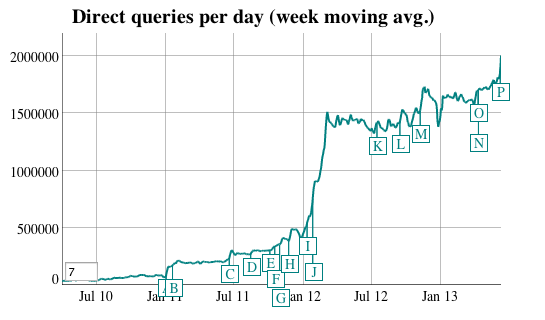
Thanks to the National Security Agency leaks and some well-timed media appearances, the private search engine is having its best traffic week ever. Visitors to the site made a record 2.35 million direct searches on Wednesday — a 26 percent increase over the previous week.

For DuckDuckGo founder Gabriel Weinberg, the numbers are proof yet again that people are eager to find and use viable alternatives to popular web services, which are prime targets for government snooping. “We offer that in web search, and there are others that offer it in other verticals. As people find out about these alternatives, they make that choice,” Weinberg said via email today.

DuckDuckGo was launched in 2008 and has since become the foremost search engine for those concerned about not just snooping by the government but Google as well. When visitors search via DuckDuckGo, the search engine doesn’t track them; it just gives them the search results they request. (Like Google, DuckDuckGo does serve contextual ads, which is how it makes its money.)

Traffic to DuckDuckGo tends to spike whenever new privacy fears pop up

While interest in the search engine has climbed over the past year, fears over PRISM surveillance have made DuckDuckGo look significantly more important and necessary seemingly overnight.

“I believe the surveillance story is paramount right now, and people are talking about it. DuckDuckGo users are telling their friends and family about the private alternatives,” Weinberg said.

On a similar note, this week designer Peng Zhong launched PRISM Break, a comprehensive site that lists private alternatives to popular web services. – Venturebeat.com

Pirate Bay plans surveillance-free messaging app

piratebayThe co-founder and former spokesperson of the file-sharing site Pirate Bay Peter Sunde is working on a new iPhone and Android messaging application that will allow the users to protect their conversations from spying.

The application called Hemlis – ‘secret’ in Swedish – utilizes end-to-end encryption to make sure that only the two people in a conversation will have access to its data.

“All communication on today’s networks is being monitored by government agencies and private companies. The politicians are not going to stop it, they’re actually asking for more,” Sunde said in a video about the app. “That’s why we decided to build a messaging platform where no one can spy on you, not even us.”

Indeed, not even Sunde and the team developing the app will see the text messages’ contents, unlike traditional applications that leave the trails of the data – something, which allows the corporations to access it.

No advertisements are set to appear in the application.

“Normally security results in a complex and unfriendly user experience. It should not be that way. Hemlis is a messenger for everyone, so we are dedicated to creating the most user friendly messenger ever,” the description of the app reads.

RT spoke to Sunde about Hemlis’ technical side and the implications of its existence.

“We know how to encrypt the traffic and which countries we can have service in and in which countries we can allow traffic to pass. So we are building a network on top of their own internet to pass the messages along encrypted. So it’s both a technology but it’s also aware of the global legal framework for privacy,” Sunde said.

Although many have tried to link encrypted communication to terrorism, Sunde says the possibility of terrorists using Hemlis is not a valid argument in this case.

“We are talking here about normal people who do not have access to that technology yet. So terrorists are definitely not going to be on our system – they are already on their own systems; they wouldn’t trust us… so I think the only people we are helping are the [ordinary citizens] whom the government is surveilling.”

There is currently a crowd-funding campaign for the application, with the users willing to participate paying in cash or Bitcoin.

At $5, extra features in the app are unlocked, while after spending $10 or more the user gets to pre-register usernames. A donation of $500 allows to be mentioned as a fundraiser in the application, plus hundreds of unlock codes.

The fundraising campaign is in its early stage, though, so there is no official release date planned for the application.

The development of the app follows the NSA leak scandal, and Sunde’s target group are those who are also concerned about the level of government surveillance and data capture.

Sunde is one of the three founders of The Pirate Bay, although he stepped down as the website’s spokesman in 2009. When he announced his departure from The Pirate Bay, he pointed out he was interested in moving on to new projects.

The Pirate Bay (commonly abbreviated TPB) is a website that provides torrent files and magnet links for file sharing using the BitTorrent protocol. The site was founded in Sweden in 2003, and has faced multiple legal threats since its creation.- RT

SA science website outdated since 2008 despite R16 million grant

saastaDespite a R16-million grant, most information on the SA Agency for Science and Technology Advancement’s website has not been updated in years.

A member of the public visiting the South African Agency for Science and Technology Advancement’s (Saasta’s) website for information about science in the country will find information that is outdated, and in some cases dating back to 2008. This is despite the fact that last year the agency received a parliamentary grant of more than R16-million. Only two links are up to date.

Saasta – a business unit of the National Research Foundation – is mandated with science and technology communication but despite a parliamentary grant, that since 2009 has averaged R15-million annually, it does not appear to have the resources to update its website. The site is an important avenue for people interested in science in South Africa.

Science communication has been highlighted as a way to increase interest among school learners in science, technology and engineering, and to encourage them to pursue these subjects in secondary and tertiary education.

Since the 2010/11 financial year, nearly R50 000 has been spent on upgrading and adding new information to the site, with the most recent being information about National Science Week 2013, which went up last week. However, the main page calls for entries in competitions, whose closing dates were in 2011. Also, according to the “Events” pages, the only events that Saasta has organised since 2009 were a staff meeting and a “Science Unlimited KwaZulu-Natal” event in 2010.

Head of corporate communications at Saasta Ina Roos told the Mail & Guardian that she was in charge of updating content, and pointed to the call for National Science Week proposals. “We don’t have a specific budget for the website,” she said, adding that the information and communications technology co-ordinator resigned last year and that a new person had just been appointed.

Beverley Damonse, group executive for corporate relations and science engagement at the National Research Foundation (NRF) and formerly executive director of Saasta, acknowledged “there is room for improvement”. However, she said: “The largest percentage of [Saasta] funding is contract [funding] … Contract funds are directed to specific projects” rather than core activities.

“Science communication is still a developing area … There are pockets of excellence driving science communications, but [Saasta] is not fully resourced in terms of a science communication entity,” Damonse said, adding that the focus has been on “educators and learners because of the science support needed in the system”.

Numerous attempts to contact Saasta managing director Dr Jabu Nukeri were unsuccessful. – M&G

Tablets to overtake PCs by 2015 as prices plummet

A tablet
A tablet

Tablet prices are plunging amid a flood of new devices and cutthroat competition for market share.

Amazon has slashed prices of its Kindle HD tablets to as low as $169 in the US and 139 pounds in Britain, while Barnes & Noble has cut the price of its Nook to as low as $129, and has announced plans to outsource production of its tablets.

“Since Hewlett-Packard launched its tablet, there has been a lot of pressure on prices,” said Rob Enderle, analyst with Enderle Group.

HP sells its Android-powered seven-inch Slate for as low as $139, helping make the paperback-size tablet computer an affordable commodity.

A Gartner survey suggests tablet sales globally will rise 67.9 percent to 202 million units this year, but analysts say the market is cooling after a couple of years of sizzling growth.

Gartner said the red-hot growth in tablets and smartphones will taper off as these devices gain longer life cycles. The report said many consumers are opting for “basic” tablets to cut costs.

“It looks like the market may be tiring of tablets and as makers get desperate, you may see more pressure on prices,” Enderle said.

Some retailers are selling tablets for less than $100, but Enderle said the flood of poor-quality devices may eventually backfire and turn off consumers.

Jitesh Ubrani, analyst at the research firm IDC, said many of the low-cost tablets come from small, sometimes unbranded “whitebox” vendors.

“The decline of the PC market makes it increasingly important for PC vendors to compete in the tablet space,” Ubrani said

“As more top-tier brands introduce low-cost products, we expect to see a reduction in the number of whitebox vendors.”

Even so, the analyst said, average prices for tablets is likely to drop further, and that tablet shipments are expected to overtake all PC shipments in 2015.”

The market leader, Apple, has so far kept above the fray, keeping prices steady on its iPad line of tablets, although it introduced the lower-cost iPad mini last year at $329, less than the $500 for its full-size iPad.

“Apple does not look at the competitive marketplace to determine its strategy,” said Jeff Orr, analyst with ABI Research. “They look at their buyers. Because of that I would expect their price points to remain consistent for the foreseeable future.”

Enderle said Apple is seeking to remain a “premium vendor” but faces a difficult choice — lowering prices, which can hurt its profits and worsen its share price declines, or giving up market share.

“Under Steve Jobs, when a product started to commoditize, they would come out with something new,” Enderle said. “Apple needs another premium product. It is overdue for whatever the next big thing is.”

Microsoft has also aimed at the high end of the market with its Surface, which debuted with a starting $500 price tag, but it has cut the price as low as $199 for education buyers.

Orr said some of the manufacturers may be forced out of the market if tablets are not part of their “core” business.

“Every brand believes it has an audience which will be interested in their device to connect to their ecosystem,” he said. “The reality is not every player can survive.”

Amazon sells its Kindles near the cost of production, in an effort to direct the buyers to Amazon content and apps. The others, including Apple, Google and Microsoft, also want to keep their customers tethered to an ecosystem for advertising and sales.

But Orr points out “there is none of that brand loyalty that some of these vendors had expected.” For example, an iPad user can still use Google, and Kindle users can buy from non-Amazon sellers.

Enderle noted that Google, which makes a $199 Nexus 7 tablet, “has a subsidized model in which advertising makes up the difference” of any lost profits from the device itself.

But he noted that Barnes & Noble faces an unusual predicament because it is primarily a brick-and-mortar bookseller, and needs to bring customers into its physical stores.

“Every Nook tablet sold causes them to lose a customer who might also go into the store,” he said. “They may need to go fully online and compete with Amazon.”

IDC’s Ubrani said it may be difficult for players like Barnes & Noble to compete with Amazon by subsidizing the tablets.

“Not every tablet vendor can afford to utilize this business model,” he said. “Yes, each can offer movies, music, apps, etc. to help subsidize the tablet, but none have the same scale and product selection that Amazon does.”

Enderle said that even though it seems to be a good time to buy a tablet, he advises people to wait.

“We are just short of a refresh” for many tablet makers, said Enderle. He expects new versions of the iPad, Surface and several Android models. Amazon is also reportedly working on new tablets.

“We will see a raft of new products in August and September,” he said. “Unless you find a really good buy. I would wait.” – AFP

No suspects in SA Police hack attack

hacking_for_password_smallerNo suspects have been identified in connection with the hacking of the SA Police Service website last month, Police Minister Nathi Mthethwa revealed on Wednesday.

Mthethwa said the investigation was still underway and the level of threat to identified whistleblowers was not yet known.

The information was provided in an answer to a parliamentary question by Freedom Front Plus spokesman Anton Alberts.

Alberts asked the minister whether any steps had been taken to safeguard those whose identities were compromised.

Mthethwa replied: “Full implementation of steps will be finalised after the investigation and the threat assessment is completed.”

Alberts said it was concerning that these people appeared to not receive any protection by police.

He feared the hacking incident would be a set-back for crime-fighting because people with information would be too scared to come forward.

“This is negligence on a huge scale and shows the incompetence of the state’s information technology agency which manages the police’s website. The public’s confidence in the police will definitely be harmed by this.”

In May, a State Information Technology Agency (Sita) official said information posted by citizens alerting police about crime had been left on the police site by mistake.

“The data is collected on that public server. There was a little bit of an oversight, because it should have been removed afterwards,” said divisional head responsible for government solutions, Daniel Mashao.

“We increased the functionality [of the police website] to allow people to be able to report further information. When we did that we should have also decided to move it to the secure site.”

The hacker reportedly performed a data dump when complainants and whistle-blowers’ details were downloaded from the SA Police Service website’s e-mail server and uploaded onto another site.

Mashao said at the time that the information obtained by the hacker comprised about 15,000 lines.

“Most of the information was submitted anonymously. We are concerned because there is information [within the 15,000 lines] where people have given [their] further details to say ‘I know about such and such [a crime].”

Mthethwa re-iterated in his reply that nobody in the witness protection programme had been compromised in any way, contrary to media reports.

The hackers used social networking site Twitter to inform the public that the attack was in connection with the lack of arrests for the August 2012 shooting of 34 protesting mineworkers at Marikana mine in Rustenburg.

Public Service Minister Lindiwe Sisulu also answered questions submitted by Alberts.

He had asked her what security measures were in place at the time.

Sisulu replied that the website had a firewall and network intrusion protection, malware inspection and antivirus software.

It also had an inverse proxy, which took requests from the internet and forwarded them to servers in an internal network.

“Those making requests connect to the proxy and may not be aware of the internal network, and it helps to protect the internal network from intrusions,” Sisulu said.

The website application was developed in 2004/05 and there were no external contractors involved in its maintenance.

Sisulu said the increasing sophistication of cyber-criminals had resulted in a race to implement security measures ahead of attacks.

She said Sita had scanned its websites for vulnerabilities and a process had been underway since February this year to address these vulnerabilities.

“This is unfortunately a tedious process as it requires the redevelopment of large portions of the application.” – Sapa

SA ready for nuclear

Alexander Bychkov
Alexander Bychkov

SOUTH Africa is “ready” to develop nuclear energy, an International Atomic Energy Agency (IAEA) forum held being held in St Petersburg, Russia, heard on Wednesday.

IAEA deputy director-general for nuclear energy Alexander Bychkov said he believed South Africa was “fully capable” of implementing a nuclear programme.

“There are no capacity problems in South Africa. It is a fast-growing economy. It is up to the government to decide how to implement nuclear energy. It appears interested in using the energy source to develop its people.”

Luc Oursel, CEO of French nuclear energy multinational Avera, said his company and many others in the industry globally would be interested in working with South Africa.

“South Africa is seen as a country (which) nuclear energy companies can develop long-term relationships with. Areva is awaiting a plan from South Africa. We want to know how we can play a role in the programme they develop. We want to help them to procure the necessary materials.”

Energy officials in South Africa’s government have expressed a commitment to developing nuclear energy, amid scepticism about the cost of the venture.

In April, Department of Energy director-general Nelisiwe Magubane told Parliament that South Africa’s nuclear plans were non-negotiable and were backed by the National Development Plan, which some commentators have disputed.

“The only thing(s) that we are waiting for are the procurement processes and how (they are) going to be funded,” Ms Magubane said.

In March, Deputy President Kgalema Motlanthe said a nuclear industry needed to be established in South Africa.

Ms Magubane said South Africa had to build three nuclear stations to generate a total of 9,600MW, with the first units to come on line in 2025.

Nuclear costs are rising. Given advanced, safer technologies, input costs sit at $7,000/kW compared with $5,000/kW back in 2010.

Nuclear energy stations can be expensive to build and maintain but South Africa is struggling to meet energy demand and remains heavily reliant on coal as its energy source, a National Planning Commission report found earlier this year.

If liquefied natural gas became an energy source of choice, nuclear energy could be delayed for years, while funds were diverted to developing infrastructure to mine the gas.

In addition, the proposed fracking of shale gas in the Karoo has been met with outrage over fears it would damage the environment and require lots of water. South Africa already suffers water scarcity. – bdaylive.co.za

• Anderson was invited to the IAEA international forum and Atomexpo held in St Petersburg, Russia, by Russian state nuclear energy firm Rosatom.

Digital dementia

digitaldementiaDoctors in South Korea are reporting a surge in “digital dementia” among young people who have become so reliant on electronic devices that they can no longer remember everyday details like their phone numbers.

South Korea is one of the most digitally connected nations in the world and the problem of internet addiction among both adults and children was recognised as far back as the late 1990s.

That is now developing into the early onset of digital dementia – a term coined in South Korea – meaning a deterioration in cognitive abilities that is more commonly seen in people who have suffered a head injury or psychiatric illness.

“Over-use of smartphones and game devices hampers the balanced development of the brain,” Byun Gi-won, a doctor at the Balance Brain Centre in Seoul, told the JoongAng Daily newspaper.

“Heavy users are likely to develop the left side of their brains, leaving the right side untapped or underdeveloped,” he said.

The right side of the brain is linked with concentration and its failure to develop will affect attention and memory span, which could in as many as 15 per cent of cases lead to the early onset of dementia.

Sufferers are also reported to suffer emotional underdevelopment, with children more at risk than adults because their brains are still growing.

The situation appears to be worsening, doctors report, with the percentage of people aged between 10 and 19 who use their smartphones for more than seven hours every day leaping to 18.4 per cent, an increase of seven per cent from last year.

More than 67 per cent of South Koreans have a smartphone, the highest in the world, with that figure standing at more than 64 per cent in teenagers, up from 21.4 per cent in 2011, according to the Ministry of Science, ICT and Future Planning.

Dr Manfred Spitzer, a German neuroscientist, published a book titled “Digital Dementia” in 2012 that warned parents and teachers of the dangers of allowing children to spend too much time on a laptop, mobile phone or other electronic devices.

Dr Spitzer warned that the deficits in brain development are irreversible and called for digital media to be banned from German classrooms before children become “addicted.” – The Telegraph

Snowden: British are worse than US in spying

Satellite dishes at GCHQ's outpost at Bude in CornwallThe British spy agency GCHQ has access to the global network of communications, storing calls, Facebook posts and internet histories – and shares this data with the NSA, Edward Snowden has revealed to the Guardian in a new leak.

GCHQ’s network of cables is able to process massive quantities of information from both specific targets and completely innocent people, including recording phone calls and reading email messages, it was revealed on Friday.

“It’s not just a US problem. The UK has a huge dog in this fight,” Snowden told the Guardian. “They [GCHQ] are worse than the US.”

The Government Communications Headquarters agency has two different programs, aimed at carrying out this online and telephone monitoring – categorized under ‘Mastering the Internet’ and ‘Global Telecoms Exploitation.’ Both have been conducted in the absence of any public knowledge, reports the Guardian.

“If you remember, even the NSA said that they did not record phone calls, but according to these latest revelations by Edward Snowden, that up to ‘600 million’ telephone events last year were recorded a day by the GCHQ,” said RT’s Tesa Arcilla from London.

“There’s no doubt as to what the objectives of these programs were, having put them in place,” she said, emphasizing the titles.

The agency is able to store the volumes of data it amasses from fiber-optic cables for up to 30 days in an operation codenamed Tempora. The practice has been going on for around 18 months.

GCHQ which was handling 600m telephone ‘events’ a day, according to the documents, had tapped into over 200 fiber-optic cables and had the capacity to analyze data from over 46 of them at a time.

The cables used by GCHQ can carry data at 10 gigabits per second, which in theory, means they could deliver up to 21petabytes of information per day. The program is continuing to develop on a daily basis with the agency aiming to expand to the point it is able to process terabits (thousands of gigabits) of data at once.

“This appears to be dangerously close to, if not exactly, the centralised database of all our internet communications, including some content, that successive Governments have ruled out and Parliament has never legislated for,” said Nick Pickles of UK privacy campaign group Big Brother Watch.

“If GCHQ have been intercepting huge numbers of innocent people’s communications as part of a massive sweeping exercise then I struggle to see how that squares with a process that requires a warrant for each individual intercept. This question must be urgently be addressed in Parliament,” he stated.

By May last year, some 300 GCHQ-assigned analysts and 250 from the NSA had been specially allocated large quantities of data to trawl through as a result of the operations.

The Guardian reports that 850,000 NSA and outside contractors had potential access to the databases. However, the paper does not explain how it came to such an enormous figure

“These revelations reveal the scale of and the scope of cooperation between UK and US intelligence services,” said RT’s Gayane Chichakyan from Washington. “From these revelations we learned how dramatically it has expanded over the years.”

“The document shows the FISA court lets the NSA use data snagged ‘inadvertently.’ They basically give a warrant to target suspects,” she said, recalling Lieutenant General Keith Alexander’s quote after a 2008 visit to the Menwith RAF base in England: “Why can’t we collect all the signals all the time? Sounds like a good summer project for Menwith,” he had said.

The GCHQ project was first trialed in 2008. The intelligence organization has been labeled an ‘intelligence superpower’ on account of its technical capabilities, which by 2010 gave it the strongest access to internet communications out of the ‘Five Eyes’ – an international intelligence sharing  alliance, including Australia, Canada, New Zealand, the UK and US, brought into existence in 1946.

The mass-surveillance has seen the interception of data from transatlantic cables that also carry data to western Europe through ‘intercept partners’ commercial companies that had entered into private agreements with GCHQ. Many have been paid off for their cooperation.

GCHQ feared that exposure of the names of the companies involved could lead to “high-level political fallout,” and took measures to ensure names were kept secret. Warrants had reportedly been issued to compel the companies to cooperate so that GCHQ could engage in spying through them.

“They have no choice,” said a Guardian intelligence source.

Human rights groups have spoken out against the mass data collection: “They are exploiting the fact that the internet is so international in nature,” Shami Chakrabarti, director of Liberty, told BBC Radio 4’s ‘Today’ program. “I’m pretty sad in a democracy when all that appears to be holding back the secret state is its physical and technological capability and not its ethics or a tight interpretation and application of the law,” she added.

Snowden previously warned that he would be releasing further information pertaining to mass security operations carried out on the unwary public, stating in a previous  Q & A with the Guardian that the “truth is coming, and it cannot be stopped.” – RT