Today is 16 June, a public holiday (vacation to our American friends) commemorating the race riots of 1976 in Soweto. Every year I dread the arrival of 16 June, incongruously called “Youth Day”, because it represents the acme of the anti-white propaganda calendar in South Africa.
 Even the country’s biggest beer company, SAB Miller, participates in the onslaught, with an “artistic” rendition of the dead Hector Pieterson’s famous photo which you can see lower down here. I will save you the real photo, either because you have seen it many times already, or because we are all aware of how images are debased through constant repetition. You needn’t have read any of the theories of Walter Benjamin or Jean Baudrillard about the loss of authenticity or receding reality to understand that.

To South African leftists, black nationalists, radical theologians and persons of that ilk, Hector Pieterson or his image represents common currency. There is even now a Hector Pieterson Memorial which is touted to tourists. It has already been visited by Michelle Obama and will soon be inspected by her husband, Barack, whose first visit to South Africa is imminent. It seems that Chinese tourists go to the Voortrekker Monument while American tourists prefer the Hector Pieterson Memorial. Probably, it speaks to them of their own race riots, as well as the interminable arguments around them and how whites are always, in the final analysis, to blame for black violence and mayhem.
Now get this: Hector Pieterson was shot by a black policeman., not a white one. To the crazed, left-wing propagandists on their crusade against the last vestiges of white or Western civilization, the race of the policeman is immaterial. It suffices that the previous white South African government “made him pull the trigger”, like whites always “make blacks do things” or by some intricate racial dialectic cause them to commit crime, not to do well at school or undermine their value system so they end up taking bribes in positions of authority. According to eyewitness reports, Hector Pieterson, who was supposed to be at school that day but sauntered along to see some of the protest action, simply “wandered into the line of fire” between a large crowd of stone-throwing youths and a small group of policemen defending themselves after the mob had not responded to earlier warning shots fired over their heads.

The photograph in question was taken by one Sam Nzima who worked for a black newspaper called The World at the time. It shows Hector Pieterson being carried by Mbuyisa Makhubo after being hit by a stray bullet not intended for him. The shooter being black, you could call it “friendly fire” or black-on-black violence. Hector’s sister, Antoinette Sithole, runs beside them and is obviously distressed. Here is the beer commercial version of the photograph which puts an entirely new “spin” on it, as being a message addressed to the multiracial youth of South Africa. Note also that Hector Pieterson has suddenly become white in SAB Miller’s “reworking” of Sam Nzima’s image.
SAB Miller became the second biggest beer company in the world as a result of two things:
- The thirst of black South Africans for its products.
- The fact that apartheid or white rule in the country placed enough buying power in the hands of blacks to afford so-called “clear beer”, as opposed to the African or “Bantu beer” traditionally consumed by blacks.
Not so long ago, I read someone’s Ph.D. thesis on the role of advertising in post-1994 South Africa and SAB, having the biggest “ad spend” in the country, also did the most “to shape our new identity”.
Until I saw SA Breweries’ appropriation of the Sam Nzima photograph, I had not been aware of how intimately the beer company had been involved in the whole Hector Pieterson cult! Apparently there exists a “shebeen route”, the Soweto equivalent of the Cape wine route, whereby one may visit “The world of beer”, showing a traditional (and in those days, illegal) black tavern or “shebeen”, and then move onto the Hector Pieterson Memorial and Winnie Mandela’s garage museum. After reading Rian Malan’s article in the latest Noseweek, one could safely say that Winnie Mandela has so many skeletons in her cupboard that she needs a garage to put them in. Unfortunately, the article is not available online, but perhaps someone needs to scan and OCR it to make a bootleg or “shebeen copy” available to enlighten the public on the real Winnie Mandela. Nelson Mandela’s wife (they have since been divorced) had 14-year old Stompie Moeketsi murdered but was protected by both the ANC and the dying National Party government from prosecution. Why? Because she was famous. And black, no doubt.
But let’s not digress and keep to our main topic, which is the 1976 race riot, flatteringly referred to by journalists and academics as an “uprising”. An article in the New Age newspaper, written by Zwelinzima L Sizani, an ANC official, is subtitled: “How we lost our fear of the regime in the days leading to June 16 1976 and the events that changed history.” Like SA Breweries, Sizani is also busy appropriating the riot for his party which played a very marginal, if any, role at the time.
Within the mythology of the New South Africa – why our country’s name has not been changed during all the other name changes I do not know – the Soweto riots were the “turning point”. On 16 June blacks “rose up against the white regime” which was “forcing Afrikaans down the throats of black schoolchildren”. In response – or so we are told – the rioters went on the rampage, killed a Jewish doctor caring for their sick, looted some beer halls and burned down government buildings, including some of their own schools.
‘The recent slogan of “Kill a Boer, kill a farmer” represents a prolongation of the Jew-killing, school-burning mentality of 37 years ago.’
I know that in South Africa there exists a certain inversion of values, at least among our ubiquitous leftist commentators and historians. They consider terrorism, which is decried elsewhere in the world, as the apotheosis of virtue. Every time Afrikaans street names are changed, they ransack the lists of past terrorists and killers of civilians for “heroes” to name streets in Pretoria after, such as Solomon Mahlangu. Within this mindset it is perhaps understandable that killing a philanthropic Jew, Dr. Melville Edelstein, and burning schools are considered exemplary acts which we should celebrate every year on a national holiday. With SAB Miller and other big companies tossing in some ad spend to keep the propaganda going.
The recent slogan of “Kill a Boer, kill a farmer” represents a prolongation of the Jew-killing, school-burning mentality of 37 years ago. If the Gauteng education department under Mrs. Barbara Creecy could burn down a few schools, especially Afrikaans schools, they would consider it a great contribution to this country’s intellectual development. No functional school must be left alone, is the revamped version of the slogan of yore: “Liberation before education.”
The Soweto riots of 1976 are used retroactively to justify the extremist racism and chauvinism meted out to Afrikaners today. In 1976, only a small minority of blacks and white English leftists were anti-Afrikaans. Thanks to the constant stream of ethnic hatred and propaganda, a real hatred against Afrikaans exists at present, fuelling farm murders and ethnic attacks.
The notion that anybody in the history of South Africa – or Azania as the Left calls it – has ever been forced to learn Afrikaans or learn in Afrikaans is so preposterous, it is almost laughable. Yet it suits a lot of people to repeat this fallacy mindlessly every year, including the adherents to the creed that Azania is really a British colony that should speak English only. The multiculturalist, anti-Western British Council probably loves it. For 200 years Afrikaans has survived against all odds, being suppressed under the British Empire and now under its successor, the Bantu Empire.
The denial of language rights to Afrikaners is even more pervasive in the twenty-first century than in the nineteenth in the Cape Colony. English has always been “rammed down our throats”, together with the sickening propaganda that our children are forced to learn for exams at school. It includes history, which means ANC history and the biography of Nelson Mendala, and an idiotic subject called “Life Orientation”. Given the preponderance of English in business and in the media, Afrikaans has never been the dominant language in South Africa. Yet in the Life Orientation handbook at school it is stated: “Under apartheid Afrikaans was the dominant language in South Africa.” I suppose we wrote more books than anybody else in this country, which must have been a crime.
One of those prolific Afrikaans writers is Jaap Steyn, a retired professor of linguistics and one of the greatest minds to come out of South Africa. He wrote a 500–page tome on Afrikaans entitled Tuiste in eie taal (At home in one’s own language). The section on the Soweto riots contains some interesting facts:
- In only one of the seven Soweto schools protesting against Afrikaans as a medium of instruction in 1976 was the language used as such, and then only in one subject, History;
- the English Academy of South Africa was waging a major campaign in black schools to get them to use English, whereas there was no such campaign by any Afrikaans organisation;
- unlike a small coterie of white English leftists in Cape Town, Johannesburg and Durban, blacks did not hate Afrikaans. During a competition for school choirs in Soweto, twelve of the sixteen choirs in the senior division sang in Afrikaans and only four in English.
According to Steyn, the economic damage of the riots included the following:
- More than 100 buildings of the West Rand Bantu Administration Council were damaged or destroyed;
- 250 liquor stores and beer halls were looted or destroyed;
- 170 shops were looted or destroyed;
- 25 health clinics were burnt down;
- 8 banks were destroyed;
- a number of libraries, post offices, hotels, churches, community halls, magistrate’s courts and gas stations were burnt down;
- several 100 vehicles were burnt and up to a third of the 926 buses belonging to the Public Utility Transport Corporation (Putco) were attacked.
While liberals and leftists consider such acts of arson and wanton destruction as “heroic”, the question has to be asked: Why? After all, the ANC government announced only recently that from next year all children in the country will have to learn an African language at school, including white children. No predominantly white and Afrikaans school is preparing to riot and their teachers are not encouraging them to do so.
On 27 June 1976 the editor of the Zulu newspaper, Ilanga, Obed Kunene, wrote in the Sunday Tribune: “Blacks do not destroy facilities… They destroy symbols of the entire system devised by Whites for them… When riots come… all the institutions and services that bear the stamp of White authority become prime targets…”
By the same token, Afrikaners should now be burning every government building in sight, as the reverse holds true: Thanks to their demographic superiority, blacks enjoy political power over us at all levels and decide what is good for us, including what our children should learn at school and in what language they may study at university.
But seeing the Soweto riots as a merely black-white affair, as did the editor of Ilanga in 1976, is simplistic. For long periods white and black have been able to coexist more or less peacefully, but separately, in South Africa. Whenever there was outside interference or incitement of blacks, mayhem broke loose. A deeper analysis of the Soweto riots would reveal the role played by the British Churches such as the Anglican Church and by the so-called Christian Institute, funded by the German churches. They organised and encouraged the Soweto pupils, many of whom were in their twenties as blacks in those days started school at a higher age than whites, to protest and oppose even the study of Afrikaans literature.

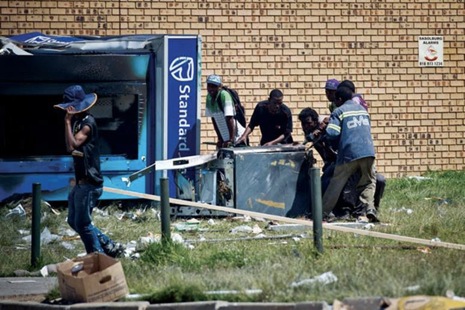
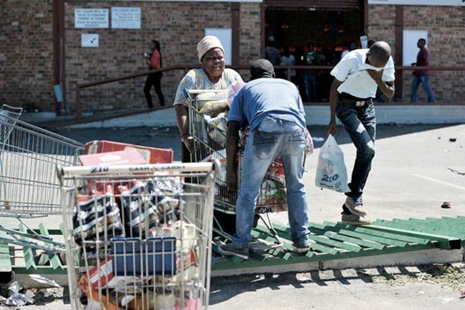
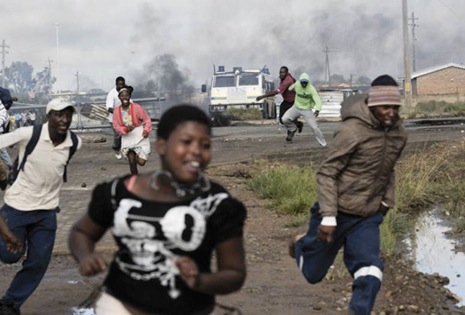
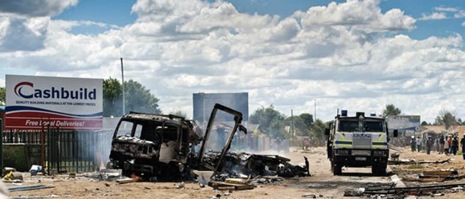
The problem with the riot-as-revolt theory is that since the advent of black rule in South Africa, we have had as many, if not more, riots than ever before! When someone had stolen cables along the railroad tracks, making trains late, the historic Pretoria statioin was set alight by blacks. Other trains were burnt out too. Not a day goes by when one does not read about “service delivery protests”. Tyres are burnt and vehicles stoned, similarly to the riots of 1976. Blacks seem to be revolting against their own government and municipalities, which they themselves had voted in. They also burn the same “symbols of oppression” as before: councillors’ homes, community centres, municipal offices, libraries, cars and still loot shops and liquor stores. In January this year, black South Africans exercised their right to loot in Sasolburg, south of Johannesburg and pictures again show burnt-out vechicles and a liquor store being ransacked.
In the United States too, race riots have been a feature of that country’s political life. When the four policemen who had assaulted Rodney King were acquitted in 1992, the Los Angeles riots ensued. During those riots, 53 people were killed and more than 2000 injured. In Britain, France, Sweden and elsewhere, burning and looting have become a way for their immigrant communities to express themselvesA recent modish term in South Africa has been the “grammar of blackness” on which I commented a few days ago in White guilt, Coloured faith. Perhaps riots are the grammar of blackness, as they often seem incomprehensible to the white mind. Winnie Mandela famously said: “With our boxes of matches and our necklaces we shall liberate this country”, the “necklace” being placing a petrol-filled tyre around the victim’s neck and igniting it.
The point to understand is that the burning has never stopped and “liberation” continues to this day.
In the Johannesburg Sunday Times I discovered the following amazing pronouncement this week, on the subject of a name change for Pretoria, our capital: “What we should accept is that victors always rewrite history and ensure their dominance is not only felt but seen.”
I may be alone in this, but I refuse to accept that because we have been conquered by propaganda, we should perpetuate the disinformation ourselves. None of the leftist fairy tale of South African history, including the Soweto riots, will stand up to closer scrutiny. There is no continuous “march to freedom” performed by South African blacks. Between the Rivonia trial where Mandela and his comrades were jailed and the Soweto riots, we discern a discontinuity or “epistemological break”. The Soweto riots must be seen as a more or less isolated event.
Neither is there continuity between the riots and the National Party’s ultimate capitulation and absorption by the ANC. FW de Klerk and Roelf Meyer betrayed their own electorate and supporters in all but surrendering to the ANC. Perhaps they were bribed or influenced by foreign powers, but they took that decision by themselves and for peculiarly idiosyncratic and personal reasons.
Like schoolchildren are fond of saying: “It’s random!” There is nothing in South Africa’s past that made the present nightmare a necessity. The Soweto riots could have been triggered by some other event that may have had nothing to do with Afrikaans at all. Like a Rodney King or soccer violence or the presence of foreign Africans in Soweto. Currently, we are seeing a lot of looting and killing around so-called xenophobia. The shops of Somali traders in black areas are regularly attacked, looted and their proprietors assaulted or murdered. So “liberation” continues.
Michelle Obama has already reaffirmed the myth of Soweto by visiting the Hector Pieterson memorial and no doubt her husband Barack will do the same during his coming visit to South Africa. He has already booked a visit to Mandela’s prison cell on Robben island, off Cape Town.
As in the dystopian novels of George Orwell, we are living through a powerful artificial consciousness, a pseudo-reality fabricated by the mass media, academia and the advertising industry. In this story the rioters are the heroes and Dr. Melville Edelstein or the Afrikaner education officials of Soweto are the villains
It constitutes rule by propaganda, domination by (dis)information. We have seen how Tony Blair lied to the world about weapons of mass destruction in Irak. The truth is what you can get away with. Or as it is bluntly put by the Sunday Times:
“What we should accept is that victors always rewrite history and ensure their dominance is not only felt but seen.”
I wonder what Orwell would have thought about that axiom.