American poverty is white

Poor whites in Mississippi

Four out of 5 U.S. adults struggle with joblessness, near-poverty or reliance on welfare for at least parts of their lives, a sign of deteriorating economic security and an elusive American dream.

Survey data exclusive to The Associated Press points to an increasingly globalized U.S. economy, the widening gap between rich and poor, and the loss of good-paying manufacturing jobs as reasons for the trend.

The findings come as President Barack Obama tries to renew his administration’s emphasis on the economy, saying in recent speeches that his highest priority is to “rebuild ladders of opportunity” and reverse income inequality.

As nonwhites approach a numerical majority in the U.S., one question is how public programs to lift the disadvantaged should be best focused – on the affirmative action that historically has tried to eliminate the racial barriers seen as the major impediment to economic equality, or simply on improving socioeconomic status for all, regardless of race.

Hardship is particularly growing among whites, based on several measures. Pessimism among that racial group about their families’ economic futures has climbed to the highest point since at least 1987. In the most recent AP-GfK poll, 63 percent of whites called the economy “poor.”

“I think it’s going to get worse,” said Irene Salyers, 52, of Buchanan County, Va., a declining coal region in Appalachia. Married and divorced three times, Salyers now helps run a fruit and vegetable stand with her boyfriend but it doesn’t generate much income. They live mostly off government disability checks.

“If you do try to go apply for a job, they’re not hiring people, and they’re not paying that much to even go to work,” she said. Children, she said, have “nothing better to do than to get on drugs.”

While racial and ethnic minorities are more likely to live in poverty, race disparities in the poverty rate have narrowed substantially since the 1970s, census data show. Economic insecurity among whites also is more pervasive than is shown in the government’s poverty data, engulfing more than 76 percent of white adults by the time they turn 60, according to a new economic gauge being published next year by the Oxford University Press.

The gauge defines “economic insecurity” as experiencing unemployment at some point in their working lives, or a year or more of reliance on government aid such as food stamps or income below 150 percent of the poverty line. Measured across all races, the risk of economic insecurity rises to 79 percent.

Marriage rates are in decline across all races, and the number of white mother-headed households living in poverty has risen to the level of black ones.

“It’s time that America comes to understand that many of the nation’s biggest disparities, from education and life expectancy to poverty, are increasingly due to economic class position,” said William Julius Wilson, a Harvard professor who specializes in race and poverty. He noted that despite continuing economic difficulties, minorities have more optimism about the future after Obama’s election, while struggling whites do not.

“There is the real possibility that white alienation will increase if steps are not taken to highlight and address inequality on a broad front,” Wilson said.

Nationwide, the count of America’s poor remains stuck at a record number: 46.2 million, or 15 percent of the population, due in part to lingering high unemployment following the recession. While poverty rates for blacks and Hispanics are nearly three times higher, by absolute numbers the predominant face of the poor is white.

More than 19 million whites fall below the poverty line of $23,021 for a family of four, accounting for more than 41 percent of the nation’s destitute, nearly double the number of poor blacks.

Sometimes termed “the invisible poor” by demographers, lower-income whites generally are dispersed in suburbs as well as small rural towns, where more than 60 percent of the poor are white. Concentrated in Appalachia in the East, they are numerous in the industrial Midwest and spread across America’s heartland, from Missouri, Arkansas and Oklahoma up through the Great Plains.

Buchanan County, in southwest Virginia, is among the nation’s most destitute based on median income, with poverty hovering at 24 percent. The county is mostly white, as are 99 percent of its poor.

More than 90 percent of Buchanan County’s inhabitants are working-class whites who lack a college degree. Higher education long has been seen there as nonessential to land a job because well-paying mining and related jobs were once in plentiful supply. These days many residents get by on odd jobs and government checks.

Salyers’ daughter, Renee Adams, 28, who grew up in the region, has two children. A jobless single mother, she relies on her live-in boyfriend’s disability checks to get by. Salyers says it was tough raising her own children as it is for her daughter now, and doesn’t even try to speculate what awaits her grandchildren, ages 4 and 5.

Smoking a cigarette in front of the produce stand, Adams later expresses a wish that employers will look past her conviction a few years ago for distributing prescription painkillers, so she can get a job and have money to “buy the kids everything they need.”

“It’s pretty hard,” she said. “Once the bills are paid, we might have $10 to our name.”

Census figures provide an official measure of poverty, but they’re only a temporary snapshot that doesn’t capture the makeup of those who cycle in and out of poverty at different points in their lives. They may be suburbanites, for example, or the working poor or the laid off.

In 2011 that snapshot showed 12.6 percent of adults in their prime working-age years of 25-60 lived in poverty. But measured in terms of a person’s lifetime risk, a much higher number – 4 in 10 adults – falls into poverty for at least a year of their lives.

The risks of poverty also have been increasing in recent decades, particularly among people ages 35-55, coinciding with widening income inequality. For instance, people ages 35-45 had a 17 percent risk of encountering poverty during the 1969-1989 time period; that risk increased to 23 percent during the 1989-2009 period. For those ages 45-55, the risk of poverty jumped from 11.8 percent to 17.7 percent.

Higher recent rates of unemployment mean the lifetime risk of experiencing economic insecurity now runs even higher: 79 percent, or 4 in 5 adults, by the time they turn 60.

By race, nonwhites still have a higher risk of being economically insecure, at 90 percent. But compared with the official poverty rate, some of the biggest jumps under the newer measure are among whites, with more than 76 percent enduring periods of joblessness, life on welfare or near-poverty.

By 2030, based on the current trend of widening income inequality, close to 85 percent of all working-age adults in the U.S. will experience bouts of economic insecurity.

“Poverty is no longer an issue of `them’, it’s an issue of `us’,” says Mark Rank, a professor at Washington University in St. Louis who calculated the numbers. “Only when poverty is thought of as a mainstream event, rather than a fringe experience that just affects blacks and Hispanics, can we really begin to build broader support for programs that lift people in need.”

The numbers come from Rank’s analysis being published by the Oxford University Press. They are supplemented with interviews and figures provided to the AP by Tom Hirschl, a professor at Cornell University; John Iceland, a sociology professor at Penn State University; the University of New Hampshire’s Carsey Institute; the Census Bureau; and the Population Reference Bureau.

Among the findings:

-For the first time since 1975, the number of white single-mother households living in poverty with children surpassed or equaled black ones in the past decade, spurred by job losses and faster rates of out-of-wedlock births among whites. White single-mother families in poverty stood at nearly 1.5 million in 2011, comparable to the number for blacks. Hispanic single-mother families in poverty trailed at 1.2 million.

-Since 2000, the poverty rate among working-class whites has grown faster than among working-class nonwhites, rising 3 percentage points to 11 percent as the recession took a bigger toll among lower-wage workers. Still, poverty among working-class nonwhites remains higher, at 23 percent.

-The share of children living in high-poverty neighborhoods – those with poverty rates of 30 percent or more – has increased to 1 in 10, putting them at higher risk of teenage pregnancy or dropping out of school. Non-Hispanic whites accounted for 17 percent of the child population in such neighborhoods, compared with 13 percent in 2000, even though the overall proportion of white children in the U.S. has been declining.

The share of black children in high-poverty neighborhoods dropped from 43 percent to 37 percent, while the share of Latino children went from 38 percent to 39 percent.

-Race disparities in health and education have narrowed generally since the 1960s. While residential segregation remains high, a typical black person now lives in a nonmajority black neighborhood for the first time. Previous studies have shown that wealth is a greater predictor of standardized test scores than race; the test-score gap between rich and low-income students is now nearly double the gap between blacks and whites.

—

Going back to the 1980s, never have whites been so pessimistic about their futures, according to the General Social Survey, a biannual survey conducted by NORC at the University of Chicago. Just 45 percent say their family will have a good chance of improving their economic position based on the way things are in America.

The divide is especially evident among those whites who self-identify as working class. Forty-nine percent say they think their children will do better than them, compared with 67 percent of nonwhites who consider themselves working class, even though the economic plight of minorities tends to be worse.

Although they are a shrinking group, working-class whites – defined as those lacking a college degree – remain the biggest demographic bloc of the working-age population. In 2012, Election Day exit polls conducted for the AP and the television networks showed working-class whites made up 36 percent of the electorate, even with a notable drop in white voter turnout.

Last November, Obama won the votes of just 36 percent of those noncollege whites, the worst performance of any Democratic nominee among that group since Republican Ronald Reagan’s 1984 landslide victory over Walter Mondale.

Some Democratic analysts have urged renewed efforts to bring working-class whites into the political fold, calling them a potential “decisive swing voter group” if minority and youth turnout level off in future elections. “In 2016 GOP messaging will be far more focused on expressing concern for `the middle class’ and `average Americans,'” Andrew Levison and Ruy Teixeira wrote recently in The New Republic.

“They don’t trust big government, but it doesn’t mean they want no government,” says Republican pollster Ed Goeas, who agrees that working-class whites will remain an important electoral group. His research found that many of them would support anti-poverty programs if focused broadly on job training and infrastructure investment. This past week, Obama pledged anew to help manufacturers bring jobs back to America and to create jobs in the energy sectors of wind, solar and natural gas.

“They feel that politicians are giving attention to other people and not them,” Goeas said. – AP

Neocons threaten life on earth with nuclear war

Dr Paul Craig Roberts

Amitai Etzioni has raised an important question: “Who authorized preparations for war with China?”  Etzioni says that the war plan is not the sort of contingency plan that might be on hand for an improbable event. Etzioni also reports that the Pentagon’s war plan was not ordered by, and has not been reviewed by, US civilian authorities. We are confronted with a neoconized US military out of control endangering Americans and the rest of the world.

Etzioni is correct that this is a momentous decision made by a neoconized military. China is obviously aware that Washington is preparing for war with China. If the Yale Journal knows it, China knows it. If the Chinese government is realistic, the government is aware that Washington is planning a pre-emptive nuclear attack against China. No other kind of war makes any sense from Washington’s standpoint. The “superpower” was never able to occupy Baghdad, and after 11 years of war has been defeated in Afghanistan by a few thousand lightly armed Taliban. It would be curtains for Washington to get into a conventional war with China.

When China was a primitive third world country, it fought the US military to a stalemate in Korea. Today China has the world’s second largest economy and is rapidly overtaking the failing US economy destroyed by jobs offshoring, bankster fraud, and corporate and congressional treason.

The Pentagon’s war plan for China is called “AirSea Battle.” The plan describes itself as “interoperable air and naval forces that can execute networked, integrated attacks-in-depth to disrupt, destroy, and defeat enemy anti-access area denial capabilities.”

Yes, what does that mean? It means many billions of dollars of more profits for the military/security complex while the 99 percent are ground under the boot. It is also clear that this nonsensical jargon cannot defeat a Chinese army. But this kind of saber-rattling can lead to war, and if the Washington morons get a war going, the only way Washington can prevail is with nuclear weapons. The radiation, of course, will kill Americans and most of the rest of the world as well.

Nuclear war is on Washington’s agenda. The rise of the Neocon Nazis has negated the nuclear disarmament agreements that Reagan and Gorbachev made. The extraordinary, mainly truthful 2012 book, The Untold History of the United States by Oliver Stone and Peter Kuznick, describes the post-Reagan breakout of preemptive nuclear attack as Washington’s first option.

During the Cold War nuclear weapons had a defensive purpose. The purpose was to prevent nuclear war by the US and USSR each having sufficient retaliatory power to ensure “mutually assured destruction.” MAD, as it was known, meant that nuclear weapons had no offensive advantage for either side.

The Soviet collapse and China’s focus on its economy instead of its military have resulted in Washington’s advantage in nuclear weaponry that, according to two US Dr. Strangeglove characters, Keir Lieber and Daryl Press, gives Washington first-strike capability. Lieber and Press write that the “precipitous decline of Russia’s arsenal, and the glacial pace of modernization of China’s nuclear forces,” have created a situation in which neither Russia nor China could retaliate to Washington’s first strike.

The Pentagon’s “AirSea Battle” and Lieber and Press’ article in Foreign Affairs have informed China and Russia that Washington is contemplating pre-emptive nuclear attack on both countries. To ensure Russia’s inability to retaliate, Washington is placing anti-ballistic missiles on Russia’s borders in violation of the US-USSR agreement.

Because the American press is a corrupt government propaganda ministry, the American people have no idea that neoconized Washington is planning nuclear war. Americans are no more aware of this than they are of former President Jimmy Carter’s recent statement, reported only in Germany, that the United States no longer has a functioning democracy.

The possibility that the United States would initiate nuclear war was given reality eleven years ago when President George W. Bush, at the urging of Dick Cheney and the neocons that dominated his regime, signed off on the 2002 Nuclear Posture Review.

This neocon document, signed off on by America’s most moronic president, resulted in consternation and condemnation from the rest of the world and launched a new arms race. Russian President Putin immediately announced that Russia would spend all necessary sums to maintain Russia’s retaliatory nuclear capability. The Chinese displayed their prowess by knocking a satellite out of space with a missile. The mayor of Hiroshima, recipient city of a vast American war crime, stated: “The nuclear Non-Proliferation Treaty, the central international agreement guiding the elimination of nuclear weapons, is on the verge of collapse. The chief cause is US nuclear policy that, by openly declaring the possibility of a pre-emptive nuclear first strike and calling for resumed research into mini-nukes and other so-called ‘useable nuclear weapons,’ appears to worship nuclear weapons as God.”

The Neocons do not accept any accountability whatsoever to international law, to human rights, to the Geneva Conventions, or to any statutory law.

The post World War II wars originate in the so-called “free world”. Other countries do not have imperial expansionary ambitions. The Chinese government has not seized Taiwan, which China could do at will. The Russian government has not seized former constituent parts of Russia, such as Georgia, which, provoked by Washington to launch an attack, was instantly overwhelmed by the Russian Army. Putin could have hung Washington’s Georgian puppet and reincorporated Georgia into Russia, where it resided for several centuries and where many believe it belongs.

For the past 68 years, most military aggression can be sourced to the “superpower”.Washington has drafted a war plan based on nuclear first strike, a direct threat to life on earth.

Paul Craig Roberts was Assistant Secretary of the Treasury for Economic Policy under Ronald Reagan and associate editor of the Wall Street Journal.

Saudi princess charged with human trafficking in USA for holding Kenyan maid

Meshael Alayban
Meshael Alayban

A Saudi princess has been charged with human trafficking for allegedly holding a Kenyan maid against her will in a luxury California apartment, news reports said late Wednesday.

Meshael Alayban, 42, was charged on Wednesday after being arrested at her home in a gated community in Irvine, California.

Prosecutors allege Alayban took the woman’s passport and forced her to work as a domestic servant for 16 hours a day, seven days a week for just 220 dollars a month, the Los Angeles Times reported.

A judge set bail of 5 million dollars for Alayban, and ordered her to wear a monitor if released from the women’s jail where she was being held.

“The law of our nation and California does not tolerate people who deprive or violate the liberty of another and obtain forced labour or services,” District Attorney Tony Rackauckas was quoted as saying.

The maid, whose identity was not released, began working for Alayban and her family in Saudi Arabia last year before moving to the US with them, the report said.

When police arrived at Alayban’s home they found four other women from the Philippines, who said their travel documents had also been taken by Alayban.

The Kenyan woman managed to escape from the apartment complex on Tuesday, before boarding a bus and contacting police.

Orange County prosecutors identified Alayban as one of the wives of Saudi Prince Abdulrahman bin Nasser bin Abdulaziz al Saud. She faces up to 12 years in prison if convicted of human trafficking. – dpa

America’s image plunges

obamasmirkIn a recent BBC World Service Country Rating Poll in 12 countries in which the survey has been conducted since 2005, the long-term trend line shows a net negative rating for the United States. The rating is calculated as the percentage of people with “mainly positive” views of the United States minus the percentage of people with “mainly negative” views.

The rating had bottomed out in 2007 at a net negative 30, climbed above zero after Obama was elected and then began to fall in 2012 – although it is still far higher than in 2007. That 12-nation survey included China, India, and Russia.

In a larger survey conducted between December 2012 and April 2013 of more than 26,000 people in 21 countries, 45 percent had a mostly positive view of the United States while 34 percent had a mainly negative view of the United States.

“Views in China have worsened (since last year): only one in five Chinese respondents (20%) hold positive views (down nine points). With 57 per cent holding negative views (up nine points), China has the third-most negative attitude towards the USA, after Pakistan (stable at 64%) and Turkey,” the report from the BBC World Service said.

A Gallup survey of public opinion in 130 countries published in March reached similar findings. It showed a decline in foreign views of U.S. leadership from 49 percent approval in 2009 to 41 percent last year. The sharpest falloff in the Gallup survey came in European countries, where 47 percent approved of U.S. leadership in 2009, but only 36 percent approved last year.

Not surprisingly regard for the United States is lowest in places where U.S. drone strikes have occurred, such as Yemen, where 59 percent disapprove of U.S. policies and Pakistan where 79 percent disapprove. On Wednesday, at least seventeen people, believed to be militants, were killed in a U.S drone attack in the North Waziristan tribal region in northwest Pakistan near the Afghan border.

In Egypt which is heavily depended on U.S. foreign aid and military sales, 62 percent of Egyptians disapprove of the United States.

But the Gallup survey also found that some of those who have benefited from U.S. support and liberation have a very positive view of America: nearly 90 percent of those surveyed in Kosovo approved of the United States. It was partly due to policies of Presidents Bill Clinton and George W. Bush that Kosovo became an independent nation in 2008.

The wide data collection efforts of the National Security Agency and Obama’s use of drones to kill terrorists in Yemen and other nations seem to be tarnishing the American image among Europeans.

Reacting to report in the German magazine Der Spiegel that the NSA conducted surveillance of European diplomats, French President Francois Hollande said Monday, “We cannot accept this kind of behavior from partners and allies.” In an apparent signal of its displeasure, the French government moved Wednesday to suspend trade negotiations between the United States and the European Union for two weeks.

Without confirming or denying the Der Spiegel report, Obama said Monday intelligence gathering was simply a part of real world politics: “I guarantee you that in European capitals, there are people who are interested in, if not what I had for breakfast, at least what my talking points might be should I end up meeting with their leaders.” – NBC News

US orders Americans to leave Egypt as anti-American sentiment soars

obamaegyptA U.S. official says the State Department is ordering nonessential U.S. diplomats and the families of all American Embassy personnel to leave Egypt after the Egyptian military removed Morsi and in anticipation of potential violence.

The official, speaking on condition of anonymity because the official wasn’t authorized to discuss it publicly, said the State Department had placed the U.S. Embassy in Cairo on “ordered departure” status for nonemergency staff and dependents all employees. That means that those covered by the order are required to leave the country. It was not immediately clear if an evacuation operation would be mounted or if those departing would use commercial airlines or passenger ships to leave.

‘Kidnapped by imperialism’

Morales in Russia
Morales in Russia

Bolivia has accused Austria of “kidnapping” its president, Evo Morales.

After a 12-hour interruption during which the president’s plane was stopped and searched by Austrian authorities for US fugitive Edward Snowden, Morales was allowed to fly home. Bolivia’s vice-president, Alvaro Garcia Linera, described Morales as being “kidnapped by imperialism” in Europe. Authorities had suspected Morales was taking Snowden to Latin America.

The unusual treatment of the Bolivian leader touched a sensitive nerve in the region, which has a history of US-backed coups, and presidents rallied in support of Morales.

“Definitively, they’re all crazy,” Argentine President Cristina Fernandez tweeted after a phone call to Morales. Fernandez described Morales as defiant.

” ‘I’m not a thief’,” she quoted him as saying.

Nicaraguan and Cuban officials also decried the incident.

A senior Bolivian diplomat said the Austrians had acted at the bidding of the US, which has been trying to get its hands on Snowden since he revealed details of its secret surveillance programmes.

“We’re talking about the president on an official trip after an official summit being kidnapped,” Bolivia’s ambassador to the UN, Sacha Llorenti Soliz, said.

The plane, which was taking Morales home from an energy conference in Moscow, was stranded at Vienna airport after Portugal and France refused to allow it to fly through their airspace.

The search found that Snowden was not on board.

Bolivia has filed a complaint at the United Nations on Wednesday over what it called the kidnapping of its president.

The country’s ambassador to the UN, Sacha Llorenti, said the enforced rerouting to Austria was an act of aggression and a violation of international law. The US admitted that it had been in contact with other nations over potential flights by Snowden.

“We will demand appropriate explanations from those countries that submitted to North American imperialism and briefly put President Morales in such a helpless situation,” Llorenti told the state radio Patria Nueva. Bolivia’s vice-president, Alvaro García Linera, said Morales was “kidnapped by imperialism”.

South American nations accused the United States of being behind the extraordinary manoeuvring, furious at what they regarded as the humiliation of Morales. In Washington, the state department would not comment on the Morales flight but conceded that it discussed the issue of flights by Snowden with other nations.

“We have been in contact with a range of countries that had a chance of having Snowden land or travel through their country but I am not going to outline what those countries were or when this [contact] happened,” said spokeswoman Jan Psaki.

The diplomatic crisis may have been set off by a remark by Morales during a television interview in Russia, where he had been attending an energy conference. Morales said that he sympathised with Snowden, who is believed to be holed up in the transit area of Sheremetyevo airport, and hinted that Bolivia might accept an asylum petition. “If there were a request, of course we would be willing to debate and consider the idea,” Morales told RT Actualidad, the Spanish-language service of the Russian broadcaster RT.

Later that day, soon after Morales was bound for La Paz, Spain, Italy, France and Portugal refused to allow the presidential jet to fly through their airspace over suspicions that Snowden was on board, according to the Bolivian government’s account.

The Bolivian foreign minister, David Choquehuanca, said France and Portugal were the first to cancel air permits. “They say it was due to technical issues, but after getting explanations from some authorities we found that there appeared to be some unfounded suspicions that Mr Snowden was on the plane. We don’t know who invented this lie. We want to denounce to the international community this injustice with the plane of Evo Morales,” Choquehuanca said.

Diverted from their planned route, pilots feared they would not be able to complete their journey. The plane was eventually cleared to land in Vienna, where Morales was forced to spend 13 hours in humiliating limbo while officials worked to resolve the dispute.

It later took off after Austrian officials said Snowden was not on board. But it was unclear whether any officials in Vienna had searched the plane. Austria’s deputy chancellor, Michael Spindelegger, said Morales “agreed to a voluntary inspection”. But the Bolivian defence minister, Ruben Saavedra, later said Morales had refused entry to the inspectors, and that they had only got as far as the door of the aircraft.

In Bolivia, the treatment of the president stirred up patriotic and anti-imperialist sentiment. Several labour and indigenous organisations planned a welcome rally for the president on his arrival in La Paz on Wednesday evening.

The Argentinian president, Cristina Fernández de Kirchner, attacked the “vestiges of colonialism” in a speech in Buenos Aires. “We believe this constitutes not only the humiliation of a sister nation but of all South America,” she said. An emergency meeting of the Union of South American Nations was expected to be convened on Thursday.

It was widely assumed in South America that Washington was responsible for the presidential plane being refused air permissions. Earlier in the week, the state department said it hoped Snowden would be returned to the US to face charges of espionage and theft after a string of other countries said they would not accept his applications for asylum.

Speaking before the developments in Vienna, the state department rejected claims made by Snowden on Monday that the US had bullied other potential hosts, such as Ecuador, into withdrawing their offer of asylum. The US says it has only impressed upon possible host countries the seriousness of the crimes with which Snowden had been charged. – Reuters/The Guardian

Residents anxious as shootings in black Baltimore surge

baltimoreThe surge in violence continues in Baltimore as the police report more shootings, the last of which happened late Saturday in Northeast Baltimore.

Clergy and lawmakers are trying to calm anxious residents.

There have been three shootings in the last 24 hours in Baltimore. At least 40 shootings have happened in the last 10 days and 16 of them were deadly.

City clergy are now asking residents to step up and end this violent trend.

At Lafayette Avenue, a man is shot in the leg and at South Haven street, a woman is shot and killed.

“We’ve never had anything like this happen on Haven Street. I’ve been here for 15 years and never seen anything like that,” said concerned resident John Wrencher.

His block becomes the latest home to Baltimore’s nearly 40 shootings in two weeks. More than a dozen people are dead.

City clergy and members of 120 churches are rallying and praying this weekend for peace.

Even a 21-car motorcade drives through the city showing just how deadly this violent trend is becoming.

“If you put a police officer in every block, you still could not solve the program when the problem is inside of the individual, ” said Bishop Angel L. Nunez of Bilingual Christian Church.

This recent surge in shootings highlights the city’s problem with gun violence and homicide rate. So far this year, there have been around 117 homicides, the highest in six years.

But for Stephanie Rawlings Blake, it’s personal.

Her cousin, was gunned down last month near his home.

“Whether our homicide rate is 200 or 300 or one, we can never get that life back,” said Rawlings-Blake.

With the violence spotlighting Baltimore, the mayor said the solution starts with us.

“When we have a spike, we have cameras from all over the city, outside of the city, national reporters. I welcome them back for the miracle. I know that as you are standing here, you are not going to tolerate it,” said Rawlings-Blake.

City leaders say that call to action, may stop the next shot from being fired in your neighborhood.

In the latest shooting, an adult male was shot in the back on a basketball court. He is being treated for non life-threatening injuries at a local hospital.

Police plan to step up enforcement through Fourth of July weekend. – CBS

Obama’s liberals were living in a fantasy world

obamadeskGideon Rachman writes in the FT that Obama’s liberals were living in a fantasy world of expectations. It has taken a long time, but the world’s fantasies about Barack Obama are finally crumbling. In Europe, once the headquarters of the global cult of Obama, the disillusionment is particularly bitter. Monday’s newspapers were full of savage quotes about the perfidy of the Obama-led US.

Der Spiegel, the German magazine that alleged that America’s National Security Agency has bugged the EU’s offices, thundered that “the NSA’s totalitarian ambition … affects us all … A constitutional state cannot allow it. None of us can allow it.” President François Hollande of France has demanded that the alleged spying stop immediately. Le Monde, Mr Hollande’s home-town newspaper, has even suggested that the EU should consider giving political asylum to Edward Snowden, the NSA whistleblower.

But if liberals wanted to compile a list of perfidious acts by the Obama administration, the case of the bugged EU fax machine should probably come low down the list.

More important would be the broken promise to close the Guantánamo detention centre and – above all – the massive expansion of the use of drone strikes to kill suspected terrorists in Pakistan, Yemen and elsewhere, It has gradually dawned on President Obama’s foreign fan club that their erstwhile hero is using methods that would be bitterly denounced if he were a white Republican. As Hakan Altinay, a Turkish academic, complained to me last week: “Obama talks like the president of the American Civil Liberties Union but he acts like Dick Cheney.”

Obama campaigned with the human rights rhetoric of Jimmy Carter but has governed like Henry Kissinger.

It is not entirely Mr Obama’s fault that he became the vessel into which liberals all over the world poured their fantasies. Of course, like any politician, he pumped up expectations when running for office. But when Obama-mania really took off in 2008, it swiftly moved into a realm beyond reason. What was candidate Obama meant to say to the 200,000 Berliners who turned out to cheer him that year – “Go home guys, this is silly”? When the new president was given the Nobel Peace Prize, simply for existing, all he could do was graciously accept.

It is perfectly legitimate to argue that Mr Obama should have done more to cut back the rapidly growing secret state that he inherited when he took office. The combination of a “war on terror” and the new world of “big data” has created possibilities and pressures – and Mr Obama may have made some wrong calls in response. Yet the US president has had to balance a variety of pressures – including the continuing existence of a terrorist threat and the entrenched power of the intelligence world.

Mr Obama was living in a real universe, full of hard choices. It was his overheated critics who lived in a fantasy world. – FT


EU lashes out at new NSA spying report

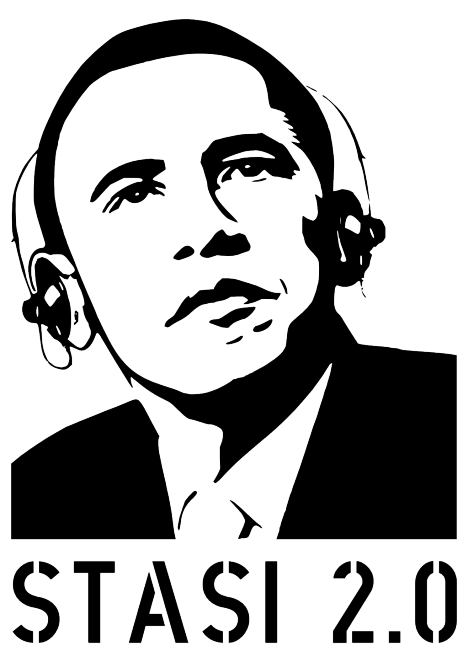
stasi2A top German official accused the United States on Sunday of using “Cold War” methods against its allies, after a German magazine cited secret intelligence documents to claim that U.S. spies bugged European Union offices.

Justice Minister Sabine Leutheusser-Schnarrenberger was responding to a report by German news weekly Der Spiegel, which claimed that the U.S. National Security Agency eavesdropped on EU offices in Washington, New York and Brussels. The magazine cited classified U.S. documents taken by former NSA contractor Edward Snowden that it said it had partly seen.

“If the media reports are accurate, then this recalls the methods used by enemies during the Cold War,” Leutheusser-Schnarrenberger said in a statement to The Associated Press.

“It is beyond comprehension that our friends in the United States see Europeans as enemies,” she said, calling for an “immediate and comprehensive” response from the U.S. government to the claims.

Other European officials demanded an explanation from the U.S.

“I am deeply worried and shocked about the allegations,” European Parliament President Martin Schulz said in a statement, according to CNN. “If the allegations prove to be true, it would be an extremely serious matter which will have a severe impact on EU-US relations. On behalf of the European Parliament, I demand full clarification and require further information speedily from the U.S. authorities with regard to these allegations.”

The revelations come at a particularly sensitive time for U.S.-E.U. relations, as long-awaited talks about a new trade pact are scheduled to begin next week. It is unclear how the latest report on NSA spying are going to affect them, but the trade pact has been a centerpiece of the Obama administrations diplomatic efforts in Europe for some time.

According to Der Spiegel, the NSA planted bugs in the EU’s diplomatic offices in Washington and infiltrated the building’s computer network. Similar measures were taken at the EU’s mission to the United Nations in New York, the magazine said.

Der Spiegel didn’t publish the alleged NSA documents it cited or say how it obtained access to them. But one of the report’s authors is Laura Poitras, an award-winning documentary filmmaker who interviewed Snowden while he was holed up in Hong Kong.

The magazine also didn’t specify how it learned of the NSA’s alleged eavesdropping efforts at a key EU office in Brussels. There, the NSA used secure facilities at NATO headquarters nearby to dial into telephone maintenance systems that would have allowed it to intercept senior EU officials’ calls and Internet traffic, Der Spiegel report said.

Germany was allegedly the focus of the European spying, according to The Guardian, categorising Washington’s key European ally alongside China, Iraq or Saudi Arabia in the intensity of the electronic snooping.

During a trip through Europe two weeks ago, President Obama assured an audience in Germany that America is not indiscriminately “rifling” through the emails of ordinary European citizens, describing the National Security Agency’s surveillance programs as a “circumscribed” system that has averted threats in America, Germany, and elsewhere.

Leutheusser-Schnarrenberger urged EU Commission President Jose Manuel Barroso to take personal responsibility for investigating the allegations.

The United States has defended its efforts to intercept electronic communications overseas by arguing that this has helped prevent terror attacks at home and abroad. – CBS

Obama due to land in SA

Obama in Senegal
Obama in Senegal

Obama called Mandela, South Africa’s first black president, a “personal hero” during a visit to Senegal this week at the start of his three-country whistle-stop tour through Africa.

US officials says they will comply with the Mandela family’s wishes with regard to Obama visiting the ailing 94-year-old icon or meeting his relatives.

“If and when he passes from this place, one thing I think we’ll all know is that his legacy is one that will linger on throughout the ages,” said Obama, who is due to land in the evening.

Makaziwe Mandela, the former president’s eldest daughter, told SABC television that her father was “waning” but is still responding to his children’s voice and touch.

“When you touch him he still responds, and for us as his progeny as long as tata (father) is still responding when we talk to him and touch him, I think that gives us hope,” she said.

South Africans have been laying wreaths of flowers outside the Pretoria clinic where Mandela is hospitalized and also near his home in Johannesburg.

Candles burned late into the night as people, often emotional, held vigils at the gate to the Pretoria clinic.

Mandela family members have thanked the public repeatedly for their prayers and well-wishes, saying it is giving them strength during a difficult time.

Mandela was hospitalized on June 8 for a recurring lung infection. His situation turned critical on Sunday. He has been hospitalized several times in recent years.

President Jacob Zuma on Thursday said Mandela’s condition was “critical but is now stable.”

A steady stream of family members and relatives have visited Mandela in hospital this week. – SAPA

Senegalese go into hiding for Obama visit

africaobamaOrdinary Senegalese are drawing lessons from the past and leaving nothing to chance so that they avoid “foreseeable” embarrassing circumstances during President Barack Obama’s visit, which commences on June 26.

Enduring long hours in traffic jams while waiting for high profile visitors to pass through, being unable to hawk their wares freely in the streets and being virtually “held prisoner in one’s house” are some of the embarrassments they recall from the 1998 visit of former American president Bill Clinton.

Many businesses particularly in downtown Dakar and its peripheral districts have already started recording low sales due to this anticipation. “We’ve virtually been closed for a week now,” says Doudou Keita, a garment seller in Guelle Tapé, a few kilometres from the city centre.

Mbaye Ndiaye, an economist formerly employed by the Trade ministry, says the visit will cause losses of several million dollars, especially to the informal sector “who will take months to recover”.

“While the Americans are capable of making our country a better place, Obama is also capable of making our small businesses in Dakar poorer,” argues Ndeye Diop, a doughnut and coffee seller in a conversation with her colleague.

Assuredly, Ndeye’s colleague Bintou Diagne retorted in English with a native accent “Yessi, e can!” It was a play on Obama’s 2008 campaign slogan: ‘Yes we can.’

These “unforeseeable” embarrassments have led thousands of Dakar city dwellers whose neighbourhoods are being “bunkered” to return to their villages until Obama – nicknamed “the big cat” – goes away.

Barack (which means ‘shack’ in Wolof) “should have lodged in a shack to show solidarity with the majority shack dwellers here”, leading comedian “Kutia” insistently jokes on television about Obama, who he calls the “White House rent payer”.

Pickpockets and prostitutes

Since the announcement of the date of his arrival, the thousands of street beggars in Dakar have visibly disappeared and gone underground.

The same thing has happened to the noisy hawkers on the streets of the capital, most of whom were mistakenly picked up by police during a clean-up against pickpockets classified by security agents as “persons with the propensity to cause embarrassment”.

This category also includes both licensed and unlicensed prostitutes who made good profits during visits by less high profile statesmen whose delegations frantically sought out their services.

But for Obama’s visit, they are among those bearing the heaviest brunt of the tour, which has been extended from 48 to 72 hours beginning this Wednesday.

“No matter…some of us can still harvest from Obama’s field”, says Aisha Konaté, a sex worker with nearly two decades of experience and who boasts of having contacts capable of roping in “high profile” clients to her private abode

For a week now, the national television “RTS” has been clocking Obama’s upcoming visit with the Senegalese and American flags displayed on the top left corner of TV screens, and the inscription “D-Day 3 days to go,” or whichever days are pending.

The youthful face of Obama has for two weeks been very visible on a billboard on one of the tallest buildings along the Place de l’independence main square in Dakar.

And elsewhere, especially at the heavily secured Leopold Sedar Senghor International airport, several giant Senegelase and American flags are flapping high in the sky around photographs of the two heads of state. – africareview.com

American cars assume ethnic identities

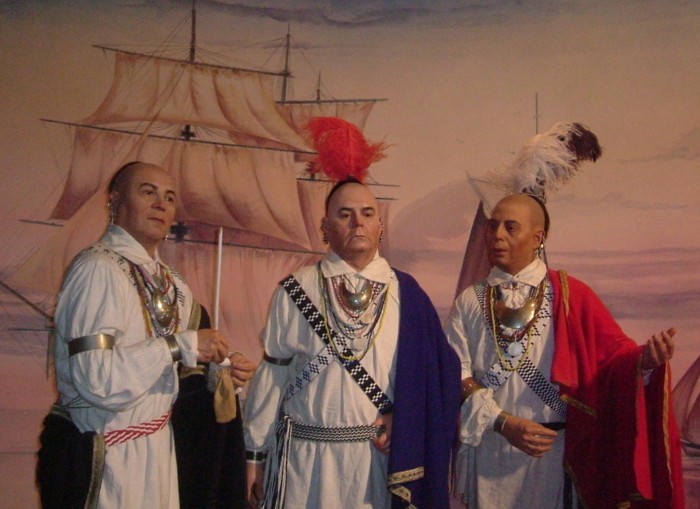
Cherokees
Cherokees

Coming to a showroom near you for 2014: the first sport utility vehicle in its class equipped with a 9-speed automatic transmission. It’s also the first to offer a parallel-parking feature. And, in 4-wheel-drive models, the rear axle disconnects automatically, for fuel efficiency.

Oh, yes: its name is the Jeep Cherokee.

Hold on — wasn’t that model name retired more than a decade ago? Wasn’t it replaced by the Jeep Liberty for 2002?

Yet now, in a time of heightened sensitivity over stereotypes, years after ethnic, racial and gender labeling has been largely erased from sports teams, products and services, Jeep is reviving an American Indian model name. Why?

“In the automobile business, you constantly have to reinvent yourself, and sometimes it’s best to go back to the future,” said Allen Adamson, managing director of the New York office of Landor Associates, a brand and corporate identity consultancy.

Jeep, a division of the Chrysler Group, explained that its market research revealed a marked fondness for the name. The 2014 version, said Jim Morrison, director of Jeep marketing, “is a new, very capable vehicle that has the Cherokee name and Cherokee heritage. Our challenge was, as a brand, to link the past image to the present.”

The company says it respects changed attitudes toward stereotyping. “We want to be politically correct, and we don’t want to offend anybody,” Mr. Morrison said. Regarding the Cherokee name, he added: “We just haven’t gotten any feedback that was disparaging.”

Well, here’s some: “We are really opposed to stereotypes,” said Amanda Clinton, a spokeswoman for the Cherokee Nation in Oklahoma. “It would have been nice for them to have consulted us in the very least.”

But, she added, the Cherokee name is not copyrighted, and the tribe has been offered no royalties for the use of the name. “We have encouraged and applauded schools and universities for dropping offensive mascots,” she said, but stopped short of condemning the revived Jeep Cherokee because, “institutionally, the tribe does not have a stance on this.”

So far, marketing materials for the 2014 Cherokee model have eschewed references to, or portrayals of, American Indians and their symbols. That’s a far cry from the excesses of past years, when marketers went beyond embracing stereotyping to reveling in it. Indeed, Chrysler’s restraint seems an indication of just how much things have changed.

For decades, American Indian tribal names have helped to propel automobiles out of showrooms. Return with us now to the era when Pontiac’s sales brochures carried illustrations comparing its 6-cylinder engines to six red-painted, feathered cartoon Indian braves rowing a canoe.

Or review Pontiac’s marketing copy, which proclaimed that “among the names of able Indian warriors known to the white race in America, that of Pontiac, chief of the Ottawas and accepted leader of the Algonquin family of tribes, stands pre-eminent.” Of course, the visage of the chief was appropriated as a hood ornament.

Many other tribes were adopted as marketing tools. Long gone is the Jeep Comanche pickup truck, sold in the late 1980s, along with the Jeep Comanche Eliminator.

Certainly, American Indian names are still in the market: consider Indian motorcycles, about to resurface under yet another new owner, Polaris Industries. And Chrysler’s full-sized S.U.V., the Grand Cherokee, introduced in 1992 as a larger version of the Cherokee and still a market leader. In fact, its success was a reason for the revival of the Cherokee name for a midsize S.U.V.

American Indians have hardly been alone in the cavalcade of automobile cultural stereotyping. In the 1950s, advertising for the Studebaker Scotsman didn’t actually use the word cheapskate, but prospective buyers were informed that “when you and your family sit in your thrifty Scotsman…this great Studebaker body cradles you, your family and friends in safety.” It should be noted, though, that the Scotsman featured cardboard door panels and its hubcaps and trim weren’t chrome-plated: they were painted silver.

While there is no indication that the General Motors Viking was discontinued in the early 1930s because of protests by outraged Scandinavians, it’s a certainty that no automaker’s copy writers would dare write today that “the development of the Viking car closely parallels the development of the Viking youth in attaining manhood,” where “only those best fitted for leadership survived to contribute to the strength and superiorities of the race.”

Moreover, in the Roaring Twenties there was no apparent feminist backlash against the Little Jordan Tomboy. The cover of its 1927 advertising brochure depicted a smart, stylish woman in jodphurs and knee-length boots, clutching a riding crop. The purple marketing prose stated that “I am the Little Jordan Tomboy,” with “a thousand miles of open road before my saucy nose.”

Also hard to fathom today is the Studebaker Dictator, “Champion of its Class,” discontinued after 1937, when the rise of Hitler and Mussolini gave the model name an unpleasant odor.

In the late 1920s, the quest for association with high-profile leaders led the Windsor Autoworks in St. Louis to shamelessly place a color portrait of the Prince of Wales on its 1929 brochure for a new vehicle, The White Prince. Buckingham Palace was not amused, and expressed its displeasure.

American Indians have long opposed derogatory sports-team labels and likened fans’ use of war paint to the derogation of African-Americans with blackface. The N.C.A.A. has forbidden the use of nicknames, as well as mascots, logos, signs and band uniforms that are “deemed hostile or abusive in terms of race, ethnicity or national origin.”

In 1994, St. John’s University in New York changed the name of its sports teams from the Redmen to the Red Storm. Also gone are the Miami Redskins and the Marquette University Warriors; the Southeastern Oklahoma State University Savages are now the Savage Storm.

The Washington Redskins have resisted; so have the Atlanta Braves, opposing a name change or the discontinuation of its tomahawk chop. But the Braves’ team mascots, Chief Noc-A-Homa and Princess Win-A-Lotta, have been remaindered.

Even aside from the use of an American Indian tribal name in the Jeep Cherokee, the risks are high in the introduction of any vehicle. Automobile experts estimate the cost of renewing a nameplate like Jeep Cherokee at more than $50 million.

Why, given these risks, return to a discontinued brand? “Coming up with new names is very expensive these days,” said Mr. Adamson, the brand consultant, explaining that trademark research, focus groups and legal due diligence can be costly. The growing quest for viable names — and the third-rail of stereotypical labeling — are possible explanations for the advent of such hard-to-spell monikers as the Volkswagen Tiguan, and the growing adoption of concocted names like Acura, Elantra, Infiniti and Lexus — as well as the proliferation of alphanumeric designations.

“New models have all of these three-letter-code designations that mean nothing to me,” said Stephen W. Hayes, a Manhattan automotive historian and a collector of printed auto memorabilia, of nameplates like MKX, RX 350, F-150, 328i, QX56 and GL450 that populate the auto world. “Companies don’t name their cars as colorfully anymore.”

Nevertheless, “just the name of a brand itself is one of the most powerful marketing tools you have,” Mr. Adamson said. “Automobile brands define who you are, and Cherokee summons up rich associations.”

The Jeep Cherokee was a winner from the start, introduced in 1974 as a sport utility vehicle with the latest gadgets. Recent market research revealed that “there was so much passion behind the Cherokee,” Mr. Morrison, the Jeep marketing director, said. “What was really interesting was that people’s fondness for the Cherokee was greater than that for Liberty.”

Giving the new Jeep its old tribal name may have seemed just another acceptable risk. “Names can be polarizing, and can cause controversy, so you have to be careful,” Mr. Adamson said, but opposition to brand names has become something of a national pastime. “Anytime you introduce a name, someone will be upset.”

A name that has zero associations is even more likely to sabotage a new model’s introduction. “If you have a name that offends nobody, then you end up with a forgettable brand” that won’t cling to the memory, Mr. Adamson said.

“So,” he said, “it just won’t be sticky.”

First-Strike nuclear war as U.S. policy

nuclearI have now had the chance to read Obama’s Report on Nuclear Employment Strategy of the United States, that just came out on Friday, June 21, 2013.  The critical passage can be found on page 5:

“The 2010 Nuclear Posture Review established the Administration’s goal to set conditions that would allow the United States to safely adopt a policy of making deterrence of nuclear attack the sole purpose of U.S. nuclear weapons. Although we cannot  adopt such a policy today, the new guidance re-iterates the intention to work towards that goal over time.”

In other words, “nuclear deterrence” is not now and has not been the policy of the Obama administration going back to and including  their 2010 Nuclear Posture Review as well.  Since “nuclear deterrence” is not now and has never been the Obama administration’s nuclear weapons  policy from the get-go, then by default this means that offensive first-strike  strategic  nuclear war  fighting is now and has always been the Obama administration’s nuclear weapons policy. This policy will also be pursued and augmented by means of  “integrated non-nuclear strike options.” Id.

Therefore the entire 2013 NPR and Obama’s recent nuclear arms “reduction”  proposals must be understood within this context of the United States pursuing an offensive, strategic first-strike  nuclear war-fighting capability as augmented by non-nuclear strike forces:

“After a comprehensive review of our nuclear forces, the President has determined that we can ensure the security of the United States and our Allies and partners and maintain a strong and credible strategic deterrent while safely pursuing a one-third reduction in deployed nuclear  weapons from the level established  in the New START Treaty.” Id. at 6.

And we know now for sure that all the Ballistic Missile Defense (BMD)  systems that Obama is currently in the process of deploying in Europe, Asia, and the United States, on land, at  sea and perhaps in Outer Space are designed to provide the United States with a  strategic,  offensive, first strike nuclear war fighting capability against Russia and China and Iran and North Korea and Syria  for starters. The latter three because the United States has taken the position that they are not in compliance with their obligations under the Nuclear  Non-Proliferation Treaty: “…the United States has relied increasingly on non-nuclear elements to strengthen regional security architectures, including a forward U.S. conventional  presence and effective theater ballistic missile defenses…” Id. at 9.

So  the United States government  is currently preparing to launch, wage and win an offensive,  first-strike strategic nuclear war against Russia, China, Iran, North Korea and Syria. All the rest is just palaver. Including by our Dissembler-in-Chief. An “honors”  graduate of Harvard Law School.

Francis A. Boyle is a graduate of the University of Chicago and Harvard Law School. He has advised numerous international bodies in the areas of human rights, war crimes, genocide, nuclear policy, and bio warfare. He received a PHD in political science from Harvard University.

Americans overwhelmingly against arming Syrian rebels

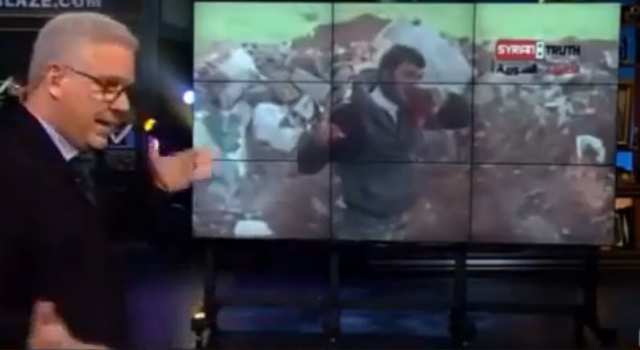
TV-personality Glenn Beck shows video of rebel eating human flesh

Broad majorities continue to oppose the U.S. and its allies sending arms and military supplies to anti-government groups in Syria. Last Thursday’s announcement that the U.S. would aid the rebels has not increased public support for action, and majorities of all partisan groups are opposed.

Overall, 70% oppose the U.S. and its allies sending arms and military supplies to anti-government groups in Syria; just 20% favor this. Opinion is little changed from December of last year (24% favor) and support is down slightly from March, 2012 (29% favor).

The latest national survey by the Pew Research Center, conducted June 12-16 among 1,512 adults, finds a major factor in overall attitudes about Syria is the impression that the U.S. military is already stretched thin. About two-thirds (68%) say the U.S. is too overcommitted to get involved in another conflict, and just 27% disagree. The public also has questions about the opposition groups in Syria: 60% say that they may be no better than the current government.

There is very little partisan divide in attitudes about the conflict in Syria. Majorities of independents (74%), Republicans (71%) and Democrats (66%) oppose the U.S. and its allies sending arms and military supplies to anti-government groups in Syria.

Nearly identical majorities of Democrats (69%), independents (69%) and Republicans (68%) also believe that U.S. military forces are too overcommitted to get involved in another conflict.

Independents (66%) and Republicans (64%) are most concerned that the opposition groups in Syria may be no better than the current government, but 52% of Democrats also agree with this statement.

By a 58%-38% margin, more Democrats agree than disagree that the U.S. has a moral obligation to do what it can to stop the violence in Syria. Republicans are split with 49% saying the U.S. has a moral obligation to do what it can to stop the violence, and 48% saying it does not have this responsibility. Most independents (53%) disagree that the U.S. has a moral obligation to stop the violence in Syria.

The survey, conducted from Wednesday, June 12 through Sunday, June 16, found no significant trend in opinion about Syria over the course of the five nights of fieldwork. In the first two nights of interviewing 69% opposed arming Syrian rebels, in the final three nights of fieldwork 71% were opposed.

Even amidst developments on the ground in Syria and the announcement of U.S. plans to aid anti-government groups there, the public continues to pay very little attention to news about Syria. In a separate survey conducted Thursday through Sunday, just 15% say they are following news about charges that Syria has used chemical weapons against anti-government groups very closely, far fewer than are following other stories such as the government’s collection of communication information (35%) and news about the national economy (30%). In fact, 33% say they are following news about Syria not at all closely.

Partisans express similarly low levels of interest in the conflict in Syria. Just 12% of Democrats, 14% of Republicans and 17% of independents say they are following charges that Syria used chemical weapons very closely.

The 20% of the public that favors arming anti-government groups in Syria also expresses concerns about the U.S. getting involved. More than half (56%) of those who favor arming rebels agree with the statement that U.S. military forces are too overcommitted to get involved in another conflict, and 55% agree that the opposition groups in Syria may be no better than the current government. However, far larger majorities agree that it is important for the U.S. to support people who oppose authoritarian regimes (76%) and that the U.S. has a moral obligation to do what it can to stop the violence in Syria (75%).

To a lesser extent, those who oppose arming the rebels are sympathetic to some arguments for greater U.S. involvement in Syria. About half of those who oppose arming rebels (48%) agree that it is important for the U.S. to support people who oppose authoritarian regimes; 41% say the U.S. has a moral obligation to do what it can to stop the violence in Syria. – PEW