Detroit water shutoffs ‘racially’ motivated

After a class action lawsuit filed against the city of Detroit, the NAACP Legal Defense Fund says that recent water shutoffs to Detroit residents were racially motivated.

Veronica Joice with the NAACP Legal Defense Fund says, “That (the shutoffs are) being done in a discriminatory fashion; and they should at least take a look at whether there’s a better way to do this that doesn’t affect the most vulnerable citizens — the majority of whom are African American here in Detroit.”

Attorney Alice Jennings, who filed the lawsuit on behalf of Detroit residents, said it’s a known fact that there are corporations that owe hundreds of thousands of dollars to the city of Detroit Water and Sewerage Department.
“These companies are basically Caucasian companies,” Jennings said. “The folks who are being cut off are almost one hundred percent African American.”

Asked by WWJ’s Charlie Langton directly if this is a “racial issue,” Jennings replied: “It sure is! You bet it is.”

The Detroit Water and Sewerage Department stopped service to about 7,200 homes and businesses in June, compared to 1,570 in the same month last year. Water was restored to 43 percent after customers paid or worked out payment plans.

At a bankruptcy hearing Monday, federal Judge Steven Rhodes asked the city for an update on the water issue, but fell short of ordering any action.

Talking to WWJ’s Sandra McNeil shortly after the announcement, water department spokesman Greg Eno admitted there’s no doubt that the department has been lax over the years, letting the bills pile up.

He said people who now owe more than they can afford are being asked to come in and apply for assistance through the Water Affordability Program.

Eno said, through, it’s not just free money.

“We don’t have, you know, a bottomless cup of funds,” he said, adding that’s why it’s important that affected customers come in as soon as possible.

Near half of Detroit can’t pay water bills

Black city struggling

It’s a basic human right: water. But could the United Nations soon help the Detroit Water and Sewerage Department provide the service to struggling customers?

Water department spokeswoman Curtrise Garner says it’s a possibility — but for now, the water bills must be paid.

“We do have programs that do help those that are just totally in need; can’t afford it — but we also know that there are also people who can’t afford it would can not pay and we know this because, once we shut water off, the next day they are in paying the bill in full. So we do know that that has become a habit as well,” said Garner.

“At the DWAS Department — it’s not our goal to shut off water. We want people’s water on, just like they do; but you do have to pay for your water…That’s the bottom line.”

Garner said the reality is that nearly half of Detroit Water and Sewerage customers can’t pay their bills; and that has led activists to lobby the UN to step up and take action.

“If they do contact us we are willing to speak with them,” she said, adding “We owe it to the customers that are paying to collect from those that aren’t. Somebody has to pay for the water.”

And while Garner says water is “a God-given right,” she says there is a cost to move water from the water resource to the customer and that the infrastructure costs money.

According to the Free Press, the average Detroit water bill is now $75 a month — much higher than the nation’s average rate of about $40.

Source: CBS local

Bashing the black city

L. Brooks Patterson
L. Brooks Patterson

The often outspoken Oakland County Executive is once again in hot water over comments he made about Detroit in a recent interview with “New Yorker” magazine.

L. Brooks Patterson is quoted in an article titled “Drop Dead, Detroit!” as saying he only has negative things to say about the Motor City. He made the controversial comments while giving reporter Paige Williams an extended tour of Oakland County last September.

“Anytime I talk about Detroit, it will not be positive. Therefore, I’m called a Detroit basher,” he said. ”The truth hurts, you know? Tough s***.”

The 75-year-old Republican went on to say he warned his children never to travel to Detroit.

“I used to say to my kids, ‘First of all, there’s no reason for you to go to Detroit. We’ve got restaurants out here.’ They don’t even have movie theatres in Detroit — not one,” he said.

Patterson said the one thing Detroit offers that the suburbs can’t is live sports – and even then a trip to the city is quite risky.

“For that, fine — get in and get out,” he said. “But park right next to the venue — spend the extra 20 or 30 bucks. And, before you go to Detroit, you get your gas out here. You do not, do not, under any circumstances, stop in Detroit at a gas station! That’s just a call for a carjacking.”

He’s also quoted as saying a prediction he made has come to pass. He said, “What we’re going to do is turn Detroit into an Indian reservation, where we herd all the Indians into the city, build a fence around it, and then throw in the blankets and corn.”

A statement from Patterson’s office said the seven-page article casts the executive in a false light, but didn’t dispute the quotes or apologize for his actions.

The National Action Network, an organization founded by the Reverend Al Sharpton, is calling for a public apology from Patterson. The group is holding a news conference at 11 a.m. Tuesday to request the apology.

In a statement, Rev. Charles Williams II, the National Action Network’s Michigan chapter president, said Patterson’s remarks were “repulsive” — not just because Detroit is mostly a black city, but “because it is also a direct slight to the American Indians who occupied the land before Detroit was Detroit, and Oakland County.”

Source: CBS Detroit

America’s Bantustan

detroit2By Glen Ford

“If we don’t do something real soon, I think you’ll have to agree that we’re going to be forced either to use the ballot or the bullet. It’s one or the other in 1964. It isn’t that time is running out — time has run out!” – Malcolm X, “The Ballot or the Bullet,” Cleveland, Ohio, April 3, 1964.

A half-century after the man once known as Detroit Red spoke those words, the last grains of sand are trickling from the hour glass of what has passed for democracy in America. The principle of one-person, one vote – or any meaningful franchise, at all – is no longer operative for the majority of Black people in the state of Michigan, whose largely African American cities are run by emergency managers accountable to no one but Rick Snyder, the venture capitalist in the governor’s mansion. The same bell is tolling for every urban center in the land, as hegemonic finance capital creates the template for direct corporate rule through the systematic destruction of Detroiters’ citizenship rights.

The 82 percent Black metropolis has been reduced to a Bantustan in both the economic and political senses of the term. Surrounded by some of the richest counties in the nation, the impoverished city exemplifies a national racial wealth gap that is more profound than that which existed in South Africa at the height of apartheid, as detailed by Jon Jeter in this issue of BAR (See “Worse Than Apartheid: Black in Obama’s America”). The Emergency Manager law, passed by the Republican state legislature after rejection by voters in a referendum, makes the Bantustan analogy complete, with a Black corporate lawyer overseeing the dismantling of every mechanism of local democracy. Kevyn Orr’s ascension as plenipotentiary of Wall Street is also the ultimate logic of the most vulgar current of African American politics, which seeks only Black representation at the highest levels of power, no matter whose interests are served. Wall Street long ago scoped this Black weakness, and has exploited it at every political level.

“The same bell is tolling for every urban center in the land.”

Detroit’s dissolution also sounds the death knell for a generation’s dreams of authentic “Black Power” through purely electoral means in collaboration with corporate “renaissance” schemes. The Black masses have never been envisioned as part of any “renewal” of the cities under corporate auspices. Rather, investment is contingent on Black disempowerment and removal – the corporate axiom from which the Emergency Manager regime logically flows. Barack Obama, as loyal (and lawyerly) a servant of the banks as Orr, accepts the validity of the premise, which is why he raises no principled objection to Detroit’s disenfranchisement, either in its particulars or as a model for urban America.

The drama unfolds in bankruptcy court, a venue whose rules were written almost entirely by the financial capitalist class. By virtue of the Emergency Manager law, Detroit is represented in court by its nemesis, Kevyn Orr – which is like imposing Newt Gingrich as chief counsel for the NAACP. (The Detroit NAACP seeks to halt the proceedings on voting rights grounds.) Orr’s office is referred to as “the city” in both legal terms and by idiot corporate media, who confuse the public by reporting, as did Detroit PBS correspondent Christy McDonald, this week, that the issue is “whether the city can go ahead with its bankruptcy” process. In fact, hardly an elected official or candidate exists that openly supports bankruptcy, especially under Kevyn Orr’s terms (Detroit holds a meaningless mayoral and council election, next week).

Orr may be the most hated man in Detroit – a fact that would be noted by every media outlet in the nation, if the metropolis were largely white. But the Detroit model for democracy’s demolition is depicted as a white supremacist morality play, in which corruption and incompetence are the inevitable fruits of Black majority rule, which must be extirpated by any means necessary. White Americans, in general, can be distracted by the slightest hint of ghetto graffiti from seeing their own futures written on the wall.

“Detroit is represented in court by its nemesis, Kevyn Orr – which is like imposing Newt Gingrich as chief counsel for the NAACP.”

Kevin Orr, ensconced in a $5,000 per month luxury penthouse condominium paid for by one of Governor Snyder’s private slush funds with contributions from secret corporate donors, is building the template for urban democratic dissolution from scratch. He is a crude and unimaginative man, doing Wall Street’s bidding with little finesse in the bright light of day. His arrogance is buttressed by the certainty that he is backed by the real rulers of the American State, Wall Street, and that the outcome in Judge Steven Rhodes’ federal bankruptcy court will create precedent to render all of America’s cities servile and neutered. Orr is also aware that his coloration provides perfect cover for his mission – added value for his services, well worth the luxury suite. (The judge ruled that Orr’s accommodations were irrelevant to the case.)

First-responders, revered in the post-911 United States, are crucified along with the rest of the city rabble. Orr ejected 8,000 city retirees under age 65 from their city-paid $605 per month health insurance, including police and firefighters. The state constitution specifically forbids impairing pensions, which average only $18,000 a year, yet Orr testified that he thinks federal law allows him to override those protections. He and the governor, who was subpoenaed by unions, both claimed they didn’t start out wanting to bankrupt the city – but why would Snyder hire bankruptcy lawyer Orr unless that were the intention? The lying duo claimed they never conspired to push Detroit into the venue, and that it was the unions that refused to negotiate in good faith. Apparently, “good faith” means negotiating away rights guaranteed by law.

“Orr ejected 8,000 city retirees under age 65 from their city-paid $605 per month health insurance, including police and firefighters.”

Orr admitted that he never even raised the subject of getting the state to help Detroit out of its fiscal difficulties. And, why would he? His mission is not to save the city, but to break it into auctionable pieces and to garnishee its remaining revenue streams for bankers. His opening fiscal reorganization plan would pay off Bank of America and UBS, who have already made millions on a 2005 derivatives scheme with the city, establishing Britain’s Barclay’s Bank as the super-priority creditor with dibs on $4 million a month in Detroit casino revenues if the city defaults.

To ensure that the city can never escape the clutches of capital, the contract would allow Barclay’s to immediately declare Detroit in default if Emergency Financial Manager rule is ended for any reason – that is, the corporate plan calls for the permanent cessation of democracy in Detroit.

That’s the plan for the whole country. Wall Street recognizes that it cannot effectively consume the public sphere as long as the public retains the electoral democratic mechanisms to stop it. In other words, concentrated capital can no longer coexist with even the thin gruel of American democracy. The Black polity is the weakest link in the U.S. democratic armor. White folks won’t protect it, and Black folks have the least resources to defend it. The generals of Wall Street have purposely chosen Detroit as the decisive battleground, where the power of massed capital will be hyper-charged by an endemic, unreconstructed racism that can reliably be expected to deny that democracy is really at stake, at all. It’s just, you know – “the Blacks.”

And even some Black folks will agree. – Black Agenda Report

‘More white kids have to die’

Eric Dyson
Michael Eric Dyson

Appearing on the “progressive” cable network owned by death merchant General Electric, MSNBC, a regular guest at globalist forums held at the Aspen Institute and funded by the Rockefeller Brothers and the Ford Foundation, Michael Eric Dyson, said white people will not understand racism until their children are murdered.

“Not until, and unless, the number of white kids die that approximate the numbers of black and other kids who have died will America see it is beyond logic, it is beyond rationality, its about let’s get something done,” Dyson said.

“As for Eric Holder, look the reality is you gotta act now,” Dyson said. “The president, you won the second term, you’re in office, you are ensconced. Do something courageous, bold, and helpful, not only to African-American people, but to America, because unless we do this [subject Zimmerman to double jeopardy] white Americans and others will feel this was a justifiable verdict.”

Dyson argued Sunday also on MSNBC that racism is to blame for Detroit’s financial woes, after the once-booming industrial metropolis filed for bankruptcy last week.

Host Ed Schultz asked if race could be responsible for the city’s downfall.

“Of course, it’s an 85 percent black city,” Mr. Dyson replied. “It’s been perceived as a colony of black people who are ringed by suburban white areas that are now going into the city to plunder it. The perception is that there is a massive takeover of resources and materials and properties, basically being occupied.”

“We have to acknowledge that part of this has to be the racial animus that has characterized that city for the last 50-some-odd years,” he continued. “The service industries hemorrhaged jobs in the inner city, depleted that city of its economic infrastructure and left it to its own fate.” – Kurt Nimmo, Infowars/Washington Times

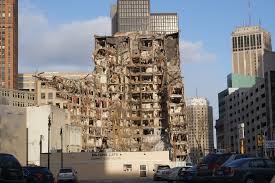
Detroit bankruptcy: a cocktail of white flight and black corruption

A house in Detroit, mirroring the black city's decay
A house in Detroit, mirroring the black city’s decay

by Tom Krishner and Dee-Ann Durbin

The city of Detroit, which for years paid its bills with borrowed money, is the largest city in U.S. history to file for bankruptcy protection. Here’s a look at how the city spiraled into financial ruin and why it’s in so much trouble:

What happened?

For decades, Detroit paid its bills by borrowing money while struggling to provide the most basic of services for its residents. The city, which was about to default on a good chunk of its $14 billion-plus debt, now will get a second chance in a federal bankruptcy court-led restructuring. Detroit’s budget deficit this year alone is estimated at $380 million, and Kevin Orr, its state-appointed emergency manager, chose bankruptcy over diverting money from police, fire and other services to make debt payments. The move conserves cash so the city can operate, but it will hurt Detroit’s image for years. It also leaves creditors with pennies on the dollar and places in jeopardy the pension benefits of thousands of city retirees.

Kwame Kilpatrick, after his federal indictment on corruption charges
Mayor Kwame Kilpatrick, after his federal indictment on corruption charges

Why did it happen?

It took decades of decay to bring down the once-mighty industrial giant that put the world on wheels. The city grew to 1.8 million people in the 1950s, luring them with plentiful jobs that paid good wages to stamp out automobiles for sale across the globe. But like many American cities, Detroit’s fall began late that decade as developers starting building suburbs. Then came the 1967 race riots that accelerated the number of white residents who moved to the cities north of Eight Mile Road, considered the region’s racial dividing line. At the same time, auto companies began opening plants in other cities, and the rise of autos imported from Japan started to cut the size of the U.S. auto industry. Detroit’s property values fell, tax revenue dropped, police couldn’t control a growing murder rate, and many middle-class blacks fled the city for safer suburbs with better schools. By 2009, the auto industry collapsed along with the economy as a whole, eventually pulling the city down with it. Government corruption under former black Mayor Kwame Kilpatrick only made things worse. In the 2000 census, Detroit’s population fell under 1 million in as the exodus continued. Today it’s barely above 700,000.

Did the auto industry’s fall drag down Detroit?

It’s a big factor. The city is littered with abandoned factories built in the postwar boom years, most of which have multiple stories. As the Japanese auto invasion began cutting into Detroit’s sales, General Motors, Chrysler, Ford and hundreds of auto parts companies looked outside the city to build one-story plants that could handle modern assembly lines. With every downturn, more companies abandoned the city, leaving the hulking buildings to squatters. Detroit’s tax base continued to erode. By the time the auto industry melted down in 2009, only a few factories from GM and Chrysler were left. GM is the only one with headquarters in Detroit, though it has huge research and testing centers with thousands of jobs outside the city.

Where else has this happened?

Before Detroit, the largest local government bankruptcy filing was in Jefferson County, Ala., in November 2011. The county cited more than $4 billion in debt, mostly from corrupt deals involving sewer financing that fell apart when the home mortgage crisis hit in 2008. The county is still trying to clean up the mess. Last month, commissioners sought a compromise that calls for paying creditors a little over half the money they’re due and raising sewer rates. They hope to exit bankruptcy by December. Jefferson County has nearly 700,000 people, which is similar in size to Detroit, and includes the city of Birmingham. The economic crisis also caused bankruptcies of smaller cities. The California cities of Stockton, San Bernardino, and Mammoth Lakes all filed for bankruptcy last year. Stockton and San Bernardino were hit by plummeting home values during the recession, which cut property and sales taxes, while Mammoth Lakes was overwhelmed by a $43 million breach-of-contract judgment brought against it by a developer.

General Motors rebounded after bankruptcy: can Detroit follow?

Maybe. In GM’s 2009 government-funded bankruptcy, the company was split in two, with money-making assets staying at GM and decrepit plants and billions in debt going to a separate company. GM reduced its debt from $46 billion to $8 billion and used the bankruptcy to close factories, shed brands and get more concessions from union workers. The new, leaner company has since racked up $17.2 billion in profits and added jobs in Detroit. For the city, the comeback will be much harder. Its decaying neighborhoods can’t be sent elsewhere. But creditors whom Detroit owes more than $14 billion will have to take pennies on the dollar. Thousands of retired city workers could lose at least part of their pension benefits. Concessions could be forced upon dozens of city unions, including pay and benefit cuts. Free of these financial burdens, Detroit will be able to concentrate its limited dollars on services such as basic police and fire protection. Better services could bring more people and lure more business investment. Already the downtown and an area to the north called Midtown are seeing business and residential growth — signs that Detroit has a future. – AP

Detroit, an education wasteland

Detroit Public Schools (DPS) also need metal detectors

In the public schools in Detroit, Mich., according to the U.S. Department of Education, only 7 percent of the eighth graders are grade-level proficient or better in reading.

Detroit public-school eighth graders do even worse in math than they do in reading, according to the Department of Education. While only 7 percent scored highly enough on the department’s National Assessment of Educational Progress test in 2011 to be rated “proficient” or better in reading, only 4 percent scored highly enough to be rated “proficient” or better in math.

Statewide in Michigan, only 32 percent of public-school eighth graders scored grade-level proficient or better in reading, and only 31 percent scored grade-level proficient or better in math.

68 percent of Michigan public-school eighth graders are not proficient in reading and 69 percent are not proficient in math.

Over the past decade, Michigan’s public school have shown no improvement at all in teaching children how to read. In 2002 just as in 2011, according to the U.S. Department of Education, only 32 percent of Michigan public-school eighth graders scored proficient or better in reading. – CNSNews