Apple’s iPhone loses market share in China

Apple iPhone 4
White Apple iPhone 4S

Apple Inc’s share of China’s booming smartphone market slipped for a second straight quarter in October-December, as it lost ground to cheaper local brands and as some shoppers held off until after the iPhone 4S launch last month.

China, the world’s largest mobile phone market, has not been easy for Apple, which is grappling with a lawsuit from a local firm over the iPad name and issues at its suppliers’ factories over wages and working conditions.

With the number of mobile subscribers set to top 1 billion in China this year, there is cut-throat competition among South Korea’s Samsung Electronics Co Ltd, Nokia, Apple and local firms Huawei Technologies Co Ltd and ZTE Corp.

While Apple regained its top spot as the world’s largest smartphone vendor in the fourth quarter and for last year as a whole, it slipped to 5th place in China, overtaken by ZTE. Apple’s China smartphone market share slid to 7.5 percent from 10.4 percent in July-September.

In the last quarter, Samsung knocked Nokia off the top slot, taking 24.3 percent of the market, more than three times Apple’s share, data from research firm Gartner showed. Nokia’s market share more than halved last year, from above 40 percent in the first quarter to below one fifth by the fourth quarter.

“Chinese handset makers have been actively promoting their smartphones with China’s three telecoms operators, so we saw ZTE and Huawei gain significant market share,” said Taipei-based Gartner analyst CK Lu.

Gartner said this week it expected Apple’s iPhone market share to slip for a couple of quarters as the novelty of its latest 4S model wears off.

In the first quarter of last year, ZTE had a market share of just 3 percent, but ended 2011 ranked 4th with more than 11 percent market share.

Chinese firms are gradually shifting up towards the higher end of the market, unveiling more feature-packed smartphones.

“If you want to sell handsets to the mass market, a simple rule of thumb in China is that the handset price has to be close to 70 percent of the monthly salary,” said Jayesh Easwaramony, an analyst with Frost & Sullivan in Singapore.

“Today, an iPhone is more than two months salary.”

This, said Easwaramony, gives the likes of Huawei and ZTE the opportunity to cater to a mass market that is captivated by the iPhone, but doesn’t have the purchasing power for it.

VALUE FOR MONEY

“The quality of Huawei’s phones is quite high and it’s good value for money compared to the iPhone,” said Dale Dai, a 28-year-old sales executive from Beijing.

Dai, who uses his Huawei phone to write weibo, or Chinese microblogs, surf the Internet and make calls, recently bought a new Honor smartphone for 1,800 yuan ($290), almost a third of the price of a new iPhone 4S at 4,988 yuan.

But given the sheer size of the Chinese market, just targeting the highest end users should be enough for Apple, though it’s not always been a smooth ride.

Last month, shoppers in Beijing threw eggs at the Apple store and fought with police when they were told the iPhone 4S would not be on sale as scheduled.

In Shenzhen, some genuine iPhones and iPads are smuggled in from Hong Kong, while sellers also take advantage of Apple’s popularity by packaging fake iPhones in iPhone 5 boxes – even before the 4S was launched.

In Hong Kong, Apple resorted to an online lottery reservation system for the 4S model after crowd control issues disrupted initial sales.

Analysts expect Apple to stem its slide in market share in China by signing up another carrier.

China Unicom, the country’s No.2 telecoms operator, is currently the only carrier to officially carry the iPhone. It has not officially given its iPhone sales, but analysts estimate it has sold around 3 million iPhones since signing a contract with Apple in 2009.

China Telecom Corp Ltd, the third and smallest operator, is expected to be next to clinch a similar deal with Apple later this year, and analysts predict it would sell about 1.4 million iPhones this year if it can reach a deal with Apple by May, rising to 2-4 million new iPhone users in 2013.

($1 = 6.3016 Chinese yuan)

– Reuters

Taxi violence in Pretoria

Police were monitoring East Lynne, east of Pretoria, on Friday morning after violent fights between taxi owners the day before, Captain Pinky Tsinyane said.

The Mamelodi Long Distance Taxi Association and the PLAZA Taxi Association were allegedly involved in violent fights at the corner of Baviaanspoort and Stormvoel roads on Thursday morning.

“During the violence about 11 taxis tyres were slashed, a driver was assaulted and was taken to the hospital,” Tsinyane said.

Violence broke out between taxi drivers who were fighting over the route from Pretoria CBD to Mamelodi via East Lynne.

“We hope people will come forward with information with regards to the damage to property case registered at Villeria Police Station,” Tsinyane said.

A meeting between the associations was expected to take place soon and police would monitor the situation which was calm on Friday, said Tsinyane.

ANC must take land, Mantashe tells Young Communists

The ANC cannot be a liberation movement if it does not tackle the issue of land reform, ANC secretary general Gwede Mantashe said on Thursday.

“The land question is at the centre of the struggle. If we raise it in the ANC some are irritated. It can’t be a liberation movement that refuses to deal with the land question,” he said.

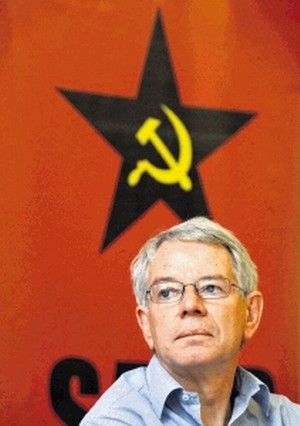
Mantashe, who is also the chairman of the SA Communist Party, was speaking at a Young Communist League meeting at the University of Witwatersrand in Johannesburg.

He said land could not just be claimed without compensation, as unskilled workers would not be able to successfully care for their land.

“When the people were dispossessed, they were also de-skilled. Land distribution must go together with a support mechanism for emerging farmers.”

He said historians needed to focus on the indigenous people of South Africa.

“The first war in the country [with colonialists] left what they call the ‘Khoisan Genocide’,” he said.

“This left [the Khoi and San] believing they are extinct, and they say now that they are the ‘coloured’ people. They are the first indigenous people in Africa… they are a part of the African identity.”

He said subsequent wars forced the Basuto nation into the mountains as a means of defence.

“We need to see history through the eyes of the lion. We cannot allow hunters to write the history of lions.”

He was talking in reference to the claim made by Freedom Front Plus leader Pieter Mulder in Parliament on Wednesday.

Mulder suggested that black “Bantu-speaking” people had no historical claim to 40 percent of the country. “Africans in particular never in the past lived in the whole of South Africa,” Mulder claimed during debate in the National Assembly on last week’s state-of-the-nation address.

Mantashe said the ANC and SACP were both fighting different sides of the same “monster”.

“We are fighting the monster at the same time. The ANC is fighting against racial exploitation and the SACP against economic exploitation.”

He said both parties needed to clear themselves of members with “negative tendencies”.

“It is like taking a mouse to a cheese factory, it will eat itself to death. We need to fight these tendencies wherever they are… things like corruption and the use of money to balance forces in conferences, or singing songs that are decisive.

“The ANC needs to reinforce that the only thing that is yours is your salary,” he said

ANCYL: Malema won’t go

ANC Youth League president Julius Malema will not be removed from his position by anyone but the structures of the league, his deputy Ronald Lamola said on Thursday.

“It is only the internal process of the ANCYL that can decide to elect or un-elect leadership of the ANCYL,” Lamola told reporters at Luthuli House in Johannesburg.

“The ANCYL will never agree that its leadership be subjected to unfair and unjust treatment or banished for narrow political purposes.”

At the ANCYL’s lekgotla last week, Malema said he would resign as the organisation’s president if the structures of league said he should.

“All leaders of regional, provincial and national executive committees… across the country rejected the offer of the ANCYL president to resign his position.”

Lamola said the ANCYL’s leaders would remain in place until June 2014, when its next elective conference would be held, because there was no constitutional basis on which to remove them.

He said the “foreign tradition” of trying to remove leaders of elected league structures without consent had to be “nipped in the bud”.

“If committees remove leaders of the ANCYL, they will one day appoint leaders of the ANCYL. That will be a complete undermining of the will of the people,” said Lamola.

Malema, his spokesman Floyd Shivambu and league secretary general Sandiso Magaqa did not attend the media briefing.

They were attending a hearing, also at Luthuli House, in mitigation of their suspensions.

They were found guilty, in November, of bringing the ANC into disrepute and of sowing division in the party, partly for making comments about regime change in Botswana.

Malema, who was found to have compared President Jacob Zuma unfavourably to his predecessor, Thabo Mbeki, was suspended for five years. Shivambu, who insulted a journalist, was suspended for three years.

Magaqa, who was found to have made derogatory and potentially defamatory statements about Public Enterprises Minister Malusi Gigaba, received an 18-month suspension, suspended for three years, on condition he apologise within five days of receiving the penalty or appealing against it.

Also suspended were Lamola, ANCYL treasurer general Pule Mabe and deputy secretary general Kenetswe Mosenogi.

On February 4, the ANC’s appeals committee announced it had dismissed attempts by Malema, Shivambu, Magaqa and the others to have the guilty verdicts against them overturned.

Asked whether the ANCYL was distancing itself from the ANC by not complying with its sanctions, Lamola said it was not.

“There will never be a time when the ANCYL will operate outside of the ANC. We will always be an organisation within the ANC.”

He said the ANCYL had subjected itself to the ANC’s internal processes.

It was upset that its structures, like the rest of the country, had to hear from the media about its leadership’s suspensions.

The ANC should have spoken to these structures before the announcement was made.

Lamola said all ANCYL national executive committee members had accepted at the lekgotla that the disciplinary proceedings had been politically motivated.

“There is no consistency of discipline in the ANC… there has been disrepute brought to the ANC by many amongst its leadership and there was no action that was taken,” he said.

“We believe that the ANC carries an obligation to educate and guide the ANCYL on all critical policy issues and not persecute the leadership for articulating the policy of the ANCYL.”

DA says Pieter Mulder needs ‘history lesson’ on land

Freedom Front Plus leader Pieter Mulder needs to be reminded about the “real history” of South Africa, the DA said on Thursday.

“Instead of denying our history, as Mr Mulder does, we must do everything we can to ensure that people have access to land. We have to put right the wrongs of the past,” Democratic Alliance national spokesman Mmusi Maimane said in a statement.

“We cannot simply wish it away. Redress is a democratic imperative. But we have to remedy the sins of apartheid in a way that is sustainable so that all South Africans may benefit from the richness of our soil.”

On Wednesday, Mulder suggested in Parliament that black “Bantu-speaking” people had no historical claim to 40 percent of the country.

“Africans in particular never in the past lived in the whole of South Africa,” he said during debate in the National Assembly on last week’s state-of-the-nation address.

Maimane said there was plenty of land available for land reform, and South Africa needed a land reform programme which was fair and economically viable and the answer was not to do away with the willing-seller, willing-buyer model.

“The solution is an efficient department of rural development that can process claims quickly and can facilitate the efficient and fair distribution of land.

“If we can get that right there will be no need for anybody — whether it is Julius Malema or Pieter Mulder — to use the emotive issue of land to pander to their own narrow constituencies,” said Maimane.

Mulder’s remarks on Wednesday provoked an angry buzz from ruling party benches, which rose in pitch when he explained: “There is sufficient proof that there were no Bantu-speaking people in the Western Cape and north western Cape.”

These areas formed 40 percent of South Africa’s land surface, he told MPs.

Mulder serves in President Jacob Zuma’s Cabinet as deputy agriculture minister.

In his state-of-the-nation address, Zuma said the willing-buyer willing-seller option had “not been the best way to address” land redistribution.

Mulder said the question of land ownership was an emotional issue that had caused many wars. He took issue with land ownership figures cited by Zuma in his address.

“The president quotes in his address the department of rural development’s figures on land reform.

“According to [these], white people possessed 87 percent of the land, and the government had reached only eight percent of its 30 percent [land reform] target. I seriously differ from these figures.

“How does the department calculate the eight percent? There isn’t a completed land audit against which we could correlate these facts.”

The Development Bank of SA calculated in 2001 that 44 percent of the country’s land belonged to whites, 20 percent to blacks, nine percent to brown people and one percent to Asians.

“The way in which the department has calculated the 30 percent and eight percent figures creates the impression that they are setting themselves up to fail.”

Mulder said he seriously differed with the claim that white people had stolen land.

Referring to Zuma’s remarks on the willing-buyer, willing-seller option, he said that, in plain language, this meant the government now believed in the nationalisation of agricultural land. However, anyone who had dealt with land reform knew the problem was not with the willing-buyer, willing-seller principle.

Mulder said he hoped there would come a time when both white and black commercial farmers did not have to look for opportunities elsewhere in Africa.

Critic of Malawian president jailed

An outspoken opponent of Malawi’s president who once served as his attorney general says the administration sent thugs to petrol bomb his law office – and the government critic ended up in jail.

Ralph Kasambara was arrested Monday, accused of kidnapping and torturing three men he told reporters confessed to his bodyguards that they had been sent after him by the government.

Information Minister Patricia Kaliati denies Kasambara’s accusations, and Kasambara denies the kidnapping and torture charges.

Concern that President Bingu wa Mutharika is intolerant of criticism and violating human rights has led to protests and strained relations between Malawi, among the world’s poorest countries, and its foreign donors. At least 19 people were killed by police when anti-government demonstrations last year degenerated into looting.

In the Kasambara case, court clerks who have been striking for higher pay for weeks suspended their strike to allow a bail hearing because lawyers have supported the clerks. On Tuesday, a magistrate ordered Kasambara released. Prison authorities balked at first, saying the order came too late in the day Tuesday. Kasambara was released Wednesday and greeted by hundreds of his supporters, colleagues and journalists outside a Blantyre jail.

Hours later, police arrested him again at his home, saying his bail procedure was flawed. Supporters again gathered at the jail, and police wielded batons to disperse them.

Kasambara’s arrest came days after weekly newspapers quoted him criticizing Mutharika.

“Malawians have options. They should ask the president to resign or they should impeach him. He wants to be a dictator,” Kasambara was quoted as telling The Weekend Nation.

Mutharika, a former World Bank official, was once heralded by economic analysts and was overwhelmingly re-elected in 2009 by voters who embraced his anti-corruption, anti-poverty pledges. But the country’s economy has struggled in the last year, and questions about Mutharika’s commitment to democracy and human rights became an issue.

Mutharika expelled a British diplomat who had described his as “becoming ever more autocratic and intolerant of criticism.” Former ruler Britain subsequently indefinitely suspended aid to Malawi, which later withdrew its expulsion order.

The European Union, Germany, Norway and the U.S. have also halted or suspended assistance to Malawi, raising governance questions.

Thousands gather for al-Shabab-al-Qaida merger

Thousands of Somalis are gathering at a militant-organized demonstration in support of the merger of the Somali militant group al-Shabab with al-Qaida.

Al-Shabab spokesman Ali Mohamud Rage told those gathered at Monday’s rally that al-Shabab is happy with its unification with al-Qaida, a merger announced last week by al-Qaida leader Ayman al-Zawahri.

Several hundred people gathered at the rally, including veiled women and armed, masked men.

Rage also said that an upcoming international conference in London on Somalia is being organized to “colonize” Somalia.

Somalia has not had a fully functioning government in more than 20 years, but African militaries from Uganda, Burundi, Ethiopia and Kenya are pressuring al-Shabab from three sides. – AP

Love is a dying tradition: work is eliminating families

by Charlene Smith

Don’t cry if you’re no-one’s Valentine, love is a dying tradition as marriages and family life disappear according to a rush of new studies released this month.

The Brookings Institute in the United States reported on February 3 that, “Fewer Americans are married today than at any point in at least 50 years.” This correlates with data in the same report that says while half of women didn’t work 40 years ago, it is rare for women not to work now and they’re waiting longer to have children, if at all. Today in the United States a third of first time mothers are older than forty and around 10 percent of men and women are choosing not to marry at all.

Vicky Eriksson of human resources training group The People Element said, “ours are the most job-focused generations ever. We work longer hours -up to 500 hours more a year according to stats – and because we have become so consumed with accumulating degrees, status, and wealth, the other significant need for successful humans – good relationships – falls by the wayside. Yet, stats of the wealthiest one percent of Americans who earn 40 percent of that country’s wealth reveal that 48 percent are in stable, happy, long-term marriages. The very wealthiest have learned the secrets of successful relationships, the rest of us have not.” Figures for South Africa show rampant divorce, multiple marriages and a very high ratio of struggling single mothers.

The Organisation of Economic CoOperation and Development also released a report early in February saying that marriage in Western nations (including South Africa) is a dying trend. “Since the 1960s the family has undergone significant transformation. In many countries, the extended family has all but disappeared, and the traditional two-parent family has become much less widespread as divorce rates, re-marriages, cohabitation, single parenthood and same-sex partnerships have all increased.

“Families have seen more mothers take up work in the labour market, their adolescents spend longer and longer in education and training, and the elderly members of the family live longer and, increasingly, alone.”

Vicky Eriksson and Karin Wellman of The People Element said they were increasingly engaging with people in workshops who had chosen to give up relationships to devote time to their career. Eriksson said, “women especially tend to choose to focus on their career in their early years and then consider a relationship in their late thirties or early forties when they are at the top of their careers. But a relationship requires compromise and some struggle to do that after achieving success in the workplace. This can lead to personal stress and sadness later on.”

Wellman and Eriksson said they were so concerned by the high levels of stress in the workplace that they were organizing a conference on People Effectiveness @ Work to be held at the Midrand Conference Centre on the 8th of May 2012 “It will be a one day bootcamp to look at ways to help individuals and workforces to transform and cope with stress in ways that don’t disable their work performance or their family or personal life.”

Wellman pointed out that OECD figures on the breakup of relationships -especially families – were now imposing significant costs on economies, “In Britain that figure is now £42bn per year and rising, according to the Relationships Foundation. Family breakdown costs more than the entire defence budget in that country. In Britain and here most of the cost to the economy comes from benefits and tax credits that support single parents and their children. Today in Britain there are two million single parent families: there were one million in 1980. In South Africa most children are now being raised in single parent families.”

Recent demographic projections performed by OECD countries suggest that the next 20 years are likely to see a continuation and even acceleration of changes in household and family structures. In particular, the numbers and shares of single-adult and single-parent households are expected to increase significantly, as is the number of couples without children.

In Britain today, 40 percent of all children can expect to see their parents split up before their 16th birthday. At least half of family breakdown takes place within the first three years of childhood. (However, the latest study from the Centre for Social Justice and the Bristol Community Family Trust estimates that, of children born today, no less than 48% will see their parents split by their 16th birthday.)

OECD research has shown that, of all countries (not just the 30 member countries), the UK has the fifth highest lone parent rate, after Latvia, Estonia, the Czech Republic and the US.

Globally divorce rates have gone up about six fold since 1960.

It is estimated that in most developed nations including South Africa up to 15 percent of babies are born without a resident biological father.

Eriksson said, “It’s worth reflecting on these sobering statistics this Valentine’s day, we talk a lot about love, but today we say those words and forget it’s ancillary: commitment, which in turn is part of responsibility. We are good about our responsibilities in the workplace, but have forgotten responsibility for our personal happiness and for those closest to us. Maybe now is the time for a values check.”

A look at Maine, where Mitt Romney and Ron Paul are vying for victory

Lighthouse in Maine
A lighthouse in Maine
A profile of Maine, site of the Republican caucus on Feb. 11:

NUMBERS

Population: 1,328,361

AGE

Median age: 42.7

Percentage of population 65 and over: 15.9 percent

RACE AND ETHNICITY

95.2 percent white, 1.3 percent Hispanic or Latino origin, 1.2 percent black, 1 percent Asian

LANGUAGE

Language other than English spoken at home: 7.1 percent

EDUCATION

High school graduate or higher: 89.8 percent

Bachelor’s degree or higher: 26.5 percent

MONEY

Median household income: $46,933

People below poverty level: 12.6 percent

Home ownership rate: 73.1 percent

2008 PRESIDENTIAL RESULTS:

Barack Obama, 57.6 percent; John McCain, 40.4 percent; Ralph Nader, 1.4 percent.

REGISTERED VOTERS (as of 11/2/11):

Republican: 275,978

Democratic: 324,435

Undeclared: 355,037

Green Independent: 34,435.

MAINE QUICK FACTS:

— Maine is the nation’s most heavily forested state.

— Maine has 3,500 miles of coastline and 6,000 lakes and ponds.

— Maine fishermen harvested more than 100 million pounds of lobster in 2011.

— Hannibal Hamlin of Paris, Maine, served as vice president under Abraham Lincoln.

— Writer Stephen King was raised in Maine and lives in Bangor.

— Maine is nearly as large as the other five New England states combined.

— Maine is home to Mount Katahdin, the northern end of the Appalachian Trail and the state’s highest mountain at 5,268 feet

— Maine has the nation’s oldest median age.

___

Sources: 2010 U.S. Census data; Maine Office of the Secretary of State; State of Maine website. – Associated Press

Greek lawmakers pass austerity bill as Athens burns

Greece riots
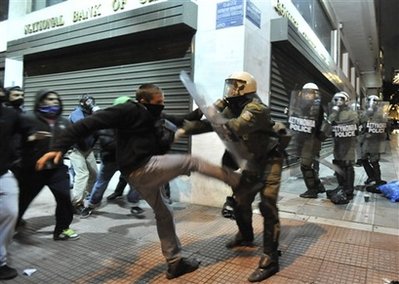
Clashes between police and rioters in Athens

Greece’s parliament approved a deeply unpopular austerity bill Monday to secure a second EU/IMF bailout and avoid national bankruptcy, as buildings burned across central Athens and violence spread around the country.

Cinemas, cafes, shops and banks were set ablaze in central Athens and black-masked protesters fought riot police outside parliament before lawmakers voted on the package that demands deep pay, pension and job cuts — the price of a 130 billion euro ($172 billion) bailout needed to keep the country afloat.

State television reported the violence spread to the tourist islands of Corfu and Crete, the northern city of Thessaloniki and towns in central Greece. Police said 150 shops were looted in the capital and 34 buildings set ablaze.

Altogether 199 of the 300 lawmakers backed the bill, but 43 deputies from the two parties in the government of Prime Minister Lucas Papademos, the socialists and conservatives, rebelled by voting against It. They were immediately expelled by their parties.

Asian shares and the euro gained modestly Monday, relieved by the Greek parliament’s passage of austerity measures that put the country a step closer to securing a much-needed bailout fund and avoiding a messy default.

MSCI’s broadest index of Asia Pacific shares outside Japan edged up as much as 0.3 percent on the news.

The rebellion and street violence foreshadowed the problems the Greek government faces in implementing the cuts, which include a 22 percent reduction in the minimum wage — a package critics say condemns the economy to an ever-deeper downward spiral.

Papademos, a technocrat brought in to get a grip on the crisis, denounced the worst breakdown of order since 2008, when violence gripped Greece for weeks after police shot a 15-year-old schoolboy.

“Vandalism, violence and destruction have no place in a democratic country and won’t be tolerated,” he told parliament as it prepared to vote.

“SHORT-TERM SACRIFICES”

But he admitted that imposing the austerity on a nation that has already endured several years of cuts would be tough.

“The full, timely and effective implementation of the program won’t be easy. We are fully aware that the economic program means short-term sacrifices for the Greek people,” Papademos said.

Greece needs the international funds before March 20 to meet debt repayments of 14.5 billion euros, or suffer a chaotic default which could shake the entire euro zone.

Outside parliament chaos reigned. A Reuters photographer saw buildings in Athens engulfed in flames and huge plumes of smoke rose in the night sky.

“We are facing destruction. Our country, our home, has become ripe for burning, the center of Athens is in flames. We cannot allow populism to burn our country down,” conservative lawmaker Costis Hatzidakis told parliament.

The air in Syntagma Square outside parliament was thick with teargas as riot police fought running battles with youths who smashed marble balustrades and hurled stones and petrol bombs.

Terrified Greeks and tourists fled the rock-strewn streets and the clouds of stinging gas, cramming into hotel lobbies for shelter as lines of riot police struggled to contain the mayhem.

State NET television reported that trouble had also broken out in Heraklion, capital of Crete, as well as the towns of Volos and Agrinio in central Greece.

On the streets of Athens many businesses were ablaze, including the neo-classical home to the Attikon cinema dating from 1870 and a building housing the Asty, an underground cinema used by the Gestapo as a torture chamber during World War Two.

NO GOOD CHOICES

The EU and IMF say they have had enough of broken promises and that the funds will be released only with the clear commitment of Greek political leaders that they will implement the reforms whoever wins an election potentially in April.

Euro zone paymaster Germany ratcheted up the pressure on Sunday. “The promises from Greece aren’t enough for us any more,” German Finance Minister Wolfgang Schaeuble said in an interview published in Welt am Sonntag newspaper.

“Greece needs to do its own homework to become competitive, whether that happens in conjunction with a new rescue program or by another route that we actually don’t want to take.”

When asked if that other route meant Greece quitting the euro zone, Schaeuble said: “That is all in the hands of the Greeks themselves. But even in the event (Greece leaves the euro zone), which almost no one assumes will happen, they will still remain part of Europe.”

The bill sets out 3.3 billion euros ($4.35 billion) of extra budget cuts for this year alone.

It also provides for a bond swap to ease Greece’s debt burden by cutting the real value of private-sector investors’ bond holdings by some 70 percent. Greece would have missed a February 17 deadline to offer a debt “haircut” to private bondholders if the vote had not been passed.

Many Greeks believe their living standards are collapsing already and the new measures will deepen their misery.

“Enough is enough!” said 89-year-old Manolis Glezos, one of Greece’s most famous leftists and a national hero. “They have no idea what an uprising by the Greek people means. And the Greek people, regardless of ideology, have risen.”

Glezos is a national hero for sneaking up the Acropolis at night in 1941 and tearing down a Nazi flag from under the noses of the German occupiers, raising the morale of Athens residents. – Reuters

SA govt wants cities to control trains

Jeremy Cronin
South Africa's deputy minister of transport, Jeremy Cronin, a member of the Communist Party

The government is considering handing control of passenger train services from the Passenger Rail Agency of SA (Prasa) to cities, Beeld newspaper reported on Monday.

Deputy Transport Minister Jeremy Cronin said the government wanted cities to develop programs for a comprehensive transport system, taking into account buses, trains, minibus taxis and other means of transport.

“Our cities are expanding at an ever accelerating pace. The government expects that by 2030, 70 percent of South Africans will be living in cities, and it is therefore important to develop systems that can keep pace with this level of growth,” Cronin was quoted as saying.

Public transport should be integrated with the development of settlements and industries. Currently, cities were responsible for city planning, but had no control over metro train services, which complicated co-ordination. Cronin said Metrorail passenger services formed an integral part of city infrastructure.

Thus far, Cape Town’s and Durban’s systems looked as though they would be the easiest to transfer from Metrorail to city authorities. The government was still discussing the financial and logistical details with Prasa, Cronin said. – Sapa

Cele said ‘shoot to kill’, court told

A Sowetan journalist has testified in court that suspended national police commissioner General Bheki Cele used the words “shoot to kill”, the newspaper reported on Monday.

Mhlaba Memela testified against Cele, who had denied saying this, in the High Court in Johannesburg on Friday.

Cele is suing the Sowetan for defamation after a doctored image of him appeared in the newspaper in 2007, showing him holding a rifle.

Memela testified that although some KwaZulu-Natal residents were initially happy with Cele’s stance on violent crime, they became worried when people were killed without being taken in for questioning, the newspaper reported.

“The victim’s families would ask if their family members had died because of what Cele had said,” Memela was quoted as telling the court.

“People called the office to complain about the police’s conduct. There had been a change in how they operated.”

Last week, Cele told the High Court he could not remember telling police officers to “shoot to kill”.

The case was expected to continue in June. -Sapa

Malema mitigation to start

Arguments in mitigation of ANC Youth League leader Julius Malema’s suspension from the ruling party begin on Monday.

ANC spokesman Keith Khoza said proceedings would start on Monday, but could not confirm if they would be held at the party’s headquarters, Luthuli House in Johannesburg.

On Sunday, during a closed session of the ANCYL’s lekgotla, Malema told delegates he had received a letter from the committee informing him, league spokesman Floyd Shivambu and the league’s secretary general Sindiso Magaqa, that they had be at the mitigation proceedings on Monday at 8am. They were informed they would each have two hours to argue in mitigation of their sentences.

Last Saturday, the ANC’s disciplinary committee of appeals announced that attempts by Malema, Shivambu, Magaqa and three other ANCYL officials to have the guilty verdicts against them overturned were dismissed.

They were found guilty in November last year of bringing the ANC into disrepute and of sowing division in the party. – Sapa

Is DA’s ‘fopswarte’ Mazibuko the new Buthelezi?

‘Unless the DA wishes to court middle-class black voters only, its confident foray into identity politics might backfire’

THE news about Lindiwe Mazibuko’s election as Democratic Alliance (DA) parliamentary leader had hardly been announced when inveterate blogger Anton Barnard published his acidic take on it under the title, The DA’s token black. Not only did he coin a new term for a token black in Afrikaans, a fopswarte or “faux black”, but he astutely concluded that “the DA had committed the most blatant act of identity politics”.

Dene Smuts and other diehard colour- blind liberals in the DA were right to oppose the appointment of the young Swazi-born “iron lady”, as an effusive Beeld dubbed her. For by embracing identity politics, the DA is abandoning its classical liberal stance that SA represents a mere collection of individuals whose ethnic affiliations are the products of happenstance and as inconsequential as the colour of a person’s shirt.

The immediate question is: does this matter? Clearly, DA leader Helen Zille does not think so. Perhaps the electorate no longer cares for ideology and votes for brands. The DA has been building a strong brand as an alternative to the increasingly radical and precisely ethnic African National Congress (ANC) with its dancing Zulu president and firebrand youth leader embroiled in controversies about “Shoot the Boer” songs.

The DA has been a hodgepodge of old Nats and Progs, even former Conservative Party members, with the former Pan Africanist Congress mayor of Cape Town, Patricia de Lille, spicing up the mixed grill. Mazibuko’s left-wing noises about land reform and support for the ANC’s Freedom Charter have dragged the party with its few million middle- class supporters further to the left. I suppose one could argue that SA is undergoing a major lurch to the left, with Julius Malema calling himself a Marxist-Leninist and vociferously championing nationalisation of land and mines. Is the DA simply following a trend being set by Malema?

But muddled or eclectic thinking in politics never gets one very far, as the graveyard of southern African “pragmatists” attests. Is Mazibuko the new Mangosuthu Buthelezi, a seemingly moderate black ally that should divide the majority-black electorate, thereby catapulting Zille into Mahlamba Ndlopfu? For those who do not know, that is the name of the presidential residence in Pretoria, designed by Afrikaner architect Gerrit Moerdyk and formerly known as Libertas.

Not only did the National Party (NP) of the 1970s not have much success, despite its alliance with Buthelezi and other homeland leaders, but FW de Klerk’s equally “strategic” transformation of the NP into a “melting-pot party” swiftly led to its demise and absorption into the much smaller but staunchly liberal Democratic Party under Tony Leon. In a similar vein, one still remembers the assurances given by stolid SABC commentators in 1980 that Ian Smith would win a landslide against Robert Mugabe, thanks to his moderate black ally, Bishop Abel Muzorewa.

Mazibuko is seemingly popular with whites because she speaks English with a more or less “white” accent. She could be a kind of female Barack Obama. However, unless the DA wishes to court the middle- class black voter only and not the township dwellers, its confident foray into identity politics might backfire badly. Apparently Mazibuko does not speak an African language. How will that affect her appeal towards Zulus, SA’s largest ethnic group?

Volumes have been written about the importance of being black in SA. The question must be asked, however: is Mazibuko black enough, in that sense? Her popularity with the ageing white liberals in the DA caucus may yet turn out to be her kiss of death. Already a chorus of young black radicals in the ANC or ANC Youth League are labelling her a “sell-out” and a traitor to the black cause. Will the shot of blackness she adds to the DA’s cocktail compare with the heady brew of black nationalism already served by Malema and his party that made black economic empowerment a ubiquitous business and social shibboleth?

The DA will also be walking a tightrope in pandering to the interests of the ANC voters it wants to win over. Its core constituency still consists of whites and coloureds. An equally high percentage of Afrikaners voted for Zille as blacks voted for Obama, in the order of 80% or 90%. In embracing identity politics and applying affirmative action in her own party, Zille is betting the bank on the loyalty of her followers.

Even if the Freedom Front remains the Cinderella of Parliament with its four MPs, Afrikaner intellectuals will find solace in the demise of both communism and liberalism in SA. For most of the 20th century, they were ridiculed for asserting that ours was a multi- ethnic state in which identity politics would always predominate. The DA, like the Communist Party before it, has just admitted that the siren song of race and identity far outweighs the appeal of ideology.