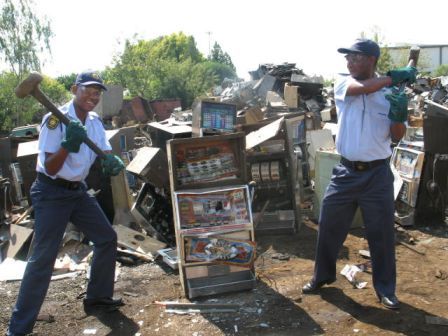
The Police in North West in partnership with North West Gambling Board destructed more than 1000 illegal gambling machines which were confiscated in illegal gambling places around the province.
Fortune Sekgaphane, CEO of the North West Gambling Board said he is excited about the partnership that they have with the SAPS. He further said that they are serious in fighting illegal gambling in North West and that working with SAPS means that they are going to win this fight. “Illegal gambling is destroying the province’s economy. North West has shown 0.4 decline year on year in our economy because of these illegal gamblers’, said Sekgaphane.
He indicated that illegal gambling places’ owners do not pay their taxes; they do not contribute anything to the economy of the province. The machines were confiscated in Zeerust, Klerksdorp, Rustenburg and Brits. Finance MEC Louisa Mabe who was also present at the event, was pleased to see SAPS partnering with the North West Gambling Board in fighting this crime.
She said as the province they are committed in making sure that illegal gambling is no longer a problem in the province. She requested Municipality to partnering with SAPS and Gambling Board to fight this crime.
“Municipalities are there ones who issue licences for these gambling places”, she said. She said they must make sure that when they are issuing permits to these premises they are giving them to people who are registered with the gambling board.
Sekgaphane added that with SAPS, they are committed in squeezing the illegal gambling crime to zero tolerance. He encouraged the other law enforcements agencies to join North West Gambling Board and South African Police Service in fighting this crime.
The illegal machines were destructed at Klerksdorp Scrapyard. Other departments who were present in the destruction of illegal machines was the Department of Tourism. – SAPS
The success of British Prime Minister David Cameron’s flagship immigration policy was called into serious question on Sunday, dealing him a potential blow ahead of 2015 elections by playing into the hands of a populist anti-immigration party.
A report by lawmakers from across the political spectrum concluded that Britain’s migration statistics were grossly unreliable and “not fit” for purpose, undermining the credibility of Cameron’s assertions about the issue.
Immigration is a hot button issue in Britain, where Cameron is trying to stop an exodus of voters to the UK Independence Party (UKIP) before a parliamentary election in two years’ time, and polls show the issue is one that worries voters the most.
Concerns have been fuelled by warnings in the right-leaning press about “hordes” of Romanians and Bulgarians moving to Britain next year when EU freedom of movement restrictions lapse, at a time when Britons face rising competition for jobs.
To compound Cameron’s problems on immigration, a government pilot scheme that involves vans driving around London with billboards telling illegal immigrants to “go home or face arrest” has angered his junior coalition partner, the Liberal Democrats, and prompted allegations of racism.
Questioning immigration was for years regarded as racist in Britain, but all three main parties have started to talk tough about the subject in response to rising public anxiety, campaigns in the country’s popular tabloid press, and the popularity of the anti-immigration UKIP.
Cameron’s ruling Conservatives, who are trailing the opposition Labour party in the polls, have promised a far-reaching immigration crackdown and say they have cut net migration – the numerical difference between people coming in and out of the country – by a third.
They have also pledged to cut that figure to tens of thousands of people a year from over 100,000 now.
Data ‘too uncertain’
But the report, by the lower house of parliament’s Public Administration Committee, said that government migration data was neither systematically nor rigorously collected.
“We are struck by the advice of the Migration Advisory Committee to the Government that it should aim for net migration of only 50,000 as the only means of being certain that net migration is in fact below 100,000,” it said.
Bernard Jenkin, a Conservative lawmaker who oversaw the report, told local media government statistics were “little better than a best guess and could be out by tens of thousands.”
Chris Bryant, a Labour lawmaker, said the report showed the government’s assertions on immigration could not be trusted.
“We should be able to count people in and out of this country,” he told Sky TV. “If the government is going to boast about having cut net migration then you would think that the statistics would be reliable ones. The truth is they’re not.”
Cameron’s Conservatives are trailing Labour in the polls, but several surveys show Labour’s lead, which until recently had been fairly steady at ten percentage points, is narrowing.
One opinion poll published earlier this month put the Conservatives in joint first place with Labour for the first time in over a year.
UKIP, which campaigns for Britain to leave the European Union and for a halt to “open door immigration,” made sweeping gains in May local elections, winning almost one in four votes.
But its poll rating has since fallen from a high of 22 percent. Some polls suggest it has lost one or two percentage points. Others suggest its fall in support may be more serious.
A spokesman for Britain’s Home Office (interior ministry) said the government was confident it was on the right track.
“We disagree with the report’s conclusions,” he said. “Government reforms on immigration are working and the statistics do show that net migration is at its lowest level for a decade.” – Reuters
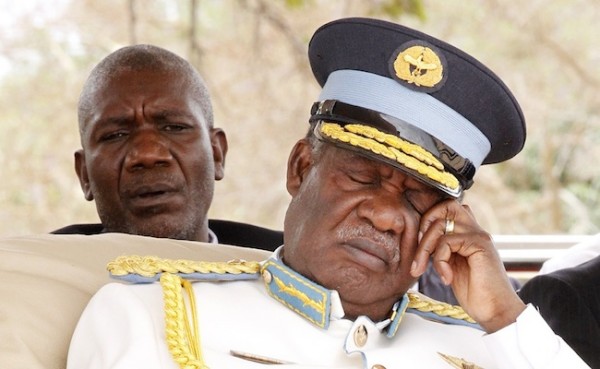
Great Scott, it’s a white face! Guy Scott with President Sata (left)
Zambia recently woke up to a story in state-owned media that a group calling itself Tongas Under Oath had killed two people belonging to President Michael Sata’s ethnic group, and was now in the process of removing settlers from the ethnically Tonga Southern Province. However, the story did not wash with the citizens who simply viewed it as an attempt by the ruling Patriotic Front (PF) government to clamp down on the opposition United Party for National Development (UPND).
Zambia’s third largest opposition party is led by Hakainde Hichilema, a Tonga who has been very critical of the Sata government. And as is often the case in Zambian politics, Hichilema is the latest in a line of fearless opposition leaders whose increasing popular support is likely to result in electoral success.
Prior to the release of the letter allegedly written by the Tongas Under Oath group, Hichilema was arrested and charged after he claimed that the PF government was planning to send youths to Sudan to train as militias. A few days later, the opposition’s headquarters in the capital, Lusaka, were searched by the police looking for seditious materials.
They did not find any but a few days later a far more sinister letter about an assasination plot was sent to President Sata with a date stamp from Mazabuka, a town in Southern Province.
No one was ever arrested in the Tongas Under Oath terror plot however, since President Sata himself admitted that the supposedly incriminating letter was not authored in the Southern Province, but in Lusaka.
Despite Zambia’s obvious ethnic struggles, the white British Zambian Vice-President Guy Scott said recently in an unusually frank interview: “The South Africans are very backward in terms of historical development. I hate South Africans… actually they’ve been the cause of so much trouble in this part of the world.”
The comments ruffled feathers on social media and appeared to threaten relations between the former liberation struggle allies.
During the interview in Lusaka, Scott mocked South Africa’s membership of the Brics developing economies, compared President Jacob Zuma with FW de Klerk and opined: “I have a suspicion the blacks model themselves on the whites now that they’re in power. ‘Don’t you know who we are, man?'”
He also defended the Zimbabwean president, Robert Mugabe, and spoke out against Zuma’s attempts to mediate in that country on behalf of the Southern African Development Community.
Recalling a meeting between Mugabe and the Zambian president, Michael Sata, Scott said, without irony: “Michael the other day was saying, ‘You have to get this thing sorted out among yourself, you don’t want to go to SADC – it’s a new kind of colonialism’.”
The Daily Maverick’s Simon Allison quickly came to Scott’s rescue and tried to defend his strange comments. – ISN/ The Guardian
Zambian police on Monday arrested and charged a journalist with having porn on his computer in another apparent crackdown on a publication critical of the government, his lawyer said.
Clayson Hamasaka is the third reporter taken into custody for ostensible links to the Zambian Watchdog, which publishes articles critical of President Michael Sata’s government.
“They have arrested Hamasaka and charged him with the offence of possession of obscene materials,” his lawyer Keith Mweemba told AFP.
“They claimed they found some obscene material on his personal laptop,” he added.
“All is aimed at linking them up to the Zambian Watchdog,” Mweemba said.
The news site withholds its reporters’ names to protect their identities.
The equipment was confiscated in a raid on Hamasaka’s house on July 10, when he was detained with fellow journalist Thomas Zyambo.
Hamasaka was investigated for sedition but later released.
Zyambo was arrested on charges of rebelling against the state, released on bail, then summoned to the police station again on Monday together with Hamasaka.
A conviction for possessing pornography carries a five-year prison sentence in the conservative southern African country.
Police wanted to match Zyambo’s writing to a handwritten biography of President Sata that was found on him during his arrest and led to the sedition charge.
“I am already appearing in court, so why do they want me to write the same thing? They want to now know my handwriting,” Zyambo told AFP at the police offices.
Hamasaka secured bail in the evening and is due in court on August 12.
Critics have accused the government of targeting journalists with trumped-up charges.
Another journalist, Wilson Pondamali, was arrested for possession of restricted information two weeks ago.
Police have refused to release him despite a court granting bail, and he was hospitalised after collapsing in prison.
He remains handcuffed to his hospital bed while undergoing treatment for pneumonia, according to London-based rights group the Media Legal Defence Initiative (MLDI).
MLDI and the Southern African Litigation Center have referred his case to the United Nations and the African Union.
They petitioned the bodies “to declare that Mr. Pondamali’s continued detention violates his right to freedom of expression and liberty, and secure his immediate release,” according to a statement on the MLDI website.
Zambia’s government has meanwhile blocked local access to the Zambian Watchdog.
It remains difficult to confirm the existence of the Barotse Liberation Army, the supposed paramilitary wing of various groups calling for the secession of Zambia’s Western Province. However, if President Michael Sata’s order to the army to kill the rebel activists is anything to go by, the organization is nevertheless considered a serious threat to Zambia’s national security.
The November 30, 2012 order came after it was reported that the rebels were recruiting former soldiers and policemen to serve in the Barotse Liberation Army. Speaking at a Southern African Development Community (SADC) regional Defence Command Staff College graduation ceremony, Sata said:
In Lukulu (Western Province) people have formed a group called Barotse Liberation Army, they are recruiting people. As of today, I am aware that they have recruited 276 people. They are recruiting former army officers, police officers and former poachers they want to rise against us and we have to be prepared… And you the Army Commander I have told you before that I need troop career planes because how can I transport troops to Lukuku?
In a veiled criticism of the army’s lack of preparedness and alleged toleration for unrest in the region, Sata said:
Our soldiers are graduating but some of them, they have never fired a gun since they joined the army until they retire… because it is different to train and to go and do the action. You need to be well trained in order to defend this country.
On a Facebook group, Zambian Voice, Isikanda Wamulwange expressed concern at President Sata’s call:
If military force will be used on the so called “rebels” in the Western province, might this not lead to civil war, is there no better way to resolve this issue.
Chileshe Tayali responded on the same thread:
Surely the President’s outburst is not the best way to sort out BRE [Barotse Royal Establishment] conflict. He is declaring war in public. I find his directives very careless.
A local online publication, the Barotse Post, reported that the soldiers sent to the area pulled out after failing to find rebels:
The Zambian troops began their disgraced pull out from Lukulu on Sunday, 2nd December 2012, after failing to find the imagined Barotse Liberation Army activists. Four helicopters were seen flying out with some of the special forces who were sent on what has proved to be a wild goose chase. In order to save face, the disappointed and ashamed Minister of Defense has pleaded for information on BLA from the locals. This only shows how panicky the Zambian Government gets to be whenever it comes to the Barotseland issue.
The same publication accused the Zambian government of allegedly fabricating lies against against Barotse people:
Not so long ago the Zambian people were fed on a lie that the Barotseland Freedom Movement in Kaoma was recruiting retired military personnel. This claim was recently followed by another malicious one, in the wake of Mr Clement Sinyinda’s resignation as Ngambela [Prime Minister] of Barotseland, that some Lozi people in Senanga and Sesheke were organizing to dethrone the Litunga [king].
Calls for the secession of Western Province have heated up in the last few years over allegations that successive Zambian governments have ignored the Batrotseland Agreement of 1964 which united the region with the rest of Zambia at independence in 1964.
As an opposition leader, Sata promised restoration of the agreement within 90 days of assuming office but, surprisingly, he has now taken a belligerent stance against it and it seems dialogue is not yet on the horizon. – ISN/Sapa/AFP
Italy’s first black minister, a target of racist slurs since her appointment in April, has condemned a spectator who threw bananas towards her while she was making a speech at a party rally.
Integration minister Cecile Kyenge, who was born in Democratic Republic of Congo, has angered far-right groups with her campaign to make it easier for immigrants to gain Italian citizenship.
Shortly before the incident on Friday, members of the right-wing Forza Nuova group left mannequins covered in fake blood at the site of the rally in Cervia, central Italy, in protest against Kyenge’s proposal to make anyone born on Italian soil a citizen.
“Immigration kills,” was written on leaflets accompanying the dummies – a slogan Forza Nuova has previously used when referring to murders committed by immigrants in Italy.
Although the bananas missed the stage where Kyenge was speaking, she responded to the gesture on Twitter, calling it “sad” and a waste of food, considering the economic crisis.
“The courage and optimism to change things has to come above all from the bottom up to reach the institutions,” she added.
Kyenge has faced regular insults since becoming minister, often from other politicians. Earlier this month a senior parliamentarian in the anti-immigration Northern League party likened her to an orangutan and only apologized after a storm of criticism. – Reuters
The Mandelas are going to have to wait for the loot
A court application for the removal of trustees by former president Nelson Mandela‘s children has been struck off the roll, the law firm Norton Rose Fulbright said on Monday.
The ongoing battle revolves around the removal of George Bizos, Tokyo Sexwale, and Bally Chuene as directors of Harmonieux Investment Holdings and Magnifique Investment Holdings.
The application to remove them, brought by Makaziwe Mandela and Zenani Mandela-Dlamini, was removed from the roll for hearing this week by notice of removal, said Norton Rose Fulbright spokeswoman Candice Collins.
The firm, which represents Bizos, Sexwale, and Chuene, said that after Ismail Ayob withdrew as the attorney for the Mandela children, the court directed them to provide a new address for service by Friday and to file further affidavits by 30 August.
Also on Monday, Mandela’s grandson Nkosi Zwelivelile Mandela condemned the women’s action as a blatant attempt to disregard and undermine decisions Mandela made while he was “strong”.
“I consider the action by my relatives as a blatant abuse of the elderly.
“Why wait until the sponsor of a trust is not well to question decisions that he made [a] long time ago?” he asked.
He considered the court action nothing more than an attempt to “loot Nkosi Dalibhunga’s [Mandela] money that he has so carefully set out how it must benefit the family, and who must guide decisions relating to that”.
He believed all the people appointed by his grandfather were men of integrity, who had always had his grandfather’s confidence and support.
“All of us are mere beneficiaries and should be grateful that Nkosi Dalibhunga was kind enough to consider our needs through this trust and we should, therefore, avoid this type of actions that clearly infringe on his dignity,” he said. – Sapa
The resignation from office by Midvaal Mayor Nast was not unexpected at all.
“It is my considered opinion that Nast had no choice but to resign,” says Mr. Corrie Pypers, FF Plus councillor for Midvaal. Nast, contrary to the portrayal of Midvaal as being an above average performer under his leadership, made fatal mistakes resulting in continuous pressure by the FF Plus and revealed mismanagement in the municipality.
Nast was instrumental in the rezoning of land, belonging to close relatives, adjacent to the R59 freeway. A rezoning application, involving industrial rights, was approved by the Mayoral Committee, under his chairmanship, 10 days before the 2011 municipal elections. The rezoning process was marked by major irregularities and the matter is still under investigation.
Nast was instrumental in the persecution of the Meyerton Golf Club management (council owned land and operated as a joint venture between council and the Golf Club management since its creation during the 80’s) which, inter alia, led to legal costs amounting to tens of thousands of rand for the account of the club and council.
Nast, in a personal vendetta aimed at the club chairperson, Corrie Pypers, not only misappropriated tax money through this action, but duped officials to get involved in this action. Nast and all the councillors and officials involved in this matter should account for these fruitless and wasteful expenses. The cost appropriation principle was handed down in the judgement recently in the Tlokwe-case involving the mayor who refused to vacate the office following a motion of no confidence.
The leader of the DA, Helen Zille, published blasphemous remarks about Pypers and former councillor Hoffman on her website. This disinformation could only have been made available to her by Nast and his predecessor Marti Wenger, as Zille had no knowledge of the persons referred to above.
This action of Zille has resulted in a multi-million rand legal claim against her for slander which was instituted by Mr. Corrie Pypers and former DA MMC, Kobus Hoffman.
Apparently untouchable, Nast continued to be instrumental in the dismissal of whistle blowers – councillors and officials alike.
Nast was further involved in the name change of a predominately Afrikaans school and instituted proceedings for the changes of various street and place names, similar to actions usually instituted by ANC controlled municipalities.
It is therefore widely expected that Nast will be joining the ANC in due course.
A number of issues, with long term implications for Nast and the DA, are still sub judice and will be made known when possible. Pypers, with all these facts in mind, called for the resignation of Nast two months ago.
Cosatu secretary general Zwelinzima Vavi is happy that a grievance against him has been withdrawn by his accuser, he said on Monday.
“I am pleased that the grievance [hearing] has been finalised,” Vavi said in a statement.
“I hope that we all can put this saga behind us so that we all can concentrate on the real issues of the day — ensuring that we have a vibrant trade union federation that promotes South Africa and the interests of workers.”
Vavi admitted to having consensual sex with a married woman who was employed by the Congress of SA Trade Unions, and claimed she later tried to extort R2 million from him and alleged rape.
He denied raping her, and said the sex was consensual.
However, she brought a complaint of sexual harassment against him at work.
The hearing commenced on Monday morning.
Vavi said the woman withdrew the complaint two hours into the hearing.
He said he would consult with his lawyer to see if any further action could be taken regarding the complaint.
“In the light of the extreme damage that has been done to my reputation, I will consult with my lawyers to consider any further actions about this matter.” – Sapa
In a groveling public display earlier this week, the American Department of Defense announced plans to increase its public affairs efforts due to the devastating effect independent media is having on the Pentagon’s ability to control its news, more specifically, its ability to quash negative news stories before they go viral.
On Thursday, the DoD bemoaned the fact that, because of citizen journalists, social media and other online platforms reporting news in real time, the public is more quickly becoming aware of the constant patterns of contradictions and habitual lying by a government long ago captured by a group of corrupt interests.
“..we cannot hide our bad news stories. Bad news gets out one way or the other and we must come to terms with telling bad stories as well as the good,” the secretary of defense for public affairs, George Little, stated.
When bad things happen, the American people should hear it from the DoD, not as a scoop on an aggregated news site, Little said.
When it came time for a brief question and answer segment, Staff Sgt Hostutler, a junior enlisted member of Air Force production, highlighted that many in her position feel that, as a result of recent spates of negative publicity, the American people are just not buying their stories anymore, making it difficult to execute positive spin effectively.
“My question is: you mentioned that we need to start telling the story about the bad news as well as the good, and the issue I see that we’re facing… It seems like we have this culture in our career to kinda glaze over these issues and put out this positive press, and “No, our jets are fine,” and so with the good and the bad, I don’t think the American people actually trust us to deliver accurate information.
“What’s the plan to change that in the way ahead, because to continue the way we have, to continue to put that positive spin, it feels like we’re losing a lot of our audience because they’re not listening, because we keep saying the same thing over, everything is okay, and it’s not…
“… Is there a plan to kinda change the way that we think? Because as it is, a lot of people, from what I can see, are going through, “We’re putting out mindless propaganda,” is what some of us feel that we’re putting out and what the American people feel that we’re putting out, so how do we change this?”
In essence, this is a signal of defeat to the power that is independent media, and shows just how large of an effect it is having. All independent forms of journalism alive on the web today are frequently been the target of naysayer critics saying these stories actively “hurt” the White House’s message “on a daily basis.”
On one hand, the government has revealed it is not invincible to the onslaught of curious, honest and hard-working journalists eager to obtain and report the truth. It shows just how vulnerable the man behind the curtain really is; in all his power, he’s upset over the few forms of media he can’t control.
With their constant contradictions being exposed, the American government is finding it harder to keep their stories straight and consistently gets caught off-guard. – prisonplanet.com
A Saudi prince has warned that his oil-reliant nation is under threat because of fracking technology being developed elsewhere around the world.
Billionaire Prince Alwaleed bin Talal said the Gulf Arab kingdom needed to reduce its reliance on crude oil and diversify its revenues.
His warning comes as rising shale energy supplies in the United States cut global demand for Saudi oil.
In an open letter to his country’s oil minister Ali al Naimi and other government heads, published on Sunday via his Twitter account, Prince Alwaleed said demand for oil from Organisation of the Petroleum Exporting Countries (Opec) member states was “in continuous decline”.
He said Saudi Arabia’s heavy dependence on oil was “a truth that has really become a source of worry for many”.
He added that the world’s biggest crude oil exporter should implement “swift measures” to diversify its economy.
Prince Alwaleed, owner of international investment firm Kingdom Holding, is unusually outspoken for a top Saudi businessman.
But his warning reflects growing concern in private among many Saudis about the long-term impact of shale technology.
It is allowing the US and Canada to tap unconventional oil deposits which they could not reach just a few years ago.
Chancellor George Osborne has also announced support for fracking in Britain and in offshore waters, to ease a reliance on foreign oil and gas.
Some analysts think this may push demand for Saudi oil, as well as global oil prices, down sharply over the next decade.
Over the past couple of years the Saudi government has taken some initial steps to develop the economy beyond oil.
It has sought to liberalise the aviation sector and provided finance to small, entrepreneurial firms in the services and technology sectors.
Mr Naimi said publicly in May that he was not concerned about rising US shale oil supplies.
Prince Alwaleed told Mr Naimi in his open letter, which was dated May 13 this year, that he disagreed with him.
The prince said: “Our country is facing a threat with the continuation of its near-complete reliance on oil, especially as 92% of the budget for this year depends on oil.
“It is necessary to diversify sources of revenue, establish a clear vision for that and start implementing it immediately.”
The prince said Saudi Arabia should move ahead with plans for nuclear and solar energy production to cut local consumption of oil.
The shale oil threat means Saudi Arabia will not be able to raise its production capacity to 15 million barrels of oil per day (mbpd), Prince Alwaleed argued.
Current capacity is about 12.5mbpd; a few years ago the country planned to increase capacity to 15mbpd, but then put the plan on hold after the global financial crisis.
While most Saudi officials have in public insisted they are not worried by the shale threat, Opec has recognised that it needs to address the issue.
In a report earlier this month, Opec forecast demand for its oil in 2014 would average 29.61mbpd, down 250,000bpd from 2013. It cited rising non-Opec supply, especially from the US.
The fracking warning comes as Saudi Arabia announced three foreign consortiums – led by US, Spanish and Italian firms – have won a $22.5bn contract to build Riyadh’s 110-mile, six-line metro train network. – Sky News
Four out of 5 U.S. adults struggle with joblessness, near-poverty or reliance on welfare for at least parts of their lives, a sign of deteriorating economic security and an elusive American dream.
Survey data exclusive to The Associated Press points to an increasingly globalized U.S. economy, the widening gap between rich and poor, and the loss of good-paying manufacturing jobs as reasons for the trend.
The findings come as President Barack Obama tries to renew his administration’s emphasis on the economy, saying in recent speeches that his highest priority is to “rebuild ladders of opportunity” and reverse income inequality.
As nonwhites approach a numerical majority in the U.S., one question is how public programs to lift the disadvantaged should be best focused – on the affirmative action that historically has tried to eliminate the racial barriers seen as the major impediment to economic equality, or simply on improving socioeconomic status for all, regardless of race.
Hardship is particularly growing among whites, based on several measures. Pessimism among that racial group about their families’ economic futures has climbed to the highest point since at least 1987. In the most recent AP-GfK poll, 63 percent of whites called the economy “poor.”
“I think it’s going to get worse,” said Irene Salyers, 52, of Buchanan County, Va., a declining coal region in Appalachia. Married and divorced three times, Salyers now helps run a fruit and vegetable stand with her boyfriend but it doesn’t generate much income. They live mostly off government disability checks.
“If you do try to go apply for a job, they’re not hiring people, and they’re not paying that much to even go to work,” she said. Children, she said, have “nothing better to do than to get on drugs.”
While racial and ethnic minorities are more likely to live in poverty, race disparities in the poverty rate have narrowed substantially since the 1970s, census data show. Economic insecurity among whites also is more pervasive than is shown in the government’s poverty data, engulfing more than 76 percent of white adults by the time they turn 60, according to a new economic gauge being published next year by the Oxford University Press.
The gauge defines “economic insecurity” as experiencing unemployment at some point in their working lives, or a year or more of reliance on government aid such as food stamps or income below 150 percent of the poverty line. Measured across all races, the risk of economic insecurity rises to 79 percent.
Marriage rates are in decline across all races, and the number of white mother-headed households living in poverty has risen to the level of black ones.
“It’s time that America comes to understand that many of the nation’s biggest disparities, from education and life expectancy to poverty, are increasingly due to economic class position,” said William Julius Wilson, a Harvard professor who specializes in race and poverty. He noted that despite continuing economic difficulties, minorities have more optimism about the future after Obama’s election, while struggling whites do not.
“There is the real possibility that white alienation will increase if steps are not taken to highlight and address inequality on a broad front,” Wilson said.
Nationwide, the count of America’s poor remains stuck at a record number: 46.2 million, or 15 percent of the population, due in part to lingering high unemployment following the recession. While poverty rates for blacks and Hispanics are nearly three times higher, by absolute numbers the predominant face of the poor is white.
More than 19 million whites fall below the poverty line of $23,021 for a family of four, accounting for more than 41 percent of the nation’s destitute, nearly double the number of poor blacks.
Sometimes termed “the invisible poor” by demographers, lower-income whites generally are dispersed in suburbs as well as small rural towns, where more than 60 percent of the poor are white. Concentrated in Appalachia in the East, they are numerous in the industrial Midwest and spread across America’s heartland, from Missouri, Arkansas and Oklahoma up through the Great Plains.
Buchanan County, in southwest Virginia, is among the nation’s most destitute based on median income, with poverty hovering at 24 percent. The county is mostly white, as are 99 percent of its poor.
More than 90 percent of Buchanan County’s inhabitants are working-class whites who lack a college degree. Higher education long has been seen there as nonessential to land a job because well-paying mining and related jobs were once in plentiful supply. These days many residents get by on odd jobs and government checks.
Salyers’ daughter, Renee Adams, 28, who grew up in the region, has two children. A jobless single mother, she relies on her live-in boyfriend’s disability checks to get by. Salyers says it was tough raising her own children as it is for her daughter now, and doesn’t even try to speculate what awaits her grandchildren, ages 4 and 5.
Smoking a cigarette in front of the produce stand, Adams later expresses a wish that employers will look past her conviction a few years ago for distributing prescription painkillers, so she can get a job and have money to “buy the kids everything they need.”
“It’s pretty hard,” she said. “Once the bills are paid, we might have $10 to our name.”
Census figures provide an official measure of poverty, but they’re only a temporary snapshot that doesn’t capture the makeup of those who cycle in and out of poverty at different points in their lives. They may be suburbanites, for example, or the working poor or the laid off.
In 2011 that snapshot showed 12.6 percent of adults in their prime working-age years of 25-60 lived in poverty. But measured in terms of a person’s lifetime risk, a much higher number – 4 in 10 adults – falls into poverty for at least a year of their lives.
The risks of poverty also have been increasing in recent decades, particularly among people ages 35-55, coinciding with widening income inequality. For instance, people ages 35-45 had a 17 percent risk of encountering poverty during the 1969-1989 time period; that risk increased to 23 percent during the 1989-2009 period. For those ages 45-55, the risk of poverty jumped from 11.8 percent to 17.7 percent.
Higher recent rates of unemployment mean the lifetime risk of experiencing economic insecurity now runs even higher: 79 percent, or 4 in 5 adults, by the time they turn 60.
By race, nonwhites still have a higher risk of being economically insecure, at 90 percent. But compared with the official poverty rate, some of the biggest jumps under the newer measure are among whites, with more than 76 percent enduring periods of joblessness, life on welfare or near-poverty.
By 2030, based on the current trend of widening income inequality, close to 85 percent of all working-age adults in the U.S. will experience bouts of economic insecurity.
“Poverty is no longer an issue of `them’, it’s an issue of `us’,” says Mark Rank, a professor at Washington University in St. Louis who calculated the numbers. “Only when poverty is thought of as a mainstream event, rather than a fringe experience that just affects blacks and Hispanics, can we really begin to build broader support for programs that lift people in need.”
The numbers come from Rank’s analysis being published by the Oxford University Press. They are supplemented with interviews and figures provided to the AP by Tom Hirschl, a professor at Cornell University; John Iceland, a sociology professor at Penn State University; the University of New Hampshire’s Carsey Institute; the Census Bureau; and the Population Reference Bureau.
Among the findings:
-For the first time since 1975, the number of white single-mother households living in poverty with children surpassed or equaled black ones in the past decade, spurred by job losses and faster rates of out-of-wedlock births among whites. White single-mother families in poverty stood at nearly 1.5 million in 2011, comparable to the number for blacks. Hispanic single-mother families in poverty trailed at 1.2 million.
-Since 2000, the poverty rate among working-class whites has grown faster than among working-class nonwhites, rising 3 percentage points to 11 percent as the recession took a bigger toll among lower-wage workers. Still, poverty among working-class nonwhites remains higher, at 23 percent.
-The share of children living in high-poverty neighborhoods – those with poverty rates of 30 percent or more – has increased to 1 in 10, putting them at higher risk of teenage pregnancy or dropping out of school. Non-Hispanic whites accounted for 17 percent of the child population in such neighborhoods, compared with 13 percent in 2000, even though the overall proportion of white children in the U.S. has been declining.
The share of black children in high-poverty neighborhoods dropped from 43 percent to 37 percent, while the share of Latino children went from 38 percent to 39 percent.
-Race disparities in health and education have narrowed generally since the 1960s. While residential segregation remains high, a typical black person now lives in a nonmajority black neighborhood for the first time. Previous studies have shown that wealth is a greater predictor of standardized test scores than race; the test-score gap between rich and low-income students is now nearly double the gap between blacks and whites.
—
Going back to the 1980s, never have whites been so pessimistic about their futures, according to the General Social Survey, a biannual survey conducted by NORC at the University of Chicago. Just 45 percent say their family will have a good chance of improving their economic position based on the way things are in America.
The divide is especially evident among those whites who self-identify as working class. Forty-nine percent say they think their children will do better than them, compared with 67 percent of nonwhites who consider themselves working class, even though the economic plight of minorities tends to be worse.
Although they are a shrinking group, working-class whites – defined as those lacking a college degree – remain the biggest demographic bloc of the working-age population. In 2012, Election Day exit polls conducted for the AP and the television networks showed working-class whites made up 36 percent of the electorate, even with a notable drop in white voter turnout.
Last November, Obama won the votes of just 36 percent of those noncollege whites, the worst performance of any Democratic nominee among that group since Republican Ronald Reagan’s 1984 landslide victory over Walter Mondale.
Some Democratic analysts have urged renewed efforts to bring working-class whites into the political fold, calling them a potential “decisive swing voter group” if minority and youth turnout level off in future elections. “In 2016 GOP messaging will be far more focused on expressing concern for `the middle class’ and `average Americans,'” Andrew Levison and Ruy Teixeira wrote recently in The New Republic.
“They don’t trust big government, but it doesn’t mean they want no government,” says Republican pollster Ed Goeas, who agrees that working-class whites will remain an important electoral group. His research found that many of them would support anti-poverty programs if focused broadly on job training and infrastructure investment. This past week, Obama pledged anew to help manufacturers bring jobs back to America and to create jobs in the energy sectors of wind, solar and natural gas.
“They feel that politicians are giving attention to other people and not them,” Goeas said. – AP
The Mandela family is heading back to court today.
This time it’s over access to money that has accrued in trusts the elder statesman set up for the upkeep of his family.
Lawyers representing Madiba’s daughters and grandchildren will square up against his appointed trustees and confidants.
Among the latter are Mandela’s long-time friend and lawyer, George Bizos, and politician and former Robben Island prisoner Tokyo Sexwale. At issue is money.
The Mandela-appointed trustees are having none of it. They say their overriding duty is to carry out Madiba’s wishes.
Mandela-appointed trustee Tokyo Sexwale said: “We’ll stick with it. It is at this time that those he asked to do certain things must stand firm. If we don’t, that would be behaving like traitors.”
The two sides have spent the past few weeks trying to reach a settlement but failed.
To make matters worse, the lawyer representing Mandela’s family, Ismail Ayob, has quit.
The family has since found a new lawyer. They say nothing and no one is going to deter them from fighting on.
Former president Nelson Mandela has begun his 52nd day in hospital. – SABC
Presidency spokesman Mac Maharaj yesterday refused to comment on a weekend report by US TV channel CBS that Nelson Mandela was “in distress” at one point last week.
South African journalist Deborah Patta, reporting for CBS news, said Mandela had undergone a “minor procedure” to unblock a dialysis tube on Friday.
Dialysis is the use of machines to take over kidney functioning when the organs are no longer able to work on their own.
Patta told the network that Mandela had “two scares last week”.
In one instance, “he was not responding to his [medications]” and in another “life-support machines indicated that he was in distress”.
She gave no other details.
Maharaj would say only that Mandela was in a critical but stable condition, and was responding to treatment.
Last month, in a report for the same US channel, Patta broke the story about the military ambulance, in which Mandela was being taken to hospital, breaking down on the highway from Johannesburg to Pretoria early on Saturday, June 8.
Mandela has been in hospital for over a month. – timeslive.co.za
An ANC councillor in East London, in the Eastern Cape, has been charged with theft for allegedly selling council jobs, according to a report on Monday.
A jobseeker could reportedly secure work as a cleaner, grass cutter, admin clerk or driver for between R500 and R1 500, said Dispatch Online.
Last week, angry Mdantsane residents visited the home of the councillor to ask about the promised jobs at the Buffalo City metro. They found a bag of job resumes under a bed
Warrant Officer Hazel Mqala reportedly confirmed to the online news site that a docket has been opened.
It reported that the councillor had denied the allegations, and claimed they were part of a political smear campaign.
No arrests had been made yet. – Sapa
This website uses cookies to improve your experience. We'll assume you're ok with this, but you can opt-out if you wish. Cookie settingsACCEPT
Privacy & Cookies Policy
Privacy Overview
This website uses cookies to improve your experience while you navigate through the website. Out of these cookies, the cookies that are categorized as necessary are stored on your browser as they are essential for the working of basic functionalities of the website. We also use third-party cookies that help us analyze and understand how you use this website. These cookies will be stored in your browser only with your consent. You also have the option to opt-out of these cookies. But opting out of some of these cookies may have an effect on your browsing experience.
Necessary cookies are absolutely essential for the website to function properly. This category only includes cookies that ensures basic functionalities and security features of the website. These cookies do not store any personal information.
Any cookies that may not be particularly necessary for the website to function and is used specifically to collect user personal data via analytics, ads, other embedded contents are termed as non-necessary cookies. It is mandatory to procure user consent prior to running these cookies on your website.