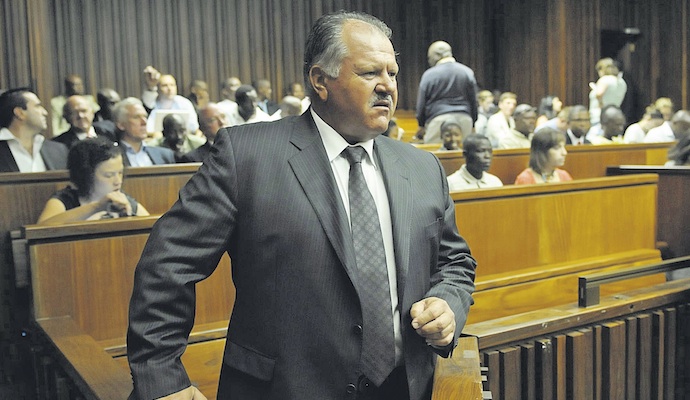
A farm owner accused of attempted murder after he allegedly shot and wounded a teenager has appeared in the Ladybrand Magistrate’s Court, Free State police said on Wednesday.
The case against Motlalentoa Alfred Makoae, 53, was postponed on Tuesday to December 9, Sergeant Martin Xuma said.
Makoae, currently out on R1500 bail, owns a farm that borders Lesotho.
He was arrested on November 6. He allegedly saw five youths, aged between 13 and 15 hunting on the farm with sticks and dogs on October 28.
Xuma said the farm owner shouted at the boys to leave his property and they ran away. While chasing the boys away the man allegedly fired three shots in their direction. A 15-year-old was struck in the back.
The teenager and Makoae are both from Lesotho. – Sapa
The basic education department will consider excluding a question about baby rape from a matric exam paper.
“To ensure that no candidate has been negatively affected, the department will mark a sample of the scripts of learners from all nine provinces… to establish any possible disadvantage to the candidates,” the department said in a statement on Wednesday.
This was after media reports that pupils, teachers, and parents were upset by a question that asked pupils how best to dramatically represent the rape of a baby, symbolically using a loaf of bread and a broomstick.
“If there is evidence that candidates have been affected by this question, the question will be excluded from the question paper and the marking guidelines will be adjusted accordingly,” the department said.
The exam question was about Lara Foot Newton’s play “Tshepang”, based on real events.
The purpose of the question was to assess pupils’ understanding of the concept of “action metaphor”.
“The horror and aversion the audience feels is achieved without resorting to an actual rape.
“…Nowhere is it expected of the candidate to have to literally describe the actual act of raping a nine-month-old baby.”
The examiners and moderators responsible for the exam question were within the prescripts of the curriculum, the department said.
“Further, Grade 12 learners are young adults who are fully aware of the social issues confronting our country, and dramatic arts… are powerful vehicles for creating social awareness and education to societal issues that need to be addressed to bring about change.”
The internal moderator said the pupils were expected to explain how the symbols of the broomstick and bread could be used to make an audience feel the horror of child rape, using props, lighting, sound and stage directions.
“[The question] is valid and fair because the rape of babies is a relevant societal issue.”
The Witness reported on Wednesday that parents, pupils, and teachers intended complaining to the department over the question, asking that all pupils be awarded the 15 marks allocated to it.
The memo for marking the exam was expected to be discussed at a meeting in Pretoria on Wednesday.
Baby Tshepang, as she became known, was raped in the Northern Cape when she was 11 months old in 2001. She had to have extensive reconstructive surgery as a result of the attack. – Sapa
A matric drama exam question asked pupils to describe how to depict a baby rape on stage with a broom handle and a loaf of bread, The Witness reported on Wednesday.
The compulsory question, based on Laura Foot Newton’s play “Tshepang”, required pupils to describe, through the props, how child rape could be dramatically depicted.
Parents, pupils and teachers told the newspaper they intended complaining to the department of education over the question, asking that all pupils be awarded the 15 marks allocated to it.
The memo for marking the exam is expected to be discussed at a meeting in Pretoria on Wednesday. – Sapa
A Congolese couple was arrested in Springs, on the East Rand, on Tuesday for possession of explosives and detonators worth about R1.5 million, the Hawks said.
“These devices are normally used during ATM bombings and illegal mining,” Hawks spokesman Captain Paul Ramaloko said.
“The team also confiscated gold concentrates, platinum concentrates, pyrobor chemicals as well as mercury and smelting apparatus,” he said.
The two would appear in the Springs Magistrate’s Court on Friday. – Sapa
Convicted drug dealer Glen Agliotti took a R400,000 loan from a company linked to Czech fugitive Radovan Krejcir, Beeld newspaper reported on Wednesday.
Agliotti admitted to the Afrikaans daily that he had taken the R400,000 loan from Groep Twee Beleggings, the same company that also lent money to the Germiston head of organised crime, Colonel Francois Steyn.
Groep Twee Beleggings is owned by Krejcir’s wife, Katerina.
Beeld reported that the company was mentioned in court on Monday during Agliotti’s sequestration hearing. He was provisionally sequestrated in the High Court in Pretoria.
Agliotti told Beeld he and Krejcir were acquaintances and not close friends. He said the loan was a “normal business transaction” and that he had paid it off, including interest. – Sapa
Police in the Democratic Republic of Congo were Tuesday on the offensive against youth gangs in the capital, long accused of robbing, beating up and even murdering residents, police said.
“Operation Likofi (“punch” in Lingala) began in Kinshasa on November 15 and will end on February 15,” police colonel and spokesman Pierre Mwana Mputu told AFP. “We have mapped out the hotbeds of criminal activity.”
The youths known as “kuluna” roam the streets in packs, often under the influence of drugs or alcohol. They violently snatch bags, jewellery and mobile phones. Victims who resist face being clubbed or hacked with machetes. Several have been killed.
“The threat has grown in scale. It’s as if there was no state… it pleased the supreme authority (President Joseph Kabila) to instruct the police to eradicate this phenomenon… and clean up the town,” Mwana Mputu said.
Most people in Kinshasa, a city of some 10 million, live in dire poverty. But the authorities have urged them to help by denouncing gang members, who include the children of police officers and soldiers, several residents told AFP.
On the streets, police officers — some of them masked — have been arresting many young bandits, who will be sent before magistrates especially assigned to the task. State television has shown footages of dozens of youths, including women, handcuffed with bands of cloth.
“Let us hope that this lasts, because in Kinshasa the authorities often don’t go through with their missions to the end,” a women resident said.
“This is a really good idea. The kuluna sometimes kill pregnant women for no reason. They even wreck the stalls of people selling bread and fritters,” she added.
The more notorious gang leaders have sought to evade the police crackdown by disguising themselves, locals said.
Some residents claimed that police officers have carried out several summary executions of youths, sometimes in front of the homes of the alleged gang members. Human rights organisations told AFP that they had received reports of such killings, without being able to confirm them.
Mwana Mputu denied the allegations and said that if any breaches of regulations came to the notice of authorities, these would be punished. – AFP
Two American B-52 bombers flew over a disputed area of the East China Sea without informing Beijing, challenging China’s claims to an expanded air defense zone, officials said Tuesday.
The flight of the giant, long-range Stratofortress planes sent a clear warning that Washington would push back against what it considers an aggressive stance by Beijing in the region.
The move also signaled staunch US support for Japan, which has been locked in a mounting feud with Beijing over disputed islands in the East China Sea.
The unarmed bombers took off from Guam on Monday on a scheduled flight, as part of what defense officials insisted was a routine exercise dubbed “Coral Lightning Global Power Training Sortie.”
“Last night we conducted a training exercise that was long-planned. It involved two aircraft flying from Guam and returning to Guam,” Pentagon spokesman Colonel Steven Warren told reporters.
Although China has insisted it has a right to police the skies over the area, no flight plan was submitted beforehand to the Chinese and the mission went ahead “without incident,” Warren said.
The two aircraft spent “less than an hour” in China’s unilaterally-declared Air Defense Identification Zone (ADIZ) and did not encounter Chinese planes, he said.
A defense official, speaking on condition of anonymity, confirmed to AFP the two US planes were B-52 bombers.
The military flight carried important symbolism as it came a week before US Vice President Joe Biden’s scheduled trip to China, Japan and South Korea next month.
China announced the expanded air defense zone amid a sovereignty dispute with Japan over the island chain in the East China Sea known as Senkaku in Japanese and Diaoyu in Chinese.
The area also includes waters claimed by Taiwan and South Korea, which also have both denounced Beijing’s move.
Without taking sides in the territorial argument, UN Secretary General Ban Ki-moon on Tuesday called on China and Japan to negotiate an end to their dispute.
Ban on Tuesday said tensions should be handled “amicably through dialogue and negotiations.”
Under the rules declared by China, aircraft are expected to provide a flight plan, clearly mark their nationality and maintain two-way radio communication to allow them to respond to identification queries from Chinese authorities.
Pentagon officials said the United States views the area as international air space and American military aircraft would operate in the zone as before without submitting flight plans to China in advance.
Japan, the United States and several other governments promptly rejected China’s announced air defense zone after it was announced Saturday.
The US State Department renewed its criticism Tuesday, saying China’s action appeared to be an attempt to “unilaterally change the status quo in the East China Sea.”
The move “will raise regional tensions and increase the risk of miscalculation, confrontation and accidents,” State Department spokeswoman Jen Psaki said.
Australia summoned Beijing’s ambassador to express its opposition and Japanese airlines said Wednesday they had stopped following China’s new rules.
The reversal came after pressure from the Japanese government, which insisted China’s announcement was invalid, and after governments around the world lined up alongside Tokyo.
France and Germany each expressed concern and urged restraint on all sides.
“We are committed to a peaceful resolution through dialogue to this dispute, in accordance with international law,” French foreign ministry spokesman Romain Nadal said.
The territorial dispute over the islands has simmered for decades but in September 2012, Japan nationalized three of the islands, in what it portrayed as an attempt to avoid a more inflammatory step by a nationalist politician.
Beijing, however, accuses Tokyo of disturbing the status quo, and has sent ships and planes to the islands in a show of force.
In response, Japan has mobilized vessels and aircraft, raising fears the tensions could trigger an accidental clash.
Beyond the East China Sea, Beijing has taken an assertive approach to a number of territorial disputes, particularly in the strategic South China Sea.
In response to China’s growing military might and influence, the United States has sought to shift its strategic focus to Asia, planning to expand America’s military presence across the Pacific.
But a spate of crises in the Middle East and budget woes have often hampered Washington’s attempt at a so-called “pivot” to the Asia-Pacific. – AFP
Sapa repports that a Diepsloot couple accused of murdering the woman’s seven-month-old baby appeared briefly in the Pretoria Magistrate’s Court on Tuesday.
The case against Nokuthula Gumede, 23, and her Mozambican boyfriend Fernanado Sidanvo, 35, was postponed to January 21 for further investigation.
Gumede and Sidanvo remained in custody. Sidanvo told the court he lost his residence permit when Diepsloot residents ransacked his shack.
The baby was found dead and mutilated earlier this month.
Police spokesman Captain Tsekiso Mofokeng said rats gnawed off the baby’s foot while the child was left alone in a shack. However, sources within Diepsloot describe the murder as a muti or medicine murder and that the body parts of the child were being sold to witchdoctors.
Gumede was arrested in a Randburg, Johannesburg, tavern two weeks ago, and Sidanvo the following day in Diepsloot.
Police crime intelligence gathered information that protesting Marikana mineworkers had performed muti rituals and believed they were invincible before the August 16 shootings last year.
Brigadier Adriaan Calitz told the Farlam Commission of Inquiry in Centurion on Tuesday that even though the strikers believed they were invincible police had to intervene to curb the violent strike.
“We had received intelligence that there was this story around the muti and these people believed that the police would not be able to do anything to them. They believed that their [police] weapons would not be able to do anything.
“The police are being subjected to such things on a daily basis, for example in the cash-in-transit robberies. People use muti and believe that nothing will happen to them. At the end of the day, we had to act,” he said.
Calitz was one of the police commanders assigned to the operation during the labour unrest at Lonmin’s platinum mining operations at Marikana, near Rustenburg in North West last year.
He said the police had been threatened and told to leave the Marikana koppie (hill), where the strikers had gathered, six times in the hours before the shooting.
Ishmael Semenya, for the police, asked Calitz to explain whether police were sure that methods like verbal orders, use of stun grenades, water cannon, rubber bullets, and the display of force would not have caused the protesters to disperse from the koppie.
Calitz said: “From my own experience based on around 20 years in charge of the POP (public order policing), it is not the first time I was giving instructions for dispersal. These methods [the water cannon, stun grenades, and verbal orders] always work correctly.
“People [protesters] take the easiest way out to avoid being shot or being arrested.”
He rubbished claims that the mineworkers “misunderstood” the purpose of barbed wired, which led to the chaotic confrontation.
“It [the rolling out of barbed wire] was not misunderstood. The purpose of the barbed wire had been explained to them. It [the confrontation] was a deliberate action by protesters,” said Calitz.
On Monday, Calitz told the commission he was unaware that mineworkers “lying around” after the encounter with police were dead.
In a sworn statement submitted to the commission, Calitz testified that due to the noise around the koppie, he had not heard the police tactical response team (TRT) firing live ammunition at the strikers.
“I contacted Lt-Col [Solomon] Vermaak on radio and inquired from him why the TRT was not following our dispersal action. He said he would go and check and later reported that the TRT were at the kraal and there were bodies lying around,” said Calitz.
“I thought, given my experience and the absence of such a report to me, that the bodies referred to people who were injured by the dispersion action or lying down to be arrested.”
Calitz detailed how he instructed officers to pursue protesters who were escaping in the northern and western directions. He urged the officers to arrest the fleeing protesters.
“I gave clear instructions over the radio to the dispersion group [police officers] ‘do not shoot unless the target engages you’. I repeated the instruction to ensure that members understood me clearly,” said Calitz.
“The shooting I was referring to [meant the use of] rubber rounds and not sharp ammunition. They were to use rubber only as a last resort if the armed strikers approached them with dangerous weapons.”
The three-member commission led by retired judge Ian Farlam is holding public hearings. The other commissioners are senior advocates Bantubonke Tokota and Pingla Hemraj.
Thirty-four people, mostly striking miners, were shot dead on August 16, 2012, and 78 were wounded when police fired on them while trying to disperse and disarm a group which had gathered on a hill near Lonmin’s platinum mining operations.
In the preceding week, 10 people, including two policeman and two security guards, were killed near the mine.
President Jacob Zuma appointed the commission in August last year.
The President of the Republic of South Africa, His Excellency Mr Jacob Zuma last night, 25 November 2013, arrived in the Republic of Ghana for the State Visit, taking place from 26 to 27 November 2013 President Zuma will have official talks with his Ghanaian counterpart, His Excellency President John Dramani Mahama in which they will discuss, among other things, political, economic and security cooperation.
The visit is expected to strengthen the already existing cordial relations between South Africa and Ghana which date back to the period of ANC and SACP terror directed against South Africa.
The State Visit will also afford the two Presidents an opportunity to assess progress regarding the implementation of the seven Agreements/Memoranda of Understanding (MoU) that were signed during the State Visit to South Africa by the late President of Ghana Dr John Atta Mills in August 2011.
Furthermore, the Presidents will be able to endorse the Action Plans agreed upon by both Ministers of International Relations and Cooperation and Foreign Affairs and Regional Integration respectively during the 3rd Session of the South Africa-Ghana Permanent Joint Commission on Cooperation (PJCC) held in South Africa on 5 November 2013.
In terms of trade and investments, Ghana represents a major export market for South African goods. In 2012, South African exports to Ghana were estimated at R5 billion and the imports from Ghana at R1, 9 billion and the bulk of which was crude oil.
South Africa is the 14th largest investor in Ghana with investments amounting to more than R64 billion between 2003 and April 2013. There are more than 80 South African multinational and small scale companies registered in Ghana.
President Zuma is accompanied by the Ministers of International Relations and Cooperation, Ms Maite Nkoana-Mashabane; Trade and Industry, Dr Rob Davis; Transport, Ms Dipuo Peters; Energy, Mr Ben Martins; Agriculture, Forestry and Fisheries, Ms Tina Joemat-Peterson; Science and Technology, Mr Derek Hanekom and Police, Mr Nathi Mthethwa
President Zuma is also accompanied by a business delegation.
“… and Esau was a man who understood hunting, a man of the field.” — Beresheet (Genesis), 25:27
The place: a South African secondary school.
The setting: an English class.
Lights, camera, action:
The teacher is quizzing the class. One senior—she happens to be my sister—provides the rapid-fire reply:
Teacher: “What is a taxidermist?”
Sister: “a motherf-cker.”
That was a long time ago, but I have no doubt that my witty sibling would extend similar linguistic niceties (adapted to the fairer sex) to Melissa Bachman.
Ms. Bachman is described by OutdoorLife.com as a big-game hunter, host of the hunting reality show, “Winchester Deadly Passion.” The controversy that continues to eddy around Bachman began when she posted a picture of herself with an African lion on her webpage and Facebook page. She wrote of the trophy pic: ‘An incredible day hunting in South Africa! Stalked inside 60-yards on this beautiful male lion. What a hunt!'”
South Africans were disgusted by the woman, seen here grinning (or, rather, grimacing) from ear to ear, as she crouches beside the dead beast. They want to ban her from their country.
“It’s perfectly legal,” roared the conservative pack animals stateside. Especially eager to exhibit their macho-girl credentials were the younger chicks of this silly species.
As an example of “this-was-a-good-kill-carried-out-with-a-permit” argument, I’ve culled the extravagant rhetoric of a member of the unthinking herd at Townhall.com.
The writer chalks up the public’s general disgust at Bachman’s proud pose to “animal rights activists and general public ignoramuses.” Deploying more cut-and-paste action than writing (a lost craft in said circles), she goes on to enumerate the benefits to Africa of “conservation through sustainable hunting.”
This is partly true. The Maroi Conservancy that unleashed Ms. Bachman on the lion would not survive without ugly Americans like Bachman. The money this private preserve generates from selling rights to stalk and kill cornered game helps sustain a community which would otherwise poach the animals.
Plaintively, the game farmers of Maroi Conservancy pleaded with their critics:
“If you are not a game farmer and struggling with dying, starving animals, poaching and no fences in place to protect your animals and crop, please refrain from making negative derogatory comments.”
Maroi should have added that some values are uniquely Western—like the worldview that wild life has its own intrinsic value independent of man. In Africa, unless animals are a commercially viable resource—a source of hunting and eco-tourism—they are driven to extinction by their main predator: the indigenous, not-so-sapient Homo sapiens.
Concluded the twit of Townhall.com: “Hunters have done more for animals than any animal rights group ever has. The healthy animal population and economy in places like South Africa, [sic] proves it.”
In addition to her grammatical offenses, the news editor at Townhall.com offends the truth with factoids about the husbandry of animals and economy in South Africa. Taken as they are from the second most corrupt government in the world—these factoids have the veracity of president Pinocchio’s “you can keep your health-care plan if you like it” promise.
More to the point: an act that is legal is not necessarily moral.
At best, these “conservative” screeches can lay claim to an impoverished, utilitarian philosophy, whereby such gratuitous, showy killing is condoned because it reduces man’s evil incentives to kill unprovoked.
Another gargoyle with a gun is teletart S.E. Cupp. Here Cupp is seen sprawled over a bear’s carcass, facial features deformed in Dionysian ecstasy.
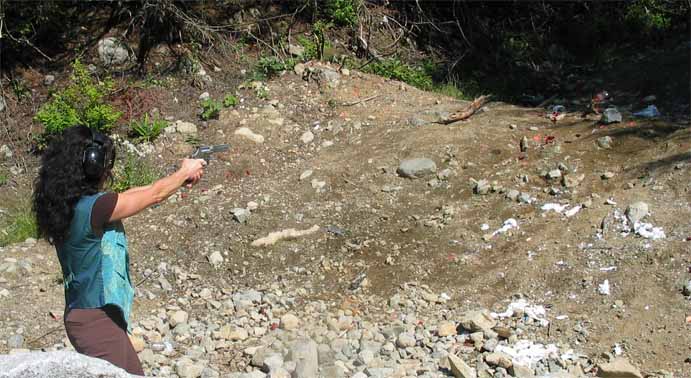
The author’s weapon of choice is the Smith and Wesson 686P .357 4″
The statement must first be qualified: I am a girl with guns. The writer’s weapon of choice is the Smith and Wesson 686P .357 4″. This gorgeous piece will fend off most wild beasts. But certain bedrock principles—arguably a true conservative mindset—dictate a respect for life. A life-conserving sensibility means that guns are meant for self-defense, not for needless killing.
In other words, this gun owner is no gun nut; but a right-to-self-defense fanatic. I’ll take aim to defend myself and my family.
While this girl’s guns are meant for self-defense; her epistolary boots are meant for walking—walking all over the dumb distaff that dominates American TV.
And Cupp is a leader of the pack, a luminary in the Age of the Idiot. The “intellectual” forte of this low-watt woman is to gesture wildly and grimace, while parroting the talking points and mind-numbing banalities disgorged by every other Bush bootlicker before her.
“The secret to becoming a successful right-wing columnist-cum-circus animal,” quipped Canadian conservative writer Kevin Michael Grace, “is to echo the mob while complimenting yourself on your daring. The rest is exploitation of the sexual masochism of the American male—he just can’t get enough of the kitten with claws.”
Those libido-driven males (for they are not men) who’ve deified “Duck Dynasty” also lap up the antics of America’s boneheaded Lolita. Watch this heathen skin a small bear. Watch Cupp whip out the little creature’s innards and offer them up to the camera, as she salivates about the fun she’s having.
There is nothing wrong with hunting for food and harvesting the animal humanely, discreetly and respectfully. This, however, is the hedonistic handiwork of an Aztec priestess.
You already know what my sister would call S.E. Cupp.
And here’s what the Node Beyehuda, an authority in Jewish law (1713–1793), ruled: “Hunting for sport is a barbaric practice suited for Esau, Nimrod and their ilk, and not for the merciful people of Israel.”*
* The reference I owe to another South African relative: my brother the rabbi.
South Africa ended a long, hard season with a bruising victory over France in Paris on Saturday and in so doing reaffirmed the difference between the top two in the world and the rest.
Only one team have beaten the Springboks in 2013 and, barring an unlikely upset in Dublin later on Sunday, New Zealand will record the first ever 100 percent calendar year in the professional era.
While there is no doubt that the world champions, beaten only once in the last two years — a stunning 38-21 defeat to England at Twickenham last November — are the best team in the world, South Africa underlined at the Stade de France that they are clearly the best of the rest.
Although the 19-10 scoreline in Paris was relatively close, it did not tell the full story of a masterful display from South Africa.
Twice they were denied adding to JP Pietersen’s second-minute try by the video review system and, although the French did score through Yoann Huget right at the end of the first period, it came from a rare turnover offered up by the Boks deep in their own 22.
Otherwise they largely controlled territory, if not as much possession, and put such a huge amount of pressure on France deep down in the Les Bleus half that fly-half Remi Tales’s kicking appeared ineffectual.
By contrast Boks fly-half Morne Steyn, and particularly the excellent full-back Willie Le Roux, showed measured tactical nous in keeping France pinned down in their own half with a range of deep, long clearances, perfectly weighted up-and-unders and even a few cunning dinks over the fast approaching backline.
One excellent grubber from Le Roux deserved more than to see Francois Louw beaten to the end zone touch-down by a sliding, scrambling Huget.
In truth, France were really holding on to such a close result rather than knocking on the door and threatening to snatch a victory.
It means that this year South Africa have beaten Australia, Argentina and Scotland at home and away, turned over Six Nations champions Wales, earnt victory against France and defeated Samoa and Italy to boot.
If it wasn’t for the mighty All Blacks, this would possibly be hailed as one of the best South African teams of all time.
Captain Jean de Villiers alluded as much to that when he pointed out just how impressive their recent form has been.
Including last year’s November tests — when they beat Ireland and England, as well as Scotland — South Africa have beaten all of the rest of the top 11 teams in the world at least once in the last year — except New Zealand of course.
“We’re very happy with the last 12 months, if you take the end of the last year as well, that’s 13 (wins) from 15,” said De Villiers.
“It makes it results-wise one of the best years South African rugby’s had in a very long time.”
While the All Blacks’ dazzling brilliance is there for all to admire, it is easy to overlook just how talented the Boks are.
As well as their traditional strengths of power and commitment, and an impenetrable wall of defence, they also have creativity brimming through the side, with pace to spare on the flanks in Pietersen and former world player of the year Bryan Habana.
It was in the rucks and at the breakdown that France found them most effective, though.
“They were more solid than us in the rucks where they managed quite a few turnovers,” said France captain Thierry Dusautoir.
The question now for South Africa, is how to take that next step up and challenge New Zealand for the number one spot.
And that’s a conundrum that De Villiers says they are working on.
“For us (beating France) is not the end of the year, it’s just another step in our journey towards where we want to be and where we’re going.” he said. – AFP
Race remains a legitimate measure of disadvantage in South Africa, the DA said on Sunday.
“A non-racial society is a goal — it doesn’t exist today,” Democratic Alliance parliamentary leader Lindiwe Mazibuko told journalists, speaking at the end of her party’s federal council meeting in Cape Town.
The event, which ran over three days, was attended by about 150 delegates from around the country.
Mazibuko said the “big thing” to come out of the meeting was “the question of whether or not the DA accepts race as a legitimate proxy for disadvantage”.
“The reality is, we don’t live in a non-racial society… So we had to answer a very big policy question, which is going to underpin every redress policy we have — from social development to land reform, and many others in between.
“The question is: Do we believe that in 2013 race is still a legitimate proxy for disadvantage? And the answer was yes.”
Mazibuko stressed this was not a “permanent proxy” for disadvantage.
“It has a horizon,” she said, adding that this limit would depend on future measurements of how successful black advancement proved to be.
DA leader Helen Zille said the message from the conference could be summarised in three broad messages.
“The first is we support BBBEE [broad-based black economic empowerment] that creates jobs… The second is that black advancement benefits everyone. And the third is we support BBBEE when it is broadbased and productive.”
She said this did not imply the party supported the African National Congress approach to redress.
Zille listed what she called the fundamental principles underpinning the party’s so-called economic inclusion policy, and spelled out why the party rejected racial quotas.
“We reject racial quotas in favour of programmes that actively promote black advancement by extending opportunity.”
Responding to a question on whether there had been tensions between members of the DA’s so-called “black caucus” and its “old guard”, as reported in the media, Zille said this had never been an issue.
“There was never an issue… There never really was anything such as a ‘black caucus’… There wasn’t any division or racial polarisation on issues at all,” she said.
On whether there would be “recriminations” over the DA’s apparent confusion in Parliament over its position on employment equity and BEE legislation, Mazibuko said this would not happen. The matter had been dealt with by party structures.
“There will be no recriminations. I have re-allocated two portfolios and that is the extent of the change that will take place at a personal level,” she said.
Zille said the set of policies finalised by her party over the weekend would “drastically reduce poverty and inequality”.
Economic growth had to be inclusive.
“That is why we support corrective programmes that actively promote black advancement without hampering growth and jobs.”
Asked how she thought the party’s voters might respond to these policies in next year’s general election, Zille said black advancement was aimed at benefiting all.
“If there are South Africans who don’t like this, there are many other parties to choose from,” she said. – Sapa
This website uses cookies to improve your experience. We'll assume you're ok with this, but you can opt-out if you wish. Cookie settingsACCEPT
Privacy & Cookies Policy
Privacy Overview
This website uses cookies to improve your experience while you navigate through the website. Out of these cookies, the cookies that are categorized as necessary are stored on your browser as they are essential for the working of basic functionalities of the website. We also use third-party cookies that help us analyze and understand how you use this website. These cookies will be stored in your browser only with your consent. You also have the option to opt-out of these cookies. But opting out of some of these cookies may have an effect on your browsing experience.
Necessary cookies are absolutely essential for the website to function properly. This category only includes cookies that ensures basic functionalities and security features of the website. These cookies do not store any personal information.
Any cookies that may not be particularly necessary for the website to function and is used specifically to collect user personal data via analytics, ads, other embedded contents are termed as non-necessary cookies. It is mandatory to procure user consent prior to running these cookies on your website.


 A farm owner accused of attempted murder after he allegedly shot and wounded a teenager has appeared in the Ladybrand Magistrate’s Court, Free State police said on Wednesday.