China could become US nightmare

Most Americans assume that the U.S. military is so vastly superior to everyone else that no other nation would ever dream of fighting a full-scale war against us.  Unfortunately, that assumption is dead wrong.  In recent years, the once mammoth technological gap between the U.S. military and the Chinese military has been closing at a frightening pace.  China has been accomplishing this by brazenly stealing our technology and hacking into our computer systems.  The Pentagon and the Obama administration know all about this, but they don’t do anything about it.  Perhaps the fact that China owns about a trillion dollars of our national debt has something to do with that.  In any event, today China has the largest military in the world and the second largest military budget in the world.  They have stolen plans for our most advanced jets, helicopters, ships and missile systems.  It is estimated that stealing our technology has saved China about 25 years of research and development.  In addition, China is rapidly developing a new generation of strategic weapons that could potentially enable it to actually win a future war against the United States.  At one time such a notion would have been unthinkable, but as you will see below, the next war with China could go very badly for the United States.

The Washington Post is reporting on a confidential report that was prepared for the Pentagon, and what this report says about the extent of Chinese cyber espionage is absolutely startling.  Will China know ALL of our secrets at some point?  The following is a brief excerpt from the Washington Post article about the theft of our military technology by China.  It turns out that Chinese hackers have gotten their hands on plans for almost all of the new cutting edge weapons systems that we have been developing…

Some of the weapons form the backbone of the Pentagon’s regional missile defense for Asia, Europe and the Persian Gulf. The designs included those for the advanced Patriot missile system, known as PAC-3; an Army system for shooting down ballistic missiles, known as the Terminal High Altitude Area Defense, or THAAD; and the Navy’s Aegis ballistic-missile defense system.

Also identified in the report are vital combat aircraft and ships, including the F/A-18 fighter jet, the V-22 Osprey, the Black Hawk helicopter and the Navy’s new Littoral Combat Ship, which is designed to patrol waters close to shore.

Also on the list is the most expensive weapons system ever built — the F-35 Joint Strike Fighter, which is on track to cost about $1.4 trillion.

One military expert that the Washington Post showed the report to was absolutely stunned…

“That’s staggering,” said Mark Stokes, executive director of the Project 2049 Institute, a think tank that focuses on Asia security issues. “These are all very critical weapons systems, critical to our national security. When I hear this in totality, it’s breathtaking.”

The experts said the cybertheft creates three major problems. First, access to advanced U.S. designs gives China an immediate operational edge that could be exploited in a conflict. Second, it accelerates China’s acquisition of advanced military technology and saves billions in development costs. And third, the U.S. designs can be used to benefit China’s own defense industry. There are long-standing suspicions that China’s theft of designs for the F-35 fighter allowed Beijing to develop its version much faster.

But it isn’t just hackers that the U.S. military needs to be concerned about.

The truth is that the Chinese are stealing secrets from us any way that they can.

For example, the Chinese use attractive young women to seduce our defense contractors.  In fact, as the Washington Times recently reported, one 59-year-old American man was recently charged with passing very sensitive secrets to a 27-year-old Chinese “honeypot” that he was seeing…

A U.S. defense contractor who works in intelligence at the military’s Pacific Command in Hawaii has been charged with passing classified national security information to a 27-year-old Chinese woman he was dating.

Benjamin Pierce Bishop, 59, is accused of sending the woman an email in May with information on Pacom’s war plans, nuclear weapons and U.S. relations with international partners, according to the complaint filed in U.S. District Court in Honolulu and unsealed Monday.

The complaint goes on to allege that Mr. Bishop told the woman over the telephone in September about the deployment of U.S. nuclear weapons and about the ability of the U.S. to detect other nations’ short- and medium-range ballistic missiles.

Another way that China is gaining a strategic advantage over the U.S. is by getting the U.S. military to become increasingly dependent upon them.  According to Forbes, now the U.S. military is even leasing a Chinese satellite for communications purposes…

American dependence on China grows by the day. The latest news is that the United States has been reduced to leasing a Chinese satellite to handle communications with U.S. military bases in Africa. Surprising, isn’t it? The nation that launched the world’s first communications satellite (I remember it well – it was called Telstar) has so lost its manufacturing mojo that it has to rely on its most formidable military adversary to provide the hardware for some of its most sensitive communications. This at a time when underlying unemployment rates among U.S. manufacturing workers remain at near-depression levels.

Isn’t that crazy?

And a recent Senate report discovered that many of our most advanced weapons systems are absolutely riddled with counterfeit Chinese parts…

A recent Senate report, titled Inquiry Into Counterfeit Electronic Parts In The Department Of Defense Supply Chain, “uncovered overwhelming evidence of large numbers of counterfeit parts making their way into critical defense systems.”

The investigation found 1,800 cases of counterfeit electronic parts involving over one million suspect parts in 2009-10 alone, thereby exposing “a defense supply chain that relies on hundreds of unveiled independent distributors to supply electronic parts for some of our most sensitive systems.”

The report concluded, among other things, that China is the “dominant source” of counterfeit products that enter the DoD supply chain, that the Chinese government does little to stop it and that the DoD doesn’t know the “scope and impact” of these parts on critical defense systems.

Who in the world would be stupid enough to allow one of their greatest strategic enemies to supply large numbers of parts for key weapons systems?

Apparently we are that stupid.

Things are particularly bad when it comes to semiconductors…

Senator John McCain commented: “We can’t tolerate the risk of a ballistic missile interceptor failing to hit its target, a helicopter pilot unable to fire his missiles, or any other mission failure because of a counterfeit part.” Calling the issue “a ticking time bomb,” Brian Toohey, president of the Semiconductor Industry Association, commented: “The catastrophic failure risk inherently found in counterfeit semiconductors places our citizens and military personnel in unreasonable peril.”

It would be bad enough if we just had to worry about counterfeit parts failing.  But what if China has a way to shut some of those parts down in the event of a conflict?  What if some of those parts contain “Trojan Horse” computer chips or malware?

That may sound crazy, but unfortunately Trojan Horse chips can be extremely difficult to detect.  The following is from a recent Forbes article…

As the Defense Science Board pointed out, Trojan Horse circuitry is almost impossible to detect even with the most rigorous analysis. This is particularly so if a saboteur can accomplish matching subversions in both software and relevant hardware.

And as I mentioned above, China is rapidly developing a vast array of new strategic weapons which may enable it to actually win the next war with the United States.

For example, China has been developing a new generation of inter-continental and submarine-launched nuclear missiles.

The submarine-launched missiles are of particular concern…

The Ju Lang-2 intercontinental missile is the second generation of Chinese submarine-launched ballistic missiles.

It’s a closely held secret, and details are sketchy. If it lives up to what public military intelligence says it is, it’s a huge get for China, especially with their new sub fleet.

The missile is believed to have a range of 8,000 km, and can carry conventional or nuclear warheads.

Do you remember a few years ago when a Chinese sub fired a missile from just off the west coast of the United States?

We didn’t know that the sub was there.  If that missile had been fired at Los Angeles it would have been destroyed long before we could have ever responded.

And don’t think that a first strike by either China or Russia is inconceivable.  As I have written about previously, the U.S. strategic nuclear arsenal has already been reduced by about 95 percent, and Obama seems absolutely determined to whittle it down even more.  In fact, there has been talk that the Obama administration ultimately wants to reduce our arsenal down to just 300 warheads.  If Russia or China knows exactly where those warheads are, it would be very easy to take them out in less than 10 minutes with a submarine-based first strike.

And China has also reportedly been developing very sophisticated EMP weapons.  The following is from a WND report…

In 2011, it was first revealed that China was developing EMP weapons to be used against U.S. aircraft carriers in any future conflict, especially over Taiwan, according to a 2005 National Ground Intelligence Center study.

That center study said the Chinese were developing a family, or “assassin’s mace” of EMP and high-powered microwave, or HPM, weapons to be used by a technologically inferior force such as China’s, against U.S. military forces.

The once secret but now declassified study pointed out that the Chinese could detonate an EMP weapon some 30 to 40 kilometers over Taiwan or – by inference – a U.S. carrier strike group – and destroy the electronics capability on which U.S. network-centric strategy depends.

But an EMP weapon does not have to be a high-altitude weapon that affects a large area.  Smaller scale EMP weapons could take out a wave of fighter jets or a carrier fleet.

In a future conflict with China, we could see U.S. planes falling out of the sky or great naval vessels sitting dead in the water after being hit with EMP blasts.

But isn’t China our friend?

That is what most Americans and most American politicians seem to believe.  They seem to think that China is our “buddy” and “trading partner” and that we will never have a military conflict with China.

But that is NOT how the Chinese see things.

The Chinese regard the United States as their greatest strategic threat and as an enemy that needs to be vanquished.

That is why they are constantly spying on us, hacking into our computers and stealing our technology.

That is why they are feverishly building up their military and preparing for a future war with America.

So what do you think?

Do you believe that war with China is in our future? – http://endoftheamericandream.com

Rise of a New Currency Order

For years now, the collapse of the dollar has been in the cards. Recent developments show mounting pressure on the dollar’s reserve currency status. With a major international deflation going on, the threat of inflation through money printing is unreal. However, should the dollar’s  reserve currency status end, the repatriation of trillions of petro- and eurodollars could lead to a strongly inflationary scenario.

The roles of a reserve currency are to finance international trade and to function as a store of value for Governments. Until the second world war it used to be the British pound, but with the demise of the British Empire, the pound lost its international relevance and was overtaken by the dollar. This was formalized in the 1944 Bretton Woods system. All other currencies were fiat currencies, but pegged to the dollar, which in turn was pegged to Gold at 40 dollars an ounce and redeemable for international trading partners.

The Eurodollar
With the dollar as the reserve currency, the US had to export dollars. In the early years after the war especially for Europe, the famous Eurodollars. This sounds great: print money and buy whatever you like. But with the Gold window it was also risky: overprinting could mean excess dollars would be exchanged back to Gold, depleting US Gold reserves.

This was also a weakness that those annoyed with American Hegemony could exploit. In 1967 the leftist press mogul Jean-Jacques Servan-Schreiber penned a famous screed called ‘le défi Américain’ (the American challenge’), arguing Europe was being colonized economically by superior American competition.

France, at the time, was run by de Gaulle, who never was impressed with Anglo-American supremacy. He made a point of exchanging every dollar he could lay his hands on as a means to undermine it.

In the late sixties the situation got badly out of hand because of the Great Society and the Vietnam war, very costly projects that were deficit financed, leading to serious inflationary pressures. Inflation that the US tried to export, leading to an excess of dollars abroad. Especially the resurging Deutschmark’s appreciation became untenable. The Europeans started pressuring the US to fix its deficits, provoking the US Treasury Secretary John Connally famous cry ‘the dollar is our currency and your problem’.

But the situation had become unsustainable and Nixon was forced to close the Gold window to stop the depletion of US gold. This was the end of the Bretton Woods system and from then on the major currencies were floated freely in the international currency markets.

The Petrodollar
But it did not end the dollar reserve currency status, as the Empire had been found another basis for it: they reached an agreement with the House of Saud, to accept only dollars for its oil. The Sauds agreed to invest their dollar wealth on Wall Street, making the deal even more powerful for the Empire. Saudi Arabia controlled OPEC and the dollar was saved: international oil trading is financed with dollar only. Since then we have been on an informal Black Gold standard, known as the petrodollar.

This situation was better than before, because overprinting of the dollar for international trade or to finance all sorts Empire projects could no longer be punished by depleting Gold reserves and would result only in rising prices.

In the last decade the problem of over printing was solved by artificially raising oil prices through the Peak Oil hoax, and ending Iraqi oil production. It must be understood that the Empire is not looking for more oil production. There is so much oil in the world that should it be drilled for freely, it would end the Money Power’s energy monopoly. The Iraq invasion and the quest for control of the Middle-East is to keep a lid on oil production. Saddam’s suicidal decision to accept euro for his oil only hastened his demise.

Even today Iraqi oil production is not even half of what it was before 1991. With the Western Oil companies now in charge, it will most likely never fully recover. By raising the price for oil, the oil market has mopped up  excess dollar supplies, which are now needed for the oil trade. As a result, the dollar has remained relatively stable in its value. Of course, it fits well with the agenda of decapitating the middle classes and under this agreement higher oil prices also means ever more oil profits invested in Wall Street.

Of course, the great boon of this for the Empire is that it can pay with worthless paper for real goods. It can eternally finance a major trade deficit.

Trade deficits are incorrectly understood as problematic.
From a nation’s point of view, the goal of trade is not to export, but to import. We export to give back for what we need from others. If you run the reserve currency, you don’t need to export as much as you import, because you can partially finance your imports with money printing. For all other nations this is impossible and trade deficits are lethal in the long run, as it leads to net capital outflow.

But the US Empire is in trouble. Its infrastructure is crumbling, its manufacturing base gone, it’s badly over extended. It needs ever more virulent threats to coerce the nations into dollar submission and just like Connally failed in 1971, the US is failing today. The Money Power is done with the Empire and the dollar and it is moving to the next phase. The dollar will have to step back and we are seeing a realignment.

The new currency order
China is moving towards a Gold backed yuan that will be very powerful in the international arena. Recently Australia, which is already completely dependent on China, with 30% of its exports going there, is preparing direct convertibility between the yuan and the Australian dollar, meaning they will no longer use US dollar to finance bilateral trade. This means less US dollars are needed in its reserve currency role.

In 2001 Goldman Sachs executive Jim O’Neill invented the BRIC’s. South Africa was later added, representing Africa and emphasizing its globalist agenda. Russia and China, as two powerful neighbors, obviously have long standing and important bilateral relations. But equally obviously, have little in common with Brazil, India and South Africa. India and China are actually sworn enemies. However, in 2009 they organized a first summit. Just a week ago we all of the sudden hear the BRICS are planning to open up a competitor to the IMF.  They’re still working out the details and it’s not a done deal yet, but the move looks very serious.

And there is of course the euro, which, make no mistake, is in great shape. True, Eurocrat legitimacy is suffering because of the euro crisis, even in Germany the currency is losing support. But the euro crisis is purely for internal consumption, to sucker the nations into surrendering budget responsibility to Brussels. This is the final frontier for a full blown EU federalist Super State. While the euro is deeply hated, this is not really a problem for the Money Power: it isn’t in this business to make friends and it does not mind a big fight. It only fears real alternatives and these are nowhere to be seen. There is nobody proposing anything real, people are just letting off steam. Once they get their fiscal union, the crisis will quickly end. People have a short memory.

The euro was designed to be eventually backed by Gold and the ECB has enough of the stuff to be ready for the coming transition.

Conclusion
We are seeing the advent of the new currency order. There will be a number of more or less equal blocks: a dollar zone, a Yuan/BRICS zone and the euro, with the Yen and the Pound as lesser entities. These will later be able to converge to even more ‘cooperation’, in the Money Power’s relentless march towards World Currency.

These units will be at least partially Gold backed, implying long term deflationary pressures. Central Banks are buying Gold in major quantities, creating the interesting question why Gold prices have not risen in the last 18 months.

The problem for the United States will be to manage the transition. Trillions of dollars that will no longer be needed will have to be repatriated and this will lead to very strong inflationary pressures at home. It is unclear how the Fed is going to deal with that. It probably can’t. Furthermore, the US is probably in the worst of positions to deal with a new Gold standard. They claim to have 8,000 tonnes of Gold in Fort Knox, but nobody really believes that.

The hyperinflation scare that the Austrians have been promoting because of ‘money printing’ is ridiculous: we are in a stagflationary depression and prices are rising because of speculation, not because of excess money. But when the dollar loses its current status, long term price rises will become the norm.

The Greatest Depression has only just started.

Anthony Migchels

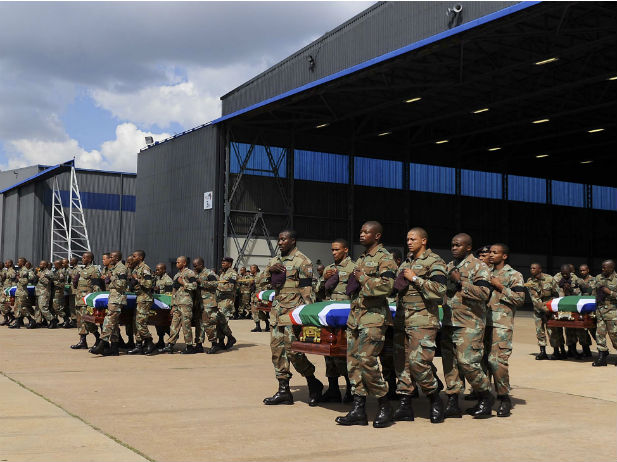
SA plan for new African military force adopted by AU

SADF funeral for CAR casualties

The AU will establish a new military force following a suggestion from South Africa, the international relations department has said.

“On Monday … the African Union summit [in Ethiopia] adopted a historic decision to establish the African Capacity for Immediate Response to Crises [ACIR], at the initiative of South Africa,” said spokesperson Clayson Monyela on Tuesday.

The proposal was made to tackle ongoing obstacles to peace and security which undermined democratically elected governments. The AU did not at the moment have an immediate response mechanism, as the process of implementing the African Peace and Security structure was ongoing, said Monyela.

The proposed ACIR was an interim measure, pending the African Standby Force’s commencement of operations and rapid deployment capability.

The ACIR was therefore not a new concept, but built on the principles of the African Standby Force. “This interim measure will further provide African countries with the flexibility to take concrete measures to address the challenges in the interim,” he said.

This would allow the process of getting the African Standby Force into operation to take place.

President Jacob Zuma told the summit that South Africa stood ready to provide support to deal with urgent matters of the continent.

Following South Africa’s pledge of assistance, other countries also pledged their support, and readiness, to contribute to the ACIR.Monyela said: “South Africa’s initiative has thus received broad consensus from member states of the African Union and has been adopted as a decision of the summit.”

Asked by Sapa whether any troop commitments had been made by South Africa at this stage, Monyela said that it was “running ahead of the process”. – Sapa

Night 7 in Sweden: Cars ablaze, police attacked

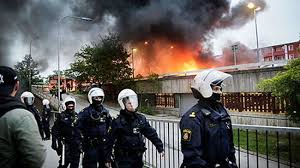
Automobiles were torched and police confronted stone-wielding youths in Stockholm’s suburbs early Sunday as riots, which erupted following reports that police had killed an elderly immigrant, enter their first week.


Pockets of violence and vandalism continue to pose a challenge to police in Stockholm, the Swedish capital that is home to an increasingly diverse 2 million residents. “When it comes to car fires, there have been a few, spread out in various locations, but not as many as in recent days,” Stockholm police spokesperson Lars Bystroem told Swedish Radio.

In Vaarberg, a suburb south of Stockholm, police were attacked by stone-throwing youths, while in Jordbro, another southern neighborhood, police resorted to teargas as they met resistance while attempting to arrest several individuals, AFP reported.

Violence has broken out in other parts of the country as well. In Orebro, a town in central Sweden, some two dozen masked youths set fire to three cars and a school and attempted to torch a police station, Reuters reported, citing police. About 200 km (124 miles) to the southwest in the city of Linkoping, several vehicles were set alight and youths tried to torch a school and a kindergarten.“With the strong presence on the streets of the good forces, and the police reinforcements, I think we are well on our way towards calmer times in the coming days.” The riots began one week ago in Husby, a predominantly immigrant suburb of Stockholm, following the fatal police shooting of an elderly man who police said was brandishing a machete in his home.

Analysts believe the shooting ignited deep-seated frustration among disenfranchised youths – many of whom have not assimilated into Swedish society and are unemployed – who claim to have suffered from police brutality and racism to the country due to its attractive social programs.

The Scandinavian country is ranked as one of Europe’s most popular destinations for immigrants, both in absolute numbers and relative to its size, but critics say the new arrivals are failing to learn even the basic language skills necessary to find employment, and despite free government assistance programs.

Ingrid Carlqvist, editor-in-chief of Dispatch International, told RT that Sweden is an attractive destination for immigrants because the government gives them “money for nothing.”

“For the last 20 years or so, we have seen so many immigrants coming to Sweden [who] really don’t like Sweden,” Carlqvist said. “They don’t want to integrate, they don’t want to live in this society – working and paying taxes, and so on – they come here because they know Sweden will give them money for nothing.

“[The police] could use water cannons, they could [enforce curfews]; there are so many things they could do within the law, but they don’t do it.” The change in Sweden’s domestic dynamics comes at a time when far-right groups are commanding attention across the EU, with many residents furious over austerity measures, high unemployment and the general consensus that the individuals most responsible for triggering the collapse of the global economy have escaped responsibility.

“We have tried harder than any other European country to integrate, spending billions on a welfare system that is designed to help jobless immigrants and guarantee them a good quality of life,” Marc Abramsson, leader of the National Democrats Party, told the Telegraph.

“Yet we have areas where there are ethnic groups that just don’t identify with Swedish society. They see the police and even the fire brigade as part of the state, and they attack them. Multiculturalism does not recognize how humans actually function, Abramsson added, emphasizing that such a stance should not be confused with racism.

According to the OECD, Sweden still ranks among the nine most equal member-states of the organization, but inequality rates surged by one-third between 1985 and 2008 – the largest increase among OECD countries, the organization said in a report released earlier this year. – RT

New Zealand, China to drop US dollar

New Zealand—Seeking to help its exporters, New Zealand is negotiating with China to make their currencies directly convertible, a spokeswoman for Prime Minister John Key said.

Most of New Zealand’s exports to China are agricultural products—particularly milk powder, meat and wool—while most of its imports from there are computers, mobile phones and clothes. Above, sheep shearering near Dunedin, New Zealand in September.

Wellington’s push is aimed at driving down costs for companies that do business with China, which is close to overtaking Australia as New Zealand’s No. 1 trading partner.

Talks are in the “very early stages” and “progressing,” the spokeswoman said, adding that the issue had been brought up during Mr. Key’s visit to China last month.

Officials at the People’s Bank of China didn’t return calls seeking comment.

Direct convertibility between the Chinese yuan and New Zealand dollar would end the need for New Zealand’s companies and currency traders to convert New Zealand dollars or yuan into U.S. dollars when making or receiving payments.

New Zealand’s two-way trade with China totaled 15.3 billion New Zealand dollars (US$12.4 billion) in the year ended April 30, compared with NZ$16.8 billion with Australia, government data showed last week. Most of New Zealand’s exports to China are agricultural products—particularly milk powder, meat and wool—while most of its imports from there are computers, mobile phones and clothes.

Trade relations took a knock earlier this month when China temporarily blocked millions of dollars of New Zealand meat from entering the country, as it bolstered scrutiny of imports after a spate of mainly homegrown food-safety scandals.

Beijing is undertaking a long, gradual campaign to establish the yuan as a more market-oriented, international currency. China’s State Council, or cabinet, said in a statement this month that the country would draft a plan to allow the yuan to become fully convertible. Meanwhile, the People’s Bank of China is guiding the currency higher and set the median point of its permitted daily trading band last week at the strongest level ever.

China and Australia reached a deal to allow direct convertibility between the yuan and Australian dollar last month; before that, only the U.S. dollar and Japanese yen were directly exchangeable with the yuan. As China has become more industrialized, it has become Australia’s biggest trading partner and buyer of its commodities, including raw materials such as copper and iron ore.

For New Zealand, “There is no time frame for concluding an agreement,” Mr. Key’s spokeswoman said. “We are aware it took Australia around 12 months to achieve its recent agreement with China.”

China topped Australia as New Zealand’s biggest trading partner from February through April this year, recent monthly government data showed. Trade between the countries has been growing ever since they reached a bilateral free-trade agreement five years ago. That increased trade helped New Zealand, like Australia, weather the economic turmoil in Europe and the fragility of the U.S. recovery, which have weighed on global growth.

As well as lowering business costs, direct convertibility may pave the way for New Zealand’s central bank to diversify some of its foreign-exchange assets into Chinese government bonds. Last month, the Reserve Bank of Australia said it planned to invest up to 5% of its foreign-currency assets—close to two billion Australian dollars (US$1.9 billion)—in Chinese government bonds.

The Reserve Bank of New Zealand declined to comment. – WSJ

Another Marikana?

Continuing wildcat strikes and tension in the mining industry could impoverish South Africa, President Jacob Zuma warned on Thursday.

“If the workers demand higher wages and that becomes a point of conflict, so sharp a conflict it could produce another Marikana, then there’s something wrong in our society,” he said in response to debate in the National House of Traditional Leaders.

Deviating from his prepared speech, the president called on traditional leaders to “engage” workers.

“The tension in the industry will not help the economy…. We could impoverish our country. That’s why the leaders ought to engage workers, so that workers understand exactly what are the consequences of their actions.

“I’m not saying workers must not strike. That is a right that is enshrined in the Constitution. The question is how do you do it? Do we do it to make others lose their jobs, or do we do it so that others can get more jobs?”

Zuma said the labour unrest in the mining sector was a contradiction.

“If we say we need more jobs, and… in the process, those that are working are engaged in strikes that cause some of… the mines… to close, it is a contradiction.

“We are contradicting ourselves because we need more jobs, [but] we are creating a situation where the very jobs that are there, are actually lessened.”

The more workers lost jobs, the more they engaged in actions that cost more jobs.

“It’s a contradiction. We are likely to run the economy of the country into a serious problem, and… there will be more people unemployed. And there will therefore be an extension of poverty,” he said.

Zuma also warned on investors’ perceptions of South Africa.

“These people who put in money; unfortunately, at times, they don’t rely on facts, they rely on perceptions. And perceptions can at times be more dangerous than real facts.”

Earlier, Zuma told traditional leaders that while South Africa’s economy had proved “resilient”, its capacity to develop “with greater speed” was lower than it would otherwise have been.

It was important that even as the country strove to obtain a more equitable distribution of national wealth, this was done in a manner that enhanced, rather than destroyed it.

“Wildcat strikes of the type happening in the mining industry and other sectors are hardly the way to advance the interests of marginalised sections of our people in a democratic dispensation such as we have.

“We should demand better salaries and working conditions, but we may not wreck the economy.”

Zuma told the House that the task of leadership required “that we all draw the line between anarchy and constructive engagement”.

He reminded traditional leaders that he had once been a trade unionist.

“Going for a strike took a lot of debate, because we understood the consequences. It was not something where, one day, you wake up angry and call a strike.”

What was happening gave an impression that the understanding of trade unionism among workers was “one-sided”, or very narrow.

He said trade unionism was about “how do you protect your members, how do you make sure they continue working”, he said. – SAPA

51 projects worth $68bn for Africa

THE World Economic Forum on Africa is one fabulous talk shop. Recurring themes are the need for investment, transparency, regulatory reform and infrastructure development.

Much is being made of the fact that on average African country growth is among the fastest in the world. Africa’s time, it is said, has arrived.

Yet one wonders, why after fifteen years, are African governments still marvelling at the possibilities for tele-medicine and tele- education? Meanwhile in Kenya, where young IT entrepreneurs are not waiting for government, functional tools are being developed. One group developed a mobile application that was used to monitor the recent election.

The tool was so successful it was immediately exported to Pakistan, which held its own election this past weekend.

Mobile you see, is not dependant on fixed-line, government-installed networks.

The lack of cheap access to broadband is one reason tele- medicine and tele-schooling have yet to reach their potential across the continent. Africa’s development, it appears, is destined to move at African speed.

Infrastructure, or rather the lack of it, is cited as one of the biggest constraints to African trade, economic growth and job creation.

“Why is it that we are importing from China, when our friends across the border are making the same product; or why are we driving four hours to reach an airport to fly to a town that is a mere 100km away,” said Donald Kaberuka, president of the African Development Bank.

Tired of talk, a group of business leaders and non-governmental organisations decided to actively intervene. At last year’s WEF on Africa, 27 African and global companies, including Sasol, Old Mutual, African Rainbow Minerals, the IDC and Transnet partnered with the WEF and the African Development Bank to form a business working group that aimed to unblock the bottlenecks constraining infrastructure development.

After a year of work ,the project team has identified 51 projects which span sectors from power generation and transportation to water and telecommunications with an overall capital cost of $68bn between now and 2020.

Power generation alone accounts for 15 projects and transportation for 24 projects. One of the problems bedevilling these type of ‘transformational’ projects which typically cross country borders, and are typically beyond the scope of private finance, is the inability of governments to agree on common priorities.

Work in the past year by the Business Working Group and supported by the Boston Consulting Group presents a framework for governments to assess a project based on clear economic, technical, social and regional criteria.

The development of a common framework is designed to accelerate project development and implementation.

“The classic PPP model has not worked well,” said South African finance minister Pravin Gordhan, at the launch of the framework. “On average it takes seven years to get a project off the ground. This effort aims to reduce the amount of time it takes to bring a project to the bankability stage.

This provides African governments with a better basis for co-operation within regions and between regions.”

At this point none of the 51 projects – which extend from building an 8 000km power line from Egypt to South Africa to supplying water to Gauteng via a water transfer programme – have been given the go-ahead.

However, several are on the table. “We have moved beyond the discussion of what is bankable to a discussion on what is to be implemented first,” Gordhan said.

The projects will be financed in different ways, but Kaberuka, made it clear that all forms of finance would be considered.

“There is a role for PPP’s as well as the private sector. But this is also about those projects where business finance will not be enough. We are working to see these initiatives through as well. The time for talking has passed.” – sasha@moneyweb.co.za

SA’s chess queen

Charlize van Zyl

A 13-year-old girl has become the youngest South African to win the world chess federation title of Woman International Master, it was reported on Monday.

Charlize van Zyl, of Collegiate Girls High School in Port Elizabeth, won the women’s division of the FIDE (Fédération Internationale des Échecs) Africa zone’s 4.3 championships in Gaborone, Botswana, last week, Beeld reported.

The title of FIDE Master was won by South Africans Dr Deon Solomons and Calvin Klaasen, according to Chess SA’s website.

Players from Angola, Botswana, Mozambique, Namibia, Malawi, Madagascar, Mauritius, Zimbabwe, Lesotho, Swaziland, the Democratic Republic of Congo and the Comores competed.

SA going to war in DRC

As South African troops prepare for deployment to the violence-racked east of the Democratic Republic of Congo, the enemy is gearing up for full-scale war.

M23 welcomed in Goma

As South African troops prepare for deployment to the violence-racked east of the Democratic Republic of Congo, the enemy is gearing up for full-scale war.

A 1000-strong South African contingent is expected to be deployed to the region within a month as part of an African intervention force. It will almost certainly be drawn into conflict with the heavily armed and battle-hardened M23 rebel group after the collapse of peace talks between the rebels and the central government in Kinshasa.

One of 33 rebel groups in the region, the M23 has 40t of munitions looted from DRC army armouries in clashes in the east of the country last year.

The M23 routed DRC government forces in November in a fight for the capital of the country’s eastern region, Goma, where South African peacekeepers were deployed. In the battle for Goma, South African soldiers were caught by surprise and the M23 forces – whose officers have over 20 years of jungle combat experience – were able to take the town within days.

Reported to have access to T55 and T72 Soviet-era tanks, and armed with anti-tank and surface-to-air missiles, anti-aircraft guns, heavy machine guns, armoured vehicles and rocket-propelled grenades, the M23’s 5500-strong force is in the final stages of preparing for war.

The rebels have upped their propaganda war against the South Africans since warning President Jacob Zuma last month of a “catastrophic and apocalyptic” response if the SANDF engaged them.

The group has since revealed that it plans to kidnap SANDF troops to force South Africa to about-turn on the deployment.

The rebels are said to be backed by Rwandan and Ugandan military advisers and special forces, a claim both countries deny.

In March, the UN Security Council authorised the deployment of a 3000-man intervention force to the DRC to work alongside 17000 UN peacekeepers. The intervention force, which will comprise South African, Malawian and Tanzanian troops, is expected to arrive in the DRC within a month.

As opposed to the peacekeeping force, the new intervention force’s mandate will see troops being able to engage rebel forces regardless of provocation in order to bring stability to the region.

The SANDF has limited heavy-lift air transport capability, its Rooivalk attack helicopters’ Makopa anti-tank missiles are not yet certified, and it is most unlikely that the air force’s Gripen fighter jets will be deployed to the DRC. Knowing all this, South African soldiers are gravely concerned about the impending battle.

An army officer, who has knowledge of the mission’s planning, said: “We train and fight hard. We know our job and are capable, but with little air support, this fight is difficult. We learned good lessons in CAR but, make no mistake, this will not be easy.

“The M23 are well-armed and have good intelligence. They will not fight conventionally. It will be guerrilla-style attacks preying on our weaknesses, and our lack of cohesion and joint training with the other forces.”

SANDF spokesman Brigadier-General Xolani Mabanga declined to comment other than to say: “We are awaiting the UN’s force deployment orders.”

Defence analyst Helmoed Heitman said: “The M23 are not a bunch of ragtag rebels. They are superior in their jungle-fighting capabilities with backing from neighbouring countries [that are] running proxy military forces in the region.

”Our biggest problem is lack of air capabilities. We have the Rooivalk attack helicopter and Oryx troop-carrying helicopters, but we have no proper heavy-lift transport aircraft to get our equipment and troops in and out safely.

“The Rooivalk’s anti-tank missile is not certified, meaning it will have to get dangerously close to the enemy for its rockets to be effective.

“We are taking our long-range G5 cannon and various armoured vehicles but these vehicles will not withstand the M23’s fire-power. Their 37mm anti-aircraft guns are lethal both to air and ground targets and they have the support of tanks and special forces.”

Heitman said major hindrances included the lack of intelligence. “Our defence intelligence is what got us into trouble in CAR.

“Added to this is the UN’s view that this is just another peacekeeping mission. Instead of additional forces, they divided the current peacekeeping force, transferring the South African brigade to the intervention force and creating a vacuum for the rebels to capitalise on. This is not peacekeeping. It will be aggressive counter-guerrilla warfare in which people, including civilians, will die. You need numbers that are not there to bring about peace.”

Heitman said the M23 rebels knew the SANDF’s capabilities.

“They will not pick on us. They will pick on the possible weak links – Malawi and Tanzania – who have little battle experience. They will harass, divide and conquer.” He added: “They have the strong possibility of tank and special forces support.”

Sources from the DRC however, say there is little evidence that the different parties involved understand the real issues in the country. According to the dominant ethnic group, the Lingala, the president is happy about the diversion that both Malawi and Rwanda have created in order to bolster his power. – timeslive.co.za/PRAAG


Armed revolution 44% of Republicans say

Nearly half of Republican voters beileve that armed revolution may soon be coming to the United States, a new poll by Fairleigh Dickinson University has found.

Think of it as an alternate definition for the term “gun control.”

Nearly half of all Republicans surveyed said they believed that “an armed revolution in order to protect liberties might be necessary in the next few years,” a new poll

While 44% of registered Republican voters indicated that they believed armed rebellion would soon be a reality in the U.S., just 18% of Democrats agreed. As for Independent voters, 27% indicated that guns would soon be used to settle the country’s political problems.

The partisan gap on the question of whether armed revolution will soon play a role in America’s political history mirrors the differences in opinion on gun control. While 50% of those surveyed said that new gun control legislation was necessary to protect the public, just 24% of Republicans said new laws were needed. A whopping 73% of Democrats favored new legislation, the survey found.

“If there was a bipartisan moment after Sandy Hook to pass gun control legislation, it’s past,” Dan Cassino, a professor of political science at Fairleigh Dickinson, said in a press release. “Partisan views have strongly re-asserted themselves, and there’s no sign that they’ll get any weaker.”

Conspiracy theorists would also seem to have partisan leanings, according to the poll. Asked whether they agreed or disagreed with the statement: “Some people are hiding the truth about the school shooting at Sandy Hook Elementary in order to advance a political agenda,” 45% of Republicans said they either agreed or weren’t sure, compared with 29% of Democrats.

“The differences in views of gun legislation are really a function of differences in what people believe guns are for,” Cassino said. “If you truly believe an armed revolution is possible in the near future, you need weapons and you’re going to be wary about government efforts to take them away.” – Daily News


Let’s hope the Boston Marathon bomber is a white American

As we now move into the official Political Aftermath period of the Boston bombing — the period that will determine the long-term legislative fallout of the atrocity — the dynamics of privilege will undoubtedly influence the nation’s collective reaction to the attacks. That’s because privilege tends to determine: 1) which groups are — and are not — collectively denigrated or targeted for the unlawful actions of individuals; and 2) how big and politically game-changing the overall reaction ends up being.

This has been most obvious in the context of recent mass shootings. In those awful episodes, a religious or ethnic minority group lacking such privilege would likely be collectively slandered and/or targeted with surveillance or profiling (or worse) if some of its individuals comprised most of the mass shooters. However, white male privilege means white men are not collectively denigrated/targeted for those shootings — even though most come at the hands of white dudes.

Likewise, in the context of terrorist attacks, such privilege means white non-Islamic terrorists are typically portrayed not as representative of whole groups or ideologies, but as “lone wolf” threats to be dealt with as isolated law enforcement matters. Meanwhile, non-white or developing-world terrorism suspects are often reflexively portrayed as representative of larger conspiracies, ideologies and religions that must be dealt with as systemic threats — the kind potentially requiring everything from law enforcement action to military operations to civil liberties legislation to foreign policy shifts.

“White privilege is knowing that even if the bomber turns out to be white, no one will call for your group to be profiled as terrorists as a result, subjected to special screening or threatened with deportation,” writes author Tim Wise. “White privilege is knowing that if this bomber turns out to be white, the United States government will not bomb whatever corn field or mountain town or stale suburb from which said bomber came, just to ensure that others like him or her don’t get any ideas. And if he turns out to be a member of the Irish Republican Army we won’t bomb Dublin. And if he’s an Italian-American Catholic we won’t bomb the Vatican.”

Because of these undeniable and pervasive double standards, the specific identity of the Boston Marathon bomber (or bombers) is not some minor detail — it will almost certainly dictate what kind of governmental, political and societal response we see in the coming weeks. That means regardless of your particular party affiliation, if you care about everything from stopping war to reducing the defense budget to protecting civil liberties to passing immigration reform, you should hope the bomber was a white domestic terrorist. Why? Because only in that case will privilege work to prevent the Boston attack from potentially undermining progress on those other issues.

To know that’s true is to simply consider how America reacts to different kinds of terrorism.

Though FBI data show fewer terrorist plots involving Muslims than terrorist plots involving non-Muslims, America has mobilized a full-on war effort exclusively against the prospect of Islamic terrorism. Indeed, the moniker “War on Terrorism” has come to specifically mean “War on Islamic Terrorism,” involving everything from new laws like the Patriot Act, to a new torture regime, to new federal agencies like the Transportation Security Administration and Department of Homeland Security, to wars in Iraq and Afghanistan to mass surveillance of Muslim communities.

By contrast, even though America has seen a consistent barrage of attacks from domestic non-Islamic terrorists, the privilege and double standards baked into our national security ideologies means those attacks have resulted in no systemic action of the scope marshaled against foreign terrorists. In fact, it has been quite the opposite — according to Darryl Johnson, the senior domestic terrorism analyst at the Department of Homeland Security, the conservative movement backlash to merely reporting the rising threat of such domestic terrorism resulted in DHS seriously curtailing its initiatives against that particular threat. (Irony alert: When it comes specifically to fighting white non-Muslim domestic terrorists, the right seems to now support the very doctrine it criticized Democratic presidential candidate John Kerry for articulating — the doctrine that sees fighting terrorism as primarily “an intelligence-gathering, law-enforcement, public-diplomacy effort” and not something more systemic.)

If recent history is any guide, if the bomber ends up being a white anti-government extremist, white privilege will likely mean the attack is portrayed as just an isolated incident — one that has no bearing on any larger policy debates. Put another way, white privilege will work to not only insulate whites from collective blame, but also to insulate the political debate from any fallout from the attack.

It will probably be much different if the bomber ends up being a Muslim and/or a foreigner from the developing world. As we know from our own history, when those kind of individuals break laws in such a high-profile way, America often cites them as both proof that entire demographic groups must be targeted, and that therefore a more systemic response is warranted. At that point, it’s easy to imagine conservatives citing Boston as a reason to block immigration reform defense spending cuts and the Afghan War withdrawal and to further expand surveillance and other encroachments on civil liberties.

If that sounds hard to believe, just look at yesterday’s comments by right-wing radio host Laura Ingraham, whose talking points often become Republican Party doctrine. Though authorities haven’t even identified a suspect in the Boston attack, she (like other conservatives) seems to already assume the assailant is foreign, and is consequently citing the attack as rationale to slam the immigration reform bill.

The same Laura Ingraham, of course, was one of the leading voices criticizing the Department of Homeland Security for daring to even report on right-wing domestic terrorism. In that sense, she perfectly embodies the double standard that, more than anything, will determine the long-term political impact of the Boston bombing.

David Sirota is a nationally syndicated newspaper columnist, magazine journalist and the best-selling author of the books “Hostile Takeover,” “The Uprising” and “Back to Our Future.”  He describes himself as “a Jew”

China, Brazil drop Dollar

China and Brazil agreed to trade in each other’s currencies just hours ahead of the BRICS summit in South Africa.

The deal, which extends over a three-year period and amounts to an exchange of about $30 billion in trade per year, marks the latest effort among two of the world’s largest emerging economies to shift the dynamics of international trade that have long favored the U.S. dollar.

“Our interest is not to establish new relations with China, but to expand relations to be used in the case of turbulence in financial markets,” Brazilian Central Bank Governor Alexandre Tombini said, Reuters reported.

By shifting some trade away from the U.S. dollar, the world’s primary reserve currency, the two countries aim to buffer their commercial ties against another financial crisis like the one that resulted from the collapse of the U.S. housing market bubble in 2008.

“Trade ties between China and Brazil are of great importance to the two countries’ economies amid global woes and the member states’ economic stability is vital for the BRICS mechanism,” said Zhou Zhiwei, a researcher with the Chinese Academy of Social Sciences, Xinhua reported.

Trade between China and Brazil has exploded in recent years from $6.68 billion in 2003 to over $75 billion in 2012, and in 2009, China replaced the U.S. as Brazil’s main trading partner.

The trade deal comes before a summit of the BRICS nations (Brazil, Russia, India, China and South Africa) in Durban, where the group of five is expected to discuss the establishment of an international development bank.

“BRICS Development Bank will make the global financial sector more democratic,” said Brazil’s Minister for Development, Industry and Foreign Trade Fernando Pimentel, according to Xinhua.

China and has touted the proposed bank as an alternative to international financial institutions like the World Bank, which funds infrastructure and development projects in emerging economies around the world.

With a combined GDP of over $14 trillion, the BRICS is looking to expand its economic influence throughout African countries in particular.

“We are creating new axis of global development,” Anand Sharma, India’s Minister of Commerce, Industry and Textiles, Xinhua reported. “The global economic order created several decades ago is now undergoing change and we believe for the better to make it more representative.” – IBT

Lesotho witch doctor found cooking the remains of white Afrikaner farmer

A witch doctor from Lesotho was busy cooking body parts of a white farmer when he was arrested, the Free State High Court heard this week.

The trial of Moeketsi Hopolong Mokoena (34) on Monday before Judge A. Kruger was postponed until April 22, the Beeld reported.

According to the charge sheet, he was busy cooking parts of Jan van Wyk (82) of the farm Jakkalsfontein.

The black man allegedly killed Basie Venter (65) of the farm Biesiesvlei in the evening of March 30, 2009. His wife witnessed the murder outside their home.

The state argues that Mary Venter saw how Mokoena killed her husband with an iron pipe. Mokoena then fled, presumably to Van Wyk’s farm. It is about 5 km away.

The state said when security officers arrived at Van Wyk’s farm, they found Mokoena, bloodied, seated on the front porch of the homestead.

Van Wyk’s badly mutilated body was found in the living room. He died as a result of a deep wound to the neck.

His body parts were found in a pan where Mokoena was busy cooking them.

Lesotho is often called a British Bantustan. Prince Seeiso of the royal house of Lesotho, is also high commissioner to the Court of St James in Britain.

The extent to which the British exerted direct control over Basutoland waxed and waned until Basutoland’s independence in 1966, when it became the Kingdom of Lesotho, but Britain has remained a strong influence.

A third of the population goes hungry. It has one of the highest rates of HIV/Aids in the world and life expectancy now is only 41 with some sources claiming it is as low as 34. It is so poor that it is sometimes classified as Fourth World.

Yet the mountainous African kingdom of Lesotho is the place where the British Royal, Prince Harry says he can truly be himself. He runs a charity in the country and regulary visists the place.


Oscar Pistorius book not selling well

The sale of paralympian Oscar Pistorius’ biography has not done well after he was arrested and charged for the murder of his girlfriend Reeva Steenkamp.

Enquiries by The Star at bookshops in Gauteng indicated that while newspapers publishing articles on Pistorius were flying off the shelves, the attention on him failed to have an effect on the sale of his book, which was released in August.

The newspaper reported that one response was that it should be “chucked into the bin next to Lance Armstrong”.

Kalahari.net has been advertising the book at a discounted price on sites that are running articles on the Pistorius court case.

A sales assistant at Exclusive Books at OR Tambo International Airport said the book was a hit last year after the Paralympic Games, but that it had not been selling well lately.

A manager at a Books Galore branch, identifying herself as Ashley, said people had not shown an interest in buying it.

At Exclusive Books in Brooklyn Mall, Pretoria, the response was similar. Christo Kellermann said: “Maybe people are waiting until this is over before they buy it.”

Another bookstore manager, who did not want to be named, said there been “no explosion in the sales of the book or a rush of customers placing orders for it.”

The newspaper also reported that the publishers of Sarie and GQ magazines — whose covers featured Pistorius — had ordered that their magazines be taken off the shelves the day after Steenkamp was shot dead. – Sapa