Tony Blair’s daughter held at gunpoint

kathrynblair
Kathryn and Tony Blair

Tony Blair’s daughter Kathryn has been threatened at gunpoint in a botched robbery.

The young barrister was walking her dog with her boyfriend and a group of friends when the attackers struck.

The pair were in Marylebone, a mile from the million pound home her father bought her in 2010, and near his own central London property.

Neither 25-year-old Miss Blair nor her boyfriend were harmed in the attack, which took place at around 8pm on Monday.

The attempted mugging is thought to be linked to another similar incident in the area on the same night.

The two attempted robberies took place just half an hour apart and both involved the use of a firearm to threaten a couple.

A spokesman for the Blairs said:  ‘Kathryn was with a group of friends. No one was hurt and nothing was stolen.’

The group were approached by two men, one armed with a gun, and were asked for cash and jewellery before the suspects fled empty-handed.

No arrests have been made and the race of the attackers were not mentioned.

The attack raises concerns for the safety of the Blairs, who could be  targeted due to the former prime minister’s role as peace envoy to the Middle East, and to his decision to go to war in Iraq in 2003.

One security expert said last night: ‘It seems staggering that the daughter of a man who evokes such extreme emotions in some should be wandering around in the dark at night without protection.

‘Neither of the two victims were injured. A firearm was shown on each occasion though no shots were  discharged. Officers are investigating both attempted robberies. There have been no arrests at this stage.

‘We would urge anyone with information to contact us immediately,’ the police said. – Daily Mail

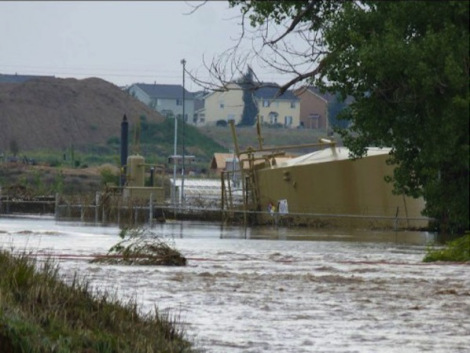
Oil, fracking chemicals spill into Colorado’s floodwaters

Fracking equipment damaged

Heavy rains returned to Colorado in the US on Sunday and hampered rescue efforts after last week’s flash floods. The confirmed death toll has risen to seven, and hundreds are still unaccounted for. An estimated 1,500 homes are destroyed. Some 1,000 people in Larimer County, north of Boulder, were awaiting airlifts that never came on Sunday — they were called off because of the foul weather.

The floods have also triggered other problems that have gotten a lot less media attention: Fracking infrastructure has been inundated and its toxic contents have spilled out. Pipelines that transport fossil fuels are sagging and snapping under pressure. Tanks that store chemicals and polluted water are being overwhelmed and toppling over. Oil and gas wells are flooding.

The Boulder Daily Camera reports:

Lafayette-based anti-fracking activist Cliff Willmeng said he spent two days “zig-zagging” across Weld and Boulder counties documenting flooded drilling sites, mostly along the drainageway of the St. Vrain River. He observed “hundreds” of wells that were inundated. He also saw many condensate tanks that hold waste material from fracking at odd angles or even overturned.

“It’s clear that the density of the oil and gas activity there did not respect where the water would go,” Willmeng said. “What we immediately need to know is what is leaking and we need a full detailed report of what that is. This is washing across agricultural land and into the waterways. Now we have to discuss what type of exposure the human population is going to have to suffer through.” …

A spokesman for the Colorado Oil and Gas Conservation Commission said the agency is aware of the potential for contamination from flooded drilling sites, but there simply is no way to get to those sites while flooding is ongoing and while resources are concentrated on saving lives.

The Denver Post interviewed a farmer who ignored evacuation orders and watched as floodwaters overwhelmed a drilling operation on his land and released some oil. The newspaper also reported that at least one oil pipeline was confirmed to have been broken open by the floodwaters. From the article:

Oil drums, tanks and other industrial debris mixed into the swollen [South Platte River] flowing northeast. …

One pipeline has broken and is leaking, Weld County Emergency Manager Roy Rudisill. Other industry pipelines are sagging as saturated sediment erodes around the expanding river.

East Boulder County United, a group that fights fracking, has been posting photographs on its Facebook page of fracking tanks and other equipment toppled over or submerged by floodwaters. Blogger TXsharon has also been posting updates and photographs.

Meanwhile, experts are beginning to discuss the links between climate change and the floods. The flooding was worsened by drought and wildfires, both of which have been linked to global warming and which left the ground dry and hard. That reduced the amount of water that the soil could absorb from the unusual late-summer inundation.

“This was a totally new type of event: an early fall widespread event during one of the driest months of the year,” Brad Udall of the University of Colorado-Boulder told National Geographic News. “As the climate warms further, the hydrologic cycle is going to get more intense.”

Climate Central notes that it “will take climate scientists many months to complete studies into whether manmade global warming made the Boulder flood more likely.” But the wild weather hitting the state lately fits general climate change projections:

An increase in the frequency and intensity of extreme precipitation events is expected to take place even though annual precipitation amounts are projected to decrease in the Southwest. Colorado sits right along the dividing line between the areas where average annual precipitation is expected to increase, and the region that is expected to become drier as a result of climate change.

That may translate into more frequent, sharp swings between drought and flood, as has recently been the case. Last year, after all, was Colorado’s second-driest on record, with the warmest spring and warmest summer on record, leading to an intense drought that is only just easing.

Might the fracking industry have worsened Colorado’s floods by contributing to climate change, then spilled its toxic chemicals into those floodwaters? That would be a cruel double-punch. – grist.org

Belgium investigates suspected cyber spying by foreign state

belgacom_tvBelgium said on Monday it was investigating suspected foreign state espionage against its main telecoms company, which is the top carrier of voice traffic in Africa and the Middle East, and a newspaper pointed the finger at the United States.

Federal prosecutors said in a statement that the former state telecoms monopoly Belgacom had filed a complaint in July about the hacking of several servers and computers.

“The inquiry has shown that the hacking was only possible by an intruder with significant financial and logistic means,” they said.

“This fact, combined with the technical complexity of the hacking and the scale on which it occurred, points towards international state-sponsored cyber espionage.” The prosecutors declined to say which foreign state they suspected.

Documents leaked by the former U.S. intelligence contractor Edward Snowden have revealed a vast National Security Agency (NSA) electronic surveillance program that has tracked enormous quantities of both Americans’ and foreigners’ email and telephone data.

This has mostly been done by agreement with telecommunications or internet providers or foreign government intelligence agencies.

However, the Brazilian television network Globo this month alleged that the NSA had tapped into the computer systems of companies including Google Inc. and the Brazilian state oil firm Petroleo Brasileiro, as well as France’s Foreign Ministry and the Belgian-based international banking cooperative SWIFT, which handles international financial transactions.

The Belgian daily De Standaard said the NSA had been monitoring international telephone traffic through Belgacom for two years. It said the hackers had been primarily interested in Belgacom’s subsidiary BICS, a wholesale provider of international phone lines and biggest voice carrier in Africa and the Middle East.

The government of Belgium, which has a majority stake in Belgacom, condemned the intrusion and the violation of a public company.

Prosecutors said the intruder had used malicious software and advanced encryption techniques with the aim of gathering strategic information, and had not sabotaged Belgacom’s data or sought to cause direct economic damage.

Belgacom itself said it had carried out work over the weekend to improve security and remove an unknown virus from its internal systems, adding that at the moment there was no indication of any impact on customers or their data. It said it had filed a complaint against an unknown third party.

Globo’s revelations were based on leaked U.S. documents provided by Guardian journalist Glenn Greenwald, who has worked with Snowden to expose the extent of U.S. spying.

James Clapper, the U.S. Director of National Intelligence, responded last week by saying U.S. agencies did collect information about economic and financial matters, which was used to combat terrorist financing and predict problems that could lead to financial crises or disrupt financial markets.

“What we do not do,” Clapper said in a statement, “is use our foreign intelligence capabilities to steal the trade secrets of foreign companies on behalf of – or give intelligence we collect to – U.S. companies to enhance their international competitiveness or increase their bottom line.” – Reuters

Brazil to break free from US-centric internet

brazilBrazil plans to divorce itself from the US-centric Internet over Washington’s widespread online spying.

This is a move that many experts fear will be a potentially dangerous first step toward politically fracturing a global network built with minimal interference by governments.

President Dilma Rousseff has ordered a series of measures aimed at greater Brazilian online independence and security following revelations that the US National Security Agency intercepted her communications, hacked into the state-owned Petrobras oil company’s network and spied on Brazilians who entrusted their personal data to US tech companies such as Facebook and Google.

Internet security and policy experts say her government’s reaction to information leaked by former NSA contractor Edward Snowden is understandable, but warn it could set the Internet on a course of Balkanization.

“The global backlash is only beginning and will get far more severe in coming months,” said Sascha Meinrath, director of the Open Technology Institute at the Washington-based New America Foundation think tank.

“This notion of national privacy sovereignty is going to be an increasingly salient issue around the globe.”

While Brazil isn’t proposing to bar its citizens from US-based Web services, it wants their data to be stored locally as the nation assumes greater control over Brazilians’ Internet use to protect them from NSA snooping.
Brazil intends to increase its independent Internet connections with other countries.

The danger of mandating that kind of geographic isolation, Meinrath said, is that it could render inoperable popular software applications and services and endanger the Internet’s open, interconnected structure.

The effort by Latin America’s biggest economy to digitally isolate itself from US spying not only could be costly and difficult, it could encourage repressive governments to seek greater technical control over the Internet to crush free expression at home, experts say.

In December, countries advocating greater “cyber-sovereignty” pushed for such control at an International Telecommunications Union meeting in Dubai, with Western democracies led by the United States and the European Union in opposition.

US digital security expert Bruce Schneier says that while Brazil’s response is a rational reaction to NSA spying, it is likely to embolden “some of the worst countries out there to seek more control over their citizens’ Internet. That’s Russia, China, Iran and Syria. That’s Tunisia. That’s Egypt.”

Rousseff says she intends to push for new international rules on privacy and security in hardware and software during the UN General Assembly meeting later this month.

Among Snowden revelations: the NSA has created backdoors in software and Web-based services.

Brazil is now pushing more aggressively than any other nation to end US commercial hegemony on the Internet. More than 80 percent of online search, for example, is controlled by US-based companies.

Most of Brazil’s global Internet traffic passes through the United States, so Rousseff’s government plans to lay underwater fibre optic cable directly to Europe and also link to all South American nations to create what it hopes will be a network free of US eavesdropping.

More communications integrity protection is expected when Telebras, the state-run telecom company, works with partners to oversee the launch in 2016 of Brazil’s first communications satellite, for military and public Internet traffic.

Brazil’s military currently relies on a satellite run by Embratel, which Mexican billionaire Carlos Slim controls.

Rousseff is urging Brazil’s Congress to compel Facebook, Google and other US companies to store all data generated by Brazilians on servers physically located inside Brazil in order to shield it from the NSA.

If that happens, and other nations follow suit, Silicon Valley’s bottom line could be hit by lost business and higher operating costs: Brazilians are among the most voracious consumers of social media, ranking No. 3 on Facebook and No. 2 on Twitter and YouTube. An August study

by a respected U.S. technology policy nonprofit estimated the fallout from the NSA spying scandal could cost the U.S. cloud computing industry, which stores data remotely to give users easy access from any device, as much as $35 billion by 2016 in lost business.

Brazil also plans to build more Internet exchange points, places where vast amounts of data are relayed, in order to route Brazilians’ traffic away from potential interception.

And its postal service plans by next year to create an encrypted email service that could serve as an alternative to Gmail and Yahoo!, which according to Snowden-leaked documents are among US tech giants that have collaborated closely with the NSA.

“Brazil intends to increase its independent Internet connections with other countries,” Rousseff’s office said.

It cited a “common understanding” between Brazil and the European Union on data privacy, and said “negotiations are underway in South America for the deployment of land connections between all nations.”

It said Brazil plans to boost investment in home-grown technology and buy only software and hardware that meet government data privacy specifications.

While the plans’ technical details are pending, experts say they will be costly for Brazil and ultimately can be circumvented. Just as people in China and Iran defeat government censors with tools such as “proxy servers,” so could Brazilians bypass their government’s controls.

International spies, not just from the United States, also will adjust, experts said. Laying cable to Europe won’t make Brazil safer, they say. The NSA has reportedly tapped into undersea telecoms cables for decades.

Meinrath and others argue that what’s needed instead are strong international laws that hold nations accountable for guaranteeing online privacy.

“There’s nothing viable that Brazil can really do to protect its citizenry without changing what the US is doing,” he said.

Matthew Green, a Johns Hopkins computer security expert, said Brazil won’t protect itself from intrusion by isolating itself digitally.

It will also be discouraging technological innovation, he said, by encouraging the entire nation to use a state-sponsored encrypted email service.

“It’s sort of like a Soviet socialism of computing,” he said, adding that the US “free-for-all model works better.”
-Sapa

11 Million users quit Facebook over spying

facebookA new report by the Daily Mail reveals Facebook users are abandoning the social media giant at an unprecedented rate over privacy concerns.

New research shows Facebook has lost a total of eleven million users, nine million in the US and two million in Britain. Researchers at the University of Vienna analyzed 600 users and found that almost half quit as a result of privacy concerns.

Studies show the majority of users that quit the site were older males.

Facebook, among other tech giants, have been repeatedly under scrutiny for their lack of user privacy, including turning over thousands of user’s info to the government. In August, Infowars revealed Facebook submitted information on approximately 38,000 users in 74 countries during the first half of 2013.

Over half of the requests originated from inside of the United States. Tech giants are unable to reveal absolute numbers on how many requests they’ve submitted to because the government prohibits them from doing so. However, companies like Google, Microsoft, Facebook and Yahoo have formed a unique alliance and are fighting back.

The tech alliance is putting pressure on the Foreign Intelligence Surveillance (FISA) court by filing motions asking to publicly disclose more details about secret national intelligence requests, instead of just releasing approximations.

“We believe there is more information that the public deserves to know, and that would help foster an informed debate about whether government security programs adequately balance privacy interests when attempting to keep the public safe,” said Facebook’s general counsel Colin Stretch.

“Editor of the journal Cyberpsychology, Behaviour and Social Networking which published the findings, said: ‘Given high profile stories such as WikiLeaks and the recent NSA surveillance reports, individual citizens are becoming increasingly more wary of cyber-related privacy concerns,’” reported Mail Online.

Facebook has also been under close examination for their recently updated “Statement of Rights and Responsibilities” policy which states users’ profile data including their profile picture, name and personal information “could show up as part of a Facebook ad their friends may see on the site,” according to a report by Mashable.

Even more controversy surrounded the social media giant when they announced the update of the “Tag Suggest” feature, which would allow facial recognition technology “to speed up the process of ‘tagging’ friends and acquaintances who appear in photos posed on the network,” reported Reuters.

As you can see, users’ concerns over privacy, or lack thereof, are certainly substantiated. However, if your information isn’t being collected through Facebook, NSA’s spy program, PRISM, is sure to scoop up your info in some other way, most likely through email or cellular data. – infowars.com


Sierra Leone deputy minister charged with rape

rape7Sierra Leone’s Deputy Education Minister Mamoud Tarawali has been charged with raping a university student, police said.

“He is facing counts of rape, wounding, wounding with intent and assault. He has been denied bail and is currently in Pademba road prison,” the inspector general of police Francis Munu said on Tuesday.

Tarawali was sacked last week after he was accused of rape.

He was in court on Monday to hear the charges read out and denied the accusations, police said.

Police said a complaint was filed by a 24-year-old student at the University of Sierra Leone in Freetown who said she was raped by Tarawali in a private residence.

Sierra Leone is recovering from years of war, during which sexual violence committed by fighters against women and girls was widespread. – Reuters

Russia reopens Arctic military base

arctic2Russia is reopening a Soviet-era military base in the Arctic, President Vladimir Putin said on Monday, part of a drive to make the northern coast a global shipping route and secure the region’s vast energy resources.

Two decades after abandoning it, Russia has sent 10 warships behind four nuclear-powered ice breakers to the base on the Novosibirsk Islands, a show of force as it resumes a permanent naval presence in the thawing region.

The flotilla was led by Russia’s flagship nuclear-powered cruiser, Peter the Great, along the Northern Sea Route, which connects Europe to Asia across Russian waters from the Kara Gate to the Bering Strait.

“Our troops left there in 1993, and yet it is a very important location in the Arctic Ocean, a new stage in the development of the Northern Sea Route,” Putin told a meeting of Russian defense officials.

“We will not only reopen the military base but restore the airfield to working order and make it possible for the emergency services, hydrologists and climate specialists to work together to ensure the security and effective work of the Northern Sea Route.”

Russia has staked future growth on mining the Arctic’s vast energy resources, and reviving the Soviet-era shipping route is an integral part of that plan.

Warmer summers have thawed more of the frozen waterways, rendering it navigable for longer periods and raising hopes the maritime passage could become a shorter alternative to southern routes.

But industry analysts and mariners say poor infrastructure, ice floes, narrow straits, shallow waters, and stormy winters remain as obstacles to safe and profitable shipping. – Reuters

Western powers poised to pressure Syria

William Hague
Everything is ‘abundantly clear’ to William Hague

Western powers were poised Tuesday to press their efforts for a UN resolution to rid Syria of chemical weapons, one day after a report by the world body describing a “chilling” sarin gas attack there.

United Nations experts, without assigning blame, said they had gathered “clear and convincing evidence” that surface-to-surface rockets took sarin gas into the opposition-held Damascus suburb of Ghouta on August 21.

The United States had threatened a military strike on Syria over the attack, which it said killed more than 1,400 people.

Washington said responsibility for the attack rests squarely with the regime of President Bashar al-Assad.

“The technical details of the UN report make clear that only the regime could have carried out this large-scale chemical weapons attack,” said Washington’s UN ambassador Samantha Power. “It defies logic to think that the opposition would have infiltrated the regime-controlled area to fire on opposition-controlled areas.”

French Foreign Minister Laurent Fabius said there was “no doubt” that government forces were to blame, while British Foreign Secretary William Hague said the report made “abundantly clear” that the Syrian regime was behind the attack.

France and Britain will soon send a draft resolution to other Security Council members demanding a threat of sanctions if Assad does not keep to a disarmament plan and for the chemical attacks to be referred to the International Criminal Court, diplomats said.

The council, meanwhile, is expected to start negotiations this week.

UN chief Ban Ki-moon condemned the use of chemical weapons in Syria as “a war crime” as the country’s conflict again spilled into neighboring nations, with Turkey saying it had shot down a Syrian military helicopter.

Ban said the report prepared by the experts “makes for chilling reading.”

He added that the use of sarin had been proved “unequivocally and objectively” and that the Ghouta attack was “the most signficant” with chemical weapons since Saddam Hussein unleashed poison gas in Halabja, Iraq, in 1988, killing thousands.

“The environmental, chemical and medical samples we have collected provide clear and convincing evidence that surface-to-surface rockets containing the nerve agent sarin were used” in Ghouta, said the report by UN inspectors who were in Syria when the attack was staged.

The experts concluded that “chemical weapons have been used in the ongoing conflict between the parties in the Syrian Arab Republic, also against civilians including children on a relatively large scale.”

A separate UN-mandated independent human rights inquiry announced separately on Monday that it was investigating 14 alleged chemical weapons attacks in Syria.

Ban would not say on Monday who had carried out the attack.

“We may all have our own thoughts on this, but I would simply say that this was a grave crime and those responsible must be brought to justice as soon as possible,” Ban told reporters.

On Friday, he said Assad had “committed many crimes against humanity.”

While the United States, Britain and France all insist that the findings show Assad’s forces had used the weapons, Russia’s UN envoy Vitaly Churkin said after a Security Council meeting on the report that there should be more investigation into who was responsible.

Moscow has sided with Assad in blaming opposition rebels for the chemical assault.

The UN experts’ report will now become a key weapon in a Security Council battle over how much of a threat must be made against Assad to make him disarm.

The French, US and British foreign ministers called for a “strong” resolution after a meeting in Paris.

US Secretary of State John Kerry said: “If Assad fails to comply with the terms of this framework, make no mistake we are all agreed, and that includes Russia, that there will be consequences.”

Kerry and Russian Foreign Minister Sergei Lavrov agreed a plan on Saturday under which Syria’s chemical weapons would be eliminated by mid-2014.

Russia has agreed the plans must be backed by a Security Council resolution but rejects any move to include the threat of force into a UN text.

Lavrov said such threats could kill off hopes of a peace conference on the 30-month-old conflict in which more than 110,000 people, according to activists.

Kerry was due to meet Thursday to discuss the issue with his counterpart from China, which has welcomed the agreement but has sided with Russia in its resolve to veto any UN Security Council resolution against Syria.

Fighting has worsened in Syria as the diplomatic wrangling goes on and Turkey said it shot down a Syrian military helicopter on Monday after it entered Turkish airspace.

The Syrian MI-17 helicopter was detected two kilometers (1.2 miles) inside Turkish airspace and shot down by two F-16 jets five minutes later after failing to heed warnings, Deputy Prime Minister Bulent Arinc told reporters.

“It was continuously warned by our air defense,” Arinc said, adding there was no information about the fate of its crew because the helicopter fell on Syrian soil.

Arinc said Turkey has changed its military rules of engagement in response to repeated gunfire from the Syrian side. – Sapa/AFP

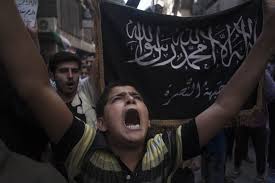
Al-Qaeda attacking minorities in Syria

syriajihadOpposition forces battling Bashar al-Assad’s regime in Syria now number around 100,000 fighters, but after more than two years of fighting they are fragmented into as many as 1,000 bands.

The new study by IHS Jane’s, a defence consultancy, estimates that more than half the rebels fighting in Syria for powerful factions are linked to al-Qaeda.

Rebels now number around 100,000 fighters, but after more than two years of fighting they are fragmented into as many as 1,000 bands.

There are around 10,000 international jihadists, who would include foreign fighters.


Another 30,000 to 35,000 are hardline Islamists who share much of the outlook of the jihadists, but are focused purely on the Syrian war rather than a wider international struggle.

There are also at least a further 30,000 moderates belonging to groups that have an Islamic character, meaning only a small minority of the rebels are linked to secular or purely nationalist groups.

Jihadists have been the most active portion of the rebellion, attacking ethnic Kurds and religious minorities nationwide, including three more Alawite villages sacked today in Homs Province.

The stark assessment, to be published later this week, accords with the view of Western diplomats estimate that less than one third of the opposition forces are “palatable” to Britain, while American envoys put the figure even lower.

Fears that the rebellion against the Assad regime is being increasingly dominated by extremists has fuelled concerns in the West over supplying weaponry that will fall into hostile hands. These fears contributed to unease in the US and elsewhere over military intervention in Syria. – The Telegraph


Malawi sells jet for food

malawijetPresident Joyce Banda decided last year to sell the jet, bought by her predecessor Bingu wa Mutharika for $22m, due to the cost of running it.

Former colonial power Britain, Malawi’s main bilateral donor, reduced its aid to Malawi by $4.7m after the 14-passenger aircraft was purchased.

Mutharika, who died last year from heart attack, often defended the buying of the jet, saying it was cheap to run and a status symbol for the poor southern African nation.

In July, the United Kingdom said it would provide Malawi with $20m to alleviate  the “looming food crisis” in southern Africa.

Lynne Featherstone, the UK’s international development minister, said the funds would “save countless lives”.

Malawi, which was a net exporter of maize just a few years ago, has now seen stocks depleted to a quarter of its annual average after the worst harvest in seven years

Price hikes and unpredictable weather have left food stocks dangerously low in the region, the government said.

Since taking office, Banda has introduced a host of cost-cutting measures and uses commercial airlines to travel outside the country.

The presidential aircraft was auctioned off to a Virgin Islands company, Bohnox Enterprise Ltd and the deal was announced in May.

The luxury jet cost Malawi about $300,000 a year in maintenance and insurance, a government official revealed. – Al Jazeera

India tests nuclear missile

agniIndia successfully test-fired for a second time a nuclear-capable missile yesterday that can reach Beijing and much of Europe, bringing a step closer production of a weapon designed to strengthen its nuclear deterrent.

“The test was successful,” said Ravi Kumar Gupta, spokesman for the Defence Research and Development Organisation (DRDO). “It hit the target in a predefined trajectory. It met all the mission objectives”

A video distributed by the DRDO showed the Agni-V rocket blasting off from a forest clearing on an island off India’s east coast state of Odisha.

India is trying to keep up with China’s growing military strength and wants to have a viable deterrent against its larger nuclear-armed neighbour.

The country is trying to keep up with China’s growing military strength

The two countries have generally warm relations, but they fought a brief Himalayan war in 1962 and a build up of conventional defences along their disputed border is a source of tension.

The Agni-V is the most advanced version of the indigenously built Agni, or Fire, series, part of a programme that started in the 1960s. Earlier versions could reach old rival Pakistan and western China.

Nuclear-armed Pakistan is increasing its arsenal of nuclear warheads and developing short-range, tactical nuclear weapons, raising concern about an escalating South Asian arms race, the International Institute for Strategic Studies said on Thursday.

The think-tank said in a report the race with Pakistan was increasing the risk of a nuclear exchange during a conventional conflict, perhaps sparked by an act of terrorism.

The Agni-V missile was first tested in April 2012. It is mostly domestically built and has a range of about 5,000 kilometres. Only the UN Security Council permanent members – China, France, Russia the United States and Britain – along with Israel, are believed to have such long-range weapons.

Gupta said India was now ready to start a process of production and subsequent induction of the missile. – Times of Malta

‘Western promotion of LGBT values a concern’

South African artist Steven Cohen
South African gay artist Steven Cohen

A senior Russian diplomat has blasted as unacceptable the ongoing attempts of Western nations to impose their values on other countries, while at the same time infringing on the socio-economic rights of their own citizens.

“The urge of Western countries to impose their neoliberal system of values on the other members of the international community as a universal basis of living can only cause concern. This is especially noticeable on the background of their aggressive promotion of the sexual minorities’ rights,” said the Foreign Ministry’s plenipotentiary for human rights, Konstantin Dolgov, while addressing the International Human Rights Forum, currently underway in Beijing.

Attempts to force other nations into accepting homosexuality and same-sex marriage as some natural social phenomenon which deserves support at a state level cannot be tolerated, Dolgov emphasized.

He added that such an approach was met with resistance not only in countries that hold to traditional values, but also those that have always had liberal attitudes to people of non-traditional orientation. He recalled the protests held in France after same sex marriage was legalized earlier this year.

In addition, Dolgov noted that the aggressive advertising of neo-liberal values is often done at the same time with frequent infringement of socio-economic rights and liberties inside the countries that pursue such politics. 

The speech was made against the backdrop of the massive international campaign against a Russian act that outlaws the promotion of non-traditional sexual relations to minors. LGBT activists around the world dubbed the act ‘the gay propaganda ban’ and called for protest measures ranging from a boycott of Russian vodka to a boycott of the 2014 Winter Olympics in the Russian city of Sochi.

Russian sponsors of the ban and senior officials have repeatedly noted that the law is not discriminatory and only seeks to protect children.

The Russian Olympic Committee at some point issued a special address assuring that LGBT athletes had nothing to fear in Sochi and that people of all orientations would be welcome in Sochi as contestants and guests.

Russia has also addressed the International Olympic Committee with a request to help stop the relentless campaign of speculation and protests over the issue, noting that LGBT activists often distort the meaning of the Russian law in their addresses.

In a recent TV interview, President Vladimir Putin also described the ban as non-discriminatory and said he was ready to meet with leaders of the LGBT community to discuss their problems, but had not yet received any suggestions.

The ban on the promotion of non-traditional sex to children has also caused some protests and a great deal of public discussion inside Russia. However, the majority of Russians support it. In March this year, the Levada public opinion center released the results of the poll that said that about 85 percent of adult Russians were strongly against same sex marriage and 87 percent oppose the idea of gay pride events in their cities. – RT

Israel owns 80 nukes, can triple number

Dimona
Dimona

Israel has never confirmed or denied possession of nuclear weapons, but according to new report by US experts it has at least 80 operative warheads and has enough material to produce up to 190 more.

In a report published in the Bulletin of the Atomic Scientists, nuclear weapon proliferation experts Robert S. Norris and Hans M. Kristensen assess that Israel stopped producing nuclear warheads back in 2004 once it reached around 80 munitions.

However, the country can easily double its arsenal since it has enough fissile material to build at least another 115 bombs, experts say.

“There are rumors that Israel is equipping some of its submarines with nuclear-capable cruise missiles,” the report says, echoing the 2013 Stockholm International Peace Research Institute yearbook on armament and international security which also suggested Israel could have nuclear-capable submarine-launched cruise missiles and reported the same assessment of nuke stockpiles.

The suspicions were fueled by the fact that Germany supplied Israel with five Dolphin-class submarines, allegedly capable of launching nuclear missiles, and signed a contract to build a sixth.

It remains unknown how many nuclear warheads of the total inventory could already be deployed, as Israel continues to maintain its long-standing policy of nuclear opacity. In December 2012, Israel once again dismissed the latest demand from the members of the Treaty on the Non-Proliferation of Nuclear Weapons to join the accord.

Israeli stockpiles of weapons of mass destruction have come under unusual scrutiny following the US-Russian roadmap for the destruction of Syrian chemical weapons, which is seen as a significant step towards a WMD-free region.

Recently declassified CIA documents suggest that Israel secretly built up its own stockpile of chemical and biological weapons decades ago. This has added more fuel to the lingering complaint of Arab states, who constantly accuse Israel of possessing nuclear weapons. Israel remains one of just seven countries which has never ratified the Chemical Weapons Convention as well.

In his speech on Sunday before talks with US Secretary of State John Kerry, Israeli prime minister, Benjamin Netanyahu said that “in any case, Israel must be poised and ready to defend itself, by itself, against any threat – and this capability and readiness are more important now than ever.” – RT

Whitey Basson, not going anywhere soon

whiteyAt the helm of Africa’s largest retailer, Shoprite Holdings is Afrikaner Whitey Basson.

Comfortably now past retirement age, there have been murmurs for years that sooner or later, Basson must surely hang up his hat.

And once the man who dragged Shoprite to the top of the retail flagpole is out the way, analysts believed, it would be open season in the retail space, with the way open for Pick n Pay to mount a renewed challenge.

But Basson says he’s not going anywhere any time soon, despite more than three decades in the job.

When asked whether he’d still be at Shoprite in five years – he’ll be in his 70s then – Basson is unequivocal.

“Yes, but not in the same job. I’ll stay on as the CEO but I’ll pass more things over.”

It’s this relentless drive that, a few weeks ago, made Shoprite – a home-grown retailer – the second-largest retailer in the world after America’s Walmart, surpassing even the French-owned Carrefour.

Shoprite is now worth R96.9-billion, making it the 18th-biggest company on the JSE.

The stock is worth R167 a share. Which means that if you’d put R100 000 into Shoprite shares back in April 1994 when South Africa entered a democratic era and the share was at R1, that stock would now be worth R16.7-million.

This is a consequence of Basson’s theory that his team and inner circle are like that of boxers in a ring, competing for excellence. No excuses or mediocrity are tolerated.

But the question is, where will Shoprite go during the next decade? What will be the driver of its next R100-billion?

The answer lies in the rest of the continent.

Basson was the first retailer to see big possibilities in Africa. Though initially it was more a case of testing himself against bigger competitors and international players outside of South Africa, it was also to see if they really were a good team. “Africa was really the only place where we could take the money out to play.”

Challenges have not changed much in Africa, but they have become more moderate, he says. “The biggest challenge is still Africa trying to do business with Africa …” he says.

“Then you have these fantastic politicians like the one I just saw in Turkey. I asked how the hell did you manage to change things in 10 years because the last time I was there, I was travelling behind goats. He says for instance, Turkish airlines now flies to the most destinations, it’s the cheapest airline. Because his motto is: ‘we take the people to the rest of the world so they can do business, and we’ll bring the tourists here’. That’s 31.5million tourists a year in a 75million country.”

Another challenge is the inability to get products inexpensively into Africa. Basson says a basket of goods in Luanda costs 3.01 times more than in South Africa.

“A lettuce costs R75 in Luanda, it costs R140 for a pocket of potatoes. Why should the people of the breadbasket of Africa – Angola – pay three times more?

“Those are the practical things that people never expose themselves to. So you have these conferences where people spend their governments’ money, they have 150 bodyguards and I say come with me to the shop, let me show you what it’s like. And that’s Africa.

“It’s getting better but we’re never going to catch up with the world.”

Luckily for Shoprite, Basson does not see much competition from global retailers in Africa yet. He says Walmart has other challenges such as corporate governance accusations affecting the group.

Carrefour recently said it was moving into North Africa, but Basson says it is battling. Its new CEO has a lot on his plate.

Shoprite has fewer labour disputes than many peers. Some would say it’s about the iron management and steely executive team. Basson says money is not the only driver behind working for a company, and that the group has a policy of employing employees’ children , so long as they meet the criteria.

He says Shoprite does not have senior managers hired from elsewhere; its own people are built up over the years.

And with that he’s off to other challenges and meetings before he flies off to Johannesburg the next day.

Within the week a crisis emerges in Mozambique. Five Shoprite stores are closed there. The group said this action stemmed from the dismissal of an employee found selling expired margarine through the back door. The Mozambican government’s National Inspectorate of Economic Activities closed down the stores in Maputo, Boane and Chimoio for selling old food. – timeslive.co.za