Fatal attraction

Is it African symbolism, or just plain attraction?

The buzzing insect stole the show as the President announced two new members of his second administration, cutting wild loops around the leader of the free world before landing squarely on his forehead.

The official White House transcript simply reads: “This guy is bothering me here – (swatting at a fly.)”

Meanwhile, the pool report which describes the President’s movements throughout the day noted that “the president spoke for about five minutes while being menaced by a house fly”.

It wasn’t the first time Mr Obama has shared camera time with a fly. In June 2009, the newly-elected president dealt some tough justice to one which interrupted an interview.

And during a 2010 announcement on healthcare reform, Mr Obama cut off an emotional story about an American struggling without health insurance as a fly zipped around him.

In that instance, the fly did manage to land briefly on his face, providing an unsightly addition to the mole on the left side of his nose.

French war in Mali with hostage crisis in Algeria

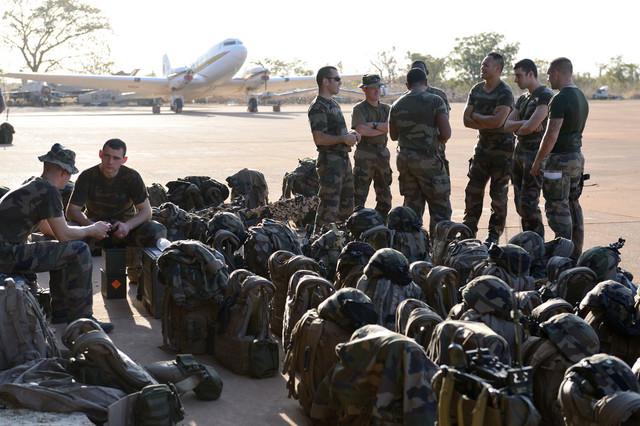
French troops arriving in Mali

French troops fought Islamist rebels in Mali while in neighbouring Algeria Al-Qaeda-linked fighters killed two people, took more than 40 foreign hostages and called for an end to France’s “crusade”.

Chad meanwhile announced it would be sending 2,000 soldiers to fight in Mali.

After days of air strikes on Islamist positions in northern Mali, controlled by the rebels since April, French and Malian ground forces battled the insurgents in the central towns of Diabaly and Konna.

But the assault on a gas field over the border in Algeria dramatically raised the stakes.

Islamists said they were holding 41 foreign hostages, including seven Americans, after their attack on the In Amenas gas field in the east of the country.

A group calling itself “Signatories for Blood” claimed the action in a post to the Mauritanian website Alakhbar.

The attack was in reprisal for “the crusade being waged by French forces in Mali” and for Algerian’s cooperation, it said, calling for an end to the operation.

Algerian Interior Minister Dahou Ould Kablia said that one Briton and an Algerian had been killed in the attack, while another six people — a Briton, a Norwegian a Scot and three Algerians — had been wounded.

Other reports said the hostages included Japanese, Malaysian, Norwegian and Filipino nationals. Dublin confirmed the kidnapping of an Irish national while the US State Department said several of its nationals were being held.

The attackers had also demanded the release of 100 Islamists held in Algeria in exchange for their hostages, a worker at the gas field site told AFP.

The attack came less than a week after France launched its air strikes on Islamists in northern Mali on January 11 and just days after Algeria opened its airspace to French fighter jets engaged in the mission.

Jointly operated by British oil giant BP, Norway’s Statoil and state-run Algerian energy firm Sonatrach, the gas field is located 1,300 kilometres (810 miles) southeast of Algiers, close to the Libyan border.

On the ground in central Mali, French troops engaged Islamist fighters in Diabaly, a town seized two days earlier by fighters led by Algerian Abou Zeid, one of the leaders of AQIM.

“The special forces are currently in Diabaly, in close-quarter combat with the Islamists. The Malian army is also in place,” a Malian security source said on condition of anonymity.

There were also clashes near Konna, the central town Islamists seized last week, prompting the French intervention, security sources said.

The French military said it had secured a strategic bridge on the Niger river near the town of Markala, south of Diabaly, blocking a key route to Bamako.

French Defence Minister Jean-Yves Le Drian said the western zone around Diabaly was home to “the toughest, most fanatical and best-organised groups. It’s under way there but it’s difficult”.

— ICC launches Mali war crimes probe —

The International Criminal Court said it had launched a warcrimes probe Wednesday, as rights groups and military sources denounced the Islamists’ use of child soldiers and use of civilians as human shields.

“Different armed groups have caused havoc and human suffering through a range of alleged acts of extreme violence,” chief prosecutor Fatou Bensouda said in a statement.

“I have determined that some of these deeds of brutality and destruction may constitute war crimes.”

Chad announced Wednesday it would send 2,000 soldiers to Mali, a significant boost to the African forces gathering there.

“We intend to send an infantry regiment and two support battalions, which comes to around 2,000 men,” Moussa Faki Mahamat told Radio France Internationale. They would work closely with the Malian army and the multinational West African force taking shape, he added.

Nigeria will command the UN-approved 3,300-strong multinational African intervention force and has promised 900 troops. Niger, Burkina Faso, Togo, Senegal, Guinea and Ghana have also promised troops.

Some 2,000 men will arrive within the next 10 days, according to a report from a meeting of regional army chiefs seen by AFP.

Ivory Coast President and ECOWAS regional bloc chairman Alassane Ouattara called for all European countries to lend support to the operation after a meeting with Chancellor Angela Merkel in Germany.

Germany has already pledged two transport planes and Italy logistical support.

France says it will ultimately send 2,500 troops, pitted against what are thought to be around 1,300 Islamic fighters.

Mali has been effectively split in two since April 2012, when Islamists took advantage of a military coup in Bamako and an offensive launched by Tuareg separatists in the north to seize half the country.

The UN and aid agencies report some 370,000 Malians have been displaced by the fighting. – AFP

60 dead in Ivory Coast during New Year’s Eve stampede

The Ivory Coast on Wednesday began three days of national mourning after a stampede among crowds gathered for celebratory New Year’s Eve fireworks in Abidjan left at least 60 dead and dozens injured.

An AFP journalist saw many injured children, while images broadcast by RTI television showed bodies stretched lifeless on the ground outside the city’s main stadium.

Piles of abandoned shoes and clothing could also be seen at the stadium, where soldiers and police were deployed, along with UN peacekeepers.

“This is a real tragedy on this New Year’s Day,” President Alassane Ouattara said at the scene.

“We are all in shock,” he added, announcing that three days of national mourning would be held starting Wednesday.

The government said 60 people had died, with an average age of 18. Earlier, the head of military rescue workers, Lieutenant Colonel Issa Sako, told journalists that 61 had died.

“Forty-nine wounded were evacuated” by rescue workers, Sako said, adding that other injured victims had gone to hospital on their own. Another rescue official said at least 200 people had been wounded in all.

Sako said the flow of people at the stadium had caused a “very large crush” and that “in the crush, people were walked over and suffocated by the crowd”.

Officials said around 50,000 people had gathered for the fireworks.

Witnesses said the stampede had broken out after the fireworks ended, though the cause remains unclear. It erupted near the stadium’s main entrance, where security had set up tree trunks as crowd control barriers.

According to a police source, the crush occurred when two streams of spectators going in opposite directions crossed paths.

A security source added that rescue services “took some time to arrive”.

Interior Minister said the “exact circumstances” of the tragedy are “under investigation by the security services”.

Visibly shaken children were among the roughly 40 wounded taken to a hospital in the wealthy neighbourhood of Cocody, in the north of the economic capital.

A mother named Zeinab who had taken two of her children to the stadium found one of them in the hospital, a small boy who lay on a bed in a groggy state.

Zeinab said she “hurt all over” and showed a journalist the scratches on her body.

“I don’t know what happened but I found myself lying on the ground with people stepping on me, pulling my hair or tearing my clothes,” she said.

She said she had been knocked unconscious and that a young man had pulled her from the crowd.

The New Year’s fireworks, the city’s second in two years, had been touted as a symbol of national renewal under Ouattara after a violent post-election crisis that tore the country apart from December 2010 to April 2011, killing some 3,000 people.

The unrest began after Ouattara’s long-time rival and former iron-fisted ruler Laurent Gbagbo refused to step down.

He was later arrested by forces loyal to Ouattara, with UN and French military backing, and transferred to the International Criminal Court in The Hague, where he is accused of crimes against humanity.

Though the troubled west African nation — the world’s top cocoa producer — is still recovering from the political and military crisis, Ouattara had struck a note of optimism in a New Year’s message on Monday evening.

He said the former French colony had “possibilities like seldom before” ahead of it, promising it would soon reap the rewards of economic growth and development. – AFP

Mozilla against secret Internet treaty

Add another name to the list of critics concerned with attempts to rewrite the International Telecommunication Union to give governments control of the Internet: Silicon Valley’s Mozilla now officially opposes the ITU.

Mozilla, the makers of the highly successful Firefox Web browser for Macs, PCs and smart phones, have come out to condemn a top-secret meeting in Dubai this week that could lead to changes with how the world is wired to the Internet.

The details of the closed-door discussions being held between members of the United Nation’s World Conference on International Telecommunications (WCIT) this week in the United Arab Emirates remains a secret, and that’s exactly why Mozilla is speaking up. In a plea posted on Mozilla.org, the developers write, “The issue isn’t whether our governments, the UN or even the ITU should play a role in shaping the Web. The problem is that they are trying to do it behind closed doors, in secret, without us.”

“The Web lets us speak out, share and connect around the things that matter. It creates new opportunities, holds governments to account, breaks through barriers and makes cats famous. This isn’t a coincidence. It’s because the Web belongs to all of us,” insists Mozilla. “We all get a say in how it’s built.”

Now in order to raise awareness of what the WCIT can do by rewriting the ITU, Mozilla has released an “Engagement Kit” in order to get people around the globe talking about what could happen to the Web without their input ever being considered.

“Mozilla has made it our mission to keep the power of the web in people’s hands,” the developers say.

Mozilla now joins a list of major Internet names opposed to the ITU talks, which in recent days has added both Vint Cerf and Sir Tim Berners-Lee, two computer scientists widely regarded as instrumental figures as far as getting the world online goes.

Berners-Lee, the inventor of the World Wide Web, spoke openly against the ITU just recently while attending the WCIT, warning that rewriting the international treaty to put Internet regulation in the hands of government is not just unnecessary, but would cause a “disruptive threat to the stability” of the Internet as we know it.

“A lot of concerns I’ve heard from people have been that, in fact, countries that want to be able to block the Internet and give people within their country a ‘secure’ view of what’s out there would use a treaty at the ITU as a mechanism to do that, and force other countries to fall into line with the blockages that they wanted to put in place,” Berners-Lee said.

Leaked documents from the WCIT meeting suggest that shot-callers from across the globe have floated the idea of adopting a new standard for the Internet that will implement deep packet inspection, or DPI, essentially allowing all traffic sent across the Web to be reviewed by a governing body.

“It’ll be the biggest power grab in the UN’s history, as well as a perversion of its power,” blogger Arthur Herman wrote of the proposal.

Japan scrambles fighters as Chinese plane flies over disputed islands

Japan Air Self-Defense Force F-15

Tokyo scrambled F-15 fighter jets on Thursday after a Chinese state-owned plane entered airspace over islands disputed by the two countries. A Chinese maritime aircraft ventured over the Senkaku islands, called the Diaoyu Islands in China, just after 0200 GMT, Chief Cabinet Secretary Osamu Fujimura said, as cited by AFP. Confrontations have become commonplace since Japan nationalized the East China Sea islands in September. Thursday marks the 75th anniversary of the beginning of the Nanjing Massacre, when Japanese Imperial Army troops entered the then-capital of China.

This is the first time the dispute over the islands, which Japan calls Senkaku and China refers to as Diaoyu, has involved aircraft.

Chinese government ships have repeatedly entered the waters around the remote, rocky islands since the Japanese government announced in September it was buying several of the islands from private owners.

Japanese Coast Guard vessels have engaged in games of cat and mouse with the Chinese ships, with both sides broadcasting messages to one another insisting they have territorial sovereignty over the area.

On Thursday morning, a Japanese Coast Guard patrol vessel spotted the Chinese government plane in airspace around the islands, Chief Cabinet Secretary Osamu Fujimura said.

Japanese Self Defense Force sent four F-15 jets and another aircraft to the area, Fujimura said, describing the Chinese plane’s entry into the area as “extremely regrettable.” Japan has lodged a protest with the Chinese government through diplomatic channels, he said.

The Japanese government’s acquisition of the islands in September also set off several days of violent anti-Japanese protests across China and soured economic ties between the two Asian nations.

There was no immediate reaction from China about the incident.

Tennis player Caroline Wozniacki accused of ‘racist’ impersonation

Caroline Wozniacki impersonates Serena Williams

Caroline Wozniacki has been accused of doing a ‘racist’ impersonation of fellow tennis player Serena Williams after stuffing her bra and shorts.

At a recent exhibition against Maria Sharapova in Brazil, the former world No. 1 stuffed courtside towels down her kit to replicate the body of the curvaceous Grand Slam champion.

But now the 22-year-old Dane, whose boyfriend golfer Rory McIlroy was in the crowd, has now been accused of racism by some observers.

On Tumblr, one blogger wrote: ‘This isn’t “harmless fun” as one article described it. its racist. out and outright racism. mocking and making fun of the bodies of black women for a laugh? real funny, stupid white girl. real real funny.’

Another blogger pointed out: ‘It may have been done in “jest,” but I love how people can can turn a black woman’s body and sexuality into a caricature. However, we should not have the autonomy to celebrate any successes of our own.

While on feministing.com, an article read: ‘Given the history and current-day context of racialized standards of beauty, and the hypersexualization of people of color, when a white woman makes fun of a black women’s body, especially in a way that hypersexualizes her and draws on the stereotype of black women’s big butts, it’s racist.’ – mailonline.com

Gaza M75 perfume captures ‘victory’ scent

Rocket science?

“Victory” has never smelled so sweet — or at least that’s what they would have you believe at the shop selling Gaza’s newest fragrance named M75 after a long-range Hamas rocket.

It’s a bold move by the “Stay Stylish” shop in Gaza City’s upscale Rimal neighbourhood, but one that store owner Abu Ahmed expects to pay dividends.

“We came up with the name M75 for a new perfume in the shop as a symbol of the rocket of the resistance, and the victory of Gaza,” he told AFP.

The M75 rocket was among several long-range missiles Gaza militant groups fired into Israel during an eight-day conflict last month, which ended with a ceasefire between Hamas and the Jewish state.

The conflict killed at least 174 Palestinians, including more than 100 civilians, and six Israelis, four civilians and two soldiers, but many in Gaza felt Hamas emerged from the violence victorious.

The goal of the perfume is “to promote and market our products, and its only natural to use something like a victory to market our goods,” added Abu Ahmed, who declined to give his full name.

“We want to send a fast message to people about this perfume to market it as quickly and easily as possible,” he said.

“People are proud that we were able to hit Tel Aviv and Jerusalem with this M75 rocket and this name is much talked about and liked by people here.”

The fragrance, available both for men and women, has been successful so far, despite the fairly hefty price tag of 50 Israeli shekels ($13, euros), which the manufacturers justify on the basis of the perfume’s “luxurious” components.

The success, according to Abu Ahmed, has already inspired his fellow Gaza entrepreneurs, whom he expects to slap the M75 label on a whole range of new products.

The M75 rocket, among hundreds that Hamas and other groups fired into Israel during the eight-day conflict, appears to have captured the public’s imagination in Gaza, where it played a commanding role during Hamas’s 25th anniversary celebrations this weekend.

An enormous mock-up of the rocket had pride of place on a stage where the festivities took place, and Hamas leader Khaled Meshaal — in Gaza for the first time ever — emerged from a door in the fake missile to give an address. – France24


Economic warfare provoked Pearl Harbor

Robert Higgs

Many people are misled by formalities. They assume, for example, that the United States went to war against Germany and Japan only after its declarations of war against these nations in December 1941. In truth, the United States had been at war for a long time before making these declarations. Its war making took a variety of forms. For example, the U.S. navy conducted “shoot [Germans] on sight” convoys – convoys that might include British ships — in the North Atlantic along the greater part the shipping route from the United States to Great Britain, even though German U-boats had orders to refrain (and did refrain) from initiating attacks on U.S. shipping. The United States and Great Britain entered into arrangements to pool intelligence, combine weapons development, test military equipment jointly, and undertake other forms of war-related cooperation. The U.S. military actively cooperated with the British military in combat operations against the Germans, for example, by alerting the British navy of aerial or marine sightings of German submarines, which the British then attacked. The U.S. government undertook in countless ways to provide military and other supplies and assistance to the British, the French, and the Soviets, who were fighting the Germans. The U.S. government also provided military and other supplies and assistance, including warplanes and pilots, to the Chinese, who were at war with Japan.[1] The U.S. military actively engaged in planning with the British, the British Commonwealth countries, and the Dutch East Indies for future combined combat operations against Japan. Most important, the U.S. government engaged in a series of increasingly stringent economic warfare measures that pushed the Japanese into a predicament that U.S. authorities well understood would probably provoke them to attack U.S. territories and forces in the Pacific region in a quest to secure essential raw materials that the Americans, British, and Dutch (government in exile) had embargoed. [2]

Roosevelt had already led the United States into war with Germany in the spring of 1941—into a shooting war on a small scale. From then on, he gradually increased U.S. military participation. Japan’s attack on December 7 enabled him to increase it further and to obtain a war declaration. Pearl Harbor is more fully accounted for as the end of a long chain of events, with the U.S. contribution reflecting a strategy formulated after France fell. . . . In the eyes of Roosevelt and his advisers, the measures taken early in 1941 justified a German declaration of war on the United States—a declaration that did not come, to their disappointment. . . . Roosevelt told his ambassador to France, William Bullitt, that U.S. entry into war against Germany was certain but must wait for an “incident,” which he was “confident that the Germans would give us.” . . . Establishing a record in which the enemy fired the first shot was a theme that ran through Roosevelt’s tactics. . . . He seems [eventually] to have concluded—correctly as it turned out—that Japan would be easier to provoke into a major attack on the Unites States than Germany would be. [3]

The claim that Japan attacked the United States without provocation was . . . typical rhetoric. It worked because the public did not know that the administration had expected Japan to respond with war to anti-Japanese measures it had taken in July 1941. . . . Expecting to lose a war with the United States—and lose it disastrously—Japan’s leaders had tried with growing desperation to negotiate. On this point, most historians have long agreed. Meanwhile, evidence has come out that Roosevelt and Hull persistently refused to negotiate. . . . Japan . . . offered compromises and concessions, which the United States countered with increasing demands. . . . It was after learning of Japan’s decision to go to war with the United States if the talks “break down” that Roosevelt decided to break them off. . . . According to Attorney General Francis Biddle, Roosevelt said he hoped for an “incident” in the Pacific to bring the United States into the European war.[4]

These facts and numerous others that point in the same direction are for the most part anything but new; many of them have been available to the public since the 1940s. As early as 1953, anyone might have read a collection of heavily documented essays on various aspects of U.S. foreign policy in the late 1930s and early 1940s, edited by Harry Elmer Barnes, that showed the numerous ways in which the U.S. government bore responsibility for the country’s eventual engagement in World War II—showed, in short, that the Roosevelt administration wanted to get the country into the war and worked craftily along various avenues to ensure that, sooner or later, it would get in, preferably in a way that would unite public opinion behind the war by making the United States appear to have been the victim of an aggressor’s unprovoked attack.[5] As Secretary of War Henry Stimson testified after the war, “we needed the Japanese to commit the first overt act.” [6]

At present, however, seventy years after these events, probably not one American in 1,000—nay, not one in 10,000—has an inkling of any of this history. So effective has been the pro-Roosevelt, pro-American, pro-World War II faction that in this country it has utterly dominated teaching and popular writing about U.S. engagement in the “Good War.”

In the late nineteenth century, Japan’s economy began to grow and to industrialize rapidly. Because Japan has few natural resources, many of its burgeoning industries had to rely on imported raw materials, such as coal, iron ore or steel scrap, tin, copper, bauxite, rubber, and petroleum. Without access to such imports, many of which came from the United States or from European colonies in Southeast Asia, Japan’s industrial economy would have ground to a halt. By engaging in international trade, however, the Japanese had built a moderately advanced industrial economy by 1941.

At the same time, they also built a military-industrial complex to support an increasingly powerful army and navy. These armed forces allowed Japan to project its power into various places in the Pacific and East Asia, including Korea and northern China, much as the United States used its growing industrial might to equip armed forces that projected U.S. power into the Caribbean, Latin America, and even as far away as the Philippine Islands.

When Franklin D. Roosevelt became president in 1933, the U.S. government fell under the control of a man who disliked the Japanese and harbored a romantic affection for the Chinese because, some writers have speculated, Roosevelt’s ancestors had made money in the China trade. [7] Roosevelt also disliked the Germans in general and Adolf Hitler in particular, and he tended to favor the British in his personal relations and in world affairs. He did not pay much attention to foreign policy, however, until his New Deal began to peter out in 1937. Thereafter he relied heavily on foreign policy to fulfill his political ambitions, including his desire for reelection to an unprecedented third term.

When Germany began to rearm and to seek Lebensraum aggressively in the late 1930s, the Roosevelt administration cooperated closely with the British and the French in measures to oppose German expansion. After World War II commenced in 1939, this U.S. assistance grew ever greater and included such measures as the so-called destroyer deal and the deceptively named Lend-Lease program. In anticipation of U.S. entry into the war, British and U.S. military staffs secretly formulated plans for joint operations. U.S. forces sought to create a war-justifying incident by cooperating with the British navy in attacks on German U-boats in the northern Atlantic, but Hitler refused to take the bait, thus denying Roosevelt the pretext he craved for making the United States a full-fledged, declared belligerent—a belligerence that the great majority of Americans opposed.

In June 1940, Henry L. Stimson, who had been secretary of war under William Howard Taft and secretary of state under Herbert Hoover, became secretary of war again. Stimson was a lion of the Anglophile, northeastern upper crust and no friend of the Japanese. In support of the so-called Open Door Policy for China, Stimson favored the use of economic sanctions to obstruct Japan’s advance in Asia. Treasury Secretary Henry Morgenthau and Interior Secretary Harold Ickes vigorously endorsed this policy. Roosevelt hoped that such sanctions would goad the Japanese into making a rash mistake by launching a war against the United States, which would bring in Germany because Japan and Germany were allied.

The Roosevelt administration, while curtly dismissing Japanese diplomatic overtures to harmonize relations, accordingly imposed a series of increasingly stringent economic sanctions on Japan. In 1939, the United States terminated the 1911 commercial treaty with Japan. “On July 2, 1940, Roosevelt signed the Export Control Act, authorizing the President to license or prohibit the export of essential defense materials.” Under this authority, “[o]n July 31, exports of aviation motor fuels and lubricants and No. 1 heavy melting iron and steel scrap were restricted.” Next, in a move aimed at Japan, Roosevelt slapped an embargo, effective October 16, “on all exports of scrap iron and steel to destinations other than Britain and the nations of the Western Hemisphere.” Finally, on July 26, 1941, Roosevelt “froze Japanese assets in the United States, thus bringing commercial relations between the nations to an effective end. One week later Roosevelt embargoed the export of such grades of oil as still were in commercial flow to Japan.” [8] The British and the Dutch followed suit, embargoing exports to Japan from their colonies in Southeast Asia.

Roosevelt and his subordinates knew they were putting Japan in an untenable position and that the Japanese government might well try to escape the stranglehold by going to war. Having broken the Japanese diplomatic code, the American leaders knew, among many other things, what Foreign Minister Teijiro Toyoda had communicated to Ambassador Kichisaburo Nomura on July 31: “Commercial and economic relations between Japan and third countries, led by England and the United States, are gradually becoming so horribly strained that we cannot endure it much longer. Consequently, our Empire, to save its very life, must take measures to secure the raw materials of the South Seas.”[9]

Because American cryptographers had also broken the Japanese naval code, the leaders in Washington also knew that Japan’s “measures” would include an attack on Pearl Harbor.[10] Yet they withheld this critical information from the commanders in Hawaii, who might have headed off the attack or prepared themselves to defend against it. That Roosevelt and his chieftains did not ring the tocsin makes perfect sense: after all, the impending attack constituted precisely what they had been seeking for a long time. As Stimson confided to his diary after a meeting of the War Cabinet on November 25, “The question was how we should maneuver them [the Japanese] into firing the first shot without allowing too much danger to ourselves.” After the attack, Stimson confessed that “my first feeling was of relief . . . that a crisis had come in a way which would unite all our people.”[11]

Robert Higgs is senior fellow in political economy for the Independent Institute and editor of The Independent Review. He is the 2007 recipient of the Gary G. Schlarbaum Prize for Lifetime Achievement in the Cause of Liberty. Send him mail.

Notes

[1] See “Flying Tigers,” Wikipedia. Available at: http://en.wikipedia.org/wiki/Flying_Tigers .

[2] Robert Higgs, “How U.S. Economic Warfare Provoked Japan’s Attack on Pearl Harbor,” The Freeman 56 (May 2006): 36-37.

[3] George Victor, The Pearl Harbor Myth: Rethinking the Unthinkable (Dulles, Va.: Potomac Books, 2007), pp. 179-80, 184, 185, emphasis added.

[4] Ibid ., pp. 15, 202, 240.

[5] See Perpetual War for Perpetual Peace: A Critical Examination of the Foreign Policy of Franklin Delano Roosevelt and Its Aftermath, edited by Harry Elmer Barnes (Caldwell, Id.: Caxton Printers, 1953).

[6] Stimson as quoted in Victor, Pearl Harbor Myth, p. 105.

[7] Harry Elmer Barnes, “Summary and Conclusions,” in Perpetual War for Perpetual Peace: A Critical Examination of the Foreign Policy of Franklin Delano Roosevelt and Its Aftermath, edited by Harry Elmer Barnes (Caldwell, Idaho: Caxton Printers, 1953), 682-83.

[8] All quotations in this paragraph are from George Morgenstern, “The Actual Road to Pearl Harbor,” in Barnes, ed., Perpetual War for Perpetual Peace, 322-23, 327-28.

[9] Quoted in Morgenstern, “The Actual Road to Pearl Harbor,” 329.

[10] Robert B. Stinnett, Day of Deceit: The Truth About FDR and Pearl Harbor (New York: Free Press, 2000).

[11] Quoted in Morgenstern, “The Actual Road to Pearl Harbor,” 343, 384.

This talk by Robert Higgs was the Arthur M. Krolman Lecture at the 30th Anniversary Supporters Summit of the Ludwig von Mises Institute, Callaway Gardens, Georgia, on October 26, 2012. Originally posted at the Ludwig von Mises Inistitute

‘Tintin in the Congo’ not racist, Belgian court rules

A Brussels court has rejected a legal bid to ban “Tintin in the Congo”, the second adventure of Belgian writer Hergé’s globe-trotting boy reporter. Black associations in the country claimed the book contained racist stereotypes.

“Tintin in the Congo” – a classic 1920s comic strip about Belgium’s celebrated fictional boy reporter – is not racist, a Brussels court ruled on Wednesday.

The Brussels Appeals Court upheld a 2011 ruling against Congolese immigrant Bienvenu Mbutu Mondondo and the Belgian Council of Black Associations, who wanted the book banned.

In 2010 Mbutu, who lives in Belgium, Congo’s former colonial ruler, said Tintin employed a little black helper who was seen as “stupid and without qualities”.

“It makes people think that blacks have not evolved,” he said.

In one scene, a black woman prostrates herself before Tintin, saying: “White man very great. White mister is big juju man.”

‘Gentle and candid humour’

Alain Amici, lawyer for the plaintiffs, told the court in 2011: “The negative stereotypes portrayed in this book are still read by a significant number of children. They have an impact on their behaviour.”

Not so, said Brussels judges, for whom “Tintin in the Congo” is full of “gentle and candid humour”.

The cartoon strip, written in the late 1920s, was Belgian writer Hergé’s second Tintin adventure. It was followed by stories in which the author tried to add greater realism and historical accuracy.

Hergé himself recognised that “Tintin in the Congo” was a “youthful sin” that reflected the prejudices of the time.

In 2007 a British court ruled that “Tintin in the Congo” should be sold with a warning that it includes racist content.

Mbutu has also tried to have the cartoon banned in France, unsuccessfully. – France24

China surpasses US as trading partner

In just five years, China surpassed the US as leading a trading partner in the world. With 124 countries considering China their largest trading partner and only 76 having that relationship with the US, the Asian country’s influence is on the rise.

In 2006, the US was the larger trading partner for 127 countries, while China dominated among 70. In 2011, the numbers reversed, with China dominating trade among 124 countries and the US being the top trade partner for only 76, the Associated Press reported. Some US allies even consider China their top trading partner, including Australia and South Korea.

The AP findings demonstrate China’s rapid ascent as a trade partner. As a result of its international relationships, the world’s most populous country is becoming more politically influential – and its rise won’t be ending anytime soon. China’s world output is forecasted to grow up to 8 percent a year over the next decade – a rate that surpasses all Western levels.

Trade with China was on average 12.4 percent of GDP for other countries – a rate that is higher than trade with the US has been in the past 30 years. Trade with China was only 3 percent of a country’s GDP in 2002, which demonstrates the surge that occurred in the last decade.

With rising trade influence, China is likely to also generate jobs, raise living standards and gain political power.

“The United States is a tiger with no power. Nobody can deny that China is the one now rising,” said Shin Cheol-soo, a South Korean businessman at the ENA Industry Co.

While the US is still the world’s largest importer and exports more expensive and high-quality products, China is a bigger market for 77 countries, which is an increase of 20 countries since the year 2000. The US exports innovative products in the automobile industry, aerospace, medicine, computers, finance and pharmaceuticals, but China’s low labor costs make it a success in products that can be produced cheaply.

At the current rate of trading, China will surpass the US and become the largest trader by the end of this year.

“The center of gravity of the world economy has moved to the east,” Mauricio Cardenas, the finance minister of Colombia, told AP. “I would say that there is nothing comparable in the last 50 years.”

While the recession hit US businesses hard, some began to thrive in China. Shin, the businessman at ENA Industry Co. who sold auto parts, moved his struggling business from the US to China. And across the world, people have begun to recognize the importance of China in the future world economy. Parents are increasingly encouraging their children to learn Mandarin in school.

“Mothers who send their kids here believe our children’s generation is the China generation. In the future, without learning Chinese, one won’t be able to get a job,” said Nancy Ching, who opened a Chinese-language school in South Korea.

China is also starting to look into markets that were so far dominated by the US. Rather than exporting products, the Chinese hope to soon sell services and investments, including construction and engineering. By building roads, dams, highways, and other structures in developing countries, China is now rivaling the US and Europe in areas it never touched before.

“When we see the people from America, they say ‘We want to assist Kenya’. But I don’t see it. China comes and I see one thing: the road,” said Joseph Makori, a professional driver in Kenya, where Chinese companies are increasingly winning government contracts to do construction.

China’s trade is reaching beyond just economic partnerships with countries in need of cheap products. The world’s most populous country is becoming an influential power in a range of aspects. While China is set to surpass the US and become the largest trader by the end of 2012, it may not be long before the countries will compete politically. – RT

The new UK breadwinner

A woman in her late 20’s came to the hospital today with her 8th pregnancy. She said to me  me “My mum told me that I am the breadwinner for the family.”

I asked her to explain. She said that she can make babies and babies get money from the State for the family.

It goes like this: The Grandma calls the Department for work and pensions, and states that the unemployed daughter is not capable of caring for all of her kids. DWP agrees, and tells her the children will need to go into foster care.

The Grandma then volunteers to be the foster parent, and receives a cheque for 700 per child each month. Total yearly income: 58,800 soon to become 67200 when the 8th one is born, tax-free and nobody has to go to work!

In fact, they get more if there is no husband/father/man in the home! The brother does not count. Not to mention free dental treatment, free housing, free council tax free school dinners, free tuition fees at college or Uni, free eyecare and glasses, free prescriptions and various other benefits…

Total value of all benefits combined probably approaching 100,000 per annum which would require an income of around 148000 to create.

That’s about my salary as a senior consultant with years of experience and surgical skills in a central London teaching hospital.

Indeed, Grandma was correct that her fertile daughter is the “breadwinner” for the family.

This is how the politicians spend our taxes. When this generous programme was invented in the ’60s, the Great Society architects forgot to craft an end date… and now we are hopelessly overrun with people who vote only for those who will continue to keep them on the dole…..

No wonder our country is broke!

Worse, our Muslim brothers have been paying attention, and by mandating that each Muslim family have eleven children, they will soon replace the voting bloc above and can be running this country.

Are we alarmed yet, is anybody listening?

Sincerely, Sebastian J. Ciancino – Urologist, Guys Hospital trust – London

Oh yes, and don’t forget to pay your taxes! There are a lot of “breadwinners” depending on you!
 

Smoking ‘rots’ brain

Smoking “rots” the brain by damaging memory, learning and reasoning, according to researchers at King’s College London.

A study of 8,800 people over 50 showed high blood pressure and being overweight also seemed to affect the brain, but to a lesser extent.

Scientists involved said people needed to be aware that lifestyles could damage the mind as well as the body.

Their study was published in the journal Age and Ageing.

Researchers at King’s were investigating links between the likelihood of a heart attack or stroke and the state of the brain.

Data about the health and lifestyle of a group of over-50s was collected and brain tests, such as making participants learn new words or name as many animals as they could in a minute, were also performed.

They were all tested again after four and then eight years.

The results showed that the overall risk of a heart attack or stroke was “significantly associated with cognitive decline” with those at the highest risk showing the greatest decline.

It also said there was a “consistent association” between smoking and lower scores in the tests.

One of the researchers, Dr Alex Dregan, said: “Cognitive decline becomes more common with ageing and for an increasing number of people interferes with daily functioning and well-being.

“We have identified a number of risk factors which could be associated with accelerated cognitive decline, all of which, could be modifiable.”

Dr Simon Ridley, from Alzheimer’s Research UK, said: “Research has repeatedly linked smoking and high blood pressure to a greater risk of cognitive decline and dementia, and this study adds further weight to that evidence.

“Cognitive decline as we age can develop into dementia, and unravelling the factors that are linked to this decline could be crucial for finding ways to prevent the condition.

“These results underline the importance of looking after your cardiovascular health from mid-life.”

The Alzheimer’s Society said: “We all know smoking, a high blood pressure, high cholesterol levels and a high BMI [Body Mass Index] is bad for our heart. This research adds to the huge amount of evidence that also suggests they can be bad for our head too.

“One in three people over 65 will develop dementia but there are things people can do to reduce their risk. – BBC


The least emotional country in the world

Skypark, Singapore

Singapore, where residents work the longest hours in the world, was also found to be the least emotional country.

Never mind its temperate 28C weather, low unemployment rate and high per-capita GDP – Singapore is the most emotionless society in the world, according to a new Gallup poll, beating the traditionally po-faced Georgia, Lithuania and Russia in a survey of more than 150 nations.

Asking respondents questions such as “Did you feel well-rested yesterday?”, “Were you treated with respect all day yesterday?” and “Did you smile or laugh a lot yesterday?”, the survey found that Singaporeans were the least likely to reveal experiencing any emotions at all.

Just 36% of Singaporeans reported feeling positive or negative emotions on a daily basis, while 60% of Filipinos recorded regularly feeling both – the highest response rate of any country worldwide.

The poll’s findings – released on Wednesday – soon went viral on the internet, where they became the butt of many jokes, not least among Singaporeans themselves. “Singapore ranked most emotionless country in the world – not sure how to feel about that,” ran a number of Singapore-based tweets. “That

Who is South Africa's biggest racist?

View Results

Loading ... Loading ...
is a lie,” commented one reader on the online news portal Today. “I use many emoticons to express how satisfied I am.”

Singapore’s 5.2 million residents work – at 46.6 hours a week – the longest hours in the world, according to the ILO. And only 2% of the country’s workforce describe themselves as engaged by their jobs, according to the Bloomberg report, despite the global average being 11%.

While many Singaporeans seem to agree that the nation does indeed work excessively long hours, its population is not necessarily “emotionless”, said the Singaporean native Adrianna Tan. “Every culture expresses everything differently. [The] European love of siesta, or quality of life, is seen in Asian eyes to be laziness,” said the 27-year-old IT consultant. “You can’t put one set of expectations that one group of people decides is ‘how one should live’ and apply it uniformly across the world.”

In the Philippines – which ranked as the world’s most emotional society, followed by El Salvador and Bahrain – analysts were quick to point out that being emotional doesn’t necessarily equate with being happy. One reporter at GMA News stressed that the nation ranked 103rd out of 155 countries in the 2012 World Happiness Report – and that its 95 million inhabitants are said to be the most depressed in all of south-east Asia. – The Guardian


Africa For Norway New charity single out now!

A spoof music video appealing to Africans to donate radiators for freezing children in Norway got almost 430 000 hits in five days on YouTube.

The video, a parody of the 1985 US charity song We are the World written by Michael Jackson and Lionel Richie, was the idea of a Norwegian group which said it aimed to challenge stereotypes about Africa.

“We need to change the simplistic explanations of problems in Africa,” the Norwegian Students’ and Academics’ International Assistance Fund said.

Watch it here timeslive.co.za