Mandela Park residents vandalise, demolish houses

ecprotestHundreds of angry Mandela Park residents outside Mthatha in the Eastern Cape have vandalised and demolished houses allegedly built on their land without their consent.

They claim that homes of child headed families and widows were stolen by a local chief who resold them without their permission.

The demolitions were led by the South African National Civic Organisation. Chairperson of Mandela Park, Daluxolo Myeki says, “We are here to support the family …especially the orphans.”

Residents used anything at their disposal to demolish the houses and began demolishing an eight roomed house which was built next to an appalling two roomed flat which belongs to five children who are orphans.

Angry residents of Mandela Park allege that their chief sold this site for more than R45 000.

Myeki says they were there to protect them from the chiefs of the area which he termed “thugs”.

He says, “If there is no one who is occupying the space or the yard they just take the yard and sell it.”

Villagers say they live under terrible conditions because they are not sure when will they lose their homes to the local chiefs.

They say they will continue to protect child headed households.

The news owners of the houses could not be traced and the local chief could not be reached for comment. – SABC

Motor industry workers to strike

benzfabriekMore than 30 000 assembly line workers in the motor manufacturing industry are expected to down tools today. This after wage talks between the seven biggest manufacturers and metalworkers’ union Numsa deadlocked.

The National Union of Metalworkers of South Africa (Numsa) is demanding a 14% pay increase, while employers are offering between 7.5% and 8.5%.

The motor industry-dependant Eastern Cape, with its three manufacturers, Volkswagen, Mercedes-Benz and General Motors, is expected to be hard hit.

CEO of the Nelson Mandela Bay Business Chamber Kevin Hustler says, “The concern always around the automotive trade is that it is an anchor industry in the Nelson Mandela region and parts of the Eastern Cape. A strike right now is a threat to production as well as local and international orders.”

He says, “If the strike continues for a protracted time, the greater the effect will be for businesses themselves and the economy as a whole. At this time South Africa is affected quite strongly by lack of confidence by both business and foreign investors. This does not bode well for building confidence in international markets.” – SABC

South Africa, USA in joint military exercise

US defence and Army attaché Colonel Daniel L Hampton (right) with Major General Luvuyo Nobanda of the SANDF

The South African and US armed forces will conduct a joint exercise in the Eastern Cape, the SA National Defence Force said on Thursday.

SA Navy Captain Jaco Theunissen said the militaries would share technical expertise during the exercise, which would start on July 24 and end on August 5, and would involve 5000 soldiers.

“We are exercising to do a human support intervention in an unstable country,” said Theunissen.

“What we simulate is what is currently happening in a lot of countries in the world, especially in the African continent.

“You’ve got warring factions destabilising the country…. We are exercising the war fight, where you will fight against rebel groups.”

Medical units would also practice giving basic medical healthcare to a local population in an unstable warring environment.

All branches of the SANDF — the army, air force, navy, and health –would participate. – Sapa

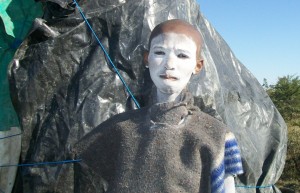
Xhosa initiation season: 30 dead, 293 hospitalised, ‘some losing genitals’

Xhosa initiates
Xhosa initiates

Five people have been arrested since the start of the initiation season in the Eastern Cape, police said on Tuesday.

The arrests were made in different parts of the province since May, Colonel Sibongile Soci said.

Thirty initiates had died in the province during the current initiation season, the provincial health department said on Sunday.

Department spokesman Sizwe Kupelo said in the most recent case of botched circumcisions during the initiation season, 10 initiates were rescued from a forest in Mbizana.

“The 10 initiates’ private parts are rotten. They are badly damaged. Their condition is scary,” he said.

They were recovering in hospital.

A total of 293 initiates were currently in hospitals in the province, and were recovering from dehydration, gangrene, and septic wounds. Some had lost their genitals.

African National Congress spokesman Jackson Mthembu said illegal initiation schools were criminal activities masquerading as respected customs.

“Activities that have led to the deaths of initiates, particularly in the Pondoland region of the Eastern Cape, must be harshly condemned,” he said in a statement.

In some illegal schools, young men had been taken by force and money had been demanded from their families.

“The justice, crime prevention and security cluster must consider… the establishment of a specialised unit to crack down on this growing problem and halt it decisively in its tracks,” he said.

He said those who were arrested had to be speedily prosecuted and the cases hastily concluded. – Sapa

Circumcision culture has become criminal: minister

Xhosa initiates
Xhosa initiates

Illegal initiation schools have turned the circumcision culture into “something criminal”, Health Minister Aaron Motsoaledi said in The Times newspaper on Monday.

“The mushrooming of initiation schools is seen every single day in Eastern Cape. Hooligans… tsotsis take advantage and prey on this custom.

“It has turned into something criminal and no longer has anything to do with culture. Young lives are being destroyed,” said the minister.

The Eastern Cape health department said at the weekend that 30 initiates had died from circumcision-related injuries and nearly 300 had been hospitalised.

“Some parents are blackmailed into paying for their children’s safety,” said Motsoaledi.

“Because of the belief that children must be left at these initiation schools, parents do not report them missing to the police in fear of going against tradition.” – Sapa

Mandela’s ‘last hill’

Artist's impression of the Nelson Mandela Centre of Memory

By Christopher Torchia, Associated Press

The desk is spotless and books neatly line the shelves in Nelson Mandela’s office at a Johannesburg-based foundation that carries his name, but the former South African president and anti-apartheid leader hasn’t worked there for years.

The meticulously preserved room is one of many tributes to the legacy of a former prisoner who became so revered for his efforts to reconcile a racially divided nation that many South Africans cannot bring themselves to speak openly about the possibility of his death. That reluctance is gradually eroding as the 94-year-old receives treatment for a recurring lung infection, spending a fourth day in a Pretoria hospital on Tuesday.

President Jacob Zuma called Mandela’s condition “very serious” but said he has stabilized, in an interview with state broadcaster SABC.

Prayers are pouring in for Mandela, adding to a mood of urgency about his deteriorating health that has been compounded by a series of hospital stays in recent months. The description of Mandela as “ravaged by time,” in a statement from a foundation led by retired archbishop Desmond Tutu and his wife, speaks to the fragile state of a man who is so mighty in stature.

Concerns about his health already had been heightened in recent weeks after a video broadcast on state television in April showed him silent and unresponsive, even when Zuma tried to hold his hand.

“He was a very fruitful fighter, but he’s only human,” said Thabiso Masemola, a 21-year-old student. “He’s reached a point in life where he needs to rest. Let him go, let him be. He’s finished his purpose in life.”

Such a view is gaining currency as South Africans become uneasy with the protracted decline of Mandela, who endured 27 years in prison during white minority rule and became the first black president in all-race elections in 1994. At the other end of the spectrum is a stubborn hope that this larger-than-life figure will somehow defy the inevitable.

The aversion to blunt talk of Mandela’s eventual demise stems partly from traditional respect for the living, but also from adulation in a country that put Mandela’s image on its banknotes and erected busts and statues in his likeness. The intensity of emotion among some South Africans is an indicator of the outpouring of feeling that will accompany Mandela’s passing, whenever it comes.

Mzinkosi Tantsi, a driver for a neighbor of Mandela in the Johannesburg neighborhood of Houghton, said it had been a “blessing” to shake the former president’s hand.

“I see him as my father,” said 12-year-old Kutlwano Hlabana, whose school group was visiting the Apartheid Museum, which documents the repressive system of racial segregation and the fight against it. The Johannesburg site invites visitors to experience a taste of apartheid’s arbitrariness by choosing between two entrances labeled “Whites” and “Non-Whites.”

For Johannesburg resident Mokgadi Mabuti, Mandela’s sacrifice and contribution to reconciliation amount to a psychological balm. She struggles with the idea of his departure even though South Africa, for all its inequality and other social problems, is relatively stable.

“I’m worried about what might happen when he’s dead. Most of the things that have happened in South Africa are because of him, so I’m not ready to let him go,” she said.

Mabuti would rather skirt the subject of Mandela’s eventual end, quoting a biblical passage about the impact of words.

“The tongue is very powerful. What you say with your tongue can speak into the future,” she said. “So it’s not good that they should speak of him as if he doesn’t exist anymore.”

Cashing in is on the minds of some in Qunu, the rural village in the Eastern Cape province where Mandela grew up. The Sowetan newspaper reported that a number of people were preparing to rent rooms in their homes on the assumption that there would be a big influx of visitors if he dies.

After his retirement from the presidency, Mandela regularly worked from an office in the recently refurbished building that houses the Nelson Mandela Centre of Memory, which promotes the former leader’s values.

The office, which is open by appointment, resembles the kind of hallowed memorial usually reserved for those no longer among the living.

There are framed photographs of Mandela in healthier times with his wife, Graca Machel, former U.N. chief Kofi Annan, fellow activist Walter Sisulu, who died a decade ago, and others. His volumes include the Quran, “A Briefer History of Time” by Stephen Hawking and a book about leadership. A boxing glove, cricket bat and a British police helmet are among the gifts on display.

Glass cases at the center show penned messages in books given to Mandela from people including Nadine Gordimer, a South African author and winner of the Nobel literature prize in 1991. She wrote that the anti-apartheid leader had read a smuggled copy of her then-banned novel, “Burger’s Daughter,” while held at the Robben Island prison.

“You most likely didn’t bring the book back with you when you returned to us, and lived magnificently, untiringly, leading the Struggle, so I thought I’d like to replace the ‘imprisoned’ copy,” Gordimer wrote.

Cornel West, an American civil rights activist, addressed his book, “Democracy Matters,” to: “Bro’ Nelson Mandela.”

In his autobiography, “Long Walk to Freedom,” Mandela summarized a life of struggle:

“I have walked that long road to freedom. I have tried not to falter; I have made missteps along the way. But I have discovered the secret that after climbing a great hill, one only finds that there are many more hills to climb.”

Now he is climbing the last hill.

—

Associated Press writer Wandoo Makurdi contributed to this report from Johannesburg.

Deadly initiation schools

The state has been unified in its calls for better monitoring and interventions to improve the outcomes of traditional circumcision. But how can the state intervene in a process on which it does not even have basic data? When the Mail & Guardian canvassed officials for information on the numbers of deaths and mutilations caused by botched circumcisions each year, reporters were sent from pillar to post in search of statistics.

There was national outrage in May when news emerged that 27 boys died during initiation in Mpumalanga province. President Jacob Zuma echoed the national outrage at the unnecessary loss of lives, saying: “It cannot be acceptable that every time young men reach this crucial time in their development, their lives are culled in the most painful of ways in the care of circumcision schools.”

By the time a snap debate on the issue was called in Parliament, the death toll approached 40. MPs defended cultural practices, called for the arrest of those responsible for the deaths, a clampdown on fly-by-night initiation schools and “culturepreneurs”, and demanded better monitoring of the initiation process to ensure safe health practices.

But with poor record keeping at the outset, it’s unclear whether the state has any sort of plan to prevent the death and mutilation of the boys who would be men.

Initiation may be a highly valued cultural practice but there are no indications that government tracks the issue of deaths and mutilations caused during it.

There do not appear to be any reliable national statistics on the number of boys who undergo initiation each year, nor the number who die or are mutilated as a result of traditional circumcision.

According to Health Minister Aaron Motsoaledi, the main medical issues that can cause death in initiates are massive bleeding leading to hypovolemic shock, infection, septicaemic shock, dehydration from being denied drinking water, hypothermia from exposure to extreme weather, and low blood sugar from extreme food restriction. Poor circumcision technique can lead to genital amputation. In some cases, the cause of death is assault.

Of the three provinces in which initiation is most commonly practiced, the M&G was only able to get statistics from one, the Eastern Cape.

In that province, the death toll for the five years from 2008 to 2012 was 323. During that time, a further 126 boys suffered genital amputations.

An effective intervention strategy cannot be put into place unless government has an indication of the state of play in each province where initiation is practiced.
Initiation is most commonly practiced in the Eastern Cape, Limpopo and Mpumalanga.

The Limpopo and Mpumalanga health departments could not provide numbers and referred further questions to traditional leaders and the department of traditional affairs.

Sizwe Kupelo, a spokesperson for the Eastern Cape health department, said that keeping these statistics was possible because the department works together with Eastern Cape House of Traditional leaders, local government and various community structures.

The Eastern Cape has a head start on other provinces – in 2001 it became the first province to introduce legislation regulating traditional circumcision in an attempt to curb deaths and genital mutilation taking place in the bush.

In contrast, Mpumalanga has yet to finalise its initiation Bill.

Ten things about initiation:

1. Last month, 28 youths died of wounds sustained at initiation schools in Mpumalanga. The ritual period can be as long as three months, isolated in a remote area, usually in winter.

2. The origins of circumcision are obscure. The earliest record is from ancient Egypt, 25 centuries ago: a bas-relief in the sixth-dynasty tomb of Ank-Mahor at Saqqara shows what seems to be an adult or adolescent circumcision. About a century later, a written record tells of a mass circumcision (120 men) and the writer’s pride that none showed pain.

3. The ritual still takes this form in East Africa, where boys making the transition to men are circumcised in a public ceremony. They are expected not to flinch or cry out.

4. Jewish people circumcise male children soon after birth, for religious reasons: the founding covenant with Abraham involves circumcision (Genesis 17: 9-14; the same text is treated by Muslims as an injunction to circumcise).

5. Moses also made a covenant with God, but God tried to kill Moses “as they camped overnight” (Common English Bible) and he was rescued by his wife Zipporah, who seized a flint and chopped off her son’s foreskin, throwing it at Moses’s feet (Exodus 4:24-26).

6. There are three forms of Jewish circumcision: milah, periah and metsitzah, in order of increasing amounts of prepuce and surrounding tissue of the penis to be removed in the operation. Milah is the oldest form, with periah introduced in the second century AD. Metsitzah was ordered by the rabbis in the Talmudic period of the sixth century AD, the earlier forms being deemed insufficient.

7. The Catholic Church declared circumcision a mortal sin in 1442.

8. Infant circumcision increased in the Anglophone world in the late 19th and early 20th centuries. It is not clear why. Rationales, later debunked, include the idea that it reduced masturbation (thought to lead to insanity) or risk of disease. As late as the 1890s, it was believed retention of the foreskin could lead to “hernia, bladder infections, kidney stones, insomnia, chronic indigestion, rheumatism, epilepsy, asthma, bed-wetting, Bright’s disease, erectile dysfunction, syphilis, insanity and skin cancer” (Maurice Clifford, Circumcision: Its Advantages and How to Perform It).

9. Today, some studies suggest circumcision may reduce the risk of HIV and other sexually transmitted diseases, but the evidence is uncertain.

10. Circumcision was stopped as a cultural practice by the Zulu king Shaka. He replaced it as a rite of passage with the youths’ graduation through age-grouped regiments (amabutho) of his army. The present Zulu king, Goodwill Zwelithini, recently recommended circumcision for lowering the Aids risk. – M&G


‘Dog eating newborn’s head’

A dog seen eating a newborn baby’s head led to the arrest of a woman on a charge of concealing a birth, Eastern Cape police said on Monday.

Residents of Ngcingwana village, near Dutywa, saw the dog eating the decomposing head on Sunday evening, Captain Jackson Manatha said.

They called the police, who found a 21-year-old black woman in the area who had recently given birth. Her baby died and was buried in a shallow grave in the garden of her home. It could not be established if the baby was born alive.

The woman would appear before the Dutywa Magistrate’s Court on Tuesday on a charge of concealment of birth.- SAPA

92-year old woman raped, killed in South African province

A 92-year-old woman has been raped and killed in her home at Zingonyameni, Mount Fletcher, Eastern Cape police said on Tuesday.

Lieutenant Raphael Motloung said the woman’s body was found on Friday night by a neighbour who went to visit her, as she lived by herself.

She had been stabbed several times in the head and legs.

Motloung said the motive for the killing was not known.

A man who lived in the area had been taken in for questioning, said Motloung.

Mount Fletcher is above Mthatha, near Lesotho. – Sapa

Did South African police kill at Marikana to help black billionaire Ramaphosa’s finances?

The scene at Marikana, north west of Johannesburg, last week

Over the past few days PRAAG obtained new information about the Marikana massacre that is currently still making frontpage news in South Africa. It appears as if the miners of the Association of Mineworkers and Construction Union (AMCU) were deliberately murdered by the police as part of a campaign to get rid of the bothersome union.

AMCU was busy replacing the NUM (National Union of Mineworkers) as the majority union at the mine. The NUM is affiliated with COSATU, which is a member of the ANC regime’s so-called “tripartite alliance”. Before the shooting started, police ordered the media to leave the area.

Lauren Clifford-Holmes, the multimedia editor for the Johannesburg Mail & Guardian, was prevented last Thursday night from speaking to injured mineworkers. However, she stumbled upon two workers at Lonmin who confirmed that strife between the two trade unions was responsible for the problems, as NUM representatives were not re-elected by dissatisfied miners.
Cyril Ramaphosa

Black businessman and high-ranking ANC politician, Cyril Ramaphosa, apparently owns a contract to supply labour to the Lonmin mine at Marikana via his company Shanduka. “Ramaphosa and the NUM is practising a form of slave labour at the mine,” a source said at Marikana. “He is supplying labour at about R12 000 ($1500) per worker per month, but only pay his workers R4000 ($500) per month, thereby pocketing the difference. As a former NUM chief, he is able to control the union leaders and sees to it that he maintains this grotesque form of exploitation.”

However, NUM’s rival, AMCU, demands that the R12 000 received by Shanduka as labour broker in terms of the contract, should be paid directly to workers. Particularly the rock drillers, who perform the most difficult and dangerous work, felt that they were entitled to this wage, given that this was the tariff already received by Cyril Ramaphosa’s company for work at the mine.

An ex-policeman that PRAAG spoke to, but who prefers to remain anonymous, said that judging from the photographs he had seen, the workers were not attacking the police, but were fleeing from an area where a second police contingent was throwing tear gas at them. “One could see how some of them were trying to protect their eyes and faces. They thought they were fleeing to a safe place, where the heavily armed policemen mowed them down with automatic weapons, however,” said the ex-policeman.

The motive for the mass murder at the Lonmin mine at Marikana was apparently the protection of Shanduka’s lucrative service contract for supplying labour to the mine. Shanduka has already annouced that it will donate R2 million for the funeral of the 34 workers.

The workers are mostly from Lesotho, an independent country, and areas in the Eastern Cape. It would therefore be difficult for them to defend their rights and lives against the ANC-controlled state, cooperating closely with the British-controlled mining company. Until now, the only questions abut the massacre have come from black politicians and activists from outside governing ANC circles.

A group known as the September National Imbizi did a local investitagion and talked to an eyewitness alleging that the mineworkers were “drawn into an ambush” and that they were first bombarded with a “blue substance”, after which they were shot dead during the confusion. Many were executed while trying to hide among rocks and under bushes. On the websit of September National Imbizo, the eyewitness is referred to as “our friend”:

“…our friend shows us how several people were shot while they were hiding between the rocks and under bushes. We see for ourselves splatters of blood that indicate the determination to dig workers out of their hiding holes and shoot them dead. All sorts of items of clothing and shoes, soiled with blood lie all around the scene.”

The website also claims:

“What is clear from what we are told is that this was an ambush. The video material in mainstream media showing workers charging at the police was in fact workers running away from bullets being hurled from behind. Why would workers, armed with knobkierries [African-style clubs – ed.] charge at armed police? The workers were completely surrounded and what we’ve been seeing in the media is only half the story. There was clearly a mission: shoot to kill, thus the deployment of the army.”

Other strange incidents took place.

The media were kept away from the scene for hours so that it would be difficult to reconstruct the exact events. A contact of The Star newspaper was shot dead during the massacre. The police also forced a photographer from the Johannesburg Mail & Guardian to delete his photographs. Why were the police so scared that particular evidence regarding the shooting would leak out?

A video shown in the Netherlands, contained a Vodafone ambulance on the scene. The same vido was later shown in South Africa on News24.com, but without the ambulance, indicating that the video must have been edited.
Beforehand SAPA reported the following statement by the leader of the AMCU:
“We are not safe. Our phones have been tapped,” the Association of Mineworkers and Construction Union president Joseph Mathenjwa told a crowd in the Wonderkop informal settlement at Lonmin.
“We have been democratically colonised – workers work under very harsh conditions.”
After the massacre Mathenjwa demanded a really independent investigation, but the ANC simply appointed one of its own ministers, Collins Chabane, to lead the commission of enquiry. Under the previous, so-called “apartheid government” judges were always appointed to commissions of enquiry.
What Mathenjwa is probably referring to when he talks of “democratic colonisation”, is that workers are paid R4000 per month while Cyril Ramphosa is receiving three times as much per worker.

A Johannesburg businessman PRAAG spoke to and who is also in the services sector, confirmed that the ANC’s cadres have virtually instituted a system of “slave labour” in the country. The former officers of their militia, Umkhonto we Sizwe, is currently providing labour to the mines by recruting foreigners. Few, if any, mines still employ workers directly.

“Everything which the ANC described as apartheid, including the system of migrant labour, now applies, except in a far worse degree,” said the businessman. “The ANC’s cadres control everything. They have dug themselves into all sectors of the economy. They do not rule, they are in business. The state is for them just another business, with resources that they may use to enrich themselves. That is what BEE stands for, Black Elite Enrichment.”

Among those state resources controlled by the ANC, is the police force. Was it used to punish the AMCU and “make an example” of the rival union? In the run-up to the 1994 elections the ANC committed necklace murders against so-called “sell-outs”. Where tens of millions of rand are at issue in the provision of labour to a mine, one may therefore expect that an organisation as ruthless as the ANC will use all means at its disposal to eliminate a rival.

During the shooting a journalist from The Star, Poloko Tau, tweeted from the scene:  “Auto guns creacking [sic] and cocked like 100 at a time, scary … warzone down here, 1st shot fired … journalist running, diving and hiding amid shots, water canon spewing water at the strikers … my contact has just been shot dead …”

After the Marikana massacre, some people simply “disappeared”. SAPA reported the following:

“Around 100 women arrived at the Ga-Rankuwa Magistrate’s Court outside Pretoria today where more than 250 protesters were expected to appear for public violence.

One woman, Nombulelo Jali, 37, wept hysterically. She said police did not know what happened to her husband Themba Khalo Jali, 40, who she says was arrested on Thursday.

‘I have come all the way from Harding in KwaZulu-Natal but we can’t find him. We have frantically searched everywhere and we can’t locate him. Police took him,’ said Jali.”

Julius Malema alleges that many of the striking workers are currently detained “irregularly in a private prison”. His friend and ex-colleague from the ANC Youth League, Floyd Shivambu, also said that many of the workers were shot in the back, which would indicate that they were running away from the police when they were shot.

This could not be verified, as a security blanket has been pulled over the area and journalists are not allowed at the mine hospital.

The narrow links between the British-controlled mining houses and the ANC may be traced back many decades. The first contact between the Afrikaner establishment and the exiled ANC was arranged by the mining company Consolidated Goldfields in England during the eighties. On that occasion Thabo Mbeki and Willie Esterhuyse met each other. Their relationship later played a crucial role in the capitulation of the Afrikaner government as Esterhuyse had persuaded several cabinet ministers that the ANC could be “trusted”.

The mining houses also played a leading role in portraying the ANC as the new government for South Africa and probably entered into private agreements with the so-called “liberation movement”.

Yesterday the chairman of Lonmin, Roger Phillimore, blamed “apartheid” for the poor conditions in which his mineworkers have to live, knowing that Shanduka and Lonmin are pocketing the greater share of the mine’s income for themselves.

Riah Phiyega

Julius Malema held Jacob Zuma and Cyril Ramaphosa responsible for the mass murder: “They presided over the massacre of our people… Not even the apartheid government killed as many.”

It is unclear whether the police’s actions will be investigated internally, as the executive director of South Africa’s Independent Police Investigative Directorate, Mr. Francois Beukman, has recently resigned “to pursue other interests”. He is leaving the service at the end of the month. His contract would only have expired in August 2014. At any rate, the new national police commissioner, Riah Phiyega, does not consider the shooting of 34 people “to be a massacre”.

South African Education Department ‘burns textbooks’

Burnt textbooks found in the Eastern Cape, a formerly independent black homeland

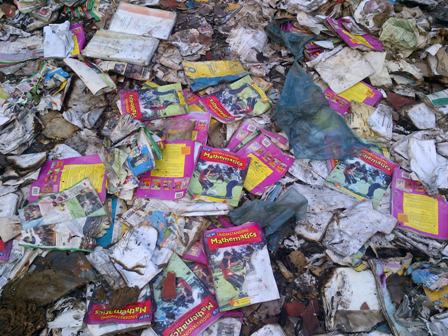
Thousands of burnt textbooks have been found in a warehouse in Fort Beaufort in the Eastern Cape, the DA said on Monday.

“We have written to MEC Mandla Makupula demanding an explanation as to how valuable public resources for Eastern Cape children were allowed to be destroyed in this irresponsible way,” Democratic Alliance provincial education spokesperson Edmund van Vuuren said in a statement.

However, provincial education department spokesperson Loyiso Pulumani said the books found in Fort Beaufort were destroyed during an arson attack.

The books were from the old Cape College of Education, which was closed in 1996, and had no relevance to current textbooks, Pulumani said.

“The old store-room was burnt down on 16 June. It is a suspected arson case. The books are more than 10-years-old.”

Van Vuuren said the books, most of them mathematics textbooks, were found by a DA inspection team.

“Given the massive shortages of both textbooks and workbooks in schools, every single book that does not reach a school will have an impact on a child’s ability to learn,” he said.

Boxes of books still wrapped in packaging were found in other parts of the district warehouse.

“The department needs to account for how many boxes of books remain inside the warehouse, and when these will be delivered to schools,” Van Vuuren said.

“The destruction of these books raises serious questions about why proper care was not taken to ensure that they were delivered to schools on time at the beginning of the year.”

Like Limpopo, the Eastern Cape has also been plagued by textbook problems.

Earlier this month, several thousand school workbooks were returned to the Eastern Cape education department because they were in the wrong language.

When approached for comment, provincial officials referred all questions to the national department.

National spokesperson Panyaza Lesufi said the department ordered books based on numbers given to it by the province.

“The other provinces all seem to be correct, so why is it only in the Eastern Cape? It must tell you something about that province,” he said.

At the time, Van Vuuren said the department’s database for Port Elizabeth showed 25 370 literacy workbooks and 15 500 numeracy workbooks were still outstanding.

“Claims… that chronic book delivery problems are limited only to the Port Elizabeth district, are false,” he said.

Burnt textbooks found in the Eastern Cape, a formerly independent black homeland