Japan’s stock market is imploding

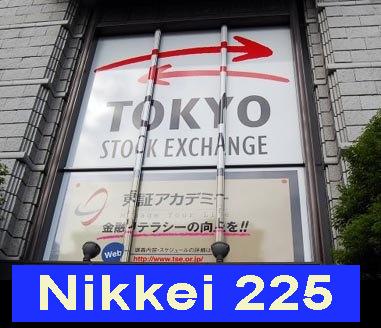
nikkeiDid you see what just happened in Japan? The stock market of the 3rd largest economy on the planet is imploding. On Tuesday, the Nikkei fell by more than 610 points.

If that sounds like a lot, that is because it is. The largest one day stock market decline in U.S. history is only 777 points. So far, the Dow is only down about 1000 points during this “correction”, but the Nikkei is down more than 2,300 points.

The Nikkei has dropped more than 14 percent since the peak of the market, and many analysts believe that this is only just the beginning. Those that have been waiting for a full-blown stock market collapse may be about to get their wish.

Japan is absolutely drowning in debt, their central bank is printing money like crazy and the Japanese population is aging rapidly. As far as economic fundamentals go, there is very little good news as far as Japan is concerned.

So will an Asian financial collapse precede the next great financial crisis in the United States? That is what some have been predicting, and it starting to look increasingly likely.

What happened to the Nikkei early on Tuesday was absolutely breathtaking. The following is how Bloomberg described the carnage…

At the end of January 2013, Japanese stocks trailed only Portugal for the biggest rally among developed markets. Now the Nikkei 225 Stock Average is leading declines, slumping 8.5 percent last month and today capping a 14 percent drop from its Dec. 30 peak.

Losses snowballed in Tokyo during a global retreat that has erased $2.9 trillion from equity values worldwide this year amid signs of slower growth in China and stimulus cuts by the U.S. Federal Reserve.

As Bloomberg noted, much of the blame for the financial problems that we are seeing all over the planet right now is being placed on the Federal Reserve.

Source: theeconomiccollapseblog.com

Japan’s Nikkei closes at highest in 6 years due to yen weakness

nikkei225Tokyo’s benchmark Nikkei 225 index jumped 1.80 percent to its highest close in almost six years Thursday as a weak yen and record finishes on Wall Street helped propel the market.

The headline Nikkei finished up 277.49 points to 15,727.12, its best close since mid-December 2007, while the broader Topix index of all first-section shares added 1.12 percent, or 13.96 points, to 1,261.04. – AFP

Australia spied on Japanese companies for BHP Billiton

bhpkloppersAs more information comes to light about the global snooping being conducted by the NSA and GCHQ, it is becoming clearer that much of it had little to do with combating terrorism, as a recent EFF article makes plain. But most damaging to the idea that massive surveillance was justified, because it was to protect people from extreme threats, is the revelation that commercial espionage was also being conducted. So far, the chief example of that is in Brazil, but The Sydney Morning Herald (SMH) now has information about large-scale industrial spying on Japanese companies carried out by Australian secret services:

BHP [BHP Billiton — the world’s largest mining company] was among the companies helped by Australian spy agencies as they negotiated trade deals with Japan, a former Australian Secret Intelligence Service officer says.

A former diplomat has also confirmed Australian intelligence agencies have long targeted Japanese companies. Writing in The Japan Times, Professor Gregory Clark said Australian companies were beneficiaries of intelligence operations.

“In Australia, favoured firms getting spy material on Japanese contract policies and other business negotiations used to joke how [it had] ‘fallen off the back of a truck’,” Professor Clark wrote.

The article has more details, but doesn’t reveal how the materials were obtained. However, since Australia is part of the “Five Eyes” inner circle of snooping countries that also includes the US, UK, Canada and New Zealand, it seems likely that information of interest from those partners also found its way to Australian companies. SMH quotes Clark as saying:

Business information is a main target for [intelligence] agencies

It will be interesting to see if later releases from Snowden’s hoard of documents show any evidence of this Australian use of NSA materials for industrial espionage. – techdirt.com

The warmongers: not looking out for us

mercer_ilanaby Ilana Mercer

[followbutton username=’IlanaMercer’ count=’true’ lang=’en’ theme=’light’]

Like Ilana Mercer’s Facebook page

To listen to U.S. government officials there is only an upside to the punitive sanctions imposed on Iran by the United States and a reluctant European Union. Consequently, the emphasis is forever on how to toughen the punishment; never on whether to lift economic sanctions on the long-suffering people of Iran.

But what about the effects of trade boycotts on American businesses?

Chris Harmer of The Institute for the Study of War estimates that the Boeing Company alone forfeits a minimum of $25 billion in business every year because of U.S.-imposed sanctions on Iran, a niche market that is filled by the Russians. Overall, Harmer puts the value to U.S. business of trade lost due to the economic embargo on Iran at approximately $50 billion per annum.

For example, Iran imports $1.5 billion worth of cars a year, the beneficiaries of which are companies like Nissan, Toyota and Peugeot (when they might have been General Motors and Chrysler). Peugeot does an added half a billion dollars’ worth of commerce with Iran just in car parts.

The Iranian economy, moreover, has diversified and is adapting to life without the U.S. The rest of the world—pockets in Europe and most of Asia—has not isolated Iran, with the result that the country has many trading partners other than the U.S. And while Iran has lost petroleum revenue due to sanctions, the trend will not endure. China, Japan and South Korea are hungry for the country’s crude.

Not to be overlooked are the costs to Americans of sanction enforcement, avers Harmer. In addition to the opportunity costs—the missed business aforementioned—there are “direct costs.” The Office of Foreign Asset Control in the U.S. Treasury Department squanders around $1 billion a year in developing lists of “financial institutions that are subject to sanctions,” and then infringing on the rights of individuals and companies to freely exchange privately owned property.

“Indirect costs” are incurred in the course of cultivating a massive U.S. intelligent infrastructure—a veritable alphabet soup of agencies—upon which the Treasury draws in enforcing a regimen of sanctions.

Into the Cannibal's Pot

So, too, are the “deterrent costs” borne by the American taxpayer who pays for patrolling the Persian Gulf, the Northern Arabian Sea and the Strait of Hormuz.

Ultimately, trade, not democracy, is the best antidote to war with Iran. The more economically intertwined countries become, the less likely they are to go to war. More than boycotts, barter with Iran is bound to promote goodwill and reduce belligerence on both sides.

As a general rule, state-enforced boycotts harm honest, hard-working Americans who use the economic means to earn their keep. They benefit servants of Uncle Sam—the political class and its media and think-tank hangers-on. For they deploy the political means to advance their ends and grow their sphere of influence. As libertarian economist Murray Rothbard once observed, these “are two mutually exclusive ways of acquiring wealth”—the economic means is honest and productive, the political means is dishonest and predatory.

As always, it’s us against them: the state versus the people who labor outside it and in spite of it.

For now, Obama’s eager response to Iranian overtures has sidelined Syria. Before Syria recedes in memory—to be replaced by demands for action against Iran—it’s worth considering one constant quantity: the media guttersnipes and their motivation.

The bobbingheads of TV have been complaining in the most unctuous terms that Russia and Syria have pulled one over us. The U.S., they lament, has been weakened, evidently, because someone halted the momentum of war.

You see, the chattering and political classes cannot conceive of greatness outside the state because they are part of the state apparatus and depend on it for status and income.

Conversely, individual Americans—who have nothing to gain and only losses to sustain from war—should never conflate their interests with those of the government and its emissaries, who have everything to gain from the great theatre that is war.

More than anyone, who benefits when America goes to war? Those who “function within the nimbus of great power” in D.C. and around it—the media-military-congressional-industrial complex.

Thus did Charles Krauthammer ridiculously equate the failure to go to war against Syria with “Russia supplanting America as regional hegemon.”

Krauthammer was joined by others, not least of them Bill O’Reilly and his sidekick Dennis the Menace. How diminished will the bluster of both media mouths be if the U.S. is no longer dictating the terms of war (lots of it) and peace (too little of it) in the world? Their immense egos will suffer. Maybe even their incomes, eventually.

But not you, the everyday American.

Putin stopped a war in Syria. This is not the same as “supplanting” American power. Rather, the Russians replaced bully power with a balance of power, and this is good for ordinary Americans.

He who saves you from war is better than he who sends you to war. The proof is in the Putin.

[followbutton username=’IlanaMercer’ count=’true’ lang=’en’ theme=’light’]

Like Ilana Mercer’s Facebook page

©2013 By ILANA MERCER

For syndication rights to http://BarelyABlog.com or http://IlanaMercer.com, contact ilana@ilanamercer.com. Read more.

SA destined to go nuclear

electricitySouth Africa is destined to get more nuclear power stations as means of electricity generation as part of the Integrated Resources Plan.

It is envisaged that 9 600 megawatt of electricity will be generated in this manner by 2030 but nuclear power stations are not universally welcomed, especially after the Fukushima disaster in Japan.

These issues will be on the agenda of the Nuclear Industry Association’s (Niasa) annual convention starting in Port Elizabeth on Wednesday but even more significant is that Thyspunt, a 90-minute drive from Port Elizabeth is the preferred site for South Africa’s second nuclear-fuelled electricity plant.

Over the past six years, the proposed nuclear power station for Thyspunt has been opposed on several grounds. These include environmental, cultural and agricultural.

A third draft Environmental Impact Assessment is due to be released by Eskom in October which will then re-ignite the public participation progress.

Those opposing the building of a nuclear power station at Thyspunt are very concerned about the lack of transparency in the process.

“This site was selected by the previous regime by the apartheid Government. It would have been really great if we could start the selection process again in the new South Africa which would have been more inclusive and would look more at the situation that it is at the moment,” says the Thyspunt Alliance’s Trudi Malan.

She says that they are greatly concerned by the fact that it seems that Eskom is not really paying attention to what they are being told about this specific site at Thyspunt.

The Niasa convention will also be looking at the potential economic developments surrounding the implementation of the nuclear programme in South Africa.

The technologies used are foreign based but the potential for job creation is based in the construction phase creating cautious optimism for organised business.

“We have companies that are in the energy space and in the engineering and manufacturing space. We advocate for them to get an opportunity on such a big plant. It is complicated in one sense but it still works with bolts and nuts and pipes and valves. The point is also to demystify such a plant that it is not as complicated sometimes as it gets presented,” says Nelson Mandela Bay business Chamber’s Mandla Madwara.

A second nuclear power station for South Africa is not a done deal yet and indications are that the court will probably have the last say as those opposing nuclear power say they will take it all the way. – SABC

Japan’s Aso won’t quit over Nazi comment

Taro Aso
Taro Aso

Japan’s Finance Minister Taro Aso refused on Friday to resign or apologise over remarks suggesting Japan should follow the Nazi example of how to change the country’s constitution stealthily and without public debate.

The ruling Liberal Democrats want to revise the US-inspired postwar constitution, in part to allow a higher profile for Japan’s military.

Following protests by neighbouring countries and human rights activists, he “retracted” the comments on Thursday but refused to go further.

“I have no intention to step down” as Cabinet minister of lawmaker, Aso, who is also the deputy prime minister, told reporters. The government also said it is not seeking Aso’s resignation, which some opposition members have demanded.

Aso, who is known for intemperate remarks, drew outrage for saying Japan should learn from how the Nazi party stealthily changed Germany’s pre-World War II constitution before anyone realised it. He also suggested that Japanese politicians should make visit Tokyo’s Yasukuni war shrine quietly to avoid controversy. Such visits currently take place amid wide publicity and are a sore point for Southeast Asian nations, who suffered under Japanese occupation during World War II.

Aso said on Thursday he was misunderstood and only meant to say that loud debate over whether Japan should change its postwar constitution, and other issues is not helpful.

In retracting his comments, he said it was “very unfortunate and regrettable” that his comments were misinterpreted.

On Friday, Aso said he stands by all his other remarks in the speech made earlier this week in Tokyo to an ultra-conservative audience.

Japan and Nazi Germany were allies in World War II, when Japan occupied much of Asia and Germany much of Europe, where the racial supremacist Nazis oversaw the killings of an estimated 6 million Jews before the war ended in 1945 with their defeat. Japan’s history of military aggression, which included colonising the Korean Peninsula before the war, is the reason its current constitution limits the role of the military.

According to a transcript of the speech published by the newspaper Asahi Shimbun, Aso decried the lack of support for revising Japan’s pacifist constitution among older Japanese, saying the Liberal Democrats had held quiet, extensive discussions about its proposals.

“I don’t want to see this done in the midst of an uproar,” Aso said, according to the transcript. Since revisions of the constitution may raise protests, “doing it quietly, just as in one day the Weimar constitution changed to the Nazi constitution, without anyone realising it, why don’t we learn from that sort of tactic?”

He has apologised previously for accusing the elderly of being a burden on society, joking about people with Alzheimer’s disease, saying the ideal country would be one that attracts “the richest Jewish people”, and comparing the opposition Democratic Party of Japan to the Nazis.

On Thursday, Aso insisted that he was referring to the Nazis “as a bad example of a constitutional revision that was made without national understanding or discussion …I just don’t want [the revision] to be decided amid a ruckus”. – AP

Japan’s shoplifting grannies

elderly_japanese_womanThe number of elderly people caught shoplifting in Japan’s capital city has outstripped that of teenagers for the first time since records began, a report said Monday.

A quarter of the people arrested on suspicion of the crime in Tokyo last year were at least 65 years old, figures showed, amid warnings of increasing isolation in the age group.

“Even though the total number of arrests for shoplifting has been declining, the ratio of elderly people are on the rise,” a Tokyo Metropolitan Police spokesman said.

“Our survey shows that elderly shoplifters tend to be lonely, having no one to talk to, and having no hobby to enjoy,” he said.

Statistics showed 3,321 people aged 65 or older were arrested for shoplifting, accounting for 24.5 percent of the total, while those aged 19 or younger made up 23.6 percent, with 3,195 individual arrests. Both figures are slightly down in absolute terms from 2011, the spokesman said.

It was the first time since comparable data had been collected that the elderly made up a higher proportion of suspected thieves, the Mainichi Shimbun newspaper reported.

Around a quarter of Japan’s 128 million population is aged 65 or older, and the country has a far-below replacement birthrate of an average 1.39 children for every woman.

There are regular reports of bodies lying unfound for weeks or even months after a single, elderly person has died alone. Commentators say the phenomenon is a result of the fraying of familial ties as Japan has modernised.

A government survey last week found 3.5 million elderly women and 1.4 million elderly men live alone. – AFP

Japan scrambles fighters as Chinese plane flies over disputed islands

Japan Air Self-Defense Force F-15

Tokyo scrambled F-15 fighter jets on Thursday after a Chinese state-owned plane entered airspace over islands disputed by the two countries. A Chinese maritime aircraft ventured over the Senkaku islands, called the Diaoyu Islands in China, just after 0200 GMT, Chief Cabinet Secretary Osamu Fujimura said, as cited by AFP. Confrontations have become commonplace since Japan nationalized the East China Sea islands in September. Thursday marks the 75th anniversary of the beginning of the Nanjing Massacre, when Japanese Imperial Army troops entered the then-capital of China.

This is the first time the dispute over the islands, which Japan calls Senkaku and China refers to as Diaoyu, has involved aircraft.

Chinese government ships have repeatedly entered the waters around the remote, rocky islands since the Japanese government announced in September it was buying several of the islands from private owners.

Japanese Coast Guard vessels have engaged in games of cat and mouse with the Chinese ships, with both sides broadcasting messages to one another insisting they have territorial sovereignty over the area.

On Thursday morning, a Japanese Coast Guard patrol vessel spotted the Chinese government plane in airspace around the islands, Chief Cabinet Secretary Osamu Fujimura said.

Japanese Self Defense Force sent four F-15 jets and another aircraft to the area, Fujimura said, describing the Chinese plane’s entry into the area as “extremely regrettable.” Japan has lodged a protest with the Chinese government through diplomatic channels, he said.

The Japanese government’s acquisition of the islands in September also set off several days of violent anti-Japanese protests across China and soured economic ties between the two Asian nations.

There was no immediate reaction from China about the incident.