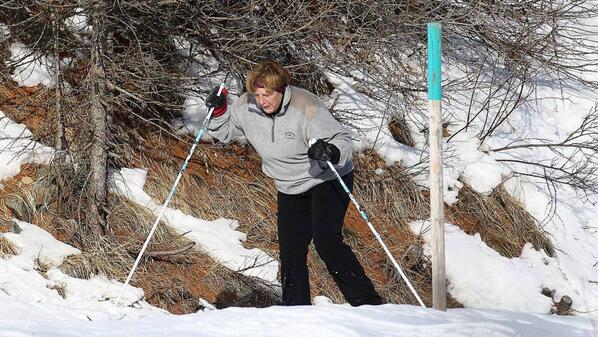
German Chancellor Angela Merkel has injured her pelvis on a cross-country skiing trip during her Christmas vacation, her spokesman Steffen Seibert said. She will be mostly bedbound for three weeks and will not visit Warsaw on Wednesday as planned.
The injury will also prevent Merkel from receiving Luxembourg’s new prime minister, Xavier Bettel, on Thursday.
Merkel fell and now has a crack in her pelvis, Seibert said. She has also suffered a serious contusion.
“The chancellor is of course able to work and is in full communication,” said Seibert. He added that Merkel’s accident occurred “at low speed” but he declined to give further details.
The chancellor was staying at the skiing resort of St. Moritz in Switzerland with her husband, Joachim Sauer. The resort is a traditional Christmas vacationing spot for their family.
Merkel is the second prominent public figure to suffer a serious skiing injury these Christmas holidays. Last week former Formula 1 world champion Michael Schumacher had an accident in the French Alps, and remains in a coma due to a head trauma. – RT
Whistleblower Edward Snowden has met with a German MP in Moscow. He passed a letter addressed to the German government and federal public prosecutor where he allegedly said he is ready to testify over Washington’s probable wiretapping of Merkel’s phone.
During the meeting, Snowden made it “clear that he knows a lot,” Greens lawmaker Hans-Christian Stroebele told ARD channel.
“He expressed his principle readiness to help clarify the situation. Basis for this is what we must create. That’s what we discussed for a long time and from all angles,” the MP said. “He is essentially prepared to come to Germany and give testimony, but the conditions must be discussed.”
Stroebele, 74, is a member of the German parliament’s control committee which is responsible for monitoring the work of intelligence agencies.
Snowden wouldn’t be able to travel to Germany to give evidence, as that would effectively see his refugee status lifted. If that were to happen, it would be possible for him to be extradited to the US, Interfax news agency quoted an unknown source as saying.
“At the same time, the German General Prosecutor’s Office could in principle send its representatives to Russia or pass its written questions on to Edward Snowden,” the same source said.
German Chancellor Angela Merkel has dispatched the country’s top foreign affairs and intelligence advisers to Washington this week to further investigate the allegations that her cell phone was tapped by the NSA, the report which caused fierce outrage in Germany.
The scandal initially broke when journalists working with Snowden’s leaked documents contacted the German government for clarification. German politicians subsequently suggested involving Snowden as a witness in the wiretapping case.
The German Federal Prosecutor’s Office may summon Snowden to be a witness in the case, German justice minister Sabine Leutheusser-Schnarrenberger told Deutschlandfunk radio on Sunday.
“If our suspicions prove correct and a case is opened, the German Federal Prosecutor’s Office will have to consider the possibility of interrogating Snowden as a witness,” she said.
If Snowden were to come to Germany for the case, the EU country could breach US’ requests for extradition, the minister added.
Leutheusser-Schnarrenberger also said that the phone tapping is illegal and constitutes a crime, therefore those responsible should be held accountable.
A parliamentary session will be held on November 18 to discuss the phone tapping. The Greens, along with the far-left Die Linke party, previously asked for a public inquiry into the matter. They were the ones to call on witnesses, including Snowden.
In June, Edward Snowden, a former NSA contractor who disclosed secret US surveillance programs, fled to Hong Kong and then to Russia.
President Vladimir Putin rejected US demands to extradite Snowden to face charges including espionage.
In early August, Snowden was granted temporary asylum, which can be extended annually.
German Chancellor Angela Merkel, an unflappable pastor’s daughter, is closing in on a third term in Sunday’s general election, cementing her title as the world’s most powerful woman.
So strong is Merkel’s position that she has often seemed to transcend politics during what may be the last of her juggernaut campaigns, simply ignoring her opponent along the way.
This month a giant billboard went up at Berlin’s main train station featuring only a picture of the chancellor’s hands folded in her trademark diamond-shape gesture.
Quite simply, the mighty Merkel is the message.
After eight years at the helm of the top European economy, and three as the go-to leader in the eurozone crisis, Merkel looks set to sail to another term at the helm for steering the country unscathed through the turmoil.
But abroad, angry protesters have marched through the streets of Athens, Lisbon and Madrid blaming her for national budget cuts they say are choking off desperately needed economic growth, some even brandishing caricatures of Merkel in Nazi garb.
“I am determined to see Europe emerge stronger from the crisis,” she intones regularly. “Germany can only be strong with a strong Europe.”
During a widely criticised campaign virtually devoid of real substance, observers complain that Merkel has lulled the prosperous country into a false sense of security 23 years after its joyful reunification.
“Merkel perfectly embodies the sensibilities of the Germans in the early 21st century,” the publisher of the influential weekly Die Zeit, Josef Joffe, wrote last month.
“You don’t have to expect any threatening new tacks from her, no tough decisions for or against. She is perfectly predictable in her flexibility and the risk-averse electorate loves it. Merkel is us, and we are Merkel.”
Her late biographer Gerd Langguth found a “sphinx-like quality” in her, allowing Merkel to quietly triumph in the most unlikely circumstances.
Merkel dispensed with rivals in her conservative Christian Democratic Union (CDU) despite being a misfit in a party of mainly Roman Catholic family men from the wealthy southwest.
A twice-married childless Protestant raised in communist East Germany, she has become the unchallenged conservative leader of her generation.
The girl born Angela Kasner in 1954 left Hamburg in then West Germany a few weeks after her birth when her Protestant preacher father decided to tend to the flock in the East.
Locals remember her fierce intellect and discretion as a Christian in a totalitarian state.
She earned a physics doctorate, married and divorced fellow student Ulrich Merkel, and stayed out of politics until the Berlin Wall fell in 1989.
In 1990 she joined the CDU and won her first parliamentary seat.
Then chancellor Helmut Kohl made her minister for women’s issues and later environmental affairs, and bestowed on her the fond but patronising nickname “the girl”.
But in 2000, the frumpy newcomer rose to the head of the CDU when she alone had the courage to tell Kohl to quit as party chairman over a slush fund scandal.
In 2005 she unseated Social Democratic (SPD) chancellor Gerhard Schroeder after seven years in power, becoming Germany’s first female chancellor as well as its youngest.
She is also the only woman to lead a major European power since Margaret Thatcher of Britain.
During her first term, Merkel presided over a loveless “grand coalition” between the conservatives and their traditional rivals, the SPD.
Her decisive victory in the 2009 vote allowed her to drop the SPD in favour of the smaller, pro-business Free Democrats, in theory giving her more scope to set her own course.
But polls indicate they may have trouble renewing their tie-up and Merkel may again have to revert to a grand coalition.
Forbes magazine has named her the world’s most powerful woman for seven out of the last eight years, and she insists despite the friction that hers is the “most successful government since reunification” in 1990.
Critics say her own science background leads her to scrutinise the minutiae and at times dither, which in the euro crisis has left ailing European partners to twist in the wind. Rivals also find her chameleon-like qualities exasperating.
Merkel was a staunch defender of nuclear power until Japan’s Fukushima disaster in 2011, prompting a dizzying about-face that has seen her pledge to phase out all of Germany’s nuclear power reactors by 2022.
Angela Merkel
A lover of German opera, French red wine and walking holidays in the Italian mountains, Merkel has repeatedly pointed to the iconic Swabian housewife — a paragon of thrift and self-control — as her model.
Indeed she shuns the trappings of power, wearing boxy trouser suits, spending precious free weekends in her spartan dacha north of Berlin, and doing her own shopping at a discount supermarket.
Meanwhile her husband since 1998, chemistry professor Joachim Sauer, is so publicity-shy he opted not to attend Merkel’s inauguration in 2005. – AFP
Members of the Pro Deutschland group at a similar protest a year ago
German police kept angry rival protesters apart Wednesday during a third day of demonstrations in suburban Berlin over a new shelter for asylum seekers.
The conflict on the streets over a recent upsurge in refugee arrivals has spilled into violence this week. However Germany’s government rejected a call to summon state leaders for crisis talks about how to handle a recent upsurge in arrivals.
On Tuesday evening, the far-right National Democratic Party (NPD) demonstrated near the newly opened shelter, a four-storey former school in a housing estate built in Hellersdorf, east of Berlin.
Leftist counter-demonstrators then blocked a tramline nearby. During a melee between them and police, one officer’s cheekbone was broken by a hurled bottle. City police said they made 25 arrests.
Pro Deutschland, an anti-Islam group that has previously demonstrated against mosques, held a protest about 1 kilometre from the site, but there was no violence. Police fielded 300 officers.
With a general election on September 22, mainstream parties are wary of the deep divisions on the issue of refugees. Far rightists want to expel foreigners, whereas many liberals favour friendly immigration laws.
Most refugees in Germany enter without documents and apply for asylum after arrival. There has been a sharp rise this year in arrivals because of the conflicts in Syria and Afghanistan.
Wolfgang Bosbach, a conservative in Chancellor Angela Merkel’s Christian Democratic Union, urged local, state and national leaders to hold crisis talks, warning that extremists would exploit the issue.
“The government is aware that the increase in the numbers of refugees is posing a major challenge for the states and the regions,” an Interior Ministry spokesman said. “We are working closely together with them and therefore see no need for a crisis meeting.”
He said 5,000 approved refugees from the Syrian conflict would begin arriving at the end of August or early September under a relief plan. Nearly 12,000 other Syrians had reached Germany and applied for
asylum.
“We take the concerns of people about the refugee situation seriously,” he said.
The 200-bed overflow hostel at Hellersdorf has been set up in a low-income area of the capital where divisions run deep. Hellersdorf is an area of apartment blocks built by the communist authorities.
In the 23 years since reunification, attacks on foreigners have been especially common in the former communist east, where unemployment is high and populists accuse immigrants of taking away jobs.
Germany allocates asylum seekers to hostels across the country while their applications are processed. They are not allowed to work.
On Monday, the first 42 residents arrived at the shabby overflow hostel at Hellersdorf. A pro-refugee Berlin group said six people moved out again in fear for their safety. – dpa
European Union leaders Herman Van Rompuy and Jose Manuel Barroso warned Egypt’s army and interim government Sunday the bloc would review its ties with the country unless the violence ended.
Further escalation could have “unpredictable consequences” for Egypt and its neighbours, the presidents of the European Council and European Commission said.
“This path will not succeed. It is crucial that violence ends immediately,” they said.
The 28-nation bloc would continue efforts to promote an end to violence, resumption of political dialogue, and return to a democratic process, the statement added.
“To this effect, together with its member states, the EU will urgently review in the coming days its relations with Egypt and adopt measures aimed at pursuing these goals.”
Senior diplomats from the 28 EU nations will Monday hold emergency talks on Egypt in Brussels in which they are expected to call for a snap meeting of foreign ministers within the next days.
The EU has pledged nearly five billion euros in loans and grants for Egypt for 2012-2013 and said shortly after the July 3 ouster of president Mohamed Morsi that aid provisions would be “under constant review” as the situation evolved.
“While all should exert maximum restraint, we underline the particular responsibility of the interim authorities and of the army in bringing clashes to a halt,” Van Rompuy and Barroso said.
“The calls for democracy and fundamental freedoms from the Egyptian population cannot be disregarded, much less washed away in blood.”
They regretted that international efforts and proposals for building bridges were set aside and confrontation chosen instead, and said there was no alternative to dialogue.
“All the Egyptian political forces must recommit to the country’s democratic future and engage in a political process leading to the early holding of elections and the establishment of a civilian government,” they said.
“The violence and the killings of these last days cannot be justified nor condoned. Human rights must be respected and upheld. Political prisoners should be released.”
The leaders of Germany and France, President Francois Hollande and Chancellor Angela Merkel, last week raised the spectre of the EU rethinking its cooperation with Egyptian authorities and called for a swift meeting of the bloc’s foreign ministers.
The next scheduled meeting of EU foreign ministers is in the Lithuanian capital, Vilnius, on September 6 and 7. – AFP
Europe must fight right-wing ideas and movements to protect its democracy, German Chancellor Angela Merkel said Saturday as she prepared to visit a Nazi concentration camp next week.
“We must never accept that such lines of thought have a place in our democratic Europe,” she said in her weekly video podcast.
Merkel plans Tuesday to visit the Dachau concentration camp outside Munich. She described herself as moved that a survivor of the camp, Max Mannheimer, the chairman of the committee of former Dachau prisoners, had invited her.
She is travelling there with a “feeling of shame and shock,” she said, “because what happened in the concentration camps is and remains unfathomable.”
“We know that today we live in a democracy, but we also know that this democracy is always at risk,” she warned.
She called it “mortifying,” for example, that Jewish establishments in Germany must stay under police watch “because otherwise we must always worry that they will be desecrated.”
The government and large parts of society take the danger posed by right-wing extremism seriously, Merkel said.
Germany has established clear punishments through its legal system as well as programmes for those who want to leave right-wing movements, she said. All people are also urged to be aware that the rewriting of history and bogus slogans have no room in German society, she said.
“Civil courage is also part of society here, so that such ideas have absolutely no chance of spreading,” she said. – dpa
Is it not astounding that so many people are criticising the outcome of the Zimbabwean elections, when that country went through an official poll in which Zanu (PF) won a clear majority?
In addition, Robert Mugabe’s view of democracy is entirely commensurate with that of most western leaders, especially those of Britain and the US. There exists a dichotomy between the spectacle of campaigning and voting – the soap opera of elections – and the real business of power that is normally settled outside of public scrutiny, in proverbial smoke-filled rooms.
Democracy is what follows a “state of exception” (Carl Schmitt) during which one regime is replaced by another. Both the American and French revolutions were examples of such states of exception. In the case of Zimbabwe, Britain virtually appointed Mugabe as permanent president during the state of exception known as the Lancaster House Conference of 1979. Every election since in Zimbabwe has merely confirmed Britain’s support for revolutionary change in the ex-Rhodesia, hence the hypocrisy of complaints about largely minor deficiencies in the Zimbabwean electoral process.
“Instead of expressing his anxieties, the Foreign Secretary could offer the Zimbabwean people a heartfelt apology on behalf of the British Government for inflicting Robert Mugabe on them in the first place, and then standing aside as he pillaged his country, murdered his enemies and ruined the economy… What has happened in Zimbabwe is to Britain’s eternal shame.”
Mr Mugabe is a self-styled “strong leader”. In so doing, he is simply displaying the “leadership” that everyone talks about, and that they even teach in business schools.
Modern democracy is indeed a process whereby the voter surrenders his freedom of action to members of the elite who may act on his behalf, tax him and even impoverish him to their heart’s content. During the banking crisis, we have seen how Western governments did the same and have burdened future generations with mountains of debt, simply to save their sponsors and cronies among members of the corrupt banking fraternity.
In most third-world countries, including Zimbabwe, you first queue to vote and then you stand in line for bread or some or other hand-out. The one is good practice for the other.
In South Africa, of course, those who queue to vote are rewarded with poverty, joblessness and grants of R250 a month, enough to buy beer and air time. Just look at the 10 biggest companies by market capitalisation on the JSE, and you will notice that smoking and drinking beer dwarf all other forms of economic activity, followed by mobile telephony.
Democracy is all about talking, drinking, smoking and making babies, for which you get child-support grants. The notion of freedom as defined by the philosophers of the western enlightenment is, of course, slightly more complex and subtle than subsisting for the sake of a pay-as-you-go cellphone connection.
Sadly, such classical ideas of freedom and what some people refer to as “higher ideals” have been derided by so-called “liberals” and Marxists as being tantamount to fascism. Taking pride in one’s language or culture, showing patriotism or constructing a society where people are not sheep to be lorded over by professional politicians, are all very suspect notions that are regularly denounced as “right-wing extremism”.
Aspiring to be one’s own master, holding one’s leaders accountable for public expenditure and the quality of their decision-making is reminiscent of the Tea Party programme in the US.
As the New York Times has assured us, the Tea Party is a racist movement of soon-to-be-outnumbered white Americans who hanker after the halcyon days of the Ku Klux Klan.
Private property, too, is a decidedly reactionary concept, which Mr Mugabe has “democratically” dispensed with. Most white-owned farms in Zimbabwe were bought after 1990 and after ZANU (PF)’s accession to power, yet the rights of these property owners were forfeited in favour of a revolutionary “land-reform programme”.
Most university professors in the West and in SA probably applauded him for trampling upon private property. Not to mention the nongovernmental organisations for whom starvation is big business and whose customers, the voters, will queue up again for hand-outs.
The destiny of man is to be a shopper. Everything else is Nazism, even though German Chancellor Angela Merkel still attends the annual Wagner Festival in Bayreuth.
No doubt the professors and media pundits will soon have Wagner banned worldwide and then everybody will just listen to Justin Bieber and Lady Gaga. Democracy entails the lowering of intellectual and aesthetic standards down to the basest level.
The verbiage of Barack Obama on “democracy” resembles the kitsch of fast food, wearing track suits and sports caps in public and the obsessive, banal voyeurism of most TV programmes. We are living through a modern version of Nero’s mob rule whereby a few powerful political and financial dictators occupy the minds of the masses with “bread and circuses”, an election being the ultimate circus, of course.
As Pat Buchanan has said somewhere, democracy cannot be foisted on people by carpet-bombing them from 40 000 feet. Zimbabwe is but one among a number of societies that have been destabilised by so-called democracy. In North Africa and the Middle East, the West has not balked at supporting Al-Qaeda and related fundamentalist movements in a kind of anti-modern fervour. The paradox is that modern democracy so often leads to fundamentalism, mayhem and even primitivism.
Systems of ethnic domination whereby one group is victimised by another are routinely approved as “democratic”. In fact, there is an element of sadism in South African democracy with its endemic violence, torture and persecution of ethnic minorities about which international silence is maintained. Far from making people free, democracy often leads to greater coercion and oppression than more traditional forms of rule. It seems that democracy may only be established through terror, coercion and war, while the most democratic countries, such as the U.S. and the U.K., are also the most aggressive when it comes to foreign military adventures and attacking other countries.
Not for nothing did the Russian leader Mr. Vladimir Putin state that he was revolted by the “pro-democracy rebels” of Syria who devoured the organs of their enemies. Under democracy, more and more such cannibalistic incidents are also occurring in South Africa.
Not only does Mr Mugabe understand democracy and its empty theatrics well, but his wife Grace has mastered the art of shopping better than any New York socialite.
Surely the elected leader of Zimbabwe deserves a better press?
The European Union flag, left, and Croatian national flag fly from the Croatian state parliament building in Zagreb, Croatia.
Tens of thousands of Croatians cheered the country’s entry into the European Union at midnight Sunday as fireworks lit up the skies above Zagreb.
It was a historic moment for the former Yugoslav republic, coming nearly two decades after it emerged from a bloody independence war in the 1990s.
Some 20,000 people gathered at Zagreb main square, joining more than 100 European dignitaries to mark event on the stroke of midnight (2200 GMT) when Croatia officially became the bloc’s 28th member.
“Welcome to the European Union!” European Commission President Jose Manuel Barroso told the crowd.
Countdown celebrations were held in towns throughout the country as crowds cheered to the EU anthem, Beethoven’s “Ode to Joy”, waving EU and Croatia’s flags in joy.
Welcoming Croatia into the bloc, European President Herman Van Rompuy said the country had “crossed an important threshold.
“It will change the life of this nation for good,” Van Rompuy told the festive crowd in Zagreb.
As thousands of Croatians took to the city squares to celebrate, officials removed the “Customs” sign at a border crossing with fellow EU member Slovenia.
At the same time, the “EU” sign appeared at the land border with Serbia, another ex-Yugoslav republic which on Friday got a green light from Brussels to open membership talks by January 2014.
But the celebrations were overshadowed by economic worries that the membership would only burden already recession-hit Croatia’s economy.
“There is nothing to celebrate, it will not get better, prices will jump and we will become a cheap workforce,” said 30-year old Zagreb administrator Branka Horvat.
The centre-left government hopes that EU entry will attract badly needed foreign investment and boost the economy with 11.7 billion euros ($15 billion) of potential financial aid.
Croatia’s tourism-oriented economy has been either in recession or stagnant for the past four years, while unemployment stands at around 20 percent.
The country’s per capita gross domestic product is 39 percent below the EU average, with only Romania and Bulgaria lagging behind, the bloc’s figures show.
But Croatian President Ivo Josipovic vowed not to “let the cloud of the economic crisis overshadow our vision and optimism.”
“The crisis is a challenge, an invitation to make tomorrow better than today,” Josipovic said in his celebratory speech in Zagreb.
A lavish EU entry celebration in Zagreb included performances by some 700 singers, musicians and dancers at three stages decked out in the EU’s trademark blue colour.
Nik Kolveshi, 23-year-old student from Zagreb, said Croatia was “finally joining its family.”
“Many opportunities will open as we will be officially linked with Europe,” he said.
“I am satisfied that we are finally there where we belong, but we are not ecstatic as we have a pile of problems to deal with,” said psychiatrist Lukrecija Pavicevic.
But Croatia’s branch of global Occupy movement declared: “EU entry is an economic genocide against our citizens.”
Prime Minister Zoran Milanovic earlier dismissed fears that Croatia, with a population of 4.2 million, would be an economic burden on the EU.
“At the end of the day we are not a part of the eurozone,” he said referring to the crisis-ridden single currency bloc.
In a toast at the official dinner on Sunday, Josipovic described the EU accession as the “end of one stage in Croatia’s history and the beginning of a new, European age for us.
“The moment of Croatia’s accession to the EU is a time of many doubts and questioning. In Croatia also there are similar dilemmas,” Josipovic added, in a reference to the eurozone debt crisis.
Zagreb has aspired to join the EU club ever since it proclaimed independence from the former Yugoslavia, a move that sparked the bloody 1991-1995 war against rebel Serbs backed by Belgrade.
Croatia becomes only the second former Yugoslav republic to join the bloc, after Slovenia, following the bloody breakup of the ex-communist federation in the 1990s.
Heads of state from all six ex-Yugoslav republics were among the guests, but the leaders of many EU member states including Britain, France and notably Germany did not attend.
German Chancellor Angela Merkel cited a full workload to excuse herself from the event, but both Croatian media and the opposition labelled her decision a “diplomatic slap”.
Chancellor Angela Merkel on Wednesday hosts EU talks on felling sky-high youth unemployment less than three months before German elections after coming under fire for championing austere spending cuts and helping to create a “lost generation”.
Days after EU leaders okayed up to eight billion euros ($10.4 billion) for initiatives to help get the region’s 5.6 million jobless under 25-year-olds into work, Merkel will gather leaders and labour ministers in Berlin to thrash out the ways and means.
Merkel, whose conservatives have been cruising high in the polls, has shifted tone on fighting Europe’s financial woes in recent months, tempering her earlier insistence on budgetary rigour with an emphasis on growth.
And while she began co-opting major social policies from the main opposition Social Democratic Party (SPD) years ago, she has hardly missed a chance of late to warn that if Europe fails to foster more growth, it faces losing a whole generation.
Hard on the heels of a warning by US President Barack Obama on his Berlin visit this month that a change of tack was needed to avoid just that, Merkel said last week that Europe’s young people were “owed” chances for the future.
“And we particularly owe them it because they, the youth, are in no way to blame for the failures which have arisen in recent years,” she said in the Bundestag lower house of parliament.
French President Francois Hollande and EU Commission head Jose Manuel Barroso are due at the talks, which, according to a German government spokesman, will focus on “concrete measures” and “an exchange of best practices”.
“We want to share particular national experiences with each other — and Germany has broad experience from the time of German reunification — on advancing youth employment, and identify the most promising measures,” Merkel said.
Germany, Austria, the Netherlands and Denmark have experience to share on their systems of offering youngsters an apprenticeship at a company that combines vocational education, she added.
EU leaders agreed in Brussels Friday that the funding could be used from January to promote work placement programmes and help job seekers find work in other parts of the EU, although critics have called the amount a mere “drop in the ocean”.
The EU executive had announced in February its seven-year plan to ensure that young people are guaranteed either training, further education or employment within four months of leaving school.
Twice bailed-out Greece leads the way, with youth unemployment having reached more than 62 percent in April, but young adults in Spain, Portugal and Italy are also badly affected, while Germany struggles with a skilled labour shortage.
In Germany, some 34,000 apprenticeships in industry and trade were still unfilled shortly before programmes were due to begin, the Association of German Chambers of Commerce and Industry (DIHK), announced earlier this month.
DIHK Vice President Achim Drecks warned against too-high expectations. “When you speak of a ‘guarantee’ (of training, jobs or education), you hamper the acceptance of Europe” if it is not met, he told reporters.
But he said the jobs conference showed concern, after Germany and in particular Merkel have been skewered over their anti-crisis policies by angry protesters in the likes of Greece and Spain.
Gero Neugebauer, political scientist at Berlin’s Free University, said the conference had no bearing on the campaign for September 22 elections in which Merkel is seeking a third term — but also did her no harm.
“Germans are basically interested in what is happening here. They would like to be protected from the effects of the crisis.
“When Mrs Merkel then says ‘we’re giving money to fight youth unemployment in poor or economically weak countries…’ then they’ll say ‘as long as I don’t pay individually, that’s OK’ and Mrs Merkel is seen as a woman who only wants to do good.
“And who can have anything against that?” he said.
Her chief SPD rival Peer Steinbrueck heaped some of the blame for Europe’s high youth unemployment on what he called Merkel’s “one-sided” focus on austerity, criticising a “vicious circle of savings and growth setbacks”.
But labour market expert Karl Brenke, of the German Institute for Economic Research, cautioned against “disproportionately high” expectations over the migration of jobless youngsters to regions where labour is needed.
“The first thing to do isn’t to carry out action at the European level but to think about how at national level one can organise more solid training,” he said. – AFP
Chancellor Angela Merkel forcefully condemned on Friday the conduct of Irish bankers who were caught on tape joking about a bailout deal and mocking Germany, saying their actions were an insult to working people and damaged democracy.
Transcripts of telephone conversations from 2008 between bankers at Anglo Irish Bank have caused outrage in Ireland and beyond in recent days.
In the tapes they made light of the Irish government’s decision at the height of the global financial crisis to guarantee their liabilities and talk about demanding “moolah” – slang for money – from the country’s central bank.
They were also heard singing the pre-war version of the German national anthem, with the words “Deutschland ueber alles”.
Asked about the recordings at a European Union summit in Brussels, Merkel said: “For people who go to work each day and earn an honest living, this kind of thing is very hard to take, it’s impossible to stomach.
“This is really damaging to democracy, the social market economy and all that we work for,” she said, adding that it made it harder for policymakers to convince their citizens to support aid for struggling European partners.
Ireland’s government offered a blanket guarantee to Anglo and other lenders in 2008 to keep them operating. The decision eventually cost Irish taxpayers some 30 billion euros, forcing Dublin to seek a European bailout in late 2010.
EU finance ministers agreed on Thursday new rules for dealing with failing banks which would hit shareholders, bondholders and wealthy depositors before taxpayers.
Germany, concerned it could be asked to rescue mismanaged banks in other European countries, has put the brakes on a push by some of its partners to create a single bank resolution mechanism and a deposit guarantee fund for the bloc. – Reuters
Trying to tamp down concerns about government over-reach, President Barack Obama on Wednesday defended U.S. Internet and phone surveillance programs as narrowly targeted efforts that have saved lives and thwarted at least 50 terror threats.
“This is not a situation in which we are rifling through ordinary emails” of huge numbers of citizens in the United States or elsewhere, the president declared during a news conference with German Chancellor Angela Merkel. He called it as a “circumscribed, narrow” surveillance program.
“Lives have been saved,” Obama said, adding that the program has been closely supervised by the courts to ensure that any encroachment of privacy is strictly limited.
Merkel, for her part, said it was important to continue debate about how to strike “an equitable balance” between providing security and protecting personal freedoms.
“There has to be proportionality,” she said. She added that their discussion on the matter Wednesday was “an important first step” over striking a balance.
Merkel appeared to be looking to avoid a public rift with Washington over the surveillance program, particularly since Germans benefit from U.S. intelligence. Much of the German criticism of the program has come from her junior coalition partners, facing the prospect of losses in the September election and looking for an issue.
The two leaders spoke to the media after meeting privately on a range of issues confronting U.S. and European leaders, including the fragile effort to bring peace in Afghanistan, where peace talks with the Taliban are in the offing to find ways to end the nearly 12-year war. Earlier Wednesday, Afghan President Hamid Karzai suspended talks with the United States on a new security deal to protest the way his government was being left out of the initial peace negotiations with the Taliban.
Obama said the U.S. had anticipated “there were going to be some areas of friction, to put it mildly, in getting this thing off the ground. That’s not surprising. They’ve been fighting there for a long time” and mistrust is rampant.
Karzai said Wednesday that peace talks cannot begin amid “fighting and bloodshed.” But Obama said it was important to pursue a parallel track toward reconciliation even as the fighting continues, and it would up to the Afghan people whether that effort ultimately bears fruit.
On another world trouble spot, the 2-year-old Syrian civil war, the president declined to provide details on the type of military support the U.S. will provide to opposition forces. But he said the administration had been consistent in working toward the over-riding goal of a Syria that is “peaceful, non-sectarian, democratic, legitimate, tolerant.”
“I cannot and will not comment on specifics around our programs related to the Syrian opposition,” he said.
The president said while world leaders at the just-completed Group of 8 summit in Northern Ireland could not agree on whether Syrian President Bashar Assad must go, he believes Assad cannot regain legitimacy.
And the president offered reassurances on another issue of particular concern in Germany. In response to a question from a German reporter, Obama said the United States doesn’t use Germany as a launching point for unmanned drones to strike terrorist targets. He said he knows there have been some reports in Germany speculating that was the case, but it’s not so.
Later Wednesday, Obama planned to draw attention to his plan for a one-third reduction in U.S. and Russian arsenals, rekindling a goal that was a centerpiece of his early first-term national security agenda.
His 26-hour whirlwind visit to the German capital caps three days of international summitry for the president and marks his return to a place where he once summoned a throng of 200,000 to share his ambitious vision for American leadership.
Obama will make the case for his nuclear plan during a speech at Berlin’s iconic Brandenburg Gate. His address comes nearly 50 years after John F. Kennedy’s famous Cold War speech in this once-divided city, and five years after Obama spoke in the city during his 2008 run for president.
The president has previously called for reductions to the stockpiles and is not expected to outline a timeline for this renewed push. But by addressing the issue in a major foreign policy speech, Obama is signaling a desire to rekindle an issue that was a centerpiece of his early first-term national security agenda.
Five years later, Obama comes to deliver a highly anticipated speech to a country that’s a bit more sober about his aspirations and the extent of his successes, yet still eager to receive his attention at a time that many here feel that Europe, and Germany in particular, are no longer U.S. priorities. A Pew Research Center poll of Germans found that while their views of the U.S. have slipped since Obama’s first year in office, he has managed to retain his popularity, with 88 percent of those surveyed approving of his foreign policies.
Obama also has an arc of history to fulfill.
Fifty years ago next week, President Kennedy addressed a crowd of 450,000 in that then-divided city to repudiate communism and famously declare “Ich bin ein Berliner,” German for “I am a Berliner.” Since then, presidents from Ronald Reagan to Bill Clinton have used Berlin speeches to articulate broad themes about freedom and international alliances.
Obama, fresh from a two-day summit of the Group of Eight industrial economies, placed his hand over his heart outside the sunny presidential palace as a German military band played “The Star-Spangled Banner,” the American national anthem. He and German President Joachim Gauck inspected a lineup of German military troops before entering the palace, stopping to greet children who waved American and German flags.
The visit was attracting widespread attention in Germany. People waved and snapped photos as Obama sped by after his arrival and a thick cluster awaited the motorcade as it passed the Brandenburg Gate. An evening news show in Berlin devoted itself to the president’s visit, highlighting “Das Biest,” or “The Beast,” as the president’s armored limousine is called.
There have been a few small protests, including one directed against the National Security Agency’s surveillance of foreign communications, where about 50 people waved placards taunting, “Yes, we scan.”
Merkel has said she was surprised at the scope of the spying that was revealed and said the U.S. must clarify what information is monitored. But she also said U.S. intelligence was key to foiling a large-scale terror plot and acknowledged her country is “dependent” on cooperating with American spy services.
For Merkel, the visit presents an opportunity to bolster her domestic standing ahead of a general election in September.
The U.S. and the Germans have clashed on economic issues, with Obama pressing for Europe to prime the economy with government stimulus measures, while Merkel has insisted on pressing debt-ridden countries to stabilize their fiscal situations first.
But the two sides have found common ground on a trans-Atlantic trade pact between the European Union and the U.S. At the just-completed G-8 summit, the leaders agreed to hold the first talks next month in the U.S. – AP
This website uses cookies to improve your experience. We'll assume you're ok with this, but you can opt-out if you wish. Cookie settingsACCEPT
Privacy & Cookies Policy
Privacy Overview
This website uses cookies to improve your experience while you navigate through the website. Out of these cookies, the cookies that are categorized as necessary are stored on your browser as they are essential for the working of basic functionalities of the website. We also use third-party cookies that help us analyze and understand how you use this website. These cookies will be stored in your browser only with your consent. You also have the option to opt-out of these cookies. But opting out of some of these cookies may have an effect on your browsing experience.
Necessary cookies are absolutely essential for the website to function properly. This category only includes cookies that ensures basic functionalities and security features of the website. These cookies do not store any personal information.
Any cookies that may not be particularly necessary for the website to function and is used specifically to collect user personal data via analytics, ads, other embedded contents are termed as non-necessary cookies. It is mandatory to procure user consent prior to running these cookies on your website.