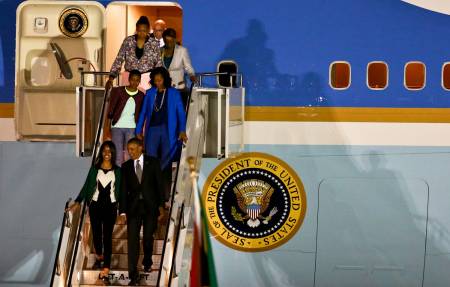
Obama on last leg of African tour in Tanzania

Obama with Tanzanian president Jakaya Kikwete durng a welcoming ceremony at Julius Nyerere Airport, Dar es Salaam

US President Barack Obama and his predecessor George W Bush are to lay a wreath Tuesday in Tanzania at the site of the 1998 bombing of the US embassy, the White House said.

Obama touched down in Dar es Salaam on Monday, for the last leg of his three-country tour of Africa. Bush has been in Africa since last week promoting causes linked to cancer awareness.

On August 7, 1998, twin bomb attacks by Islamist militants on US diplomatic missions in Nairobi and Dar es Salaam killed more than 200 people.

Obama is due to meet his Tanzanian counterpart, Jakaya Kikwete, and then visit a power plant, following up on his announcement that Washington will invest 7 billion dollars in expanding power networks in Africa.

Shortly after touching down in the East African nation and receiving a 21-gun salute at the airport, the president announced new US support for tackling poaching, in particular rhino and elephants.

Obama said poaching had become an “international crisis that continues to escalate”. The administration set up a task force to aid African governments in combating the illegal trade in animals while also seeking to curb the demand for items such as rhino horns.

The horns are most in demand in Asia, where some people believe they have medicinal value, although there is no science to back the claim.

The president is being accompanied by first lady Michelle and daughters Malia and Sasha. Numerous trade and business officials are travelling with Obama, who is drumming up support for deepening commerce links between the United States and the continent.

The president announced that he would invite African heads of government to the US next year to take part in a summit to relaunch relations between Washington and African nations.

During his visit to South Africa and Senegal, the US leader urged for better governance in Africa, to match the fast pace of economic expansion.

Obama has been criticized for not engaging enough with the continent and ceding ground and influence to China and other emerging powers.

Much of the president’s trip has been overshadowed by the continued ill health of Nelson Mandela, who remains in critical but stable condition in a Pretoria hospital.

Obama has lauded the former South African president throughout the trip and met with his family privately. – dpa

Obama to Africa: Don’t trust foreign powers

obamacapetownPresident Obama pledged $7 billion in aid Sunday to provide electricity to sub-Saharan Africa, as he warned Africans to be wary of exploitation by other countries, including the U.S.

“I’m calling for America to up our game when it comes to Africa,” Mr. Obama said in a speech at the University of Capetown in South Africa, midway through his weeklong tour of the continent. “We want to unleash the power of entrepreneurship and markets to create opportunity here in Africa.

Funds from the electricity initiative, dubbed Power Africa, will be distributed over the next five years to six countries: Ethiopia, Ghana, Kenya, Liberia, Nigeria and Tanzania. Mr. Obama said the U.S. wants to help Africa without interfering like colonial powers did in the past.

“You will always find the extended hand of a friend in the United States of America,” he said.

But on his three-nation tour, the president also has been warning Africans not to automatically trust foreign powers offering help, including the U.S.

“When we look at what other countries are doing in Africa, I think our only advice is make sure it’s a good deal for Africa,” Mr. Obama told reporters in Johannesburg.

“If somebody says they want to come build something here, are they hiring African workers? If somebody says that they want to help you develop your natural resources, how much of the money is staying in Africa? … Don’t just assume that folks come here and they’re automatically benefiting Africans. And that includes the United States. Ask questions in terms of what we do.”

Although Mr. Obama has been emphasizing initiatives such as food security and international funding to combat AIDS, much of his African trip has been overshadowed by his inability to meet over the weekend with the critically ill Nelson Mandela, 94, hospitalized with a lung infection.

The president and his aides held out the possibility of a meeting with Mr. Mandela until Saturday, when Mr. Obama decided to meet instead with several members of the civil rights icon’s family, saying he didn’t want to intrude at the hospital. He praised Mr. Mandela as a “hero for the world” and said America’s prayers were with him.

Mr. Obama told the audience at the University of Capetown that Mr. Mandela inspired his first political act, when he was a 19-year-old student at Occidental College in California.

He said he was motivated to give a short speech about divesting from South African companies after learning about Mr. Mandela and other political prisoners fighting for equality in South Africa.

“My own government in the United States was not standing on their side,” Mr. Obama said. “That’s why I got involved in what was known as the divestment movement in the United States. It was the first time I ever attached myself to a cause.

“I know now that something inside me was stirring at that time, something important,” he said. “And that was the belief that I could be part of something bigger than myself, that my own salvation was bound up with those of others.”

Earlier Sunday, Mr. Obama and his family toured the South African prison that held Mr. Mandela. The president wrote in a visitors log that they were “deeply humbled” by the experience, although this was Obama’s second visit to the prison.

Mr. Obama, first lady Michelle Obama, daughters Malia and Sasha, and the Obamas’ niece Leslie Robinson arrived on Robben Island after a five-minute helicopter flight from Capetown on Marine One. They were accompanied by a press helicopter and a contingent of Secret Service agents.

They got a tour of the prison, where Mr. Mandela spent 27 years as a political prisoner, from 83-year-old former inmate Ahmed Kathrada. They also saw the small cell that Mr. Mandela once occupied.

The president and first lady paused at the prison’s logbook, and Mr. Obama wrote the following entry:

“On behalf of our family we’re deeply humbled to stand where men of such courage faced down injustice and refused to yield. The world is grateful for the heroes of Robben Island, who remind us that no shackles or cells can match the strength of the human spirit. Barack Obama and Michelle Obama, 30 June 2013.” – Washington Times

Obama warns Africa’s ‘tyrant’ leaders

Barack Obama at the University of Cape Town

US President Barack Obama warned Sunday that Africa could only fulfill its rising potential with leaders who serve their people, not tyrants who enrich themselves.

In a strident call for democratic change and good governance, Obama used the political legacy of ailing Nelson Mandela and South Africa’s emergence from years of Afrikaner rule as proof that freedom will ultimately prevail.

“In too many countries, the actions of thugs and warlords and human traffickers hold back the promise of Africa,” Obama said at a speech at Cape Town University.

“America cannot put a stop to these tragedies alone, and you don’t expect us to. That is a job for Africans. But we can help you and we will help you,” he said, announcing major new US programs to boost electricity and health care.

“History shows us that progress is only possible where governments exist to serve their people and not the other way around,” said Obama, in a line that drew loud and prolonged cheers from his audience of more than 1,000 people.

The speech was delivered from the same spot where American political icon Robert Kennedy delivered his famous “ripple of hope” speech in 1966, which called on students to decry the “racial inequality of apartheid”.

Obama’s goal was to inspire a new generation of Africans with the belief that they could ignite political change and the potential of their continent.

He slammed leaders who “steal or kill or disenfranchise voters,” saying that the ultimate lesson of South Africa was that such brutal tactics will not work.

“So long as parts of Africa continue to be ravaged by war and mayhem, opportunity and democracy cannot take root,” said Obama.

“Across the continent, there are places where still, fear often prevails,” Obama said, warning of “senseless terrorism” from Mali to Mogadishu.

“From Congo to Sudan, conflicts fester,” Obama said, hitting out at those who argue that American calls for democracy and freedom are “intrusive” or “meddling”.

He also condemned the rule of Robert Mugabe in neighbouring Zimbabwe, where he said the “promise of liberation gave way to the corruption of power and the collapse of the economy”.

Like the rest of Obama’s trip to South Africa, the speech was rich in emotion when he mentioned his hero Mandela, who lies critically ill in a Pretoria hospital.

“You have shown us how a prisoner can become president,” Obama said. – AFP

EU lashes out at new NSA spying report

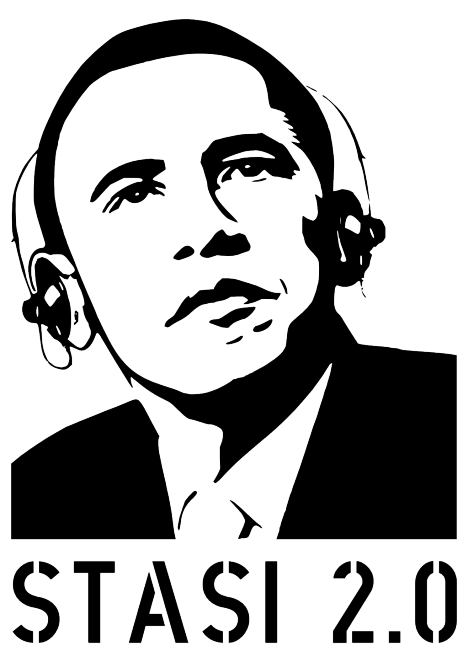
stasi2A top German official accused the United States on Sunday of using “Cold War” methods against its allies, after a German magazine cited secret intelligence documents to claim that U.S. spies bugged European Union offices.

Justice Minister Sabine Leutheusser-Schnarrenberger was responding to a report by German news weekly Der Spiegel, which claimed that the U.S. National Security Agency eavesdropped on EU offices in Washington, New York and Brussels. The magazine cited classified U.S. documents taken by former NSA contractor Edward Snowden that it said it had partly seen.

“If the media reports are accurate, then this recalls the methods used by enemies during the Cold War,” Leutheusser-Schnarrenberger said in a statement to The Associated Press.

“It is beyond comprehension that our friends in the United States see Europeans as enemies,” she said, calling for an “immediate and comprehensive” response from the U.S. government to the claims.

Other European officials demanded an explanation from the U.S.

“I am deeply worried and shocked about the allegations,” European Parliament President Martin Schulz said in a statement, according to CNN. “If the allegations prove to be true, it would be an extremely serious matter which will have a severe impact on EU-US relations. On behalf of the European Parliament, I demand full clarification and require further information speedily from the U.S. authorities with regard to these allegations.”

The revelations come at a particularly sensitive time for U.S.-E.U. relations, as long-awaited talks about a new trade pact are scheduled to begin next week. It is unclear how the latest report on NSA spying are going to affect them, but the trade pact has been a centerpiece of the Obama administrations diplomatic efforts in Europe for some time.

According to Der Spiegel, the NSA planted bugs in the EU’s diplomatic offices in Washington and infiltrated the building’s computer network. Similar measures were taken at the EU’s mission to the United Nations in New York, the magazine said.

Der Spiegel didn’t publish the alleged NSA documents it cited or say how it obtained access to them. But one of the report’s authors is Laura Poitras, an award-winning documentary filmmaker who interviewed Snowden while he was holed up in Hong Kong.

The magazine also didn’t specify how it learned of the NSA’s alleged eavesdropping efforts at a key EU office in Brussels. There, the NSA used secure facilities at NATO headquarters nearby to dial into telephone maintenance systems that would have allowed it to intercept senior EU officials’ calls and Internet traffic, Der Spiegel report said.

Germany was allegedly the focus of the European spying, according to The Guardian, categorising Washington’s key European ally alongside China, Iraq or Saudi Arabia in the intensity of the electronic snooping.

During a trip through Europe two weeks ago, President Obama assured an audience in Germany that America is not indiscriminately “rifling” through the emails of ordinary European citizens, describing the National Security Agency’s surveillance programs as a “circumscribed” system that has averted threats in America, Germany, and elsewhere.

Leutheusser-Schnarrenberger urged EU Commission President Jose Manuel Barroso to take personal responsibility for investigating the allegations.

The United States has defended its efforts to intercept electronic communications overseas by arguing that this has helped prevent terror attacks at home and abroad. – CBS

Obama speaks to African youth from Soweto via video link

Obama in Soweto
Obama in Soweto

by Shabtai Gold

US President Barack Obama was met Saturday with songs, cheers and laughter from young South Africans at a university in the Soweto area of Johannesburg.

Before he entered the room, the crowd sang songs from the struggle against apartheid and burst into a lively round of Shosholoza, an old miners song from southern Africa with a call and response format that became more lively with each chorus.

As he appeared, Obama shouted out, “Yebo Mzanzi!” or “Yes, South Africa!” to jubilation from the crowd.

The president used the town-hall-style meeting, which was hooked up via video link to several other African nations, to encourage young people to innovate and act on their imaginations.

While Nelson Mandela, the ailing anti-apartheid leader who Obama said was a personal hero and “one of the greatest people in history,” was still in hospital in critical condition, his spirit was felt in the room.

“Building the future you see, realizing the vision you have not only for your own country but for the world – it will not be easy,” Obama told the hundreds of young people in attendance at the University of Johannesburg’s Soweto campus.

“But as you go forward, think of the man who is in our prayers today. Think of 27 years in prison. Think of the hardship and struggles and being away from family and friends,” Obama said, referring to Mandela’s time in jail for opposing white minority rule.

Obama was quick to stress the importance of education, as Mandela had always done, saying it was the “best investment” any country could make in its youth.

Or, indeed, for its politicians. “I don’t want to reinforce for the American press here that Africa is just one big piece of land on the map,” Obama, a Democrat, said in an apparent reference to widely reported claims that former US Republican vice presidential candidate Sarah Palin believed Africa was a country, not a continent.

He was met by loud cheers from the crowd and laughter from his travelling press corps.

The questions he received were often tough, focussing on trade, the environment, women’s rights and even a promise he made to travel to Kenya, his father’s home, during his presidency.

“I’m going to be president for another three and a half years,” he said when asked via a video link from Nairobi why he had not visited the country. “You learn as president that people not only want you to fulfil your promises but want you to fulfil your promises yesterday.”

But Obama admitted that the International Criminal Court warrant out for that country’s new president and vice president had influenced his decision.

“I did not think it was an optimal time for me to visit,” he said but pledged he would still make a trip to Kenya before his time in office ends, which would be 2017.

For many in the crowd, however, the key concerns they had were jobs and economic opportunities. They wanted clear words from the president that he envisioned an economic partnership between the United States and Africa.

“Everywhere I go in Africa, people want to break out of the dependency trap,” Obama said.

“What we need is an Africa that is building, manufacturing, creating value, inventing and then sending those products around the world and receiving products in return under fair terms of trade,” the president said. “If we do that, there is no reason Africa cannot succeed.”

Obama insisted the US was not interested in global domination, a concern often felt strongest in countries once subjected to colonial rule, which milked resources while oppressing their people.

“I was elected to end the wars,” he said, adding that he regularly visits young US soldiers who have been gravely injured in Iraq and Afghanistan.

“This idea that we want to get more involved militarily around the world is not true,” he said.

Obama said the US would rather be “selling iPads and planes” rather than using its military abroad, drawing applause from the crowd, many of whom snapped photos of the president and his large entourage on their smartphones and tablets. – dpa

Obama: Africa’s future is in young hands

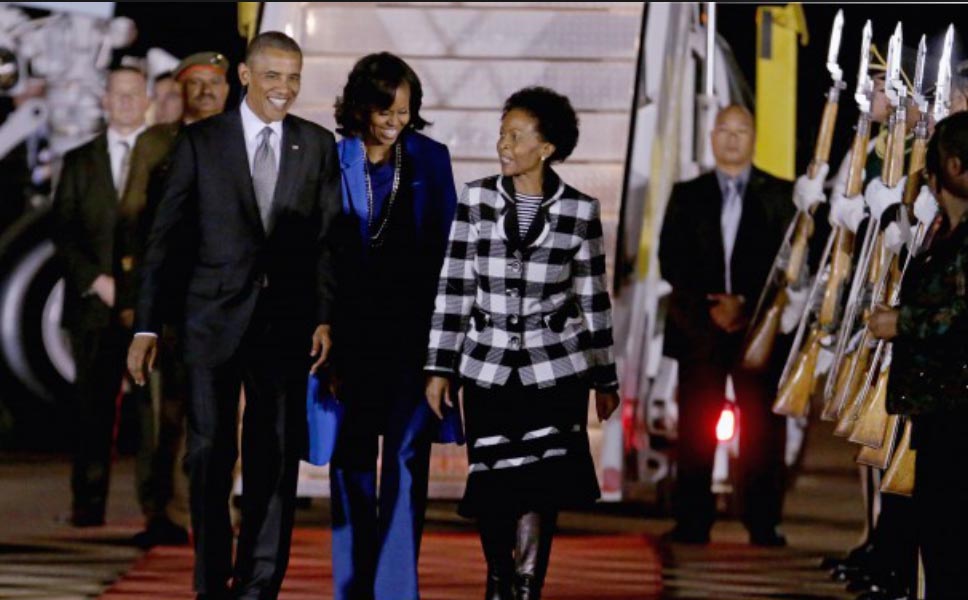
Obama upon his arrival at Waterkloof Air Force Base, with wife Michelle and Maite Nkoana-Mashabane, the SA foreign minister

US President Barack Obama told Africa’s youth Saturday that the future of the continent was in their hands and urged them to use Nelson Mandela as a model for political leadership.

Obama got a rowdy welcome as he used a town hall style meeting in South Africa to announce a new fellowship that will initially take 500 young African leaders to the United States every year for academic and leadership training.

As Obama spoke at a university in the sprawling township of Soweto where opposition to apartheid sprung into life, police nearby fired stun grenades to disperse hundreds of people critical of his anti-terror policies.

The US leader, on the second leg of an African tour, spoke at a University of Johannesburg not far from the simple homes in Soweto where Mandela, now 94 and in a critical condition in hospital, spent several years of his life.

“The future of this continent is in your hands,” Obama said.

He urged young people in Soweto and those watching the town hall meeting in Kenya, Nigeria and Uganda to take inspiration from Mandela’s refusal to be cowed by 27 years in jail.

“Think about 27 years in prison. Think about hardships and the struggles and being away from family and friends,” Obama said.

“There were dark moments that tested his faith in humanity, but he refused to give up.

“In your lives there will be times to test your faith.”

Obama was greeted with wild enthusiasm by the crowd in Soweto, who sang South African protest songs before he arrived and chanted his “Yes We Can” campaign slogan when he took the stage.

However, protesters set fire to US flags and portraits of Obama and at least three bangs from stun grenades were heard as armed police tried to move demonstrators away from the university.

“The message is clear. We want him to honour the promises he made when he became president, including things like the closing of Guantanamo Bay,” 30-year-old Firoz Osman told AFP. – AFP

Police disperse anti-Obama protestors

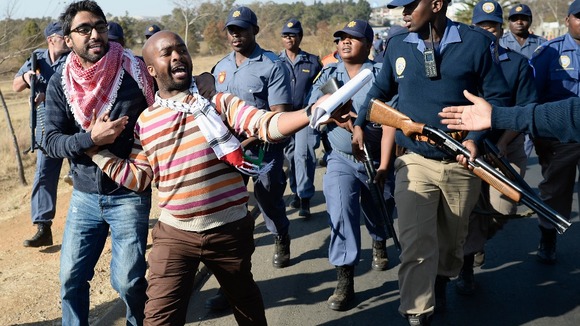
Protestors being escorted by police in Soweto

Police officers on Saturday fired a stun grenade at a group of protestors near the entrance of the University of Johannesburg Soweto campus ahead of US President Barack Obama’s visit there.

Spokeswoman Sally de Beer said about 120 protestors gathered about 400 metres from the gates to the campus.

The group were allowed permission to protest, but only until 2pm.

“When their time lapsed at 2pm, they refused to comply with a request to disperse as they were required to …the police fired one stun grenade and they then dispersed,” de Beer said.

No arrests were made.

De Beer said: “We totally respect everyone’s right to demonstrate peacefully, but if they are required in terms of their permission to protest, they must stick to the requirements.”

Obama was due to address young people at an event at the Soweto campus. – Sapa

Soweto to welcome Obama, a ‘fellow African’

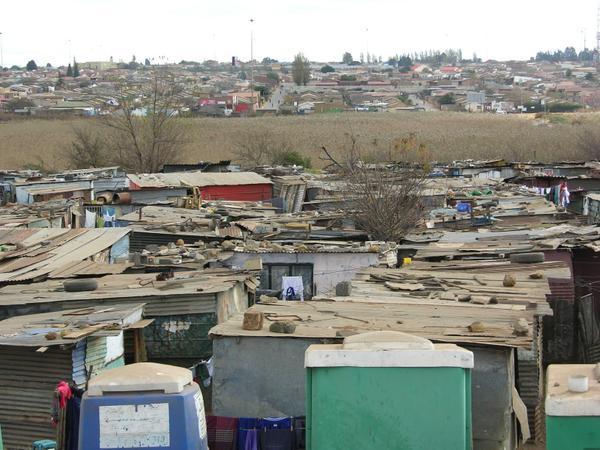
Scene in Soweto
Scene in Soweto

Barack Obama was barely 15 years old when riots erupted in the South African township of Soweto over a circular concerning the use of Afrikaans and other African languages in black schools. Decades later, its residents are preparing to welcome the US president as a “fellow African”.

Obama, now 51, will host a town hall meeting at a university campus as part of his visit to a crucible of the fight against apartheid, which saw protests break out in 1976 that spread across the country.

Although the white nationalist regime was not defeated, the 1976 riots spawned a new generation of black liberation leaders who continued the struggle while senior figures like Nelson Mandela and others languished in prisons.

While hundreds of anti-Obama protesters marched on the US Embassy in the capital Pretoria, 80 kilometres (50 miles) to the north on Friday, many Sowetans were keenly anticipating the visit by the first black US president.

“I want it to be a message of hope. I hope he talks about important things like education and the importance of going to school,” Christopher Mutangwa, a 20-year-old accounting student, said outside the University of Johannesburg’s (UJ) satellite Soweto campus.

“But I also hope that he can learn something about us and what happened here in Soweto during the struggle,” Mutangwa told AFP.

“He should, because I think he is an African.”

While there were few signs of preparation ahead of the highly anticipated visit at the UJ campus, many residents said they planned to line the streets, or watch the event on television.

“I was planning to visit my grandmother … but now I think I would rather go see Obama,” said Sibongiseni Kekana, 22, who makes a living as a struggling artist.

“Maybe I’ll even sell something to him,” Kekana laughed as he showed AFP around his tin shack, which also doubles as his art studio.

“In any case, I hope for inspiration from him,” Kekana said.

But even with Obama visiting Soweto, the continuing illness of South Africa’s own first black president, Nelson Mandela, never strays far from the conversation.

Mandela, 94, spent a third week in the intensive care section of a Pretoria hospital where he is being treated for a recurring lung infection.

After taking a turn for the worse last weekend, Madiba, as he is popularly known by his clan name, has been showing tentative signs of recovery.

— Two generations of black leaders —

With a possible visit by Obama to the ailing statesman on the cards over the weekend, inevitable comparisons are being drawn in many conversations.

“To me, Madiba represents an older and perhaps more traditional generation of black leaders, while Obama represents the new generation,” Tshepo Mofokeng, 43, told AFP.

“I’m sure he will be welcomed here as an African,” said Mofokeng, as he took some pictures on his mobile phone of his children at the Hector Pieterson Museum, which covers the 1976 uprising.

“I just think he (Obama) is sexy,” his wife Nomsa, 36, added with a laugh.

Even though many people will flock to welcome the US head-of-state, not all Sowetans were happy with his presence and demonstrations were planned for Saturday.

“I don’t think it’s a good thing that he’s coming here,” said Freddy Mhaule, 25.

“Especially with him spying on the world,” he added, referring to the recent revelations about PRISM, the US Internet surveillance programme.

“Obama’s visit will have zero impact on us,” said an art vendor, who only wanted to be identified as “Lebo”, at the Hector Pieterson Museum, which commemorates the death of the youth activist, shot dead in 1976 by apartheid police at the age of 12.

“To me he’s just another politician,” Lebo added, as he tried to sell tourists a wooden model of the Soweto home where Mandela once lived, which today serves as a museum. – AFP

Obama poses at the wrong door for ‘slavery’

Wrong building, wrong door

For a black American president on a tour of Africa, it seemed an obvious opportunity for a speech about the “evils of slavery”. When Barack Obama visited Senegal on Thursday, he headed for Gorée Island.

Historians pointed out however that a crumbling fort that is said to have been the key departure point for millions of slaves shipped across the Atlantic, was probably never used for that purpose at all.

The 18th century building could therefore not have allowed Obama to “fully appreciate the magnitude of the slave trade”.

Pictures on Thursday showed Mr Obama standing with his wife Michelle at Gorée’s so-called Door of No Return, a dark passageway from where the fort’s human cargo is said to have been loaded via gangplanks onto ships.

However, despite the claims that millions of slaves passed through the door, its most likely use is now thought to have been for disposing of rubbish. Likewise, the waters it overlooks are too rocky and shallow for a slave ship to have used it as a loading bay.

“There are literally no historians who believe the Slave House is what they’re claiming it to be, or that believe Goree was statistically significant in terms of the slave trade,” said Ralph Austen, a professor at the University of Chicago who has researched the subject.

Mr Obama is not the first international statesman to have made a pilgrimage to Gorée, which lies a short boat ride from the Senegalese capital, Dakar, and which has long been a draw for both foreign tourists and African Americans seeking to discover their historical roots.

Others who have visited in recent years include Nelson Mandela, Pope John Paul II and Mr Obama’s predecessors in the White House, Bill Clinton and George W Bush.

The fort’s museum was opened in 1962 by the late Boubacar Joseph Ndiaye, a Senegalese who was a passionate advocate of the belief that it had been used to transport slaves in great numbers. Its reputation spread worldwide thanks partly to the powerful symbolism of the Door of No Return, which was said to have offered slaves a final view of their homeland before the Atlantic crossing.

Yet its historical claims to be at the epicentre of the slave trade have long been in question. Most agree now that while slaves were indeed kept at the fort, they were there not for mass onward transport but for use by the fortress’s own residents. A more likely point of departure was another fort nearby, although records suggest that at most, some 26,000 slaves were sent there – a fraction of the claims of up to 15 million touted by the museum staff.

Other slave forts along the West African coastline, such as at Cape Coast in Ghana, have much more substantial claims to being major slaving centres. However, historians who have questioned Gorée’s claims have often been accused of attempting to “deny” the extent of the slave trade. Given the amount of tourist income that the island generates for a country still living in poverty, there has been little incentive in Senegal itself to put the record straight.

The US president was visiting Senegal as part of a week-long tour of Africa, and was due to land later in South Africa, where the country’s former leader, Nelson Mandela, is now critically ill. On Friday Mr Obama, travelling with a White House press pack on Air Force One, the presidential jet, insisted he would not be seeking a “photo op” with Mr Mandela.

“The last thing I want to do is to be in any way obtrusive at a time when the family is concerned about Nelson Mandela’s condition,” he said.- The Telegraph

‘Obama is supporting a British policy of genocide throughout Africa’

obamaafricaPresident Obama’s trip to Africa is little more than a public relations stunt to a continent desperate for his help, says Lawrence K. Freeman, editor of Executive Intelligence Review magazine.

Freeman believes not much is going to be accomplished. The purpose of the trip is not to help the African people to develop these African nations. He says it is a very calculated, glorified public relations tour to three countries and most people in Africa are going to realize, and do realize already, that the US is doing nothing to help their continent. “And what they do know is that the overthrow of Colonel Gaddafi, led by Obama and NATO, has been a catastrophe for north and West Africa in supporting various elements that have now allowed the destabilization of many of these countries, especially with the arms and the flow of Tuaregs and terrorists coming out of Libya. South Africans are not pleased or happy with President Obama and he’s going to offer absolutely nothing except maybe entice private sector companies to make a few investments. But this is really pathetic in terms of what Africa needs.”

Freeman says there is this silly notion in the US that somehow China is an American competitor in Africa. “But in fact what China has done over the last recent period, five to ten years, is invest massively and construct all types of infrastructure projects throughout many African countries totaling tens of billions of dollars per year. So the US had to stop doing that 40 years ago. The US does not build infrastructure. The US does not provide government-backed investment in the kinds of projects that are necessary for the people of Africa. We’ve done nothing, for example, to develop water management in the African Sahel. We’ve done nothing to develop the Arab culture capability of these regions and therefore you have the spread of terrorism, the spread of insurgency because you have these alienated youth who see no future because their economies are dying. In fact Obama’s done less than George Bush and less than Bill Clinton even though he’s called the Son of Africa. So he has a record of failure and in fact he’s been supporting destabilization, such as the overthrow of Gaddafi, which has actually worsened conditions throughout Africa.”

Obama is not really concerned about the continent, Freeman believes. “In 2009 he spent less than 24 hours and made one speech in Ghana. Here he’s visiting three countries – Senegal, South Africa, and Tanzania – and avoiding going to other countries such as Nigeria, such as Mali, many other countries that are in the spotlight right now. He doesn’t have anything to offer them, the United States – the transatlantic community of Europe and the United States, the financial system, is collapsing. We see this throughout Europe and the United States, dying economically, politically, and culturally. We have no vision, we have no future. Obama cares nothing about the welfare of the South African people as he cares nothing about the welfare of the people of the United States. In fact he’s supporting a British policy of genocide throughout Africa by allowing destabilization and by allowing hunger and shortages of food and medicine to kill Africans in large numbers, and this is something that could be corrected and changed if we had a policy to do that.”- RT

Mandela’s health overshadows Obama visit

Scene at the Medi-clinic Heart Hospital in Pretoria

by Laszlo Trankovits

“Viva Mandela! Viva Mandela!” sing the colourfully dressed women dancing in front of the hospital in Pretoria. Children bring pictures they have drawn, teddy bears, dolls and balloons, while adults lay down bouquets and greeting cards.

The closely guarded hospital is increasingly a place of pilgrimage. Behind its walls, national hero Nelson Mandela is struggling for his life.

At night, candles burn in front of the hospital. People are often seen praying together. During the day there is a lot of singing, especially the old anthems of the ANC liberation movement, now South Africa’s ruling party.

Everyone praises the achievements of the now seriously ill former president. A wealthy businessman was permitted to release 100 white doves into the sky on Tuesday in recognition of the work towards reconciliation of the father of South African democracy.

All of South Africa is agitated. Whether in offices, businesses or government offices, in the huts of townships such as Khayelitsha or the luxury villas in Camps Bay and Constantia: Everywhere, radios and televisions chatter constantly, everyone following the news spellbound.

The fate of the grand old man of South Africa is on everyone’s lips. “Let him die with dignity at last,” Cape Town businesswoman Glini Le Roux said, articulating what many are thinking.

The media, who have besieged the hospital for weeks in tents, caravans and satellite vans, have come in for criticism. Mandela’s eldest surviving daughter Makaziwe called foreign journalists camped outside the building “vultures” who were “waiting for the last carcasses.”

“There is an element of racism to their attitude. That is the image that we have as a family,” she said in a TV interview.

Mandela’s struggle is increasingly affecting public life. South Africa’s politicians have put aside all their plans. After President Jacob Zuma hurried to Mandela’s bedside on Wednesday, he announced he would not take part in a regional summit in Mozambique.

Many took this as a sign that Mandela was now dying – or even already dead, as some sensationalist reports had it. On Thursday, there was a surprise: Following his second visit to Mandela’s bedside in 24 hours, Zuma reported his condition had improved.

Mandela’s health has weighed on the visit of US President Barack Obama, who is expected in Johannesburg on Friday with an entourage of about 1,000 people.

“The US diplomats here are deeply concerned,” one of them said, given what would happen in the event of Mandela’s death and the subsequent national mourning.

They know that if Mandela died, the president’s agenda, with a visit to Soweto, academic honors in Johannesburg and Cape Town and a keynote speech in Cape Town – probably on the future of Africa – would be impossible. – dpa

Obama: ‘Moral imperative’ to feed Africa

Obama on the tired old theme of African hunger

President Barack Obama, wrapping up the first leg of an African tour, said on Friday Washington had a “moral imperative” to help the world’s poorest continent feed itself and he then left for South Africa hoping to see ailing Nelson Mandela.

White House officials hope Obama’s three-nation tour of Africa – his first substantial visit to the continent since taking office in 2009 – will compensate for what some view as years of neglect by America’s first black president.

Before departing Senegal after a two-day stay, Obama met farmers and local entrepreneurs to discuss new technologies helping to raise agricultural output in West Africa, one of the world’s most under-developed and drought-prone regions.

Standing in front of the agricultural displays at an event hosted by “Feed the Future”, the U.S. government’s global hunger initiative, Obama said his administration was making food security a top priority of its development agenda.

“This is a moral imperative. I believe that Africa is rising and wants to partner with us: not be dependent but be self sufficient,” he told reporters. “Far too many Africans endure the daily injustice of poverty and chronic hunger.

“When people ask what’s happening to their taxpayer dollars in foreign aid, I want people to know this money’s not being wasted. It’s helping feed families.”

But the health of Mandela, the 94-year-old former South African president and anti-apartheid hero clinging to life in a Pretoria hospital, dominated Obama’s day even before he arrived in Johannesburg.

Trade unionists, student activists and Communist Party members protesting against American foreign policy gathered on Friday a few blocks from the hospital where Mandela is being treated for a lung infection.

Like Mandela, Obama has received the Nobel Peace Prize and both men were the first black presidents of their nations.

Air Force One departed Senegal’s coastal capital Dakar just before 1100 GMT (0700 AM ET) and was due to arrive in South Africa around eight hours later. On Friday evening, Obama has no public events scheduled and could go to the hospital then.

He is scheduled to visit Robben Island, where Mandela spent years in prison under South Africa’s former white minority regime, later during his trip. Obama’s last stop on his tour will be Tanzania in East Africa.

Food security, along with anti-corruption measures and trade opportunities for U.S. companies, are topics the White House wants to highlight on Obama’s eight-day tour.

Food security and public aid are two of the issues the Obama team believes are success stories. USAID head Raj Shah told reporters that Africa had seen a steady increase in resources under Obama’s administration despite a tough budget environment. – Reuters

‘Free Palestine! Free Swaziland!’ demonstrators shout at Obama in Pretoria

Poster_anti-US_protetstActivists from different groups marched to the US embassy in Pretoria on Friday protesting against President Barack Obama.

The large group marched along Francis Baard Street, singing and chanting anti-Obama slogans. One activist, on a truck mounted with a public address system, led the songs and slogans.

He shouted: “Free Palestine. Free Swaziland. Free Zimbabwe. Down Obama, down!”

The group initially gathered at the Caledonian Stadium before embarking on the march.

Some of the protesters’ placards read: “Obama, stop supporting dictators in Africa. No oil here, move on.

“100 years of genocide in Iraq. War in 100 countries. Rogue State.”

A young boy’s poster read: “No you can’t spy on me”.

Many protesters wore orange overalls and black hoods. Others were dressed in Young Communist League red regalia.

The league’s national secretary was with other officials in front of the protesters.

A large banner with Obama’s face had the words: “Meet the world’s top assassin”. The banner also had a picture of Obama behind prison bars.

Many local and international journalists, who were camped outside the nearby Medi-Clinic Heart hospital where former president Nelson Mandela is being treated, rushed to the stadium.

As the group passed close to the hospital, they shouted messages of support for the ailing anti-apartheid icon.

Six police vehicles, including a Nyala, escorted the lively protesters. – Sapa

Obama accepts honorary doctorate from UJ, ex-Rand Afrikaans University

The Rand Afrikaans University, photographed in 1976 by liberal photographer David Goldblatt as an example of 'fascist architecture'
The Rand Afrikaans University, photographed in 1976 by liberal photographer David Goldblatt as an example of ‘fascist architecture’

US President Barack Obama has accepted an honorary doctorate of laws from the University of Johannesburg, vice chancellor Ihron Rensburg announced on Friday.

“It is my delight and pleasure to announce, on behalf of the entire community of the University of Johannesburg, that Dr Barack Obama has become our newest alumnus, and that all matters relating to the award were concluded according to the relevant policies and charters of the university,” he said in a statement.

Obama would not accept the award in person at this stage.

“First, it is normal and standard that the formal procedures relating to the conferral of an honorary degree do not coincide with the actual conferral of the qualification,” said Rensburg.

“Secondly, Dr Barack Obama’s visit to South Africa is a matter between the South African state and the US. Accordingly, and on this occasion, Dr Obama is a guest of the South African state and the South African people, and not of the University of Johannesburg.”

The fact that Obama’s visit coincided with former president Nelson Mandela’s hospital stay was also cited as a reason for the university not physically conferring the doctorate.

“Accordingly, the ceremonial conferral of the honorary doctorate on Dr Barack Obama will take place at a future occasion on a mutually agreed date,” Rensburg said. – Sapa