Jews flock to Le Pen

The number of Jews who voted for the far-right National Front party soared in the most recent presidential election from the previous two votes, surveys showed.

In the surveys of French Jews, some 13.5 percent of 1,095 respondents who self-identified as Jews said they voted for National Front President Marine Le Pen in the 2012 presidential elections.

Asked about the two previous presidential elections, from 2002 and 2007, respectively only 6.1 percent and 4.3 percent of Jewish voters polled said they chose the National Front candidate — Le Pen’s father and predecessor as party leader, Jean-Marie Le Pen, who has a history of convictions for “inciting racial hatred” and Holocaust denial.

Marine Le Pen has worked to rehabilitate the party and recently entered a war of words in the media with her father over his suggestion to put a Jewish singer “in the oven.”

The surveys were conducted over 10 years and compiled by the IFOP polling company for publication earlier this month by the news website atlantico.fr, which commissioned the report.

The National Front is a vociferous critic of what it describes as the government’s inaction to stop France’s “Islamization.”

Overall, National Front candidates received 19.2 percent of the vote in the first round in 2002 and 10.6 percent and 19 percent in the first rounds in the following two elections.

In a statement released Friday, National Front General Secretary Nicolas Bay blamed the government’s immigration policy for a 91 percent increase in the number of anti-Semitic attacks documented in France during the first seven months of 2014 over the corresponding period last year.

Muslims are the main perpetrators of anti-Semitic attacks on Jews, according to the Jewish watchdog BNVCA, or the National Bureau of Vigilance Against Anti-Semitism.

“It demonstrates what National Front has long denounced: the development of a radical Islam which endangers the safety of citizens,” the statement said. “It is a direct consequence of the massive immigration that the political class of UMPS led for 40 years in an utterly irresponsible manner.”

UMPS is a mashup of the French-language initials of the centrist UMP and the left-wing Socialist Party.
Former French President Nicolas Sarkozy of UMP received more than 45 percent of the votes of Jews polled in the first rounds of both the 2007 and the 2012 elections — far above his share of the votes in the general voter population.

The Socialist Party, which is believed to have been a favorite among Jews in the 1970s and 1990s, fell far behind Sarkozy in the poll of Jews, nabbing 19.7 percent, 28.8 percent and 22.5 percent of the Jewish vote in the first rounds of the presidential elections of 2002, 2007 and 2012, respectively.

Source: JTA

SA Muslims reject ISIS

The Islamic Unity Convention (IUC) has joined several South African Muslim bodies in condemning the actions of the Islamic State in Iraq and the Levant (Isis).

It said on Wednesday that core tenets of Islam included love, peace and unity and justice and that these values were not reserved only for Muslims. “It is therefore with abhorrence that the Islamic Unity Convention witnesses the crimes of the so-called ‘Islamic State’,” it said.

“How can a group claiming to act in the name of Islam … build a caliphate on mass murders and human rights abuses?”

Last week the Muslim Judicial Council (MJC) urged the United Nations to put an end to atrocities in the region. The MJC is a faith-based organisation, which was established in 1945. It is one of the oldest religious organisations in South Africa.

“The Muslim Judicial Council unequivocally condemns the group … for the mass murder and destruction committed against innocent civilians, religious minorities, scholars and places of worship,” it said.

“We reject this murderous group, which seeks legitimacy among Muslims by claiming the noble title of the caliphate while it violates Islamic sharia [law] and brings disrepute to the noble legacy of the house of Islam.”

In August, the scholarly body Jamiatul Ulama SA, a body comprising more than 900 Islamic scholars and guides and represents the majority of SA’s Muslims, condemned Isis.

“Warfare does not absolve the members of any Islamic caliphate, state or entity from the responsibility of observance of human rights and the rules of engagement where women, children and the elderly as well as all civilian non-combatants, their lives and property, are never targeted but safeguarded,” it said.

“It therefore comes strange to us that an Islamic state would be founded on atrocities, massacres and extrajudicial punishments that include summary executions of individuals suspected of crimes.”

Source: M&G

ISIS a disgrace to true fundamentalism

The problem with terrorist fundamentalists is not that we consider them inferior to us, but, rather, that they themselves secretly consider themselves inferior

By Slavoj Žižek.

It has become a commonplace in recent months to observe that the rise of the Islamic State in Iraq and Syria, or ISIS, is the latest chapter in the long story of the anticolonial awakening — the arbitrary borders drawn after World War I by the great powers being redrawn — and simultaneously a chapter in the struggle against the way global capital undermines the power of nation states. But what causes such fear and consternation is another feature of the ISIS regime: The public statements of the ISIS authorities make it clear that the principal task of state power is not the regulation of the welfare of the state’s population (health, the fight against hunger) — what really matters is religious life and the concern that all public life obey religious laws.

This is why ISIS remains more or less indifferent toward humanitarian catastrophes within its domain — its motto is roughly “take care of religion and welfare will take care of itself.” Therein resides the gap that separates the notion of power practiced by ISIS from the modern Western notion of what Michel Foucault called “biopower,” which regulates life in order to guarantee general welfare: the ISIS caliphate totally rejects the notion of biopower.

Does this make ISIS premodern? Instead of seeing in ISIS a case of extreme resistance to modernization, one should rather conceive of it as a case of perverted modernization and locate it into the series of conservative modernizations which began with the Meiji restoration in 19th-century Japan (rapid industrial modernization assumed the ideological form of “restoration,” or the return to the full authority of the emperor).

http://tlaxcala-int.org/upload/gal_8886.gif

The Caliph and his flashy wristwatch, as seen by Carlos Latuff

The well-known photo of Abu Bakr al-Baghdadi, the ISIS leader, with an exquisite Swiss watch on his arm, is here emblematic: ISIS is well organized in web propaganda as well as financial dealings, although these ultra-modern practices are used to propagate and enforce an ideologico-political vision that is not so much conservative as a desperate move to fix clear hierarchic delimitations. However, we should not forget that even this image of a strictly disciplined and regulated fundamentalist organization is not without its ambiguities: is religious oppression not (more than) supplemented by the way local ISIS military units seem to function? While the official ISIS ideology rails against Western permissiveness, the daily practice of the ISIS gangs includes full-scale grotesque orgies, including robberies, gang rapes, torture and murder of infidels.

Upon a closer look, the apparent heroic readiness of ISIS to risk everything also appears more ambiguous. Long ago Friedrich Nietzsche perceived how Western civilization was moving in the direction of the Last Man, an apathetic creature with no great passion or commitment. Unable to dream, tired of life, he takes no risks, seeking only comfort and security: “A little poison now and then: that makes for pleasant dreams. And much poison at the end, for a pleasant death. They have their little pleasures for the day, and their little pleasures for the night, but they have a regard for health. ‘We have discovered happiness,’ say the Last Men, and they blink.”

It may appear that the split between the permissive First World and the fundamentalist reaction to it runs more and more along the lines of the opposition between leading a long satisfying life full of material and cultural wealth and dedicating one’s life to some transcendent cause. Is this antagonism not the one between what Nietzsche called “passive” and “active” nihilism? We in the West are the Nietzschean Last Men, immersed in stupid daily pleasures, while the Muslim radicals are ready to risk everything, engaged in the struggle up to their self-destruction. William Butler Yeats’ “Second Coming” seems perfectly to render our present predicament: “The best lack all conviction, while the worst are full of passionate intensity.” This is an excellent description of the current split between anemic liberals and impassioned fundamentalists. “The best” are no longer able fully to engage, while “the worst” engage in racist, religious, sexist fanaticism.

But are the terrorist fundamentalists really fundamentalists in the authentic sense of the term? Do they really believe? What they lack is a feature that is easy to discern in all authentic fundamentalists, from Tibetan Buddhists to the Amish in the United States — the absence of resentment and envy, the deep indifference towards the nonbelievers’ way of life. If today’s so-called fundamentalists really believe they have found their way to Truth, why should they feel threatened by nonbelievers. Why should they envy them? When a Buddhist encounters a Western hedonist, he hardly condemns. He just benevolently notes that the hedonist’s search for happiness is self-defeating. In contrast to true fundamentalists, the terrorist pseudo-fundamentalists are deeply bothered, intrigued and fascinated by the sinful life of the nonbelievers. One can feel that, in fighting the sinful other, they are fighting their own temptation. This is why the so-called fundamentalists of ISIS are a disgrace to true fundamentalism.

It is here that Yeats’ diagnosis falls short of the present predicament: The passionate intensity of a mob bears witness to a lack of true conviction. Deep in themselves, terrorist fundamentalists also lack true conviction — their violent outbursts are a proof of it. How fragile the belief of a Muslim must be if he feels threatened by a stupid caricature in a low-circulation Danish newspaper. The fundamentalist Islamic terror is not grounded in the terrorists’ conviction of their superiority and in their desire to safeguard their cultural-religious identity from the onslaught of global consumerist civilization.

The problem with terrorist fundamentalists is not that we consider them inferior to us, but, rather, that they themselves secretly consider themselves inferior. This is why our condescending, politically correct assurances that we feel no superiority toward them only makes them more furious and feeds their resentment. The problem is not cultural difference (their effort to preserve their identity), but the opposite fact that they already like us, that, secretly, they have already internalized our standards and measure themselves by them. Paradoxically, what the fundamentalists of ISIS and those like them really lack is precisely a dose of that true conviction of one’s own superiority.

Source: Tlaxcala

Isis is Islam

“ISIL” is how President Barack Obama refers to the Islamic State of Iraq and Syria (ISIS). He pronounces it as one would the last syllable in “Moishel,” giving it the ring of a Yiddish diminutive. Yiddish adds an “-l or –ele” suffix to signify affection. “ISIL,” the more expansive appellation preferred by the president, stands for the Islamic State of Iraq and the Levant.

ilanaObama was set to tee off on the golf course, when the outfit released footage of its latest bloodletting in Iraq: a video clip depicting the handsome head of American photojournalist James Foley being sawed off by a masked man with a British accent – yes, the West either admits these Muhammadans through mass immigration, or grows them at home in hothouses of multiculturalism.

The life of another journalist, Steven Sotloff, now hangs by a thread.

Unlike our Israeli and European allies, the U.S. government does not haggle for the lives of its countrymen. In fairness, Obama had at least made attempts to rescue poor Mr. Foley. His predecessor, Genghis Bush, sat bone idle, never lifting a bloodstained finger to spare Paul Johnson, Nick Berg, Jack Hensley and Eugene Armstrong, of blessed memory, who also met the most ghastly fate imaginable: beheading.

Even before these men were headless, they were faceless to Bush and his followers.

From Martha’s Vineyard, Obama addressed the media. His response to the beheading of Mr. Foley exhilarated the groupies at CNN. “The entire world is appalled,” the president intoned solemnly. It shocks the conscience of the world. Foley was a good man who stood for “hope and civility.” The killers are craven cowards. They have no ideology, only an “empty vision.” They offer their neighbors nothing but “nihilistic” horror.

“ISIL speaks for no religion. Their victims are overwhelmingly Muslim. No faith teaches people to massacre innocents. No just God would stand for what they did yesterday and what they do every single day,” asserted Obama, before scampering back to his game.

Don’t be too harsh on the White House’s current occupant for symbolically severing the ISIS snake head from its Islamic body and tail. His predecessor was as devoted to promoting the Religion of Peace pie-in-the-sky. When it comes to anodyne assurances about Islam’s compatibility with diversity and democracy, Bush was every bit the delusional dhimmi Obama is.

As Paul Sperry documented in “Infiltration: How Muslim Spies and Subversives have Penetrated Washington,” Bush inaugurated the practice of always mentioning the nation’s churches and synagogues in tandem with its mosques. As did he promise Muslim leaders never to pair “Islam” with “terrorism,” a promise he kept. And never did Bush utter a peep about “Islamic terrorism,” emphasizing only equal-opportunity terrorism.

Bush hosted regular iftaar fast breakers and had selected as his “expert” on Islam a dabbler – a law professor called David Forte who doubled up as a “religious pluralist.” Forte crafted one of the Bush administration’s central stupidities: the notion that the essential Islam has been hijacked by a few bad-a–ed Arabs. Bush was forever offering incantations about Islam’s compatibility with liberty and tolerance; a faith based on love, not hate, ad nauseam.
Into the Cannibal's Pot

As the ideologues that purport to be saving us from the scourge of Islamic terrorism see it, the Religion of Peace was doing what it does best – inspire peace and prosperity – when, out of nowhere, radicals materialized and derailed it. This is contradicted by history as well as an important primary source: the Quran.

The first attests that the sword has always been integral to Islam, and that conversion has invariably meant conquest and carnage. The second proves that Islam’s alleged “hijackers” have done no more than heed their scriptures. The soldiers of ISIS or ISIL are obedient Muslim. They’ve obeyed the Quran. “The Call to Jihad” instructs Muslims: “When you meet those who disbelieve smite at their necks till you have killed and wounded many of them.”

“Holy war, which is demanded in Islamic law, is not defensive war as the Western students of Islam would like to tell us,” cautions Serge Trifkovic, author of “The Sword of the Prophet.” Even apologists for Islam à la John Esposito admit that murderous missionizing is a filament of the Islamic faith: “Jihad means to fight to spread Islam, not just to defend it, and to wage war against [Jews and Christians] who refuse Muslim rule.”

What can the aspiring dhimmi anticipate? Peace has its place in Islam, promises Sperry, who has mined the Quran, but “only after the entire world is conquered in the name of Allah.” And even then, peace is the province of Muslims, mainly, while others are subdued and must pay for protection.

The Quran’s ruthless particularism runs counter to the universal concepts of justice and love of the Hebrew and Christian Bibles. The tenet of religious literalism, moreover, explains why Islam has changed little over 1,400 years. Unlike the Jewish (and no doubt Christian) holy texts that have been reinterpreted by the sages over the centuries, the Quran has not – its decrees are not debatable and are to be taken literally.

Before being hushed, the greatest theologian alive – no, he’s not Pope Francis I – worried out loud that Islam was a closed and irrational system, impermeable to reform. Pope Benedict XVI was threatened, in 2006, for marshaling yet more primary sources to show that Islam does not brook reason or reformation and is commanded to will the world to its ways.

You might say that the term “radical Islam” is something of a redundancy. Islam is radical, and by extension, so are its true believers. Some, like ISIS or ISIL, are simply more devoted than others.

© 2014 by Ilana Mercer

[followbutton username=’IlanaMercer’ count=’true’ lang=’en’ theme=’light’]

Like Ilana Mercer’s Facebook page

Read Ilana in German on Junge Freiheit.

France adamant about separating state and Islam

Islamic women protest in France

Riots over a full-face Islamic veil, a woman losing her unborn baby in another similar confrontation and tensions flaring over a supermarket chain’s ad for the end-of-day feast for the Muslim holy month of Ramadan, are almost a daily staple for France.

France’s enforcement of its prized secularism is inscribed in law, most recently in a ban on wearing full-face veils in public. The policy instead may be fueling a rising tide of Islamophobia and driving a wedge between some Muslims and the rest of the population.

Yet ardent defenders of secularism, the product of France’s separation of church and state, say the country hasn’t gone far enough, AP reported.

They want to continue the cause of Voltaire helped and Victor Hugo, with a law targeting headscarves in the work place. Political pressure from a resurgent far-right has increased the tension.

A new generation of French Muslims — which at some 5 million, or about eight percent of the population, is the largest in Western Europe —  are defending mosques, halal food and Muslim religious dress.

Women who wear Muslim apparel “are no longer safe,” said a 26-year-old mother of three living in Trappes, a town south of Paris known for its large immigrant population.

Women wearing Muslim headscarves, suffered three attacks in Reims and three more in Orleans. Investigations and court cases are underway.

Police clashed last week with crowds protesting the arrest of a man who allegedly attacked an officer after his wife was ticketed for veiling her face in public. Dozens of cars were set afire in two nights of unrest in Trappes and an adjoining town. A 14-year-old boy suffered an eye injury.

Weeks earlier, a man allegedly assaulted a pregnant woman and ripped off her veil— one of two separately accosted in the Paris suburb of Argenteuil. She lost her baby days later, although the link with the incident remains unclear.

Interior Minister Manuel Valls insisted that Islam and the French Republic are compatible and denounced “a rise of violence against the Muslims of France.” At a dinner celebrating the end of Ramadan at the Grand Mosque of Paris, he denounced “those who want to make France a land of conquest.”

People told a veiled woman who is of Algerian origin, “If you’re not happy, leave, go home,” she said. But, she pointed out, she was born in France.

Most French people are Catholic, but church attendance has been in decline for decades and secular ideals run deep. With the growth of France’s Muslim population, lawmakers have increasingly turned to legislation to try to stifle public displays of Islamic faith.

In 2004, a law banned “ostentatious” religious symbols in public schools, a measure clearly directed at Islamic headscarves. It has been enforced without resistance.

A two-year-old law banning burqa-style veils from the streets of France has met with more outcry, even though only some 2,000 Muslim women cover their faces. Most Muslim women in France wear neither, as Islam does not Islam does not require face veils or covered head

A report by the Observatory of Secularism, created in 2013 by President Francois Hollande, revealed that a handful of the 705 women stopped by police for covering their faces in public chalked up more than 10 tickets each – two of them more than 25 – suggesting that some are provoking authorities intentionally.

A local official in Nimes, posted on his Facebook account an ad by the Carrefour supermarket chain publicizing “oriental” dishes for the nightly breaking of the fast during Ramadan with the comment, “Our Republic, is it still secular? Everything is on the way out.” The post was hastily removed after an outcry from Muslims.

While several European countries embrace secular values, France has been at the forefront of enforcing them, with the separation of church and state enshrined in law since 1905.

“Laicite,” is the French word for secularism. Associations throughout France work to uphold it. Far-right groups use it as a mantra, and leftists embrace it as well. There is even a secularism prize.

Hicham Benaissa of the National Center for Scientific Research said today’s secularism “appears to be a sort of (protection) against the religious influence of Islam” when “its spirit is to protect the faiths.”

A pre-school has just fired a woman who refused to remove her headscarf. An appeals court ruling in March calling the firing illegal spurred a demand for laws protecting secularism in private companies that would govern, for instance, dress and schedule requirements for prayer time or religious holidays.

A resulting bill to regulate religion in companies, sponsored by the opposition conservatives, failed.

Another report, released in June by the Observatory, tried to tone down the controversy, suggesting that slights to secularism have been exaggerated and dialogue, not a new law, may solve problems.

Some Muslims believe they are being driven away from the mainstream, leading to the growth of private Muslim schools and propelling Muslims to open their own businesses.

The law and the media “with their constant finger-pointing at Muslims are the reason the French population has become aggressive,” one woman said. Because of her robes, she sells cosmetics from her home. “I myself couldn’t apply for a job in an office.”

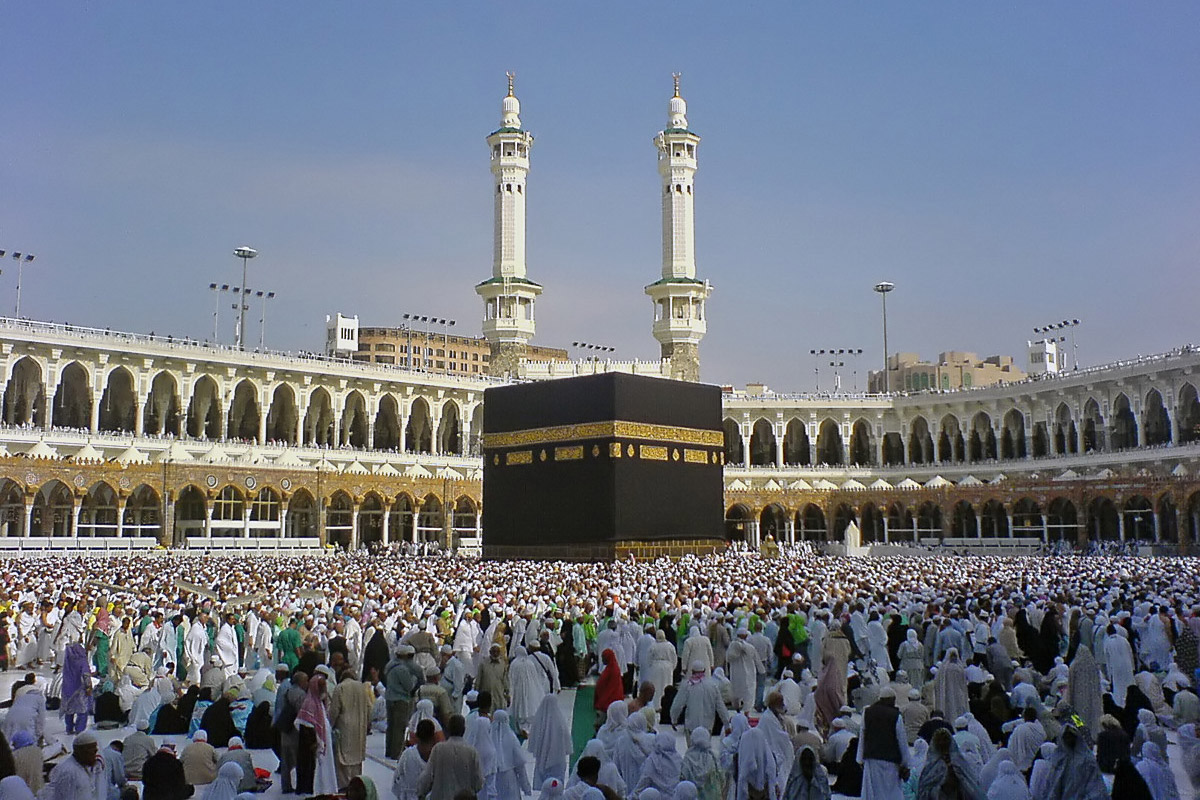
3 million Muslim pilgrims in Saudi Arabia for climax of Haj

The Kabba in Mecca
The Kabba in Mecca

Some 3 million Muslim pilgrims ascended Mount Arafat near Mecca in Saudi Arabia at the climax of the annual haj.

Authorities deployed around 100,000 security personnel to secure the pilgrims, the state-run Saudi Press Agency reported.

The granite hill is the place where the Muslim prophet Mohammed is said to have delivered his last sermon around 14 centuries ago.

The pilgrims wear seamless white robes to symbolize equality during the haj, one of the five pillars of Islam. It culminates in the feast of Eid al-Adha on Tuesday.

Saudi officials on Sunday said 1.3 million pilgrims arrived from abroad – 21 per cent less than last year. No reason was given for the decline.

The pilgrimage comes as the Middle East Respiratory Syndrome -Coronavirus (MERS-CoV) has been slowly spreading in parts of the region.

At least 136 cases, including 58 deaths, have been reported since last month. Sporadic outbreaks have been limited to Jordan, Saudi Arabia, Qatar and the United Arab Emirates.

The risk of the spread of illness or stampedes in Saudi Arabia is present during the haj.

In 2006, nearly 350 pilgrims were killed in a stampede.

In 1987, more than 400 people were killed when police attempted to break up a political rally. Saudi authorities have since warned pilgrims to avoid political activities during the pilgrimage. – dpa

Anti-Islamic campaign in New York subway

Anti-Islam campaign in NYC

Anti-Islamic advertisements will go up across New York City’s subway system next week after a federal judge ruled that the city’s Metropolitan Transportation Authority could not legally refuse to host the signs on the basis of “demeaning” language.

As early as next Monday, ten NYC subway stations will showcase adverts declaring, “In any war between the civilized man and the savage, support the civilized man. Support Israel. Defeat Jihad.” The campaign was created by the American Freedom Defense Initiative (AFDI), an organization considered a hate group by the Southern Poverty Law Center watch group.

Pamela Geller, the executive director of the AFDI, stands by her signage despite rampant complaints circulating before the campaign has even begun.

“I will not abridge my freedoms so as not to offend savages,” Geller tells Sky News

Geller has long advocated against so-called “Islamist propaganda” in America and has campaigned in the past to call for the shutting down of a Washington, DC museum exhibit that highlighted Muslim contributions to science. The installation was declared “Best Touring Exhibit” by the Museum Heritage Awards in 2011, but Geller claimed “It has indoctrinated hundreds of thousands of children into a rosy and romanticized view of Islam that makes them less appreciative of their own culture’s achievements and more complacent about Islamization in the West.”

For her overt actions waged against Islamic culture, the pro-Israel Anti-Defamation League has said Geller “fuels and fosters anti-Muslim bigotry in society.”

Those ideals will be brought to New York subway stations next week despite a legal battle that ended in July with a Manhattan federal judge agreeing that the First Amendment allowed Geller to have her ads run in the metro system.

“I live in America and in America we have the first amendment,” Geller tells Sky News.

[ad 1]

Ibrahim Hooper, spokesman for the Council on American Islamic Relations, responded to the outlet by condemning Geller’s actions, but agreeing with the federal judge’s decision regardless.

“Our basic position is that the first amendment means that everyone is free to be a bigot or even an idiot like Pamela Geller,” Hooper tells Sky. “We wish she wasn’t provoking and inciting hatred, but in America that’s her right.”

“We encourage Muslims to exercise the same right to publicly denounce such adverts. The real danger is the spread of hatred in our society, which can lead to attacks on innocent people.”

On the website for the AFDI, Geller critiques a journalist who has labeled her efforts as anti-Muslim, insisting that such a label “implies that every Muslim is a jihadi who wants to impose sharia and ‘eliminate and destroy Western civilization from within and sabotage its miserable house.’”

Defending her advertisements to KQED News last month, Geller said it was right to refer to Islamic worshipers as “savage,” because “any targeting of innocent civilians is savagery.”

“Mothers and children on a bus are targeted, and that is savagery. Kidnapping and murdering is savagery. The U.S. does not conduct war that way, and neither does Israel. Now, there is sometimes the accidental death of civilians, which is far different than the targeting of innocent civilians,” she said.

Previously, Geller told Huffington Post of her ads, “If I had my way, they’d be in every city in the United States of America and if I can get the funding, that’s exactly what’s going to happen.”

She has successfully campaigned to have the adverts included in San Francisco and is all but certain to expand to New York in the coming days. In California, San Francisco’s transit authority promised to donate the $3,400 Geller spent on advertising fees to the Human Rights Commission.

U.S. groups also sponsor Geert Wilders of Dutch Freedom Party

Geert Wilders

(Reuters) – Anti-Islam groups in America have provided financial support to Dutch politician Geert Wilders, an anti-immigration campaigner who is seeking re-election to the Dutch parliament this week.

While this is not illegal in the Netherlands, it sheds light on the international connections of Wilders, whose Freedom Party is the least transparent Dutch parliamentary group and a rallying point for Europe’s far right.

Wilders’ party is self-funded, unlike other Dutch parties that are subsidized by the government. It does not, therefore, have to meet the same disclosure requirements.

Groups in America seeking to counter Islamic influence in the West say they funded police protection and paid legal costs for Wilders whose party is polling in fourth place before the Sept 12 election.

Wilders’ ideas – calling for a halt to non-Western immigration and bans on Muslim headscarfs and the construction of mosques – have struck a chord in mainstream politics beyond the Netherlands. France banned clothing that covers the face in April 2011 and Belgium followed suit in July of the same year. Switzerland barred the construction of new minarets following a referendum in 2009.

The Middle East Forum, a pro-Israeli think tank based in Philadelphia, funded Wilders’ legal defense in 2010 and 2011 against Dutch charges of inciting racial hatred, its director Daniel Pipes said.

The Middle East Forum has a stated goal, according to its website, of protecting the “freedom of public speech of anti-Islamist authors, promoting American interests in the Middle East and protecting the constitutional order from Middle Eastern threats”. It sent money directly to Wilders’ lawyer via its Legal Project, Pipes said.

Represented by Dutch criminal lawyer Bram Moscowitz, Wilders successfully defended himself against the charges, which were brought by prosecutors in Amsterdam on behalf of groups representing minorities from Turkey, Morocco and other countries with Muslim populations.

The case heard in October 2010 was filed in response to Wilders’ comments in the Dutch media about Muslims and his film “Fitna”, which interlays images of terrorist attacks with quotations from the Koran and prompted protests by Muslims in Islamic countries worldwide. The court found he had stayed within the limits of free speech.

Pipes declined to say how much his group paid for Wilders’ defense.

Moscowitz declined to discuss payments for Wilders’ defense, citing client confidentiality.

Wilders said in an emailed statement that his legal expenses were paid for with the help of voluntary donations from defenders of freedom of speech.

“I do not answer questions of who they are and what they have paid. This could jeopardize their safety,” Wilders said.

VISITS TO THE UNITED STATES

Wilders, 49, first became a member of the Dutch parliament for the pro-business Liberal Party before winning nine seats for his own Freedom Party in 2006, campaigning against Islam, which he calls a threat to Dutch culture and Western values.

He called Islam a violent political ideology and vowed never to enter a mosque, “not in 100,000 years”. His party won 24 seats in the 150-seat lower house in June 2010.

He has been under 24-hour security for eight years after receiving death threats from radical Muslim groups in the Netherlands and abroad. Norwegian mass killer Anders Breivik cited anti-Islamic comments by Wilders in an online manifesto that sought to justify his crimes. Wilders has denounced Breivik and his actions.

David Horowitz, who runs a network of Los Angeles-based conservative groups and a website called FrontPage magazine, said he paid Wilders fees for making two speeches, security costs during student protests and overnight accommodation for his Dutch bodyguards during a 2009 U.S. trip.

Horowitz said he paid Wilders for one speech in Los Angeles and one at Temple University in Philadelphia. He declined to specify the amounts, but said that Wilders had received “a good fee.”

When Wilders’ Philadelphia appearance sparked student protests, Horowitz said, he paid a special security fee of about $1,500 to the Philadelphia police department. Horowitz said he also paid for overnight accommodation for four or five Dutch government bodyguards accompanying Wilders on the trip.

Wilders said in response: “I am frequently asked to speak abroad. Whenever possible I accept these invitations. I never ask for a fee. However, sometimes the travel and accommodation expenses are paid. My personal security is always paid for by the Dutch government.”

Pipes and Horowitz denied funding Wilders’ political activities in Holland. Both run non-profit, tax exempt research and policy organizations which, under U.S. tax laws, are forbidden from giving direct financial backing to any political candidate or party. U.S. law does allow such groups to support policy debates financially.

During Wilders’ visit to Los Angeles, where Horowitz runs an organization called the David Horowitz Freedom Center, Horowitz said he organized an event at which Danish cartoons lampooning the Prophet Mohammed were auctioned. He said he did not remember how much money this event raised or what happened to the proceeds.

Horowitz agreed with the Dutchman’s repeated, public comparison of the Koran to Hitler’s Mein Kampf. Comparing the two works was a “fair analogy,” Horowitz said. He said Wilders was “fighting the good fight.”

Horowitz said U.S. backers helped Wilders raise money to pay legal fees to fight a ban from visiting Britain in 2009, where he planned to screen Fitna. The British government said at the time: “The Government opposes extremism in all its forms. The decision to refuse Wilders admission was taken on the basis that his presence could have inflamed tensions between our communities and have led to inter-faith violence.”

Wilders won an appeal in the British courts in October 2009 when the ban was overturned.

Wilders has other supporters in the United States, such as Pamela Geller, who runs Stop Islamization of America and has backed Wilders in public statements. Geller remains a supporter. She says she does not provide Wilders with financial assistance.

Wilders has not revealed how his political activities are paid for. Former Freedom Party officials have said he has no personal funds and almost entirely relies on foreign donations.

Like other Dutch political parties, members of parliament for the Freedom Party have been allocated 165,000 euros ($211,200) per year for expenses. Former Freedom Party officials speaking on condition of anonymity said the money, nearly 4 million euros per year, went to the party and has not been accounted for.

Wilders said in his emailed response that former Freedom Party officials making such allegations were bitter and spiteful. “These people have other motives than telling the truth,” he said.

“Our party has a sixty euro annual budget. The rumors about millions of euros in sponsoring are complete nonsense. A Freedom Party-related foundation receives donations from Dutch or foreign sources, but these are modest amounts of money and certainly never millions,” it continued.

The Dutch government turned down requests for additional information about Freedom Party finances.

“I do not possess relevant information or documents” about the Freedom party finances or campaign contributions because the party does not receive subsidies, Dutch Minister for Internal Affairs Liesbeth Spies said in a written response.

Anders Breivik’s ideas ‘are almost mainstream in many European countries’

Anders Breivik in court in April 2012Norwegian mass killer Anders Behring Breivik may have failed to ignite a race war with Muslims, but he succeeded in stoking anxieties about the stability of Europe’s increasingly diverse societies.

Though his talk of an international underground of killers – latter-day Crusaders he called the Knights Templar – seemed to be mere fantasy, and while his methods place him far beyond the pale of mainstream politics, many of his beliefs are to be found within the fold of anti-Muslim, anti-immigrant populists.

“His ideological `manifesto’ is a distilled representation of a cultural crisis that pervades the European continent and finds expression in an increasingly xenophobic populism,” Kirsten Simonsen, a professor at Denmark’s Roskilde University, wrote in “Bloodlands”, a 2012 series of essays about Breivik.

Some notions – that Europe and its indigenous cultures are being weakened by immigration and multiculturalism – have been helping reshape the continent’s right-wing politics for years.

These beliefs occasionally find an echo on the margins of centre-right parties, among politicians seeking support from communities plagued by rising unemployment.

Mario Borghezio is a case in point.

The Italian politician set off a storm of outrage after Breivik’s gun and bomb massacre by declaring in a radio interview that its perpetrator had some “excellent” ideas.

Borghezio exemplifies a trend among populist anti-immigration groups – the use of the language of Western counter-terrorist efforts against al Qaeda to pursue what amounts to an anti-Islamic cultural campaign.

CALL FOR A “EUROPEAN SPRING”

Human rights groups are increasingly alarmed, not just at the far right, but at what many see as the pandering to its Islamophobic stereotypes by Europe’s mainstream parties.

“We need our own ‘European Spring’ to overcome old and emerging forms of racism and intolerance,” Nils Muiznieks, the Commissioner for Human Rights at the Council of Europe, a governmental human rights body, wrote in a July 2012 blog.

Muslims, he said, had become the primary “other” in right-wing populist discourse in Europe, and needed to be accepted as an integral part of society, entitled to equality and dignity.

Political parties in Austria, Bulgaria, Belgium, Denmark, France, Italy, the Netherlands, Norway and Switzerland had employed anti-Muslim rhetoric for political gain, he said.

Borghezio’s Breivik comment was denounced by his party, the pro-devolution, anti-immigrant Northern League, which apologized to Norway and temporarily suspended Borghezio from their ranks.

The European lawmaker argued the indignant reaction was misplaced, because he strongly condemned Breivik’s violence.

And yet, a year on, he still sees Breivik’s stance on some issues as attractive – particularly a perceived need to prevent Muslim immigration to Europe and combat Islamist extremism.

“Not all the ideas were criminal. It is the man who behaved in a criminal way,” Borghezio told Reuters.

CHEAP MUSLIM LABOUR

Tough regulation of immigrants, particularly Muslims, was essential, he said. In many mosques in Italy, he said, Muslims in economic difficulty were encouraged by extremist Islamist organizations “to carry out antisocial and illegal acts”.

His comments echo the public position of many in Europe’s far-right networks: a sense that the continent is under threat from Islamic extremists and is being betrayed by a rapacious political elite that values cheap Muslim labor above the economic welfare of its own communities.

Security specialists worry that far-right social media commentary stigmatizing Europe’s Muslims may help push enthusiasts towards militancy, much as al Qaeda propaganda opened pathways to violence for numerous Islamist radicals.

In a 2012 report, European police agency Europol stated the threat of violent right-wing extremism “has reached new levels in Europe and should not be underestimated. The threat will most likely come from lone actors, but organized, underground groups also have the capability and intention to carry out attacks.”

Some argue Breivik might have had more chance of setting off the kind of religious war he imagined if he had targeted Muslims, so as to create a cycle of revenge killings, rather than killing young white Norwegians from the pro-immigration Labour party, which encouraged a rallying behind common values.

“COUNTER-JIHADIST” MOVEMENT

On September 3, 2011, six weeks after Breivik’s Utoeya massacre, Stephen Lennon, a leader of the rightist English Defence League, took to a podium in central London and warned against any repeat of the 2005 attacks by British Islamists on London’s transport network that killed 52 people.

“The Islamic community will feel the full force of the English Defence League if we see any of our citizens killed, maimed or hurt on British soil ever again,’ he said.

U.S.-based researcher Arun Kundnani, in a June 2012 paper for the Hague-based International Centre for Counter-Terrorism, asserts that in the past two decades rightist violence in Europe has been comparable to Islamist bloodshed.

By his count, since 1990, at least 249 people had died in incidents of far‐right violence in Europe, compared to 263 who have been killed by jihadist violence.

A 2012 report by a left-wing anti-racist group, Hope Not Hate, identified more than 100 groups it said were part of a so-called counter-jihadist movement promoting anti-Islamic agendas in Europe, the United States, Canada and Australia, sharing anti-Islamic commentaries, photos, videos and rock music.

The groups, some of which Breivik quotes from in his manifesto, replaced the old racial nationalist politics of neo-Nazis with the language of cultural wars, Hope Not Hate said.

Immigration is an obsession with such groups.

Fifteen to 20 million Muslims, out of a total population of 500 million, are estimated to live in the 27-member European Union as well as non-EU members Norway and Switzerland.

France, a nation of 60 million people, is home to Europe’s largest Muslim minority, estimated at about 5 million. Norway estimates two percent of its 5 million population are Muslims.

A 2011 Pew survey of 50 European countries said the Muslim share of the population was expected to grow from six percent of the region’s people in 2010 to eight in 2030, due in part to higher birth rates among Muslims than non-Muslims.

“ADULTERATING” PURE NORWEGIAN BLOOD

Breivik argued his 77 victims, mostly teenagers at the ruling Labour Party’s summer camp on Utoeya, deserved to die because they supported Muslim immigration, which he said was adulterating pure Norwegian blood.

In Norway itself, Breivik’s deeds rebounded against the right. The mainstream but anti-immigration Progress Party, briefly joined by Breivik, suffered a huge blow in municipal elections two months after the attack.

But a growing number of opinion surveys show Europeans increasingly receptive to the notion that immigration, especially by Muslims, should be curbed or halted.

A July 2011 Pew Attitudes survey found that, when asked whether Muslims wanted to adopt local customs or stay culturally distinct, majorities of European populations chose the latter answer. A Populus research service poll in 2011 of more than 5,000 people in Britain for the Left-wing Searchlight Educational Trust found deep resentment among a range of communities about immigration.

“TOO MANY” IMMIGRANTS

In June 2012 an Ipsos MORI poll on attitudes to immigration found that in seven out of nine EU member states surveyed the majority regarded immigration as having had a negative impact on their country: Sweden and Poland were the only exceptions.

Mainstream centre-political parties have tried to keep up with the trend, enacting a variety of measures in the social sphere that have sometimes inflamed tensions on the street.

France banned clothing that covers the face in April 2011 and Belgium followed suit in July of the same year, while similar legislation has been proposed in the Netherlands, Italy and some Spanish regions. Switzerland barred the construction of new minarets following a referendum in 2009.

There is a broad European shift away from overt skin-color racism to prejudices about culture and religion shaped in part by the West’s war on al Qaeda.

“The whole focus of far right activity in Europe has shifted from race, the idea that ‘blacks are inferior’, to wider issues of identity,” said Ted Cantle, executive chairman of the Institute of Community Cohesion, a think tank.

Multiculturalism is another bugbear of the far right, which tends to define it as an excessive tolerance of immigrant communities that amounts to Western cultural suicide.

Centre-right politicians who have also questioned multiculturalism and advocated the primacy of Western liberalism in recent years include British Prime Minister David Cameron, German Chancellor Angela Merkel and former French President Nicolas Sarkozy. All did so facing domestic political pressure to take a tougher line on immigrants unwilling to adapt to host cultures.

Another example is Dutch populist Geert Wilders, head of the anti-immigration, anti-euro Freedom Party. Breivik’s manifesto reproduced anti-Islamic comments Wilders made to the Dutch parliament. Wilders has denounced Breivik and his actions.

Pepe Egger, head of Western European Forecasting for the UK-based Exclusive Analysis research house, says some of Breivik’s ideas are held quite widely among European political activists.

“The bizarre thing is that his ideas, as Islamophobic as they are, are almost mainstream in many European countries,” he told Reuters. “The perceived need to defend Europe against ‘Islamisation’ is not that far removed from what you can find in the opinion pieces in large daily newspapers.” – Reuters