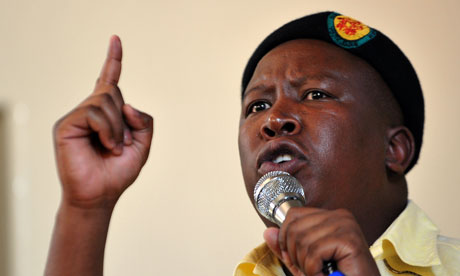
Expelled ANC Youth League president Julius Malema’s business partner Lesiba Gwangwa will appear in the Pietersburg (ANC name: Polokwane) Magistrate’s Court on Tuesday.
Gwangwa, who is chief executive of On-Point Engineers, will appear on accusations of tender fraud with other Limpopo businessmen and government officials.
According to a City Press report, Public Protector Thuli Madonsela has said Malema made millions from a R52 million fraudulent tender by On-Point Engineers.
The newspaper reported that Malema’s Ratanang Family Trust was one of two shareholders in On-Point.
Although Madonsela could not find any evidence that Malema interfered in the tender process, she found that he benefited “improperly” from the contract, City Press reported.
Her investigation found that On-Point acted corruptly.
Madonsela recommended that the tender be immediately cancelled, and that the National Prosecuting Authority and the Asset Forfeiture Unit consider criminal action and that the Master of the High Court investigate the flow of money into Malema’s trust.
Malema is scheduled to appear in the same court on Wednesday for alleged fraud and money-laundering related to the On-Point tender.
On Tuesday, the police cordoned off streets surrounding the courthouse.
The accused were to hand themselves over to the police before their court appearance.
[ad 1]
Brigadier Hangwani Mulaudzi said the police were implementing their security plan the day before Malema’s appearance.
He said they wanted to be prepared for a planned night vigil for Malema, and ensure people were safe. – Sapa
More than 15,000 people are expected to attend a night vigil on Tuesday for expelled ANC Youth League president Julius Malema ahead of his corruption trial, The Sowetan reported.
Limpopo ANCYL spokesman Klaas Mabunda told the newspaper it had arranged buses to take members and Malema supporters to the night vigil.
“I can confirm that after lengthy articulations, the provincial executive committee of the ANCYL has mandated to organise transport for members and Malema’s supporters,” Mabunda said.
The buses would transport people from all 10 sub-regions of the province to the Jack Botes hall.
According to The Sowetan, Mabunda said the buses would be paid for by businesspeople and “some” ANC leaders.
The branch was also printing posters and T-shirts in support of Malema.
ANCYL deputy president Robert Lamola and provincial chairman Rudzani Ludere would address the gathering. – Sapa
The SA Revenue Service (Sars) has obtained a R16 million judgment against former ANC Youth League leader Julius Malema for unpaid taxes, according to a report on Sunday.
The judgment was obtained in the High Court in Pretoria on September 11, City Press reported.
Malema did not oppose the application by Sars.
Sars spokesman Adrian Lackay confirmed the judgment against Malema for R16 million was obtained.
[ad 1]
He told the newspaper the amount included unpaid taxes, penalties and interest.
Lackay said he could not give any more details of Malema’s tax affairs because a “taxpayer’s confidentiality is a legal obligation imposed on Sars”.
According to the report Sars was about to seize Malema’s property and assets in Gauteng and Limpopo.
Alan Lewis, a tax law consultant and advocate, told City Press the judgment showed two things: Malema had a “hell of a lot of money” and he was in deep trouble.
Lewis, a former Sars employee, said the revenue service would most likely hand the judgment to a sheriff of the court, who would attach Malema’s properties and assets.
Sars started looking into Malema’s tax affairs last year after it was revealed that he was linked to companies which had obtained lucrative contracts from the Limpopo provincial government.
Millions of rands were channelled through Malema’s Ratanang Family Trust, according to the report. – Sapa
The University of Limpopo must explain why two men linked to the Friends of the Youth League (FYL) allegedly benefited from big contracts, the IFP Youth Brigade said on Friday.
“How is it possible that an institute of higher learning can be involved in such corrupt, nepotistic practices?” chairman Mkhuleko Hlengwa asked in a statement.
“The University of Limpopo must fully disclose the tender process it followed and the criteria it used in awarding these tenders.”
The Mail & Guardian reported that the university had confirmed that it awarded a R27.8 million tender in July last year for the conversion of a gymnasium into a laboratory to Collins Foromo.
Foromo was once a driver for expelled African National Congress Youth League president Julius Malema.
FYL spokesman Floyd Shivambu has rejected the allegation as a “cheap and lousy claim”.
Hlengwa called for the university council’s probe into the matter to investigate thoroughly and quickly.
“Our universities must not become pawns in the political arena, serving the self-interest of a few and in the process, sacrificing their political stance in exchange for partisanship.”
Questions have been raised about who funds the FYL, an organisation which was formed after Malema was expelled.
The M&G reported that Foromo said he was invited to all FYL rallies, but he denied contributing to the organisation.
The university also awarded Mandla Seopela, one of the founders of the FYL, a three-year lease for dining facilities on campus.
Seopela has been quoted as a spokesman for the FYL, and works as a speech-writer for Limpopo premier and Malema ally Cassel Mathale, according to the report.
The M&G alleged that the FYL was using the university to fund its activities.
Shivambu denied this.
“This cheap and lousy claim is made because of comrade Mandla Seopela’s open and unashamed association with struggles of economic freedom fighters, which he said on various occasions is due to the fact that the leadership of the ANC Youth League… was treated unfairly and should be supported.”
Foromo and Seopela “have a right to be economically active and involve themselves in legitimate economic activities”, Shivambu said.
He called on the M&G to provide proof that university money was being used to fund FYL programmes. – Sapa
An arrest warrant has been issued for expelled ANC Youth League leader Julius Malema and he is due to appear in a Pietersburg (ANC name: Polokwane) court next week.
“We were notified today that a warrant of arrest was issued for Mr Malema,” Malema’s lawyer Nicqui Galaktiou told Sapa.
“We don’t know which court and when it will happen, but we are engaging with authorities on that. It will be in Pietersburg.”
She said Malema had not yet been arrested.
“No, he hasn’t. My understanding is that he won’t be arrested.”
She said the charges against her client were unknown.
“We do not know what the charges are and we don’t have a copy of the warrant.”
The City Press reported earlier that Malema faced charges of money laundering, corruption and fraud relating to his Ratanang Family Trust and its share holding in On-Point Engineering, a company that allegedly made millions from Limpopo government tenders.
Earlier, authorities refused to comment or confirm the warrant.
The SA Revenue Service said it had nothing to do with the warrant.
“…We want to state categorically that any and all reports that SARS requested that a warrant be issued for Mr Malema’s arrest are completely untrue and without foundation,” it said in a statement.
“SARS is not involved in the criminal investigation into and prosecution of this matter.”
The Hawks said it did not issue warrants.
“The Hawks don’t issue warrants, so we don’t comment on that,” said Hawks spokesman McIntosh Polela.
Asked if the unit was planning to arrest Malema, he said: “Even if we were planning to arrest him, we won’t tell you.”
Police Minister Nathi Mthethwa’s spokesman, Zweli Mnisi, referred queries to provincial police.
Gauteng police spokesman, Brigadier Neville Malila, said he knew nothing about an arrest warrant for Malema.
Justice department spokesman Mthunzi Mhaga could not immediately be reached for comment.
Malema’s close colleague, suspended ANC Youth League spokesman Floyd Shivambu could not be reached for comment.
On Tuesday, Malema told reporters in Johannesburg if he was arrested, it would be done illegally.
“If we are illegally arrested tomorrow, we would have been arrested by [President] Jacob Zuma,” Malema said at the time.
He said he was willing and ready to go to jail, and was not intimidated.
“I have nothing to hide… I only have my convictions. Nothing will stop me from fighting for economic freedom, not even my death… We are unshaken.”
Malema said he had it “on good authority” that there were instructions “to get rid of some us…”
At the time, presidential spokesman Mac Maharaj said: “The presidency is aware that this person is prone to making wildly unsubstantiated and unwarranted claims and statements, and we do not wish to dignify them.” – Sapa
The Hawks would not confirm a news report on Friday that a warrant had been issued for the arrest of expelled ANC Youth League leader Julius Malema.
“The Hawks don’t issue warrants, so we don’t comment on that,” said spokesman McIntosh Polela.
Asked if the unit was planning to arrest Malema, he said: “Even if we were planning to arrest him, we won’t tell you.”
Police Minister Nathi Mthethwa’s spokesman, Zweli Mnisi, referred queries to provincial police.
Gauteng police spokesman, Brigadier Neville Malila, said he knew nothing about an arrest warrant for Malema.
The City Press reported that the warrant was issued on Friday morning.
Malema was due to appear in a Pretoria or Polokwane court next week on charges of money laundering, corruption and fraud, it said.
The matter related to his Ratanang Family Trust and its shareholding in On-Point Engineering, a company that had allegedly made millions from Limpopo government tenders.
The publication said it was unclear whether Malema would be jailed before appearing in court. – Sapa
With a warrant out for Julius Malema’s arrest, it seems that both President Zuma and Helen Zille were right on cue in deploying the army. After Malema’s imminent arrest was leaked to City Prees, the South African National Defence Force may be necessary to keep the peace upon Malema’s supporters getting unruly.
The Friends of Malema and the ANCYL leadership suspended earlier this year, as well as current leaders of the League’s National Executive Committe have warned that the country’s youth would rebel and engage in mass action if the suspended former League President had to be arrested.
These warnings were issued in a week during which Malema spoke openly about alleged threats to have him killed or arrested.
Malema’s closest ally, Floyd Shivambu, the League’s former spokesman who had also been suspended, told the Mail & Guardian newspaper this week that both Malema and the Youth League’s secretary-general Sindiso Magaqa no longer slept at home because they feared being attacked.
Shivamabu said that State Security sources had told him that there was a plan to neutralise them, concocted at the highest levels of government and that options had been narrowed down to “arrest or kill”. But he did add that Malema had no fear of arrest as he knew that he had committed no crime.
Two members of the Youth League’s National Executive Committee told the M&G anonymously that the youth will go on the rampage if the state had to “abuse” resources to arrest Julius Malema.
“On what basis would he be arrested? What has he done wrong with tenders in Limpopo? When there are limitations in society you can’t stop people from addressing any section of society,” said one of the members.
“Julius has lots of support from youth who don’t rely on patronage from the ANC. They are not MECs, mayor or ministers. The youth are angry and they will go out in numbers. Young people will lead the mass action and they have lots of energy. And young people will not be peaceful …
“We know that the security cluster has allocated five people to follow him wherever he goes and this surveillance has not even been approved by a judge,” one of the members said.
The President of the Congress of the People, COPE’s youth movement, Ncaba Bhanga, promised that the organisation would defend Malema if hy had to be arrested.
“This is not about Malema,” said Bhanga. “It is about the ruling party using state resources to suppress dissenting views [in the build-up to] its Mangaung conference. Malema has done nothing wrong.”
A warrant of arrest for Julius Malema was issued this morning, City Press reported. He is expected to appear in court next week.
Eyewitness News reported earlier in the week that Malema might be arrested after conclusion of the Hawks’ investigation of him. He was being investigated for alleged corruption.
Expelled ANC Youth League president Julius Malema has likened critics of the nationalisation of mines to those who opposed the end of apartheid.
Malema was asked by Talk Radio 702 host John Robbie on Wednesday how the nationalisation of mines could take place and whether it was plausible.
“You sound like people who opposed our struggle for freedom,” answered Malema.
“You are arguing exactly like they argued, that we cannot run the economy… I am telling you that it can sound difficult until it is done.”
Malema said the government should “not necessarily” expropriate mines, but should instead use Botswana as a model, where the state owned 51 percent of mine shareholding.
“Why are you not having a problem with Botswana? [Mine companies] are more than willing to work with government in Botswana, but when they come here they are refusing,” Malema said.
“I’m not calling for wholesale, blanket nationalisation. We still encourage the involvement of the private sector. We’re talking about greater control and participation of the state in the economy.”
Malema also responded to questions about reports that the Hawks had concluded their corruption probe and he would soon be arrested.
He said he was not aware of any intention to arrest him.
“I hear that from you at the start of the programme. I hear that from papers,” Malema said.
“I’ve been ‘getting arrested’ since 2009,” he said.
Malema said that if the police wanted to arrest him, they would not have to “create an unnecessary scene”.
“Those that are looking for me, they don’t have to create an unnecessary scene, they just have to call me, ‘Mr. Malema, report to Polokwane police station at 9am’, and I’ll be there,” he said.
Malema also told Robbie that he would return to the ANC, regardless of the outcome of the party’s national elective conference in Mangaung.
Malema said he was expelled from the party because a “faction” in the ANC, which was led by President Jacob Zuma, was determined to be re-elected to positions.
“I was booted out by those who felt threatened by my presence in the organisation,” Malema said. “They thought my presence threatened their re-election at Mangaung.”
He said that once the pressure of the election contest was over, he would be welcomed back into the ANC.
“Once they get re-elected or not re-elected, we will still be welcomed back into the organisation, because they will be cool-headed and they will no longer be afraid of the unknown,” Malema said.
He said that as an expelled member, no administrative rules prevented him from rejoining the party.
“Being expelled from the ANC means that you can wake up tomorrow and apply to be a member of the ANC,” Malema said.
“I’m not rejoining the ANC, I’m joining as a new member of the ANC.”
Malema said he still had a good relationship with his branch and participated in its meetings.
“It’s my branch. I’ve never had bad blood in my mind. I’ve got a bad blood with those ones who have an ambition to be elected,” Malema said.
Robbie asked Malema about his continued commitment to the ANC and whether that commitment was reasonable following his expulsion.
“But you’re living in cuckoo land. You say you’ll die for the ANC, all that wonderful stuff, but the ANC has kicked you out, aren’t you living a dream?” asked Robbie.
“No, no, no,” answered Malema. “I would have walked away if I was an opportunist.” – Sapa
Expelled ANC Youth League leader Julius Malema is a “populist, lumpen and right-wing demagogue,” the Communication Workers Union said on Thursday.
“The CWU condemns the populist, lumpen and right-wing demagogue Julius Malema, who is also known as tenderpreneur,” said the union in a statement.
The union accused Malema of using the recent shooting of 34 mineworkers at the Lonmin mine in Marikana for his own political gain.
“It is not exactly known when this lumpen started to be involved in the mining sector,” said the union.
“The loosely-structured Malema, who suffers from a never-ending verbal diarrhoea, has been scavenging, among others, on deceased workers to gain popularity.”
The union accused Malema of using the deaths to engage in attacks against President Jacob Zuma, the National Union of Mineworkers (NUM) and the Congress of SA Trade Unions.
CWU’s slamming of Malema comes on the heels of comments from the National Education Health and Allied Workers’ Union (Nehawu), criticising Malema and accusing him of “Nazi tactics”.
Malema spokesman Floyd Shivambu hit back against the unions and defended the expelled ANCYL president’s stance.
“We don’t respond to fools. We don’t dignify fools,” Shivambu said.
Shivambu accused unions critical of Malema of themselves being in factional battles, and serving the interests of Zuma.
“They’re narrow, they have no politics. They’re just a lackey of Jacob Zuma,” Shivambu said.
Since the shooting of the 34 mineworkers a month ago, Malema has been a fixture in the Rustenburg area, speaking to disgruntled mineworkers.
This week, Malema called on mine workers to go on a nation-wide strike to remove the leadership of the NUM. – Sapa
Bobby Godsell, the former Anglo American boss, Eskom boss and friend of Cyril Ramaphosa, the ANC’s chief negotiator at Codesa, said that the deaths at the Marikana mine was “outrageous”.
“In an apartheid South Africa with no (democratic) constitution you can say that violence was regrettable and understandable,” he said during a discussion at the Gordon Institute of Business Science in Johannesburg the other day.
“In a constitutional democracy, (violence) is not understandable. It is completely outrageous.
“People must be held accountable for those murders.”
Funny how Bobby Godsell seems to be concerned about 34 black miners, yet he has never spoken out against farm murders. More than 3 000 white farmers murdered since his beloved ANC took over in 1994… to date not a single word by Bobby Godsell.
He ain’t seen nothing yet. The situation at Marikana is far from over. A few days ago they marched to the Andrew Saffy Memorial Hospital and had another standoff with the police and another dead body (hacked to death with pangas) was found.
Yesterday morning at the Goldfields KTC West mines at Driefontein near Carletonville, Julias Malema said, “The mines are paying millions of rands of protection money into Jacob Zuma’s trust accounts.”
He called for a national strike, five days every month, and to make the mines “ungovernable” through peaceful means until their R12 500 wage demand was met.
Malema also confirmed that he was “under heavy police investigation” because he was accused of having instigated the violence at Marikana’s Lonmin mine.
At the time there was not a single newspaper in the country that did not run with this nonsense. Look now. Nothing happened to Malema. He was not arrested and he is still visiting mine after mine fomenting his hatred towards whites and inciting violence and revolution in South Africa and the ANC lets him be.
Like I have always said, Malema says the things the ANC cannot say openly. His so-called banning from the ANC was just a scam. He is still their loyal agent and lapdog, carrying out the true agenda.
AT other mines, miners are also downing tools. More than 200 mine workers at Golfview Colliery near Ermelo have downed tools following a breakdown of wage negotiations with management.
Zwelenzima Vavi of Cosatu said before Marikana he spoke of South Africa sitting on a ticking time bomb, but now we should be speaking of exploding bombs.
Vavi said superstitions and elements of backwardness on the part of workers also needed to be addressed. He obviously referred to the Sangoma “Nzabe” who promised the miners to be bullet-proof after taking his Muti and the miners blaming their slaughter on a rabbit they killed earlier in the day.
Just like the rest of us, Vavi is also waiting for the report of the judicial enquiry. If it come out that the police indeed shot miners in the back, hunted them down and drove over them, I am afraid nothing will be able to stop the revolution.
To Communists there can be no revolution without extreme violence. They believe brutal violence is the midwife of revolution…
Don’t take my word for it, but South Africa is in for a rough ride in the next few months…all we need on top of the current explosive situation is for Nelson Mandela to croak and it will be the catalyst to disaster.
The SA National Defence Force will seek legal advice on expelled ANC Youth League president Julius Malema’s address to soldiers, the SANDF said on Thursday.
“We want to understand the legality of it and the implication. The meeting between Mr Malema and SANDF members… we need to find the legal basis of that,” said Brig-Gen Xolani Mabanga.
“We cannot think that any member of the public can just go and talk to members of the SANDF.”
Mabanga said it was also unacceptable for SANDF members to invite a person to address them outside defence structures.
“Anybody outside the established military structure and the South African government, that would be out of order. Even if they invited a pastor, or a priest or a bishop or a sangoma or whatever,” Mabanga said.
He said SANDF members who had grievances should use existing structures to voice them and not air them with private individuals such as Malema.
Mabanga said legal advice would not be sought by the SANDF itself, but through its civilian leadership in the department of defence.
On Wednesday, Malema addressed about 60 soldiers in civilian dress at the Lenasia Recreation Centre.
There he criticised the political leadership of the country and accused them of ignoring the needs of SANDF members, including not re-instating the 1100 soldiers put on special leave for protesting at the Union Buildings in 2009.
Mabanga said some of the 60 soldiers at Malema’s speech were among the 1100 members put on special leave and they could face disciplinary action for their attendance.
“They still fall under the military disciplinary code. They’re still members of the SANDF,” Mabanga said.
He said they had been ordered to return to their home units and would now be charged with failing to obey that order.
Some of the other SANDF members had already been dismissed and the military had no jurisdiction over them. – Sapa
The ongoing labour dispute at Lonmin and spreading throughout the mining sector is being organised by an ANC faction with expelled ANCYL president Julius Malema acting as their front man, Cosatu president Sdumo Dlamini said in a report on Thursday.
The Congress of SA Trade Unions leader told Business Day the unrest was the result of a “systematic, orchestrated, long-time plan” by this faction within the African National Congress.
This faction was hoping to force the ANC into “chaos” ahead of their elective conference this December in Mangaung to compel the party to remove Jacob Zuma from his position as African National Congress president.
“We also understand that there have been certain individuals behind him [Malema] who are funding this for their own political ambitions,” he told the paper.
“Julius Malema may be the point person running at the front but we know that there are big guns behind him.”
Malema has made himself a fixture amongst protesting miners throughout the sector since 34 Lonmin miners were shot a month ago.
He has been offering them support for their wage demands and calling on them to demand the resignation of political figures and the leadership of the National Union of Mineworkers, a Cosatu affiliate. – Sapa
South African military bases were placed on high alert last night.
The status – the first of its kind since the ANC’s takeover of the country in 1994 – comes as axed ANC Youth League president Julius Malema is expected to meet soldiers near a military base in Lenasia, south of Johannesburg, today.
Defence Minister Nosiviwe Mapisa-Nqakula issued a strongly worded statement which said, in part, that ill-discipline in the military was a direct threat to the country’s security.
Today’s meeting comes after sources told The Times, a Johannesburg newspaper, that top security intelligence briefings, involving several government ministers, were held last night.
In a statement issued late yesterday by Friends of the ANC Youth League, Malema said he would address soldiers after listening to their “cries and demands”.
The meeting comes after Malema met disgruntled mineworkers from various companies around Gauteng over the past two weeks.
Malema’s planned address has been slammed by the Ministry of Defence and Military Veterans slammed as incitement. He yesterday called for mineworkers to go on a five-day nationwide strike every month until mine bosses had listened to their demand for better wages and for National Union of Mineworkers leaders to step down.
Malema has called on the miners not to give up on their struggle for a R12500 a month salary.
It is a move economists say will shut down mines and affect pension savings.
Malema’s spokesman, Floyd Shivambu, said: “The meeting is as a result of the pleas and requests the armed forces – soldiers of the SANDF – sent to Malema to come listen to and voice the military and soldiers’ cries and demands.
“For a considerable amount of time now, South Africa’s important component of its defence force has been marginalised and threatened with dismissal whenever they raised concerns about conditions of work.”
Defence Ministry spokesman Siphiwe Dlamini said all bases had been placed on “high alert”.
“The situation is being monitored. We cannot elaborate. Directives have been issued to base commanders and certain steps are being taken,” he said.
Dlamini said it was the first time that something like this had happened in the military.
“The military is a non-partisan organisation … this is being viewed as incitement … which is a criminal offence … it will be treated as such,” Dlamini said.
Mapisa-Nqakula said Malema’s intentions had been noted.
“It has been the expressed intention of Malema that his activities in the mining sector are aimed at rendering the sector ‘ungovernable’, thereby undermining the economy. The country cannot afford for similar instability in the military. The SANDF is the last line of defence of the sovereignty of the country. We cannot allow anyone to play political football with this institution,” she said.
Mapisa-Nqakula said any attempt to destabilise the military would be regarded as anti-South African and counter-revolutionary at the highest level.
“It is not going to be tolerated. It must be stated in no unclear terms that the military operates within an environment of command and control wherein discipline forms an integral part.
“Any actions outside this realm will be dealt with decisively by the chief of the SANDF.
“The minister calls on all members of the SANDF and the public to distance themselves from these actions of Malema.
“No permission has been granted by the SANDF’s command structures for any soldiers to participate in the proposed gathering.
“Any member who does without proper permission will be subjected to the disciplinary code of the SANDF. The compromise of discipline within the SANDF is a threat to the security of our country and all our people.”
Military analyst Helmoed Heitman said it was clear the military was the next target.
“Malema turned his sights on the mines and unions, but did not succeed. Now he is targeting the military in an attempt to continue with his campaign.
“If you are intending to plot sedition, the military is a good place to start. If you want to destabilise the state you demoralise the military.”
Heitman said a dim view should be taken of pseudo-politicians who addressing the military, which is meant to be “apolitical”.
“It is definitely something to keep an eye on. Despite there being numerous systems such as the military ombudsman, the Defence Review Commission and service commission being in place to address soldiers’ concerns, some troops will fall for Malema’s rhetoric,” he said.
SA National Defence Union spokesman Pikkie Greeff said the meeting was not union-driven.
“We have nothing to do with this. The information we have is that among the matters to be discussed are concerns over the deployment of ANC cadres to the top structures of the defence force, poor salaries and grievances around dismissals and disciplinary matters.”
NUM spokesman Lesiba Seshoka said heeding the firebrand’s calls would lead to massive job losses.
“To call on workers to embark on illegal strikes is totally irresponsible and childish.
“NUM condemns his attack on its leadership and the desperate behaviour of taking advantage of vulnerable people and trampling on rights of families of the deceased in Marikana in an attempt to score cheap political points.
“The National Union of Mineworkers appeals to all its loyal members to reject Malema’s hogwash and to return to work.
“Cosatu called on mineworkers not to allow themselves to be used as a “political football”.
“[Malema] is playing a dangerous game, exploiting the emotions of angry workers. This can only inflame tensions within the mining industry, flames which he is quite incapable of quenching.
“It is revealing that his main target is not the capitalist employers, who are responsible for the mineworkers’ low wages and terrible conditions, but their union, the National Union of Mineworkers.”
Peter Major, a mining consultant at Cadiz Corporate Solutions, said companies would lose $192-million a day should the national strike take place, a move that would lead to massive retrenchments.
“Eventually everyone would sell their shares. They would rather put their money in the banks, property and bonds.
“All these pension funds – the government pension funds, the mineworkers’ pension funds and foreign pension funds – they will obviously sell all their South African mining shares,” he said.
In this article Jane Duncan of Rhodes University argues that South Africa remains the most racist society in the world and that racism will only end once whites hand over their remaining assets to blacks.
In the wake of the Marikana massacre, information is trickling into the public domain, which suggests that the police killing of workers was more premeditated than initially thought. Workers who were released from police custody have confirmed accounts of unjustified police violence against protestors, and these accounts have challenged the dominant narrative of the police having acted purely in self-defence.
Public opinion remains sharply divided about whether the police were justified in shooting the miners, and much opinion has divided along racial lines, which is hardly surprising given the experiential and perception gaps between so many black and white people. More disturbingly, though, many responses have taken a decidedly racist turn.
Media reports of miners having engaged in rituals, ostensibly to protect themselves against police bullets, have unleashed a torrent of racist remarks on online news sites and social networks. Commentators have referred to black people as primitive, superstitious, retarded, chimpanzees, lazy unproductive parasites, “…moronic Neanderthals that would rape a baby to cure themselves of HIV,” (in the words of one commentator) undeserving of the vote and incapable of running a country.
In the wake of Marikana, social networks are seething with racial hatred. Delighted by the fact that the black government was doing something right for a change, racists rushed to the defence of the police and ignored or rubbished evidence suggesting that the police acted inappropriately.
In gloating over the miners’ deaths and what they consider to be black stupidity generally, racists seem blithely unconcerned about possibility that they may be straining black patience to the limit.
Racist utterances have become much more visible in the past few years, suggesting a fracturing of the country’s social fabric. Institutions that track social cohesion in South Africa have sounded alarm bells too. The government’s National Planning Commission (NPC) and the Institute for Justice and Reconciliation (IJR) have both warned that the South African nation is not cohering as it should.
According to the IJR, South Africans are experiencing a low sense of national belonging and continue to associate strongly with identity groups based on language, ethnicity and race. While day-to-day interactions across racial lines are gradually becoming more frequent – although mainly in the middle class – a staggeringly high 42 per cent of the people surveyed said they still never socialised across racial lines.
The South African nation is clearly very, very ill. Why are more South Africans retreating into racial laagers, quicker to recognise their apparent differences than their commonalities, and why do public displays of racism seem to be on the rise?
Racism is not just as a set of attitudes, but a systemic phenomenon. Racism serves a particular ideological function in capitalist societies – including South Africa’s – namely to justify the subjugation of blacks to extract surplus value out of them more easily. Under apartheid, the South African state used racism to portray inequality as an inevitable outcome of the inherent superiority of whites and inferiority of blacks.
What needs to be more fully understood is why racism did not simply wither away after apartheid. Appropriate anti-racist strategies cannot be developed without a correct diagnosis of the problem.
It could be argued that racism continues to exist because of the residual racist consciousness left over from the apartheid era, and that racists merely need to be educated out of their attitudes. This approach ignores the social function of racism in post-apartheid South Africa.
Racism allows whites to portray the country’s continuing inequality as natural and inevitable, that exists because of the inherent weaknesses of black people (and therefore which cannot be changed), rather than as a result of how society is organised (and which therefore can be changed). It allows them to argue that black people remain at the bottom of society – with substandard housing, crumbling education and chronic unemployment – because they are naturally inclined towards this social status.
In the case of Marikana, racism played a particular ideological role, namely to justify violent repression of workers’ wage demands. It is in the interest of whites – who still largely remain at the apex of the economic power structure – to keep race thinking alive as a mainstay for black exploitation, and to demonise resistance to that exploitation.
Many white people simply do not appreciate that the transition to democracy did not have to unfold in the way that it did. The transition created a democracy while leaving the commanding heights of the economy still in white hands, and the government’s Broad Based Black Economic Empowerment strategy has largely failed to change this racialised economic structure.
The ANC could have insisted on widespread expropriation of property without compensation: an entirely justifiable position given the historic dispossession of black people. Instead of recognising and appreciating black magnanimity, racists are rebuffing the hand of reconciliation that has been extended to them.
The rise of racism is not driven by local factors only. Globally, racism becomes more pronounced during recessionary periods, as competition for jobs amongst workers increases, which may quickly become racialised. This is why the 2008 global recession saw a sharp rise in racist and xenophobic sentiments globally, especially against migrant workers.
How can South Africa develop a community of shared values? According to the recently deceased activist and scholar, Neville Alexander, the nation must be built on all levels of the social formation, including the cultural, the social and the economic.
The ANC’s cardinal error – informed by errors in its theory of national unity – was to assume that they could legislate the nation into being, without creating the material conditions for South Africans to experience a common identity. Deepening inequality has made national unity even more elusive, and created fertile ground for racists. The ANC’s top down, idealist approach to nation building was naïve, dangerously misguided and ultimately unsustainable.
The danger is that, in this recessionary period, organised responses to intensifying racism may not be guided by anti-racist principles: that is, principles that seek to make race thinking disappear entirely by creating the basis for a truly non-racial society, rather than the cosmetic one South Africa has now.
The rise of Julius Malema has shown that South Africa is still capable of a rightward shift towards re-racialised, even proto-fascist politics, and a racial backlash along these lines is entirely possible. If this shift happens then South Africa’s dream of a non-racial society will be shattered, and the country could descend into a spiral of strife that it may not be able to emerge from very easily.
This is why racists need to think very, very deeply before speaking; blog by blog, tweet by tweet, they are courting disaster for themselves, and for the country as a whole.
It is important to note, though, that white people are not the only racists in South Africa, and many whites are decidedly anti-racist. But whites remain the most vocal culprits because they command inordinate amounts of social, cultural and economic capital.
Racism must be fought at every turn, and racists must be named and shamed. It is tempting simply to ban public displays of racism, but this will not make racist attitudes go away. It is better for South Africa to realise just how sick it is.
Whites need to start accepting some harsh realities. Most importantly, whites need to realise that the country’s social inequalities – expressed most starkly in the massive wage gap between the Lonmin managers and workers – are unsustainable. Whites will need to start sharing their wealth, if they are to continue to have a future in this country. Admittedly, they are unlikely to do so without a fight, but as the unfolding events at Lonmin and other mines suggest, that fight has already begun.
Professor Duncan is Highway Africa Chair of Media and Information Society, School of Journalism and Media Studies at Rhodes University, Grahamstown, South Africa.
With acknowledgements to The South African Civil Society Information Service.
This website uses cookies to improve your experience. We'll assume you're ok with this, but you can opt-out if you wish. Cookie settingsACCEPT
Privacy & Cookies Policy
Privacy Overview
This website uses cookies to improve your experience while you navigate through the website. Out of these cookies, the cookies that are categorized as necessary are stored on your browser as they are essential for the working of basic functionalities of the website. We also use third-party cookies that help us analyze and understand how you use this website. These cookies will be stored in your browser only with your consent. You also have the option to opt-out of these cookies. But opting out of some of these cookies may have an effect on your browsing experience.
Necessary cookies are absolutely essential for the website to function properly. This category only includes cookies that ensures basic functionalities and security features of the website. These cookies do not store any personal information.
Any cookies that may not be particularly necessary for the website to function and is used specifically to collect user personal data via analytics, ads, other embedded contents are termed as non-necessary cookies. It is mandatory to procure user consent prior to running these cookies on your website.

 Expelled ANC Youth League president Julius Malema’s business partner Lesiba Gwangwa will appear in the Pietersburg (ANC name: Polokwane) Magistrate’s Court on Tuesday.