Tiger felt ‘different energy’ with Mandela

Tiger meets Mandela
Tiger meets Mandela

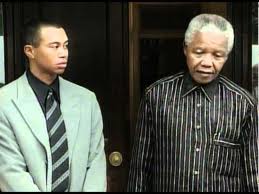
Black golf star Tiger Woods has remembered how his first meeting with Nelson Mandela 15 years ago was an experience like no other.

“I went down there to play [at] Sun City, and he [Mandela] invited us to his home. And my father and I went to have lunch with him. It still gives me chills to this day, thinking about it,” Woods told journalists at Muirfield in Scotland on Tuesday, where the start of the British Open on Thursday coincides with Mandela’s 95th birthday.

Woods became a poster boy for multiracial America in 1997 when, at just 21, he became the first black golfer to win a major, a feat all the more startling as he did it on a course that up until seven years previously had been off limits to African-Americans.

He described his private lunch the following year with Mandela, South Africa’s anti-apartheid hero, as unforgettable.

“We walked in the room and my dad and I were just kind of looking around. And I said, ‘Dad, do you feel that?’ And he says, ‘Yeah, it feels different in this room.’ And it was just like a different energy in the room,” Woods said.

“And maybe, I’m guessing probably 30 seconds later, I heard some movement behind me and it was [former] president Mandela folding up the paper. And it was pretty amazing.

“The energy that he has, that he exudes, is unlike any person I’ve ever met. And it was an honour to meet him at his home. And that’s an experience that I will never, ever forget.”

Mandela, who overcame 27 years in jail to become South Africa’s first black president and bring an end to decades of whites-only rule, is confined to his Pretoria hospital bed on life-support as the world prepares to mark his birthday with a raft of celebrations and charity events.

Defending British Open champion and South African sporting legend Ernie Els, also paid tribute to Mandela at Muirfield and said it would be “wonderful” if a South African player could win this week and give his sports-mad nation a much-needed morale boost.

“Obviously sport has been a key factor in bringing South Africa together into a democratic place and state,” Els said on Monday. “And president Mandela played such a big part in that; also back in the early 1990s, and the World Cup and … African Nations Cup.”

Els is one of 10 South Africans competing at Muirfield, along with Thomas Aiken, Richard Sterne, Tim Clark, George Coetzee, Charl Schwartzel, Branden Grace, Louis Oosthuizen, Justin Harding and Darryn Lloyd. – AFP

Thousands sing ‘Happy Birthday’ for Mandela

Soccer at Loftus Versfeld

Thousands of football-lovers descended on the Loftus Versfeld Stadium in Pretoria for the first of two Nelson Mandela Football Invitational matches on Sunday.

Before kickoff, the crowd sang “happy birthday Tata” in celebration of Madiba’s oncoming birthday.

The anti-apartheid icon turns 95 on July 18.

The 2011/12 English Premiership champions Manchester United will wrap up their South African tour with another match against Amazulu at Moses Mabhida Stadium in Durban, on Madiba’s birthday.

The funds generated from both fixtures will go towards the refurbishment of 10 schools in Madiba’s birth town of Qunu in the Eastern Cape.

Though almost half the seats were empty, the divided crowd cheered on as the game progressed.

Many people in the crowd were wearing City jerseys. Some wore branded regalia of other English Premiership clubs.

Other were wearing Kaizer Chiefs jerseys.

Madiba was hospitalised on June 8 at the Medi-Clinic Heart Hospital in Pretoria for a recurring lung infection.

On Sunday, numerous well-wishers visited Madiba’s hospital.

Spruitview resident Vusumzi Makalima brought his four children to the hospital to teach them about Mandela.

“The kids wanted to know where Madiba was… what he did, and why he was in prison,” he said.

“I wanted to teach them about what he did for the country, and show them where he was hospitalised.” He said the visit was about teaching Mandela’s legacy to his children so they would not forget.

His children had written letters for Mandela, which they placed on a growing wall of well-wishes outside the hospital.

Ovayo Makalima, 9, said she wanted to wish Madiba well.

“I said in the message – we love you Madiba and get well soon.” Her older sister Thandiswa Makalima said: “I think he’s a great man and very kind. All of South Africa loves him.” Another Johannesburg resident visited to be a part of history.

“This will go down in the history books and I wanted to be a part of history,” said Joel Mdantshe.

“Mandela will be a man in the history books that will not be forgotten.” Mdantshe and his friends posed for pictures at the shrine and said they would keep the pictures safe to remember that they visited the hospital where Mandela was.

“Even if we can’t see him, we will remember that we were here, so close to him, just the building standing between us and Tata,” said Mdantshe.

Sunday marked Mandela’s 37th day in hospital.

The Presidency said last week that he remained in a critical but stable condition. – Sapa

Mandela’s Empire

by Albert Brenner

The simulacrum is never that which conceals the truth — it is the truth which conceals that there is none. The simulacrum is true. – Jean Baudrillard

Bearing an analogy derived from Jorge Luis Borges` On Exactitude in Science, Baudrillard endeavoured to colloquialize his conceptualisation of (Sophist) simulacra into the language of the layman.

In this specific analogy, he explained how a great empire was created whilst, simultaneously, a map was created to (cartographically) plot the former/original creation. As this real-world empire grew in size and might, so did its symbolic representaion, the map. Until it, the map, eventually assumed the exact same dimensions of the original.

Then this empire crumbled into dust…as do all empires. And all that was left of this once magnificent empire, was the map…minutely depicting its original splendour, on paper.

And this is exactly what the so-called New South Africa is all about. It is not real. It is a simulacrum. A virtual MSM and popular-culture representation…of a map, an abstract symbol, outlining an empire most magnificent in splendour…that never was!

21st-Century (moral) South Africa is simply an aggregate of (Western) narratives – linguistic symbols signifying an all-conflated signified that never was. In short; Nelson Mandela, the proverbial `Emperor without Clothes`.

Mandela, like his Noble Savage Empire (the Rainbow Nation), is not real. He is simply the feel-good projection of the Oediphusian `anger, forlornness and despair` (Sartre) postmodern Westerners have been experiencing ever since they slew their, ertswhile, Father (the Christian God) on the altar of Science.

Be that as it may; Mandela, the Wits-educated Xhosa goat-herder from Qunu, has wittingly (and hubristically) taken on the mantle of Emperor…..of a map-empire that was not even of his making.

Let us be frank here; Mandela basically sat in a locked room for 27 years whilst, occasionally, hitting stones into smaller stones. Apart from that, he only wrote one original text called How to be a good Communist.

Nothing more, nothing less.

That said; what exactly – in (the) physical reality – in/of South Africa still, remotely, inversely represents the map called Mandelatopia accurately?

Endemic corruption, nepotism, cronyism, rape, murder and mayhem is what the real is in South Africa. Not the map…not Mandelatopia!

Yet he has attained god-like status among the feeble-minded. How come? Well, being the integer of the (Western) narratives of de-colonialization, capitalism (neo-liberalism, now) versus communism and postmodern body/identity politics, Mandela just had to sit back (as he did in jail), bide his time – in order to let the precession of simulacra solidify – and await the outcome of these, aforementioned, great (moral) struggles of the West.

And that he did. Pax Americana won. The Berlin Wall fell. And seeing that the winner writes morality, the god-Man (conveniently) forgot about `how to be a good communist`…and assumed the Emperor`s neo-liberal clothes…and got rewarded with the Nobel Prize for Peace for all those stones he so painstakingly turned into smaller stones.

And now here we stand…in the real South Africa. It is a bloody mess. A typical post-colonial African failed-state in the making. And we only have the map, of an empire that never was and never will be.

But yet we persist, desperately holding onto the promise of paradise. As if this map is our only Salvation. For this map has become the (new) Bible. A holy script presaging and , retrospectively , validating, the new Messiah – a secular-humanist God, the Noble Savage goat-herder that will lead us to La La Land.The Alpha and the Omega.

And this will be our ultimate undoing, for forsaking the Future to placate the Present will only unleash that which had no place in History, in the first place…for “

…it is the map that engenders the territory and if we were to revive the fable today, it would be the territory whose shreds are slowly rotting across the map.“ (Jean Baudrillard)

Mandela responding to treatment says Zuma

MandelacellFormer president Nelson Mandela is responding to treatment but is still in a critical but stable condition, says President Jacob Zuma.

“We are encouraged that Madiba is responding to treatment and urge the public to continue providing support and showering him with love, which gives him and the family strength,” President Jacob Zuma said in a statement on Wednesday.

Zuma visited Mandela in hospital on Wednesday evening.

The elder statesman was spending his 33rd day at the Mediclinic Heart Hospital in Pretoria for treatment of a recurring lung infection. He was admitted on June 8.

Zuma turned up shortly after Defence Minister Nosiviwe Mapisa-Nqakula left the hospital. He left after about 30 minutes.

Meanwhile, people continued to flock to the hospital to leave messages of support for Mandela; among them New York University students.

The students are in the country for a month to study education and social reforms. They lit candles near the wall filled with messages and well wishes for Mandela.

Inspired by Mandela
“His influence and what he stands for has touched all of us,” said Curtis Outlaw.

He said he was inspired by Mandela and all he had accomplished in his life.

“I look at him as an inspirational individual. From him I have learned that with perseverance, anything can be accomplished,” he said.

Crystal Soto said it was very important for them, as social welfare students, to visit the hospital and see what the country had been saying about Madiba.

“As educators, it is also important to study who he is and what he has accomplished as a person,” she said.

The students said it was important for them to show respect for the sacrifices Mandela had made, to ensure peace and unity in the country. – Sapa

‘Mandela is not in a vegetative state’

The American educated Makaziwe Mandela
The American educated Makaziwe Mandela says her grandfather is in a vegetative state

Doctors treating former president Nelson Mandela have denied that he is in a vegetative state, the Presidency said on Thursday.

“We confirm our earlier statement released this afternoon after President Jacob Zuma visited Madiba in hospital that Madiba remains in a critical, but stable condition,” spokesman Mac Maharaj said in a statement.

He said Mandela was under the care of a “multi-disciplinary” panel of medical experts drawn from the South African Military Health Services, the public and private sector, and universities.

“Under this panel, a team of doctors, nurses, paramedics and other health professionals attend to Madiba on a 24-hour basis.”

The statement from the Presidency came after court documents surfaced stating that Mandela was in a “permanent vegetative state” and that his family had been advised to turn off his life-support machine.

The certificate of urgency dated June 27 and submitted to the Eastern Cape High Court was widely reported by local and international media. A copy was obtained by Sapa.

In it, an advocate for the American educated Makaziwe Mandela said he had been advised by his instructing attorney that Mandela’s condition had “taken a turn for the worst (sic)” and that the “Mandela family” – ie Makaziwe and her supporters – have “been advised by the medical practitioners that his life-support machines should be switched off”.

“Rather than prolonging his suffering, the Mandela family is exploring this option as a very real probability.”

The document was attributed to David Smith, an advocate representing 15 members of the “Mandela family” in a court case against Mandela’s grandson, Mandla Mandela.

In the document, Smith described Mandela’s health as perilous, and said he was in a permanent vegetative state and was being assisted in breathing by a life-support machine.

“Affidavits will be provided, at the hearing of this application, from his treating physicians that he is in a permanent vegetative state and is assisted in breathing by a life-support machine,” he said.

“The anticipation of his impending death is based on real and substantial grounds.”

A later version of the document filed in the court omitted the paragraphs referring to Mandela’s “vegetative state” and the advice by physicians to take Mandela off life support.

A lawyer for the Mandela family later said the original certificate of urgency was “merely a submission outside of court”.

“To the extent there is speculation, a certificate of urgency was filed in terms of the practice of our court,” said Wesley Hayes, who represented the family in the dispute with Mandla Mandela about the graves of his father and his grandfather’s other two children.

“The certificate is not evidence, but merely submissions on why a matter should be heard outside ordinary court sittings.”

Hayes said the ruling on the urgency of the matter had been made “in camera” and that this “would extend to the contents of the certificate of urgency”.

“Further than that we have no comment,” he said.

On Wednesday, the Eastern Cape High Court ordered Mandla Mandela to return the remains of his grandfather’s three children to Qunu from Mvezo, where he moved them two years ago.

The remains were those of Mandela’s eldest son Madiba Thembekile, who died in a car accident in 1969; Mandla Mandela’s father Makgatho Mandela, who died in 2005; and Mandela’s first daughter Makaziwe Mandela, who died as an infant in 1948.

The bones were re-buried at a ceremony at a gravesite at Nelson Mandela’s home in Qunu on Thursday afternoon. – Sapa

Prayers for Mandela go global

nelsonmandelaPeople from different religions around the world continued praying on Monday for the recovery of former president Nelson Mandela, who remains in a critical condition in a Pretoria hospital.

In the United Kingdom, Westminister Abbey said on its website that daily prayers were being carried out for Mandela.

“Prayers for the former president of South Africa… are being included in daily eucharists at Westminster Abbey.

“The Church of England has published a prayer for use by individuals and communities of prayer.”

The prayer asks God to “look with mercy on Madiba Mandela and on all your children in South Africa”.

The Abbey has been the coronation church since 1066 and is the final resting place of 17 monarchs.

Mandela was admitted to the Medi-Clinic Heart Hospital in Pretoria with a recurring lung infection on June 8. Monday was his 24th day in hospital.

On Saturday, President Jacob Zuma said Mandela remained in a critical condition but he hoped for a recovery.

In Dublin, at the Christ Church Cathedral, a prayer vigil was held for Mandela last week.

“The service drew people from all over Dublin City,” its said on its website.

“As people, communities, organisations, and countries come together to pray for this venerable personality who has been a torchlight of knowledge and an example of outstanding character and values, Christ Church has invited all friends and neighbours to come and join them to sing, speak, light candles, and pray collectively as one for Nelson Mandela,” Rev Dermot Dunne said on the website.

He led prayers for Mandela, honouring the example he set and praying for him “at this critical moment in his life”.

He prayed for the Mandela family and the people of South Africa to continue their “great journey of nation building”.

The service concluded with a rendition of the South African national anthem.

The Islamic Society of North America urged its members to pray for Madiba.

“[T]he ISNA remembers his historical contribution as a fighter for freedom and human solidarity,” the society said on its website.

“Mandela not only led his people to victory against apartheid but also inspired all of humanity with his unwavering commitment to reconciliation and forgiveness.”

The society applauded the 94-year-old statesman for his “special qualities” as a leader and a “model of virtue, integrity, and sincerity”.

“We join the South African nation, Muslims of South Africa, and the whole human family in fully identifying with his life-long struggle and spirit of sacrifice, and we pray to Allah that his legacy will continue to emblazon the people of South Africa and the world.”

South Africa’s chief Rabbi Warren Goldstein was quoted as saying on the JewishJournal.com website: “The prayers and thoughts of the South African Jewish community are with former president Nelson Mandela and his family at this difficult time.”

Rabbi Avi Rabin said Mandela was one of the great leaders of “our time”.

“Here is a real leader, a man who is willing to sacrifice and place the country’s needs above his own. He is largely responsible for the great peaceful transformation that took place in South Africa after apartheid,” he said on the website.

Archbishop Thabo Makgoba of the Anglican Church of Southern Africa prayed for Mandela while visiting him in hospital.

Part of his prayer, posted on the church’s website reads: “Make your compassionate and strengthening presence known to Graca [Machel], and to all who love Madiba, at this hard time of watching and waiting.

“Fill them with your holy courage… take away their fears so that they may dare to face their grief.”

Makgoba called on God to “guide the medical staff so that they may know how to use their skills wisely and well, in caring for Madiba and keeping him comfortable”.

In Nevada, in the US, leaders of various religions gathered on June 16 for a multi-faith prayer service for the Nobel laureate. It was organised by the Rehoboth Holy Temple and the Universal Society of Hinduism.

Prayers were offered by Christian, Muslim, Hindu, and Buddhist leaders. – SAPA

‘Racism’: South Africa’s biggest industry

delport_manfred_600by Manfred Delport

There is an email joke currently doing the rounds, which contains more than just a grain of truth. A black boy asks his mom: “Mommy, what is democracy?” His mother answers that democracy is something that allows the black majority to elect a government which will use the money provided by the mostly white tax base for all kinds of goodies to black people, including housing, expensive cars for black officials and child grants. The boy then asks his mother whether the mostly white taxpayers don’t complain about this. His mom answers: “Yes, they do, and that’s what we call racism.”

The often-imaginary concept known as racism can mean almost anything. For example, Makaziwe Mandela complains that the extensive media interest in her father’s feared passing away is somehow “racist.” Nobody knows how she arrived at that particular conclusion, but apparently it is racist for Agence France Presse to set up its cameras outside the Pretoria Heart Hospital.

While some may accept that a media frenzy indeed somehow equals racism, it is notable how well Mkaziwe Mandela and the rest of the Mandela gang have done financially by being victims of racism. Were it not for their imaginary victimhood, they would merely have been a bunch of below-average nonentities. And I would certainly include Nelson Mandela in the latter group of mediocrities.

People such as US president Obama continuously refer to the so-called “Madiba legacy”. However, nobody can supply a good definition of exactly what this so-called legacy is supposed to entail. Mandela was jailed for a failed terrorist conspiracy, although it was thought up mostly by white communists. Mandela is nobody’s intellectual, clearly, and did not have much in the way of strategic thinking to contribute to the failed terror plot. He stayed in jail longer than necessary because of his hard-line refusal to renounce violence. Cyril Ramaphosa and Joe Slovo were more important ANC negotiators at Codesa than Mandela was. After only one mediocre term as president, during which Thabo Mbeki was the real power behind the scenes, and during which the country exploded into an orgy of criminal violence, Mandela retired to enjoy his wealth.

(Funny thing that, incidentally. How does a person who’s been in jail for 27 years get to be so filthy rich so quickly? A South African president only earned approximately 200,000 US dollars per annum at the time.)

Let me then repeat my question: What, exactly, is meant by Mandela’s legacy? What did he actually do, except to participate in a failed terrorist plot? The answer is simple. Mandela, once described as somebody of only average intelligence by a black American writer, is really a professional victim of imaginary racism, and this has proven extremely lucrative for both Mandela and the rest of the Mandela gang.

It would not be far-fetched to say that South Africa’s biggest industry is not mining, financial services or agriculture. It is rather extorting money in the name of imaginary white racism, by posing as professional black victims of racism. This, then, is Mandela’s true and only legacy. He is the most famous professional victim of imaginary white racism in the world, a poster boy for white guilt, as another writer put it. He was jailed for plotting to commit violent acts of terror against innocent civilians, white and black, but somehow he has managed to transform himself into the victim of his own conspiracy to commit terror. Perhaps Osama Bin Laden should have taken a cue from Mandela and transformed himself into the actual victim of 9/11, so that he too could be feted by liberal whites, instead of being deservedly eliminated by Seal Team 6.

One sees this phenomenon in all walks of South African life. The entire ANC; all its elected officials and its supporters who have been appointed to the public service after whites, as well as competence, were ethnically cleansed from the civil service, are really making a living by being professional victims of so-called racism. The logic, if that is the right term, is that they may not be competent to run a government or a municipality (or even a brothel), but that the world owes them because they are victims. The civil service and municipalities are, predictably, collapsing because of this mentality.

Exploiting misplaced white guilt is also a highly profitable pursuit. Prior to 1994 Scandinavian donors were lining up to hand over money to fraudsters like the Reverend Allan Boesak, who promptly abused their donations to buy luxury cars and a large home.  His black victimhood, incidentally, didn’t prevent him from marrying a white journalist. He clearly didn’t think that one through – he could have doubled the household income if both he and his spouse were both to become professional black victims.

The private sector is by no means immune to this. Black Economic Empowerment of BEE is nothing but a huge and racially-based extortion racket aimed at blackmailing companies into handing over chunks of their equity to connected ANC cadres. Should they resist, they are threatened with being exposed as “racists”, which is the worst crime imaginable these days, worse even than raping and murdering babies.

When one realizes that professional victimhood – of imaginary racism perpetrated by those evil whites – is the biggest growth industry in South Africa, if not also in loony-left universities in the USA, you gain an entirely new perspective on many issues.

For example: the Affirmative-Action rector of the University of the Free State, Jonathan Jansen, is wont to vociferously condemn imaginary white racism, by writing acres of column space shrilly condemning such iniquity, but says nary a word about the endemicm, murderous violence and drug culture amongst his own ethnic group. Perhaps Jansen feels it’s better to be shot to death during a drive-by shooting at a crack house, than it is to suffer an imaginary racial slur. What Jansen is really doing, however, is affirming his credentials as a victim because of the post he currently occupies to the powers that be, because he knows his appointment was political, and not based on academic or managerial merit.

When Makaziwe Mandela draws the ridiculous conclusion that media interest equals racism, it’s not about racism at all. It is really a marketing ploy. She is affirming her status as a professional victim to the world, and naïve white liberals are falling over themselves to further enrich her and the rest of the Mandela gang.

This industry is so pervasive that it even extends into the field of religion. The same Boesak fraudster mentioned above was involved in drawing up a document known as the Confession of Belhar, which is nothing but a sorry political tract pointing the finger at whites, posing as a serious theological document. This document is being forced down the throats of whites belonging to the largest white church grouping in South Africa, the Dutch Reformed Church. In addition to confessing to sinning against God, whites are also now apparently expected to confess to the mortal sin of racism during their Sunday sermons.

It is an open question for how long whites will continue to entertain and endure this absurd situation.

Oh, wait, silly me! Yes, of course!

It would be racist to resist.

This column was first published in Afrikaans earlier today.

ANC finds Winnie Mandela’s comments ‘regrettable’

Winnie Madikizela-Mandela

The ANC was unaware that the family of former statesman Nelson Mandela was unhappy about a publicised visit President Jacob Zuma made to Mandela’s house shortly after he was released from hospital in April, the party said in a statement on Sunday.

ANC spokesman Jackson Mthembu said comments made by Mandela’s ex-wife Winnie Madikizela-Mandela about the visit were regrettable.

“As the ANC we are in contact on a daily basis with the Mandela family and these issues that have been publicly aired by Winnie Madikizela-Mandela have not been raised in any of these occasions,” said Mthembu.

The AFP reported on Sunday that Madikizela-Mandela told Britain’s ITV News television that the visit by Zuma and other ANC delegates was insensitive.

“I honestly cannot put in words how hurt the family was. It was one of the most insensitive things for anyone to have done,” she was quoted as saying.

Zuma said at the time Mandela was “up and about”, a description that was clearly at odds with televised footage that showed the revered ex-leader frail and dazed, sitting frozen in an armchair, said the AFP.

Prior to the visit, Mandela had been out of the public eye for some time.

In excerpts published on the ITV website, Madikizela-Mandela added: “It compromised the family, compromised his dignity and it should have never been done.”

Mthembu said the visit was one of many that the ANC had made to Mandela to continue to show support to him and his family.

“We have to demonstrate [an] active interest in the life of [former] President Mandela who remains our leader and our icon,” said Mthembu.

He said the ANC would continue to pray for Madiba who was in a critical but stable condition at the Medi-Clinic Heart Hospital in Pretoria.

Mandela has been in hospital since June 8 and is being treated for a recurring lung infection. – Sapa

Obama heads to Africa for week-long tour

GTY 158441009 A CLJ POL USA CTUS President Barack Obama and his family were headed to Senegal on Wednesday, where they will start A week-long stay in Africa.

During the trip, Obama will meet with Senegal’s President Macky Sall on Thursday, South African President Jacob Zuma on Friday and Tanzania’s President Jakaya Kikwete on Monday.

On Friday, Obama will arrive in South Africa, where the continued hospitalization of anti-apartheid icon Nelson Mandela has drawn the nation into a mood of worry and well-wishing for the 94-year-old former leader.

“We simply hope that he recovers,” White House spokesman Jay Carney told reporters on board Air Force One. “We continue to pray for him and his family, and obviously all of the South African people to whom he means so much as well as his admirers around the world.”

Carney was also asked about Wednesday’s decision by the US Supreme Court that handed victory to supporters of same-sex marriage, and whether the topic would come up in Obama’s official meetings in Senegal, where homosexuality is a criminal act.

“Well, I wouldn’t rule it out,” Carney said. “You can assume that that’s something that is both a concern to the president and the administration, and that would be something that we would discuss.”

Highlights of Obama’s trip will include a visit to Senegal’s Goree Island, the so-called “Door of No Return” for many African slaves; Robben Island off of Cape Town, where Mandela spent much of his 27 years in jail under the apartheid regime; and the memorial to the victims of the 1998 US embassy bombing in Dar es Salaam.

Obama will on Saturday host a town hall meeting at the University of Johannesburg in Soweto, part of his Young African Leaders Initiative. On Sunday, he is to deliver a major speech on his Africa policy in Cape Town.

On Tuesday, the final day of the journey, first lady Michelle Obama and former first lady Laura Bush will participate in an African First Ladies’ Summit in Dar es Salaam.

A driving interest underlying Obama’s journey – only his second to Africa since taking office in 2009 – is Africa’s economic boom and the investment competition coming from other parts of the world, including China. Obama will travel with a large economic and trade team.

Carney noted that the “intense focus on the Middle East” in the first decade of the century had “an unintended consequence that resulted in us not being as engaged in Africa … as President Obama believes we need to be.”

But he denied that the United States was “too late” and pointed out Washington’s ongoing engagement with Africa.Author: Pat Reber, dpa

Candles burn for ailing Mandela

Cards and flowers for Nelson Mandela outside the Mediclinic Heart Hospital in Pretoria

Burning candles, bouquets of pink and red flowers, paintings and hundreds of messages at the entrance of a Pretoria hospital on Wednesday urged critically-ill former president Nelson Mandela to soldier on.

Well-wishers have consistently registered support for Mandela in different forms, transforming the Medi-Clinic Heart Hospital’s security wall into a miniature art gallery.

The celebrated anti-apartheid icon was admitted at the facility in the early hours of June 8 for a recurring lung infection.

The catalogue of presents, get-well-soon cards, mainly handwritten on cardboard, eclipsed the hospital’s signpost at the entrance on Celliers Street.

A card attached to a white teddy bear read: “Dearest Madiba. Thank you for everything you have done for our country. You are and will always be a true legend and a grandfather to all. From Alphonso Tania”.

Another read: “Tata Madiba, the Lord knows the plans of his children. May you get better, but even if you don’t, we will still love you as a nation. [From] Lwandile”.

Three candles were burning slowly near the messages. Many balloons, including several from a popular pizza outlet, were tied with ribbon onto bunches of flowers.

Security at the private hospital has been upscaled since Madiba was admitted.

After 5am on Wednesday, several police officers started screening vehicles entering the facility.

Despite the cold, scores of journalists from local and international media houses stayed outside the hospital.

Several broadcast vans still had their engines running. The news crews also set up generators for back up power.

Tshwane metro police officers parked near journalists on Celliers street. Numerous police patrol cars were also in the area.

Mandela’s home in Houghton was quiet on Wednesday morning, with police cars occasionally patrolling the area.

Around 1.10am three cars and one van from the Johannesburg metro police came down 4th Street, and turned into the street where Mandela’s house is located.

The van at the back of the patrol switched on its hazard lights, reversed and parked in the street in front of the gate before flashing its headlights.

About eight officers got out of the vehicles and had a discussion in front of the gate for 10 minutes before they all got back into the cars and drove off slowly.

Many Mandela family members, politicians, socialites and religious leaders had visited Madiba at the hospital after he was admitted for a recurring lung infection on June 8.

On Tuesday, Defence Minister Nosiviwe Mapisa-Nqakula and Pumla-Makaziwe Mandela visited the Medi-Clinic Heart hospital, in Arcadia, east of Pretoria.

Mapisa-Nqakula arrived in a black Mercedes-Benz with blue flashing police lights shortly before 7pm.

Minutes earlier Mandela’s eldest daughter, Pumla Makaziwe-Mandela, and his granddaughters Tukwini and Ndileka Mandela, arrived at the hospital in a red Range Rover.

Shortly before their arrival, Anglican Archbishop of Cape Town Thabo Makgoba left the hospital.

Madiba’s step-daughter Jozina Machel was also at the hospital.

Controversial businessman Kenny Kunene arrived at the hospital’s Celliers street entrance to place flowers and speak to the media.

After Kunene’s visit, more Pretoria metro police officers arrived at the entry point.

They cordoned off Celliers Street where it meets with Park Street.

Tshwane mayor Kgosientso Ramokgopa arrived to check on the police officers and left after a brief discussion with them.

Earlier on Tuesday, the presidency confirmed that Mandela remained in a critical condition.

“[Mandela’s] condition remains unchanged in hospital, and doctors continue to do their best to ensure his recovery, wellbeing, and comfort,” spokesman Mac Maharaj said in a statement. – Sapa

Mandela’s family called to private Qunu meeting

Qunu
Qunu

The eldest daughter of Nelson Mandela summoned the clan to Qunu to discuss ‘sensitive matters’.

In African tradition it means the end is near and relatives have to discuss if the ailing patient is ready to be “released”.

Yesterday, for the first time since Mandela was admitted to hospital, the pool of visitors went beyond just family members with senior politicians and government ministers visiting.


Among them were Defence and Military Veterans Minister Nosiviwe Mapisa-Nqakula and United Democratic Movement leader Bantu Holomisa, who is a family friend. Holomisa arrived and left the hospital with Makaziwe.

Madiba’s grandson Ndaba, granddaughters Zoleka and Zaziwe and her husband David Manaway also spent time with him.

Security remained tight at the Mediclinic Heart Hospital. Handmade cards with get well messages, balloons and flowers continued to fill the security wall at one of the hospital.

This came as Mandela, whose condition was described as critical by the presidency on Sunday night, spent his 16th night in hospital.

Activity in Mthatha was also starting to grow, and yesterday two airlines, one which does not fly even to East London, expressed interest in flying to the newly refurbished Mthatha Airport.

Some residents were preparing to turn their homes into home-stay accommodation, as they said there might not be enough place in the village should the ailing icon die, according to the report.

Villagers, who did not want to be named, told the newspaper there were only three bed and breakfasts (B&B) in the village.

An employee at one of the residences said the house had been converted into a 10-room B&B and had previously accommodated many foreigners who came to the village to see Mandela’s home.

Nowinothi Geledwana, 63, told the newspaper she had previously rented out some rooms in her house and expected to do so again, should there be a demand.

“I have about three to four rooms that are available and can be rented out should people prefer home-stay accommodation in Qunu,” Geledwana was quoted as saying.

“I really don’t know how much I will charge for them, but I’m sure I will make some profit.”

Apart from accommodation provided by residents, the Nelson Mandela Museum in the village also had accommodation for 60 people, while there was a plush guesthouse less than 10km from Qunu. – The Sowetan


Less activity at Mandela hospital

Nelson Mandela
Nelson Mandela

A few vehicles were entering and exiting the Pretoria hospital on Tuesday morning where ailing former president Nelson Mandela is in a critical condition.

Hospital security staff attended to the infrequent motorists at the facility’s entrance on Park Street.

The main entrance on Celliers Street was still closed after 3am on Tuesday.

Reporters and technical staff, camping on Celliers Street sidewalks, packed and departed after midnight.

Vehicles belonging to media personnel were left parked near the hospital’s entrance. Private security guards kept an eye on the broadcast equipment.

The usually busy Park Streets, where there is another entrance, was almost deserted. Patrolling police cars with flashing lights were seen at intervals.

Several police officers could be seen inside the hospital.

At midnight, several news crews made up of mainly international broadcasters, were doing live crossings near the Celliers Street entrance.

Several generators for back-up power were running through the night and broadcasting equipment including huge lights and cameras had been set up.

Numerous Mandela family members, politicians and government officials have been visiting the anti apartheid icon.

Public Service and Administration Minister Lindiwe Sisulu and Madiba’s daughter Makaziwe, left the hospital on Monday night.

Sisulu arrived at the hospital just after 6pm in a black Mercedes with blue flashing police lights. She and Makaziwe Mandela left just before 8pm.

Some of Mandela’s relatives left the hospital earlier in the day.

First seen leaving on Monday after a visit was grandson Ndaba Mandela, who arrived shortly after Mandela’s ex-wife Winnie Madikizela-Mandela and daughter Zindzi Mandela-Motlhajwa.

Earlier in the day, Defence and Military Veterans Minister Nosiviwe Mapisa-Nqakula and United Democratic Movement leader Bantu Holomisa arrived separately at the hospital.

On Sunday night presidential spokesman Mac Maharaj said in a statement that Mandela’s condition had turned critical.

Addressing the media in a briefing, which was initially scheduled as an off-the-record editors’ briefing, on Monday, President Jacob Zuma said Mandela’s condition had not changed.

“Mandela remains in a critical condition in hospital and doctors are doing everything possible to ensure his well-being and comfort,” Zuma said in Johannesburg.

He and deputy African National Congress president Cyril Ramaphosa visited Mandela at the hospital on Sunday night. – Sapa

Mandela ‘unresponsive’: report

Nelson Mandela
Nelson Mandela

Numerous relatives of former president Nelson Mandela visited the Pretoria hospital where he was spending his 15th day on Saturday.

Mandela’s ex-wife, ANC MP Winnie Madikizela-Mandela arrived at the Medi-Clinic Heart hospital in Arcadia, east of Pretoria.

She was with her daughter Zindzi Mandela-Motlhajwa.

Madiba’s daughter, Makaziwe drove into the hospital in her red Range Rover.

Earlier, a group of Mandela’s relatives arrived at the hospital led by Zaziwe Dlamini-Mandela’s husband, American businessman David Manaway.

Zaziwe is a granddaughter of the ailing anti-apartheid icon.

At least six police officers were searching all vehicles entering the hospital. Drivers were being asked to open luggage compartments for officers to search the cars.

Across the busy Park Street, scores of journalists were camped outside the hospital.

Four cameras were filming activities at the Medi-Clinic Heart hospital’s entrance.

At least six broadcast vehicles were stationed near the facility’s other entrance on Celliers Street.

The catalogue of get-well-soon cards, balloons and flowers had grown rapidly on the hospital’s security wall.

Some of the flower bouquets were placed in jars of water.

A message printed on an Ethiopian flag read: ” We love you our father, Madiba”.

Another message read: “Tata, you are stronger than anything. I am what I am today because of you. From Karabo Chilwane and Magret Moila [in] Limpopo”.

Some well-wishers had pasted several pictures including those of Mandela, flowers, heart designs and popular cartoon character Winnie the Pooh.

Earlier on Saturday, the presidency confirmed that the military ambulance that transported Mandela to hospital two weeks ago broke down due to “engine problems”.

“All care was taken to ensure that Madiba’s medical condition was not compromised by the unforeseen incident,” spokesman Mac Maharaj said.

“Doctors attending to Madiba are satisfied that the former president suffered no harm during this period.”

Mandela, 94, was hospitalised in the early hours of June 8 with a recurring lung infection.

On Friday, United States-based CBS News reported that Mandela’s liver and kidneys were functioning at 50 percent, and that the ailing former statesman had two procedures, one to repair a bleeding ulcer and another to insert a tube.

According to the report, Mandela had not opened his eyes in days and was unresponsive.

However, Maharaj said the presidency has been the “source for authoritative reporting on Mandela’s health”.

“Our reports are based on the reports we receive from doctors. We avoid clinical details because we want to ensure no transgression into the privacy of Mandela and his family is ensured,” Maharaj said.

“The presidency needs to ensure the dignity of the former president and need to ensure the circumstances are not surrounded by undignified speculative reports.” He said Mandela remained in a serious but stable condition in hospital.

The African National Congress said on Saturday that the presidency had been consistent in keeping South Africa and the world informed of Mandela’s health condition.

“The presidency has been consistent and reliable in ensuring that the nation and the world is kept informed on developments relating to our beloved statement and icon, Comrade Nelson Mandela,” spokesman Jackson Mthembu said.

“The ANC has no doubt that the reports they provide are indeed sufficient to ensure that, while respecting the privacy of the former president and his family, we are all kept up-to-date and knowledgeable about his condition within the confines of medical ethics and doctor-patient confidentiality.”

Mthembu said the ANC have no doubt that Mandela continued to receive the “very best medical care and attention”. – Sapa

Mandela doesn’t sell anymore

randelaBut despite Nelson Mandela’s stature as a global icon, money has failed to follow the flow of interest. Over the past two weeks, as Mandela recuperated in a Pretoria hospital from a recurring lung infection, those trading on his name, directly and indirectly, did not see a spike in their revenues, to their considerable distress.

In the Pretoria CBD, street vendors flogging portraits and postcards said they had had more inquiries from foreigners, but that sales were occasional at best. In Soweto, at the Regina Mundi church, mosaics with Mandela’s name and T-shirts bearing his face sat unsold; vendors said their trade was more heavily influenced by the seasons and weather than by news of the statesman’s health.

In the market of rare coins and common medallions nothing much changed, except marked disappointment for traders and speculators still hoping to cash in on common coins.

“In the past there has been a sort of an uptick, but this time we haven’t noticed that,” says Alan Demby, chief executive of the South African Gold Coin Exchange, which sells a number of Mandela-themed medallions. “Interest in this kind of thing peaks when people are in the news; when British royals Kate and William got engaged, a lot of people bought coins. When they married, more people bought coins. People like to have that kind of memorabilia. With Mandela, it’s not always the case.”

In 2008 it was indeed the case. Very rare proofs – the most highly valued grade of coin – featuring Mandela achieved record-breaking prices, with confirmed sales of more than R100000 and claims of one coin selling for R2.5-million. After that, various sellers attempted to flog common versions of the same coin for far more than their face value, and often succeeded, with prime examples selling for about R5 000 each.

In July attempts to sell similar coins for R250 each failed dismally, although sealed and allegedly uncirculated coins were sold for R75 a piece. Coins that were actually used as currency, with all the wear and tear that comes with use, were also on offer. An attempt to sell an entire bag of such coins attracted attention – with an offer of R4 each for coins that merchants are obliged to exchange for R5 worth of goods. – M&G