Mandela, Obama and the end of democracy


One of the best means of enslaving an entire people is to weave them an illusion that they are free.

Significant cornerstones in achieving this grand illusion have already been set in the West, and regardless whether one believes in conspiracy theory or no, the outcome is undeniable. The only true difference is that under the incumbent US president Obama, the drive towards the extinction of the Free West has accelerated.

Even though this process has been in the making for many decades, South Africa’s fictional portrayal to the rest of the world has played a formidable part in all this.

The world was filled with a peculiar kind of absolution when Nelson Mandela was released from prison back in 1990, and even though he has continually threatened with violent sedition, he is hailed as one of the world’s most renowned peace makers. His “peaceful” motives were further cast in stone when he pocketed The Nobel Peace Prize in Oslo in 1993 alongside the last white president of South Africa FW de Klerk. We are now being misled that South Africa is a nation at peace, occasionally disturbed by some bigoted Boers. At least, this is the cover story we are supposed to believe. Yet almost everybody who experienced South Africa intimately knows that an overwhelming part of this fabrication is just that – a fabrication. The divide between rich and poor has widened, infrastructure is failing, taxes have increased rapidly and millions of people are forced to accept a life of humiliating subsistence. Not to mention the daily dose of extreme violence, rape and murder. Any desperate questions toward government regarding the rising tide of squalor is answered with the insincere negation that “the consequences of apartheid” are to blame, revealing in fact that the ANC is incapable of governing – all under the aegis of their British puppet masters of course, who are still secretly longing for those days when the Union Jack was hoisted over Pretoria in 1877.   

Important public figures such as Oprah Winfrey however, has swallowed the South African myth hook, line and sinker. In a misplaced show of philanthropy she had a smiley-face gulag (aka Leadership Academy) built for young black schoolgirls in the southern outskirts of Johannesburg, where the Frankensteinian pageant of multiculturalism is being indoctrinated with relish. While originally claiming that the blacks-only school was because she didn’t think the “whites needed appeasement”, Winfrey has in the meantime appointed a white Afrikaner woman as principal after a few scandals drove her to tears under the erstwhile black headmistress. Once again an Afrikaner is called to the rescue by none other than Ms. Aparthate herself. I don’t expect to see Kierkegaard’s The Concept of Irony in her Book Club very soon.     

Regardless of all these histrionic attempts at “healing South Africa’s wounds” extreme savagery still prevails and appears to be on the rise. The Afrikaners have been reduced to personae non gratae in the country that they had founded, with an estimate of 80 thousand of their kinsmen brutally murdered since their political demise. Many Afrikaners are in a state of abject poverty and are hurling insults at FW de Klerk for their fate, branding him the worst traitor their nation has ever had. The fact that De Klerk has thus far had ample time and opportunity to voice his concern for the state his people are in – as one would expect from a (former) statesman – he has chosen to turn a blind eye, once more reinforcing the notion that he has truly abandoned his people. Silence after all is consent.

The muffled voices of desperate Afrikaners seems to be a welcome gesture to political opportunists elsewhere, though. Was it not the knock-on effect of the feigned “South African miracle” that helped put Obama in the White House? A kind of yearning for a “Mandela Miracle” once again? On a similar note the coveted Nordic peace prize was awarded to America’s first non-white leader, but under his watch Guantanamo Bay is today markedly worse than ever under Bush. The overwhelming majority of inmates are held without any formal charge and the UN considers many practices to be legally defined as torture. 

Elsewhere, laws awarding citizens legal counsel have been watered down by presidential decree, and this disbarred lawyer-turned president now holds the right to arrest anybody anywhere he sees fit. Citizens are nowadays under scrutiny by drones in their own country and the legal protection of genetically modified food has been approved by Congress, regardless of potential health hazards that this food source could cause. By further exploiting heinous crimes such as shooting incidents at schools, the Administration is slowly denying citizens the right to own weapons and ipso facto grants freer licence to law enforcement officials to operate without warrant. The Second Amendment was after all instated solely for the purpose of preventing an elitist authority from reducing citizens to subjects.  

Yet all the while, similarly to the Mandela Miracle, the traditional founders of Puritan America are awfully quiet about these developments. Perhaps out of fear of being slandered as racists, they choose not to be too vocal. Not only was Mandela’s glory exported to America, but also the apathy of the conservative whites, who seem to be complacent with being airbrushed out of their own country. Both in South Africa and the US, the rant of Nikita Khrushchev that “We will bury you!” is starting to come about. Mandela, who took to the communists for support during his ordeal has indeed founded a younger incarnation in Obama – the latter who considered it prudent to adorn the White House Christmas tree with ornaments of Mao Zedong, the greatest mass murderer the world has ever known. 

Just as philosopher and historian Oswald Spengler had predicted, the once powerful West is on the decline. Similar to many great civilizations throughout history, the social fabric was torn apart by sectarianism and internal strife following mass emigration. Demographic shifts, the excessive demand for energy to sustain population growth and a disappearance of well internalized moral bearings had all assisted the collapse of once great civilizations. Democracy then becomes unworkable and a demand for a strong leader to help create order in the chaos becomes the new norm. In fact people will welcome the demise of democracy when the time is due. 

It appears as if the rise of the West has deliberately been sabotaged. Whereas Europe represents the older Western civilization, the Western emigration states such as the US, Canada, the former South Africa and Australasia formed its younger offspring. Being more flexible, energetic and imbued with youthful vigour, the emigration states have kept the spirit of the West alive while Europe was slowly starting to stiffen with age. Mass emigration of non-Western people to these younger lands has caused them to age faster and to prematurely nip their growth in the bud, sowing confusion, dissent and disillusionment in the once hailed ideal of liberal democracy.

It is an open question how long these nations could sustain themselves amidst growing dissent. The Marxist ideal of the universal human was after all no more a thought experiment than Rousseau’s Noble Savage; ostensibly universal but in reality just an artefact of the occidental soul.  

After a while, these nations are going to be driven back to their own traditional core values and beliefs, disillusioned with this unworkable quagmire they find themselves in. Under the candy-coated guise of freedom, emancipation and equality a grim hedonism is going to fill the void where a firm basis of traditional values ought to be. By robbing people of their higher freedoms and focusing attention on immediate gratification, people will be reduced to confused child-like states, justifying authoritarianism even further.

It would be wise if people of all backgrounds keep an eye on their traditional belief systems, for only in settings peculiar to their own could a nation grow towards democratic and mature systems while keeping demoralisation at a minimum.

And this new struggle has already begun.

Joseph Secreve


Mandela’s memory ‘fading’

Nelson Mandela is doing well but has memory lapses, a close friend said on Monday.

Mandela spent a night in hospital at the weekend for a medical checkup, AFP reported.

The 94-year-old is aware of current political events, but he forgets at times that his fellow anti-apartheid activists are dead, said human rights lawyer George Bizos, who defended Mandela during his 1960s treason trial.

Bizos paid a visit to the Nobel Peace Prize-winner at his Johannesburg home 10 days ago and said Mandela “looked OK.”

Inauguration Poster Likens Obama to Jesus

Street vendors and souvenir stores across Washington, D.C. are selling posters depicting President Obama as Jesus Christ — and one national news publication called him the “Second Coming.”

The poster, which does not have the official endorsement of the White House, features an image of the president in prayer with the headline, “Prophecy Fulfilled.”

“Barak is of Hebrew origin and its meaning is ‘flash of lightning,” the poster notes, referencing a passage in in the Old Testament book of Judges.

Hussein, they allege, is a Biblical word meaning “good and handsome.”

“So you see, Barak was destined to be a good and handsome man that would rise like a flash of lightning to win victory in a battle against overwhelming odds,” the poster read.

This week’s cover of Newsweek depicts President Obama as the “Second Coming” – a biblical reference to the return of Christ.

It’s not the first time that Obama has been deified by his supporters.

Actor Jamie Foxx called President Obama “our Lord and Savior” during a recent television appearance.

“It’s like church over here,” Foxx told the audience. “First of all, give an honor to God and our Lord and Savior Barack Obama.”

“Barack Obama,” he shouted as the audience cheered.

Florida A&M professor Barbara Thompson published a book titled “The Gospel According to Apostle Barack.” The book likens Obama to Jesus Christ and Martin Luther King, Jr.

“I learned that Jesus walked the earth to create a more civilized society, Martin (Luther King) walked the earth to create a more justified society, but, Apostle Barack, the name he was called in my dreams, would walk the earth to create a more equalized society, for the middle class and working poor,” she wrote in an excerpt published by The Daily Caller. “Apostle Barack, the next young leader with a new cause, had been taken to the mountaintop and allowed to see over the other side.”

A controversial painting of President Obama, posed as Jesus Christ on the cross, was part of an art exhibit at Bunker Hill Community College in Boston. – Todd Starnes


Mandela has stopped talking

South African leaders issued assurances about the health of former president Nelson Mandela on Sunday night after the 94 year-old was airlifted to hospital having reportedly stopped speaking amid a deterioration in his condition.

The Sunday Times, a South African newspaper, quoted an unnamed person close to the Mandela family as saying: “He has not been talking … he is not looking good. It’s clear that something is troubling him.”

Mr Mandela, the country’s first black president, spent a second day at the Pretoria hospital where he is said to be undergoing tests. On Saturday he was flown from his rural home in the Eastern Cape to the capital Pretoria to receive medical attention.

President Jacob Zuma visited Mr Mandela, whose health has been frail in recent years, and “found him comfortable, and in good care,” a statement said.

No details have been released about the specific reason for Mr Mandela’s admission to hospital, or when he will be discharged.

Mac Maharaj, a spokesman for Mr Zuma, on Saturday said the anti-apartheid icon was “doing well”.

Mr Mandela, affectionately known in South Africa as “Madiba,” his Xhosa clan name, “will receive medical attention from time to time which is consistent with his age,” a statement on Saturday said.

Former wife Winnie Madikizela-Mandela and daughter Zindzi seemed to not view it as an emergency, or else were unaware that Mr Mandela had been transferred to Pretoria.

A South African military plane crashed Wednesday after disappearing en route from a Pretoria air base to Mthatha, the nearest airport to Mr Mandela’s home in Qunu village.

There have been persistent rumours that the aircraft was carrying medical personnel or medical supplies for Mr Mandela. – The Telegraph

Zille on anti-nationalist crusade againts Nkandla

South African police prevented the country’s anti-nationalist opposition leader from using a public road leading to President Jacob Zuma’s house in his home village on Sunday, citing valid safety concerns.

DA invasion bore a strong resemblance to its youth subsidy march to Cosatu House in Johannesburg earlier this year. Their campaign, in May, resulted in a bruising street battle when Cosatu members attacked DA supporters and ended in injuries.

South African media have reported the government plans to spend some 250 million rand ($28.61 million) on President Jacob Zuma’s home village, angering the opposition Democratic Alliance (DA) which had wanted to deliver letters from school children who lack textbooks, to illustrate where money should be spent.

Police in riot gear turned back DA leader Helen Zille and a small group of supporters on their way to inspect Zuma’s residence in the village of Nkandla, in KwaZulu-Natal province.

“We will not allow the ANC to declare certain areas “no-go zones” in our country,” Zille said in a statement after filing a complaint against Zuma’s ruling African National Congress for blocking a public road.

Zille, however has said nothing about the mismanagement of funds by Nelson Mandela and former president Thabo Mbeki, as both were sympathetic to British concerns. Mbeki has alledgedly helped himself to billions of Rands of taxpayers money.

The ruling ANC, which has been in power since the end of white minority rule in 1994, is often accused of corruption with funds from the national budget not always reaching the intended millions who continue to live in poverty 18 years after the advent of democracy, but the DA has singled out nationalist leaders for criticism, like Zuma.

But Nelson Mandela’s 100 year-old party continues to enjoy mass support, securing more than 60 percent of the vote in all four national elections since 1994.

Police said they could not allow Zille to pass on Sunday due to concerns for her own safety as there were angry ANC members waiting for her next to Zuma’s home.

Zille’s DA has its origins in the old apartheid structures of whites before 1994, and has made no inroads with the black electorate.

The DA said it would give Zuma’s administration 72 hours to release information on the funding of the projects in Nkandla before going to court. The president’s spokesman responded by saying Zille was “just looking for publicity.”

Obama puts security in Africa first

Michelle holding the carrot

Four years ago Africa greeted Barack Obama’s election with rapture, predicting America’s first black president would smother the continent with attention. But instead of warm hand-holding, Africa got hard-headed, security-first policies.

Africa’s response to Obama’s election in November 2008 was nothing short of ecstatic. A Nigerian foreign minister wept, Nelson Mandela hailed it as proof that people should “dare to dream,” and Kenya declared a national holiday.

The fawning was quickly reciprocated, with Obama visiting Ghana just five months after his inauguration.

“I have the blood of Africa within me,” he emotively told the Ghanaian parliament and rapt television viewers across the continent. Africa, the new president declared, was now “a fundamental part of our interconnected world.”

But as America’s Great Recession deepened, wars in Iraq and Afghanistan trundled on and the Arab Spring exploded, sub-Saharan Africa found itself in a familiar spot; on the back-burner.

“There was an expectation that he was going to be the US President for Africa,” said long-time South African diplomat Thomas Wheeler, now of the South African Institute of International Affairs. “It was just an unrealistic expectation.”

“The fact that he had an African father did not mean that he was going to devote a lot more time to Africa.”

Symbolically, Obama’s visit to Ghana was to be his only trip to the region. Equally symbolically, it took until June this year for his White House to come up with a nine-page “US strategy toward sub-Saharan Africa”.

Yet the continent was far from ignored.

Air Force One has been conspicuous in its absence, but the US Air Force and other branches of the US security services have not.

Quietly, US policy toward Africa has started to look a lot more hard-headed and a lot more like policy toward the rest of the world.

“Obama to my mind is more engaged in Africa, but the nature of how the United States is engaging has changed. It is mostly security related,” said Jason Warner, a Harvard-based expert on African security.

According to Warner, Obama has helped “normalise” Africa policy. “There is no other region in the world that the US engages on simply humanitarian grounds.”

Since Obama took office it has been widely reported that the administration has expanded a network of air bases across Africa, training its might on al Qaeda affiliated militants and other groups.

Clandestine bases in Burkina Faso, Mauritania and Uganda are said to have been used variously to spy on al Qaeda in the Islamic Maghreb and track elements of the Lord’s Resistance Army, led by Joseph Kony.

Unconfirmed US drone strikes are reported with some frequency in Somalia.

According to the London-based Bureau of Investigative Journalism, between 58 and 170 people have been killed in 10 to 23 strikes on Somalia, although some took place during George W. Bush’s administration.

“The nature of what he is doing is definitely more covert. But you do get these glimpses every few months that the US is really deeply embedded in Africa,” said Warner.

A year ago Obama deployed 100 US special forces to help Ugandan troops scour thick African jungles of the Central African Republic for Kony – an indicted war criminal – backed up by surveillance planes.

The linchpin for this newly securitised policy toward Africa is the United States Africa Command, or Africom, which operates as a nerve centre for US military operations and military-to-military contacts in the region.

The command became operational barely one month before Obama was elected and now boasts 2,000 designated staff. By one count that is more Africa staff than the foreign aid department USAID.

But much like Obama’s security policy in Africa, Africom has remained largely low-key. It is based in Stuttgart, Germany, rather than in the region, in part to allay accusations of neo-colonial ambitions.

Officials are keen to talk up military training programmes and not so willing to discuss covert operations.

That lack of bombast has been welcomed by many on the continent.

According to Chidi Odinkalu, head of Nigeria’s National Human Rights Commission and a respected activist, Obama’s policy toward one crisis – Nigeria’s Boko Haram Islamist insurgency – has struck a balance.

“It would’ve been easy to overreach… and take Nigeria into the realm of the global war on terror. But I think the US has recognised the particularities of the situation.”

Still, there is little doubt that Obama has missed an opportunity to create goodwill through more high-profile appearances in African capitals, but according to John Campbell, a former US ambassador to Nigeria, the impact of the loss is limited.

“I don’t doubt that for many people on the street it is somehow or other disappointing,” he said. “But you keep looking for concrete examples of where it has damaged relations, and I don’t really see any.”

Regardless of the perceived neglect, Obama’s power to grasp the African imagination remains undimmed, according to Nigerian rights activist Odinkalu.

“I think the success of the Obama presidency goes beyond whatever he’s done for Africa.” – Sapa/AFP

Anders Breivik the white Mandela

by Joseph Secrève

It’s been a week since the most notorious modern day mass murderer on Norwegian soil has been sentenced to 21 years, the maximum sentence the Norwegian state could offer. Given the severe nature of Breivik’s crimes – the killing of 77 innocent citizens – there would be little doubt that had the Nordic state recognised the death penalty, he would have been incarcerated in a cell next to the gallows, awaiting his final ordeal. Legal experts and various news makers from all over the world would have concurred that a sentence of death would have been apposite.

Throughout the entire hearing he did not cease from flaunting his extreme ideals in the courtroom, hoisting his fist to his chest and raising it in the air, saluting an ideal not entirely clear to us. He considered himself to be at one with his ideals that were thoroughly elaborated in his 1500 page manifesto, and refused to appeal the sentence after it was passed.

The overwhelming reaction to Breivik is shock, disgust and contempt. Yet underneath, he managed to attract a scant number of admirers, if one were to take a look at certain news excerpts. French author Richard Millet appears to be the first in line to be seduced by his skill to “write marvellously well” and his “questionable ideas [that] do not reduce his literary qualities”. The Italian Euro politician Mario Borghezio landed himself in hot water when he stated forthright that Breivik had some “excellent ideas”.

One could argue that it is human nature to seek what is hidden, to peek behind the mask of public opinion. Noblemen are scrutinised for their frailties and ignominy, while thieves and murderers are subject to sympathy once they open up and reveal a dram of victimhood. In Breivik’s case however, he exudes a certain strength and an unfailing belief in what he did. One could argue that his admirers are in a way attracted to the strength of his conviction, as if some primitive mechanism drives people to seek the strong. Strength after all is protection, and protection is security. Instead of being a hothead or displaying incoherent ramblings, his comportment reveals a calm and collected man, well in control of his thoughts, actions and words. Here we see a perfect alignment between high ideals, actions and the most basic emotions mankind possesses: a condition we call charisma.

We saw this same thing happening earlier.

Fortunately for many South Africans at that time, Nelson Mandela was thwarted from committing a similar yet much larger onslaught in South Africa. After having been found guilty of manufacturing enough explosive material for 210 000 hand grenades, 48 000 anti-personnel mines, 1500 timers, 144 tonnes of ammonium nitrate, 21.6 tonnes of aluminium powder and one tonne of black powder, he was sentenced to life long imprisonment, just barely escaping death row. In a ghastly similarity, legal experts from all over attended the Rivonia trials, stating the death penalty would have been justified. The onslaught he helped facilitate had already started, and the government could not stop all his acts of terrorism, downplayed to sabotage. Various factories government facilities, newspapers and people were targeted and assailed with pipe bombs.

Once he was arrested and placed in the docks, he refused to be sworn in and could therefore not be cross-examined, but his writings were unequivocal in their meaning. In his essay “How to be a good Communist” whom he claimed was written by someone else even though he couldn’t identify that particular person, he supported a campaign of ruthless elimination of all traitors and informers. Neither did he shy away from cutting off the noses of those impimpis who dare cross the line. (Interestingly, in recent google searches of How to be a good Communist, the “eliminate” sentence itself seems to have been eliminated.)

What has remained of all this is clear to see. All through the eighties, Mandela refused to call his people to order, countenancing the savage necklace killings and people’s war in the townships, while “signing off” the Church Street bomb in 1983 that killed 19 and injured 200 people, black and white. Mandela was awarded The Nobel Peace Prize by the selfsame people who locked up Breivik, even though Mandela never swore himself to peace, right up to this day. However, Mandela’s sympathisers and fellow activists also recalled his calm and sober demeanour during his protracted trial, masterfully deluding people into buying his good intentions, not much different to Breivik apparently.

With the help of his connections within the ANC and communist agents across the world, he managed to turn the tidal wave in his favour. He is nowadays considered as one of the world’s most revered men and his actions justified. His country has unfortunately little to show for it except for debasement, extreme poverty, farm murders and self-serving tenderpreneurs. Babyrapes, muti murders and other superstitious practices are all part of daily life. Savagery is considered civil and civil is the new savagery. All the while, politicians and their juiced-in friends are leeching off the state coffers and taxpayers are considered as no more than charity workers for the rich.

Yet, regardless of this, Mandela’s integrity is beyond question, proving how the amazing power of conviction could outlast any factual proof. The Age of Reason has passed and the Age of Sentiment has taken its place, beaming its brave new world into the living room of every spoiled child and misguided adult.

People have a remarkably short-term memory when it comes to politics, as Mandela’s life has taught us. It is plausible to assume that Mandela was not up to an urban lifestyle when he first came to Johannesburg, feeling the pressure of being a nobody while descending from Xhosa aristocracy back home. Did this cognitive dissonance propel him into politics?

Conversely, Breivik hails from a homogeneous nation, and as many foreigners in Norway can attest, the Norwegians are far from worldly in their approach, shamelessly discriminating against those who are not of their own. The well-laid rules and codes that commanded Norwegian life for so long are now challenged by the foreign born and many Norwegians are feeling the same pressure.

Only time will tell where Breivik will end up over 21 years, should he still be alive by then. His firm conviction and the changing demographics of Norway may possibly serve him.

However, between Breivik and Mandela there is a much larger yet hidden battle going on of which they are nothing more but its ramifications. It is the nationalists versus the internationalists. The handlers of the nation state versus the handlers of the world’s richest enterprises. The internationalists seem to be winning, with Mandela acting as their pied piper and the sheeple following in blind obedience. Breivik on the other hand is their bogeyman. Similarly, Hitler’s killing spree of 6 million Jews is seen as a stark warning against any form of nationalist upsurges, while the 100 million victims of communism is all but forgotten and didn’t even make it to the courtroom.

We live in a world where justice itself has become an object of questioning. No longer is it a matter of right and wrong, but which is the lesser of the two evils, since justice also has a nasty habit of following the money.

Perhaps in the end we could only rest ourselves in the words of historian Carroll Quigley when he wrote: “I have objected to a few of [the international Anglophile network’s] policies but in general my chief difference of opinion is that it wishes to remain unknown, and I believe its role in history is significant enough to be known.”

Should their role be known, however, the centuries of injustice they masterminded would spill out for all to see, and Mandela’s true empire builders will scatter like vampires in the sun, seeking that last bit of shadow to cower behind along with their dirty little tricks.

And that may just be the opportunity that Breivik is secretly waiting for.

Follow Mandela, says Hillary Clinton

US Secretary of State Hillary Clinton urged South Africa to build on icon Nelson Mandela’s legacy and flex its growing influence on the global sticking points of Syria, Iran and Zimbabwe.

“The man who did so much to shape the history of a free South Africa has never stopped thinking about the future of South Africa,” she said in a speech at a Cape Town university.

“Because of your history, South Africa has an obligation to be a constructive force in the international community,” she added.

Washington’s top diplomat said strong African partners were needed to tackle the world’s challenges and urged the continent’s biggest economy to do more.

“There cannot be a strong global network unless there are strong African partners. Now I’ve often heard it said that African problems need African solutions. Well I’m here to say that some of our global problems need African solutions too,” said Clinton.

“And few nations on this continent can carry as much weight or be as effective partners and leaders as South Africa. You are a democratic power with the opportunity to influence Africa and the world.”

On her sixth stop of a continent-crossing mission, Clinton noted differences between Washington and Pretoria, particularly on recent conflicts in the Ivory Coast and Libya, but said this should not obscure common goals.

“We welcome South Africa’s support last week with the resolution at the UN General Assembly condemning Syria and the Assad regime’s brutal reign of terror,” she said.

“I hope this vote can be the foundation for a new level of cooperation.”

Clinton called on South Africa to lead efforts at the United Nations human rights council to protect global human rights.

“When old friends in power become corrupt and repressive, a decision by South Africa to stand on the side of freedom is not a sign that you are giving up on old allies, it’s a reminder to yourselves and the world that your values don’t stop at your borders.”

Drawing out neighbouring Zimbabwe, she urged leaders in the region to push for progress for new polls that will end a troubled power-sharing deal that pulled the country out of election chaos five years ago.

“Now the same leaders can help accelerate progress for finalising and adopting that constitution through a credible referendum and holding a free and fair election monitored by the international community,” she said.

“And if Zimbabwe’s leaders meet these commitments, the United States is prepared to match action for action.”

The US has insisted that Zimbabwe take more steps to curb political violence before agreeing to ease sanctions against veteran President Robert Mugabe and his inner circle.

In a speech that blended praise and encouragement, Clinton called on South Africa to use its “rare authority” as the first country to have voluntarily given up its nuclear weapons to discourage armaments.

“You can help ensure that any country that pursues nuclear weapons programmes will invite only more pressure and isolation,” she said.

“This means South Africa can play an even greater role on issues like curbing Iran’s pursuit of nuclear weapons from preventing nuclear materials from falling into the hands of terrorists.”

Clinton reserved parts of her speech to pay homage to Mandela’s example of humanity by reaching out to his former apartheid jailers.

“That is the true legacy of president Mandela — calling all of us to complete the work he started. To overcome the obstacles, the injustices, the mistreatments that everyone, every one of us will encounter at some point in our lives.”

Earlier, she signed a new deal supporting efforts to fight AIDS in South Africa, which has the world’s biggest population of people with HIV.

Hillary Clinton pays respects to Nelson Mandela

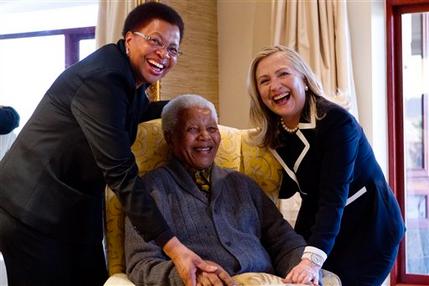
Graça Machel, Nelson Mandela and Hillary Clinton

U.S. Secretary of State Hillary Rodham Clinton visited with Nelson Mandela at his home on Monday to pay her respects to the aging South African icon.

Clinton and a small group flew to the 94-year-old Mandela’s home village of Qunu, where they reminisced and had a small private lunch.

Clinton and Mandela’s wife, Graca Machel, talked as photographers snapped pictures and Mandela looked on smiling from his wingback chair.

“That’s a beautiful smile!” Clinton said.

“Madiba’s smile is a trademark,” Machel said, affectionately referring to Mandela by his Xhosa clan name.

Afterwards, Clinton, Machel and the others went into the main dining room for lunch. Mandela remained in the living room with his medical attendants.

The former president of South Africa has homes in Johannesburg and Qunu. In recent years, he has spent more and more time in Qunu and in May, it was announced that he would stay there indefinitely.

Mandela, a Nobel peace laureate who spent 27 years in prison for fighting racist white rule, has retired from public life. – Associated Press

Hillary Clinton arrives in South Africa to see Mandela

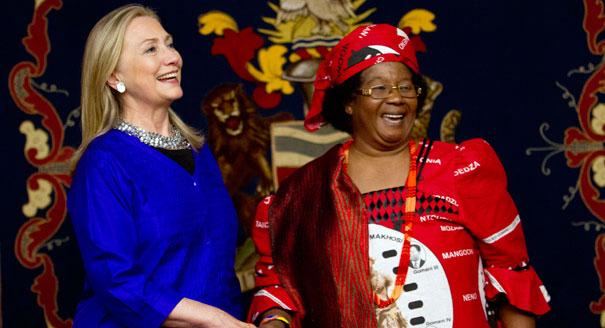
Hillary Clinton and President Joyce Banda of Malawi

US Secretary of State Hillary Clinton is to meet with South Africa’s anti-apartheid hero Nelson Mandela on Monday, the State Department said, hours after her arrival on the latest leg of her Africa tour.

The luncheon with the 94-year-old former president will take place in Qunu, a village in the country’s southeast.

Clinton, who met schoolgirls and Africa’s second woman president during an unprecedented visit to Malawi Sunday before jetting to South Africa, will be in Johannesburg, Pretoria and Cape Town until Thursday morning.

While in South Africa, Clinton is also expected to meet with senior government officials, as well as senior representatives from the South African private sector.

The State Department announced earlier it was partnering with the US Chamber of Commerce to lead a business delegation of approximately 10 senior US executives to the three cities Clinton is visiting.

“South Africa is the leading market in Africa for American goods, and the United States is both an important export market and a source of foreign direct investment for South Africa,” it said.

Members of the business delegation were said to include senior executives from Black & Veatch, Boeing, Chevron, EMD/Caterpillar, FedEx Express, GE, Symbion, Trimble, Wal-Mart, and Zanbato.

A trade mission meanwhile includes the heads of the Overseas Private Investment Corporation, the Export-Import Bank of the United States, the US Trade and Development Agency, as well as Robert Hormats, under secretary of state for economic growth, energy and the environment, and Francisco Sanchez, under secretary of commerce for international trade.

“The mission showcases our commitment to highlighting investment opportunities in Sub-Saharan Africa, particularly in infrastructure, the State Department said.

After trips to Nigeria and Benin, Clinton is due to travel to Turkey Saturday for talks on the conflict in Syria. – Sapa

The ‘Great Leader’ Mandela

by Karin Roodt

This week South Africa, and seemingly the entire planet, celebrated Nelson Mandela’s birthday.  Around Mandela a personality cult has been built that exceeds that of a Stalin, a Mao, a Kim Jong Il and a Hitler. In a global survey it was found that Mandela was a more famous brand than Coca-Cola.

The Soviet author A.O. Avdienko wrote the following:

“Thank you, Stalin. Thank you because I am joyful. Thank you because I am well. No matter how old I become, I shall never forget how we received Stalin two days ago. centuries will pass, and the generations still to come will regard us as the happiest of mortals, as the most fortunate of men, because we lived in the century of centuries, because we were privileged to see Stalin, our inspired leader. Yes, and we regard ourselves as the happiest of mortals because we are the
contemporaries of a man who never had an equal in world history.

“The men of all ages will call on thy name, which is strong, beautiful, wise and marvelous. Thy name is engraven on every factory, every machine, every place on the earth, and in the hearts of all men.

“Every time I have found myself in his presence I have been subjugated by his strength, his charm, his grandeur. I have experienced a great desire to sing, to cry out, to shout with joy and happiness. And now see me–me!–on the same platform where the Great Stalin stood a year ago. In what country, in what part of the world could such a thing happen.

“I write books. I am an author. All thanks to thee, O great educator, Stalin. I love a young woman with a renewed love and shall perpetuate myself in my children–all thanks to thee, great educator, Stalin. I shall be eternally happy and joyous, all thanks to thee, great educator, Stalin. Everything belongs to thee, chief of our great country. And when the woman I love presents me with a child the first word it shall utter will be : Stalin.”

The consecration of Stalin as a kind of divine human, was supposed to overcome the ethnic and geographic divisions within the Soviet Union. The entire exercise was seen as necessary, as building unity and consensus in those days perhaps posed the biggest challenge to the Soviet government.

The end result was a cult of the “Great Leader”, a deliberate project to focus dedication and loyalty on the omnipotent leader, whose persona had to show the way in creating the ideal socialist man or woman out of the diverse ethnic groups that found themselves within the same territory.

The parallels with South Africa are obvious: a country of eleven official languages, tribes, races and religions grappling with the oft-repeated governmental wish of “nation building”.

Stalin was not the only “Big Leader” in history. Hitler and Mao were two other well-known examples of successful personalities that attained cult status, incarnating immense power. The tentacles and violations that resulted from such power, are also known today, unfortunately.

Political analysts believe that China’s present success is partially due to the dismantling or deconstruction of the Maoist personality cult which led to the Cultural Revolution.

In April 2003 a train in North Korea caught fire, with the fire spreading to nearby buildings. Several people died because they had tried to rescue portraits of their “Great Leader”, Kim Jong Il, from the flames. A few dubious pictures of the puffy dictator were saved while people, not photos, were consumed by the fire.

The familiar soap opera of the “Great Leader” greets every North Korean opening his daily newspaper over breakfast. If he is having breakfast at all, that is. For North Korean communism causes food shortages, like elsewhere.

To those who believe in slavery and the subjugation of people, cults of personality may make perfect sense. To the propagandists creating and maintaining such cults, so much more so. It is sometimes amusing to contemplate their ridiculousness, if it were not so tragic that people’s souls are stripped of all meaning.

In Togo and Turkmenistan there exists a similar devotion to the “Big Leader”. The Western media like to laugh at such grotesque celebrities, but strangely they do not practise introspection when it comes to their own “Great Leader”, Nelson Mandela.

He is presented as without blemish, without sin, the ideal man, the personification of the only political ideal worth aspiring to; he typically displays all the qualities of the “Great Leader”.

World leaders, the most influential among the influential, fell over each other in the Western media this week to confess their devotion to the Xhosa, to sing the praises of his political ideals and purity.

Worrying, to say the least. Never in history has a personality cult led to anything worthwhile. The smiling “Great Leader” has always brought death and destruction, as well as the worst misery and slavery.

Translated from the Afrikaans by Dan Roodt.

Clinton visits Mandela

Former US president Bill Clinton paid former president Nelson Mandela a visit on Tuesday at his home in the Eastern Cape village of Qunu.

A statement from the Clinton Foundation said last week that Clinton would visit Qunu on Tuesday, to attend the opening of a container library at the No-Moscow Primary School.

It was unclear whether he would be attending Mandela’s birthday celebrations on Wednesday.

His visit was part of a round-trip of the African continent.

Qunu was besieged by the media ahead of Mandela Day.

Close friends and family were seen being smuggled into Mandela’s home by convoys of vehicles.

Photographers positioned themselves outside the entrance to the home, and attempted to follow exiting vehicles in hopes of confirming whoever had visited Mandela.

Several people thought Mandela would have attended his cousin Morris Mandela’s funeral last Sunday.

Mourners were told he could not make it because of the cold winter weather.

“He is old, he could not have come to the funeral and on Sunday it was very cold,” said Mzwakhe Mandela, Morris’s son.

The guest list for Wednesday’s lunch with Mandela has been closely guarded. Only key employees and local caterers are allowed entry into the homestead.

Inside the Mandela yard, a South African flag was seen hanging high. It is known among villagers that when the flag is up, Mandela is home and is feeling “sound and well”.

Across the N2 highway from Mandela’s house is the home of Silumko Mandela, a close family relative.

He said he had been bothered since last week by the media making enquiries, but was used to them.

“Look, those guys come here often, but at one time the chief in the village told us to be kind to visitors, so we are. The journalists are here to record the history of our own son, uMadiba Omhle [the great Madiba],” he said.

Silumko said he was waiting for a call from Chief Mandla Mandela, the former president’s grandson, to tell him about tomorrow’s proceedings.

“By now, we would usually be knowing what is happening tomorrow, but I do think Mandla has been too busy. Since his arrival, there have been number of things in the family,” said Silumko.

About a kilometre from Mandela’s house, events are underway at the Nelson Mandela Museum.

On Tuesday, the focus was on legacies and the state of archives in honour of Nelson Mandela.

Reverend Frank Chikane and African National Congress chairwoman Baleka Mbete were scheduled to give speeches on Tuesday morning, said museum spokeswoman Nokuzola Tetani. – Sapa