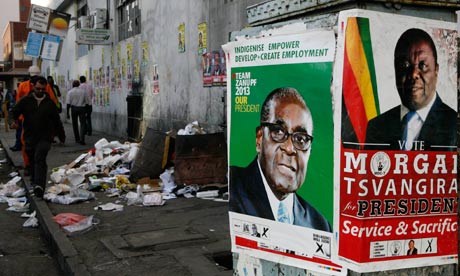
Even before this week’s vote in Zimbabwe, it seems clear that President Robert Mugabe will remain in power. Voter lists have been manipulated, critics are being intimidated and the opposition is divided.
Even after a week’s search, there are no 100-year-olds to be found in Harare, the Zimbabwean capital. There isn’t even anyone who knows a centenarian. Still, there ought to be plenty of very old people in Zimbabwe, because exactly 116,195 of its 13 million citizens have supposedly reached this biblical age. If that were the case, Zimbabwe would be home to nine times as many centenarians as Germany.
“It’s easy to explain,” McDonald Lewanika says wryly: “These people don’t exist. They are phantom voters.” Lewanika is the director of the Crisis in Zimbabwe Coalition, an alliance of regime critics. “The voter list is bogus. I’m afraid the result is already clear: The old man will win again.”
The “old man” is Robert Mugabe, 89, president of Zimbabwe for the last 33 years, since Lewanika was born. During this time, his regime has practically ruined the country, and yet he has been repeatedly re-elected, with completely implausible election outcomes. Through a series of manipulations, Mugabe’s power machine has also made sure that this week’s presidential and parliamentary elections are decided in advance.
Voter List Irregularities
The large number of 100-year-olds is just one of many oddities. According to the voter lists, 63 districts have more voters than residents. And in the rural strongholds of Mugabe’s party, the Zimbabwe African National Union-Patriotic Front (Zanu-PF), there was a miraculous increase in eligible voters, while their numbers were corrected downward in urban areas where, coincidentally, many supporters of the main opposition party Movement for Democratic Change (MDC) live. More than a million people on the voter lists are either dead or have moved away. And 1.9 million citizens under 30 were not even included on the rolls, according to experts with the Research and Advocacy Unit, which analyzed the voter lists. Only those whose names appear on the lists are allowed to vote.
The remaining possible supporters of the opposition are intimidated to ensure that they vote for Zanu-PF. The regime has reportedly distributed 50,000 members of party militias across the country. Dissidents are systematically persecuted, locked up and tortured. In June, a former Zanu-PF cabinet minister who had exposed senior politicians’ involvement in diamond deals was killed in a mysterious traffic accident.
Glen View on the outskirts of Harare is a densely populated, dilapidated neighborhood, with potholed dirt roads, mountains of garbage and wrecked cars by the roadside. The majority of Glen View’s impoverished residents sympathize with the opposition.
A woman waits by the side of the road. She wears a broad-rimmed straw hat to avoid being recognized. It’s dangerous to be seen with white foreigners. She calls herself an activist fighting for democracy, but for security reasons she wants to remain anonymous. “In the 2008 election campaign, Mugabe’s gangs of thugs set houses on fire and beat up people wearing red clothing, the color of the MDC,” the woman says. “We haven’t forgotten that.” Today the Big Man, as he is called here, doesn’t need to resort to brute violence. It’s enough, she says, for his people to go from door to door and hold up matches. “Glen View is practically paralyzed. People are afraid.”
The live broadcast of a campaign event is on the TV screen in a beer pub in Glen View. Mugabe talks and talks, speaking for an entire two hours. He clings to the podium, mumbles, becomes muddled and gets the African Union confused with the European Union. He faces a sea of yellowish-green caps and T-shirts, either real supporters or people who were bussed in to cheer the president, the “God-chosen leader for Zimbabwe,” as Mugabe’s wife Grace calls him.
The geriatric dictator seems exhausted and fragile. He has advanced-stage prostate cancer and has reportedly had two or three mild strokes recently. But his will to stay in power keeps him going. He wants to bring in the harvest of fear and show the world, once again, that he can win.
‘The Kiss of Death’
Mugabe is at his best when he announces his rescue plan for the ailing country. He wants to “indigenize” — that is, expropriate — 1,138 foreign companies and turn them over to the majority control of local businesspeople, cleaning up the government’s budget in the process. “That would be the next pilferage after the catastrophic land reform,” says a market expert who prefers to remain anonymous. “It would be the kiss of death for Zimbabwe.”
The country’s rapid decline began with the land grab 13 years ago, when 4,000 white farmers were expropriated and driven out. Since then Zimbabwe, once a breadbasket, has had to import corn. In addition, some 1.5 million Zimbabweans would starve without the food provided by international aid organizations. Three million have emigrated to South Africa, in the search for bread and work.
After the so-called agrarian revolution, the economy has declined by as much as 40 percent a year, with unemployment topping 90 percent. In 2009, the currency collapsed and was replaced with the US dollar, after inflation had reached the unimaginable figure of 60 billion percent.
Mugabe liberated his country in its struggle against British colonial rule — and then he turned it into a poorhouse. But in his eyes, others are always to blame for Zimbabwe’s troubles: the British, neo-imperialists, whites, the West with its sanctions.
Ironically, the man charged with “indigenizing” the economy is named Saviour Kasukuwere, a giant of a man, as heavy as a prize fighter. His supporters call him “Tyson.” Kasukuwere, 42, the youngest minister in Zanu-PF, has his office on the 20th floor of a high-rise building in downtown Harare. It’s a large office with flashy leather sofas and a view of the city.
Is it possible that party leaders are trying to line their pockets with the help of expropriations? That’s complete nonsense, Kasukuwere grumbles. “It’s about fighting poverty. We are liberating ourselves from economic apartheid.” He sounds like Mugabe, which is probably one reason he is mentioned as a possible successor. There are rumors that the president told a politician friend from Zambia that he intends to step down shortly after winning the next election.
Western Hopes for Peaceful Election
“The preparation for these elections was much too short, and the requirements under the new constitution were not met,” says a Western diplomat. “We just hope that the election is peaceful. And that the military doesn’t stage a coup if the wrong outcome is achieved.” Representatives of the United States and the European Union have already announced their intention to lift the remaining sanctions against the regime if the election remains peaceful.
But that is by no means certain. The majority of the people no longer believe Mugabe’s bluster. In the last presidential election, in 2008, he lost the first round against MDC leader Morgan Tsvangirai, 61. To secure a Mugabe victory in the runoff election, the police, military and party militias terrorized the population, and more than 200 people were killed.
Neutral election observers are not allowed. Only the envoys of friendly nations are permitted to monitor the vote. “Once again, the elections are neither free nor fair. And, once again, Mugabe will steal victory,” predicts Blessing Vava, 30, one of the many bloggers who, for lack of an independent press, are gaining more and more supporters.
The best known of them is “Baba Jukwa,” who discovers new machinations on the part of Zanu-PF every day and has 286,000 supporters on Facebook. Baba Jukwa is a pseudonym, and no one knows who is behind the site. But the whistleblower’s revelations are often correct. So correct, in fact, that Mugabe has promised a reward of $300,000 (€226,000) for his exposure.
“Many young people mistrust the political class and won’t vote for the MDC, either,” says Vava. “They are disappointed in Tsvangirai. Some even accuse him of being in bed with Mugabe.”
Since 2009, MDC leader Tsvangirai has been prime minister in a government brokered by South Africa. But Mugabe still controls the police, military, intelligence services, judiciary and the media. Tsvangirai, the pro-forma premier and opposition leader in one, tends to make headlines because of his womanizing activities. Some of his fellow party members have become just as corrupt as the Zanu-PF fat cats, driving flashy official cars and living in attractive villas. The opposition is deeply divided and has failed to come up with a shared candidate.
In the Book Café in Harare, where artists, intellectuals and students meet, no one takes the politicians seriously anymore. Most of the patrons are under 30, part of a new, skeptical generation that gets its information from the Internet and sees no future in its country.
Three performers are doing a parody of the news broadcast by ZBC, the propagandist government broadcaster, on the stage at the café. One actor is playing a journalist, who is reporting from a village and holds up a sealed ballot box, already stuffed with 50,000 ballots before the election day. “Respect our ancestors!” says the host, and the people in the audience laugh. They know all about the many dead people on the voter lists. – spiegel.de
Zimbabwe President Robert Mugabe’s party claimed on Thursday that the veteran leader had won the hard-fought election over his long-time rival but local observers charged that the vote was seriously flawed.
“We have romped [to victory] in a very emphatic manner. We have defeated the MDC [Movement for Democratic Change],” a top member of Mugabe’s Zanu-PF party told AFP.
He said Mugabe had trounced three-time challenger Morgan Tsvangirai in Wednesday’s vote and that the Zanu-PF had retaken many parliamentary seats in urban areas, where support for the MDC was believed to be strong.
There was no immediate confirmation from election authorities about the claim, and no official results have yet been issued from the presidential and parliamentary vote.
And local observers cited a slew of flaws that called into question the victory claim, after the MDC charged that Mugabe’s rivals had been engaged in vote-rigging.
“The election is seriously compromised,” said Solomon Zwana, the chairperson of Zimbabwe Election Support Network. “Up to a million voters were disenfranchised.”
Regional observers from the African Union had said the process had been “orderly and fair” while the United States said it was too early to make a full judgement.
Turnout was reported to be high nationwide after queues of Zimbabweans lined up for hours to vote in the first election since bloody polls in 2008 that led to the creation of an uneasy government alliance between Mugabe and Tsvangirai.
Final results
The 89-year-old Mugabe, Africa’s oldest leader, is seeking a seventh term but Tsvangirai has voiced hope the election will usher in a new era for the troubled southern African nation.
Final results had been expected within five days of the election and police warned on Wednesday that anyone trying to release unofficial figures ahead of time risked being arrested.
Mugabe himself had even threatened to arrest Tsvangirai if he tried to declare an early victory.
The African Union, which has been accused of whitewashing problems in the run-up to the vote, said initial reports indicated it was “peaceful, orderly, free and fair”.
US State Department spokesperson Marie Harf also said early signs indicated a “peaceful environment” – but that it was too soon to say if the election had been fair.
“We’ve made clear to the government of Zimbabwe and the region that further reductions in our sanctions will only occur if these next elections are credible, transparent and reflect the will of the Zimbabwean people,” she said.
Despite the tensions over the rigging allegations and the fierce rhetoric of the campaign, there were no reports of widespread violence.
Many of the 6.4 million eligible voters started queueing before sunrise in the winter cold, hours before polls opened. The lines continued well into the evening, with many marking their ballots by candle light.
Mugabe said after he cast his ballot there was “no pressure” being exerted on voters.
Series of violent crackdowns
On Tuesday the firebrand had vowed to step down if Tsvangirai was the victor, saying: “If you lose you must surrender.”
Mugabe came to prominence as a hero of Africa’s liberation movement, guiding Zimbabwe to independence in 1980 from Britain and white minority rule.
But his military-backed rule has been marked by a series of violent crackdowns, economic crises and suspect elections that have brought international sanctions and made him a pariah in the West.
As the economy recovers from a crisis that saw mass unemployment and galloping inflation, Mugabe loyalists insist their hero is “tried and tested” and dismiss concerns about his age.
Mugabe had focused his campaign on attacking homosexuals and on promises to widen the redistribution of wealth to poor black Zimbabweans.
Tsvangirai himself predicted the MDC would win “quite resoundingly”.
“This is a very historic moment for all of us,” he said Wednesday. It is the time to “complete the change”.
Tsvangirai won the first round of voting in 2008, but was forced out of the race after 200 of his supporters were killed and thousands more injured in suspected state-backed attacks.
But the 61-year-old former union boss has repeatedly voiced concerns that the election was being rigged and the MDC on Wednesday listed a battery of alleged irregularities.
Rural areas
Finance Minister Tendai Biti, a senior MDC member, said the names of thousands of voters were missing from the electoral roll and that there were two million dead people on the lists.
The MDC handed its evidence to observers from the Southern African Development Community (SADC) and since no Western groups were allowed to monitor the polls, its account will be closely watched.
Tsvangirai hopes his plans to lure back foreign investors, create a million jobs in five years and improve public services will deliver a long-awaited victory.
But some analysts had cautioned against interpreting high urban turnout as a sign Tsvangirai would sweep the election — in which the victor needs more than 50% to avoid a second round.
“This election is going to be decided in the rural areas,” where two thirds of Zimbabweans live and where Mugabe enjoys strong support, said Michael Bratton, founder of pollsters Afrobarometer. – AFP
Vote counting was underway in Zimbabwe’s tightly fought election Wednesday, amid high turnout and accusations of rigging by President Robert Mugabe’s allies who wish to extend his 33-year rule.
The 89-year-old Mugabe is Africa’s oldest leader and is running for office for the seventh and perhaps final time.
His rival Morgan Tsvangirai hopes the election will usher in a new era for the troubled southern African nation.
Organisers reported high turnout across the country for the first election since the violent polls of 2008, that led to an uneasy power-sharing government between the two men.
There were no reports of widespread violence this time round, despite the fierce rhetoric of the campaign.
Police said officers in Harare fired warning shots in the air and arrested 10 soldiers who tried to jump the queue to vote.
At many stations voters started queueing before sunrise in the winter cold hours before polls opened. The lines continued well into the evening, with many marking their ballots by candle light.
Mugabe voted before lunchtime in a Harare suburb, where he insisted the poll would reflect the will of the people.
“I am sure people will vote freely and fairly, there is no pressure being exerted on anyone,” he said.
The one-time teacher came to prominence as a hero of Africa’s liberation movement, guiding Zimbabwe to independence from Britain and white minority rule.
But his military-backed rule has been marked by a series of violent crackdowns, economic crises and suspect elections that have brought international sanctions and made him a pariah in the West.
On Tuesday Mugabe vowed to step down if Tsvangirai was the victor. “If you lose you must surrender,” he said.
Tsvangirai, the current prime minister, said that promise should be taken “with a pinch of salt”.
Tsvangirai won the first round of voting in 2008, but was forced out of the race after 200 of his supporters were killed and thousands more injured in suspected state-backed attacks.
But the 61-year-old former union boss has repeatedly voiced concerns that the election is being rigged.
Tsvangirai’s party on Wednesday listed a battery of alleged irregularities.
Finance Minister Tendai Biti, a senior member of Tsvangirai’s Movement for Democratic Change, said the names of thousands of voters were missing from the electoral roll.
Biti, speaking after a meeting with the electoral commission, added: “They are admitting that there’s still two million people who are dead on the voters’ roll, but they said ‘because they’re dead, they can’t vote’.”
The MDC has handed its evidence to observers from the Southern African Development Community (SADC).
Since no Western groups were allowed to cover the presidential and parliamentary poll, the SADC’s account will be closely watched.
The African Union, which has been accused of whitewashing problems in the run up to the vote, said initial reports indicated it was “peaceful, orderly, free and fair”.
In Washington, US State Department spokeswoman Marie Harf also said that early signs indicated a “peaceful environment” — but that it was too soon to say if the election had been fair.
“We’ve made clear to the government of Zimbabwe and the region that further reductions in our sanctions will only occur if these next elections are credible, transparent and reflect the will of the Zimbabwean people,” she told reporters.
Tsvangirai cut a confident figure as he cast his own ballot, predicting his MDC would win “quite resoundingly”.
“This is a very historic moment for all of us,” he said. It is the time to “complete the change”.
Turnout appeared to be particularly brisk in the urban areas where Tsvangirai has enjoyed his strongest support, and which he must retain to stand any chance of victory.
But some analysts cautioned against interpreting the high urban turnout as a sign Tsvangirai would sweep the election.
“This election is going to be decided in the rural areas,” where two thirds of Zimbabweans live and where Mugabe enjoys strong support, said Michael Bratton, founder of polling organisation Afrobarometer.
Police warned on Wednesday that anyone trying to release unofficial results ahead of the official figures risked being arrested.
Already Sunday, Mugabe had threatened to arrest Tsvangirai if he tried to declare an early victory.
Some 6.4 million people, around half of the population, are eligible to vote. A candidate needs 50 percent of the vote to avoid a run-off.
The sharp-tongued Mugabe has focused his campaign on attacking homosexuals and on promises to widen the redistribution of wealth to poor black Zimbabweans.
As the economy recovers from a crisis that saw mass unemployment and galloping inflation, Mugabe loyalists insist their hero is “tried and tested”.
Tsvangirai hopes his plans to lure back foreign investors, create a million jobs in five years and improve public services will deliver a long-awaited victory.
The final results are expected within five days. – AFP
Newly formed South African political party, the Economic Freedom Fighters (EFF) yesterday called on Zimbabweans to vote overwhelmingly for Zanu-PF in the July 31 harmonised elections to protect the gains of the war of liberation.The EFF party is led by former ANC youth league leader Julius Malema.
“The Economic Freedom Fighters (EFF) calls upon the revolutionary people of Zimbabwe to defend the Zimbabwean revolution by voting for Zanu-PF and retaining comrade Robert Mugabe as the President of that liberated nation,” the party said in a statement.
“The gains of the Zimbabwean revolution must be defended.
“These gains find concrete expression in the historic and unparalleled land redistribution programme that took land from 4 000 white settler farmers who owed 80 percent of Zimbabwean land, and redistributed it to more than 274 000 Zimbabweans! It is your victory. Defend it by any means necessary!”
The EFF said Zimbabweans stood to benefit economically by retaining a Zanu-PF government which has over the years implemented pro-poor policies aimed at uplifting the lives of ordinary Zimbabweans.
The party saluted Zimbabweans for enduring and surviving a brutal and illegal economic sanctions embargo imposed by the West as punishment for returning the stolen land to its rightful owners.
“The people of Zimbabwe have been punished as a strategy to separate the people from the revolutionary leadership of Zanu-PF and leadership of President Mugabe. We say do not allow the schemes of the enemies of Africa to succeed. Vote for liberation! Vote Zanu-PF!
“We implore the people Zimbabwe to realise that the Zimbabwean revolution is still under massive attacks and new plots are being hatched and new schemes cooked to reverse the gains you have made.
“The demonisation of Zanu-PF and comrade Mugabe is part of the plot to divide the nation for re-colonisation,” it said.
The EFF also called on Zanu-PF to continue implementing the indigenisation programme in order to complete the economic emancipation of the black majority. – The Herald
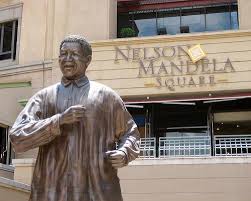
Three protestors chained themselves to Mandela’s statue at Nelson Mandela Square on Tuesday to voice their concerns about the presidential election in Zimbabwe.
Zimbabweans went to the polls on Wednesday. According to Reuters, the Zimbabwean exiles argued that despite the imminent election, their country was not free.
The three wrapped a thick silver chain around their necks at the base of the 2.7 metre tall statue. The spectacle ended quickly after security staff requested them to leave.
The protest happened in the affluent Sandton Square shopping centre, the site of the towering bronze statue of Mandela.
The three Zimbabwean nationals brandished placards with the message: “Zimbabwe deserves to be free.”
The protest did not last long after security guards told them and some supporters and passersby to leave.
But the message soon spread on Facebook and Twitter, with other Zimbabwean exiles echoing the sentiment that the country is still not free from the control of Robert Mugabe and Zanu-PF.
Respected human rights advocate and the head of the Zimbabwe Exiles Forum, Gabriel Shumba, told SW Radio Africa that voting day is a bittersweet one for Zimbabweans in the Diaspora. He said that while there is “so much hope for change,” there is still skepticism.
Thousands of Zimbabweans in the Diaspora have returned home to vote, after the right to vote in their resident countries was denied by the government. This is in spite of a successful court application that Shumba filed at the African Commission on Human and People’s Rights, which ordered the Zim government to allow the postal vote for Zimbabweans in the Diaspora.
“What we were told when the government defied this order is that we should try go back and vote anyway. Unfortunately not everyone can do this, and even when they do, it seems the practice on the ground is to deny this,” Shumba said.
He was referring to the fact that at least seven buses believed to be filled with Zimbabweans travelling from South Africa to cast their votes, were stopped at Beitbridge in the early hours of Wednesday morning. One of the buses was impounded and the others were prevented from travelling onto their final destinations. It is understood that the Zimbabwe Lawyers for Human Rights were trying to intervene on Wednesday morning.
“So there is a mood of skepticism that this vote will bring change. We don’t think this election will be credible, legitimate, free and fair,” Shumba said.
Riot police were reportedly deployed in Zimbabwe on the eve of the election. An election in 2008 was marred by political violence. – SW Radio
Whatever the result of Zimbabwe’s election Wednesday one thing is for sure: four years of uneasy power-sharing between President Robert Mugabe and Prime Minister Morgan Tsvangirai will end.
As Zimbabweans streamed to the polls, the unity government partners sighed with relief at the close of their “painful”, “disappointing” union.
The forced marriage was arranged by the international community to avoid further violence in the wake of suspect and blood-soaked 2008 elections.
Tsvangirai won the first round, but was forced to drop out of the second round amid the killing of 200 of his supporters.
He then became prime minister as a reluctant partner in the unity government alongside Mugabe, the former guerrilla who has ruled since independence from Britain.
While the power-sharing deal which took effect in 2009 prevented full-scale conflict, critics today deplore its failure to achieve much-needed democratic reforms and kickstart the economy.
“It has been a major disappointment,” Rugare Gumbo, spokesman for Mugabe’s ZANU-PF party, told AFP.
But communications minister Nelson Chamisa, spokesman for Tzvangirai’s Movement for Democratic Change (MDC), said the government had achieved some victories.
“It has been difficult, difficult, painful but useful for the people of Zimbabwe. People’s lives have improved,” he said. “We are excited that we are coming out of the blast furnace.”
The arrangement was aimed at creating a “genuine, viable, permanent, sustainable” solution to the crisis.
But in its early days, Mugabe could not hide his discomfort.
“I feel awkward in a thing like that, absolutely awkward,” he told mediator President Jacob Zuma of South Africa at the time.
Ex-finance minister Simba Makoni, who was not part of the unity deal, branded the Mugabe-Tsvangirai government “pathetic” and “dismal”.
And analysts said the deal had failed to set a democratic framework for fresh elections.
Days before Wednesday vote, the country was “still grappling with issues of reforms, the timing of elections, issues of sporadic violence and intimidation,” said Trevor Maisiri, a researcher with the International Crisis Group.
“It has not fully served its primary purpose because the idea was to create a transitional mechanism that would lead to a credible election,” he said.
Initially the unity government was to last just two years but it had to be extended as delays plagued the formulation of a new constitution that would lay the basis for credible polls this time around.
The MDC “regrets, definitely that quite a number of reforms did not move as we had wanted,” said Chamisa, highlighting a lack of revisions of the media and security sector.
Civic rights coalition Sokwanele, which kept an eye on the government’s performance, traced 22,482 violations of the agreement — 90 percent by ZANU-PF.
The rivals still strongly disagree on the economy, and bitterly blame each other for Zimbabwe’s slow recovery.
Unemployment still hovers on the wrong side of 50 percent while millions of people are still economic refugees in neighbouring countries.
Once a net food exporter known as Africa’s breadbasket, Zimbabwe’s reformed agricultural sector is yet to produce enough to feed the country.
“There were many programmes that we were going to carry out, but our colleagues acted like they were an opposition party instead of carrying themselves as part of the government,” the ZANU-PF’s Gumbo claimed.
The MDC said it opposed “ill-conceived” black economic empowerment schemes that forced foreign companies to cede a majority of their shares, saying it drove away investors.
But some say the power-sharing agreement was not all bad.
The government rescued the moribund economy by abandoning the Zimbabwean dollar, ending rampant inflation that peaked at 231 million percent.
Politicians who previously had not seen eye-to-eye suddenly were forced to run the country together, which may explain the peaceful run-up to Wednesday’s polls.
Just being able to talk to each other in parliament or in cabinet “has really been helpful,” said Gumbo.
The coalition “brought about some sanity, peace and stability. We are not fighting as we used to. Even campaigning is being done in a peaceful, orderly manner,” he said.
Chamisa also said the unity government was a healthy exercise.
“The past four years showed that another Zimbabwe is possible. A Zimbabwe where we can realise, appreciate and celebrate the cross-pollination of ideas,” he said.
Justice Piitso says the question of the ownership of the economy is the nerve centre of the struggles of the people
A revolution will remain incomplete without the resolution of the fundamental question of land ownership.
Next week the people of Zimbabwe will have an opportunity to exercise their democratic right to elect the government of their choice when they will be going to the polls.
This will be the most historic elections paving way for the end of the power sharing unity government between the ZANU -PF under President Robert Mugabe and the MDC under Prime Minister Morgan Tsvangirai.
This complex transitional arrangement is unfolding under the auspices of the watchful eye of the international community. The recent past elections were marred by allegations of state sponsored violence and intimidation of voters that made it difficult for a conducive environment of a free and fair elections.
It will therefore be in the best interest of the people of Zimbabwe that the forthcoming elections take place within the enabling framework of a free and fair environment. The people of Zimbabwe, Southern African region, the continent and the world need peace and stability.
The elections are taking place against the background of protracted forms of struggles between the government of Zimbabwe and the former colonial power Britain, over the historic land ownership question.
The political tensions escalated when the government under the leadership of ZANU-PF, embarked on a programme of seizure of land from the hands of the few white into the hands of the vast majority of the black people of Zimbabwe.
The state led radical programme for seizure of land from the white Zimbabwean community, sparked a fierce reaction that prompted the international community to impose sanctions against the government under the leadership of President Mugabe.
The imposition of the economic sanctions by the international community was a confirmation that colonial societies are ordered by imperialism. The reason why we say the Zimbabwean revolution fiddled with the nervous system of the forces of imperialism and colonialism.
It is from this context that revolutionaries openly debate on the important question of the complexities of the post colonial transitional periods, and how they affect the struggles of our people in the former colonies and semi colonies.
Equally we need to appreciate this as a metamorphosis of how the post colonial contradictions manifest themselves in the arena of the struggles of our people, against imperialism and neo colonial domination.
In the year 1980 Zimbabwe was declared an independent state after decades of protracted forms of struggles for national liberation against British colonial domination and the racist South African apartheid regime.
The declaration of the independence of the former colonial state of Rhodesia, was a historic breakthrough in the struggles of our people for the liberation of the Southern African region.
The declaration of the independence of the former colonial state of Rhodesia was a product of a negotiated transitional political arrangement. The transitional negotiations culminated into the former colonial master Britain and the liberation movement of Zimbabwe signing the historic Lancaster Agreement.
At the heart of the watershed agreement was the unwavering commitment by the British colonial government to assist in ensuring equitable transfer of land back to the overwhelming majority of the people of Zimbabwe. It was agreed that the process should be completed within the first decade of the transitional period.
Historical records prove that the British colonial government rescinded by not expediting the process of the transfer of land as agreed at the Lancaster house. This is the fundamental problem that has aggravated the present socio economic crisis.
The Zimbabwean land ownership question is a living testimony of how complex post colonial transitional period can be in the context of the history of the struggles of our people in the former colonies and semi colonies. It also relates to the nature and the character of the struggles, between the oppressor and the oppressed nations, post colonial transitional period.
At the core of these struggles is the fundamental question of how do we involve the oppressed people in the former colonies and semi colonies into the mainstreams of our economy. The primary issue remains to be how do we resolve the fundamental question of the ownership of the economy.
The scientific historical realities have proven that the question of the ownership of the economy is the nerve centre of the struggles of our people. The basic reason why it has become the most contentious issue after every war of the independence of our people.
The pertinent question is how do we understand the interrelationship between the primary and secondary contradictions. The mistakes we must avoid is to elevate secondary contradictions at the expense of primary contradictions.
Imperialism is trying to confuse our people by elevating the superficial issues of human rights at the expense of the fundamental question of the ownership patterns of the economy.
We must therefore refuse the attempts by imperialism to reduce the role of the people in the former colonies and semi colonies into being praise singers of national anthems and hoisting of National flags.
The most fundamental question is how do we take forward the common struggles of our people to create a new world social order. Our immediate task is to implore our collective responsibility to resolve the contradictions of poverty, disease and underdevelopment inflicting the poor people of the world.
We therefore have to ask ourselves the most important question as to what are the lessons and experiences we have learned out of the contradictions of the Zimbabwean post colonial transition.
We have to ask ourselves the most important question as what is the role and influence of the phenomenon of imperialism and colonialism during the transitional period of the post colonial nation states.
The essence of any revolutionary phase is about generations of mankind making sacrifices. The people of Zimbabwe have made sacrifices during the struggles for liberation against British colonial rule, and they are still making sacrifices today as they continue with the struggles for the socio economic transformation of their country.
The struggles of the people of Zimbabwe are still consistence with the values, culture and traditions of the progressive movement of the world. Its posture is still anti colonial in form and content.
The only task confronting the collective leadership of the ZANU-PF is how to polish their understanding of the scientific revolutionary concept of the role of an individual in the making of history.
The collective leadership of the ZANU-PF will go into the annals of history, having been the first generations of the people of the former colonies and semi colonies to have fiddled with the nervous system of the forces of imperialism and colonialism.
Phatse Justice Piitso is the former Ambassador to the republic of Cuba and the former provincial secretary of the SACP.
President Robert Mugabe on Thursday rebuked the “insane” US for criticising his push for elections without key reforms and told it to keep its “pink nose” out of Zimbabwe’s affairs.
“America must be mad, absolutely insane,” Mugabe, who is seeking to extend his 33-year rule, told an election campaign rally in the northern town of Chinhoyi.
US President Barack Obama during his visit to South Africa last month called on Zimbabwe’s government to apply key reforms ahead of the landmark elections.
“For anyone to suggest that our elections must not be held even after the expiry of the term of parliament, because some party is arguing for reforms of our security forces, is a mad argument, completely.”
Mugabe declared July 31 polling date to choose a successor to the wobbly power-sharing government.
His main rival Prime Minister Morgan Tsvangirai had wanted a delay to allow time to implement a battery of reforms including an overhaul of the security forces headed by Mugabe’s allies.
During his visit to neighbouring South Africa, Obama said “harassment of citizens and groups needs to stop and reform needs to move forward so people can cast their votes in elections that are fair and free and credible.”
Mugabe said Zimbabwe would determine its own future and that the US has no moral ground to chastise his regime.
“Keep your pink nose out of our affairs, please.”
“Where do you get that audacity to open your mouth and try to sermonise us,” questioned Mugabe, alleging racism was rife in the US.
“Your prisons are still full of blacks. Where is your democracy? There is lots of racism in your country.”
He reiterated his decision to bar the US and the European Union from observing the Zimbabwe vote.
“We have already invited well meaning friends. Ill-intentioned friends, we never can invite.”
Observers from the Southern African Development Community and the African Union will watch the vote.
The EU Thursday wrapped up a summit with South Africa, urging Zimbabwean political players to take all the necessary steps “to create and ensure a conducive environment for the holding of peaceful, credible, free and fair elections”. – Sapa-AFP
Zimbabwe’s political rivals have clashed over an apparently secret document said to be from intelligence sources that alleges an outlandish plot by President Robert Mugabe to hire a Lebanese murder squad to assassinate his South African counterpart, Jacob Zuma, and a top diplomat.
The typed two-page report – persuasively detailed but at times written in excitable language strewn with grammatical and spelling errors – has been dismissed by Mugabe’s Zanu-PF party as “hogwash” and a “typical setup”. The rival Movement for Democratic Change said the assassination threats should be taken seriously.
Roy Bennett, the MDC treasurer-general, in exile, was more certain. “We know the report to be credible; it comes from reliable and trustworthy sources within the heart of the CIO [Central Intelligence Organisation],” he said. “It is a stark reminder of the full horrific extent that Robert Mugabe is prepared to go in order to hang on to power and avenge his critics.”
The MDC and civil society groups in Zimbabwe have applauded Zuma for taking a tougher stand against Mugabe than the previous South African president, Thabo Mbeki.
They come amid souring relations between neighbours Zimbabwe and South Africa. Last week Mugabe branded Zuma’s chief mediator, Lindiwe Zulu, “some stupid, idiotic woman” and a “little street woman” after her failed attempt to force a postponement of elections.
The purportedly leaked document, dated 2 July and of unknown authorship, contains a paragraph headed: “Lebonese assasins” (sic). It states: “On Monday this week Mugabe hired six Lebanese nationals to try and assassinate Lindiwe Zulu, who is Zuma’s advisor. The six met clandestinely with Mugabe yesterday to be briefed by him on the details of their mission … The six were told they must not concentrate on Zulu only, but should also pay attention to Zuma himself, and if they get a chance to do so they must assassinate him as well – but everything must appear as an accident.”
It adds: “Mugabe promised the six Lebonese [sic] an undisclosed fortune in cash if they succeed in getting rid of the two who [sic] South Africa senior officials who are giving him a lot of trouble. Names of the six could not be established, but they entered into the country via Zambia in the last few days, where they had previously held a close meeting with [president] Michael Sata before travelling into Zimbabwe.”
The document also claims that Mugabe summoned and castigated security officers over a leak to the MDC leader, Morgan Tsvangirai, regarding the involvement of an Israeli company in managing the country’s electoral role. Mugabe ordered that “the culprits who leaked the information are made to suffer and die a painful death”, it says. Tsvangirai has spoken publicly about his concern over the role of the Israeli company Nikuv.
The secretive Israel-based firm – accused of manipulating past elections in the region – is alleged to be involved in managing Zimbabwe’s voters’ roll.
Eddie Cross, a MDC MP told the Mail & Guardian that he had been informed by security sources that the company, Nikuv International Projects, is working on the roll at Defence House, the headquarters of the Zimbabwe Defence Force. The MDC also alleged that Nikuv was a front for the Israeli intelligence agency Mossad, although it offered no evidence to support the claim.
Cross said the source told him that the company is working under the direction of Daniel Tonde Nhepera, the deputy head of the Zimbabwe’s dreaded internal security arm, the Central Intelligence Organisation (CIO).
Another Zimbabwean intelligence source confirmed to the M&G the allegation that Nikuv is working on the voters’ roll “with the CIO”.
The Guardian has seen a copy of the two-page document but has not been able to verify it as being genuine. The possibility that it is a hoax designed to embarrass the opposition cannot be ruled out.
Rugare Gumbo, spokesman for Zanu-PF, insisted: “To be frank with you, it’s all rubbish and hogwash to think a head of state like president Mugabe would set up something like that. We have a disagreement with Lindiwe Zulu but it would not go to that extent.”
Asked about the alleged threat to Zuma, he replied: “You should not take it seriously. It’s a typical setup in Zimbabwe to try and cause some confusion before the election because we are going ahead with our election according to our laws whether they like it or not.”
But this is not the first time allegations have surfaced of Zimbabwean government agents carrying out clandestine operations in South Africa. Nor are rumours of assassinations so unusual: South Africa’s Mail & Guardian newspaper recently compiled a list of nine Zimbabwean politicians who have died in mysterious car crashes, including the one last month involving Edward Chindori-Chininga, the outspoken chairperson of a parliamentary committee that had just released a highly critical report on the diamond industry.
Fierce factional infighting within Zanu-PF and the security sector has resulted in a number of damaging intelligence leaks, notably on the Facebook page of a mole known as Baba Jukwa.
Douglas Mwonzora, the MDC’s spokesperson, said of the document: “We have had sight of the intelligence information but we are unable to confirm its authenticity. For the MDC, the international community must take these assassination allegations seriously.” – The Guardian
– See more at: http://praag.org/?p=7173#sthash.Q4ousLtS.dpuf
Zimbabwe’s finance ministry said it needs to resolve a shortfall of about $85 million needed for crucial national elections just three weeks away, as a month-long chaotic voter registration effort drew to a close Tuesday.
Tendai Biti, the outspoken finance minister, described preparations for the July 31 polls as “a nightmare.”
“We don’t have money for these elections, and everyone knows it. It’s a horror movie except that you are not watching the movie, you are part of it,” Biti said late Monday.
The elections are the first to be held since the violent 2008 polls forced President Robert Mugabe to join into a coalition government with longtime opposition leader Morgan Tsvangirai, a bitter political nemesis. Mugabe has ruled Zimbabwe since independence in 1980.
On Tuesday, Mugabe’s office said it was cancelling cabinet meetings until the vote so that ministers can campaign for the election.
Tsvangirai, 61, began intense campaigning in the remote northeast Tuesday. Mugabe, 89, has not announced his own campaign schedule but his Vice President Joice Mujuru, 58, has begun a series of rallies for their ZANU-PF party.
Mugabe’s opponents maintained he had acted alone without consulting coalition leaders in a ploy to favor his party. Mugabe said he was following the instructions of a Constitutional Court ruling earlier this month.
Tsvangirai had argued that the July 31 date did not allow enough time for the needed democratic reforms to take place, and that the rushed election did not provide the conditions necessary for a free and fair vote. He later said he was accepting the date with sadness and reluctance but was confident of a victory over Mugabe.
National elections in Zimbabwe are routinely held over two days with ballots cast at up to 9,000 polling stations across the country, slightly larger than Germany. The commission says tens of thousands of voters who have since died have been removed from the lists.
The U.S.-based Robert F. Kennedy Center for Justice and Human Rights said in its latest report on Zimbabwe the close approach of the vote has ramped up political tensions in the country. It said opponents of Mugabe are facing “an atmosphere of intimidation,” curbs on free expression and political activities and the suppression of easily accessible voter registration and voter education.
“This behavior is unacceptable and represents clear breaches of domestic and international law,” said Santiago Canton, head of the center’s rights group.
Leaders of the 15-nation regional bloc known as the Southern African Development Community, or SADC, had also called on Mugabe and the judiciary he controls to delay the crucial elections.
Mugabe, launching his party’s manifesto on Friday, had also threatened to withdraw from SADC, the regional bloc he helped found, saying its chief mediator on Zimbabwe, South African President Jacob Zuma, and his colleagues had pushed for delaying the polls.
Biti, the finance minister, said he has had to “freeze” payments to government departments and only meet public service salaries to try to find the money for this month’s vote.
“The whole thing is an absolute, undiluted dog’s breakfast,” Biti said. – AP
We have a serious crisis in this country. With many millions of South Africans affected by poverty and unemployment, many millions more are expected to be affected. With high food prices already knocking the pockets of every South African, we can expect astronomical prices in the coming years and a scarcity of basic food stuffs. “A scarcity in basic food stuffs? You must be joking!” That’s what I’d say 10 years ago, but no longer. From an agricultural giant and leading world exporter, we have quickly found ourselves in the realm of net importer status. All because the ruling party got it wrong.
After our transition to democracy, the ANC decided that land redistribution was the way to go. And like planting seeds, they drew up their policies and passed a number of bills. These plans were meant to redistribute white farmers’ land to black farmers and to communities which were previously the ‘rightful owners’. Today, many years down the line, these seeds have grown to such an extent that a disaster looms for all. Let me illustrate the ruling party’s end produce.
Decline in commercial farmers, skills lost in 1994 there were some 120 000 commercial farmers but today a mere 37 000 remain. Yes, many of the previously 120 000 commercial farmers were white and transformation needed to take place, but with a sum total of 37 000 commercial farmers today, how many successful, black, commercial farmers have we produced and how many successful, white, commercial farmers has our country lost?
Farming has become “SA’s most dangerous job”. The threat of being the next farm murder victim (almost 4 000 farmers since 1994) and the threat of land grabs have resulted in many successful, white, farmers packing their bags and heading for greener pastures. And many of these farmers have indeed found greener pastures abroad and in other African countries. Congo, Malawi, Uganda, Tanzania and Mozambique are some of the governments who have invited them to farm in their countries on land earmarked for farming.
Other countries such as Gabon, Guinea and Ghana are also in talks. The starving continent of Africa has a huge demand for agriculture, job creation and filling empty stomachs. What better place for these farmers to apply their knowledge and skills. Further up north, Georgia has invited this group of endangered species to attempt to revive their agricultural industry by providing land and equipment. Quoting the Georgian government spokesperson, “South African farmers are some of the best farmers in the world. They have good experience and we would like to see such farms in Georgia. There is a lot of potential here.”
Regarding Georgian farmers who generally struggle to earn a decent living, “They want to set up joint ventures with South African farmers because they think they could raise the profitability and productivity of their farms,” he said. “They are more than delighted to have South African farmers and South African expertise on their farms.”
Meanwhile our government has opposing, often moronic, views to the rest of Africa. The Agriculture Minister, Tina Joemat-Pettersson, last week said the following regarding the departure of commercial farmers from South Africa, “This will not be a threat to food security in South Africa; instead, this will enhance food security in the continent.” This a real irony considering that other countries are trying to do the same thing but by attracting our farmers to their farm lands. It gets more idiotic when she says, “South Africa has skills it can share with other South Africans and with the rest of the continent.”
To an educated mind it would appear that skills are departing with the departing farmers and these skills are to be applied in other African countries indefinitely. Back at home, along with the loss of these farmers and their skills and experience, the former workers of these farms have lost their jobs. From around 1.6 million tax-paying farm workers (mainly black) which were employed in 1994, to around 300 000 in just 16 years.
I challenge anyone to provide me with intelligent reasons on how losing 83 000 commercial farmers and losing over a million jobs are to the advantage of our country and our people.
Demise of profitable, food producing farms According to the ANC itself last year, 90% of redistributed farms do not produce excess food. Farms which once produced hundreds of thousands of tons of produce and employed hundreds of workers now lie idle and are a mere shell of what they used to be. The remaining few black farmers are but a handful and use the land for subsistence farming.
Mismanagement, corruption and the lack of sufficient skills and experience has had catastrophic effects on many farms. To mention one of a thousand examples of farms which are now liquidated/idle/non-producing:
The Zebediela Citrus Estate (Limpopo) – Once described in the Readers’ Digest, “400 million oranges are harvested each year from the groves of Zebediela, the world’s biggest citrus estate. The output is sufficient to provide one orange for every eight people on earth.” This magnificent farm went from riches to ruins in just a few years after being taken over by the state.
Yet the talk/threat of land grabs/redistribution continues.
To avoid looking like a second Zimbabwe and forcibly removing white farmers off their land, the government has now come up with cunning plan to grab land without having to remove the white farmers by force. This plan is called the “Land Tenure Security Bill”. If signed off by the ANC government it will amongst other things, give farm workers the right to keep livestock on the farms where they work, which will be allowed to graze “indiscriminately” on the property.
The bill will also give workers the right to plant their own crops and build homes for themselves and close relatives, from which they may never be removed. Andy Tladi, a black sunflower farmer, says he is leaving to the DRC this year as the bill “gives farm workers a ‘blank cheque’ to do whatever they want to do on land that doesn’t belong to them. The bill is going to worsen the situation for farmers. You are actually going to see workers putting up villages on farms. If you allow 10 people to build houses on a farm, in about 20 years you could have up to 30 families. So how does the farmer continue to grow and invest under those circumstances? I am a black farmer and I won’t be able to handle that. A lot of farmers will fly out of the country.”
The high likelihood of failure for black farmers is a reality. Without the necessary skills and experience, even a successful farm which has been acquired through redistribution most often fails. Then when a rare success does happen, more often than not, there is a lack of backing from government which leads to failure or inability to grow. Steven Mohale, a leading black, tomato farmer in Limpopo, has been battling for years to get government assistance in order to grow his business. But it seems the only help he received was from private banks and white farmers.
To quote an article about Steven in Farmers Weekly, “I’m very disappointed in the way the government treats farmers. It’s high time government stopped insulting farmers. We spend a lot of time with white farmers in this area and almost all are very helpful. People who accuse farmers of bad things are talking nonsense. South Africans need to realise the sector is responsible for feeding the nation and creating employment – and so farmers deserve respect. But government’s attitude doesn’t help.”
In conclusion, it is clearly obvious to someone with a little bit of intelligence that we are heading for disaster. In fact we are already looking at a disaster if you look at how the majority has suffered in the last decade or so in terms of poverty, unemployment and starvation. Billions of taxpayers’ rands have been pumped into redistribution projects and this money has literally been flushed down the toilet, not to mention the millions stolen by corrupt, ANC linked officials. Now billions more has to be spent of which another 90% will be wasted. With calls for 100% nationalisation by Julius Malema, we could be in for even more serious trouble. At this moment I do not see much hope for agriculture in our country and in turn not much hope for the economy and our people.
William Mukurazita’s deposit at the bank has four legs and moos.
Zimbabwe’s first “Cattle Bank” has just opened its books in a unique kind of banking where owners bring in their animals as collateral against cash loans.
For many rural poor in this southern African country once wracked by world-record inflation, it’s the first bank account they’ve ever had.
“Cattle banking is the only way owners can get monetary value for their animals without having to sell them,” bank executive Charles Chakoma told Associated Press, speaking from a smallholding near Marondera, east of Harare.
Owners accrue interest and have the option to get back their cattle after an initial two years or leave them with the bank for longer. Depositors can get loans of an equal value of the cattle they have put in the bank.
In the event the owner fails to repay the loan, the bank keeps the animals. When an owner dies, a close member of the family can take over payment of the loan and ultimately get the cattle back.
The bank, which owns several fast food outlets across the country, says it also will slaughter aging cattle for beef and replace them with more productive cattle of the same value.
Mukurazita, 69, and his wife, Elizabeth, 66, kept about 70 head of cattle at Masomere village, 140 kilometers (90 miles) from Harare. But poor health stopped them from looking after their herd and at least 20 animals died or were stolen, Elizabeth Mukurazita said.
Now they have “deposited” 24 cattle at the TN Bank, named after its founder, financier and social innovator Tawanda Nyambirai. The couple now has $10,000 worth of cows in the bank.
“If we only knew about this cattle banking before, we could have saved all of our herd,” Elizabeth Mukurazita said.
A veterinarian checks the animals and the bank pays to transport them to paddocks it has bought across the country for fattening and cross-breeding programs. Owners are issued with the bank’s ‘Certificate of Cattle Deposit’ as proof of a transaction.
As bank officials log in their cattle, the Mukurazitas look worriedly at a scrawny calf whose mother has died days before. Two other calves nurse from their mothers. The envious, starving orphan makes an attempt to reach for the cow’s udder but is kicked aside and wanders off to graze awkwardly on a small patch of grass.
Untended, it will die within days, said Chakoma, the banker. The state veterinary official passes the calf and values it at $49.
He said the bank wasn’t supposed to accept unhealthy animals, but that this particular calf might survive because it was able to graze on its own. He requested anonymity saying he needed his superiors’ permission to speak to reporters.
Only 20 percent of Zimbabwean cattle are in commercial ranches. The rest – some 3.5 million village animals – are valued at more than $1 billion, Chakoma said. The TN Bank wants to reassure Zimbabweans that despite years of world record inflation their bovine savings are safe, he added.
In traditional rural society, cattle symbolise wealth and play a role not just in farming but as marriage dowries, funeral sacrifices and appeasers of ancestral spirits. Many cattle owners are reluctant to give up such a valued status symbol, but Chakoma said cattle banking eases the burden on the elderly, left behind as young people head for the cities.
“Farmers may not want to part with their animals but we try and persuade them to keep a few for tilling and milking as the rest will just be a burden to them,” he said.
During the dry season, there is less pasture and cattle roaming in search of grass often get lost or stolen. In winter, the cold can kill them.
Interest can be paid in cash or cows. The Mukurazitas say they’d prefer it in cows so that their son can take over managing a new herd and get more land later.
“We don’t necessarily want the cash; we want to improve our herd, ” said William Mukurazita. – Sapa
Zimbabwean President Robert Mugabe has filed an urgent application with the country’s top court to push back crucial elections by two weeks, his justice minister said Wednesday.
Justice Minister Patrick Chinamasa told AFP he had filed papers “yesterday (Tuesday)” that sought “a postponement of the date for the harmonised elections from July 31 2013 to August 14, 2013.” – Sapa
'Fast-track land reform' of the Zimbabwean style, as sought by Max du Preez
by TAU Bulletin
Anti-apartheid journalist and apologist for South Africa’s democratic dispensation Max du Preez has been caught short with his latest efforts to justify the unjustifiable. In a Natal Mercury piece (30.4.13), Du Preez tells us we can “learn from Zimbabwe’s flourishing farms”, and goes on to laud a new book by three London (where else?) left wingers: London School of Economics’ Joseph Hanlon, an anti-apartheid and commonwealth sanctions activist in the 1980’s; Jeanette Manjengwa, Deputy Director, Institute for Environmental Studies, University of Zimbabwe; and Teresa Smart, visiting fellow at the University of London.
Du Preez says the book “Zimbabwe Takes Back its Land” shows that Zimbabwe’s radical land grab “has worked” and that “agricultural production is on levels comparable to the time before the process started.” What is meaningful, says Du Preez, is that these production levels were achieved by 245,000 black farmers on land previously worked by some 6 000 white farmers. He clearly does not see the irony in this – does it take 245 000 Africans to produce the same as 6 000 white farmers?
(It is interesting that euphemisms such as “the process”, “land redistribution” and “fast track land reform” are used in the book and by Mr. Du Preez to describe one of Africa’s most haunting and terrifying attacks on any country’s productive agricultural sector. Who can forget the horrifying television footage of mobs of so-called war veterans storming white farms, destroying farm animals, beating to death family dogs trying to defend their owners’ properties, while farm families who couldn’t flee fast enough met sometimes gruesome fates at the hands of these thugs, all in the name of land reform. Ironically, these destructive mobs received few farms at all – the choicer properties were taken by Mugabe’s cronies for, in some cases, weekend parties.)
From the book, Du Preez says lessons South Africans can learn is that new black farmers can actually farm successfully and commercially if given enough time and help, and that an “ambitious land redistribution programme (in South Africa) can play a role in alleviating poverty and providing employment and dignity to large numbers or marginalized people”. (It is reported that the London team spent one month in Zimbabwe before writing the book, and that they used a simplistic method based on a very small section of agriculture – they used three farms that were “taken back” while more than five thousand farms were stolen by the Mugabe government.)
It is further common cause that many “flourishing” farms are owned by the Chinese, and that the few still owned by white farmers operate at the grace and favor of President Mugabe.(He, his courtiers and his army have to be fed after all!). We are also told that when certain farms are targeted by the ubiquitous war veterans, all the owner has to do is phone the Chinese Embassy and nothing more is heard from the mob. Sizeable tobacco contracts have been signed with the Chinese government.
What is to be gleaned from this puff piece by someone who clearly feels the need to continue defending South Africa’s current dispensation?
Millennia
Black South Africans have existed in Africa for millennia. They never developed anything better than subsistence farming –maybe food for today but little for tomorrow. They had no written language, and it was left to early Christian missionaries to formalize and put into script African languages which had been solely an oral tradition. Thus there was no recorded title to land – it is a non-African concept – so to entitle a book “Zimbabwe Takes its Land Back” is disingenuous. One commentator declared: Zimbabwe takes back its land from whom? It was taken back from Zimbabweans, seventy percent of whom had bought their farms after President Mugabe came to power and whose agricultural skills were the bedrock of a country that had been a savannah until they came.
Yes, in another way, land in Zimbabwe was “taken back” – it was plundered and stolen from white productive farmers whose accomplishments showed up the incompetence and inability of others to produce a surplus, let alone enough to eat for themselves. This highway robbery was based on racial resentment, fuelled by a tyrant afraid of losing an election and who used white achievement as a scapegoat to foster black pique.
The United Nations
Before Mr. Du Preez decided to wax unctuous about Zimbabwe’s “flourishing farms”, he could have visited the websites of the United Nations World Food Programme (WFP), the Food and Agricultural Organization (FAO) in Rome, the World Bank and a few other organizations trying to keep Zimbabwe afloat. According to WFP director Felix Bamezon (14.3.13), Zimbabwe’s current food insecurity levels are “the worst in four years.” The WFP is presently providing food aid to 1,58 million people in 37 districts of the country. In March this year, the WFP said approximately 19% of the population of Zimbabwe was estimated to be in need of food assistance.
If a government cannot even feed its people, let alone have surplus production, this can hardly be termed “flourishing”. The Japanese government recently provided nearly $6 million for flood, drought and food relief to Zimbabwe. This contribution allowed the WFP to purchase maize for 215,000 people and pulses for 835 000 people for two months. During the last decade, Japanhas provided more than $29 million to the WFP’s operations in Zimbabwe.
In January of this year, the Zimbabwean finance minister admitted to journalists the country only had $217 in its bank account! David Smith of the London Guardian wrote on 30 January of this year that “from 2000 the seizure of white-owned farms led to chaos in the agriculture sector and the economy shrank by half. In 2008 hyperinflation of 231,000,000% broke the national currency and left millions of people hungry.” (Emphasis ours)
Where did the money go? The opposition Movement for Democratic Change (MDC) says that income from diamond sales is being stolen by President Mugabe’s Zanu/PF party to finance the forthcoming election. The watchdog “Partnership Africa Canada” said last November that at least $2 billion of diamonds form the Marange fields has been stolen by Mugabe’s ruling elite.
What flourishing really means!
In the October 2009 edition of THE ROSARIAN, a publication distributed by the Flame Lily Foundation (created to secure the interests of former residents of Rhodesia/Zimbabwe), Dr. Mick Gammon writes a lengthy piece on the destruction of Zimbabwe under President Robert Mugabe, with particular emphasis on agriculture. (Dr. D.M. Gammon was a former specialist in the Department of Conservation and Extension in the Rhodesian Ministry of Agriculture.)
“The first white traders and missionaries who came to the region in the 19th century found a land devoid of infrastructure. The wheel was not yet in use. Travelers went for days without seeing any human habitation. With a population of around 250 00 at the time, most of the land was not occupied. Commercial farming started in the 1890s on what was for the most part, virgin land. There were no roads or railways, no electricity or telephones, no fences, boreholes, pumps, windmills, dams, irrigation schemes; no cattle dips, barns or any other farm buildings.
“These first farmers had to discover how to contend with predators that killed their livestock and other animals that consumed their crops; how to control diseases, pests and parasites of livestock and crops that were foreign to them. Knowledge and experience built up over generations in the developed world had limited application, since the local climate, oil and vegetation was vastly different.
“From this starting point, agriculture developed faster than it had anywhere else in the world. Soon the country became self-sufficient in most agricultural products. In many cases yields per hectare and quality equalled and bettered those in the developed world.
“The United Nations Food and Agriculture Year Book 1975 ranked the then Rhodesia second in the world in terms of yields of maize, wheat, soya beans and ground nuts, and third for cotton. In the combined ranking for all these crops, Rhodesia ranked first in the world.
Rhodesia’s Virginia tobacco was rated the best in the world in yield and quality, while maize entries in world championships were consistently placed in the first three places.
“The world’s largest single citrus producer was developed early in the country’s history. The indigenous cattle were developed through breeding and selection to highly productive breeds. Wild life was incorporated into farming systems to develop a highly successful eco-tourism industry, and endangered species found their most secure havens on farm conservancies.
“Zimbabwe was the world’s second largest exporter of flue-cured tobacco. This together with exports of maize, soya beans, cotton, sugar, coffee, tea, fruit, vegetables, flowers and beef, made agriculture the major source of foreign currency. It was the largest employer of labor, providing employment for about a third of the country’s work force.
“The country’s state departments of veterinary services, tobacco research, plant and seed research, livestock and crop management were world class. Each farm was, to a large extent, an outpost of civilization and many farms established schools for the children of their workers. Every farm was a clinic and dispensary and ambulance service for the surrounding areas.”
What happened to these farmers has been splashed around the world. It is a tragic history. From prosperity to a government balance sheet of just $217; to perennial food aid, to a tyrannical dictatorship, corruption and government theft; to poverty and large-scale emigration. From a bread basket to a basket case. The only thing flourishing in this scenario is the scary imagination of Mr. Du Preez.
This website uses cookies to improve your experience. We'll assume you're ok with this, but you can opt-out if you wish. Cookie settingsACCEPT
Privacy & Cookies Policy
Privacy Overview
This website uses cookies to improve your experience while you navigate through the website. Out of these cookies, the cookies that are categorized as necessary are stored on your browser as they are essential for the working of basic functionalities of the website. We also use third-party cookies that help us analyze and understand how you use this website. These cookies will be stored in your browser only with your consent. You also have the option to opt-out of these cookies. But opting out of some of these cookies may have an effect on your browsing experience.
Necessary cookies are absolutely essential for the website to function properly. This category only includes cookies that ensures basic functionalities and security features of the website. These cookies do not store any personal information.
Any cookies that may not be particularly necessary for the website to function and is used specifically to collect user personal data via analytics, ads, other embedded contents are termed as non-necessary cookies. It is mandatory to procure user consent prior to running these cookies on your website.