Police disperse anti-Obama protestors

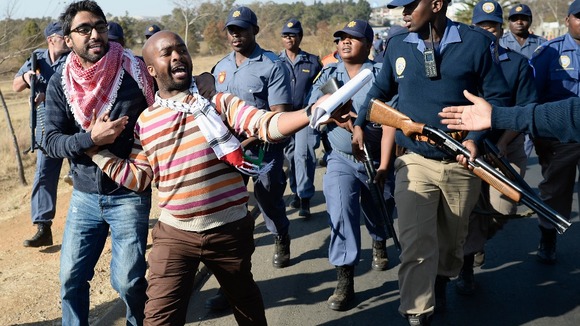
Protestors being escorted by police in Soweto

Police officers on Saturday fired a stun grenade at a group of protestors near the entrance of the University of Johannesburg Soweto campus ahead of US President Barack Obama’s visit there.

Spokeswoman Sally de Beer said about 120 protestors gathered about 400 metres from the gates to the campus.

The group were allowed permission to protest, but only until 2pm.

“When their time lapsed at 2pm, they refused to comply with a request to disperse as they were required to …the police fired one stun grenade and they then dispersed,” de Beer said.

No arrests were made.

De Beer said: “We totally respect everyone’s right to demonstrate peacefully, but if they are required in terms of their permission to protest, they must stick to the requirements.”

Obama was due to address young people at an event at the Soweto campus. – Sapa

Soweto to welcome Obama, a ‘fellow African’

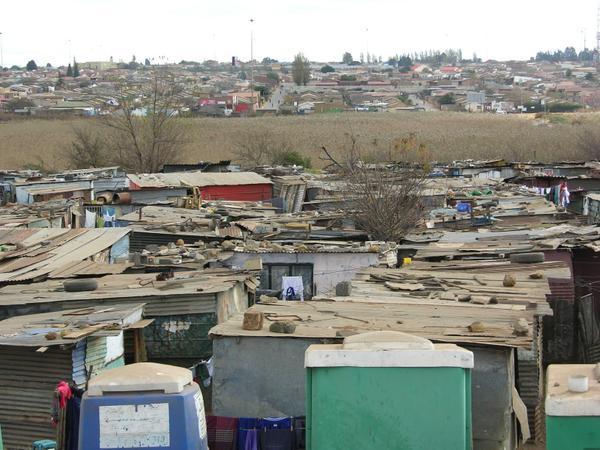
Scene in Soweto
Scene in Soweto

Barack Obama was barely 15 years old when riots erupted in the South African township of Soweto over a circular concerning the use of Afrikaans and other African languages in black schools. Decades later, its residents are preparing to welcome the US president as a “fellow African”.

Obama, now 51, will host a town hall meeting at a university campus as part of his visit to a crucible of the fight against apartheid, which saw protests break out in 1976 that spread across the country.

Although the white nationalist regime was not defeated, the 1976 riots spawned a new generation of black liberation leaders who continued the struggle while senior figures like Nelson Mandela and others languished in prisons.

While hundreds of anti-Obama protesters marched on the US Embassy in the capital Pretoria, 80 kilometres (50 miles) to the north on Friday, many Sowetans were keenly anticipating the visit by the first black US president.

“I want it to be a message of hope. I hope he talks about important things like education and the importance of going to school,” Christopher Mutangwa, a 20-year-old accounting student, said outside the University of Johannesburg’s (UJ) satellite Soweto campus.

“But I also hope that he can learn something about us and what happened here in Soweto during the struggle,” Mutangwa told AFP.

“He should, because I think he is an African.”

While there were few signs of preparation ahead of the highly anticipated visit at the UJ campus, many residents said they planned to line the streets, or watch the event on television.

“I was planning to visit my grandmother … but now I think I would rather go see Obama,” said Sibongiseni Kekana, 22, who makes a living as a struggling artist.

“Maybe I’ll even sell something to him,” Kekana laughed as he showed AFP around his tin shack, which also doubles as his art studio.

“In any case, I hope for inspiration from him,” Kekana said.

But even with Obama visiting Soweto, the continuing illness of South Africa’s own first black president, Nelson Mandela, never strays far from the conversation.

Mandela, 94, spent a third week in the intensive care section of a Pretoria hospital where he is being treated for a recurring lung infection.

After taking a turn for the worse last weekend, Madiba, as he is popularly known by his clan name, has been showing tentative signs of recovery.

— Two generations of black leaders —

With a possible visit by Obama to the ailing statesman on the cards over the weekend, inevitable comparisons are being drawn in many conversations.

“To me, Madiba represents an older and perhaps more traditional generation of black leaders, while Obama represents the new generation,” Tshepo Mofokeng, 43, told AFP.

“I’m sure he will be welcomed here as an African,” said Mofokeng, as he took some pictures on his mobile phone of his children at the Hector Pieterson Museum, which covers the 1976 uprising.

“I just think he (Obama) is sexy,” his wife Nomsa, 36, added with a laugh.

Even though many people will flock to welcome the US head-of-state, not all Sowetans were happy with his presence and demonstrations were planned for Saturday.

“I don’t think it’s a good thing that he’s coming here,” said Freddy Mhaule, 25.

“Especially with him spying on the world,” he added, referring to the recent revelations about PRISM, the US Internet surveillance programme.

“Obama’s visit will have zero impact on us,” said an art vendor, who only wanted to be identified as “Lebo”, at the Hector Pieterson Museum, which commemorates the death of the youth activist, shot dead in 1976 by apartheid police at the age of 12.

“To me he’s just another politician,” Lebo added, as he tried to sell tourists a wooden model of the Soweto home where Mandela once lived, which today serves as a museum. – AFP

Obama poses at the wrong door for ‘slavery’

Wrong building, wrong door

For a black American president on a tour of Africa, it seemed an obvious opportunity for a speech about the “evils of slavery”. When Barack Obama visited Senegal on Thursday, he headed for Gorée Island.

Historians pointed out however that a crumbling fort that is said to have been the key departure point for millions of slaves shipped across the Atlantic, was probably never used for that purpose at all.

The 18th century building could therefore not have allowed Obama to “fully appreciate the magnitude of the slave trade”.

Pictures on Thursday showed Mr Obama standing with his wife Michelle at Gorée’s so-called Door of No Return, a dark passageway from where the fort’s human cargo is said to have been loaded via gangplanks onto ships.

However, despite the claims that millions of slaves passed through the door, its most likely use is now thought to have been for disposing of rubbish. Likewise, the waters it overlooks are too rocky and shallow for a slave ship to have used it as a loading bay.

“There are literally no historians who believe the Slave House is what they’re claiming it to be, or that believe Goree was statistically significant in terms of the slave trade,” said Ralph Austen, a professor at the University of Chicago who has researched the subject.

Mr Obama is not the first international statesman to have made a pilgrimage to Gorée, which lies a short boat ride from the Senegalese capital, Dakar, and which has long been a draw for both foreign tourists and African Americans seeking to discover their historical roots.

Others who have visited in recent years include Nelson Mandela, Pope John Paul II and Mr Obama’s predecessors in the White House, Bill Clinton and George W Bush.

The fort’s museum was opened in 1962 by the late Boubacar Joseph Ndiaye, a Senegalese who was a passionate advocate of the belief that it had been used to transport slaves in great numbers. Its reputation spread worldwide thanks partly to the powerful symbolism of the Door of No Return, which was said to have offered slaves a final view of their homeland before the Atlantic crossing.

Yet its historical claims to be at the epicentre of the slave trade have long been in question. Most agree now that while slaves were indeed kept at the fort, they were there not for mass onward transport but for use by the fortress’s own residents. A more likely point of departure was another fort nearby, although records suggest that at most, some 26,000 slaves were sent there – a fraction of the claims of up to 15 million touted by the museum staff.

Other slave forts along the West African coastline, such as at Cape Coast in Ghana, have much more substantial claims to being major slaving centres. However, historians who have questioned Gorée’s claims have often been accused of attempting to “deny” the extent of the slave trade. Given the amount of tourist income that the island generates for a country still living in poverty, there has been little incentive in Senegal itself to put the record straight.

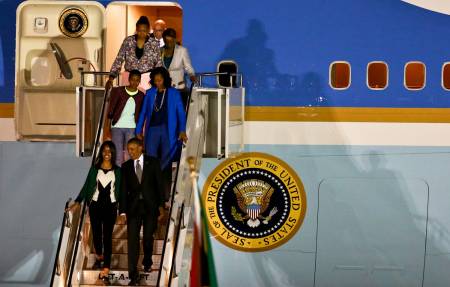
The US president was visiting Senegal as part of a week-long tour of Africa, and was due to land later in South Africa, where the country’s former leader, Nelson Mandela, is now critically ill. On Friday Mr Obama, travelling with a White House press pack on Air Force One, the presidential jet, insisted he would not be seeking a “photo op” with Mr Mandela.

“The last thing I want to do is to be in any way obtrusive at a time when the family is concerned about Nelson Mandela’s condition,” he said.- The Telegraph

Drone confiscated at clinic where Mandela lies

fchammanFC Hamman, a South African freelance film-maker, was escorted away by police along with the helicopter camera he was flying with his 21-year-old son Timothy outside the clinic where Mandela (94) has spent three weeks with a lung infection.

After nearly four hours of questioning by police, Hamman was released but the drone camera was confiscated.

“From a security point of view, they are concerned. They are inspecting our equipment to make sure it didn’t violate any security regulations,” Hamman told Reuters, adding police had not pressed any charges for the moment.

“We didn’t realise we were breaking any laws,” he said.

Hamman said he had intended to offer to media organisations the aerial shots of intense activity around the hospital, where crowds of jostling journalists have mingled with well-wishers paying tribute to South Africa’s former president.

“We were careful not to fly over the hospital,” he said.

The intense media scrutiny has angered some of Mandela’s family. Daughter Makaziwe on Thursday lambasted foreign media “vultures” for not respecting his privacy as he lay critically ill.

Hamman said he had already used the home-built flying camera in other film projects and had also assisted police with surveillance work in operations against suspected drug-dealers in the crime-plagued Johannesburg suburb of Eldorado Park.

“You can’t fly one of those things without a permit,” one police officer said at the hospital after Hamman was escorted away. Pretoria police declined to comment further.

The incident came just hours before US President Barack Obama started an official visit to South Africa, which will include stops in Pretoria, Johannesburg and Cape Town.

Asked how he thought Obama’s huge security detail might react if he launched the flying “eye in the sky” in the vicinity of the president, Hamman chuckled: “That would be a mistake.” – Reuters

‘Obama is supporting a British policy of genocide throughout Africa’

obamaafricaPresident Obama’s trip to Africa is little more than a public relations stunt to a continent desperate for his help, says Lawrence K. Freeman, editor of Executive Intelligence Review magazine.

Freeman believes not much is going to be accomplished. The purpose of the trip is not to help the African people to develop these African nations. He says it is a very calculated, glorified public relations tour to three countries and most people in Africa are going to realize, and do realize already, that the US is doing nothing to help their continent. “And what they do know is that the overthrow of Colonel Gaddafi, led by Obama and NATO, has been a catastrophe for north and West Africa in supporting various elements that have now allowed the destabilization of many of these countries, especially with the arms and the flow of Tuaregs and terrorists coming out of Libya. South Africans are not pleased or happy with President Obama and he’s going to offer absolutely nothing except maybe entice private sector companies to make a few investments. But this is really pathetic in terms of what Africa needs.”

Freeman says there is this silly notion in the US that somehow China is an American competitor in Africa. “But in fact what China has done over the last recent period, five to ten years, is invest massively and construct all types of infrastructure projects throughout many African countries totaling tens of billions of dollars per year. So the US had to stop doing that 40 years ago. The US does not build infrastructure. The US does not provide government-backed investment in the kinds of projects that are necessary for the people of Africa. We’ve done nothing, for example, to develop water management in the African Sahel. We’ve done nothing to develop the Arab culture capability of these regions and therefore you have the spread of terrorism, the spread of insurgency because you have these alienated youth who see no future because their economies are dying. In fact Obama’s done less than George Bush and less than Bill Clinton even though he’s called the Son of Africa. So he has a record of failure and in fact he’s been supporting destabilization, such as the overthrow of Gaddafi, which has actually worsened conditions throughout Africa.”

Obama is not really concerned about the continent, Freeman believes. “In 2009 he spent less than 24 hours and made one speech in Ghana. Here he’s visiting three countries – Senegal, South Africa, and Tanzania – and avoiding going to other countries such as Nigeria, such as Mali, many other countries that are in the spotlight right now. He doesn’t have anything to offer them, the United States – the transatlantic community of Europe and the United States, the financial system, is collapsing. We see this throughout Europe and the United States, dying economically, politically, and culturally. We have no vision, we have no future. Obama cares nothing about the welfare of the South African people as he cares nothing about the welfare of the people of the United States. In fact he’s supporting a British policy of genocide throughout Africa by allowing destabilization and by allowing hunger and shortages of food and medicine to kill Africans in large numbers, and this is something that could be corrected and changed if we had a policy to do that.”- RT

Native Africans ‘interbred with another species 35 000 years ago’: scientists

Pigmy villagers in Uganda near Lake Bunyonyi

According to a news report of the scientific journal Nature, “our ancestors bred with other species in the Homo genus, according to a study published… in the Proceedings of the National Academy of Sciences1. The authors say that up to 2% of the genomes of some modern African populations may originally come from a closely related species.”

Palaeontologists have long wondered whether modern humans came from a single, genetically isolated population of hominids or whether we are a genetic mix of various hominid species.

Last year, an analysis comparing the Neanderthal genome sequence to that of modern H. sapiens showed that some interbreeding did take place between the two species in Europe some time between 80 and 30,000 years ago and that, to a certain extent, Neanderthals ‘live on’ in the genes of modern humans2.

It has been a mystery whether similar genetic mixing took place among Homo species even earlier, before the populations that became modern humans left Africa.

To find out, evolutionary biologist Michael Hammer at the University of Arizona in Tucson and his colleagues studied DNA from two African hunter-gatherer groups, the Biaka Pygmies and the San, as well as from a West African agricultural population known as the Mandenka.

Each of these groups is descended from populations that are thought to have remained in Africa, meaning they would have avoided the genetic bottleneck effect that usually occurs with migration. This means the groups show particularly high genetic diversity, which makes their genomes more likely to have retained evidence of ancient genetic mixing.

“We need to modify the standard model

of human origins.”

 To find signs of infiltration from other Homospecies, the researchers looked at 61 non-coding DNA regions in all three groups. Because direct comparison to archaic specimens wasn’t possible, the authors used computer models to simulate how infiltration from different populations might have affected patterns of variation within modern genomes.

Then they looked for such patterns of variation in the DNA of the three African populations. On chromosomes 4, 13 and 18, the researchers found genetic regions that were more divergent on average than known modern sequences at the same locations, hinting at a different origin.

Mixing things up

Hammer and his colleagues argue that roughly 2% of the genetic material found in these modern African populations was inserted into the human genome some 35,000 years ago. They say these sequences must have come from a now-extinct member of the Homogenus that broke away from the modern human lineage around 700,000 years ago.

Hammer says this disproves the conventional view that we are descended from a single population that arose in Africa and replaced all other Homo species without interbreeding. “We need to modify the standard model of human origins,” he says.

Geneticist Sarah Tishkoff, who studies population genetics and human evolution at the University of Pennsylvania in Philadelphia, is more cautious. “This raises the possibility that there may have been ancient admixture with archaic populations,” she says.

But some researchers will require yet more convincing. “The authors model differences in very small parameters, such as the difference between no admixture and 1-2% admixture with an archaic population,” says anthropologist Brenna Henn, a graduate student at Stanford University in Palo Alto, California. “The ability to discern complex models of demographic history with such a small data set, when many of the basic features of African genomes and history remain unknown, concerns me.”

Tishkoff would also like to see further work. “Analyses of whole genome sequences of these populations will be necessary to more definitively test this hypothesis,” she says.

References

  1. Hammer, M. F. et al. Proc. Natl Acad. Sci. USAhttp://dx.doi.org/10.1073/pnas.1109300108 (2011).
  2. Green, R. E. et al. Science 328, 710-722 (2010). | Article | PubMed | ISI | ChemPort |

Merkel fuming about joking Irish bankers

irishmerkelChancellor Angela Merkel forcefully condemned on Friday the conduct of Irish bankers who were caught on tape joking about a bailout deal and mocking Germany, saying their actions were an insult to working people and damaged democracy.

Transcripts of telephone conversations from 2008 between bankers at Anglo Irish Bank have caused outrage in Ireland and beyond in recent days.

In the tapes they made light of the Irish government’s decision at the height of the global financial crisis to guarantee their liabilities and talk about demanding “moolah” – slang for money – from the country’s central bank.

They were also heard singing the pre-war version of the German national anthem, with the words “Deutschland ueber alles”.

Asked about the recordings at a European Union summit in Brussels, Merkel said: “For people who go to work each day and earn an honest living, this kind of thing is very hard to take, it’s impossible to stomach.

“This is really damaging to democracy, the social market economy and all that we work for,” she said, adding that it made it harder for policymakers to convince their citizens to support aid for struggling European partners.

Ireland’s government offered a blanket guarantee to Anglo and other lenders in 2008 to keep them operating. The decision eventually cost Irish taxpayers some 30 billion euros, forcing Dublin to seek a European bailout in late 2010.

EU finance ministers agreed on Thursday new rules for dealing with failing banks which would hit shareholders, bondholders and wealthy depositors before taxpayers.

Germany, concerned it could be asked to rescue mismanaged banks in other European countries, has put the brakes on a push by some of its partners to create a single bank resolution mechanism and a deposit guarantee fund for the bloc. – Reuters

Mandela’s health overshadows Obama visit

Scene at the Medi-clinic Heart Hospital in Pretoria

by Laszlo Trankovits

“Viva Mandela! Viva Mandela!” sing the colourfully dressed women dancing in front of the hospital in Pretoria. Children bring pictures they have drawn, teddy bears, dolls and balloons, while adults lay down bouquets and greeting cards.

The closely guarded hospital is increasingly a place of pilgrimage. Behind its walls, national hero Nelson Mandela is struggling for his life.

At night, candles burn in front of the hospital. People are often seen praying together. During the day there is a lot of singing, especially the old anthems of the ANC liberation movement, now South Africa’s ruling party.

Everyone praises the achievements of the now seriously ill former president. A wealthy businessman was permitted to release 100 white doves into the sky on Tuesday in recognition of the work towards reconciliation of the father of South African democracy.

All of South Africa is agitated. Whether in offices, businesses or government offices, in the huts of townships such as Khayelitsha or the luxury villas in Camps Bay and Constantia: Everywhere, radios and televisions chatter constantly, everyone following the news spellbound.

The fate of the grand old man of South Africa is on everyone’s lips. “Let him die with dignity at last,” Cape Town businesswoman Glini Le Roux said, articulating what many are thinking.

The media, who have besieged the hospital for weeks in tents, caravans and satellite vans, have come in for criticism. Mandela’s eldest surviving daughter Makaziwe called foreign journalists camped outside the building “vultures” who were “waiting for the last carcasses.”

“There is an element of racism to their attitude. That is the image that we have as a family,” she said in a TV interview.

Mandela’s struggle is increasingly affecting public life. South Africa’s politicians have put aside all their plans. After President Jacob Zuma hurried to Mandela’s bedside on Wednesday, he announced he would not take part in a regional summit in Mozambique.

Many took this as a sign that Mandela was now dying – or even already dead, as some sensationalist reports had it. On Thursday, there was a surprise: Following his second visit to Mandela’s bedside in 24 hours, Zuma reported his condition had improved.

Mandela’s health has weighed on the visit of US President Barack Obama, who is expected in Johannesburg on Friday with an entourage of about 1,000 people.

“The US diplomats here are deeply concerned,” one of them said, given what would happen in the event of Mandela’s death and the subsequent national mourning.

They know that if Mandela died, the president’s agenda, with a visit to Soweto, academic honors in Johannesburg and Cape Town and a keynote speech in Cape Town – probably on the future of Africa – would be impossible. – dpa

Mandela graves found empty

LS005617Three family graves at the Qunu, Eastern Cape, home of critically ill former president Nelson Mandela had no human remains when they were exhumed earlier this week, a Mthatha undertaker told Sapa on Friday.

Luvuyo Titi said the Mandela family had asked his company to exhume the graves of Mandela’s oldest son Makgatho Mandela, Mandela’s first daughter Makaziwe, and his second son Madiba Thembekile.

Makgatho Mandela died on January 6, 2005, aged 55; Makaziwe died aged nine months in 1948; and Madiba Thembekile died in a car accident on July 13, 1969, aged 24.

“The family informed us that they obtained permission from the municipality to go ahead with exhumations of the graves,” Titi said.

“When we opened the graves they contained no human remains.”

The exhumations were conducted under the supervision of a municipal health inspector.

Titi reported what he had found to the Mandela family, who called an urgent meeting at the Mandela home on Tuesday.

Two Mandela family members at the meeting told Sapa that Mandela’s grandson, Mandla Mandela, was confronted about ordering the removal of the remains from the family cemetery.

“When the family confronted Mandla about the missing bones, he conceded to having them moved to his home village in Mvezo,” said the relative, who asked to remain anonymous.

“When Mandla was ordered to bring back the remains, he stormed out of the meeting.”

During the meeting, Mandla’s younger brother, Ndaba, said he wanted his father, Makgatho, back.

Mandela family members accused a family elder, Napilisi Mandela, of supporting Mandla.

“He is not supposed to support Mandla as he presides over family affairs,” the relative said.

“The family was not consulted about the first exhumation of the graves.”

On Friday, 16 applicants from the Mandela family applied for an urgent high court interdict against Mandla Mandela, the Eastern Cape health department and the Eastern Cape premier.

Details of the interdict were not made public, with lawyers for the applicants and the State refusing to take questions from the media on the matter.

It emerged in court on Friday that the sheriff of the court was unable to deliver the summons to Mandla Mandela to appear in the Mthatha High Court, as the gate of his Mvezo home was locked. He was also unreachable by telephone.

Mandla Mandela has until Saturday to respond to the interdict. – Sapa

Zombie democracy, or crass majoritarianism

Voting in South Africa

This opinion piece from the British Economist deals with the ‘zombie democracy’ of Turkey, but it might as well have been written about South Africa since 1994 where huge majorities entitle rulers to trample upon the basic rights of minorities, such as whites and Afrikaners.

“BUT I’ve won three elections!” Recep Tayyip Erdogan, Turkey’s embattled prime minister, growls at his critics. On the face of it, his case is compelling: surely, many people in Turkey and beyond would agree, popularly elected leaders can govern as they please? That’s what democracy means.

Well, no. Majoritarianism—the credo of an expanding group of elected but autocratic rulers around the world, which holds that electoral might always makes you right—is not true democracy, even if, on the face of it, the two things look alike. It is worth explaining why.

To begin with, democratic legitimacy isn’t merely a correlative of a ruler’s share of the vote. Few candidates in the West nowadays win more than half of the votes, still less a majority of the electorate. Most are obliged to govern with slim electoral mandates.

If broad support does not automatically qualify a leader as a democrat, nor does strong opposition disqualify him. Margaret Thatcher’s reforms were contentious, to say the least. The heat and vitriol of politics have intensified in the Fox News, shock-jock, bile-blogging era: Barack Obama is often lambasted as tyrannical or traitorous. Tough decisions, such as spending cuts or tax rises, can provoke widespread anger, as the past few years have demonstrated. Bold reforms, which The Economist applauds, often do the same. That doesn’t make the leaders who impose them undemocratic, either.

The issue is how the relationship between supporters and opponents is managed. In part this is a matter of rules and institutions to constrain a leader’s power and to allow the aggrieved to find redress. These should include a robust account of citizens’ basic rights, independent courts to enforce them and free media to monitor them.

Beyond documents and institutions, the difference between crass majoritarianism and democracy resides in the heads of the mighty. Democrats have a bedrock understanding that the minority (or often majority) who did not vote for them are as much citizens of their country as those who did, and are entitled to a respectful hearing; and that a leader’s job is to deliberate and act in the national interests, not just those of his supporters. Turkey’s protesters took to the streets because they believed Mr Erdogan was not just hostile to their interests but deaf to their complaints. By demonising them as terrorists and foreign agents, and pulverising them with tear gas and water cannon, he has vindicated this belief. The contrast with Brazil, where Dilma Rousseff has insisted that demonstrators have a right to protest, is striking.

Heartless

The basic idea of a democracy is that the voters should pick a government, which rules as it chooses until they see fit to chuck it out. But although voting is an important democratic right, it is not the only one. And winning an election does not entitle a leader to disregard all checks on his power. The majoritarian world view espoused by Mr Erdogan and leaders of his ilk is a kind of zombie democracy. It has the outward shape of the real thing, but it lacks the heart.

Read the whole article in The Economist.

Obama: ‘Moral imperative’ to feed Africa

Obama on the tired old theme of African hunger

President Barack Obama, wrapping up the first leg of an African tour, said on Friday Washington had a “moral imperative” to help the world’s poorest continent feed itself and he then left for South Africa hoping to see ailing Nelson Mandela.

White House officials hope Obama’s three-nation tour of Africa – his first substantial visit to the continent since taking office in 2009 – will compensate for what some view as years of neglect by America’s first black president.

Before departing Senegal after a two-day stay, Obama met farmers and local entrepreneurs to discuss new technologies helping to raise agricultural output in West Africa, one of the world’s most under-developed and drought-prone regions.

Standing in front of the agricultural displays at an event hosted by “Feed the Future”, the U.S. government’s global hunger initiative, Obama said his administration was making food security a top priority of its development agenda.

“This is a moral imperative. I believe that Africa is rising and wants to partner with us: not be dependent but be self sufficient,” he told reporters. “Far too many Africans endure the daily injustice of poverty and chronic hunger.

“When people ask what’s happening to their taxpayer dollars in foreign aid, I want people to know this money’s not being wasted. It’s helping feed families.”

But the health of Mandela, the 94-year-old former South African president and anti-apartheid hero clinging to life in a Pretoria hospital, dominated Obama’s day even before he arrived in Johannesburg.

Trade unionists, student activists and Communist Party members protesting against American foreign policy gathered on Friday a few blocks from the hospital where Mandela is being treated for a lung infection.

Like Mandela, Obama has received the Nobel Peace Prize and both men were the first black presidents of their nations.

Air Force One departed Senegal’s coastal capital Dakar just before 1100 GMT (0700 AM ET) and was due to arrive in South Africa around eight hours later. On Friday evening, Obama has no public events scheduled and could go to the hospital then.

He is scheduled to visit Robben Island, where Mandela spent years in prison under South Africa’s former white minority regime, later during his trip. Obama’s last stop on his tour will be Tanzania in East Africa.

Food security, along with anti-corruption measures and trade opportunities for U.S. companies, are topics the White House wants to highlight on Obama’s eight-day tour.

Food security and public aid are two of the issues the Obama team believes are success stories. USAID head Raj Shah told reporters that Africa had seen a steady increase in resources under Obama’s administration despite a tough budget environment. – Reuters

Planting the seeds of poverty

Kevin_Kingby Kevin King

[followbutton username=’djkevking’ count=’true’ lang=’en’ theme=’light’]

We have a serious crisis in this country. With many millions of South Africans affected by poverty and unemployment, many millions more are expected to be affected. With high food prices already knocking the pockets of every South African, we can expect astronomical prices in the coming years and a scarcity of basic food stuffs.  “A scarcity in basic food stuffs? You must be joking!” That’s what I’d say 10 years ago, but no longer. From an agricultural giant and leading world exporter, we have quickly found ourselves in the realm of net importer status. All because the ruling party got it wrong.

After our transition to democracy, the ANC decided that land redistribution was the way to go.  And like planting seeds, they drew up their policies and passed a number of bills. These plans were meant to redistribute white farmers’ land to black farmers and to communities which were previously the ‘rightful owners’. Today, many years down the line, these seeds have grown to such an extent that a disaster looms for all. Let me illustrate the ruling party’s end produce.

Decline in commercial farmers, skills lost in 1994 there were some 120 000 commercial farmers but today a mere 37 000 remain. Yes, many of the previously 120 000 commercial farmers were white and transformation needed to take place, but with a sum total of 37 000 commercial farmers today, how many successful, black, commercial farmers have we produced and how many successful, white, commercial farmers has our country lost?

Farming has become “SA’s most dangerous job”. The threat of being the next farm murder victim (almost 4 000 farmers since 1994) and the threat of land grabs have resulted in many successful, white, farmers packing their bags and heading for greener pastures. And many of these farmers have indeed found greener pastures abroad and in other African countries. Congo, Malawi, Uganda, Tanzania and Mozambique are some of the governments who have invited them to farm in their countries on land earmarked for farming.

Other countries such as Gabon, Guinea and Ghana are also in talks. The starving continent of Africa has a huge demand for agriculture, job creation and filling empty stomachs. What better place for these farmers to apply their knowledge and skills. Further up north, Georgia has invited this group of endangered species to attempt to revive their agricultural industry by providing land and equipment. Quoting the Georgian government spokesperson, “South African farmers are some of the best farmers in the world.  They have good experience and we would like to see such farms in Georgia.  There is a lot of potential here.”

Regarding Georgian farmers who generally struggle to earn a decent living, “They want to set up joint ventures with South African farmers because they think they could raise the profitability and productivity of their farms,” he said. “They are more than delighted to have South African farmers and South African expertise on their farms.”

Meanwhile our government has opposing, often moronic, views to the rest of Africa. The Agriculture Minister, Tina Joemat-Pettersson, last week said the following regarding the departure of commercial farmers from South Africa, “This will not be a threat to food security in South Africa; instead, this will enhance food security in the continent.” This a real irony considering that other countries are trying to do the same thing but by attracting our farmers to their farm lands.  It gets more idiotic when she says, “South Africa has skills it can share with other South Africans and with the rest of the continent.”

To an educated mind it would appear that skills are departing with the departing farmers and these skills are to be applied in other African countries indefinitely. Back at home, along with the loss of these farmers and their skills and experience, the former workers of these farms have lost their jobs. From around 1.6 million tax-paying farm workers (mainly black) which were employed in 1994, to around 300 000 in just 16 years.

I challenge anyone to provide me with intelligent reasons on how losing 83 000 commercial farmers and losing over a million jobs are to the advantage of our country and our people.

Demise of profitable, food producing farms According to the ANC itself last year, 90% of redistributed farms do not produce excess food. Farms which once produced hundreds of thousands of tons of produce and employed hundreds of workers now lie idle and are a mere shell of what they used to be.  The remaining few black farmers are but a handful and use the land for subsistence farming.

Mismanagement, corruption and the lack of sufficient skills and experience has had catastrophic effects on many farms.  To mention one of a thousand examples of farms which are now liquidated/idle/non-producing:

  • The Zebediela Citrus Estate (Limpopo) – Once described in the Readers’ Digest, “400 million oranges are harvested each year from the groves of Zebediela, the world’s biggest citrus estate. The output is sufficient to provide one orange for every eight people on earth.”  This magnificent farm went from riches to ruins in just a few years after being taken over by the state.

Yet the talk/threat of land grabs/redistribution continues.

To avoid looking like a second Zimbabwe and forcibly removing white farmers off their land, the government has now come up with cunning plan to grab land without having to remove the white farmers by force. This plan is called the “Land Tenure Security Bill”. If signed off by the ANC government it will amongst other things, give farm workers the right to keep livestock on the farms where they work, which will be allowed to graze “indiscriminately” on the property.

The bill will also give workers the right to plant their own crops and build homes for themselves and close relatives, from which they may never be removed.   Andy Tladi, a black sunflower farmer, says he is leaving to the DRC this year as the bill “gives farm workers a ‘blank cheque’ to do whatever they want to do on land that doesn’t belong to them.  The bill is going to worsen the situation for farmers. You are actually going to see workers putting up villages on farms. If you allow 10 people to build houses on a farm, in about 20 years you could have up to 30 families. So how does the farmer continue to grow and invest under those circumstances? I am a black farmer and I won’t be able to handle that.  A lot of farmers will fly out of the country.”

The high likelihood of failure for black farmers is a reality. Without the necessary skills and experience, even a successful farm which has been acquired through redistribution most often fails. Then when a rare success does happen, more often than not, there is a lack of backing from government which leads to failure or inability to grow.  Steven Mohale, a leading black, tomato farmer in Limpopo, has been battling for years to get government assistance in order to grow his business. But it seems the only help he received was from private banks and white farmers.

To quote an article about Steven in Farmers Weekly, “I’m very disappointed in the way the government treats farmers. It’s high time government stopped insulting farmers. We spend a lot of time with white farmers in this area and almost all are very helpful. People who accuse farmers of bad things are talking nonsense. South Africans need to realise the sector is responsible for feeding the nation and creating employment – and so farmers deserve respect. But government’s attitude doesn’t help.”

In conclusion, it is clearly obvious to someone with a little bit of intelligence that we are heading for disaster. In fact we are already looking at a disaster if you look at how the majority has suffered in the last decade or so in terms of poverty, unemployment and starvation. Billions of taxpayers’ rands have been pumped into redistribution projects and this money has literally been flushed down the toilet, not to mention the millions stolen by corrupt, ANC linked officials. Now billions more has to be spent of which another 90% will be wasted. With calls for 100% nationalisation by Julius Malema, we could be in for even more serious trouble. At this moment I do not see much hope for agriculture in our country and in turn not much hope for the economy and our people.

[followbutton username=’djkevking’ count=’true’ lang=’en’ theme=’light’]

‘Free Palestine! Free Swaziland!’ demonstrators shout at Obama in Pretoria

Poster_anti-US_protetstActivists from different groups marched to the US embassy in Pretoria on Friday protesting against President Barack Obama.

The large group marched along Francis Baard Street, singing and chanting anti-Obama slogans. One activist, on a truck mounted with a public address system, led the songs and slogans.

He shouted: “Free Palestine. Free Swaziland. Free Zimbabwe. Down Obama, down!”

The group initially gathered at the Caledonian Stadium before embarking on the march.

Some of the protesters’ placards read: “Obama, stop supporting dictators in Africa. No oil here, move on.

“100 years of genocide in Iraq. War in 100 countries. Rogue State.”

A young boy’s poster read: “No you can’t spy on me”.

Many protesters wore orange overalls and black hoods. Others were dressed in Young Communist League red regalia.

The league’s national secretary was with other officials in front of the protesters.

A large banner with Obama’s face had the words: “Meet the world’s top assassin”. The banner also had a picture of Obama behind prison bars.

Many local and international journalists, who were camped outside the nearby Medi-Clinic Heart hospital where former president Nelson Mandela is being treated, rushed to the stadium.

As the group passed close to the hospital, they shouted messages of support for the ailing anti-apartheid icon.

Six police vehicles, including a Nyala, escorted the lively protesters. – Sapa

Obama accepts honorary doctorate from UJ, ex-Rand Afrikaans University

The Rand Afrikaans University, photographed in 1976 by liberal photographer David Goldblatt as an example of 'fascist architecture'
The Rand Afrikaans University, photographed in 1976 by liberal photographer David Goldblatt as an example of ‘fascist architecture’

US President Barack Obama has accepted an honorary doctorate of laws from the University of Johannesburg, vice chancellor Ihron Rensburg announced on Friday.

“It is my delight and pleasure to announce, on behalf of the entire community of the University of Johannesburg, that Dr Barack Obama has become our newest alumnus, and that all matters relating to the award were concluded according to the relevant policies and charters of the university,” he said in a statement.

Obama would not accept the award in person at this stage.

“First, it is normal and standard that the formal procedures relating to the conferral of an honorary degree do not coincide with the actual conferral of the qualification,” said Rensburg.

“Secondly, Dr Barack Obama’s visit to South Africa is a matter between the South African state and the US. Accordingly, and on this occasion, Dr Obama is a guest of the South African state and the South African people, and not of the University of Johannesburg.”

The fact that Obama’s visit coincided with former president Nelson Mandela’s hospital stay was also cited as a reason for the university not physically conferring the doctorate.

“Accordingly, the ceremonial conferral of the honorary doctorate on Dr Barack Obama will take place at a future occasion on a mutually agreed date,” Rensburg said. – Sapa