The land claims process closed 14 years ago will be reopened.
The Star newspaper reported that according to the draft Restitution of Land Rights Amendment Bill published last week the new deadline for claims would be December 31, 2018.
The previous deadline was December 31, 1998.
If the bill became law, it would allow those who missed the first deadline to claim, opening the door to new claims for those dispossessed by homelands betterment schemes, including white people, The Star reported.
It would also allow people to lodge claims that were previously refused.
The land claims process was for those who were dispossessed of a land right after June 13, 1913 as a result of past racially discriminatory laws.
An explanatory memo attached to the draft bill said the previous restitution programme had “a number of problems” and certain categories of people who lost their rights due to colonial and apartheid laws had not been included.
These were people who could not lodge claims before the December 1998 deadline, and those who were dispossessed before 1913.
Others were dispossesses through betterment planning schemes but were not allowed to lodge claims. – SAPA
A murder trial began in a Nelspruit court this week that resembles the script of a horror movie. Four men appeared in the Nelspruit Circuit High Court for the muti murder of Mr Clarance Brown (25) on Monday.
Family and community members wore T-shirts branded with Brown’s photo to court. Businessman Mr Floyd Mokoena (63), his son Mr Sydney Toto Mokoena (38) and two of Sydney’s friends, Mr Justice Ndubane (33) and Mr Simon Nkosi (37) face charges of murder.
Brown’ s body was exhumed from his grave in Oakley Trust near Bushbuckridge in 2008, three weeks after the police had received a tip-off that he was murdered for muti purposes.
Two of the accused were related to the deceased.
Floyd allegedly asked his son to help him hunt down a relative so they could remove his body parts and use them to strengthen his businesses.
Sydney apparently persuaded his two friends to ambush his cousin, Brown, on the night of February 23, 2008, after returning from a night out.
Mpumalanga police spokes-man Col Leonard Hlathi said the accused allegedly offered Brown a lift home.
“But they apparently attacked him on the way by cutting off his right testicle, removing his brain and certain bones from his body while he was still alive.”
He said they then supposedly ran over Brown with a Venture and left him to die on the road where he bled profusely.
“This was meant to make it look like he had been a victim of a hit-and-run accident but their dirty tricks backfired nearly six months after the victim’s funeral hence we were forced to exhume the body,” Hlathi said.
So-called Tshwane or Greater Pretoria mayor Kgosientso Ramokgopa will visit the Afrikaners-only community of Kleinfontein outside Rayton, east of Pretoria, on Wednesday.
“The visit is not a law enforcement exercise, but is aimed at fact-finding, reaching out to the community, and understanding their concerns,” Ramokgopa’s office said in a statement on Tuesday.
Members of the mayoral committee would accompany him.
Spokesman Blessing Manale said Ramokgopa would use the visit to reiterate that racial practices had no place in a democratic era.
“The executive mayor has called on the leadership of civil rights organisations and other government agencies to join in this exercise, so as to welcome the minority community of Kleinfontein back into Tshwane and assure them that they have no reason to fear.”
During the visit discussions on amicable remedies for the area’s apparent non-compliance with certain planning and housing regulations and other by-laws would be held.
Last week the Democratic Alliance Youth protested outside Kleinfontein’s gates. The property covers almost 800 hectares. DA Youth leader Mbali Ntuli and a few others entered the area to speak with Kleinfontein leaders.
“We want to show you what South Africa looks like. We achieve nothing by creating secluded areas,” she said at the time.
Kleinfontein controlling body chairman Jan Groenewald insisted in a debate with the DA on Thursday that the criteria for its residents were not based on race.
Inhabitants of the settlement, which had existed for 21 years but came under the media’s spotlight this week, merely wanted to live out their values in seclusion, said Groenewald. This would include providing themselves with their own “municipal” services.
“The people that have free access to Kleinfontein, who can apply, are Afrikaner. [They] are basically people who associate themselves with our Voortrekker history, the Blood River Covenant, and all these historical facts relating to our struggle for independence for the Afrikaner people,” Groenewald told reporters.
The criteria to live in Kleinfontein was “based on cultural, language, traditional, and religious beliefs”.
“You cannot use race as a base to determine anything,” said Groenewald. – Sapa
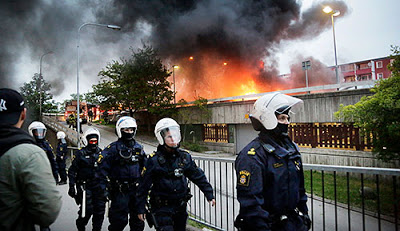
Automobiles were torched and police confronted stone-wielding youths in Stockholm’s suburbs early Sunday as riots, which erupted following reports that police had killed an elderly immigrant, enter their first week.
Pockets of violence and vandalism continue to pose a challenge to police in Stockholm, the Swedish capital that is home to an increasingly diverse 2 million residents. “When it comes to car fires, there have been a few, spread out in various locations, but not as many as in recent days,” Stockholm police spokesperson Lars Bystroem told Swedish Radio.
In Vaarberg, a suburb south of Stockholm, police were attacked by stone-throwing youths, while in Jordbro, another southern neighborhood, police resorted to teargas as they met resistance while attempting to arrest several individuals, AFP reported.
Violence has broken out in other parts of the country as well. In Orebro, a town in central Sweden, some two dozen masked youths set fire to three cars and a school and attempted to torch a police station, Reuters reported, citing police. About 200 km (124 miles) to the southwest in the city of Linkoping, several vehicles were set alight and youths tried to torch a school and a kindergarten.“With the strong presence on the streets of the good forces, and the police reinforcements, I think we are well on our way towards calmer times in the coming days.” The riots began one week ago in Husby, a predominantly immigrant suburb of Stockholm, following the fatal police shooting of an elderly man who police said was brandishing a machete in his home.
Analysts believe the shooting ignited deep-seated frustration among disenfranchised youths – many of whom have not assimilated into Swedish society and are unemployed – who claim to have suffered from police brutality and racism to the country due to its attractive social programs.
The Scandinavian country is ranked as one of Europe’s most popular destinations for immigrants, both in absolute numbers and relative to its size, but critics say the new arrivals are failing to learn even the basic language skills necessary to find employment, and despite free government assistance programs.
Ingrid Carlqvist, editor-in-chief of Dispatch International, told RT that Sweden is an attractive destination for immigrants because the government gives them “money for nothing.”
“For the last 20 years or so, we have seen so many immigrants coming to Sweden [who] really don’t like Sweden,” Carlqvist said. “They don’t want to integrate, they don’t want to live in this society – working and paying taxes, and so on – they come here because they know Sweden will give them money for nothing.
“[The police] could use water cannons, they could [enforce curfews]; there are so many things they could do within the law, but they don’t do it.” The change in Sweden’s domestic dynamics comes at a time when far-right groups are commanding attention across the EU, with many residents furious over austerity measures, high unemployment and the general consensus that the individuals most responsible for triggering the collapse of the global economy have escaped responsibility.
“We have tried harder than any other European country to integrate, spending billions on a welfare system that is designed to help jobless immigrants and guarantee them a good quality of life,” Marc Abramsson, leader of the National Democrats Party, told the Telegraph.
“Yet we have areas where there are ethnic groups that just don’t identify with Swedish society. They see the police and even the fire brigade as part of the state, and they attack them. Multiculturalism does not recognize how humans actually function, Abramsson added, emphasizing that such a stance should not be confused with racism.
According to the OECD, Sweden still ranks among the nine most equal member-states of the organization, but inequality rates surged by one-third between 1985 and 2008 – the largest increase among OECD countries, the organization said in a report released earlier this year. – RT
New Zealand—Seeking to help its exporters, New Zealand is negotiating with China to make their currencies directly convertible, a spokeswoman for Prime Minister John Key said.
Most of New Zealand’s exports to China are agricultural products—particularly milk powder, meat and wool—while most of its imports from there are computers, mobile phones and clothes. Above, sheep shearering near Dunedin, New Zealand in September.
Wellington’s push is aimed at driving down costs for companies that do business with China, which is close to overtaking Australia as New Zealand’s No. 1 trading partner.
Talks are in the “very early stages” and “progressing,” the spokeswoman said, adding that the issue had been brought up during Mr. Key’s visit to China last month.
Officials at the People’s Bank of China didn’t return calls seeking comment.
Direct convertibility between the Chinese yuan and New Zealand dollar would end the need for New Zealand’s companies and currency traders to convert New Zealand dollars or yuan into U.S. dollars when making or receiving payments.
New Zealand’s two-way trade with China totaled 15.3 billion New Zealand dollars (US$12.4 billion) in the year ended April 30, compared with NZ$16.8 billion with Australia, government data showed last week. Most of New Zealand’s exports to China are agricultural products—particularly milk powder, meat and wool—while most of its imports from there are computers, mobile phones and clothes.
Trade relations took a knock earlier this month when China temporarily blocked millions of dollars of New Zealand meat from entering the country, as it bolstered scrutiny of imports after a spate of mainly homegrown food-safety scandals.
Beijing is undertaking a long, gradual campaign to establish the yuan as a more market-oriented, international currency. China’s State Council, or cabinet, said in a statement this month that the country would draft a plan to allow the yuan to become fully convertible. Meanwhile, the People’s Bank of China is guiding the currency higher and set the median point of its permitted daily trading band last week at the strongest level ever.
China and Australia reached a deal to allow direct convertibility between the yuan and Australian dollar last month; before that, only the U.S. dollar and Japanese yen were directly exchangeable with the yuan. As China has become more industrialized, it has become Australia’s biggest trading partner and buyer of its commodities, including raw materials such as copper and iron ore.
For New Zealand, “There is no time frame for concluding an agreement,” Mr. Key’s spokeswoman said. “We are aware it took Australia around 12 months to achieve its recent agreement with China.”
China topped Australia as New Zealand’s biggest trading partner from February through April this year, recent monthly government data showed. Trade between the countries has been growing ever since they reached a bilateral free-trade agreement five years ago. That increased trade helped New Zealand, like Australia, weather the economic turmoil in Europe and the fragility of the U.S. recovery, which have weighed on global growth.
As well as lowering business costs, direct convertibility may pave the way for New Zealand’s central bank to diversify some of its foreign-exchange assets into Chinese government bonds. Last month, the Reserve Bank of Australia said it planned to invest up to 5% of its foreign-currency assets—close to two billion Australian dollars (US$1.9 billion)—in Chinese government bonds.
The Reserve Bank of New Zealand declined to comment. – WSJ
Germany’s railway operator plans to deploy mini drones to catch vandals who deface its trains with graffiti, with the aerial vehicles shooting thermal images of its train depots at night.
Deutsche Bahn plans to soon start testing the vehicles which have four helicopter-style rotors and can shoot high-resolution pictures.
“We are going to use this technology in problem areas, where taggers are most active,” a spokesman who asked not to be named told AFP.
A “pilot” remotely steers the vehicles at heights of up to 150 metres (500 feet) and speeds of up to 54 kilometres (33 miles) per hour. An operator evaluates the images, which the company plans to use as evidence.
Deutsche Bahn said it suffered property damage last year worth 7.6 million euros ($10 million) from people spray-painting its carriages.
The rail operator said it would only use the drones over its own depots, not in public areas, in line with German anti-surveillance laws.
Internet giant Google ran into problems in Germany when it filmed streets for its global Street View project, with thousands of residents complaining and Google being forced to blur many of the images. – AFP
Moving carefully along a row of apple trees, two of Australia’s newest agricultural workers check if the fruit is ripe or the soil needs water or fertiliser.
Meet “Mantis” and “Shrimp”, agricultural robots being tested to do these tasks and more in a bid to cut costs and improve productivity in Australia’s economically vital farm sector, which exported $38.8-billion of produce last year.
Australia is one of the leaders in the field and, with a minimum wage of $15.37 an hour and a limited workforce, has a big incentive to use robots and other technology, such as unmanned aircraft, to improve efficiency.
It hopes to tap fast-growing Asian neighbours, where swelling ranks of the middle class increasingly want more varied and better quality food, from blueberries to beef.
“The adoption of new technology is going to be crucial for Australia to maintain its competitiveness in terms of the global agricultural sector,” said Luke Matthews, commodities strategist at the Commonwealth Bank of Australia.
“If we don’t adopt new technology, we can give up on these high-flying ambitions of being the food bowl of Asia.”
Using such technology tooptimise the use of fertiliser can boost profitability at grain farms by 14%, according to a study by Australia’s Commonwealth Scientific and Industrial Research Organisation.
A robot effortlessly plucking fruit is some way off, though a range of simpler tasks are within reach, to add to existing technology such as automatic steering of harvesters.
Salah Sukkarieh, professor of robotics and intelligent systems at the University of Sydney and developer of Mantis and Shrimp, says the next phase aims for robots to do increasingly complex jobs, such as watering and, ultimately, harvesting.
“We have fitted them with a lot of sensors, vision, laser, radar and conductivity sensors – including GPS and thermal sensors,” said Sukkarieh.
The technology could have the biggest application in horticulture, Australia’s third-largest agricultural sector with exports of $1.71-billion in the last marketing year, since a fixed-farm layout lends itself better to using robots.
Robots and an unmanned air vehicle that are being developed at the University of Sydney had passed field tests at an almond farm in Mildura, Victoria state, said Sukkarieh.
Propelled by sets of wheels and about the height of a man, the robots were named after the native Mantis shrimp because of the marine crustacean’s 16 different colour receptors, capable of detecting up to 12 colours. Humans only have four, three of which pick up colours.
This capacity to recognise colour already allows the robots to sense whether fruit is ripe.
The data can then be processed by computer to determine what action the robot should take. This could be used to water or apply fertiliser or pesticides, or sweep and prune vegetation, and eventually harvest the crop. – Reuters
Although France officially legalized gay marriage last month, organizers of an anti-gay marriage — or “pro-family” — parade decided to go forward with a planned demonstration Sunday — and hundreds of thousands turned out.
Sandy Glass from Naperville, Illinois, was in Paris and witnessed the parade unexpectedly, telling TheBlaze she and her husband estimated more than 250,000 people were present.
“It brought tears to our eyes,” Glass, a conservative, said in a phone interview.
“We go to France a lot and thought it was another left wing protest,” she said later, recalling that last year they found themselves in the middle of a Socialist rally.
When they followed the noise and witnessed what she described as “pro-family” signs, Glass said she realized “oh, we’re not the only ‘crazy’ ones,” explaining that it is “sometimes very difficult to be on the right in America.”
The Associated Press reported there being about 5,000 police present for the demonstration, due to clashes that have occurred in other anti-gay marriage protests.
But Glass said the event was very well organized and even seemed to have its own security detail.
“Nobody bothered these people,” she said, noting that people on the street were giving thumbs up and people in balconies were cheering. “
Here are some photos from the event:
“It was such a show of force that was pro something, not against something,” she said. “I think it was awesome.”
The plan of French protesters, according to Glass, is to vote out lawmakers with whom they hold opposition in 2014. – The Blaze
The liberal Democratic Alliance protesting outside Kleinfontein
The Afrikaners-only community Kleinfontein outside Rayton, east of Pretoria, insisted in a debate with the DA on Thursday that the criteria for its residents were not based on race.
The community, which has existed for 21 years but came under the media’s spotlight this week, merely wanted to live out their values in seclusion, said controlling body chairman Jan Groenewald.
This would include providing themselves with their own “municipal” services.
“The people that have free access to Kleinfontein, who can apply, are Afrikaner. [They] are basically people who associate themselves with our Voortrekker history, the Blood River Covenant and all these historical facts relating to our struggle for independence for the Afrikaner people,” Groenewald told reporters.
The criteria to live in Kleinfontein was “based on cultural, language, traditional and religious beliefs”.
“You cannot use race as a base to determine anything,” said Groenewald.
The gated community, which covered almost 800 hectares, was in the spotlight this week following reports that Kleinfontein was a racially exclusive community.
On Thursday the Democratic Alliance Youth protested outside its gates.
The handful of youths were singing and dancing as they moved towards the gate to protest against the farm settlement’s policies.
Some held up placards reading: “Een nasie. Een toekoms (One nation. One future)”.
Guards in camouflage were stationed at the gates of the community. Also to be seen were some residents and a number of cars carrying the old Transvaal Republic flag, with an extra band of orange.
DA Youth leader Mbali Ntuli along with a few other members entered the community to speak with Kleinfontein leaders.
“We want to show you what South Africa looks like. We achieve nothing by creating secluded areas.”
But Groenewald insisted the Constitution allowed for the existence of their community.
He said Afrikaner self determination, as guaranteed by article 235 of the Constitution, was the cornerstone the community was built on.
“We feel that the discussion with the DA Youth and their leadership was eventually constructive.”
He said Kleinfontein was in discussion with the Tshwane municipality concerning service delivery.
“We would like to, as we have always done, deliver our own services.”
The community’s water was supplied by natural fountains and it bought its electricity in bulk from Eskom.
Local businessman Dannie de Beer said all construction and manual labour within Kleinfontein was done either by residents or workers approved by the board.
He said people had to apply for residency and were interviewed by a panel.
Kleinfontein, with about 1000 residents, has its own primary school, old age home and game reserve.
De Beer said Kleinfontein accommodated both rich and poor residents. He said often people would arrive at the gate with nothing more than a bag of clothes.
If they qualified they would be allocated a house in the caravan park and would usually work in Kleinfontein.
Single mother Ronelle Berrington explained she moved to Kleinfontein for her children.
“Your children have freedom of movement,” the mother of four said.
Fellow resident Gerhard Schutte, 34, said he has lived in Kleinfontein for seven years and owned his own business.
“When I was in school I became aware of Kleinfontein. It has been existing for 21 years. It was my desire to live here. It is how I want to live.”
He denied being racist, saying he just preferred living in the gated community as it prioritised his values and had no serious crime.
Double amputee Dries Oncke, who sustained his injuries when he was hit by a train almost 20 years ago, echoed these sentiments.
“I live here and I stay out of trouble.”
Orania Beweging president Carel Boshoff has since invited the DA Youth to visit Orania, the segregated Afrikaner community in the Northern Cape.
Zimbabwean President Robert Mugabe criticises Nelson Mandela for being too soft on whites, in a documentary giving a rare and intimate look into the family life of one of Africa’s longest serving and most vilified leaders.
In a cosy lunch setting with his wife and children, the 89-year old speaks on a wide range of issues from his controversial hold on power, to his relationships with former British premiers Tony Blair and Margaret Thatcher.
The two-and-a-half hour interview, described in detail by British and South African media ahead of its airing, shows the usually bellicose and sharp-tongued Mugabe as a loving family man.
Dali Tambo, the son of South African anti-apartheid hero Oliver Tambo, produced the documentary, which will be broadcast on South African public television next Sunday.
In the programme Tambo dines with Mugabe’s family at his wife Grace’s dairy farm.
The interview comes just months before crucial general elections in the country which in recent decades has gone from being the breadbasket of southern Africa to its biggest problem child.
One of Africa’s most popular liberation leaders, Mugabe has clashed with the West over controversial policies which saw white-owned farms violently seized over a decade ago.
In neighbouring South Africa, where white land ownership is still a flashpoint, Mugabe says former president Nelson Mandela was not hard enough.
He said former colonial masters Britain — with whom he has had a fraught relationship over the land grabs — “will praise you only if you are doing things that please them”.
“Mandela has gone a bit too far in doing good to the non-black communities, really in some cases at the expense of (blacks),” Mugabe said of his former South African counterpart.
“That’s being too saintly, too good, too much of a saint,” he is quoted from the documentary in South Africa’s Sunday Independent.
Despite Mugabe’s disagreements with former British prime minister Margaret Thatcher, who died in April, he says he preferred the Iron Lady to her later successor Tony Blair.
“Mrs Thatcher, you could trust her. But of course what happened later was a different story with the Labour Party and Blair, who you could never trust,” said Mugabe.
“Who can ever believe what Mr Blair says? Here we call him Bliar.”
But despite having governed for 32 years, Africa’s oldest ruler also insists on staying in power.
According to The Guardian in Britain, the topic of the upcoming vote unleashes Mugabe’s fiery rhetoric as he bangs his fist on an armrest and insists: “There is a fight to fight.”
“My people still need me,” he told Tambo.
“And when people still need you to lead them, it’s not time, sir, it doesn’t matter how old you are, to say goodbye.”
Mugabe is currently sharing power with his rival Prime Minister Morgan Tsvangirai after violent disputed polls in 2008. No date has yet been set for this year’s elections although Mugabe is pressing for them to go ahead as soon as possible.
Tambo, 54, brushed off criticism that the programme — which will air as part of his “People of the South” television series that profiles celebrities and public figures — polishes Mugabe’s image ahead of the vote.
He told the Sunday Independent that he had also interviewed Rhodesian leader Ian Smith for a previous series.
Mugabe was “warm, charismatic and very humorous”, Tambo said.
According to The Guardian, Mugabe pours out his heart during the meal on his love for his wife and their “oneness”.
In unusual candour Mugabe also explains his affair with Grace while still married to his sickly first wife Sally — he wanted to give his mother grandchilden.
“As Sally was still going through her last few days, although it might have appeared to some as cruel, I said to myself ‘well, it’s not just myself needing children, my mother has all the time said, ah, am I going to die without seeing grandchildren’.”
He married Grace, his secretary over 40 years his junior, after Sally Mugabe died in 1992.
JOHANNESBURG could become South Africa’s first megacity within the next 20 to 30 years.
A megacity is defined as an urban area with a population of 10 million people or more. Only three African cities – Lagos, Cairo and Kinshasa – currently qualify.
According to a KPMG report, “The role of cities in Africa’s rise”, five other African cities could boast 10 million people within this time frame. These include Luanda, Nairobi, Addis Ababa, Casablanca and Khartoum.
Speaking to CitiBusiness on the sidelines of the 9th Africa Conversation this week, DeBuys Scott, head of infrastructure Africa at KPMG, said Cape Town and Durban could follow suit, however, it could easily take twice as long.
He estimates that broader Johannesburg presently has between 6,5 million and 7,5 million inhabitants, although he stresses that it is a very difficult number to pinpoint.
Internationally there has been a growing trend towards urbanisation as people move to cities in search of work and better opportunities. However, the trend is also accompanied by massive infrastructure challenges.
Scott said in order to deal with the growing population of Johannesburg, the city will need to go back to its master plan, think proactively and ensure that it doesn’t focus on short-term projects. “We have to do a couple of long-term projects that will make a contribution to a longer sustainable future city,” he said.
A long-term sustainable city will need proper transport infrastructure. Scott said the city still has major work to do on transport to really enable people to get from their residence to work, thereby becoming more GDP-generative and paying more tax.
“I think there is lots of evidence that we are working towards getting it right,” he said.
These include the Bus Rapid Transport projects, the ring-road highways around Johannesburg, “as controversial as they may be”, which will go a long way in shortening travel time to and from work, he said. – moneyweb.co.za
The scene of Sweden’s worst riots in years, Husby is on the surface at least a typically neat suburb of colorful playgrounds, manicured parks and low rise apartment buildings.
Conversations with residents of this immigrant neighborhood soon bring tales of fruitless job hunts, police harassment, racial taunts and a feeling of living at the margins that are at odds with Sweden’s reputation for openness and tolerance.
Riots that began in Husby have spread across Stockholm over the last four nights in scenes reminiscent of London in 2011 and Paris in 2005 – outbursts with their roots in segregation, neglect and poverty. The Swedish model of welfare – such as its 480 days of parental leave for each child – hides another side.
Some 15 percent of the population is foreign born, the highest in the Nordic region. The rise of the anti-immigrant Sweden Democrats party, which has called for a curfew in response to the violence, has polarized Swedes.
Metros and trains out of Stockholm center late at night are full of exhausted-looking Arabic or Spanish speaking immigrants returning home from menial jobs. Even second generation immigrants struggle to find white collar employment.
As one Asian diplomat puts it: “On the one hand Sweden has all these immigrants. On the other hand, where are they? It sometimes seems they are mostly selling hotdogs.”
In a further illustration of two very different worlds, the first riot happened as many Swedes celebrated winning the world ice hockey championship. Most immigrants play football – it is a common refrain that ice hockey kits are too expensive.
“The worst vandalism is not what we’ve experienced in recent days,” said community leader Arne Johansson at a protest rally in Husby. “It is the creeping, slow vandalism that this rightist government has exposed us to over the past seven years.”
Seven years of center-right Prime Minister Fredrik Reinfeldt – who has labeled the rioters hooligans – have lowered taxes and reduced state benefits. That has helped economic growth outpace most of Europe but Sweden also has the fastest growing inequality of any OECD nation.
Professor of criminology at Stockholm University Jerzy Sarnecki said society has become much more segregated, with a large, poor immigrant population living in areas of major cities where unemployment is dramatically higher than elsewhere.
Polls show a majority of Swedes still welcome immigration. Sweden has a reputation for treating new arrivals well – providing housing, Swedish lessons and allowing asylum seekers to live with relatives.
But the consensus is increasingly frayed.
“Those who, for whatever reason, don’t have work have not taken part in the general rise in prosperity,” said Ulf Bjereld, political science professor at Gothenburg University.
One recent government study showed up to a third of young people between 16-29 in some of the most deprived areas of Sweden’s big cities neither study nor have a job.
Sweden received 43,900 asylum seekers in 2012, a nearly 50 percent jump from 2011 and the second highest on record. Nearly half were from Syria, Afghanistan and Somalia. Many native Swedes worry welfare could become unaffordable if the trend continues.
Asylum seekers, in the short term, add a fiscal burden on the welfare state. OECD data show foreign-born unemployed rates, at 16 percent, compared with 6 percent for native Swedes. Sweden needs high employment levels to pay for its extensive welfare.
ANGRY, YOUNG MEN
The riots appeared organized. Cars were set alight near pedestrian bridges and youths hurled stones when police and emergency services arrived at the scene.
Witnesses said heavy handed policing made the situation worse. Locals in Husby said they were taunted by police who shouted “ape”.
“In the beginning it was just a bit of fun,” said one young man in his early 20s who did not wish to be named. He was one of a Husby group of 30-40 youths that battled with police.
“But then when I saw the police charging through here with batons, pushing women and children out of the way and swinging their batons, I got so damned angry.”
Police, who have called the rioters youth gangs and criminals, said accusations against the police were being investigated.
In interviews with youths in Husby, most were unemployed or interns. Many said they were bounced around intern schemes, seldom being offered full-time work, fostering resentment.
Local youths believe their Husby address is in part to blame for their lack of success. If they are lucky enough to be called to a job interview, many say they come from neighboring Kista – an IT hub symbolizing Sweden’s more modern, global image.
Many complained a conviction for a small amount of cannabis might stay on a teenager’s record for ten years, ruining job chances.
Stockholm has suffered riots and burning of cars before in recent years, although most fizzle out after one night. Other cities in the Nordic country have also experienced unrest.
Five years ago in Malmo, which has one of Sweden’s biggest immigrant populations, local youths threw home-made bombs and attacked emergency services to protest a police eviction.
In Husby, the shooting of a suspected machete wielding man by police earlier in the month was the spark. Local people – around 80 pct of whom have immigrant backgrounds – organized a peaceful protest for which more than 100 people turned up.
But their call for an inquiry into the death of the 69-year-old fell on deaf ears. Plugged in young locals complained about racist insults on Twitter, feeding anger.
“Young people wound each other up and started a small fire,” said Nefel, a beautician in her 20s. “I saw how the police came and treated them. I was in shock.”
“I was there and saw it happen. I wasn’t struck, but I did have a dog come at me. A police dog isn’t a nice little puppy.”
On the streets, resentment shows no signs of ebbing.
“My daughter comes home from school and says the kids say they can’t play with her because she’s dark,” said Maria Petersson, a 39 year old Ethiopan-born nurse. “I am both Ethiopian and Swedish but I will never be considered Swedish by the Swedes. To them, I am just another immigrant.” – Reuters
‘The principal of Healdtown was Dr. Arthur Wellington, a stout and stuffy Englishman who boasted of his connection to the Duke of Wellington. At the outset of assemblies, Dr. Wellington would walk onstage and say, in his deep bass voice, “I am the descendant of the great Duke of Wellington, aristocrat, statesman, and general, who crushed the Frenchman Napoleon at Waterloo and thereby saved civilization for Europe — and for you, the natives.” At this, we would all enthusiastically applaud, each of us profoundly grateful that a descendant of the great Duke of Wellington would take the trouble to educate natives such as ourselves. The educated Englishman was our model; what we aspired to be were “black Englishmen,” as we were sometimes derisively called. We were taught — and believed — that the best ideas were English ideas, the best government was English government, and the best men were Englishmen.’ – Nelson Mandela, Long road to freedom, p. 37
Black-consciousness activist Andile Mngxitama writes in The roots of anti-Indian racism about the nouveau-riche vulgarity of the Guptas and why blacks resent Indians:
“The vulgarity of the showmanship at the Gupta wedding shows a desperate attempt to flee from blackness. The same madness is seen throughout post-colonial Africa, in the form of conspicuous consumption, and we would do well to remember that this is true for South Africa as well. The ministerial handbook is a bible for entering the white world. Why do we think Julius Malema and Jacob Zuma want houses with bunkers? Why would Juju so prize his R250 000 watch? These are all comical schemes to run away from blackness.”
However, it is too late to try and wean blacks from so-called “conspicuous consumption” and the abuse of public money to buy cars, houses, clothes and other status symbols. It is like trying to talk a drug addict out of his habit when he is already in an advanced stage of dependency.
Both blacks and Indians in South Africa have as their model the English, who are the most vulgar nation in Europe. The English pray to money and ostentation like others pray to God, tradition or nationality. Britain only became civilised in the nineteenth century and therefore lacks any real culture or tradition, unlike the French, the Italians, the Austrians/Germans or the Spanish.
In their quest to become “English gentlemen” and British celebrities, South African blacks are going to bankrupt the country. Having the right house, the right car, watch, jewellery, etc., is what counts. Mngxitama is right when he says: “…they are merely running away from blackness and mimicking whites, like all blacks do”. V.S. Naipaul wrote a novel called The mimic men, the title of which characterises the behaviour of the ruling class of a newly independent Caribbean country. However, South Africa’s nouveau riche class of blacks and Indians are not mimicking whites in general, they are mimicking Britain, possibly the last of Europe’s class societies.
In a way, I think the ANC is doing Afrikaners a favour by impoverishing us through affirmative action and BEE. I see it with my children. They accept that they are never going to be rich, being the wrong colour and speaking a marginalised, oppressed language. Therefore what is important to them is getting more than 80% for mathematics or writing an Afrikaans essay that would simply blow their teachers away.
We will go back to living simple lives like our grandparents did, keeping a few chickens and fruit trees, but with the difference that we will use technology to harness energy and invent new ways of survival. While billionaire blacks run Eskom and burn coal, we will turn to the sun and solar energy. The other day I heard over the radio that there are now light bulbs that only use 1W of electricity. Amazing! Soon we will have no need of this “English” civilisation which is but the final stage of decadence and decline before it collapses, exhausted, like a beached whale.
The greatest civilisation that Europeans built, was the Roman one. It was founded upon stoicism, asceticism, wearing a simple toga and a wooden armband, to show that you were proud to be poor. Poor but intelligent, cultivated and patriotic. When Rome became decadent under Nero and others, it declined and ultimately came crashing down.
Contemporary Britain is extremely decadent, but South Africa is even more decadent. It has surpassed its colonial centre in its plebeian excess, its sexual, dipsomaniac, money- and drug-crazed, orgiastic consumption.
If only we had had any educated authors, they could have written brilliant novels about the last days of Empire, the Trimalchian splendour of the Guptas. They invaded our country with Anglo-Indian arrogance, as if the Raj had suddenly risen from the dead, Lazarus-like, in Sun City.
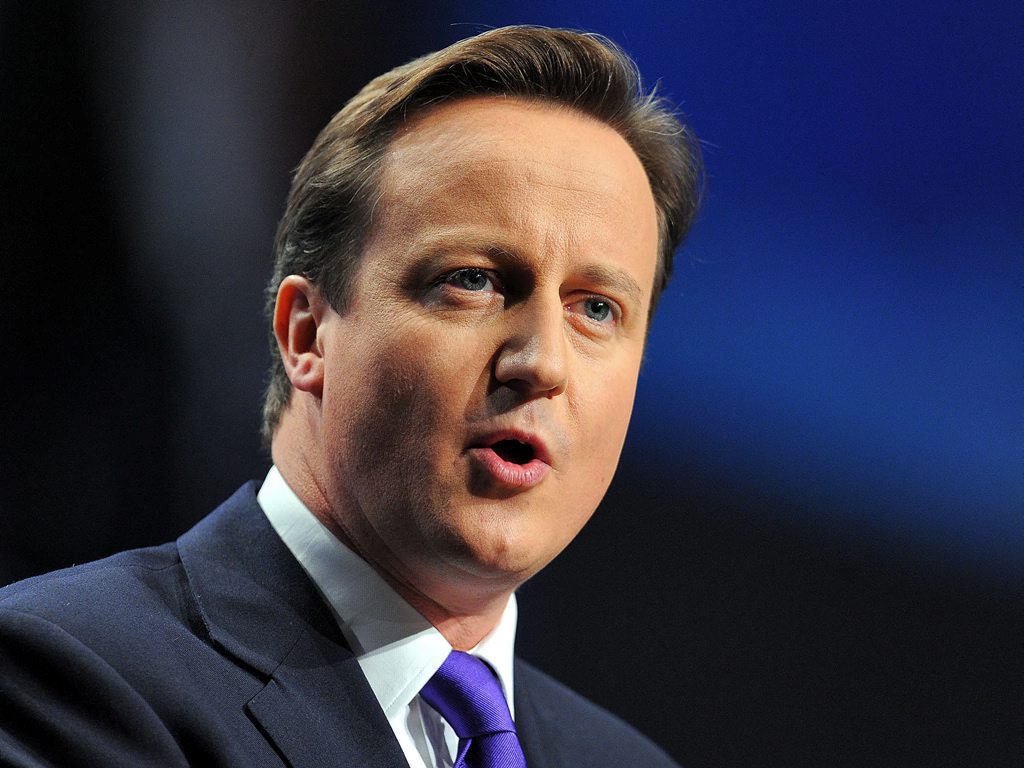
What happened yesterday in Woolwich has sickened us all. On our televisions last night, and in our newspapers this morning, we have all seen images that are deeply shocking. The people who did this were trying to divide us. They should know something like this will only bring us together and make us stronger. Today our thoughts are with the victim and with his family. They are grieving for their loved one and we have lost a brave soldier.
This morning I have chaired a meeting of Cobra and I want to thank the police and the security services for the incredible work they do to keep our country safe. There are police investigations and security service operations underway, so obviously there is a limit on what I can say. But already a number of things are clear: first, this country will be absolutely resolute in its stand against violent extremism and terror. We will never give in to terror or terrorism in any of its forms. Second, this view is shared by every community in our country.
This was not just an attack on Britain and on the British way of life, it was also a betrayal of Islam and of the Muslim communities who give so much to our country. There is nothing in Islam that justifies this truly dreadful act. We will defeat violent extremism by standing together, by backing our police and security services, and above all, by challenging the poisonous narrative of extremism on which this violence feeds.
Britain works with our international partners to make the world safe from terrorism. Terrorism that has taken more Muslim lives than any other religion. It is an utter perversion of the truth to pretend anything different. That is why there is absolutely no justification for these acts. And the fault for them lies solely and purely with the sickening individuals who carried out this appalling attack.
Confronting extremism is a job for us all. And the fact that our communities will unite in doing this was vividly demonstrated by the brave cub pack leader Ingrid Loyau-Kennett who confronted one of the attackers on the streets of Woolwich yesterday afternoon. When told by the attacker he wanted to start a war in London, she replied ‘you’re going to lose. It is only you versus many.’ She spoke for us all.
The police and security services will follow every lead, will turn over every piece of evidence, will make every connection and will not rest until we know every single detail of what happened, and we’ve brought all of those responsible to justice. I know from three years of being Prime Minister that the police and intelligence services work around the clock to keep us safe from violent extremists. I watch their work every week. They do an outstanding job. They show incredible heroism, much of which cannot be reported. They have my staunch support and the support of the whole country.
The point that the two suspects in this horrific attack were known to the security services has been widely reported. You would not expect me to comment on this when a criminal investigation is ongoing. But what I can say is this: as is the normal practice in these sorts of cases, the independent police complaints commission will be able to review the actions of the police, and the intelligence and security committee will be able to do the same for the wider agencies. But nothing should be done to get in the way of their absolutely vital work.
After an event like this, it is natural that questions will be asked about what additional steps can be taken to keep us safe. I will make sure those questions are asked and answered. But I’m not in favour of knee-jerk responses. The police have responded with heightened security and activity, and that is right. But one of the best ways of defeating terrorism is to go about our normal lives. And that is what we shall all do. Thank you.
This website uses cookies to improve your experience. We'll assume you're ok with this, but you can opt-out if you wish. Cookie settingsACCEPT
Privacy & Cookies Policy
Privacy Overview
This website uses cookies to improve your experience while you navigate through the website. Out of these cookies, the cookies that are categorized as necessary are stored on your browser as they are essential for the working of basic functionalities of the website. We also use third-party cookies that help us analyze and understand how you use this website. These cookies will be stored in your browser only with your consent. You also have the option to opt-out of these cookies. But opting out of some of these cookies may have an effect on your browsing experience.
Necessary cookies are absolutely essential for the website to function properly. This category only includes cookies that ensures basic functionalities and security features of the website. These cookies do not store any personal information.
Any cookies that may not be particularly necessary for the website to function and is used specifically to collect user personal data via analytics, ads, other embedded contents are termed as non-necessary cookies. It is mandatory to procure user consent prior to running these cookies on your website.


 The land claims process closed 14 years ago will be reopened.