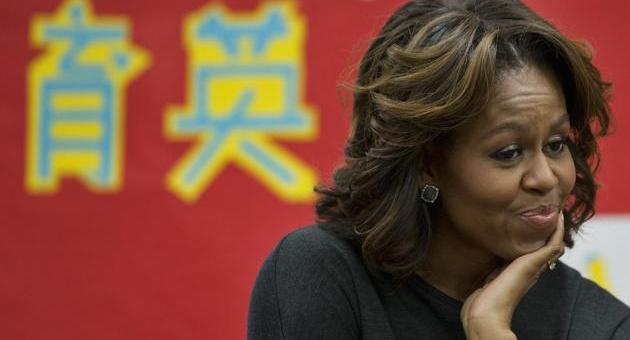
First Lady Michelle Obama will be accompanied by her children and her mother on her trip to China, which begins on Wednesday. But she won’t be accompanied by the press and she will take no questions from the media.
“Michelle Obama’s trip to China starting on Wednesday will be nonpolitical, the White House says, a ‘people-to-people exchange’ emphasizing the importance that both nations place on education. As if to underscore the point, no reporters are traveling with the first lady, and she does not plan to give interviews while there,” reports the New York Times.
The White House is defending the first lady bringing her family along for the ride by saying it’s what the Chinese would want. “Tina Tchen, Mrs. Obama’s chief of staff and a first-generation Chinese-American, said a multigenerational visit would be appreciated by the Chinese, who value tradition,” says the Times.
‘The most powerful message we can deliver [to the Chinese people] is one of the examples of not just the first lady’s life story but of America and our values,’ Deputy National Security Adviser Ben Rhodes told reporters during the Monday call.
‘That alone I think speaks to things like respect for human rights that are interwoven into the DNA of the United States of America.’
American and Chinese leaders have not had especially close personal relationships and there is hope among foreign relations experts that Obama and Peng will form a bond.
Obama’s trip comes as fears about China’s economy mount, the country flexes its muscles in disputed areas of the South China Sea and a missing Malaysian plane carrying Chinese nationals.
“In the US, women enjoy equal rights as men in politics,” said Shen Dingli, a professor of international relations at Fudan University in Shanghai. “But in Chinese traditional culture, we have a saying: ‘a woman without talent is virtuous’.” While female Chinese business leaders are common, he said, women barely appear at the highest levels of the country’s political elite – only two rank among its 25 top officials.
US officials say they want to spread the “power of American values,” and the importance of education. On her second day in Beijing, Obama will give a speech about cultural exchange at the Stanford Center at Peking University, where she’ll meet with Chinese and American students.
About 200,000 Chinese students are studying in the US, more than from any other country. Only 20,000 American students study in China each year. The Obama administration wants to boost that number.
She won’t meet with Chinese president Xi Jinping, but will visit with his wife Peng Liyuan, visit schools and tourist highlights and eat lunch at a Tibetan restaurant.
Source: The Weekly Standard/Washington Post/The Guardian
Defence Minister Nosiviwe Mapisa-Nqakula has revealed that sexual violence is rife in her department, admitting in parliament that there had been 69 complaints of rape and sexual harassment in the past three years alone.
However, not a single defence department employee accused of rape has been convicted .
Mapisa-Nqakula was responding to a question from an opposition memeber who wanted to know how many cases of sexual assault, rape and child pornography relating to the department had been reported between 2009 and 2013.
Mapisa-Nqakula said that 15 rapes and 54 sexual assaults were reported to her department during that time , adding that “appropriate policies” and system s were in place to prevent sex crimes.
High principles dominate the rhetoric on freedom-loving Ukraine, writes JP Sottile. But more mundane realities – like the interests of US oil corporations and Ukraine’s vast shale gas capacity – are part of the volatile equation.
In Ukraine, Chevron’s deal continues a long tradition of intermarriage between ‘national’ and corporate interests under the guise of national security.
Everybody’s got an opinion about the ‘showdown’ with Russia.
Some say it’s about freedom and the right to self-determination. Some say it’s about standing up to aggression and halting a dictator’s march.
Some say it’s about the future of everything-from Syria to North Korea to Iran’s nuclear program – and, according to Sen. Lindsey Graham, it all stems from Obama’s failure to kill the people who killed Americans at Benghazi.
But the most-revealing voice in the chorus is Condi Rice. She penned a tension-filled op-ed on Ukraine for the Washington Post – the newspaper of broken records.
Her nostalgic, “Baby, It’s a Cold War Outside” ditty on the “Ukrainian Problem” came just two days after a Teflon-coated Henry Kissinger opined about the “art of establishing priorities” in his own Ukraine-themed op-ed for the Post.
Why should we care about Condi?
As the world learned through painful experience, Condi Rice, much like Henry Kissinger, was all about establishing priorities. But now that she’s out of power, why should anyone waste any time considering Ms. Rice’s opinion about anything, much less about the ‘crisis’ in Ukraine?
Why? Because it’s telling. Like most American Exceptionalists, her bluster and posturing can be reverse-engineered to find the banal truth about US foreign policy.
For example, her steadfast belief that Ukraine “should not be a pawn in a great-power conflict but rather an independent nation” might have something to do with Chevron’s 50-year lease to develop Ukraine’s shale gas reserves.
It’s the gas, stupid
When that lease was signed on November 5, 2013, it stoked Russian fears about losing its influence on, and a major gas market in, a former satellite.
It also came on the eve of the much-disputed trade deal with the European Union that, once abandoned due to Russian pressure, led to the toppling of Ukraine’s government.
Reuters characterized Ukraine’s “$10 billion shale gas production-sharing agreement with US Chevron” as “another step in a drive for more energy independence from Russia.”
Of course, Ms. Rice knows something about driving for more energy. She sat on Chevron’s board of directors for ten years before resigning to become President Bush’s National Security Adviser in January of 2001.
She was such a titanic figure at Chevron and so beloved by their corporate captains that they even named a 129,000-ton oil tanker ‘Condoleezza Rice’. Do people name tankers after people? People do!
But four months after leaving Chevron, they “quietly renamed” the tanker, apparently sensitive to the implication that she might prioritize their interests in places like Kazakhstan (a de facto dictatorship never targeted by American Exceptionalists) or the Caspian Sea (where Chevron is heavily invested) or Afghanistan (where they’ve long sought a pipeline from the Caspian region to the Indian Ocean).
Corporate Interests Abroad
In the case of Ukraine, Chevron’s deal continues a long tradition of intermarriage between ‘national’ and corporate interests under the guise of national security.
As the International Business Times stated immediately after the deal, “Chevron’s agreement with Ukraine was supported by the US as part of its national security strategy to help reduce Russia’s hold on Europe and Kiev.”
As quoted in the article, US Ambassador Geoffrey Pyatt said, “I’m very determined to cooperate with the Ukrainian government in strengthening Ukraine’s energy independence.”
That “cooperation” is couched in the language of “independence” – but it’s actually about shifting to financial interdependence with powerful, American corporate interests. It’s not about freedom or self-determination or human rights.
It’s about the ‘Open Door’.
Since the US proposed the Open Door Policy in China at the end of the 19th Century, American ‘soft imperialism’ has exploited resource opportunities for American corporate interests in dozens of ‘friendly’regimes – their commitment to freedom notwithstanding.
We have been there before
Whether it was oil in Iran, bananas in Guatemala or sugar-cane in Cuba, any move to close the door on US business interests has traditionally been met with dire warnings about the dangers of isolationism and specious claims about America’s national interests – which, oddly enough, always seem to be located in another country.
Throughout the Cold War, those ‘endangered’ national interests inspired CIA hijinks around the world. US foreign policymakers supported regime change in places like Chile (calling Dr. Kissinger) and around Central America.
And they doled out generous foreign aid packages to a motley crew of anti-communist ‘strongmen’. If push came to shove, the US military might even get involved.
Since the end of the Cold War, US policy has been kicking open doors around the world and particularly around the edges of the former Soviet Union. Expansion of NATO and US involvement in the former ‘Soviet Stans’ around Afghanistan extended a semi-circle of US military might around Russia.
A declaration of economic war
And the Ukrainian energy independence trumpeted by Ambassador Pyatt amounted to a declaration of economic warfare on Russia’s oil and gas-based economy. Like Condi Rice before him, Ambassador Pyatt’s well-established priority is to ensure that well-connected businesses get in on the ground floor.
Once on the ground floor, they need insurance – either from local clients or from a neighborhood patrol by US forces. Perhaps that’s why Ms. Rice used her Ukraine op-ed as an opportunity to advocate leaving a permanent military force in Afghanistan.
She doesn’t want to hear “talk of withdrawal from Afghanistan whether the security situation warrants it or not.” For her, nothing less than 10,000 troops will do. Otherwise, the US is “not serious about helping to stabilize that country.”
Freedom, liberty, justice … and hydrocarbons
Yet, one wonders if she – like all the professional hand-wringers, truculent think tankers, and once and future policymakers who’ve grandstanded on the showdown with Russia – isn’t quietly more concerned about something more basic than freedom, liberty and justice for all.
Perhaps the former Secretary of State, former Chevron big-wig and former oil tanker is more concerned with the ability of Chevron to realize its Turkmenistan-Afghanistan-Pakistan-India (TAPI) pipeline dream.
Her old cohorts practicing soft imperialism at the US State Department have certainly been doing their part to help Chevron score that lucrative contract.
The banal truth is that America’s long-standing policy is to help people anywhere and everywhere when those people just so happen to be living on or near valuable resources.
Unless, of course, it’s Bahrain, Nigeria, Kazakhstan or anywhere else repressive and corrupt governments are already interdependent upon US corporate interests.
The war in Iraq did not end when the United States was kicked out, not by a long shot. The violence in Iraq is on the rise and for decades to come we will have to deal with what the United States and its allies have unleashed.
It’s anyone’s guess if those responsible for this war of aggression (crime against peace) will ever be held accountable for their crimes. What we do know, however, is that the decision to invade Iraq has transformed the global political landscape because according to the UN charter, the invasion was illegal:
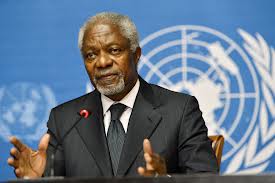
“Kofi Annan, declared explicitly… that the US-led war on Iraq was illegal. Mr Annan said that the invasion was not sanctioned by the UN security council or in accordance with the UN’s founding charter. In an interview with the BBC World Service… he was asked outright if the war was illegal. He replied: ‘Yes, if you wish.’
“He then added unequivocally: ‘I have indicated it was not in conformity with the UN charter. From our point of view and from the charter point of view it was illegal.’”
“We map the world as it is – not as people would like it to be,” National Geographic’s map-making authority says, as the educational entertainment giant prepares to mark Crimea as part of Russia after the parliament officially ratifies the measure.
Juan Jose Valdes, NatGeo’s geographer, chief editor and research director for the map-making division, emerged from a meeting with the magazine’s editorial, legal and cartographic authorities on Tuesday, where the decision was made to give the area a temporary special shading (like the Gaza Strip or the West Bank), until permanent coloring after the Russian parliament approves the treaty signed by President Putin and the Crimean authorities.
When the parliamentary vote takes place later in the week, “the document will be revised to indicate that the change has officially occurred and Crimea is officially part of Russia, then we will identify Crimea with the Russian boundary tint,” Valdes told the U.S. News.
“As you can only surmise, sometimes our maps are not received in a positive light by some individuals who want to see the world in a different light,” the director explained, which is not the case with other map makers. Rand McNally, another leader in atlas and map production, will not be making any changes to its maps.
The company spokesperson, Amy Krouse said “we take our direction from the State Department.”
Google has continued to show Crimea as part of Ukraine.
G4S is the world’s third-largest private-sector employer. The British multinational security services company headquartered in Crawley, United Kingdom, is the world’s largest security company measured by revenues.
Contractors from the security behemoth cleaned up after an explosion in a crowded souk in South Sudan.
G4S is based near London and is traded on the stock exchange there. Though it remains generally unknown to the public, it has operations in 120 countries and more than 620,000 employees.
The security company is engaged by the United Nations mission sometimes to handle difficult tasks.
In recent years it has become the third-largest private employer in the world, after Walmart and the Taiwanese manufacturing conglomerate Foxconn.
The fact that such a huge private entity is a security company is worrying.
Most G4S employees are lowly guards, but a growing number are military specialists dispatched by the company into what are delicately known as “complex environments” to take on jobs that national armies lack the skill or the will to do.
Pierre Booyse, an Afrikaner and ex-SADF colonel, for one, did not dwell on the larger meaning. For him, the company amounted to a few expatriates in the Juba headquarters compound, a six-month contract at $10,000 a month, and some tangible fieldwork to be done.
He felt he was getting too old to be living in tents and mucking around in the dirt, but he liked G4S and believed, however wearily, in the job.
As he set out for the west, his team consisted of seven men—four de-miners, a driver, a community-liaison officer, and a medic.
The medic was a Zimbabwean. All the others were soldiers of the Sudan People’s Liberation Army, the S.P.L.A., now seconded to G4S, which paid them well by local standards—about $250 a month.
At their disposal they had two old Land Cruisers, one of them configured as an ambulance with a stretcher in the back.
Merely two years after official independence, South Sudan was fracturing as a country, but the names of the Souk Sita victims could be inserted into the U.N. forms, and for G4S the day had been a success.
A girl, who survived being raped and set alight in January, has died.
The 9-year-old Lihle Hlanjwa suffered extensive burns, gave a statement to the police about two weeks ago in hospital.
She was raped and set alight on January 18, but, after being found in bush along the R300 the next day, managed to tell residents she recognised the man who had raped her and that he had laughed as he set her alight.
Lihle, also known to family and friends as Queenie, died at the Red Cross War Memorial Children’s Hospital early on Tuesday.
A community representative, Pieter Presence, said Hlanjwa father had virtually lived at the hospital since his daughter was admitted there.
Hlanjwa’s shack had even been vandalised and burgled while he was away, Presence added.
On Tuesday, police spokesman Andre Traut said the 27-year-old suspect, arrested the day after Lihle was attacked, now faced a rape and murder charge, instead of an attempted murder charge.
The suspect, Wanda Oliphant, is expected to appear in the Bellville Magistrate’s Court again next week.
Priscilla Mcentee, chairwoman of Delft Suburban, a community neighbourhood programme, said: “I feel like it’s my own daughter that has passed away.”
Mcentee was instrumental in Oliphant’s arrest. The morning that Lihle was found, she had seen a man, with a burnt T-shirt and blood on his pants, behaving suspiciously.
She called for back-up and together with neighbourhood watch members kept the man in a member’s garage.
The attack on Lihle was one of at least three against children in Delft South in less than a month.
A week before the incident, a 6-year-old girl was raped in a communal toilet in the area.
Three weeks after Lihle was raped and set alight, 11-year-old Siphokuhle Flephu was murdered and allegedly raped.
Argentine leader Cristina Fernandez de Kirchner recalled that the UN Charter stipulates the right of people to self-determination, which means that this rule should be applied to all countries without any exception.
Kirchner compared the situation in Crimea with another event in modern history. The Falkland Islands also held a referendum a year ago. It was a disputed territory, claimed by both Argentina and the United Kingdom. In 1982, differences resulted in an open military conflict.
Britain then defended the Falklands by force of arms, and last March almost all the residents voted to stay a part of the UK in a plebiscite. The UN did not question the legality of the vote at that time, Kirchner said.
“Many of the major powers, which have secured the Falklands’ people right to self-determination, do not want to do the same in relation to the Crimea now. How can you call yourselves guarantors of world stability, if you do not apply the same standards for everyone? It looks like the Crimeans cannot express their will, but the residents of the Falklands can. There is zero logic in that,” she said.
The EU countries and the US government refused to recognize the results of the referendum in the Crimea, with region’s residents voting almost unanimously for joining Russia.
The EU imposed second-tier sanctions against Russia on Monday, as a retaliation measure to the holding of a referendum in Crimea. Financial assets freezing and a visa ban on entry into the EU countries were applied to those Russian officials, who the West calls responsible for the annexation of the Crimea.
The US sanctions have affected an even higher tier – Barack Obama signed a decree that prohibits entry into the United States and seizes US assets of seven Russian officials and deputies: the Federation Council Speaker Valentina Matviyenko, Deputy Prime Minister Dmitry Rogozin, Presidential Adviser Sergei Glazyev, Assistant to President Vladislav Surkov, State Duma deputies Elena Mizulina and Leonid Slutskiy, Senator Andrey Klishas.
Rejecting contacts with Russia, the West harms himself, not us, the Vzglyad newspaper states. As a response to the US and European sanctions the State Duma issued a document named “On the US and EU sanctions,” suggesting that Western leaders should extend restrictions on all Russian deputies.
A Grade R girl, 5, is alleged to have been raped by three Grade 2 boys on the grounds of a Mitchells Plain school.
It happened on March 4, but the school failed to notify the girl’s parents. Only during a conversation with her teacher on March 13 did the parents learn their child had allegedly been raped.
The girl’s father, who is not being identified in order to protect his daughter’s identity, said the school had “failed in its duties”.
He said the police opened a case and took the family to a social worker and to GF Jooste Hospital the next day.
“After that session (with a doctor) she and my wife came out crying. My daughter was crying because of an injection she had received. My wife was crying because the results were positive in terms of penetration.”
The family await the results of HIV and other tests.
The girl’s father says she is severely traumatised and afraid to return to class.
The alleged incident happened while the girl was waiting for her transport home after school. Her father said she usually waited in an office but later found out that on that day she had been “chased out” by a staff member. He said he later learnt his daughter had been approached by the three boys who ordered her to hold on to a tree.
“They ordered her to take off her underwear. She didn’t want to. They forced her to do it and did what they wanted to do.”
He said the boys told her they were going to kill her if she reported them, but she told a teacher the next day. The girl didn’t tell her parents.
The father said that on March 6 he received a phone call from the school and was told that there were problems with his daughter’s transport. They wanted to know if he could come to the school the next day.
He said the next morning he received another call from the school who asked if he was still coming “because the parents were there” so he assumed it was a general parents’ meeting and that it would be finished by the time he arrived there.
He later found out the “parents” were the alleged perpetrators’ parents.
“Nobody told me that my daughter had been raped. I would have left everything I was doing and gone to the school.”
The father said that on Thursday he saw her class teacher outside he asked about his daughter’s progress in class.
“The teacher said she was okay. Then she said: ‘I thought you had come here because of the rape’. We asked her what she meant.”
The parents demanded to see the principal immediately. They said he told them he was under the impression they had been informed.
Believe it or not, roughly 95 percent of ATMs in the world are still running Windows XP — and that’s about to become an expensive problem.
Machine designer NCR says that only a third of banks will upgrade their ATMs to a newer OS before official XP support ends on April 8th, leaving many institutions little choice but to pay Microsoft for an extended contract if they still want support.
At least some banks plan to update, but they’re facing both technician backlogs and steep transition costs; estimates suggest the big UK firms might pay up to £60 million ($100 million) each to make the leap.
Whether or not your bank joins the modern era, you shouldn’t be surprised if you end up footing some of the bill.
For those suggesting that the disappearance of Flight 370 is unparalleled in aviation history, Vocativ would like to remind them that another large Boeing jet took off from an airstrip in Angola in 2003 and hasn’t been seen since.
Big difference: That jet had no passengers aboard, but the circumstances surrounding its disappearance are pretty strange nonetheless. Two mechanics—American Ben Charles Padilla and Congolese assistant John Mikel Mutantu—boarded the Boeing 727 on a Luanda airstrip to get it in shape for its next flight.
Neither had a pilot’s license, which is why flight controllers were stunned when the plane taxied to the runway and then took off.
Leased to deliver diesel fuel to diamond mines, the 727 carried 10 500-gallon fuel tanks and a few passenger seats in its cabin.
Was it Padilla? Mutantu? Both? Hijackers who had slipped aboard? Investigators still don’t know, and no sign of the plane has turned up despite an intense international hunt.
Some of the theories being tossed around in regard to Flight 370—it crashed into the ocean, it landed secretly, it got shot down by some nation’s military—were similarly floated back then.
But “we never knew for sure where it went,” concluded an earlier investigation by Air & Space magazine. It was at the time the largest aircraft to go missing, but the Malaysian jet will take that distinction if it doesn’t turn up.
After her brother disappeared from Quatro de Fevereiro International Airport in Angola, Benita Padilla-Kirkland tried to persuade the FBI to re-open his case. In 2005, the FBI had closed its case.
She believes she has the “new information” agents told her they require. But she suspects that the agency already has more information than agents will admit to
According to press reports, the aircraft began taxiing with no communication between the crew and the tower; maneuvering erratically, it entered a runway without clearance. With its lights off and its transponder not transmitting, 844AA took off to the southwest, and headed out over the Atlantic Ocean. The 727 and the two men have not been seen since.
Retired U.S. Marine General Mastin Robeson, commander of U.S. forces in the Horn of Africa when 844AA went missing, says word of the 727 “came up through the intelligence network.” According to Robeson, U.S. Central Command (CENTCOM) considered moving U.S. fighter aircraft to Djibouti on the Red Sea coast, where the Combined Joint Task Force shares a base with the French military.
Robeson continues: “It was never [clear] whether it was stolen for insurance purposes…by the owners, or whether it was stolen with the intent to make it available to unsavory characters.”
Russian President Vladimir Putin’s popularity has soared after the historic referendum in Crimea.
Putin spoke to Barack Obama on the phone, after the overwhelming majority of Crimeans expressed their willingness to join Russia.
As Putin spoke about the referendum, he emphasised “the precedent set by Kosovo, among other things.”
The referendum was fully in line with international standards, its results should be recognised both in Ukraine and western countries, Austrian member of the European Parliament Johann Stadler said at the final press-conference of international observers on Sunday.
With a record-breaking turnout of over 80 percent, according to preliminary results, over 95 percent of the Crimean population said ‘yes’ to the reunion of the republic with Russia. International observers have not reported any violations or anything resembling any kind of pressure during the vote.
However, Obama said the Unites States and the “international community” will “never recognize” the results of the referendum “administered under threats of violence and intimidation,” according to White House spokesman.
Obama “emphasized that Russia’s actions were in violation of Ukraine’s sovereignty and territorial integrity” and that the US in coordination with its European partners is “prepared to impose additional costs on Russia,” the White House added.
The Republic of Crimea has addressed the UN seeking recognition as a sovereign state and called on Russia to integrate it into the Russian Federation. 96.77 percent of the Crimean population voted ‘for’ the integration in a referendum in the final outcome.
“The Republic of Crimea intends to build its relations with other states on the basis of equality, peace, mutual neighborly cooperation, and other generally agreed principles of political, economic and cultural cooperation between states.”
On March 30 Crimea will switch to the Moscow Standard Time under a resolution passed by the Crimean parliament at an extraordinary session on Monday a day after the residents overwhelmingly voted to join Russia.
“To establish across the Republic of Crimea the time standard in accordance with the third time zone with the time change at 2 pm on March 30, 2014, by moving the clock two hours forward,” the resolution says.
Julius Malema has accused billionaire businessman Johann Rupert of controlling the ANC and DA and being behind the EFF leader’s tax and political woes, the Sunday Times reported.
When Rupert was contacted for comment by the paper, he laughed uncontrollably before asking: “Did he really, really say that?”
Rupert told the newspaper that he funded neither the DA nor the ANC.
Malema accused Rupert of supporting both parties as well as the SA Revenue Service.
“The ANC and DA are one thing. They agree on everything. The ANC is a black DA and the DA is a white ANC.
“All of them are controlled by Rupert and friends,” the Economic Freedom Fighters leader told supporters at a rally in Khayelitsha in Cape Town on Saturday.
Malema told the crowd that Rupert wanted the ANC to deal with him when he was its youth league leader. He also said that Rupert controlled the SA Revenue Service.
“Rupert said the ANC Youth League is like an irritating mosquito in a room and it needs a Doom. President Jacob Zuma became that ‘Doom’.”
Fears grow in Britain of a “constitutional crisis” which would put the election in doubt, as legal expert warns that Scottish independence could bring down the next government
The 2015 general election will be thrown into turmoil if Scotland votes for independence in September’s referendum, according to government legal advice.
An election is scheduled to be held on May 7 next year but by then Scotland could already be preparing to separate from the rest of the United Kingdom.
The leading lawyer who wrote the Westminster government’s legal advice on Scottish independence is now warning that a “Yes” vote in the referendum would have major ramifications for the election, and could destabilise the next British government.
Cabinet ministers fear that if Alex Salmond’s independence campaign succeeds, the general election would be in grave doubt, plunging Britain into an unprecedented “constitutional crisis”.
In a memorandum for the House of Lords, Professor Alan Boyle, a specialist in international law at Edinburgh University, outlined two options for the election if Scotland chooses independence on September 18.
Source: The Telegraph
This website uses cookies to improve your experience. We'll assume you're ok with this, but you can opt-out if you wish. Cookie settingsACCEPT
Privacy & Cookies Policy
Privacy Overview
This website uses cookies to improve your experience while you navigate through the website. Out of these cookies, the cookies that are categorized as necessary are stored on your browser as they are essential for the working of basic functionalities of the website. We also use third-party cookies that help us analyze and understand how you use this website. These cookies will be stored in your browser only with your consent. You also have the option to opt-out of these cookies. But opting out of some of these cookies may have an effect on your browsing experience.
Necessary cookies are absolutely essential for the website to function properly. This category only includes cookies that ensures basic functionalities and security features of the website. These cookies do not store any personal information.
Any cookies that may not be particularly necessary for the website to function and is used specifically to collect user personal data via analytics, ads, other embedded contents are termed as non-necessary cookies. It is mandatory to procure user consent prior to running these cookies on your website.