Zuma wants to socialise land ownership, move away from ‘will buyer, willing seller model’

Johannesburg – In terms of the Constitution, the state has to ensure that citizens are able to obtain land rights, President Jacob Zuma said at the ANC’s policy conference on Tuesday.

“Our position is that the current willing buyer, willing seller model must be reviewed,” Zuma, who is also the ANC’s president, told delegates at Gallagher Estate in Midrand.

“It tends to distort the land market through inflating the prices of land earmarked for restitution.”

Zuma said the model made land reform expensive and delayed land restitution to the poor. A wide range of proposals had been submitted to the conference.

“[This will] enable faster movement on this matter, within the confines of the Constitution and the law,” Zuma said.

The ANC Youth League wants expropriation without compensation, and said it would push for a policy change at the conference. This has caused tensions between the ANCYL and opposition parties.

The youth league also wants the nationalisation of mines.

On Tuesday, Zuma said ANC delegates had to deliberate on how the state could obtain an equitable share from mineral resources.

“The state exercises sovereignty over the entire mineral and petroleum resources within the republic,” he said.

“In the same vein, Article (2)(1) of the United Nations Charter of Economic Rights and Duties of States, grants states full permanent sovereignty, including possession and disposal over all their natural resources.”

Zuma said the country needed to go “back to the basics” and take difficult decisions that it could not take in 1994. The structure of the apartheid economy had remained largely intact, and had not allowed for higher or inclusive growth.

“We must create a thriving mixed economy, where the state, private capital, co-operative and other forms of social ownership complement each other in an integrated way to eliminate poverty and foster shared economic growth,” he said.

“To achieve inclusive and labour absorbing growth, the state must play an active role in the economy, driving development especially in neglected areas.”

– SAPA

Second revolution against whites must come, says Zuma

Johannesburg – The ANC’s second transition is necessary to overcome the compromises it made in the fight for democracy, President Jacob Zuma said on Tuesday.

“One of the causes of the slow pace to economic freedom is that ahead of [the first democratic election in] 1994… we went through a negotiations process,” Zuma said in Midrand.

“We had to make certain compromises in the national interest, and these were absolutely necessary to make. We had to be cautious about restructuring the economy in order to maintain economic stability and confidence at the time.”

Zuma was opening the policy conference of the ruling African National Congress.

He said the apartheid era’s economic power had remained intact.

“The ownership of the economy is still primarily in the hands of white males, in which it has always been.”

A document on the second transition was one of the ANC’s 13 policy documents which would be discussed during the four-day conference.

Zuma said the second transition would make the country a “true democratic developmental state… which has a number of instruments it can use to facilitate change”.

The first transition was still important because it had ushered in an era of democracy in South Africa.

“The time has come to do something more drastic to accelerate change towards economic transformation and freedom.”

Zuma asked delegates to discuss the notion of a second transition when dealing with the strategy and tactics document.

“It is time to ask questions about the present and future… the last 18 years was the first transition. We are calling for a dramatic shift… to deal with the triple challenge[s] of poverty, unemployment and inequality.”

– SAPA

Minister’s company implicated in school book scandal

The school book scandal in Limpopo province has now implicated the… national minister of education. Her company makes money out of school books that do not get delivered, it seems.

At the centre of the textbook crisis in Limpopo is a politically connected company called EduSolutions. Minister Angie Motshekga has been working with this company since 2008 when she was still Gauteng Education MEC.

The Limpopo government irregularly awarded a R320 million contract to EduSolutions for textbook provision to Limpopo schools. The evaluation and specification committee was ignored at the time the contract was awarded.

This contract was due to be cancelled as soon as the national intervention team arrived in the province to run the Education Department.

Limpopo Education Administrator Anis Karodia now claims that the Minister initially obstructed the cancellation of the contract, preferring for government to continue doing business with EduSolutions instead.

Motshekga made this call even though textbooks were late to Gauteng schools back in 2008 when the Minister was Education MEC in Gauteng and doing business with EduSolutions. EduSolutions is also implicated in a fraud scandal for charging government R13 a pencil.

The obstruction by the Minister continued for a month and a half, according to Mr Karodia, before Motshekga finally agreed that books could be ordered directly from publishers.

While this was happening, Minister Motshekga was promising the public that all learners would receive their books when schools opened in Limpopo. This was said at the announcement of the matric results on 5 January.

Eskom, ANC government causing water crisis, says Greenpeace

JOHANNESBURG, June 25 2012 — A water crisis is looming in South Africa, communities are at risk of losing access to water, and coal is right in the middle of it, according to a report released by Greenpeace today. This latest briefing is a stark reminder to the SA government to start pushing Eskom to substantially invest in renewable energy.

South Africa is projected to experience a 17% gap between water supply and demand by 2030, but new mega coal-fired power stations (Medupi and Kusile) are being built by the national utility Eskom without a clear view of what the water impacts are likely to be.

According to Melita Steele, climate and energy campaigner for Greenpeace Africa: “The truth is that in the face of looming electricity price hikes, and a R13.2 billion net profit recorded by Eskom this year, local communities in coal areas may lose their water rights to make way for mines, to help feed Eskom’s coal addiction.”

The briefing entitled: ‘The Eskom factor: Power politics and the electricity sector in South Africa'[1] tries to identify what the real story is behind Eskom’s decisions, outlining Eskom’s role in South Africa, its evolution as a state-owned company, and its current status as an influential player in South African politics [2]. This is combined with an independently commissioned feature story ‘Coal’s hidden water cost to South Africa’ [3], written by award-winning journalist, Yolandi Groenewald.

“Eskom is the only ‘strategic’ water user under the National Water Act, which means that the Department of Water Affairs has to provide it with water, come hell or high water. The problem is that in one day, Eskom uses enough water to grow almost a million kilograms of maize, due to its reliance on coal. If there were a drought, water might have to be taken away from other users. But Medupi and Kusile will push up Eskom’s water usage considerably in the next decade. The impact of new coal-fired power stations on a future water crisis hasn’t been adequately taken into account”, continued Steele.

“South Africa’s current electricity system is geared to supply energy-intensive industries, and building new coal-fired power stations to ‘keep the lights on’ means catering to big business, at the expense of the 12.3 million South Africans without access to electricity. Making profits for a privileged few, while the people of South Africa pay the price.”

“It is time to hold Eskom and the South African government accountable for the decisions being made today, which will affect all of our futures. South Africa’s continued reliance on coal goes to the heart of whether we can keep our taps running with clean water. Greenpeace calls on Eskom to stop building new coal-fired power stations, and instead invest in the substantial rollout of large-scale and decentralised renewable energy projects to allow for a just transition away from coal: creating jobs, ensuring universal energy access, and avoiding a water crisis exacerbated by catastrophic climate change. In the face of South Africa’s already severe water and electricity crises, the government’s inaction is irresponsible”, Steele concluded.

Minister urges engineers not to leave South Africa

The Minister of Science and Technology, Naledi Pandor, today challenged some 200 graduating engineers from Wits University to forget about their “boarding passes and visas until every village in South Africa have a bridge, everyone walks on tar roads and all cities are greened”.

Opening the University’s June-July Graduation Cluster, Pandor told some 200 graduates from the Faculty of Engineering and the Built Environment (EBE), that recent statistics show that in South Africa one engineer services 3 166 people, while in Brazil there is one engineer for every 227 people.

“South Africa is in desperate need of professional men and women who have the courage to do great things and who could make practical changes,” she said.

According to Pandor South Africa has many great debaters and many people with excellent ideas, but there are still millions of people who live in poverty on the perimeters of social change. “We need practical agents of change. We need people who can roll-up their sleeves and who can bring radical and progressive social change,” she said.

On Monday, the 25th of June 2012, Wits awarded 13 students with doctorates in engineering; as well as 47 Masters of Engineering degrees; and 44 Masters of Science in Engineering degrees.

The midyear graduations are for under-graduate as well as postgraduate students in the Faculties of EBE; Humanities; Science; Commerce Law & Management; and Health Sciences, and run until the 5th of July 2012.

Wits will also be awarding five Honorary Doctorates: Archbishop Njongonkulu Ndungane, Dr Elza Miles, David Nthubu Koloane and Professors Duncan Mitchell and Albert Solomon. Bishop Paul Verryn will receive a Gold Medal.

Letter to Commonwealth on anti-Afrikaner human rights violations

From: Dan Roodt <dan@praag.org>
Date: 2012/6/22
Subject: Urgent: Human rights violations in South Africa
To: secretary-general@commonwealth.int

His Excellency Mr. Kamalesh Sharma
Secretary-General
Commonwealth of Nations
Marlborough House, Pall Mall,
London SW1Y 5HX, UK

Dear Sir,

I wish to bring to your urgent attention the systemic violations of human rights taking place in South Africa, a member country of the Commonwealth.

Yesterday 24 shops belonging to Pakistani nationals, another member country, were ransacked and burnt to the ground in the town of Viljoenskroon, as reported by the South African Press Association (SAPA).

The New York Times has also reported on the many extra-judicial killings taking place against Commonwealth subjects in South Africa, such as Malawians, Mozambicans and Zimbabweans. Although Zimbabwe is no longer a member of the Commonwealth, its citizens should not be subjected to murder and ethnic persecution in South Africa, one of the founding members of the Commonwealth.

I am writing to you on behalf of the Pro-Afrikaans Action Group, an Afrikaner NGO in South Africa. Afrikaners are an indigenous people in South Africa and we are asking your protection, as well as that of Queen Elizabeth II, against the systemic violation of human rights that we are suffering from. These transgressions include the following:

  • racial discrimination in jobs, education and access to capital
  • language and cultural discrimination
  • murder, extra-judicial killings and ethnic persecution
  • rape of our women and girls
  • displacement from our traditional lands and farms
  • forcible transfer of children from our group to the South African group through anglicisation, indoctrination and assimilation
  • interference in our traditional schools and educational practices so as to break them down and prevent the transmission of our language, culture and identity to the next generation
  • vandalism directed against our heritage, museums, literature, arts and historic sites through neglect, lack of funding or willful destruction
  • name changes of towns, streets and places to eradicate our heritage and historical presence in South Africa

I trust that you will respond favourably to our request for help in addressing the human rights crisis in South Africa and our right to be protected from the above-mentioned violations.

I humbly ask you to acknowledge receipt of this letter sent by e-mail.

Yours sincerely,

Dr. Dan Roodt

Director, Pro-Afrikaans Action Group (PRAAG)

Afrikaner singer Steve Hofmeyr marches against violent crime

Steve Hofmeyr with crosses
Singer Steve Hofmeyr with white crosses on his cheek

Local celebrities and members of the public marched to the Union Buildings in Pretoria on Tuesday to protest against violent crime.

The march which was organised by Afrikaans singers Bobby and Karlien van Jaarsveld and Steve Hofmeyr as well as other celebrities was aimed at calling on government to take action against violent crime in the country.

“This is our long walk to freedom…it’s our little war. Crime is high in this country and I mean I have children and want to make sure they are safe and that’s what this is about,” said Bobby Van Jaarsveld.

He said the march was against all crime and not specifically farm attacks.

He said the killing of a five-month-old baby showed how bad things were.

Margrietha de Goede, 66, and the five-month-old baby were found strangled in her home on May 23. De Goede’s body was found under a carpet in an outside room. The baby was found under a bed in the main house.

The march was led by Hofmeyr who had painted white crosses on his face.

He marched behind a big banner which read “Ons sal nie stil bly nie 1/8We won’t keep quiet 3/8.”

Other posters carried by the marchers read “Moeg vir bloed 1/8Tired of blood 3/8” and “this country needs leadership”.

Most of the marchers were dressed in black as they made their way to the Union Buildings to hand over a memorandum to the presidency.

Afriforum supported the march and also called on its members to join the protest. – Sapa

What is wrong with South Africa

by Prince Mangosuthu Buthelezi, MP and President of the Inkatha Freedom Party, February 14, 2012

“Twenty years ago there were many people in this country who felt that we black people are not capable enough to rule a country and administer a democratic government. That was one of the major fears during the negotiation process. Some people felt that it is in the DNA of us Africans to be inefficient, inept and corrupt. I refuse to believe that.”

From this podium, I have said that the failure of Government is the failure of South Africa. What I have to say today, I say for the love of country. When I speak, I do so to be constructive.

Mr President, we have heard your speech, your hopes and your plans, and we desire nothing more than to be able to have confidence in them. Yet, too much prevents us from doing so. How can we embrace hope when our leadership refuses to acknowledge the many problems confronting our country, or the causes that lie at their root? Year after year, the State of the Nation Address shifts the focus, without ever addressing previous failures.

Mr President, in this debate we must analyze all that you said last Thursday. But increasingly I feel that the measure of your leadership can be taken less by what you say, than by what you do not say   Understandably the State of the Nation Address will touch on the high notes of Government, leaving much unsaid. But this year, we have been left with the impression that our attention is being redirected away from the elephant in the room. There is a danger in that, for elephants can be unpredictable and extremely destructive.

It is therefore good and well to say that our Government is working with various provinces to improve governance, systems and administration. But the unspoken fact remains that two of our nine provinces have all but collapsed. Limpopo has been rendered bankrupt through corrupt activities and five of its departments have been taken  over by National Government. The administration of the State is in shambles.

It is fine to say that we are doing well with regards to treatment of HIV and Aids. But the unspoken fact remains that South Africa has lost some 5 million people to HIV/Aids because of our slow and hesitant response to the pandemic.

One can say that we are expanding access to tertiary education by assisting students to pay off their debts. But the unspoken fact remains that students are so desperate to secure admission that they stampede universities, causing injury and loss of life. In the Eastern Cape, the education system has completely collapsed due to maladministration and corruption, forcing National Government to intervene.

It is fine, Mr President, to say we will improve the movement of goods through a Durban-Free State-Gauteng logistics and industrial corridor. But the unspoken fact is that the KwaZulu Natal Department of Transport has had to halt all major road infrastructure projects, while Durban has notched up R1.3 billion in bad spending. The Free State has sought assistance from National Treasury after identifying financial mismanagement and non-compliance in supply chain management processes in its Department of Police, Roads and Transport.

Gauteng has also sought assistance from National Treasury to address the challenges in its Health Department, which is on the verge of collapse. It faces 101 legal claims due to negligence, to an amount of R235-million. The IFP has called for an urgent Commission of Enquiry to investigate this debacle because we, like every South African, want to know: why is this happening, Mr President?

Twenty years ago there were many people in this country who felt that we black people are not capable enough to rule a country and administer a democratic government. That was one of the major fears during the negotiation process. Some people felt that it is in the DNA of us Africans to be inefficient, inept and corrupt. I refuse to believe that.

Yet how do we explain the many nurses in our public hospitals who just do not feel the inner duty to respond to the needs of suffering patients? And what are we to say about teachers who do not feel the calling to spare no energy and to double their dedication to teach our children so that, through better education, they may finally be emancipated from all that oppressed my generation?

If the call of duty is not felt in these two fields, it should be no wonder that throughout the public service productivity and commitment is so low, which translates into poor delivery. What has disrupted the moral fibre and discipline of our people? We know the answer, but refuse to acknowledge it.

How, Mr President, do we explain the contamination of public service and commercial interests? It is fatal, and yet it is pursued relentlessly, from the lowest to the highest levels of Government. Too many, and I dare say the overwhelming majority, are trying to make money on account of holding public office, being in politics or exercising public power.

Corruption is the bane of our country. It is a fundamental threat to our constitutional democracy. As former Secretary-General of the United Nations, Mr Kofi Annan, said, “Corruption hurts the poor disproportionately by diverting funds intended for development, undermining a government’s ability to provide basic services, feeding inequality and injustice and discouraging foreign aid and investment. Corruption is a key element in economic underperformance and a major obstacle to poverty alleviation and development.”

Yet you shy away from this issue, Mr President. The unspoken fact is that corruption has seen the axing of two Ministers, Mr Sicelo Shiceka and Ms Gwen Mahlangu-Nkabinde. The National Police Commissioner, Mr Bheki Cele, is still suspended pending an investigation into corruption. The Speaker of the KwaZulu Natal Legislature, Ms Peggy Nkonyeni, and MEC Mr Mike Mabuyakhulu are facing corruption charges in court.

The recently released Manase Report uncovers widespread and rampant corruption within the eThekwini Municipality. High-ranking eThekwini municipal officials and politicians, including former Municipal Manager, Mr Mike Sutcliffe, and former Mayor, Mr Obed Mlaba, have been fingered in a damning forensic investigation into financial irregularities, fraud and corruption.

Last year, the former Head of the Special Investigating Unit, Mr Willie Hofmeyr, told the parliamentary Portfolio Committee on Justice that 20% of South Africa’s procurement budget, between R25-billion and R30-billion, is lost to corruption every year. According to Transparency International’s 2011 Corruption Perceptions Index, South Africa is perceived to be becoming more corrupt with each passing year. That perception is rooted in reality.

On a scale of 0, being highly corrupt, to 10, being very clean, we have fallen from a ranking of 5.1 in 2007 to 4.1 in 2011. The unspoken fact is that we are on the verge of joining the ranks of dysfunctional states, as the effects of corruption debilitate all spheres of life.

What went wrong, Mr President? How do we fix it? Surely not with more rhetoric, empty words and never-ending declarations of policy. We must have the courage to go to the root.

It was you, Mr President, who on December 30, 2000, acting as the Chairperson of a Committee of the South African Government signed a formal agreement with traditional leaders in terms of which the local government powers and functions of traditional authorities would be preserved and, to this end, Chapters 7 and 12 of the Constitution would be amended. It was you who did not bring that Agreement to Cabinet for ratification, and it is you who bears the final responsibility for it having been breached and for the powers, functions, respectability, moral authority and social guidance of traditional leadership having finally been obliterated.

What does this have to do with it? It is relevant because the core problem of the maladministration, inefficiency and corruption is the disintegration of the social cohesiveness, social values, rectitude, integrity, discipline and dedication to duty which traditional leadership has been entrusted to promote and inculcate within our communities. Once that disintegrates, as it unfortunately has, what ends up in our government offices, hospitals and schools bears the hallmark of no one willing to pay a personal price to make this country a better place.

It was you, Mr President, who was charged by President Mbeki to champion and pilot the campaign for the moral regeneration of South Africa. I need not comment on that. It was also you, Mr President, who was equally charged by President Mbeki to bring about the reform of our labour legislation to increase the flexibility in the labour market. That too ended in naught.

Why is that relevant? It is relevant because our labour legislation and the lack of flexibility in our labour market have not only been identified by your Government, Mr President, as one of the major impairments to real economic growth and real employment generation, but also a cause of the ongoing degeneration of the sense of duty and commitment in the workplace. Empowering trade unions the way you, Mr President, have been instrumental in doing, has eroded the culture of hard work, discipline, productivity, dignity and self-respect which people like me have promoted and instilled in our communities for more than sixty years.

This has compounded problems with problems. It was your Party, Mr President, which for twenty years made it its main political policy in South Africa to undermine social cohesions within our communities. Your Party embraced and promoted the strategy of making our communities ungovernable, spreading a culture of lawlessness and rebellion and destroying the black education system.

The black education system was far from perfect, but its destruction replaced it with the roots of a phenomenon which is the common denominator of most of our problems. It brings together our irresponsible nurses, our indolent teachers, our ineffective civil servants and all the youths with narrow-minded vision, distorted values and wrong hopes who were falsely lured into supporting the President of the Youth League of your Party.

Mr President, everyone makes mistakes. Every government has faults and shortcomings. The wise acknowledge and correct them. The unwise ignore them.

You correctly identify our sky-rocketing electricity prices as one of the factors which are thwarting all our efforts to develop an industrial basis and produce real growth in our economy. Yet, we did tell you that funding the build program of Eskom through tariffs was a mistake. We did tell you, Mr President, that it should have been funded by means of an international competition which would have brought into South Africa as much as R400 billion of direct foreign investment, while creating a much needed and healthy competition amongst producers and distributors of electricity. We were ignored

We further said that, if funded domestically, the build program had to be funded through the national budget and not through tariffs, so that the rich could pay more than the poor. The way it has been done is forcing industries and the productive middle class to bear a much greater burden for the investments than warranted by their actual taxable income.

I am just giving this example as part of the same problem. That is the problem of doing things for the wrong reasons, including political reasons, and not for commitment to our country’s and our people’s best interests. I will add two more examples, because the magnitude of the mistakes there shows what happens when political thinking overrides national interest.

Under your leadership, Mr President our country jumped into BRICS. Yet, to develop an industrial basis, we must manufacture export products which, in the final analysis, can mainly only be sold outside of BRICS and mainly in the regions which have been our traditional trade partners, namely Europe and North America. This shows how our priorities become confused and contradictory. Our priorities should be to ensure that the African Growth Opportunities Act of the United States is renewed and expanded so that we can export our products there without duties and quotas, and that similar agreements are entered into with other markets where we can sell our products.

Another major policy mistake is maintaining the four retail bank policy and tolerating the collusion and other restraints of trade openly practiced by our banks. Because of lack of real competition, our banks are not forced to take risks they don’t want to take, and force all the risky business onto the Industrial Development Corporation and the Development Bank of Southern Africa. This means that they choose to live only by the business which makes money with no risk, and the government, the taxpayers and our communities must bear the risk associated with promoting economic growth. It would seem as if your Government, Mr President, has a greater commitment to serving the banks than the people we represent.

Mr President, you praise the trade unions, and even SADTU, as if they should be thanked for doing less than the full measure of their destructive capabilities. Praising the South African Democratic Teachers’ Union for its diligent teachers was a step too far in placating the unions. Members of SADTU often abandon students nationwide to drive their own agendas. This ANC-aligned Union continues to act like an organization hell-bent on destroying the future of our children.

SADTU should be rebuked, not praised, for their actions have aggravated and deepened the crisis in our education system. Instead of acting like responsible educators, some members of SADTU have, on numerous occasions, proven themselves irresponsible, unprofessional and unfit to educate South Africa’s learners. The recent go-slow in the Eastern Cape, where education came to a complete halt, is a case in point.

Mr President, you mention that employment generation never recovered from the terrible knockout it received at the end of the seventies, but you fail to explain why that happened. You do not wish to remember that employment generation collapsed because of the call for sanctions against our country and for foreign divestment which your Party, Mr President, foisted onto South Africa and which I so vehemently opposed.

This was because nothing destroys economic growth more than sanctions Strangely, your Government and the ruling Party have adopted this policy against sanctions being imposed on Zimbabwe for the same reasons; that they destroy the lives of the poorest of the poor.

History has proven me right and your Party wrong. You admit that we have yet to recover from that self-inflicted injury, the same way as we have yet to recover from the self-inflicted injury of having disrupted the moral fibre and discipline of our communities.

But too much remains unsaid. You make no mention of small businesses and how they will be assisted by Government to help grow the economy and create jobs. You make no mention of the fact that the two sectors that should be in boom right now due to international demand, namely agriculture and mining, are in reverse, due to Government’s many policy failures.

The unspoken fact is that the latest Global Competitiveness Rankings of the World Economic Forum highlight how, increasingly, corruption, wasteful expenditure and government red-tape is hindering business development, SMMEs and investment in our country.

I want to have hope in our future. I want to have confidence in you, Mr President. I want to be able to believe that there is more than just words to your declaration of intent. But how much of what has been set aside by the State to achieve such lofty goals will actually fulfill its intended purpose? We know that when resources are made available, corrupt officials begin to salivate. One is galled that their consumption is so conspicuous.

I fear there is a disconnect between Government and the reality of everyday life for South Africans. It is impossible to have hope while the ANC refuses to recognize, acknowledge and mend the error of its ways. We must start by correcting the terrible injuries inflicted by ourselves – not by Apartheid, not by the colonialists, not by foreign powers – but by ourselves, onto the minds, strength and discipline of our own people.

We need to rebuild pride in our work. We need to build a sense of dignity in abiding by the discipline necessary to improve our conditions. We need to terminate the culture of dependency. We need to create a culture of real growth which must range from what young people do to build their futures, to how our enterprises understand they have to compete and survive without relying on government crutches. We need to re-establish the important role of traditional leadership throughout the country. We need to exact from each civil servant the full measure of dedication that one would expect from a soldier in a war for progress and development.

We must have a complete separation between public office and commercial venture and change our mindset in this respect completely.  And most of all, we must fire all those who do not comply with these imperatives, ranging from lazy civil servants to corrupt officials, to nurses who do not nurse and teachers who do not teach. If we fail to attend to this basic aspect of our country’s reconstruction and development, everything else is bound not to achieve its intended purpose.

Mr President, your address lacked accountability on the crisis in health, the crisis of education and the crisis of corruption. What you have said looks good on paper. But what you have not said can prevent the fulfillment of the best-laid plans.

I am reminded of final lines of Robert Burns’ ode “To a Mouse” –

But little Mouse, you are not alone,
In proving foresight may be vain:
The best laid schemes of mice and men
Go often askew,
And leave us nothing but grief and pain,
For promised joy!
Still you are blest, compared with me!
The present only touches you:
But oh! I backward cast my eye,
On prospects dreary!
And forward, though I cannot see,
I guess and fear!

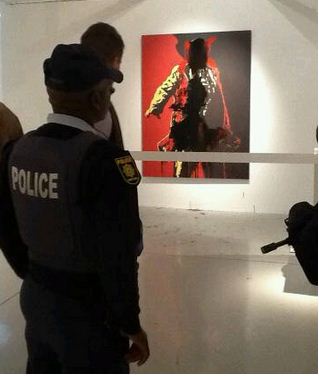
Zuma painting defaced with black paint

The defaced painting

The controversial painting of President Jacob Zuma in the Goodman Gallery in Johannesburg has been defaced, gallery staff confirmed on Tuesday.

A man is being held by the gallery security team.

“The work has been painted over with black and red paint,” a spokesman said.

Police are on their way to the scene.

On Twitter, expelled ANC youth leader Julius Malema said: “Guy who defaced Zuma spear is a national hero.”

– Sapa and Praag

Beaten Afrikaners becoming an international symbol

by Dan Roodt

Last week ANC leaders had another braai or luncheon with representatives of Afrikaans organisations. A few vacuous statements were made afterwards but as usual nothing really happened.

Why on earth does the ANC still talk to Afrikaners and Afrikaans organisations when they have absolutely zero political influence? one wonders. King Mswati III of Swaziland has much more clout as he heads up an independent nation with a seat at the UN, even if he has to beg South Africa for a few billion rand to pay his civil servants.

The fact is that Afrikaners were thoroughly beaten during the 1980’s by what I call the Afro-Saxon alliance of the exiled ANC and the English-speaking intellectuals, as well as the Anglican Church and some very influential British people. In the nineteen-eighties, that alliance mounted a superbly orchestrated propaganda campaign against the National Party that toppled it from power and condemned Afrikaners to becoming more or less internal immigrants.

Today most Afrikaners feel alienated, wondering about their role in a country that is increasingly leaving them behind in language, culture and mentality. Even the DA is changing Afrikaner names in Cape Town to more acceptable Afro-Saxon equivalents.

Yet the National Party refuses to die, apparently. Despite being merged with the ANC under Marthinus van Schalkwyk, the many Afrikaner groups and institutions that used to be under its wing are still fighting for standing room on the Titanic.

Just think of the mighty Naspers, South Africa’s biggest media group. Once upon a time strategic decisions at Naspers were made by the cabinet and not the company itself. Despite being commercially successful, Naspers is still having a political identity crisis, unsure whether it should support the moderate faction of the ANC or the DA. Its newspapers like Beeld, Die Burger and Rapport, have abolished the word “Afrikaner” and replaced it with “Afrikaanse”, a term denoting a person of uncertain identity who might sometimes speak a few words of Afrikaans.

You have already grasped that everybody in South Africa is in some sense an “Afrikaanse”. Whenever you say “boerewors” or “lekker”, you are promoted – or perhaps demoted – to this rather lowly species of humanity.

There is also the publicity-hungry Solidarity trade union, run by some ex-Conservative Party Youth members. However, the Solidarity and Afriforum boys now despise their former right-wing ideas and are more or less in line with Naspers’s flight from identity. They are short on ideas and long on complaints about corruption, farm murders, service delivery and the other seemingly insoluble ills that plague postapartheid South Africa.

Mr. FW de Klerk, who is no longer popular with Afrikaners, still attempts to keep a hand on the tiller by means of his eponymous foundation that sometimes issues strongly-worded reprimands whenever the ANC threatens to change the constitution.

Like a vampire leaving his coffin after dark, the National Party and its brand of compromising, opportunistic politics still haunt the disparate and squabbling Afrikaner groups that hold incessant meetings and issue statements that the media routinely ignore.

But while South Africa has lurched to the left since 1994, fraternising with and subsidising Cuba, odd things are happening in the rest of the world. When I lived in France two decades ago, only two percent of Frenchmen voted for the right-wing National Front of Jean-Marie Le Pen. In last Sunday’s presidential elections, his daughter Marine Le Pen polled a whopping twenty percent. Clearly, nationalist politics has suddenly become mainstream in France, as it has in many other European countries. Russia, too, has become a hot-bed of nationalism and young Russians engage in some form of “white pride”.

Like Marie-Antoinette’s death under the guillotine, the Afrikaners’ abject fall from grace – with radical land reform still to come – has become a kind of symbol. The news is out in the USA, in Holland, Italy, Russia and other countries, that this is what happens when whites become a minority in their own country. You have violence and permanent affirmative action.

Farm murders are probably not a white genocide, but certainly many people internationally already believe that, which is enough. Afrikaners have now become the victims of ANC rule and many books are being written about their plight.

One such volume is Ilana Mercer’s Into the Cannibal’s Pot – Lessons for America from Postapartheid South Africa. Ms. Mercer, a resident of Idaho but having grown up in SA, is highly intelligent and writes in a brilliant polemical style. She is worth ten or twenty FW de Klerk Foundations.

Another American who has taken up the Afrikaner cause is Jared Taylor of the American Renaissance group. His book White identity – racial consciousness in the 21st century will shortly be published in SA too. It deals with American racial identities, but resonates deeply with South Africa where 94% of black people vote en bloc for the ruling ANC. This is according to a recent Ipsos-Markinor poll.

As ever, South Africa finds itself at the heart of the world’s problems when it comes to racial and ethnic coexistence. In the past it was to the detriment of Afrikaners and white South Africans generally. Perhaps this time we could take solace from that inescapable fact.

Porno mom and her freaky family

By Ilana Mercer

“Unseemliness” is how Charles Murray might call the May 21 Time magazine cover, genuflecting to modern motherhood in America. In “Coming Apart: The State of White America, 1960-2010,” the libertarian political scientist mentions the “collapse of a sturdy code” [of conduct] in American society, rendering the nouveau riche upper class indistinguishable in that sense from the ever-accreting lower class.

“Obscene” better captures the mien of the Madonna and child that brazenly stare into the camera – and at America. Time’s cover-models are Jamie Lynne Grumet, 26, self-styled, “attachment” parent, and Aram, her chunky, garden gnome of a child.

(And “hollow-elite,” also a Murray moniker, fits Time Managing Editor Rick Stengel. Stengel, whose hagiographical tributes to Nelson Mandela have practically been serialized – he has completed two, perhaps a third is planned? – has helped cloak Mandela in the raiment of sainthood. Mandela, that paragon of virtue, has never raised his authoritative voice against the pogroms that have seen thousands of white South Africans murdered and mutilated by blacks.)

In any event, Aram is a real feeder, if you know what I mean.

Grumet junior is large for his tender age of 4. His gaze is cunning, never cute. The miniature man already reaches up to his non-gnomic mom’s waist. To help Aram get at the prized pair – mom’s perky breasts – Time’s artistic director has used a stool.

All the better to satisfy mom’s “maternal” urges, “Nudge nudge, wink wink. Say no-more, say no-more.”

One other tender touch: Porno-mom’s pelvis is tilted slightly in the direction of her gnome’s grubby hands.

At this stage, bullying would be the best corrective intervention this kid could hope for. In a better world – one in which propriety had not been pulverized – odious Aram would be taunted mercilessly at play school. Were he to make it that far, boob-boy is sure to be smacked about the head by a few manly college boys, later in life.

For now, Aram remains the play thing of bigger bullies, caught as he is in a maelstrom of mommy dearest’s making. Horrified, television spectators watched the advocacy for the onanism known as “attachment parenting,” with the fascination with which you’d watch maggots crawl in-and-out of a CSI corpse.

“A lot of people say, you know, you can’t really be intimate with your husband if you’re co-sleeping and … those are kind of myths, too,” vaporized Mrs. Grumet on NBC’s “Today” show, to the leering approval of the mad-hatter behind Jamie Lynne Grumet’s Method Parenting. Dr. William Sears was on set to dispense Delphic advice to moms who don’t measure-up. “These are tools, not rules,” this tool of a doctor effused.

Viewers of this uniquely American vaudeville were assured by Mrs. Grumet that her relationship with her husband was “very, very important” to her. If to believe her, daddy too enjoys watching mommy perform. Or as Monty Python’s Flying Circus put it in 1969, “the wife is a ‘goer,’ she’s a sport, she’s interested in photographs.”

Charles Murray’s “sturdy code” is moribund but not yet dead. I don’t know if “JoshuaW” from Charlotte, N.C., is a dad too, but this is not his idea of family fun. “How do I erase this from my computer?” he quipped on a chat-board. “If the feds raid my place, I’m looking at five to 10.”

Not that cable’s chronically incurious cretins have inquired, but I would be surprised if the appendages shared by the freaky family yield much by way of fluids. Jamie Lynne Grumet is very thin. Nutrients (and nurture, for that matter) are not what the gnome is getting from the breast on which he gnaws. For an intake of fewer than 1,500 to 1,800 calories a day by the mother would put her breast-milk supply at risk. Or so contend the experts. Being as skinny as Mrs. Grumet is would probably degrade the nutritious quality of the liquid as well. Claims Kelly Bonyata, IBCLC: “Fat-soluble environmental contaminants and toxins stored in body fat are released into the milk when caloric intake is severely restricted.”

Still, the toddler’s toxicity came in handy. Aram made it hard for viewers to make head or tail of porno mom’s NBC disquisition on “attachment parenting.” “Buddy,” as mom referred to Aram, kvetched a lot (as any half-decent parent could have predicted).

Yes, America’s Model Mom is a boob of very little brain, to quote Winnie the Pooh. Aram is “self-weaning right now,” the vacuous Mrs. Grumet intoned affectatiously, as the gnome’s self-whining reached a crescendo.

To the infant, the breast is a non-sexual organ, on which he depends for sustenance and solace. As a mother who breast-fed her baby, I understand how close a bond breast-feeding fosters. My daughter would play with a lock of my hair, or stop feeding to crack a smile. She would always turn a meal into an occasion. But when she emphatically rejected this unarguably suffocating closeness, I let go.

Having read Sigmund Freud’s primary works (as opposed to secondary source commentary about them), I consider him one of the most creative and imaginative writers. While I would not put much store on the pioneering psychoanalyst’s reductive theories of child psychosexual development, about one thing Freud was right: Children are sexual beings.

But as King Solomon (allegedly) preached in the Book of Ecclesiastes, “There is a time for everything, and a season for every activity under the heavens.”

Appropriate, non-perverse parenting should never awaken and amplify a sexuality that is destined to lie dormant until much later in life.

Stage theories (in the social sciences, at least) are problematic because they are so formulaic. However, Erik Erikson’s stages of psychosocial development have much to impart. Central to the existential conflicts Aram Grumet should be experiencing right about now are issues of “Autonomy vs. Shame and Doubt,” and “Initiative vs. Guilt” – the unsuccessful resolution of which could give rise to anything from obsessive and impulsive traits, to antisocial and narcissistic ones.

From the little we’ve seen of him, Aram is awfully unpleasant, a walking, whinging DSM-5 textbook – that’s the psychiatric Diagnostic and Statistical Manual of Mental Disorders – in the making.

Education department ordered to supply textbooks by 15 June

Human Rights Commissioner Judge Jody Kollapen yesterday handed down judgment in the application launched by the Centre for Applied Legal Studies at Wits University, acting on behalf of SECTION27, Hanyani Thomo Secondary School and Tondani Lydia Masiphephethu, for the delivery of textbooks to schools in Limpopo and the implementation of a catch-up plan for Grade 10 learners.

Kollapen has ordered the Department of Basic Education (DBE) and the Limpopo Department of Education to deliver textbooks to all schools in Limpopo by no later than 15 June 2012.

He further pronounced that the failure by the DBE and the Department to provide textbooks to learners throughout Limpopo for almost half of the academic year is a violation of the right to a basic education.

The respondents have been instructed to formulate a catch-up plan for the schools and that a copy must be submitted to the court and the applicants by 8 June 2012. The catch-up plan must identify gaps in the curricula and the extent to which the quality of teaching and learning has been prejudiced by the lack of textbooks.

The respondents are required to indicate which remedial measures will be put in place to address these problems. Furthermore, they are required to submit monthly reports to the court and the applicants on their compliance with the catch-up plan, which must be concluded by the end of this academic year.

“There are approximately 1.7 million learners at over 5 000 schools in Limpopo who will benefit from the declaratory relief and the order requiring the urgent delivery of textbooks,” says Zeenat Sujee, lawyer at the Wits Centre for Applied Legal Studies (CALS) leading the case.

In addition, Grade 10 learners throughout the province will benefit from the catch-up plan, which will assist them in closing the gaps in their syllabi caused by the late delivery of textbooks.

Painting showing Zuma’s genitals provokes ANC

The ANC vowed on Thursday to go to court to get a painting of President Jacob Zuma with his genitals hanging out removed from a Johannesburg gallery.

“The African National Congress is extremely disturbed and outraged by the distasteful and indecent manner in which Brett Murray and the Goodman Gallery in Johannesburg is displaying the person of comrade President Jacob Zuma,” ANC spokesman Jackson Mthembu said in a statement.

“We have this morning [Thursday] instructed our lawyers to approach our courts to compel [them] to remove the portrait from display as well as from their website and destroy all printed promotional material.”

The 1.85m-high acrylic on canvas painting titled “The Spear” is part of Murray’s “Hail to the Thief II” exhibition at the gallery.

It is part of a body of satirical work which is a sequel to his 2010 exhibition “Hail to the Thief”.

A biography of Murray handed out by the gallery shows how Murray’s work continues his forthright attacks on abuses of power.

His bronzes, etchings, paintings and silk-screens formed part of a “vitriolic and succinct censure of bad governance”.

They were Murray’s attempts to humorously expose the paucity of morals and greed within the ruling elite, according to the biography.

The painting of Zuma, and a few other pieces, have already been sold.

The ANC said the painting violated Zuma’s right to dignity.

It said the image and the dignity of the president as president of the ANC, president of the country, and as a human being had been dented by “this so-called piece of art”.

Staff at the Goodman Gallery said on Thursday that the exhibition, which opened on May 10, had been well received, with positive comments in the guest book.

“Hilariously sad and true,” wrote one person. Other comments were “brilliant”, “very cool” and “amazing”.

The gallery said it would make an official comment in response to the ANC’s threat of court action, but had not done so by Thursday evening.

The ANC also bemoaned the use of the party’s logo.

Part of Murray’s work was a poster of the ANC’s emblem with “for sale” printed on top of it and then “sold” stamped across it.

“The vulgar portrait and the dismembering of the ANC logo… is an abuse of freedom of artistic expression and an acute violation of our constitution, apart from being defamatory,” said Mthembu.

Murray also took struggle posters and adapted them to read: “Amandla, we demand Chivas, BMWs and bribes”; “Now you have touched the women you have struck a rock, you have dislodged a boulder; you will be president”; and “Tell my people that I love them and that they must continue the struggle for Chivas Regal, Mercs and Kick-backs”.

The exhibition runs until June 16.

Murray is Cape Town-based artist whose work is to be found in a number of South African and international galleries. – Sapa

ANC Youth League acting president: ‘Share your wealth or we will take it by force’

Ronald Lamola
Ronald Lamola

By Mike Smith

Let me introduce you to the ANCYL’s latest village idiot, the new Malema. His name is Ronald Lamola …and he is on the warpath.

Last night at the ANCYL meeting at the University of Cape Town, he said that the ANC should unapologetically pursue the changing of the constitution so that mines can be nationalized and white owned property expropriated.

He continued his rhetoric against “White monopoly capital” and said that it is in the interest of Whites to redistribute their prosperity…”

In a direct attack against the billionaire entrepreneurial family, the Ruperts, he added that, “…otherwise we cannot be held responsible if the farms of the Ruperts are invaded.”

He said that, “The ANCYL leaders will not abandon the struggle for economic freedom”. Economic freedom in Communist Newspeak means the day they have stolen everything from whites.

He said that: “White people who own land are holding the ANC government at ransom.”
He also said that: “Universities should be transformed to further the ANC agenda.”

What exactly that agenda is, he did not say.

He said that: “the only way blacks are going to become part of the economy is through the nationalization of the mines and the expropriation of white owned farms.”

He added that the ANCYL were always allowed to be “naughty”.

“We should be allowed to do things that adults normally won’t do”…

Die Burger report: Share your wealth or we will take it by force

Several things out of his speech struck me. First he admitted what we have always known and said right here on this blog, that the ANC has an “agenda”.

That agenda includes the economic dispossession of whites and driving them either into abject poverty or out of the country through the nationalization of mines and the stealing of white owned farms.

Apart from that, this idiot made himself guilty of the vilest hate speech against whites, threats of violence and theft of their property, intimidation and a declaration of war. Why is he still allowed to walk free? Should he not be in prison?

Nobody in the ANC condemned him, so I take it they approve of everything he said. Just like they always approved of everything Julias Malema said.

Like I said yesterday, nothing keeps blacks from taking part in the economy. In fact they have all the laws of BEE and AA on their side. After eighteen years there is nothing holding them back to start businesses and become prosperous.

But I suppose it is easier to sit on your arse and blame whites for all the evils of the ANC.

I have said it before and I will say it again. The ANC is spoiling for a race war. Almost daily they spew their hatred in the faces of White South Africans. Below are just a few examples of their hate speech and declarations of war against the whites of South Africa.

“When Mandela dies we will kill you whites like flies” – Mzukisi Gaba (ANC councilor and politician at the Provincial government of the Western Cape.)

“Kill the Boer – Kill the Farmer” – Peter Mokaba (Murdered ANC populist)

“Stealing from whites is not a crime” – Faraday Nkoane, Leader of the Uhuru culture club.

“I have beaten the Colonials – and I am going to beat the children of the children of the Colonials” – Julius Malema (ANC youth leader)

“Kill them- Kill the Amaburu” – song by the ANC and Mandela

“All whites are racists” – Dept. Minister Fikile Mbalula

“Whites will be threatened with a revolution by black people if the racial quotas are not met” – Jimmy Manji (Black management forum leader)

“We are here today to declare war. We are against violence, but if this is what it takes to force a bad farmer in a direction, then they should be smashed (moered) in that direction. If farmers continue to violate the rights of our workers like mad dogs then we need to beat them until they stop. They are going to shit if they do not stop.” – Tony Ehrenreich – Cosatu leader in the Western Cape.

“There is already blood on the farm workers and unless it stops there will be blood on the farmers of these farms. We will grab the land and give it to the rightful owners.” – Tony Ehrenreich – Cosatu leader in the Western Cape.