The Treasury Department’s Financial Management Service (FMS), which publishes both the US federal government’s official Daily Treasury Statement and its official Monthly Treasury Statement, is reporting that in July the federal government ran a deficit of $98 billion but that the federal government’s debt remained exactly $16,699,396,000,000 for the entire month.
The FMS said that the deficit went up $98 billion ($97,594,000,000) in the Monthly Treasury Statment for July, which it released on Monday.
At the same time, the FMS said the debt stayed at exactly $16,699,396,000,000 in its Daily Treasury Statements, which are published every business day. The Daily Treasury Statements show the daily value of the federal government debt that is subject to a legal limit set by Congress.
At the static $16,699,396,000,000 level that the Treasury reported for every day of July, the debt was just $25 million below the legal limit of $16,699,421,000,000 that was set in a law passed by Congress and signed by President Barack Obama.
If Treasury’s daily statements were to declare that the government had borrowed an additional net $98 billion to cover the $98 billion deficit the Treasury declared in its monthly statement for July, the Treasury would be conceding that the government had already surpassed the legal limit on the debt–and has been violating the law by continuing to borrowing additional money.
Instead, even as the Treasury was running up the $98-billion deficit it reported in the July Monthly Treasury Statement, every one of the 22 Daily Treasury Statements published for July said the Treasury had closed out the previous business day with exactly $16,699,396,000,000 in debt.
The Daily Treasury Statement for Aug. 12, released Tuesday afternoon, says the debt remained stuck at exactly $16,699,396,000,000 during the first 12 days of this month, too.
On May 17, the first day the Treasury reported that the debt had hit exactly $16,699,396,000,000–and was thus just $25 million below the legal limit–Treasury Secretary Lew sent a letter to House Speaker John Boehner saying he was beginning to implement what he called “the standard set of extraordinary measures” to prevent the Treasury from exceeding the legal limit on the federal debt.
Since Lew sent that letter–announcing that he would use “extraordinary measures”–the debt has remained stuck at exactly $16,699,396,000,000 for 87 straight days.
That includes all 31 days in July when Lew’s Treasury says it was running a $98 billion deficit.
When Lew stops using “extraordinary measures” to keep the debt at exactly $16,699,396,000,000, the government will have another debt-limit crisis. – CNSNews.com
The New York Times has taken down the Clintons. The killer quote is this:
For all of its successes, the Clinton Foundation had become a sprawling concern, supervised by a rotating board of old Clinton hands, vulnerable to distraction and threatened by conflicts of interest. It ran multimillion-dollar deficits for several years, despite vast amounts of money flowing in.
Over a year ago Bill Clinton met with some aides and lawyers to review the Foundation’s progress and concluded that it was a mess. Well, many political start-ups can be, especially when their sole selling point is the big name of their founder (the queues are short at the Dan Quayle Vice Presidential Learning Center). But what complicated this review – what made its findings more politically devastating – is that the Clinton Foundation has become about more than just Bill. Now both daughter Chelsea and wife, and likely presidential candidate, Hillary Clinton have taken on major roles and, in the words of the NYT “efforts to insulate the foundation from potential conflicts have highlighted just how difficult it can be to disentangle the Clintons’ charity work from Mr Clinton’s moneymaking ventures and Mrs Clinton’s political future.” Oh, they’re entangled alright.
The NYT runs the scoop in its usual balanced, inoffensive way – but the problem jumps right off the page. The Clintons have never been able to separate the impulses to help others and to help themselves, turning noble philanthropic ventures into glitzy, costly promos for some future campaign (can you remember a time in human history when a Clinton wasn’t running for office?). And their “Ain’t I Great?!” ethos attracts the rich and powerful with such naked abandon that it ends up compromising whatever moral crusade they happen to have endorsed that month. That the Clinton Global Initiative is alleged to have bought Natalie Portman a first-class ticket for her and her dog to attend an event in 2009 is the tip of the iceberg. More troubling is that businessmen have been able to expand the profile of their companies by working generously alongside the Clinton Foundation. From the NYT:
Last year, Coca-Cola’s chief executive, Muhtar Kent, won a coveted spot on the dais with Mr. Clinton, discussing the company’s partnership with another nonprofit to use its distributors to deliver medical goods to patients in Africa. (A Coca-Cola spokesman said that the company’s sponsorship of foundation initiatives long predated Teneo and that the firm plays no role in Coca-Cola’s foundation work.)
In March 2012, David Crane, the chief executive of NRG, an energy company, led a widely publicized trip with Mr. Clinton to Haiti, where they toured green energy and solar power projects that NRG finances through a $1 million commitment to the Clinton Global Initiative.
This is typical Clinton stuff. The second thing I ever wrote was about how corporations invest in politicians as a way of building their brand and raising their stock price. It can lead to some funny partnerships. This, from 2011:
Just this month, bedding manufacturer Serta announced that it will be sponsoring Bill Clinton’s keynote address to an industry conference in August. “To us,”’ said the head of the company, “Clinton represents leadership. This appearance shows Serta is a leader and is taking a leadership position. This singles us out.” Some might say that it is beneath a former president to basically endorse Serta’s new “Perfect Sleeper” line, even with its “revolutionary gel foam mattress”.
The cynical might infer from the NYT piece that the Clintons are willing to sell themselves, their image, and even their Foundation’s reputation in exchange for money to finance their personal projects. In Bill’s case, saving the world. In Hillary’s case, maybe, running for president.
It’s nothing new to report that there’s an unhealthy relationship in America between money and politics, but it’s there all the same. While the little people are getting hit with Obamacare, high taxes and joblessness, a class of businessmen enjoys ready access to politicians of both Left and Right that poses troubling questions for how the republic can continue to call itself a democracy so long as it functions as an aristocracy of the monied. Part of the reason why America’s elites get away with it is becuase they employ such fantastic salesmen. For too long now, Bill Clinton has pitched himself, almost without question, as a homespun populist: the Boy from Hope. The reality is that this is a man who – in May 1993 – prevented other planes from landing at LAX for 90 minues while he got a haircut from a Beverley Hills hairdresser aboard Air Force One. The Clintons are populists in the same way that Barack Obama is a Nobel prize winner. Oh, wait… The Telegraph
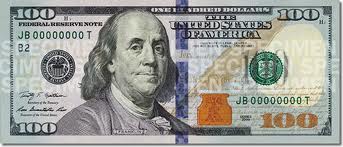
The US is approaching the release date of its new $100 bills, but the Bureau of Engraving and Printing is facing an embarrassing problem: 30 million bills were incorrectly printed, and fixing them will cost taxpayers an estimated $3.79 million.
The new $100 bills were designed to reduce counterfeiting, and were initially scheduled to be released in 2010. But that summer, the Bureau of Engraving and Printing noticed that the bills were being produced with a blank sliver, due to a fold in the paper. The release date was therefore pushed back to 2011, and again pushed back to Oct. 2013.
But additional printing problems could once again delay the release of the “Benjamins”.
The new $100 bills are designed to contain a Liberty Bell that changes its color, 3-D images that move when the bill is tilted, and a hidden message on the collar of Benjamin Franklin, one of the Founding Fathers. Two currency factories are responsible for printing all US bills.
But the Washington, D.C. factory produced “clearly unacceptable” versions of the $100 bills, according to a July memo that the New Yorker obtained from the bureau. Recent batches that came from the factory were “mashed”, which means they were produced with too much ink and the lines are not as crisp as they should be. The New Yorker compared it to a kid trying “to carefully color inside the lines – using watercolors and a fat paintbrush.”
Once these bills were delivered to the Federal Reserve, they were rejected. Officials have sent back about 30 million of them, and refuse to accept any more bills from the Washington, D.C. factory.
Instead, the factory in Fort Worth, Tx., is now expected to compensate for the defective currency. The currency release date is Oct. 8, and it remains unclear if the government will be able to obtain enough of the bills to get them into circulation. The blunder is also expensive: since it costs about 12.6 cents to produce each bill, making another 30 million costs about $3.78 million, the Atlantic estimates. Additionally, the cost of disposal of the defective bills could be around $12,000.
“There are dire consequences here because BEP sells Federal Reserve notes to the Board to finance our entire operation,” BEP director Larry Felix wrote in an internal memo. “If the BEP does not meet the order, the BEP does not get paid.”
A spokesperson for the BEP told the Atlantic that the Federal Reserve is still planning to release the new currency on Oct. 8, despite “concerns during production validation.”
“We have confidence in our process and employees,” a BEP representative told the New York Daily News, reemphasizing that the agency does not plan to delay the release date a third time. – RT
Chief Justice Mogoeng Mogoeng has reportedly hit back at whites for seeking to have him impeached for his recent comments on transformation.
According to the Cape Argus, Mogoeng told the South African chapter of the International Association of Women Judges during a keynote address that he was not a racist.
“If I was racist I would be saying only black women should benefit from transformation. Maybe there is something wrong with my logic,” Mogoeng said, according to the newspaper.
Last week, an impeachment complaint was made against Mogoeng.
The complaint, by Advocate Paul Hoffman, the director of the Institute for Accountability in Southern Africa (IFAISA), claimed contempt of court, defeating the ends of justice or gross incompetence, IOL reported at the time.
The bid came after Mogoeng made “a racist and sexist attack against white male lawyers” during a speech on 6 July.
“Speaking at the Advocates for Transformation Dinner held on 6 July 2013, Chief Justice Mogoeng Mogoeng complained of what he called the apparent resistance to change by a good number of fellow South Africans who, to him, benefitted from opportunities reserved exclusively for them by the apartheid system,” read an excerpt from the IFAISA website.
“The Chief Justice well knows that it is foundational to our new constitutional order that the values of non-racism and non-sexism be upheld. The Chief Justice has sworn an oath of office that he will uphold the Constitution.
“To launch a racist and sexist attack against white male lawyers, which is what the Chief Justice has done, does not serve to achieve or advance the type of transformed nation that is envisaged in the Constitution.” – Cape Argus
A man will appear in the Ceres Magistrate’s Court on Thursday in connection with the rape of a four-month-old baby and seven-year-old boy, Western Cape police said.
Lt-Col Andre Traut said the 25-year-old man, a local farmworker, was arrested on Wednesday.
“Crimes against children are regarded our top priority, and we will not relax any of our efforts when a suspect in this regard is sought,” he said.
“We are pleased with the outcome of our investigations so far and would like to extend our appreciation to the Ceres community who assisted us during the recent weeks.”
The baby had been sleeping in bed with her parents when a man snatched and raped her on August 3, provincial police commissioner Arno Lamoer said at the time.
A boy in the same house was also raped.
On Tuesday, the ANC Women’s League said the baby was recovering from her fourth reconstructive surgery operation.
“The rape of these children is not only disheartening, but a horrendous and inhumane act that should be condemned unrelentingly and consistently by all in society,” ANCWL spokeswoman Nosipho Ntwanambi said.
Ntwanambi said the league would continue organising protests calling for men who committed sexual offences to be removed from society.
A 32-year-old man was arrested previously, but released because he could not be linked to the case. – Sapa
In a renewed bid to bring black players into a mostly white sport, the South African Rugby Union (Saru) will introduce a stricter racial quota system in domestic rugby.
As from next year, Vodacom Cup teams will have to field seven players of colour in their 22-man squad. According to a Sport24 report, at least five of these players will have to start the match. At least two of the seven quota players will have to be forwards.
Saru chief Oregan Hoskins is hoping that the new quota system will see more black players coming through the system and playing at the top levels of Currie Cup, Super Rugby and in Tests.
“The feeling within our organisation is that we had to step in to see more black players come through. The provinces also shared our views,” Hoskins was quoted as saying by Sport24.
“To have certain targets will show that SARU is committed towards transformation. The Vodacom Cup is of critical importance to development and it has moved away from its primary aim to provide opportunities to promising young players, especially those of colour.
“The aim is to enlarge the pool of players of colour from which Currie Cup and Super Rugby coaches can pick. Hopefully, it would then also give the Springbok coach more options,” the Saru chief said.
Pagad leader, Abdus Salaam Ebrahim, has been arrested. The anti-gangsterism and drugs group has confirmed that its frontman was picked up on Wednesday morning.
Pagad has again been at the centre of controversy in recent weeks. It’s been blamed for twin blasts in and around Athlone during a cavalcade through gang-infested areas.
Pagad has denied any involvement, and believes Ebrahim’s arrest is merely an attempt to curb another protest, scheduled for Wednesday night.
Police meanwhile have only confirmed that a 55-year old man was taken into custody but are not commenting on the circumstances.
Ebrahim was released on parole in 2008, nine years after he was sentenced for public violence. – eNCA
Namibia will airlift 10 rhinoceros and five elephants to Cuba in September, concluding a massive translocation project of 135 animals taken from its national parks, the environment ministry said Wednesday.
The 15 animals will be captured from the Etosha National Park in northern Namibia — one of the country’s major tourist attractions — plus a nearby smaller game reserve, the Waterberg Plateau, environment and tourism deputy-minister Pohamba Shifeta told AFP.
The ambitious project, dubbed Noah’s Ark II, has populated Cuba’s 342-hectare National Zoo outside Havana.
A total of 120 animals of 23 species — including endangered black and white rhinos, cheetahs, leopards and lions — were already transported to the Caribbean island nation in November.
Animal rights groups have protested the capture of wild animals.
But Shifeta defended the translocation as Namibia’s “token of appreciation” to Cuba for its support.
Cuba gave the southern African country political and military backing during its struggle for independence from South Africa in the 1970s and 1980s.
“Cuban people were not complaining when their government was supporting us,” Shifeta told AFP.
The donation is also aimed at helping Cuba establish a “proper wildlife programme”, he added.
Several other species including the warthog, waterbuck, wildebeest and zebra did however not make the cut for veterinary reasons, according to local media reports.
Authorities are now racing to complete the translocation by September 6.
Meanwhile, the Namibian government has ordered over 400 springboks, kudus — another kind of antelope — and other non-endangered animals to be culled from four national parks to feed people threatened with hunger from a severe drought.
Authorities estimate that at least 400,000 people are facing hunger while Unicef has said more than 778,000 people — including 109,000 children under the age of five — are at risk of malnutrition. – AFP
There are 1,448 criminals on the South African Police Services payroll. This was the shocking admission by police management in Parliament today.
A SAPS audit has found that the 1,448 are guilty of serious offences like rape, attempted murder, corruption, fraud and assault.
They are all still on the beat.
More than 300 of the officers managed to get a job despite having criminal records and it seems they did so by cheating the system.
Nkrumah Mazibuko, SAPS HR management, said: “There are instances where the people who submitted themselves for psychometric assessments were not necessarily the same people who submitted themselves for finger printing.”
Several of the convict cops are highly ranked in positions like captains, majors and colonels — shockingly 10 brigadiers and 1 Major General are also on the list.
A member of Parliament remarked that a SAPS member can have his firearm on his hip until the moment he is marched down to the cells. “That’s how seriously SAPS takes this.”
The law prevents the SAPS from firing those with criminal records until they’ve had an internal disciplinary hearing.
The SAPS has established a board of fitness to assess whether each of the 1448 criminal cops should stay on the job.
The board is expected to start its work this week, but MPs were left fuming when police management couldn’t give them a deadline as to when it’ll finish the process. – eNCA
A four-month-old baby is recovering from her fourth operation since being raped in Ceres, in the Western Cape, the ANC Women’s League said on Tuesday.
“We are pleased with the reports that she is steadily recovering after undergoing reconstructive surgery,” said ANCWL spokeswoman Nosipho Ntwanambi.
“The rape of these children is not only disheartening, but a horrendous and inhumane act that should be condemned unrelentingly and consistently by all in society.”
The baby had been sleeping in bed with her parents when a man snatched and raped her on August 3, provincial police commissioner Arno Lamoer said at the time.
A seven-year-old boy in the same house was also raped.
Police took a 32-year-old man in for questioning, but he was released.
The African National Congress Women’s League urged the police to use all their resources to arrest the man responsible for the crimes.
Ntwanambi said the league would continue organising protests calling for men who committed sexual offences to be removed from society. – Sapa
Urgent action was needed to stop police uniforms from landing in the wrong hands, the Bellville Specialised Commercial Crime Court in Cape Town heard on Monday.
Captain Cathline Japhta, of the police Tactical Response Team, told the court: “When we heard that a police officer was involved in the illegal sale of police uniforms, we needed to act with urgency.
“All we knew was that a police officer was selling police uniforms, but we had no idea of who he or she was,” she said.
She testified at the resumption of the trial involving police captain Esmareld Bailey, 44, on eight charges – one of corruption, another of the illegal possession of ammunition, a third involving the possession or use of drugs, and five of defeating the ends of justice.
She has pleaded not guilty, before magistrate Sabrina Sonnenberg.
Questioned by prosecutor Xolile Jonas, Japhta told the court that her job entailed the prevention of crime, with the focus on drugs and gangsters.
She added: “We launch under-cover operations, in which we telephone people and pretend that we want to buy drugs from them.”
She said an informant told her in December 2011 that there was “someone wanting to sell police uniforms and firearms”.
“Because of the sensitivity of the information – it was alleged that the “someone” was a police officer – I passed on the information to our team’s intelligence officer, and then contacted the colonel in charge of undercover operations.
“Due to the urgency of the matter, I obtained electronic authority to launch such an operation.”
She said the operation involved a male police constable as the buyer, who was given R500 in R100 notes, which had been photocopied, with which to purchase a police uniform and ammunition.
The constable was taken to a petrol filling station in Brooklyn, where he was picked up by two other men in a white sedan, and taken to a block of flats.
She said she followed in an unmarked police vehicle, and she and the constable kept in contact via SMS messages.
One of the men in the white sedan, Waleed Diedericks, went up to the fifth floor of the complex, and returned carrying a red travel bag.
Soon afterwards, she received an SMS from the “buyer” that money and a uniform had exchanged hands.
Japhta told the court: “I moved quickly to Diedericks, and identified myself to him.
“The constable handed the red bag to me and said he had just paid R500 for the contents.
“I opened the bag, and it contained a police cap, two pairs of blue police trousers, a police shirt with a badge embroidered on it, an orange and yellow police reflector jacket and a small bank bag with ammunition.
“The constable pointed to Diedericks and said he had the money.”
Japhta said she was present when another police official removed the money from Diedericks’s trouser pocket.
She said she informed Hendricks that he was under arrest for selling a police uniform to undercover police officials.
Although she explained to Diedericks that he had no obligation to say anything, he said he had obtained the uniform from a police captain and insisted on taking them up to Bailey’s apartment.
Diedericks was himself sentenced last year for his part in the transaction, but the sentence was suspended on condition that he testify at Bailey’s trial, which he has already done. – Sapa
An Indian vice chancellor says the black municipality’s failure to deliver a basic service has brought his institution to brink of closure.
Open letter from Dr Saleem Badat, vice-chancellor of Rhodes University to the mayor, the municipal manager and the Makana Municipality councillors, August 14 2013:
Rhodes University views itself as an integral part of the Makana region and the Eastern Cape. We are willing to shoulder responsibility in the search for collective solutions to problems that confront our community.
It is with great dismay that we are compelled to write this Open Letter, and draw attention to the utter failure of our municipality to deal effectively and efficiently with the crisis in water provision at our university and parts of town.
Since 6 August 2013 and for the past nine days, parts of Rhodes University, including 11 residences that house over 1000 students and wardens, have been without water. As this open letter was being written yesterday afternoon, 35 additional residences and various other parts of the university were also without water.
This is not the first time this year that we, the Rhodes University community, have been without water. Earlier this year, in March, we were without water for an extended period. Indeed, we came close to shutting down the university for health and safety reasons.
Now, once again, we are faced with the crisis of hundreds of our students and staff without drinking water, which the university has to supply. There is no water for personal ablutions, for cleansing, for flushing toilets. Conditions in the residence toilets are dire, with growing health concerns.
We are again on the brink of having to close the University. Despite the valiant efforts of our staff and the great fortitude of our students we cannot cope any longer. Can you at all imagine the chaos that will occur if the university has to close its doors? Or the economic impact that this will have on the town, which is highly reliant for its economic well-being on the university operating?
Section 27 of our Constitution states that Everyone has the right to have access to sufficient food and water. Our constitutional right to sufficient water has been and is being violated. It is thus necessary for us to act as concerned citizens in defence of our right to sufficient water.
We are compelled to peacefully mobilise ourselves as a university and community because we are angry, very angry: at the indignity that we must suffer being without water; at the seeming lack of care of the Municipality; and at the lack of communication from the Municipality.
We are aware that we are not the only people who are angry – other residents in Makana who face water outages and suffer the same indignity are also angry. Many of them have not had water for many months!
We feel we are being treated like second-class citizens, which is not acceptable in our hard fought for and won democracy. So we are now mobilising in defence of our constitutional rights as citizens.
We, the residents, households and institutions of Makana, have a right to water. We dutifully pay municipal rates in the expectation that all citizens shall have access to safe and clean water. Rhodes itself pays over R2.5 million a month in rates and service charges. We expect the Municipality and its elected councillors to honour this right as servants of the community.
We can no longer remain silent in the face of these violations of our rights, to stand mute any longer as the crisis deepens, nine days into the water outage and with new parts of Rhodes now without water.
We must now act. In marching today to your offices, we seek to indicate that we have borne the numerous water supply outages and problems with great patience and resolve. We also wish to make visible our frustration and anger.
Above all, we wish to submit our demand for a responsive Municipality that takes seriously the provision of basic services to all residents. We demand that the Municipality give us a clear plan and a timetable for resolving the crisis of water provision.
As is well known to you, Rhodes University has many years sought to work with the Municipality. Indeed, we are in regular contact. We have constantly pledged our knowledge, expertise and skills so as to safeguard basic services and promote local economic and social development.
We, as a university, again pledge any support that may be required by the Municipality and that the university can reasonably offer with the express aim of resolving the crisis. This is our social responsibility, as a knowledge institution and the largest institution and employer in the town.
But, like today, when necessary we will also not hesitate to march, to demonstrate, to demand answers, demand better performance, and demand that you be responsive and accountable to residents. This is in defence of the rights enshrined in our Constitution to which we are all bound as a nation.
It is time for you, our municipal leaders, to demonstrate leadership and accountability to us, your constituents, and to give your full attention to the problems of basic services that are crippling our town and compromising the promise of a better life for all.
Rhodes University also calls for intervention at the highest level of government. We request an urgent investigation at the provincial and national government levels into water supply and water quality in Makana. We call upon the ministers of Higher Education and Training, Public Works, Water Affairs and Provincial and Local Government and the Eastern Cape MEC for Local Government to ensure that water security in Makana is secured for current and future generations.
Dr Saleem Badat
Copied to:
The Minister of Higher Education & Training
The Director General of the Department of Higher Education & Training
Brazilian actors perform in Rio on Tuesday in front of the legislative parliament, where a public hearing on cases of disappearing people was taking place.
Police officers investigating the death of a teenager clashed with residents of a Rio de Janeiro slum, police said Wednesday amid a series of protests on issues ranging from alleged police brutality to low wages.
Rio police said in a statement that three buses were torched and a police car damaged in Tuesday’s clash in the sprawling Penha slum.
Police were called in to investigate the death of a 17-year-old boy, whose body was found in the neighborhood. “As the military police approached, a group of locals began a violent protest,” the statement said.
The teen, whose name was not released, went missing Monday. His body showed no bullet wounds, and the cause of death was not immediately clear, police said. But news reports suggested the protesters suspected the youth died in a confrontation with police.
Police killings are not unusual in Rio, where officers are sometimes linked to armed militias.
A demonstration was called for Wednesday in another Rio slum, Rocinha, to call for light to be shed on the disappearance of a local bricklayer who was last seen in police custody.
The protest came on the one-month anniversary of the disappearance of Amarildo de Souza, a 42-year-old father of six who was hauled into a Rocinha police station for questioning July 14. Police have said he was released shortly after, but video surveillance shows no trace of Souza after he entered the police station.
His family and supporters say they suspect he was killed by police and his body dumped in a clandestine graveyard.
Souza’s disappearance has become a hot-button issue in Rio, particularly among slum dwellers and critics of Rio de Janeiro state Gov. Sergio Cabral.
Cabral has been the target of protests since June, when a wave of mass demonstrations against government corruption and calling for improved public services swept the country. Protesters allege Cabral is corrupt and have been calling for an investigation into spending on projects linked to next year’s World Cup and the 2016 Olympics, which Brazil is hosting.
A separate demonstration was scheduled outside the Guanabara Palace later Wednesday.
Several thousand mostly university professors also marched through central Rio on Wednesday demanding higher pay and better working conditions, and people calling for improved legislation for the disabled staged a protest in the capital, Brasilia. – AP
President Jacob Zuma called for reflection to restore peace in South Africa’s mining industry Wednesday, days before the first anniversary of police shooting dead strikers in the Marikana tragedy.
Friday marks a year after police opened fire on thousands of strikers at platinum producer Lonmin’s mine northwest of Johannesburg which killed 34 and injured 78 people.
Two days before the commemoration the firm recognised radical labour group AMCU, which led the wage strike, in an attempt to ease simmering inter-union tensions on the platinum belt.
“The incident of the 16th (of August) in particular shocked the whole country and caused untold pain and numbness amongst all South Africans,” Zuma said in a statement.
“It was a tragic and sad loss of life,” he added.
“We must all resolve to do everything possible to prevent a repeat of similar incidents.”
Demands for higher salaries sparked last year’s wildcat strikes.
Workers flocked to join the militant Association of Mineworkers and Construction Union (AMCU), abandoning the once-dominant National Union of Mineworkers (NUM) in droves because it was perceived to protect the mine management’s interests rather than that of labourers.
AMCU now represents 70 percent of Lonmin’s 27,000 employees, stealing the majority position from NUM, which is left with 20 percent of the membership.
The August shooting was described as the worst police brutality since the end of apartheid two decades ago.
But in the preceding week at least 10 people, including two policemen, were killed in clashes between the workers.
Following the massacre strikes spread quickly across the platinum industry and some gold mines, bringing an economic lifeblood to a standstill for months.
Mine stoppages in 2012 cost Africa’s largest economy 15.3 billion rand ($1.2 billion, 1.5 billion euro).
In the year since the bloodbath the union struggle for supremacy and ensuing benefits left a trail of bodies in its wake.
At least eight prominent members from both AMCU and NUM have been murdered, the latest victim a local NUM leader who was gunned down in front of her house on Monday.
Most victims were NUM members, and attackers periodically threatened the NUM to leave the mine.
“What is happening in Marikana does not only disrupt the community there, it disrupts economic growth,” said police commissioner Riah Phiyega launching a crime combating initiative in the town on Wednesday.
At least 13 murders occurred in the area in recent months, she added.
AMCU’s recognition as majority organisation seemed auspicious to calm hostilities in Marikana two days before the memorial of a massacre which has seen little retribution.
An inquiry Zuma set up to probe the killings is yet to conclude its work and lawyers representing wounded workers have pulled out over lack of funding.
The agreement “signals a new era”, according to Lonmin chief executive Ben Magara, who vowed that “we’ll put all we can to ensure peace and stability”.
AMCU president Joseph Mathunjwa urged a partnership to end acrimony between mine managers and labourers.
“We acknowledge that without cooperation we are all losers and that as leaders, we must find a way to ensure we can move forward together in peace and stability,” he said.
Labour analyst Daniel Silke believes that AMCU’s recognition will give it a sense of accomplishment, but won’t stop the NUM from reclaiming its position.
“In the short term, I think it’s positive on the mines,” said Silke.
Zuma urged unity in mining “so as to create an environment conducive to development”.
“Workers and managers must go to work without fear that anyone would harm them. Workers must be free to excercise their Constitutional right to join any trade union of their choice,” he added. – Sapa-AFP
This website uses cookies to improve your experience. We'll assume you're ok with this, but you can opt-out if you wish. Cookie settingsACCEPT
Privacy & Cookies Policy
Privacy Overview
This website uses cookies to improve your experience while you navigate through the website. Out of these cookies, the cookies that are categorized as necessary are stored on your browser as they are essential for the working of basic functionalities of the website. We also use third-party cookies that help us analyze and understand how you use this website. These cookies will be stored in your browser only with your consent. You also have the option to opt-out of these cookies. But opting out of some of these cookies may have an effect on your browsing experience.
Necessary cookies are absolutely essential for the website to function properly. This category only includes cookies that ensures basic functionalities and security features of the website. These cookies do not store any personal information.
Any cookies that may not be particularly necessary for the website to function and is used specifically to collect user personal data via analytics, ads, other embedded contents are termed as non-necessary cookies. It is mandatory to procure user consent prior to running these cookies on your website.


 The Treasury Department’s Financial Management Service (FMS), which publishes both the US federal government’s official Daily Treasury Statement and its official Monthly Treasury Statement, is reporting that in July the federal government ran a deficit of $98 billion but that the federal government’s debt remained exactly $16,699,396,000,000 for the entire month.