Two-thirds of rape victims in Liberia are children

Julia Duncan Cassell, Liberia's Minister of Gender and Development
Julia Duncan Cassell, Liberia’s Minister of Gender and Development

The Liberian president, Ellen Johnson Shireaf, has appeared on Liberian television on Monday to denounce the country’s epidemic of child rape, calling it one of Liberia’s “biggest challenges” and “a growing concern”.

“It is shameful that this continues to mar the image of our country,” Sirleaf said.

She said current legislation was undermined by “families of victims who are easily compromised, by the lack of evidence, and by sympathetic judges” and called on communities to do more to bring rapists to justice.

“I chaired a meeting of women leaders… who are working on a program that will call on religious, traditional and community leaders, parents, teachers, women and youth groups to become agents of change and commit to take action to prevent sexual violence, as this is everyone’s responsibility,” she said.

“We need your support also, to ensure that our children and our women are safe.”

According to Liberia’s Gender Ministry, ” 65 percent of the 1,002 cases reported in 2013 concerned victims aged between three and 14, yet just 137 cases came to court with only 49 rapists convicted”. In a statement to journalists, the Gender Ministry also said: “As a result of rape 10 children from eight counties between the ages of three and 14 died during the year 2013. In some of the cases the perpetrators are still at large.”

The Gender Ministry deplored the habit of families to coverr up the rape if the attacker is related to the victim. There was also a lack of qualified medical personnel.

“Parents are compromising the cases because mostly the perpetrators are relatives or friends. We can say that the figure could be at least three times this if parents were not compromising,” the ministry said.

However, many people eschew the Western-style court and medical system and prefer “mediation by community elders or village chiefs”.

The website Global Post reported on a recent case, unbeknown to most of the outside world, whereby a 14-year-old girl Olivia Zinnah was buried here on 22 December, “after suffering years of pain and surgeries following a rape when she was 7”.

Olivia Zinnah

Although the country’s Gender Ministry made efforts to draw attention to Zinnah’s death, her passing went unremarked but for a few stories in local media. Zinnah, who died of an infection in a Monrovia hospital a week before Christmas, was the fourth girl this year to succumb to rape-related injuries in this West African nation of four million, the ministry said.

For three years after her 2005 violation in a rural area outside Monrovia, Zinnah received only traditional healing, which can include herbs and sorcery. She was not taken to a doctor. Police were not called. When her uncle Lawrence Samuel came to visit the family in 2008, he was shocked to see Olivia in a terrible state, with poorly treated wounds and a systemic infection.

“She was almost decomposed from the infection,” said Samuel, 70.

Samuel asked women in the family what had happened and they told him Olivia had been raped by a family member, he said. Samuel reported the crime and named the suspect to the police, brought his niece to Monrovia for medical care, and contacted the Ministry of Gender, he said.

Ministry officials took on Olivia’s case, paying for her medical treatment and four surgeries, the last of which left her with a colostomy bag.

“We did everything we could to save her,” said Gender Minister Julia Duncan Cassell.

Doctors Without Borders (DWB) in 2011 reported that 92 percent of females treated for rape in its Liberia facilities were under 18. A DWB study published in November said that of about 1,500 females treated in Monrovia clinics in 2008 and 2009 after rape, four out of 10 were younger than 12 and one in 10 were younger than 5. “Half the survivors were children aged 13 years or younger and included infants and toddlers,” the report said.

Because sexual violence so often goes unreported, it’s impossible to know the true scale of the child-rape problem here. In many cases, families of raped children accept money from the rapist to hush up the crime, Cassell said. In Olivia’s case, it does not appear her family accepted any money, but once the girl’s uncle reported the crime, the rest of the family shunned both Olivia and her mother, Cassell said. That common social penalty imposed on those who break silence around rape cases combines with the payoffs to deter reporting and foster impunity for rapists, the minister said.

“There are a lot of other Olivias out there that we don’t know about,” Cassell said.

Deputy Gender Minister Annette Kiawu played a central role in the ministry’s intervention in Olivia’s case.

“For her it was difficult,” Kiawu said. “She always had an urge to want to play like the other children. You would see her once in a while laughing, or trying to jump around. She used to smile every now and then.”

Although linkages have been drawn between widespread sexual violence during Liberia’s 14 years of civil war and the current levels of sexual violence, Cassell said the causes of Liberia’s epidemic child rape go beyond the fallout from conflict that ended a decade ago. Poverty leads to the settlements and thus to impunity; poor education leads to a lack of understanding among males of the physical and emotional damage caused by rape; high rates of teen pregnancy lead to lots of mothers unequipped to secure girls from predators, Cassell said.

“You’ve got a 16-year-old girl with two children already,” Cassell said. “How does she know how to protect her children?”

The alleged perpetrator of Olivia’s rape was arrested, but released without prosecution. Gender ministry officials are investigating to determine why he went free, and plan to get the case reopened. “He needs to pay for that,” Cassell said.

Her ministry paid for Olivia’s funeral, and ministry officials were on hand to discuss the case with a handful of local media, part of Cassell’s effort to bring attention onto the child-rape issue, and build awareness among the populace about the need to prevent and report sexual violence. So far, there’s been no significant public reaction to the death of Olivia here or abroad. – News agencies and Global Post website

Can South Africa properly be called a ‘democracy’?

roodt_dan_wikiby Dan Roodt dan[at]praag.org

I find it interesting that professor Anthony Butler of UCT should point out potential tribal schisms within the ANC in Business Day. According to Stephen Ellis in his book External Mission: the ANC in exile 1960-1990 there had been a gun fight between Xhosa and Zulu members of MK in the Tanzanian camp, but this got buried under the avalanche of details concerning the heroic life of Nelson Mandela.

Many South African and British academics seriously analysed South African ethnicity using the Soviet term “the national question”. For years we were made to believe that, unlike the rest of Africa, this country had no real tribes, only artificial ethnic “divisions” imposed by the Nazi-like “apartheid regime”, at gunpoint as it were.

Likewise, the rise of the South African identity was more or less coterminous with the Book of Genesis, and everything else was just an “imagined community” or a “social construct” like race which would dissipate as people turned into global, brand-conscious consumers.

The uncomfortable truth is that South Africa is no different to any other multiethnic or multinational state where the most numerous group will capture the state through the ballot box and then use clientelism to retain power.

The current system was designed not to ensure efficient or accountable government, but to disenfranchise minorities, especially Afrikaners who do not even rule the tiniest rural municipality anymore.

Machiavelli’s dictum that the prince should be particularly generous in distributing largesse paid for by others will ensure that Afrikaner assets will be plundered to the last cent. Eventually the remaining family-owned farms of Afrikaners will have to go and South Africa will experience a Zimbabwean-style rural melt-down although it might not lead to hyperinflation as long as the mines keep earning foreign exchange. No-one in the City of London will even wince when it happens.

Xhosas and Zulus do not like each other, but they are locked into a kind of prisoner’s dilemma. Given current demographics, neither Kwazulu-Natal nor the Eastern Cape may rule the rest of the country without some degree of cooperation from its sister province on the East Coast.

Together, these two Nguni “dominant tribes” constitute 40% of SA’s population but their respective regions produce just over 20% of our GDP. So the benefits of power are obvious, especially to politicians from impoverished rural areas whose access to the state could turn them and their families into billionaires almost overnight.

Buy Dan Roodt's book through Amazon.com
Buy Dan Roodt’s book through Amazon.com

Many people scoffed at the term used by Dr. Piet Koornhof in the 1970s when he referred to the homeland system as a “plural democracy”. I suppose those same cynics are cackling today when they hear that South Africa is no longer a plural, but a “model democracy”.

Given the demographics of the current South Africa there is no way in which even an alliance of minority ethnic groups could ever outvote the ANC. Those opposition politicians, such as the DA, who are pretending otherwise, are not only deluding their supporters but also themselves. Even in the unlikely event that ANC support had to slip among ethnic Zulus and Xhosas, it would be inconceivable for South Africa to ge be governed by a coalition exluding the ANC.

First of all, the outbreak of violence and riots by ANC supporters would far surpass those which occurred in the aftermath of the Kenyan elections of December 2007. ANC potentates who have been treating the state as their private preserve would be very reluctant to leave office. The ruling party would not have to stage a coup because it has already erased any separation of party and state. In the unlikely event that it should ever lose power through the ballot box, it has maintained its militia known as Umkhonto we Sizwe which could be equipped from government military stockpiles. On the other hand, its militia commanders are already in control of the South African National Defense Force, so there would be no need for that.

In fact, the opposition coalition having triumphed at the ballot box would have to stage a coup just to assume office, or summon outside militarry intervention. Given the example of Zimbabwe where ZANU PF has held onto power through a spell of electoral weakness, the outcome seems predictable.

For all intents and purposes, South Africa is a one-party state or one-party dominant state ruled by the East Coast tribes. Event at the University of Cape Town with its British and quasi-British professors who have long denied the existence of ethnicity in South Africa, that reality is finally sinking in.

A shorter version of this column appeared as a letter in Business Day.

Education is about values… not a commodity

Top ten academic performers at Hoërskool Wagpos, an Afrikaans government school in South Africa

by TAU Bulletin

And a school matriculation certificate is not a ticket to the corner office, the VIP lift and the executive washroom.

Education is holistic: it is not a voucher for a comfortable life, nor a ticket to the turnstile of good fortune. The dictionary defines education as “the systematic development and cultivation of the mind and other natural powers. It begins in the nursery, continues through school and also through life. The impartation of knowledge by others is but a part of education.” The dictionary’s synonyms for education include “breeding, cultivation, culture, development, discipline, information, instruction, knowledge, learning, nurture, reading, schooling, study, teaching, training and tuition”.

Education is an intrinsic ingredient of a culture: it is the living embodiment of the passing from generation to generation the means by which the people of that culture conduct their lives.

The exuberance displayed by South Africa’s Minister of Basic Education Ms. Angie Motshekga when she recently announced the matriculation pass rate for South African pupils had jumped to 76.5% (from 60,6% in 2009) was met with scepticism and even derision. According to AfriForum, the actual pass rate was less than 38%, this because only half of the students who enrolled at the beginning of their school careers finished to write Grade 12, the matric year.

Mr. Tinyiko Maluleke, deputy vice chancellor of student affairs at the University of Johannesburg asked in a hard-hitting article (Independent 5.1.14) whether the matric certificate could be trusted. He said the certificate was in danger of “meaninglessness, worthlessness and irrelevance. The country’s entire education system is at issue, and 20 years of democracy have not taught teachers and principals (of mainly black schools) to stop striking during school hours.”

Professor Jonathan Jansen, rector and vice-chancellor of the University of the Free State weighed in, saying SA’s education system is a “fraud”. He concurred with other critics that the results proffered by the Minister were “grossly misleading”. “We know that the top 5% of Grade 6 pupils know more mathematics than the bottom 20% of the maths teachers in the same grade. We know that South Africa was dead last, just above Yemen, at the bottom end of international rankings on science and mathematics.” Mediocrity has been institutionalized, he declared, while “government officials hope we are all ignorant enough to accept the ‘official lies’” because of the way the so-called pass figures were manipulated. Pass rates were “pulled up by white kids” said Graeme Bloch of Wits University. “Sorry to be racial, but if you are born on the right side of the tracks, you have a 100% chance of getting matric”.

(We must pause here to comment on this “if you are born” comment. Who you are when you are born is the result of your genetic background, a consequence of your family’s ancestral lineage. And if that history is replete with achievement, initiative, hard work, the ability to overcome obstacles and a skill and desire to move forward and improve yourself, then comparing those “born on the right side of the tracks” with those ”born into” poverty is fallacious. This delusion infers that there is some sort of pantry in the sky which dishes out ways of life to some, and other less salubrious ways of life to others.

Everyone in South Africa is a genetic descendant of his ancestors. Blaming poor education results on the “privilege” of some is disingenuous. Cultural backgrounds have played a huge role in education result disparities – Africans had no written word, while South Africa’s first-world educational system was brought to this country by European settlers who then superimposed it on Africans. Similar occurrences took place during the colonial times in other new-world lands.

As well, using the term “previously disadvantaged” (liberally utilized to neutralize white academic achievements) is to refute history. Indeed, Africans were actually advantaged by European settlement. From where did they receive everything they have now – their ability to communicate in a world language, their education, health, legal and legislative system, and the country’s first-world infrastructure?)

The laughing stock

Setting a matriculation pass mark of 30% makes South Africa the world’s laughing stock. Average grade three literacy achievements only reached 35%, with numeracy at 28%. In grade six, the language average is 28% and mathematics is 30%. These figures are a reflection of how the government has managed an education system not generic to Africa. Cultural and language problems have been swept under the carpet in the government’s rush to “prove” that education is improving, when the opposite is in fact true.

Education is not just learning – it is how you interpret, utilize and develop that which is taught. In a country where mediocrity is the norm, it is not surprising that many waving their certificates cannot get work. Dumbing down the worth of this certificate has caused heartache to millions. They were led to believe that their 30% pass would get them a job. The government has sacrificed young people as scapegoats to foster the illusion that the state’s education system is delivering.

Quality is the name of the game. Said Anne Oberholzer, Independent Examinations Board’s (IEB) CEO: “If I’m prepared to spend my salary on my child’s education … rather than buying clothes or a fancy car, you can’t stop me from doing that”. The excellent IEB pass rate was the result of “extra hard work” rather than necessarily school resources. “Success at matric starts way back – matric is a combination of all the years of school exposure”, she said.

It is a simple case of values and norms. If black teachers go on strike during class teaching times, if pupils burn down schools, if ministers don’t get school books to pupils in time, and if the government shows by example that one really doesn’t need a good education to get rich as a party hack with a cushy government job (where capacity doesn’t even come into it), why bother to learn? Why have unbelievably bad results in black schools earned the ire of government when at the same time they show by their actions you don’t have to get good marks to join the government jobs gravy train?

And why try to achieve through hard work and sacrifice when government will legally provide you with a goodly share of someone else’s company just because you are black? In both the public and private sector, there are ample opportunities to feed at the trough, so why struggle at school and university? This same hypocrisy extends to government complaining about the quality of teachers, while universities across the board give preference to blacks for academic posts. A University of Johannesburg advertisement for the Deputy Vice Chancellor: Strategic Services (24.1.14) says it is “committed to taking persons with disabilities and the potential of historically disadvantaged individuals into account in making this appointment”. So if merit is not a criteria for university posts, how will government produce good teachers, and how can this in the end provide competent students and graduates for the country’s future?

Entrepreneurship

Entrepreneurship can’t be taught, yet it is the well-spring of all economies. It emanates from within and it is difficult, fraught with risk and sometimes very disappointing. It is easier to leaching on someone else’s success, a path made easier by government policies. While informal entrepreneurship is well entrenched in South Africa – small traders in townships and city streets sell goods someone else has produced – this doesn’t grow the economy.

Where is black entrepreneurial contribution to the formal economy? A weekly Pretoria is enthusiastically supported by locals and the diplomatic community. Selling mostly food, more than seventy stalls are manned by whites, Portuguese, Indians, a Moroccan family, Greeks, some Chinese. There is not one black South African stall. What is the point of an education that cannot extend to doing something for yourself?

Farming

Paging through any SA farm magazine shows the extent to which farmers have themselves developed and streamlined their profession. They haven’t just studied agriculture, they have applied it, improved on it, created new processes, adapted international methods to South African conditions and perfected agriculture to such an extent that 35 000 of them can feed 53 million people. Education was just the beginning. Without application, initiative, resilience, the ability to overcome hardship and plain hard work, where would South Africa be in terms of food security?

Most government officials and politicians see themselves as an intrinsic part of first world South Africa. They wear the clothes and drive the cars, but many do not exhibit the values generic to this first world. Education in this context should mean:

  • solving the problem yourself, not hiring a consultant;
  • making sure the traffic lights work and if they don’t, ensuring that a point officer keeps the traffic flowing until the robot is fixed;
  • making sure our cities are not littered and polluted until they look like Nairobi or Lagos;
  • answering the phone, replying to the e-mail and delivering the service to the people who pay your salaries;
  • owning up, with an apology, to the fact that many in government are incompetent and are unable to run South Africa as it should be run;
  • accepting criticism without retaliation in the form of racism accusations;
  • deciding that police asleep on duty, taking bribes and generally running amok with weapons is not worthy of a law-enforcement body;
  • immediately sacking all persons with criminal records employed in government;
  • not contemptuously ignoring court judgments;
  • ridding yourself of a completely unjustified entitlement syndrome because you didn’t create what you are now enjoying;
  • not wasting taxpayer’s money with impunity, and being contemptuous when confronted with this fact;
  • not handing over productive farms to incompetents and admitting this policy is a failure;
  • trying to emulate those who achieve instead of denigrating them and accusing them of being ”privileged”.

A point to ponder about education: Zimbabwe president Robert Mugabe has three university degrees, but he remains a savage tyrant, contemptuous of his people’s quality of life, of democracy and of what others think of him. Education without values is truly just a piece of paper!

SA justice system breaks down under rape case load

rape3A commission of inquiry held in the Cape Town black townhsip of Khayelitsha learned yesterday that the South African criminal justice system was no longer able to cope with the number of rapes being committed in the country. As a result, many of the country’s sadistic sexual criminals, often burning or mutilating their victims, were never prosecuted.

“[The number of rapes] can vary… from 50 to 110 cases a month,” Genine Josias, the medical co-ordinator at one of the Thuthuzela care centres in the area, told the commission in Khayelitsha, Cape Town.

According to her, a mere seven percent of perpetrators were ever brought to justice.

“I probably testify in less than 10 percent of the cases I see,” she said.

The rremainder of cases were withdrawn by the state or struck off the court roll for technical reasons.

As with many other problems in the country, these are usually solved by giving them fancy-sounding politically correct names. Thus Khayelitsha with its many thousands of rapists had been given a “Family violence, child protection and sexual offences unit (FCS)” but had only five investigating officers trying to solve crimes in the entire black township.

While up to a third of South Africa’s police budget is consumed by its VIP unit either protecting high-powered politicians or escorting them in fleets of German luxury cars on the country’s highways, “lack of capacity” is often cited as an excuse for police failure. Apparently, while the number of rapes in Khayelitsha are soaring, the number of investigating officers for such crimes has even been reduced.

Those few officers still dealing with the outbreak of sadistic violence, were described as “burnt out” due to their huge caseloads. One officer had 180 dossiers or “dockets” for investigation on his desk.Mob justice was taking hold in Khayelitsha, which was one of the motivating factors for setting up the commission. The South African minister of police had been opposed to holding such an inquiry, but eventually the Constitutional Court gave the go-ahead in October 2013.

Genine Josias was asked by one of the presiding commissioners if she had been aware of a January 2011 newspaper headline on the discovery of sexual offences kits on a field in Delft, a coloured township in Cape Town.

“I am painfully aware of that incident,” Josias replied.

The kits contained forensic evidence, including DNA samples collected by the medical unit and handed to an investigating officer. These had subsequently been “lost” in the field. The officer suspected of the misconduct had since dead and probably those cases had never been submitted to court.

According ot the South African news agency Sapa:

“Josias broke down in tears when asked about a serial rapist who was arrested one year after she raised the alarm in 2010. She and her colleagues had examined at least five girls under the age of nine who survived violent rapes.

“Josias suspected they were the victims of a serial rapist as they were so badly hurt that they had to be examined at a hospital under anaesthesia.”

Although police were repeatedly told about the serial rapes taking place in bushes in Endlovini, on the outskirts of the huge black township, there was no reaction.

Mzwandile Petros
Mzwandile Petros

Only when the Western Cape police commissioner Mzwandile Petros was threatened with negative publicity in the media was he prodded into action, dispensing a task force to investigate the issue.

“Many more girls were raped and I just think they could have done something earlier, you know, to prevent that,” a tearful Josias said.

The suspect, thought to be responsible for raping 21 girls, was eventually convicted of 11 such cases on the basis of DNA samples.

“He had no choice but to plead guilty… it didn’t actually go to an open court because the evidence was overwhelming.” But Josias also complained of her hard work coming to naught due to police incompetence and lack of motivation. She also accused the ANC government of “having no idea” of the long-term psychological effects of the country’s rape pandemic.

“It’s not about my hard work. That is my job. We are failing our people. We are failing helpless kids, children that are innocent.”

Cape Town sadist prefers prison after raping and burning 9-year old girl

baby_rapeIn another of South Africa’s ongoing spate of sadistic crimes committed by blacks and mixed-race coloureds, a Cape Town man no longer wishes to apply for bail, fearing reprisals from the public and even fellow criminals. He is being accused of having raped a 9-year old girl, after which he set her alight.

The girl is being treated for severe burn wounds in the Red Cross Children’s hospital. A spokeswoman for the hospital, Angelique Jordaan, said: “She was moved from the intensive care unit yesterday [Monday] and continues to receive the necessary treatment for her burn wounds.”

Appearing before magistrate Cyril Kroutz in the Belleville Magistrate’s Court yesterday, the 27-year old man had to face an enraged crowd, including relatives of the girl. One woman was so upset that she had to be removed from the court room.

A local politician and Deputy Minister for Women and Children’s Affairs, Hendrietta Bogopane-Zulu, also put in a token appearance.

Not only did the accused withdraw his bail application, but he also requested to be held in solitary confinement as he had been assaulted by other inmates at the Goodwood Prison in Cape Town, displaying facial wounds.

After some consideration, Magistrate Kroutz announced: “The request that the accused be kept in solitary confinement is granted. It seems his life is in danger.” He also ordered that the accused should receive medical attention and postponed the matter to 27 March.

The race of perpetrators in South Africa is usually filtered out by local media and the police, except where the criminal happens to be white. Non-mention of his race therefore means that he was either black or coloured. However, as the crimes took place in the coloured area of Delft in the Cape, it may be presumed that the accused is coloured.

He is being tried for kidnapping, sexual assault, rape and attempted murder. The state alleges that he abducted the child from her grandmother’s home in Delft, sexually assaulted and raped her, after which he poured oil over her and set her alight. According to medical personnel, she sustained 40% burn wounds all over her body. The acts were committed along the R300 highway in Delft approximately seven days ago.

After he had comitted his crimes, the accused was spotted with blood on his trousers and apprehended by Priscilla Mcentee, chairwoman of the Delft Suburban community watch.

“I said to him: ‘I am not accusing you of being a rapist. I am not accusing you of being a murderer. The only thing I want is you must tell me why you are full of blood’.” The man replied that he had been in a vehicle accident.

He was then held by vigilantes who did not harm him until the police arrived.

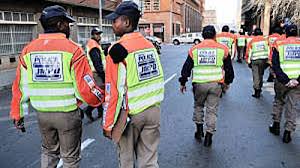
Johannesburg metro policeman arrested for rape

jhb_metropoliceA Johannesburg metro police officer has been arrested for rape, according to the Independent Police Investigative Directorate (IPID).

The black man, who is from Soweto, was supposed to have appeared before the Protea Magistrate’s Court in the black township yesterday, said IPID spokesman Moses Dlamini.

The officer was alleged to have raped the woman on Wednesday and was arrested in the early hours of Thursday morning.

“It is alleged that on January 22 the complainant was at a friend’s place of residence. One of her friend’s friends arrived with the suspect [and] the suspect suggested that they go to his place of residence of which they did,” said Dlamini.

“It is alleged that after some time, the complainant’s friend left the complainant with the suspect. The suspect allegedly used drugs in front of the complainant. After which he raped her using a condom.”

The woman alleged that the metro officer then assaulted her and prevented her from leaving.

“He allegedly raped her several times.”

The woman fled the officer’s house when he fell asleep and alerted metro police who were in the vicinity.

“She took them to the scene and pointed out the suspect,” Dlamini continued.

The man was arrested by his colleagues.

The IPID is continuing its investigation.

Suspected criminal found hanged in a police cell

baby_rapeDuring the early hours of yesterday morning Sunday 26 January 2014 at about 05:00, during  a routine cell visit in the Pietermaritzburg Police Station, members found the body of an adult male hanging from an overhead burglar guards. He was subsequently identified as Stanley Bongani Mkhize (46).It is believed that one of the prisoners who were in a cell with Mkhize woke up and found Mkhize hanging from the neck by a state issued blanket and immediately informed members. No foul play is suspected. A post mortem will be held to determine the exact cause of death. The suspect had been arrested for a murder case which occurred in the Plessislaer area in 2011.

It is alleged that on the 10 May 2011 at about 20:00, the Shoba family were returning to their home in the Imbali Unit J area and were about to enter their house when they were attacked and shot at by a group of unknown gunmen. Both the victim’s, a 38-year-old man and his 35-year-old wife, sustained gunshot wounds to their upper body and were immediately rushed to a hospital in the city. The male victim sustained gunshot wounds to his head and died on arrival at the hospital, whilst his wife sustained gunshot wounds to her chest. She was treated and later discharged.

 In June 2011 Police made a breakthrough and arrested Mkhize and his two co-accused in the Plessislaer area in Pietermaritzburg for murder and attempted murder of the victims, however, the suspects were released on bail and Mkhize then absconded court. A warrant for his arrest was issued and an appeal for his whereabouts was published in the media. The trial of his two  co-accused continued in court and in 2013 both accused were found guilty and sentenced to life in prison.

On Friday, 24 January 2014 at about 00:30, members of the SAPS Pietermaritzburg Organised Crime Unit, on information received, proceeded to the Edendale area in Plessislaer where they spotted the wanted Mkhize driving in a vehicle along the road. They immediately stopped the vehicle and re-arrested the suspect. He was expected to make his court appearance for the alleged murder and attempted murder of the Shoba family today, Monday 27 January 2014.

Police are investigating the circumstances surrounding the incident. – SAPS media service     

Conned about marriage, constitution and ‘states’ rights’

mercer_ilanaby Ilana Mercer

[followbutton username=’IlanaMercer’ count=’true’ lang=’en’ theme=’light’]

Like Ilana Mercer’s Facebook page

The ban on the ban is unconstitutional.

This was the gist of broadcaster Mark Levin’s angry tirade against the humdrum, and certainly predicable, decision of a federal judge to strike down “Oklahoma’s voter-approved ban” on gay marriage.

At the center of conservative contretemps are similar decisions in California, New Mexico and Utah, following on which U.S. District Judge Terence Kern had “determined that Oklahoma’s constitutional amendment” violated the 14th Amendment’s Equal Protection Clause. It stipulates that “No state shall make or enforce any law which shall abridge the privileges or immunities of citizens of the United States; nor shall any state deprive any person of life, liberty, or property, without due process of law; nor deny to any person within its jurisdiction the equal protection of the laws.”

Broadly speaking, WND’s Alan Keyes concurred with Levin, alluding to the Constitution’s 10th and Ninth Amendments by which “the judges and justices of the federal judiciary are forbidden to … deny the antecedent rights retained by the people.”

Indeed, “the prevailing view in 1791,” observed The Honorable Robert T. Donnelly, former chief justice of the Supreme Court of the state of Missouri, “was that the national government had only delegated powers and that reserved to the people was an undefined sphere of non-government within which people may not be interfered with by government.”

But that was then.

In voiding “voter-approved law,” Justice Kern has resorted to perfectly proper 14th Amendment judicial activism. Deploying the Equal Protection Clause of the 14th Amendment, Kern nullified the 10th. It specifies that, “The powers not delegated to the United States by the Constitution, nor prohibited by it to the States, are reserved to the States respectively, or to the people.”

As expressed in the once-impregnable 10th Amendment, the Constitution’s federal scheme has long since been obliterated by the 14th Amendment and the attendant Incorporation Doctrine.

What does this mean?

If the Bill of Rights was intended to place strict limits on federal power and protect individual and locality from the national government—the 14th Amendment effectively defeated that purpose by placing the power to enforce the Bill of Rights in federal hands, where it was never intended to be.

Into the Cannibal's Pot

In their love of Lincoln and the 14th, conservative constitutional originalists will disagree. They’ll say the 14th was meant to limit the power of the states and enlarge the power of Congress, not the Courts. “Congress, not the Court,” was to “implement the provisions of the 14th Amendment,” subject to judicial review.

And that’s somehow a good thing?

They “say tomato, I say tomahto.” As I see it, the 14th Amendment was a gargantuan grant of power to the federal government. That the judiciary has done what was left undone by Congress does nothing to alter the dismal outcome for liberty. The 14th spelt the demise of our Constitution’s decentralized dispensation.

Either way, the freedoms afforded by federalism are no longer because American federalism is no longer.

“The natural progress of things [being] for liberty to yield, and government to gain ground,” this inevitable momentum, in the form of the invented legal doctrine of “selective incorporation,” soon progressed—regressed is the right word—to complete incorporation.

A précis of Incorporation-Doctrine jurisprudence in the legal dictionary admits that “most provisions of the Bill of Rights were eventually incorporated to apply to the states.”

Put differently, matters previously subject to state jurisdiction have been pulled into the orbit of the judiciary.

Among other legal decisions to have been implicated by Justice Donnelly in expunging federalism from the Constitution is Cooper v. Aaron. In 1958, “the United States Supreme Court asserted for the first time in its history and in the history of the nation that its interpretations of the written Constitution in a particular case in one State constitute the ‘supreme law of the land’ under Article VI of the Constitution and are of binding effect in all of the States.”

“It is emphatically the province and duty of the judicial department to say what the law is,” declared the Court. (See Cooper v. Aaron, 358 U.S. 1, 1958.)

So much for Alexander Hamilton’s promise, in Federalist No. 78 (May 28, 1788), that the Judiciary would be the weakest of the three branches of his proposed government.

“Instead of protecting the legitimate interests of the states,” surmised Justice Donnelly (in “The Demise of Federalism: With Consent of the Governed?”), “the Supreme Court competes with Congress to dictate to the states their ‘legitimate’ interests.”

Commensurate with the power they’ve amassed, nine unaccountable, unelected, Supreme-Court judges now sit as “a Council of Revision over the states.”

Just as the interpretation of the 14th Amendment in Brown v. Board of Education became the supreme law of the land, so, too, will the states likely lose their (petty) marriage-licensing jurisdiction, once that coven of casuists, the Supreme Court, embroils itself in setting social policy for all the states.

Conservatives as astute as Mr. Levin, Esq., ought to quit misleading their readers and listeners about the restoration of a constitutional structure that has suffered death by a thousand cuts, long before the dreadful cur Obama appeared on the scene.

[followbutton username=’IlanaMercer’ count=’true’ lang=’en’ theme=’light’]

Like Ilana Mercer’s Facebook page

Mandela for Dummies

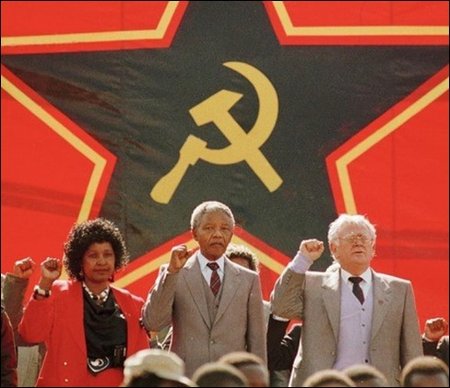
Winnie and Nelson Mandela, as well as Joe Slovo of the SACP, singing "Kill the whites"
Winnie and Nelson Mandela, as well as Joe Slovo of the SACP, singing “Kill the whites”

by Albert Brenner

[followbutton username=’albertbrenner1′ count=’true’ lang=’en’ theme=’light’]

It simply boggles the mind having to witness people still prostrating themselves in the dust whenever the name Mandela is spoken. Elevated to a modern-day god, Mandela is believed to be three, a `Holy Trinity`… yet he is only one – the one ultimately responsible for having turned South Africa into a failed-state-in-the-making.

Mandela No 1 is the latest poster boy of the secularization process which dictated the morality of the West after WWII. It is, basically, the moral world in which the 10 Commandments were replaced by Human Rights. A world in which the biblical “love God and love thy neighbor like thyself” has been replaced by “love thy neighbor like thyself because /she is thyself, (both) God”.

This is the moral universe of George Soros’ Open Society Foundation – which turned the Afrikaners Beyers Naude, Van Zyl Slabbert, Max du Preez, etc. into Walter Lippman`s useful-idiots of Mandela No 2`s world. And it is the world that grounded Pax Americana…

“We hold these truths to be self-evident, that all men are created, that they are endowed by their Creator with certain unalienable Rights, that among these are Life, Liberty and the pursuit of Happiness.”

Funny; if this “Creator” is no more – i.e. the moral rationale driving secular-humanism – how can we still state with such hubristic certainty that we are still “endowed” with them? Rather silly, but then; no wonder it has become the Inquisition.

Mandela No 2 is the world of End Game. A world which saw the dumbest Afrikaner philosopher ever, Willie Esterhuyse, formally hand South Africa’s future over to the cold Queen of England… at the behest of Her Holocaust card-playing Randlords. The world which saw Mandela and his inner-circle “struggle” buddies become some of the richest men in Africa… simply because Mandela No 3 did everything KGB colonel Joe Slovo taught him.

Mandela No 3, the real Mandela, is the great “democrat” who wrote; “If force will advance [the struggle], then it must be used whether or not the majority agrees with us.” And that is precisely what he, and his murderous “necklacing” wife, Winnie Mandela, did… killing 15 000 fellow blacks in the process!

This is the true world painstakingly depicted in the fantastic book The People’s War, by Dr Anthea Jeffery of the SAIRR…

  • “the ANC had little compunction about attacking black civilians, including its own supporters, for the formula for people’s war draws no distinction between combatants and others and regards all civilians (irrespective of their political affiliation) as expendable in conflict;
  • the ANC had a motive to unleash violence, for it wanted to create enough mayhem and unrest either to spark an insurrection or to weaken its opponents to the point where it could triumph in negotiations;
  • the ANC had the means to unleash violence, for the peace process allowed it to bring back into South Africa some 13 000 armed and trained combatants whom it then refused to disarm or disband; and
  • the ANC was the only organisation to draw benefit from the 15 000 political killings that took place in the early 1990s (after all major apartheid laws had been repealed), for it used these to;
  1. stigmatise De Klerk and the IFP,
  2. stampede negotiators into giving it what Joe Slovo called ‘a famous victory’ in negotiations, and
  3. put great pressure on the first all-race election, while making it unthinkable for anyone to demand a re-run of the deeply flawed April 1994 poll in which it was accorded (no accurate count being possible) some 63% of the vote” (source).

Well, there you have it. Mandela is not three. He is only one, No 3 – although No 1 and No 2 gave him – and his murderous, greedy and woefully incompetent ANC thugs – the Noble Prize for Peace… for having turned South Africa into a failed-state-in-the-making.

But then; only dummies won`t believe it.

[followbutton username=’albertbrenner1′ count=’true’ lang=’en’ theme=’light’]

‘Hitler maybe didn’t kill enough of them’: French mayor

Gilles Bourdouleix... doesn't like Gypsies
Gilles Bourdouleix… doesn’t like Gypsies

A French mayor was fined 3 000 euros yesterday on charges of being an apologist for crimes against humanity for saying that “Hitler maybe didn’t kill enough of them” with regard to French Gypsies. Gilles Bourdouleix, a member of parliament and mayor of the western town of Cholet, made the remark in July 2013 during an argument with a group of Travellers, who set up camp in Cholet without authorization. Angered by his refusal to accommodate around 100 caravans for a short stay, some of the Travellers accused him of racism and reportedly performed Nazi salutes. Bourdouleix’s muttered response, invoking the more than 200,000 Roma or “Gypsies” killed in the Holocaust, was recorded by a local journalist. Being an apologist for crimes against humanity is a crime punishable by up to five years in prison and fine of 45,000 euros (61,538 dollars). Bourdouleix, who was forced to quit the centrist Union of Democrats and Independents (UDI) party over his remarks, was not in court for the hearing. His lawyer argued his client had not meant the remark to be heard by anyone else and that he had been provoked. The comment was seen as reflecting growing hostility in France toward both Travellers, who are French nationals, and Roma immigrants from Eastern Europe. The two groups are often confused. Some Travellers are of Roma origin but all have been living in France for generations. The Roma live mostly in Bulgaria and Romania. Around 20,000 Roma live in informal settlements in France.

According the the French magazine Le Point, the prosecutor had asked for a prison sentence of 6 months, as well as a fine of 6 000 euros. According to the judge who handed down the sentence, Bourdouleix “was clearly apologetic” and “exalted the crime committed” towards Gypsies during the Third Reich in expressing “the regret that not enough of them were killed.” – Le Point and various news agencies

Outrage over picture with chair simulating a black woman

Dasha Zhukova sitting on a chair made to resemble a half-naked black woman

Russian billionaire Roman Abramovich’s partner has sparked an internet controversy after a picture was published of her sitting on a half-naked black woman.

The contentious picture was published online and shows Dasha Zhukova sitting on a chair made to resemble a half-naked black woman – on Martin Luther King Day.

Buro 24/7 used the offensive image to illustrate an unrelated interview about the former model’s new magazine, Garage. Miroslava Duma, the blog’s editor, also posted the insensitive photo on Instagram.

The pictures were quickly removed, but not before it sparked intense criticism and debate online.

Zhukova, staring at the camera, appears the complete opposite of the black woman she’s weighing down and has come under fire for the offensive image, along with the magazine. – independent.ie

Cultural weapons become ‘Dangerous Weapons’ under new S. African law

A 'peaceful protest' in South Africa. Brandishing of 'dangerous weapons' will now be strictly verboten
A ‘peaceful protest’ in South Africa. Brandishing of ‘dangerous weapons’ will now be strictly verboten

The Dangerous Weapons Act of 2013 (Act NO.15 of 2013), a new piece of legislation that has been promulgated to address the possession of weapons during public gatherings and mass demonstrations, officially came into force on the 2nd of January 2014.

The Act repeals the Dangerous Weapons Act that has been in force in the country as it was constituted before 27 April 1994 and as well as similar acts that had been in force in the former Transkei, Ciskei, Venda and Bophuthatswana.

In terms of the new act it is a criminal offence to possess a dangerous weapon with the intention of committing an unlawful act. If the possession of a dangerous weapon raises a reasonable suspicion that the person intends to use the dangerous weapon to commit an unlawful act, the person may be found guilty of an offence and liable on conviction to a fine or to be imprisoned for a period not exceeding three years.

As of the 2nd of January 2014 it is a criminal offence for a person to possess during a gathering or demonstration, any dangerous weapon, any airgun, firearm, imitation firearm and that is likely to be mistaken for a firearm, any harmful and sharp object or any other object capable of causing death or inflicting serious bodily harm, if it were to be used for an unlawful purpose.

Other examples of dangerous weapons include but are not limited to the following:

  • Knife such as gravity knife, switchblade, sword, dagger, blackjack, brass knuckles, ballistic knife
  • Spear
  • Tomahawk
  • Knobkierie
  • Crowbar
  • Nunchaku
  • Hammer.

According to the South African Police Service, “the Dangerous Weapons Act is wholly compliant with the Constitution of the Republic of South Africa, especially section 17 which guarantees the right, to peacefully and unarmed, to assemble, to demonstrate, to picket and to present petitions. The right to strike and assemble is not in question here. It aims to ensure that mass gatherings are conducted within the confines of the law and that, in line with section 12 of our constitution that entrenches the right to security and the right to be free from all forms of violence.”

The mere possession of a dangerous weapon during a gathering or demonstration constitutes an offence, but possession of dangerous weapons will not necessarily lead to arrest if the circumstances for carrying are found to be due to the pursuit of any lawful employment, duty or activity, during participation in any religious or cultural activities, law sport, recreation or entertainment, and for legitimate collection, display or exhibition of weapons.

The police has published the followong apppeal: “If anyone sees a person in possession of a dangerous weapon and suspects that the person intends to use it to commit an unlawful act, they are urged to call 10111 or CRIMESTOP / tip-off line 08600 10111.” – SA Police media service

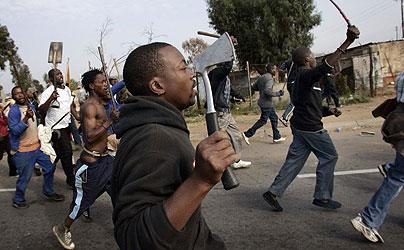
Black mob attacks, strips white family home bare on West Rand

Black Mobs on a Rampage

by Riaan van Zyl

Residents’ greatest fear came true on the evening of 18 January when rioters turned on private property.

One such resident in South Road, René Scheepers (40) and her three children were getting ready for bed at approximately 10pm when rocks started flying through the windows of the house. She immediately contacted the Witpoortjie Neighbourhood Watch who in turn contacted a nyala (police armoured vehicle) patrolling the area.

The rock-pelting attack was so intense that the nyala could not access Scheepers’ property. In the meanwhile she and her children locked themselves in a room.

Only at approximately 3am on Sunday 19 January the nyala got access to the house and evacuated the family. As soon as they left the protesters went on the rampage in the house stripping it of everything moveable such as jewellery, furniture, electric appliances, expensive crockery and even the children’s schoolbags. Scheepers’ family came the next morning to save what was left.

Scheepers has indicated that out of fear she will not move back to the house. She currently is residing with family.

A lot of questions has been raised about the SAPS and JMPD’s lack of pro-active policing in the ongoing protests. – Roodepoort Record

Young black arrested in KZN for killing entire family

Murder_titleToday on Monday 20 January 2014, a 25-year-old Tshepang Mokhali who is an accused in the murder of six family members at UMzinyathi in Kwazulu-Natal provinve during the month of December 2012 appeared in the Ntuzuma Magistrate Court facing six counts murder.

It is alleged that on 28 December 2012 Tshepang shot and killed Maselina Leneah (38) and he stabbed five of her kids to death only a toddler survived his onslaught. He locked the deceased bodies in the house and he fled to Lesotho where he had been hiding all along. The bodies were discovered on the 31st of December 2012. The suspect was finally arrested in the early hours of Friday morning in Matatiele in a joint operation between the Inanda Cluster Detectives together with Magma Security Investigators.

Tshepang was remanded in custody and will re-appear on 24 January 2014. – SA Police media service