Saudi princess charged with human trafficking in USA for holding Kenyan maid

Meshael Alayban
Meshael Alayban

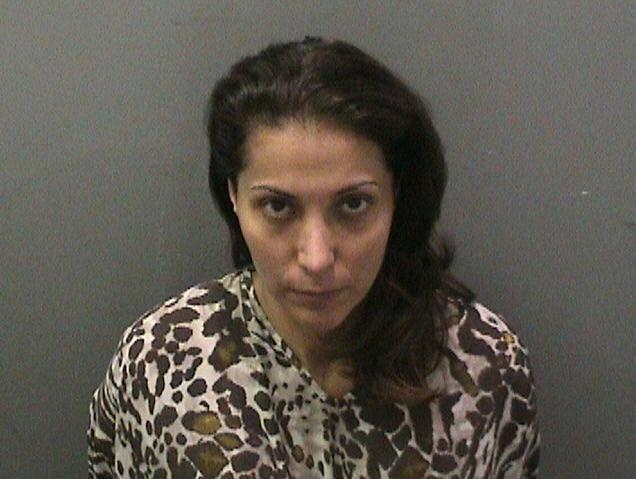
A Saudi princess has been charged with human trafficking for allegedly holding a Kenyan maid against her will in a luxury California apartment, news reports said late Wednesday.

Meshael Alayban, 42, was charged on Wednesday after being arrested at her home in a gated community in Irvine, California.

Prosecutors allege Alayban took the woman’s passport and forced her to work as a domestic servant for 16 hours a day, seven days a week for just 220 dollars a month, the Los Angeles Times reported.

A judge set bail of 5 million dollars for Alayban, and ordered her to wear a monitor if released from the women’s jail where she was being held.

“The law of our nation and California does not tolerate people who deprive or violate the liberty of another and obtain forced labour or services,” District Attorney Tony Rackauckas was quoted as saying.

The maid, whose identity was not released, began working for Alayban and her family in Saudi Arabia last year before moving to the US with them, the report said.

When police arrived at Alayban’s home they found four other women from the Philippines, who said their travel documents had also been taken by Alayban.

The Kenyan woman managed to escape from the apartment complex on Tuesday, before boarding a bus and contacting police.

Orange County prosecutors identified Alayban as one of the wives of Saudi Prince Abdulrahman bin Nasser bin Abdulaziz al Saud. She faces up to 12 years in prison if convicted of human trafficking. – dpa

Pirate Bay plans surveillance-free messaging app

piratebayThe co-founder and former spokesperson of the file-sharing site Pirate Bay Peter Sunde is working on a new iPhone and Android messaging application that will allow the users to protect their conversations from spying.

The application called Hemlis – ‘secret’ in Swedish – utilizes end-to-end encryption to make sure that only the two people in a conversation will have access to its data.

“All communication on today’s networks is being monitored by government agencies and private companies. The politicians are not going to stop it, they’re actually asking for more,” Sunde said in a video about the app. “That’s why we decided to build a messaging platform where no one can spy on you, not even us.”

Indeed, not even Sunde and the team developing the app will see the text messages’ contents, unlike traditional applications that leave the trails of the data – something, which allows the corporations to access it.

No advertisements are set to appear in the application.

“Normally security results in a complex and unfriendly user experience. It should not be that way. Hemlis is a messenger for everyone, so we are dedicated to creating the most user friendly messenger ever,” the description of the app reads.

RT spoke to Sunde about Hemlis’ technical side and the implications of its existence.

“We know how to encrypt the traffic and which countries we can have service in and in which countries we can allow traffic to pass. So we are building a network on top of their own internet to pass the messages along encrypted. So it’s both a technology but it’s also aware of the global legal framework for privacy,” Sunde said.

Although many have tried to link encrypted communication to terrorism, Sunde says the possibility of terrorists using Hemlis is not a valid argument in this case.

“We are talking here about normal people who do not have access to that technology yet. So terrorists are definitely not going to be on our system – they are already on their own systems; they wouldn’t trust us… so I think the only people we are helping are the [ordinary citizens] whom the government is surveilling.”

There is currently a crowd-funding campaign for the application, with the users willing to participate paying in cash or Bitcoin.

At $5, extra features in the app are unlocked, while after spending $10 or more the user gets to pre-register usernames. A donation of $500 allows to be mentioned as a fundraiser in the application, plus hundreds of unlock codes.

The fundraising campaign is in its early stage, though, so there is no official release date planned for the application.

The development of the app follows the NSA leak scandal, and Sunde’s target group are those who are also concerned about the level of government surveillance and data capture.

Sunde is one of the three founders of The Pirate Bay, although he stepped down as the website’s spokesman in 2009. When he announced his departure from The Pirate Bay, he pointed out he was interested in moving on to new projects.

The Pirate Bay (commonly abbreviated TPB) is a website that provides torrent files and magnet links for file sharing using the BitTorrent protocol. The site was founded in Sweden in 2003, and has faced multiple legal threats since its creation.- RT

US birthrate hits all-time low

baby2The recession has been over for four years, but the birth rate in the U.S. continues to fall as many people struggle with a sluggish economy and financial uncertainty.

According to a recent analysis by the Pew Institute, since 2007 when there were a record 4,316,233 births, the number of births has been steadily declining, with 4,007,000 births in 2012 – the lowest number since 1998.

Analysts say that the birthrate is dictated by the economy.

‘When times are up, births go up,’ D’Vora Cohn, a senior writer at Pew Research Center, told Today. ‘When times are bad, births go down.’

Despite the recession being officially over for four years, the weak recovery and economic uncertainty has resulted in the national birthrate hitting an all-time low in 2011, and staying there in 2012.

There were 63.2 births per 1,000 women aged 15 to 44 in 2012, according to the Center for Disease Control, down from 69.3 births per 1,000 women in that age bracket in 2007.

The connection between the economy and birthrates generally holds true, but there are often other factors at play as well.

According to Jonathan Last, author of ‘What to Expect When No One’s Expecting: America’s Coming Demography Disaster,’ for decades the national birthrate has been generally much lower than during the Baby Boom years of the ’50s and ’60s.

He says that factors such as higher education levels have seen women giving birth later in life and sometimes having less children overall.

‘It’s going to be fascinating to see,’ Last told Today. ‘Did the recession just exacerbate trends, or did it really put its thumb on the scale and move people into depressing fertility rates?’

Some couples are missing their window of opportunity to have a baby because they never feel financially secure enough to commit to having a child.

The U.S. Department of Agriculture estimates that a middle-income two-parent family will spend $234,900 raising a child – not including college.

For many middle-class people, parenting in the way they want – including all the trappings of a new baby such as Bugaboo prams and expensive classes and childcare for older children – is a costly and sometimes unaffordable task.

For lower income people, the expense of a baby could push families below the poverty line.

The birthrate among single women dropped substantially, as did the rate for young women in their teens and early 20s.

However, the birthrate actually increased slightly for older women in their early 40s, and remained the same for women in their 30s.

Experts say the reason for this is that older women are generally more financially secure, and for women in their 40s, the ticking of a biological clock is often louder than economic concerns.

‘The net effect in the past has been that you had about the same amount of babies… but they were just born a little later,’ Cohn told Today.

However, with the weak economy, the different ways women are thinking about parenthood and the general trend towards fewer births, it’s unclear whether the numbers will be made up this time.

‘History teaches us that there will be a bounce back. But whether it will be a full recovery, I don’t know,’ said Cohn. – Daily Mail

US National Guard to stop black Chicago violence

chicagogunsGun violence in the black city of Chicago is so severe that a state lawmaker wants state police and the National Guard to assist the local cops.

State Rep. Monique Davis (D-Chicago) is making the request.

“I am requesting with this press conference that Gov. Patrick Quinn order the Illinois National Guard (and) the Illinois State Police (to) come to Chicago and work with our mayor Ron (sic) Emanuel to provide safety for the children, especially,” she said at a news conference in Springfield.

Other state lawmakers accompanied Davis to recognize the severity of the problem, and the extent to which it carries beyond Chicago’s troubled neighborhoods to the entire city and other parts of the state, but not necessarily to concur with her solution.

Over the holiday weekend, 74 people were shot and 12 killed in Chicago, and Davis says the police don’t have the manpower to make arrests.

However, she said that if these state personnel are called in, a special commission must be set up to make sure they have clear orders on what to do each day.

“We don’t want them to have us fearing them also,” she said. – CBS

CNN denies exclusive deal to broadcast Mandela’s funeral

CNNAmerican broadcaster CNN flatly denies any involvement with a rumored deal between Nelson Mandela’s relatives and the company over exclusive rights to broadcast possible future funeral of the first South African black president.

“There is absolutely no truth to the allegation that CNN has bought the rights to the Mandela funeral,” a company spokesperson said.

Earlier South Africa’s The Sunday Independent reported that Mandela’s family claimed CNN had “preferential” access to the funeral ceremony of the former South African leader.

Nelson Mandela, 94, remains in a critical but stable condition in hospital.

Law enforcement prepares for riots on Zimmerman verdict

riotszimmermanOn Monday, the Broward County Sheriff’s Office released a video calling on the public not to riot in the wake of the George Zimmerman verdict, expected this week or next in Florida. The Sheriff’s Office released a statement explaining that it was “working closely with the Sanford Police Department and other local law enforcement agencies” to coordinate “a response plan in anticipation of the verdict.”

The video, titled “Raise Your Voice, Not Your Hands,” focuses on attempting to channel reaction into non-violent response. It depicts two youngsters, one black teenage boy, one Hispanic teenage girl. “Raise your voice!” says the girl. “And not your hands!” says the boy. “We need to stand together as one, no cuffs, no guns,” says the girl. “Let’s give violence a rest, because we can easily end up arrested,” says the boy. “I know your patience will be tested,” says the girl, and then both conclude, “but law enforcement has your back!”

“Let’s back up and choose not to act up, and deputies are with us, so no need to act up,” says the boy. “Let it roll off your shoulders,” says the girl, “it’s water off your back, don’t lack composure, because in one instant it could be over.” Both conclude: “So let’s make the choice to raise your voice and not your hands.” Sheriff Scott Israel says, “I’m Sheriff Scott Israel, and law enforcement does have your back.”

“Freedom of expression is a constitutional right,” the Sheriff’s Department states. “While raising your voice is encouraged, using your hands is not. BSO has created a public service announcement with the help of kids from the Jason Taylor Foundation, H.A.N.D.Y. (Helping Abused, Neglected, Disadvantaged Youth) and basketball star James Jones of the championship Miami Heat team urging young people not to let their emotions get the best of them.”

Sheriff Scott Israel said, “We don’t have information about a specific event that might take place at the conclusion of the trial, but we encourage everyone to keep any protests peaceful.”

The Department says that it is keeping its channels of communication open with “community leaders, civic activists, members of the clergy, as well as local, state and federal agencies.” – Breitbart


Disqus seems to be taking longer than usual. Reload?

advertisement

Send A Tip

advertisement

Breitbart Video Picks

Fox News National

advertisement

Sign up for our newsletter

advertisement

Mexico world’s most obese nation

fatmexicanThe United States no longer holds the title of the world’s most populous, obese nation; that designation has been passed on to Mexico.

According to a new report from the United Nations, nearly 70 percent of Mexican adults are overweight, and childhood obesity in the country has tripled within the past decade, Medical Daily reported. One-third of Mexican teenagers are also obese, and experts believe that four out of every five obese children will remain overweight for the rest of their lives.

Overall, 32.8 percent of Mexican adults are considered obese, compared to 31.8 percent of adults in the United States. Nearly 70,000 deaths in Mexico each year are caused by weight-related diabetes, and more than 400,000 new cases of diabetes are diagnosed annually.

Experts believe the rise in Mexico’s obesity rates has to do with the continuously growing gap between the country’s classes, as 50 percent of the population currently lives below the poverty line. According to Medical Daily, healthy diets are becoming less affordable, prompting individuals with low incomes to consume more unhealthy foods, such as fried foods and soda.

One researcher also believes the increase can be attributed to more Mexicans moving from rural to urban areas, where food prices are much higher and sedentary lifestyles are easier. – Fox News

Obama orders fed workers to spy on each other

wethepeopleIn an initiative aimed at rooting out future leakers and other security violators, President Barack Obama has ordered federal employees to report suspicious actions of their colleagues based on behavioral profiling techniques that are not scientifically proven to work, according to experts and government documents.

The techniques are a key pillar of the Insider Threat Program, an unprecedented government-wide crackdown under which millions of federal bureaucrats and contractors must watch out for “high-risk persons or behaviors” among co-workers. Those who fail to report them could face penalties, including criminal charges.

Obama mandated the program in an October 2011 executive order after Army Pfc. Bradley Manning downloaded hundreds of thousands of documents from a classified computer network and gave them to WikiLeaks, the anti-government secrecy group. The order covers virtually every federal department and agency, including the Peace Corps, the Department of Education and others not directly involved in national security.

Under the program, which is being implemented with little public attention, security investigations can be launched when government employees showing “indicators of insider threat behavior” are reported by co-workers, according to previously undisclosed administration documents obtained by McClatchy. Investigations also can be triggered when “suspicious user behavior” is detected by computer network monitoring and reported to “insider threat personnel.”

Federal employees and contractors are asked to pay particular attention to the lifestyles, attitudes and behaviors – like financial troubles, odd working hours or unexplained travel – of co-workers as a way to predict whether they might do “harm to the United States.” Managers of special insider threat offices will have “regular, timely, and, if possible, electronic, access” to employees’ personnel, payroll, disciplinary and “personal contact” files, as well as records of their use of classified and unclassified computer networks, polygraph results, travel reports and financial disclosure forms.

Over the years, numerous studies of public and private workers who’ve been caught spying, leaking classified information, stealing corporate secrets or engaging in sabotage have identified psychological profiles that could offer clues to possible threats. Administration officials want government workers trained to look for such indicators and report them so the next violation can be stopped before it happens.

“In past espionage cases, we find people saw things that may have helped identify a spy, but never reported it,” said Gene Barlow, a spokesman for the Office of the National Counterintelligence Executive, which oversees government efforts to detect threats like spies and computer hackers and is helping implement the Insider Threat Program. “That is why the awareness effort of the program is to teach people not only what types of activity to report, but how to report it and why it is so important to report it.”

But even the government’s top scientific advisers have questioned these techniques. Those experts say that trying to predict future acts through behavioral monitoring is unproven and could result in illegal ethnic and racial profiling and privacy violations.

“There is no consensus in the relevant scientific community nor on the committee regarding whether any behavioral surveillance or physiological monitoring techniques are ready for use at all,” concluded a 2008 National Research Council report on detecting terrorists.

“Doing something similar about predicting future leakers seems even more speculative,” Stephen Fienberg, a professor of statistics and social science at Carnegie Mellon University in Pittsburgh and a member of the committee that wrote the report, told McClatchy.

The emphasis on individual lifestyles, attitudes and behaviors comes at a time when growing numbers of Americans must submit to extensive background checks, polygraph tests and security investigations to be hired or to keep government or federal contracting jobs. The U.S. government is one of the world’s largest employers, overseeing an ever-expanding ocean of information.

While the Insider Threat Program mandates that the nearly 5 million federal workers and contractors with clearances undergo training in recognizing suspicious behavior indicators, it allows individual departments and agencies to extend the requirement to their entire workforces, something the Army already has done.

Training should address “current and potential threats in the work and personal environment” and focus on “the importance of detecting potential insider threats by cleared employees and reporting suspected activity to insider threat personnel and other designated officials,” says one of the documents obtained by McClatchy.

The White House, the Justice Department, the Peace Corps and the departments of Health and Human Services, Homeland Security and Education refused to answer questions about the program’s implementation. Instead, they issued virtually identical email statements directing inquiries to the Office of the Director of National Intelligence, declined to comment or didn’t respond.

Caitlin Hayden, a spokeswoman for the White House National Security Council, said in her statement that the Insider Threat Program includes extra safeguards for “civil rights, civil liberties and privacy,” but she didn’t elaborate. Manning’s leaks to WikiLeaks, she added, showed that at the time protections of classified materials were “inadequate and put our nation’s security at risk.”

Reply from the National Security Council

Even so, the new effort failed to prevent former National Security Agency contractor Edward Snowden from taking top-secret documents detailing the agency’s domestic and international communications monitoring programs and leaking them to The Guardian and The Washington Post newspapers.

The initiative goes beyond classified information leaks. It includes as insider threats “damage to the United States through espionage, terrorism, unauthorized disclosure of national security information or through the loss or degradation of departmental resources or capabilities,” according to a document setting “Minimum Standards for Executive Branch Insider Threat Programs.”

McClatchy obtained a copy of the document, which was produced by an Insider Threat Task Force that was set up under Obama’s order and is headed by Director of National Intelligence James Clapper and Attorney General Eric Holder. McClatchy also obtained the group’s final policy guidance. The White House, the Justice Department and the Office of the Director of National Intelligence declined requests for both documents, neither of which is classified.

Although agencies and departments are still setting up their programs, some employees already are being urged to watch co-workers for “indicators” that include stress, divorce and financial problems.

When asked about the ineffectiveness of behavior profiling, Barlow said the policy “does not mandate” that employees report behavior indicators.

“It simply educates employees about basic activities or behavior that might suggest a person is up to improper activity,” he said.

“These do not require special talents. If you see someone reading classified documents they should not be reading, especially if this happens multiple times and the person appears nervous that you saw him, that is activity that is suspicious and should be reported,” Barlow said. “The insider threat team then looks at the surrounding facts and draws the conclusions about the activity.”

Departments and agencies, however, are given leeway to go beyond the White House’s basic requirements, prompting the Defense Department in its strategy to mandate that workers with clearances “must recognize the potential harm caused by unauthorized disclosures and be aware of the penalties they could face.” It equates unauthorized disclosures of classified information to “aiding the enemies of the United States.”

All departments and agencies involved in the program must closely track their employees’ online activities. The information gathered by monitoring, the administration documents say, “could be used against them in criminal, security, or administrative proceedings.” Experts who research such efforts say suspicious behaviors include accessing information that someone doesn’t need or isn’t authorized to see or downloading materials onto removable storage devices like thumb drives when such devices are restricted or prohibited.

“If you normally print 20 documents a week, well, what happens if the next week or the following week you have to print 50 documents or 100 documents? That could be at variance from your normal activity that could be identified and might be investigated,” said Randy Trzeciak, acting manager of the Computer Emergency Response Team Insider Threat Center at Carnegie Mellon University’s Software Engineering Institute.

“We’ve come up with patterns that we believe organizations might be able to consider when determining when someone might be progressing down the path to harm the organization,” said Trzeciak, whose organization has analyzed more than 800 cases and works with the government and private sector on cyber security.

But research and other programs that rely on profiling show it remains unproven, could make employees more resistant to reporting violations and might lead to spurious allegations.

The Pentagon, U.S. intelligence agencies and the Department of Homeland Security have spent tens of millions of dollars on an array of research projects. Yet after several decades, they still haven’t developed a list of behaviors they can use to definitively identify the tiny fraction of workers who might some day violate national security laws.

“We are back to the needle-in-a-haystack problem,” said Fienberg, the Carnegie Mellon professor.

“We have not found any silver bullets,” said Deana Caputo, the lead behavioral scientist at MITRE Corp., a nonprofit company working on insider threat efforts for U.S. defense, intelligence and law enforcement agencies. “We don’t have actually any really good profiles or pictures of a bad guy, a good guy gone bad or even the bad guy walking in to do bad things from the very beginning.”

Different agencies and departments have different lists of behavior indicators. Most have adopted the traditional red flags for espionage. They include financial stress, disregard for security practices, unexplained foreign travel, unusual work hours and unexplained or sudden wealth.

But agencies and their consultants have added their own indicators.

For instance, an FBI insider threat detection guide warns private security personnel and managers to watch for “a desire to help the ‘underdog’ or a particular cause,” a “James Bond Wannabe” and a “divided loyalty: allegiance to another person or company or to a country besides the United States.”

A report by the Deloitte consulting firm identifies “several key trends that are making all organizations particularly susceptible to insider threat today.” These trends include an increasingly disgruntled, post-Great Recession workforce and the entry of younger, “Gen Y” employees who were “raised on the Internet” and are “highly involved in social networking.”

Report from Deloitte

Some government programs that have embraced behavioral indicators have been condemned as failures. Perhaps the most heavily criticized is the Transportation Security Administration’s Screening of Passengers by Observation Techniques, or SPOT, program.

The program, which has cost $878 million and employs 2,800 people, uses “behavior detection officers” to identify potential terrorists by scrutinizing airline passengers for signs of “stress, fear or deception.”

DHS’ inspector general excoriated the program, saying in a May 2013 report, “TSA cannot ensure that passengers at United States airports are screened objectively, show that the program is cost-effective or reasonably justify the program’s expansion.”

Interviews and internal complaints obtained by The New York Times quoted TSA officers as saying SPOT has led to ethnic and racial profiling by emphasizing certain profiles. They include Middle Easterners, Hispanics traveling to Miami and African-Americans wearing baseball caps backward.

Another problem with having employees report co-workers’ suspicious behaviors: They aren’t sure which ones represent security threats.

“Employees in the field are not averse to reporting genuine security infractions. In fact, under appropriate conditions they are quite willing to act as eyes and ears for the government,” said a 2005 study by the Pentagon’s Defense Personnel Security Research Center. “They are simply confused about precisely what is important enough to report. Many government workers anguish over reporting gray-area behaviors.”

Even so, the Pentagon is forging ahead with training Defense Department and contractor managers and security officials to set up insider threat offices, with one company emphasizing how its course is designed for novices.

“The Establishing an Insider Threat Program for Your Organization Course will take no more than 90 minutes to complete,” says the proposal.

Officials with the Army, the only government department contacted by McClatchy that agreed to discuss the issue, acknowledged that identifying potential insider threats is more complicated than relying on a list of behaviors.

Response from the Army

“What we really point out is if you’re in doubt, report, because that’s what the investigative personnel are there to do, is to get the bottom of ‘is this just noise or is this something that is really going on?’” said Larry Gillis, a senior Army counterintelligence and security official.

The Army implemented a tough program a year before Obama’s executive order after Maj. Nidal Hasan, a U.S.-born Muslim, allegedly killed 13 people in a 2009 rampage at Fort Hood, Texas. Hasan, who has not gone on trial, has said he was defending the Afghan Taliban.

Gillis said the Army didn’t want a program that would “get people to snitch on each other,” nor did it want to encourage stereotyping.

“We don’t have the luxury to make up reasons to throw soldiers out,” Gillis said. “It’s a big deal to remove a soldier from service over some minor issue. We don’t want to ruin a career over some false accusation.”

But some current and former U.S. officials and experts worry that Obama’s Insider Threat Program could lead to false or retaliatory accusations across the entire government, in part because security officials are granted access to information outside their usual purview.

These current and former U.S. officials and experts also ridiculed as overly zealous and simplistic the idea of using reports of suspicious behavior to predict potential insider threats. It takes years for professional spy-hunters to learn their craft, and relying on the observations of inexperienced people could lead to baseless and discriminatory investigations, they said.

“Anyone is an amateur looking at behavior here,” said Thomas Fingar, a former State Department intelligence chief who chaired the National Intelligence Council, which prepares top-secret intelligence analyses for the president, from 2005 to 2008.

Co-workers, Fingar said, should “be attentive” to colleagues’ personal problems in order to refer them to counseling, not to report them as potential security violators. “It’s simply because they are colleagues, fellow human beings,” he said.

Eric Feldman, a former inspector general of the National Reconnaissance Office, the super-secret agency that oversees U.S. spy satellites, expressed concern that relying on workers to report colleagues’ suspicious behaviors to security officials could create “a repressive kind of culture.”

“The answer to it is not to have a Stasi-like response,” said Feldman, referring to the feared secret police of communist East Germany. “You’ve removed that firewall between employees seeking help and the threat that any employee who seeks help could be immediately retaliated against by this insider threat office.” – McClatchy Washington Bureau

Read more here: http://www.mcclatchydc.com/2013/07/09/196211/linchpin-for-obamas-plan-to-predict.html#storylink=cpy

Brazil opens investigation into US spying

us-nsa-spying-germanyThe Brazilian government began an investigation Monday into whether telecommunications firms operating in the country cooperated with the U.S. as part of a spying program that has collected data on billions of telephone and email conversations.

Anatel, the government agency that regulates the telecom sector in Brazil, said it’s working with federal police and other government agencies on the investigation.

The O Globo newspaper reported this weekend that information released by the National Security Agency leaker Edward Snowden showed Brazil is the top target in Latin America for the NSA’s massive intelligence-gathering effort aimed at monitoring communications around the world.

Brazil isn’t alone in its concern; London-based advocacy group Privacy International filed lawsuit on Monday over alleged spying of internet and phone users in Britain. Earlier, official in Germany, France, Hong Kong and other nations lodged complaints.

Brazilian President Dilma Rousseff the nation would raise the issue at the 193-country U.N. International Telecommunications Union and also at the U.N. Commission on Human Rights since the “fundamentals” of human rights include “freedom of expression and the right to privacy.”

“If there was any involvement of other countries, of other businesses that aren’t Brazilian, then it’s certainly a violation of our sovereignty, without a doubt, just like it’s a violation of human rights,” Rousseff said. “Now, we have to look at things without pre-judgment, we have to investigate.”

Brazilian regulator Anatel said in its statement that “it’s worth clarifying that the confidentiality of data and telephone communications is a right guaranteed by the constitution, by our laws and by Anatel’s regulations. Its violation is punishable in civil, criminal and administrative realms.”

The O Globo article said the NSA collected the data through an undefined association between U.S. and Brazilian telecommunications companies. It said it could not verify which Brazilian companies were involved or if they were aware their links were being used to collect the data.

On Monday, O Globo reported that the U.S. had a significant data center in Brasilia for the collection of intercepted global satellite communications until at least 2002, based upon the Snowden document it’s seen. The documents didn’t indicate if that still exists.

Communications Minister Paulo Bernardo told reporters in Brasilia that he “has no doubt whatsoever” Brazilian citizens and institutions were spied upon.

“Even the European Parliament was monitored – you think that we weren’t?” he said. “We have to verify the circumstances in which this occurred, the exact way and when.”

Bernardo met Monday afternoon with U.S. Ambassador Thomas Shannon.

“He denied that there is such monitoring here in Brazil, he said that there never was a data center and that there is no agreement with Brazilian companies to collect data in Brazilian territory,” Bernardo said afterward, according to the state-run Agencia Brasil news agency.

The O Globo article printed Sunday said that “Brazil, with extensive digitalized public and private networks operated by large telecommunications and internet companies, appears to stand out on maps of the U.S. agency as a priority target for telephony and data traffic, alongside nations such as China, Russia and Pakistan.”

The report did not describe the sort of data collected, but the U.S. programs appear to gather what is called metadata: logs of message times, addresses and other information rather than the content of the messages.

U.S. journalist Glenn Greenwald, who lives in Rio de Janeiro and originally broke the Snowden story in the Britain-based Guardian newspaper, where he writes a regularly blog, co-authored the Sunday report in O Globo.

In an interview with the Globo TV network, Greenwald said the Snowden documents show that the U.S. was using Brazil as a “bridge” to gather data on better-protected states where it cannot gain direct access, but whose traffic may pass through Brazil.

“We don’t have access to China’s system, but we have access to Brazil’s system,” Greenwald said, speaking Portuguese. “So, we collect the traffic in Brazil not because we want to know what one Brazilian is saying to another Brazilian, but because we want to know what someone in China is saying to somebody in Iran, for example.”

Brazil’s Foreign Minister Antonio Patriota expressed “deep concern” about the monitoring of Brazil and demanded explanations from U.S. diplomats. On Monday, he said the conversations with the Americans were “encouraging” but that “we need to deepen the discussions.”

Patriota reiterated that Brazil was looking at how to take measures at the United Nations “that would guarantee not just privacy, but also the respect and the citizenship of states when it comes to the use of information technology and cyber security.”

In Washington, the U.S. State Department declined to comment on the alleged intelligence activity.

“As a matter of policy, we have been clear that the United States does gather foreign intelligence of the type gathered by all nations. I can tell you that we have spoken with Brazilian officials regarding these allegations,” said State Department spokeswoman Jen Psaki. “We plan to continue our dialogue with the Brazilians through normal diplomatic channels. But those are conversations that, of course, we would keep private.” – AP

Bundesbank: China’s currency fast becoming global reserve currency

chinacurrencyFollowing the most recent shift ‘away’ from a USD-centric world (with the China-Australia direct currency convertibility), it seems the possibility of China’s Yuan as the next global reserve currency is getting closer. The Brits, Germans, and now the Swiss (who just signed a free-trade-agreement with China) are all actively vying to become Europe’s Yuan trading hub as it seems the long line of developments to internationalize the currency over the past two years. As Bundesbank board member Joachim Nagel noted in a speech entitled “Reniminbi as a potential reserve currency” this week, “the Chinese currency is well on its way to becoming one of the future global reserve currencies.” He noted that, although the USD is still the most commonly-used currency for settling trade with China; from virtually zero in 2010, the Yuan is used to settle over 12% of trading transactions now – and is likley to increase further.

Remember, nothing lasts forever:

This latest development in global currency relations should come as no surprise to those who have followed our series on China’s slow but certain  internationalization of its currency over the past two years. To wit: “World’s Second (China) And Third Largest (Japan) Economies To Bypass Dollar, Engage In Direct Currency Trade“, “China, Russia Drop Dollar In Bilateral Trade“, “China And Iran To Bypass Dollar, Plan Oil Barter System“, “India and Japan sign new $15bn currency swap agreement“, “Iran, Russia Replace Dollar With Rial, Ruble in Trade, Fars Says“, “India Joins Asian Dollar Exclusion Zone, Will Transact With Iran In Rupees“, “The USD Trap Is Closing: Dollar Exclusion Zone Crosses The Pacific As Brazil Signs China Currency Swap“, and “Thanks, World Reserve Currency, But No Thanks: Australia And China To Enable Direct Currency Convertibility.”

Via Deutsche Bundebank (Dr. Joachim Nagel),

Renminbi as a potential reserve currency

According to Bundesbank Executive Board member Joachim Nagel, the Chinese currency is well on its way to becoming one of the future global reserve currencies. This potential stems from the renminbi’s increasing convertibility, he said at a conference of the Chamber of Industry and Commerce in Frankfurt.

He emphasised that although the US dollar is currently the most commonly used currency for settling trade with China, the significance of the renminbi has increased greatly over the last few years. He underlined this by referring to figures published by SWIFT, which indicate that the percentage of trading transactions settled in renminbi jumped from virtually zero to around 12% between 2010 and 2012 – and is likely to increase further. In view of this, he pointed out that the renminbi has already achieved the status of a trading currency.

Drawing parallels to the Deutsche Mark

Mr Nagel compared China’s growing importance with the German economic miracle of the 1950s and drew parallels between the renminbi’s current growth and the development of the Deutsche Mark. Thanks to the recovery of the German economy, the country accumulated a large volume of foreign exchange reserves and the Deutsche Mark acquired the status of a global investment and reserve currency, he explained. He anticipates that “the renminbi is certain to have similar long-term prospects if market access is liberalised further”. Mr Nagel backed up his comments by citing a survey of reserve managers carried out by RBS. The survey revealed that 14% of reserve managers have already invested in renminbi, with 37% of respondents considering investing in the currency in the next five to ten years.

Mr Nagel sees the renminbi as currently transitioning from a being trading currency to an investment currency. While both inward and outward direct investment is now possible, portfolio investments will continue to be regulated, he remarked, adding that improvements are expected in this area. “The internationalisation process of the Chinese currency is taking place more gradually than was the case with the Deutsche Mark, which, at times, was subject to radical upheaval”, he added. Mr Nagel recalled, in this context, the collapse of the Bretton Woods system of fixed exchange rates and the crisis in the European Monetary System at the beginning of the 1990s.

Renminbi financial centre in Frankfurt

Mr Nagel noted that “given China’s growing economic importance, the internationalisation of the renminbi seems long overdue”. He explained the Chinese government’s decision to employ offshore trading centres, which would allow China to establish its currency internationally, while protecting its domestic financial system. Hong Kong, where around 80% of all renminbi trade is settled, is by far the most important trading centre for the currency, with London and Singapore each accounting for 4% of renminbi trade since mid-2012. He added that the expansion of the market has led to the growing significance of other financial centres for renminbi.

Mr Nagel welcomed Frankfurt’s endeavour to position itself as a trading hub for the Chinese currency, calling it a step in the right direction, towards the free movement of capital. “The high level of interaction between China’s and Germany’s real economies highlights the necessity for a more active renminbi trade”, Mr Nagel remarked, “perhaps even using Germany as a hub” – Zero Hedge

Airport landing system off when plane crashed in San Francisco

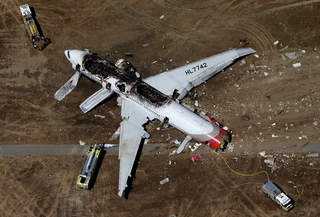
sanfranplanecrashA navigation system that helps pilots make safe descents was turned off at San Francisco airport on Saturday when a South Korean airliner crashed and burned after undershooting the runway, officials said.

The system, called Glide Path, is meant to help planes land in bad weather. It was clear and sunny, with light winds, when Asiana Flight 214 from Seoul, South Korea crashed just before noon, killing two passengers and injuring more than 100.

Aircraft safety experts said Glide Path was far from essential for routine landings, and it was not unusual for airports to take such landing systems off line for maintenance or other reasons.

But pilots have grown to rely on the decades-old technology, which is designed specifically to prevent runway misses, so investigators are likely to look closely at the issue.

“The pilots would have had to rely solely on visual cues to fly the proper glide path to the runway, and not have had available to them the electronic information that they typically have even in good weather at most major airports,” said Captain Chesley “Sully” Sullenberger, the former US Airways pilot who gained fame with a successful crash landing on the Hudson River in 2009.

“What that means is that then the automatic warnings that would occur in the cockpit when you deviate below the desired electronic path wouldn’t have been available either. So we don’t know yet if that’s a factor in this particular situation, but that’s certainly something they’ll be looking at,” he told the local CBS News affiliate.

Glide Path is a computerized system based at an airport that calculates a plane’s path of descent and sends it to pilots in real time.

San Francisco International has turned off the system for nearly the entire summer on the runway where the Asiana flight crashed, according to a notice from the airport on the Federal Aviation Administration’s Web site. It showed the system out of service June 1-August 22 on runway 28 Left.

Kevin Hiatt, chief executive of the Flight Safety Foundation and a former Delta pilot, said it was common for airports to take instrument landing systems offline for maintenance on clear days. Pilots use several other instruments and visual cues to land in clear conditions, Hiatt said.

Former Inspector General of the U.S. Department of Transportation Mary Schiavo said pilots had become increasingly dependent on instruments for flying. But she added that modern planes had plenty of systems for landing safely, down to a pilot watching the lights on the runway. – Reuters

Wife of top US diplomat falls critically ill

Teresa Heinz Kerry
Teresa Heinz Kerry

Teresa Heinz Kerry, a leading philanthropist and wife of US Secretary of State John F. Kerry, was in critical but stable condition Sunday after being flown to Massachusetts General Hospital from Nantucket, where she had been rushed to the hospital for an undisclosed ailment, according to aides to the secretary.

Heinz Kerry, 74, was stricken while at the family’s vacation home, according to State Department spokesman Glen Johnson.

“Late Sunday afternoon, Mrs. Teresa Heinz Kerry was taken by ambulance to Nantucket Cottage Hospital, accompanied by her husband,” Johnson said in a prepared statement. “Once doctors had stabilized her condition, she was transferred to Massachusetts General Hospital in Boston, again accompanied by the Secretary.”

Johnson did not provide further details of her condition, saying “the family is grateful for the outpouring of support it has received and aware of the interest in her condition, but they ask for privacy at this time.”

Shortly after 5:30 p.m., Noah Brown, public information officer for Nantucket Cottage Hospital, confirmed in a brief phone interview that Heinz Kerry had arrived at the hospital that afternoon.

“She was brought in, in critical but stable condition, and that is currently how . . . . her condition still remains,” Brown said. “At this point, we are determining the next phase of her care, be that either in our facility on the island, or on the mainland.”

Heinz Kerry has overcome serious health problems in recent years. She was diagnosed with breast cancer in September 2009 and underwent surgery and radiation treatments. She has publicly encouraged other women to get regular mammograms to help enable early detection of the disease.

The Kerry family’s holiday weekend on Nantucket was designed as a much-needed respite for the nation’s top diplomat following a frenetic pace of foreign travel, but it garnered unwanted headlines before Heinz Kerry’s hospitalization. On Friday, a State Department spokeswoman was forced to retract an earlier denial that Kerry had been on his yacht, Isabel, during the military coup in Egypt Wednesday. – The Boston Globe

Snowden’s hopes rise on asylum offers

Police outside Sheremetyevo international airport in Moscow

Hopes have risen that Edward Snowden may finally be able to leave Moscow, where he has been stranded in an airport for 14 days, after three Latin American countries offered the fugitive US intelligence leaker asylum.

Bolivia on Saturday became the third country to offer refuge to the former US National Security Agency (NSA) contractor, with President Evo Morales saying he was willing to take Snowden in “if he asks”.

The offer came not long after Venezuela’s leftist President Nicolas Maduro said he would grant the 30-year-old “humanitarian asylum” and Nicaraguan President Daniel Ortega said his country could offer a safe haven.

The flurry of offers arrived after a series of rejections from many of the 21 countries to which Snowden had applied to last week for refuge.

The WikiLeaks anti-secrecy website that has been supporting Snowden’s cause said he had recently applied to six additional countries that it refused to name.

But it was far from clear how exactly Snowden — hidden out of sight of reporters for the past two weeks — could reach another nation from the transit zone of Russia’s sprawling Sheremetyevo international airport.

He has been stripped of his passport by the US authorities and a refugee pass initially believed to have been offered to him by Ecuador has since been declared invalid.

“He has no passport and asylum can only be granted to a specific individual. I have grave doubts that this is now possible,” senior ruling party lawmaker Alexander Romanovich told Moscow Echo radio.

Sheremetyevo only handles commercial flights and Snowden cannot travel past passport control to another airport used by foreign dignitaries.

Even if he got on a commercial flight, the plane carrying him could be grounded — the fate suffered by the jet carrying Morales after several EU states denied it overflight rights over suspicions Snowden was onboard.

Analysts meanwhile said Moscow may be increasingly concerned about getting sucked into a diplomatic spat with Washington that it had never planned for and which it would rather avoid.

— Leftist Latin American leaders offer asylum —

Morales declared however that Bolivia has “no fear” of the United States and its European allies, and that he would be willing “to give asylum to the American, if he asks”.

The offer was echoed by Maduro, who visited Moscow at the start of the week for a gas summit during which he strongly hinted that Venezuela –long a diplomatic irritant for the United States — could welcome the opportunity to help Snowden out.

But he made his intentions absolutely clear in an address at an independence day event in Caracas.

“As head of state of the Bolivarian republic of Venezuela, I have decided to offer humanitarian asylum to the young Snowden … to protect this young man from the persecution launched by the most powerful empire in the world,” said Maduro said.

Nicaragua’s Daniel Ortega voiced a slightly more toned down message only minutes earlier.

“We are open, respectful of the right to asylum, and it is clear that if circumstances permit it, we would receive Snowden with pleasure and give him asylum here in Nicaragua,” Ortega said at a public event.

So far, only Nicaragua, of the three that have offered asylum, said it had received his formal request; that could mean a petition there is further along in the pipeline than elsewhere.

Ecuador had been seen as the American’s best hope when he arrived in Moscow from Hong Kong on June 23 after leaking secrets about the extent of the US data surveillance programme to the press.

But the leftist government in Quito has yet to consider his application.

— ‘Russia is not happy he is here’ —

Russian President Vladimir Putin has refused to extradite Snowden to the United States while still stressing that he would like to see him gone as soon as possible.

Analysts interpret the mixed message as a sign that Moscow feel like they are being drawn into a fracas with Washington at a time when it would rather avoid additional difficulties to the two sides’ strained ties.

“Russia is not happy that he is here. If it wanted to offer him asylum, this would have been done right away,” said Carnegie Moscow Centre analyst Maria Lipman.

She noted that Putin himself was a former KGB spy who cares deeply about the safety of state secrets.

Alexander Konovalov of the Institute of Strategic Assessments agreed that “there is nothing for us to gain from Snowden”.

Putin has denied ever questioning Snowden about the details of the US spy network and has even suggested that doing so was not worth the effort.

“Snowden’s asylum in Venezuela would be the best option,” said parliament’s foreign affairs committee chairman Alexei Pushkov.

“This country is in a sharp conflict with the United States,” Pushkov tweeted. “It will not get any worse.” – AFP

US foreign policy doesn’t pass the laugh test

ronpaul
Sen. Ron Paul

US Senator Ron Paul says US foreign policy doesn’t pass the laugh test.

A military coup in Egypt yesterday resulted in the removal and imprisonment of the elected president, Mohamed Morsi, a closure of media outlets sympathetic to him, the house arrest of his advisors, and the suspension of the constitution. The military that overthrew Morsi is the main recipient of the $1.3 billion yearly US aid package to Egypt. You could say that the US “owns” the Egyptian military that just overthrew its democratically-elected leader.

The hypocrisy of the US administration on these events in Egypt is stunning. As the New York Times reported today:

 President Obama urged the military to move quickly to return Egypt to a democratically elected government, saying, ‘We are deeply concerned by the decision of the Egyptian Armed Forces to remove President Morsi and suspend the Egyptian Constitution.’ The president notably did not refer to the military’s takeover as a coup — a phrase that would have implications for the $1.3 billion a year in American military aid to Egypt.

Well, Egypt had a democratically-elected government, but it was overthrown by the US-funded Egyptian military!

Let’s review US policy toward Egypt to see the foolish hypocrisy of the government’s interventionism: First the US props up the unelected Hosni Mubarak for decades, spending tens of billions of dollars to keep him in power. Then the US provides assistance to those who in 2011 successfully overthrew Mubarak. Then the US demands an election. The Egyptians held an election that was deemed free and fair and shortly afterward the US-funded military overthrows the elected president. Then the US government warns the military that it needs to restore democracy – the very democracy that was destroyed by military coup! All the while the US government will not allow itself to utter the word “coup” when discussing what happened in Egypt yesterday because it would mean they might have to stop sending all those billions of dollars to Egypt.

All this they do with a straight face. We are not supposed to notice the insanity of their foreign policy. – prisonplanet.com