A new book being published in Britain, Mind-forg’d Manacles: Murder, Macpherson and the (Metropolitan) Police by Jon Gower Davies, is set to explode some of the myths around white racism in that country.
The pending publication of the book has already led to newspaper artilcles, notably in the Daily Mail, exposing how police have failed to act against gangs of Asians raping British girls.
According to the London Daily Mail, “This year a gang from Rochdale were jailed for plying teenage girls with alcohol before raping them.
“All but one gang member was of an Asian Pakistani background.
The court heard up to 47 vulnerable girls were passed around the group and forced to have sex several times a week, but two years before action was finally taken, police missed an opportunity to stop the gang when a 15-year-old girl told them she had been raped.
A former Labour MP, Ann Cryer, said the police failed to investigate properly because they were ‘petrified’ of being branded racist.
Former MP Ann Cryer, said police failed in their investigation of the Rochdale sex gang because they were too afraid of being branded racist
Mr Davies, a former Labour councillor, describes the lack of investigation into sex crimes as a case of ‘reverse’ institutional racism in which the views of victims, vulnerable white girls, were not taken seriously.”
The publisher of Mind-forg’d Manacles: Murder, Macpherson and the (Metropolitan) Police, Waterstones has the following to say about the coming book:
The Macpherson Report into the handling of the murder of Stephen Lawrence became a defining moment in British political history. It accused the Metropolitan Police of ‘institutional racism’, an ambiguous phrase that has been regularly confused with overt racism. The concept was used not only to condemn the Metropolitan Police, but also to condemn all British police forces. For many commentators, it condemned Britain as a whole as a racist society.
In Mind Forg’d Manacles, Jon Gower Davies argues that the charge of institutional racism was ill-founded and that reforms designed to address it have introduced negative and unintended consequences for British policing. It has bogged down the police with unnecessary and counter-productive bureaucratic demands. It has paralysed the investigation of some crimes that involve ethnic minority suspects, frequently exposing vulnerable victims to greater harms. Davies presents an alternative, optimistic perspective on British society. Racism is, in fact, a rarity and its occasional appearance rightly condemned. The police are generally respected and trusted by British people of all ethnic origins.
Imputing institutional racism to a whole society unfairly smears the majority of fair-minded people while removing moral responsibility from the minority of people who fail to measure up to British standards of equality. Davies concludes: ‘Macpherson – not only obviated the need to make a realistic if less flamboyant analysis of the limitations of the policing of the murder of Stephen Lawrence, but also led an over-anxious police leadership to make a fool of itself by adopting policies which are neither operationally nor socially nor ethically sound and proper.’
LIMERICK, Ireland — An investigation has been launched after Manchester City defender Gael Clichy claimed he was the victim of racism after a banana was thrown onto the pitch during his side’s friendly win over Limerick.
Police and stadium officials are studying CCTV footage in an attempt to identify a spectator alleged to have thrown the missile onto the pitch during the Premier League champions’ 4-0 pre-season friendly victory at Thomond Park on Sunday.
A statement from Limerick FC and Thomond Park Stadium said: “The Gardai (Irish police) and stadium officials are reviewing the CCTV recordings to attempt to identify an individual involved in the throwing of an offensive object onto the playing field.
“Any individual identified as being involved in an incident of this nature will be banned from future attendance and the matter will be handed over to the Gardai.
“All those involved with the friendly game fully condemn all forms of unacceptable behaviour of this nature.”
It is understood Manchester City made no formal complaint over the incident, which was mentioned by Clichy via his Twitter account.
The French player tweeted: “How sad to see ‘bananas thrown on the pitch’ tonight… Knowing people around the world need food. £nowordsforthis.”
The incident came as Newcastle asked Den Haag to investigate reports of racist chanting from sections of home fans during the friendly game between the two clubs at the Kyocera Stadium the previous day. – AFP
South Africa is considering ways of strengthening bilateral economic relations with Belgium, International Relations Minister Maite Nkoana-Mashabane said on Wednesday.
She told reporters in Pretoria that a visiting Belgian delegation would meet South African ministers to explore the possible co-operation.
Belgian deputy prime minister Didier Reynders is on his first official state visit to South Africa. He is also the country’s minister of foreign affairs, foreign trade and European trade.
“I am encouraged by the fact that you will be meeting other members of our Cabinet, specifically our minister of trade and industry, and also the minister of mineral resources,” Nkoana-Mashabane said.
“We believe there is an opportunity there (in the mining sector) to work with Belgium on our plans for beneficiation of our mineral resources and taking advantage of your historical expertise in this field.”
She said the west European country had helped support South Africa’s national priorities since 1994. The help had covered areas such as health, ports management and logistics, education, rural development, and further education and training, Nkoana-Mashabane said.
“Despite the ongoing economic challenges confronting Europe, Belgium has remained steadfast in its support for our development efforts,” Nkoana-Mashabane said.
She said South Africa had expressed interest in having Belgium play an active role in the mooted Tripartite Free Trade Area (T-FTA), which involves the Common Market of East and Southern Africa (Comesa), the East African Community (EAC) and the Southern African Development Community (SADC).
“I indicated to the minister that the T-FTA will encompass 26 countries, with a combined population of 600 million people and a GDP (gross domestic product) of approximately US one trillion,” she said.
“We are convinced that the key to economic development of the continent lies in creating the necessary infrastructure to facilitate the free movement of goods and services,” Nkoana-Mashabane said.
Reynders said Wednesday’s meeting had focused on renewed interest in deepening bilateral trade between his country and South Africa.
On the international front, Reynders said the discussions touched on the possible ways to bring lasting peace and stability to its former colony, the Democratic Republic of Congo.
“Our role is not to blame the DRC or Rwanda or any one of the parties in the conflict in the eastern parts of Congo. We called for dialogue to bring peace in that region.”
An army mutiny by a group of former Congolese Tutsi rebels known as M23, who were integrated into the army but defected this year, started more than two months ago in the eastern DRC.
Rwanda, also a former Belgian colony, has denied accusations that it has been helping the M23 mutineers. – Sapa
The Spanish and Russian football associations have been fined 20,000 and 30,000 euros respectively after racist incidents among their fans at Euro 2012 matches, UEFA said in a statement on Thursday.
The 20,000 euro sanction on the Spanish has been imposed after fans sang racist chants and engaged in other racist behaviour during the Group C match against Italy in Gdansk on June 10.
Italy’s black striker Mario Balotelli started in the 1-1 draw.
The Russians have been fined after being found guilty of the same charge in the Group A game against the Czech Republic in Wroclaw on June 8.
Czech right back Theodor Gebre Selassie, who is black, played in their 4-1 defeat. Both associations can appeal.
Balotelli was also subjected to racist abuse by Croatia fans during a match on June 14 and the Croatian FA was fined 80,000 euros by European soccer’s governing body.
The size of that fine was criticised by the Football Against Racism in Europe (FARE) network, who told Reuters there was public concern that Denmark’s Nicklas Bendtner was fined 20,000 euros more for exposing an illegal advert on his underpants.
The Russian FA has already been fined three times for fan trouble at the tournament, including supporter violence.
UEFA said it would dock them six points in qualifying for the next European Championship if their fans were involved in further similar violence, with racist abuse not constituting a violent act under UEFA rules.
Holders Spain have reached Sunday’s final being staged in Kiev while Russia went out in the group stage. – Reuters
(DPA) Two in three Norwegians believe the country’s media have devoted too much coverage to last year’s bombing and shooting attacks that claimed 77 lives, according to a survey published on Thursday.
The results were released just a few days before Anders Behring Breivik, the man who has confessed to the deadly attacks, was to stand trial amid a huge media presence.
The survey found that 68 per cent of Norwegian media consumers felt the coverage of the July 22 attacks was too extensive, while 28 per cent said it was on the right level, the Oslo daily Aftenposten reported.
The February 16 to March 2 poll comprised about 1,400 people, of which almost half were journalists. The margin of error was 3.5 percentage points.
The survey said almost half of the 637 Norwegian journalists polled also considered that the coverage had been too extensive.
Research company Response Analyse conducted the survey for the upcoming Nordic media days convention in Bergen, western Norway.
Professor Frank Aarebrot of the University of Bergen, who was in charge of the survey, said the results showed that “people want to move on” and put the July 22 events behind them.
Per Edgar Kookvold, secretary general of the Norwegian Press Association, said the coverage was on the whole adequate and necessary.
Meanwhile, Oslo daily Dagbladet was set to offer its online readers an option on its home page that would take them to pages without any reference to Breivik’s 10-week trial, which is due to start on Monday and run until June.
Dagbladet editor-in-chief John Arne Markussen said the newspaper had decided on this some time ago, citing views from its readers, broadcaster NRK said.
Aftenposten and broadcaster TV2 said they had also considered this approach, but opted not to, citing the importance of the trial.
Twelve people died Tuesday when a night time fire tore through a two-story Moscow market warehouse that was being used by migrant workers from a former Soviet republic as a temporary residence.
“Twelve people died. They were migrant workers. We are trying to confirm which (ex-Soviet) republic they came from,” a Moscow emergencies ministry spokesman told AFP.
Unconfirmed news reports said the migrants came from the impoverished Central Asian nation of Tajikistan. Numerous Moscow markets employ cheap labourers from the region without giving them proper housing conditions or pay.
The blaze erupted early Tuesday at a market on the southern outskirts of the city called Kachalovsky. Officials said it took two hours to put out.
Emergency workers described squalid living conditions in which the workers slept on hard cots that were stacked on top of each other in rows of four without any direct access to the outside.
The workers “lived in a metal annex that was equipped with a space heater”, an unnamed law enforcement official told the Interfax news agency.
“They slept in frighteningly tight conditions, on hard bunk cots that were then stacked on top of each other,” he said.
Another official said the workers probably left the space heater on all night to stay warm during the frigid Moscow spring. Overnight temperatures plunged below freezing and much of central Russia has been hit by snow.
“The fire could have started from the electric space heater. It was probable left on all night because the structure was turned into living quarters,” an unnamed investigator told ITAR-TASS.
Police said they have opened a criminal investigation but have not yet pressed any charges against the market owners.
Russia’s migration service estimates that there are 700,000 Tajiks living officially in the country — a tenth of their home country’s population of just under seven million.
Tajikistan was wrecked by a brutal civil war in the early 1990s and then experienced nearly two decades of ethnic tensions and endemic drugs trafficking that hampered sustainable growth.
Its economy remains in tatters and some analysts estimate that up to half of Tajikistan’s young male population is currently trying to make a living in Moscow and other major Russian cities.
The predominant majority of the migrants who arrive in Moscow do so without acquiring the official city worker permits that the Russian capital has required since Soviet times.
Their employment is therefore never officially reported to the authorities and many end up living in Moscow apartment block basements or makeshift residences.
Seven migrants were killed in January 2009 when a fire swept through an underground Moscow garage they were building and had also used as a temporary living shelter.
Another seven died in May 2011 when a fire engulfed an old abandoned building in central Moscow.
The presence of Central Asian nationals and workers from the predominantly Muslim Caucasus region has also stirred racial tensions in the Russian capital and resulted in repeated deadly attacks.
President-elect Vladimir Putin had vowed to reinforce migration controls while serving as prime minister for the past four years and won a strong following from Russian nationalists while heading the Kremlin in 2000-2008.
European governments have opened the door to a radical offer of “debt relief” for Arab north African neighbours such as Egypt, EU and governmental sources told AFP Wednesday.
“Member states will examine possibilities of using debt relief as a signal of change” along the southern Mediterranean rim, conclusions drawn up for European Union leaders to endorse at a March 1-2 summit revealed.
The plan emerged barely 24 hours after eurozone governments backed an unprecedented write-down of Greek sovereign debt held by private investors, one expected to reduce Athens’ debt burden by nearly one third, some 107 billion euros ($141 million).
It is being driven primarily by the French government, diplomats said on the eve of first talks on the proposal among ambassadors from the 27 EU states in Brussels on Thursday morning.
“Expect a vigorous discussion,” said one senior EU official on the possible terms for debt relief that could be awarded in exchange for democratic reforms and preferential trade terms.
The idea is gaining currency one year on from the start of the ‘Arab Spring,’ with “rapid progress” demanded by EU leaders, the summit declaration was to say, on negotiations over Free Trade Agreements between the EU and the countries of its “southern neighbourhood.”
“We need to see who else shows a determination here, who is neutral at this stage and who will put up opposition,” the EU official said.
“No-one’s really talking about numbers yet, the European Commission won’t come up with finished proposals until April,” said another official with a national government.
However, this source said “billions of dollars” could eventually be at stake.
The EU executive has drafted detailed proposals on relations with countries from Morocco to Egypt that EU leaders want to integrate into the world’s biggest barrier-free market for goods and services.
The draft summit declaration, if endorsed, would turn debt relief into an incentive alongside threats to withdraw support for states accused of oppression or grave human rights violations.
The biggest of the ‘Arab Spring’ revolts one year ago, Egypt is struggling with sharply dwindling foreign reserves and transitional authorities are weighing up a much-delayed aid package worth some $3.0 billion from the International Monetary Fund.
Credit rating giant Standard & Poor’s raised its risk assessment for Egypt earlier this month, citing political instability as Cairo moves towards the election of a new president, expected in June after ousted ex-leader Hosni Mubarak’s murder and corruption trial wraps up.
Egyptian press reports in recent days have said the EU could lend the country 500 million euros alongside money from Washington.
Thursday’s discussion on who might benefit from what terms on which debts is sensitive, with EU trio Greece, Portugal and Ireland having to repay mainly eurozone partners for their bailouts for years to come.
Fears remain about the long-term prospects of full repayment from Athens.
Hungary can be expected to protest. Only on Wednesday, economy commissioner Olli Rehn asked EU governments to suspend almost 500 million euros in grants due to Budapest next year.
The governments of Hungary, Poland and Romania last week expressed mounting fears that incentives for southern EU neighbours would come at their expense, the EU source also said. – AFP
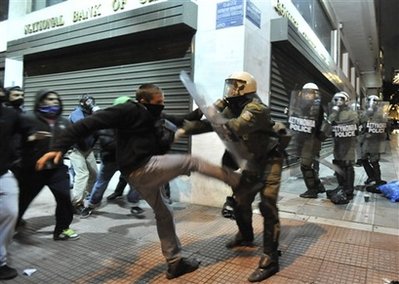
Greece’s parliament approved a deeply unpopular austerity bill Monday to secure a second EU/IMF bailout and avoid national bankruptcy, as buildings burned across central Athens and violence spread around the country.
Cinemas, cafes, shops and banks were set ablaze in central Athens and black-masked protesters fought riot police outside parliament before lawmakers voted on the package that demands deep pay, pension and job cuts — the price of a 130 billion euro ($172 billion) bailout needed to keep the country afloat.
State television reported the violence spread to the tourist islands of Corfu and Crete, the northern city of Thessaloniki and towns in central Greece. Police said 150 shops were looted in the capital and 34 buildings set ablaze.
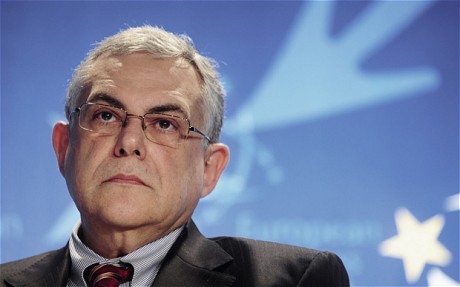
Altogether 199 of the 300 lawmakers backed the bill, but 43 deputies from the two parties in the government of Prime Minister Lucas Papademos, the socialists and conservatives, rebelled by voting against It. They were immediately expelled by their parties.
Asian shares and the euro gained modestly Monday, relieved by the Greek parliament’s passage of austerity measures that put the country a step closer to securing a much-needed bailout fund and avoiding a messy default.
MSCI’s broadest index of Asia Pacific shares outside Japan edged up as much as 0.3 percent on the news.
The rebellion and street violence foreshadowed the problems the Greek government faces in implementing the cuts, which include a 22 percent reduction in the minimum wage — a package critics say condemns the economy to an ever-deeper downward spiral.
Papademos, a technocrat brought in to get a grip on the crisis, denounced the worst breakdown of order since 2008, when violence gripped Greece for weeks after police shot a 15-year-old schoolboy.
“Vandalism, violence and destruction have no place in a democratic country and won’t be tolerated,” he told parliament as it prepared to vote.
“SHORT-TERM SACRIFICES”
But he admitted that imposing the austerity on a nation that has already endured several years of cuts would be tough.
“The full, timely and effective implementation of the program won’t be easy. We are fully aware that the economic program means short-term sacrifices for the Greek people,” Papademos said.
Greece needs the international funds before March 20 to meet debt repayments of 14.5 billion euros, or suffer a chaotic default which could shake the entire euro zone.
Outside parliament chaos reigned. A Reuters photographer saw buildings in Athens engulfed in flames and huge plumes of smoke rose in the night sky.
“We are facing destruction. Our country, our home, has become ripe for burning, the center of Athens is in flames. We cannot allow populism to burn our country down,” conservative lawmaker Costis Hatzidakis told parliament.
The air in Syntagma Square outside parliament was thick with teargas as riot police fought running battles with youths who smashed marble balustrades and hurled stones and petrol bombs.
Terrified Greeks and tourists fled the rock-strewn streets and the clouds of stinging gas, cramming into hotel lobbies for shelter as lines of riot police struggled to contain the mayhem.
State NET television reported that trouble had also broken out in Heraklion, capital of Crete, as well as the towns of Volos and Agrinio in central Greece.
On the streets of Athens many businesses were ablaze, including the neo-classical home to the Attikon cinema dating from 1870 and a building housing the Asty, an underground cinema used by the Gestapo as a torture chamber during World War Two.
NO GOOD CHOICES
The EU and IMF say they have had enough of broken promises and that the funds will be released only with the clear commitment of Greek political leaders that they will implement the reforms whoever wins an election potentially in April.
Euro zone paymaster Germany ratcheted up the pressure on Sunday. “The promises from Greece aren’t enough for us any more,” German Finance Minister Wolfgang Schaeuble said in an interview published in Welt am Sonntag newspaper.
“Greece needs to do its own homework to become competitive, whether that happens in conjunction with a new rescue program or by another route that we actually don’t want to take.”
When asked if that other route meant Greece quitting the euro zone, Schaeuble said: “That is all in the hands of the Greeks themselves. But even in the event (Greece leaves the euro zone), which almost no one assumes will happen, they will still remain part of Europe.”
The bill sets out 3.3 billion euros ($4.35 billion) of extra budget cuts for this year alone.
It also provides for a bond swap to ease Greece’s debt burden by cutting the real value of private-sector investors’ bond holdings by some 70 percent. Greece would have missed a February 17 deadline to offer a debt “haircut” to private bondholders if the vote had not been passed.
Many Greeks believe their living standards are collapsing already and the new measures will deepen their misery.
“Enough is enough!” said 89-year-old Manolis Glezos, one of Greece’s most famous leftists and a national hero. “They have no idea what an uprising by the Greek people means. And the Greek people, regardless of ideology, have risen.”
Glezos is a national hero for sneaking up the Acropolis at night in 1941 and tearing down a Nazi flag from under the noses of the German occupiers, raising the morale of Athens residents. – Reuters
(Reuters) – Greek leaders clinched a long-stalled deal on reforms and austerity measures needed to secure a bailout and avoid a messy default, government sources said, hours before the country’s financial backers were to meet in Brussels on Thursday.
Athens’ partners in the European Union and the International Monetary Fund have been exasperated by a lack of agreement on the sacrifices they demanded in return for a 130 billion euro ($172 billion) bailout, with time running out for Greece before a major March 20 bond redemption.
Finance Minister Evangelos Venizelos set off for Brussels without a complete deal after all-night talks with leaders of the three Greek coalition parties and chief EU and IMF inspectors left one sensitive issue – pension cuts – unresolved.
But following further negotiation on Thursday, two government sources said an overall agreement had been reached.
“A few minutes ago, I got a call from the Prime Minister of Greece saying that an agreement had been reached and has been endorsed by the major parties,” European Central Bank President Mario Draghi told a news conference in Frankfurt in the first official confirmation.
The euro and European stocks strengthened on news of the breakthrough, which raised prospects of averting a chaotic hard default by the euro zone’s most indebted country within weeks, that could send tremors around the global economy.
The risk premium investors charge for holding Italian and Spanish bonds rather than safe-haven German Bunds fell back.
Euro zone officials say the full package must be agreed with Greece and approved by the EU, IMF and European Central Bank by February 15 so legal paperwork can be completed in time to avoid a chaotic default that may threaten the global economic recovery.
“The financial survival of the country in the coming years depends on the new program … It is a time of responsibility for everyone,” Venizelos said.
Greece’s two major labor unions called a 48-hour strike for Friday and Saturday against the reforms that the party chiefs managed to agree on.
“The painful measures that create misery for the youth, the unemployed and pensioners do not leave us much room,” secretary general of the ADEDY union, Ilias Iliopoulos, told Reuters.
“We won’t accept them. There will be a social uprising.”
Venizelos should now be able to present to fellow euro zone finance ministers a fully-fledged new bailout plan, including a commitment for 3.3 billion euros in budget cuts this year, when they meet at 1700 GMT.
Before then, all eyes will be on what the ECB is willing to do to help Greece at its monthly policy meeting.
WRITTEN COMMITMENT SOUGHT
After the overnight talks, a senior government official said the party chiefs had agreed on how to make about 90 percent of the promised savings, leaving a relatively small hole in the calculations.
Asked how the differences over pension cuts had been resolved, another government official told Reuters: “”There will be cuts in other areas of public spending and we will see how we will minimize reductions in pensions.”
International lenders are demanding that the party leaders commit themselves in writing to implement the program of pay and pension cuts, structural and administrative reforms.
The leaders have been loath to accept the lenders’ tough conditions, which are certain to be unpopular with voters. They face parliamentary elections possibly as early as April.
“In these difficult hours we have to look after the ordinary people, the pensioners,” conservative New Democracy leader Antonis Samaras said after the political leaders’ meeting.
“I haven’t got the right to not negotiate hard and I don’t care what other people think about that. We have to make sure that people will suffer less.”
Newspaper editorials criticized the harshness of the austerity measures demanded by Greece’s lenders, but said there was no other option but to give in and agree.
“The memorandum seems, and in fact is, heavy and unbearable for the majority of the Greek people but unfortunately it is the only choice so that the country is not led over the cliff,” financial daily Imerisia said.
Greece has been falling deeper into recession since it was rescued by a first bailout deal in May 2010, and latest unemployment data showed the country’s jobless rate rose to a new record of 20.9 percent in November.
Industrial output fell 11.3 percent in December, in further proof of the deep economic malaise.
ALMOST THERE
Prospects for a bailout deal had brightened when the finance ministers’ chairman Jean-Claude Juncker called the Brussels meeting – which IMF managing director Christine Lagarde will attend – to examine the bailout plan.
On offer from the EU and IMF is a package involving the new rescue funds and a bond swap with private creditors to ease the nation’s large debt burden.
Athens is also urging the ECB to forego profits on its Greek bond holdings in what could raise 12 billion euros or more. The bank’s 23-member Governing Council met on Thursday but Draghi declined to say how the Greek bonds held by the ECB and national central banks would be handled.
For the bailout, Athens must accept conditions requiring big cuts in many Greeks’ living standards. The smallest member of the coalition, the far-right LAOS party, was particularly uncomfortable with the measures.
Panos Beglitis, spokesman for PASOK which is in the coalition along with LAOS and the conservative New Democracy party, said the leaders had agreed to cut the minimum wage by 22 percent as part of efforts to make the economy more competitive. Plans to scrap holiday bonuses paid to private sector workers had been dropped.
Two sources said the government would promise spending cuts and tax rises worth 13 billion euros from 2012 to 2015, almost double the seven billion originally pledged.
Other elements of the deal have been gradually slotting into place, including the bond swap with private creditors to ease Greece’s debt burden by reducing the value of government bonds held by banks and insurers.
Private bondholders are expected to take real losses of about 70 percent on their holdings as part of the swap, under which they receive new, longer-dated Greek bonds to try to reduce Greece’s debt burden by about 100 billion euros.
Talks on the swap have dragged on for weeks, complicated by the position of hedge funds and demands that public creditors also chip in. Officials and bankers say the deal cannot be finalized until the rest of the rescue package is nailed down.
($1 = 0.7545 euros)
(Additional reporting by Renee Maltezou, Lefteris Papadimas and Karolina Tagaris in Athens and Paul Carrel in Frankfurt; Writing by David Stamp and Deepa Babington; editing by Elizabeth Piper)
Mikhail Gorbachev said Thursday that Prime Minister Vladimir Putin has “exhausted” his potential as Russia’s leader and his inability to change the Kremlin’s political system might prompt more massive anti-government protests.
Putin – who became prime minister after serving as Russia’s president in 2000-2008 – is almost certain to become president again during the March election, despite recent opposition rallies that have been the largest protests Russia has seen since the Soviet collapse.
Gorbachev, a former Soviet leader, said of Putin: “He won’t carry that weight. By now he has exhausted himself. Looks like that.”
Gorbachev recently urged Putin to give up power and annul the results of December’s fraud-tainted parliamentary vote, which triggered the rallies. The thousands of protesters also have joined Kremlin critics in accusing Putin’s government of cracking down on dissent, limiting press freedoms and breeding widespread corruption in Russia.
“If he does not overcome himself, change the way things are – and I think it will be difficult for him to do that – then everything will end up on city squares,” Gorbachev said at a news conference.
“We can’t let it happen. We’ve already seen what happens on city squares,” Gorbachev said, referring to the Arab Spring rallies in northern Africa and the Mideast.
Gorbachev led the Soviet Union from 1985 until its collapse in 1991. He remains admired abroad, but he is regarded as insignificant at home and his comments are not likely to affect public opinion or threaten Putin’s grip on power.
Hackers from the group Anonymous said Wednesday they had accessed classified German files and posted them online, revealing details of the country’s military operations in Afghanistan.
Anonymous said it obtained the data from a server at the Bundestag or German parliament. The group has claimed responsibility for a series of leaks of confidential data worldwide in the past year.
The military documents were collected for an inquiry, now finished, into a September 2009 airstrike by US jets under German orders that killed more than 140 Taliban fighters and Afghan civilians.
Omid Nouripour, a Green Party legislator who was on the inquiry committee, told dpa the documents posted online were authentic. He said he had not seen anything in the online version that would put lives in danger.
The Bundestag administration said it was checking the leak. A spokeswoman said it was possible the documents had been merely appendices to the inquiry’s report.
The inquiry criticized the 2009 airstrike.
This website uses cookies to improve your experience. We'll assume you're ok with this, but you can opt-out if you wish. Cookie settingsACCEPT
Privacy & Cookies Policy
Privacy Overview
This website uses cookies to improve your experience while you navigate through the website. Out of these cookies, the cookies that are categorized as necessary are stored on your browser as they are essential for the working of basic functionalities of the website. We also use third-party cookies that help us analyze and understand how you use this website. These cookies will be stored in your browser only with your consent. You also have the option to opt-out of these cookies. But opting out of some of these cookies may have an effect on your browsing experience.
Necessary cookies are absolutely essential for the website to function properly. This category only includes cookies that ensures basic functionalities and security features of the website. These cookies do not store any personal information.
Any cookies that may not be particularly necessary for the website to function and is used specifically to collect user personal data via analytics, ads, other embedded contents are termed as non-necessary cookies. It is mandatory to procure user consent prior to running these cookies on your website.