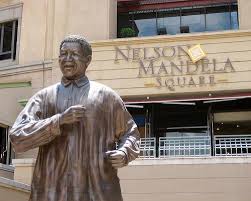
Three protestors chained themselves to Mandela’s statue at Nelson Mandela Square on Tuesday to voice their concerns about the presidential election in Zimbabwe.
Zimbabweans went to the polls on Wednesday. According to Reuters, the Zimbabwean exiles argued that despite the imminent election, their country was not free.
The three wrapped a thick silver chain around their necks at the base of the 2.7 metre tall statue. The spectacle ended quickly after security staff requested them to leave.
The protest happened in the affluent Sandton Square shopping centre, the site of the towering bronze statue of Mandela.
The three Zimbabwean nationals brandished placards with the message: “Zimbabwe deserves to be free.”
The protest did not last long after security guards told them and some supporters and passersby to leave.
But the message soon spread on Facebook and Twitter, with other Zimbabwean exiles echoing the sentiment that the country is still not free from the control of Robert Mugabe and Zanu-PF.
Respected human rights advocate and the head of the Zimbabwe Exiles Forum, Gabriel Shumba, told SW Radio Africa that voting day is a bittersweet one for Zimbabweans in the Diaspora. He said that while there is “so much hope for change,” there is still skepticism.
Thousands of Zimbabweans in the Diaspora have returned home to vote, after the right to vote in their resident countries was denied by the government. This is in spite of a successful court application that Shumba filed at the African Commission on Human and People’s Rights, which ordered the Zim government to allow the postal vote for Zimbabweans in the Diaspora.
“What we were told when the government defied this order is that we should try go back and vote anyway. Unfortunately not everyone can do this, and even when they do, it seems the practice on the ground is to deny this,” Shumba said.
He was referring to the fact that at least seven buses believed to be filled with Zimbabweans travelling from South Africa to cast their votes, were stopped at Beitbridge in the early hours of Wednesday morning. One of the buses was impounded and the others were prevented from travelling onto their final destinations. It is understood that the Zimbabwe Lawyers for Human Rights were trying to intervene on Wednesday morning.
“So there is a mood of skepticism that this vote will bring change. We don’t think this election will be credible, legitimate, free and fair,” Shumba said.
Riot police were reportedly deployed in Zimbabwe on the eve of the election. An election in 2008 was marred by political violence. – SW Radio
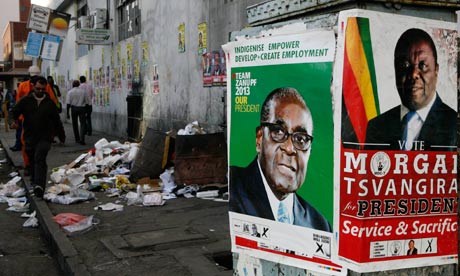
Whatever the result of Zimbabwe’s election Wednesday one thing is for sure: four years of uneasy power-sharing between President Robert Mugabe and Prime Minister Morgan Tsvangirai will end.
As Zimbabweans streamed to the polls, the unity government partners sighed with relief at the close of their “painful”, “disappointing” union.
The forced marriage was arranged by the international community to avoid further violence in the wake of suspect and blood-soaked 2008 elections.
Tsvangirai won the first round, but was forced to drop out of the second round amid the killing of 200 of his supporters.
He then became prime minister as a reluctant partner in the unity government alongside Mugabe, the former guerrilla who has ruled since independence from Britain.
While the power-sharing deal which took effect in 2009 prevented full-scale conflict, critics today deplore its failure to achieve much-needed democratic reforms and kickstart the economy.
“It has been a major disappointment,” Rugare Gumbo, spokesman for Mugabe’s ZANU-PF party, told AFP.
But communications minister Nelson Chamisa, spokesman for Tzvangirai’s Movement for Democratic Change (MDC), said the government had achieved some victories.
“It has been difficult, difficult, painful but useful for the people of Zimbabwe. People’s lives have improved,” he said. “We are excited that we are coming out of the blast furnace.”
The arrangement was aimed at creating a “genuine, viable, permanent, sustainable” solution to the crisis.
But in its early days, Mugabe could not hide his discomfort.
“I feel awkward in a thing like that, absolutely awkward,” he told mediator President Jacob Zuma of South Africa at the time.
Ex-finance minister Simba Makoni, who was not part of the unity deal, branded the Mugabe-Tsvangirai government “pathetic” and “dismal”.
And analysts said the deal had failed to set a democratic framework for fresh elections.
Days before Wednesday vote, the country was “still grappling with issues of reforms, the timing of elections, issues of sporadic violence and intimidation,” said Trevor Maisiri, a researcher with the International Crisis Group.
“It has not fully served its primary purpose because the idea was to create a transitional mechanism that would lead to a credible election,” he said.
Initially the unity government was to last just two years but it had to be extended as delays plagued the formulation of a new constitution that would lay the basis for credible polls this time around.
The MDC “regrets, definitely that quite a number of reforms did not move as we had wanted,” said Chamisa, highlighting a lack of revisions of the media and security sector.
Civic rights coalition Sokwanele, which kept an eye on the government’s performance, traced 22,482 violations of the agreement — 90 percent by ZANU-PF.
The rivals still strongly disagree on the economy, and bitterly blame each other for Zimbabwe’s slow recovery.
Unemployment still hovers on the wrong side of 50 percent while millions of people are still economic refugees in neighbouring countries.
Once a net food exporter known as Africa’s breadbasket, Zimbabwe’s reformed agricultural sector is yet to produce enough to feed the country.
“There were many programmes that we were going to carry out, but our colleagues acted like they were an opposition party instead of carrying themselves as part of the government,” the ZANU-PF’s Gumbo claimed.
The MDC said it opposed “ill-conceived” black economic empowerment schemes that forced foreign companies to cede a majority of their shares, saying it drove away investors.
But some say the power-sharing agreement was not all bad.
The government rescued the moribund economy by abandoning the Zimbabwean dollar, ending rampant inflation that peaked at 231 million percent.
Politicians who previously had not seen eye-to-eye suddenly were forced to run the country together, which may explain the peaceful run-up to Wednesday’s polls.
Just being able to talk to each other in parliament or in cabinet “has really been helpful,” said Gumbo.
The coalition “brought about some sanity, peace and stability. We are not fighting as we used to. Even campaigning is being done in a peaceful, orderly manner,” he said.
Chamisa also said the unity government was a healthy exercise.
“The past four years showed that another Zimbabwe is possible. A Zimbabwe where we can realise, appreciate and celebrate the cross-pollination of ideas,” he said.
Zimbabwe’s political rivals have clashed over an apparently secret document said to be from intelligence sources that alleges an outlandish plot by President Robert Mugabe to hire a Lebanese murder squad to assassinate his South African counterpart, Jacob Zuma, and a top diplomat.
The typed two-page report – persuasively detailed but at times written in excitable language strewn with grammatical and spelling errors – has been dismissed by Mugabe’s Zanu-PF party as “hogwash” and a “typical setup”. The rival Movement for Democratic Change said the assassination threats should be taken seriously.
Roy Bennett, the MDC treasurer-general, in exile, was more certain. “We know the report to be credible; it comes from reliable and trustworthy sources within the heart of the CIO [Central Intelligence Organisation],” he said. “It is a stark reminder of the full horrific extent that Robert Mugabe is prepared to go in order to hang on to power and avenge his critics.”
The MDC and civil society groups in Zimbabwe have applauded Zuma for taking a tougher stand against Mugabe than the previous South African president, Thabo Mbeki.
They come amid souring relations between neighbours Zimbabwe and South Africa. Last week Mugabe branded Zuma’s chief mediator, Lindiwe Zulu, “some stupid, idiotic woman” and a “little street woman” after her failed attempt to force a postponement of elections.
The purportedly leaked document, dated 2 July and of unknown authorship, contains a paragraph headed: “Lebonese assasins” (sic). It states: “On Monday this week Mugabe hired six Lebanese nationals to try and assassinate Lindiwe Zulu, who is Zuma’s advisor. The six met clandestinely with Mugabe yesterday to be briefed by him on the details of their mission … The six were told they must not concentrate on Zulu only, but should also pay attention to Zuma himself, and if they get a chance to do so they must assassinate him as well – but everything must appear as an accident.”
It adds: “Mugabe promised the six Lebonese [sic] an undisclosed fortune in cash if they succeed in getting rid of the two who [sic] South Africa senior officials who are giving him a lot of trouble. Names of the six could not be established, but they entered into the country via Zambia in the last few days, where they had previously held a close meeting with [president] Michael Sata before travelling into Zimbabwe.”
The document also claims that Mugabe summoned and castigated security officers over a leak to the MDC leader, Morgan Tsvangirai, regarding the involvement of an Israeli company in managing the country’s electoral role. Mugabe ordered that “the culprits who leaked the information are made to suffer and die a painful death”, it says. Tsvangirai has spoken publicly about his concern over the role of the Israeli company Nikuv.
The secretive Israel-based firm – accused of manipulating past elections in the region – is alleged to be involved in managing Zimbabwe’s voters’ roll.
Eddie Cross, a MDC MP told the Mail & Guardian that he had been informed by security sources that the company, Nikuv International Projects, is working on the roll at Defence House, the headquarters of the Zimbabwe Defence Force. The MDC also alleged that Nikuv was a front for the Israeli intelligence agency Mossad, although it offered no evidence to support the claim.
Cross said the source told him that the company is working under the direction of Daniel Tonde Nhepera, the deputy head of the Zimbabwe’s dreaded internal security arm, the Central Intelligence Organisation (CIO).
Another Zimbabwean intelligence source confirmed to the M&G the allegation that Nikuv is working on the voters’ roll “with the CIO”.
The Guardian has seen a copy of the two-page document but has not been able to verify it as being genuine. The possibility that it is a hoax designed to embarrass the opposition cannot be ruled out.
Rugare Gumbo, spokesman for Zanu-PF, insisted: “To be frank with you, it’s all rubbish and hogwash to think a head of state like president Mugabe would set up something like that. We have a disagreement with Lindiwe Zulu but it would not go to that extent.”
Asked about the alleged threat to Zuma, he replied: “You should not take it seriously. It’s a typical setup in Zimbabwe to try and cause some confusion before the election because we are going ahead with our election according to our laws whether they like it or not.”
But this is not the first time allegations have surfaced of Zimbabwean government agents carrying out clandestine operations in South Africa. Nor are rumours of assassinations so unusual: South Africa’s Mail & Guardian newspaper recently compiled a list of nine Zimbabwean politicians who have died in mysterious car crashes, including the one last month involving Edward Chindori-Chininga, the outspoken chairperson of a parliamentary committee that had just released a highly critical report on the diamond industry.
Fierce factional infighting within Zanu-PF and the security sector has resulted in a number of damaging intelligence leaks, notably on the Facebook page of a mole known as Baba Jukwa.
Douglas Mwonzora, the MDC’s spokesperson, said of the document: “We have had sight of the intelligence information but we are unable to confirm its authenticity. For the MDC, the international community must take these assassination allegations seriously.” – The Guardian
– See more at: http://praag.org/?p=7173#sthash.Q4ousLtS.dpuf
Zimbabwe’s finance ministry said it needs to resolve a shortfall of about $85 million needed for crucial national elections just three weeks away, as a month-long chaotic voter registration effort drew to a close Tuesday.
Tendai Biti, the outspoken finance minister, described preparations for the July 31 polls as “a nightmare.”
“We don’t have money for these elections, and everyone knows it. It’s a horror movie except that you are not watching the movie, you are part of it,” Biti said late Monday.
The elections are the first to be held since the violent 2008 polls forced President Robert Mugabe to join into a coalition government with longtime opposition leader Morgan Tsvangirai, a bitter political nemesis. Mugabe has ruled Zimbabwe since independence in 1980.
On Tuesday, Mugabe’s office said it was cancelling cabinet meetings until the vote so that ministers can campaign for the election.
Tsvangirai, 61, began intense campaigning in the remote northeast Tuesday. Mugabe, 89, has not announced his own campaign schedule but his Vice President Joice Mujuru, 58, has begun a series of rallies for their ZANU-PF party.
Mugabe’s opponents maintained he had acted alone without consulting coalition leaders in a ploy to favor his party. Mugabe said he was following the instructions of a Constitutional Court ruling earlier this month.
Tsvangirai had argued that the July 31 date did not allow enough time for the needed democratic reforms to take place, and that the rushed election did not provide the conditions necessary for a free and fair vote. He later said he was accepting the date with sadness and reluctance but was confident of a victory over Mugabe.
National elections in Zimbabwe are routinely held over two days with ballots cast at up to 9,000 polling stations across the country, slightly larger than Germany. The commission says tens of thousands of voters who have since died have been removed from the lists.
The U.S.-based Robert F. Kennedy Center for Justice and Human Rights said in its latest report on Zimbabwe the close approach of the vote has ramped up political tensions in the country. It said opponents of Mugabe are facing “an atmosphere of intimidation,” curbs on free expression and political activities and the suppression of easily accessible voter registration and voter education.
“This behavior is unacceptable and represents clear breaches of domestic and international law,” said Santiago Canton, head of the center’s rights group.
Leaders of the 15-nation regional bloc known as the Southern African Development Community, or SADC, had also called on Mugabe and the judiciary he controls to delay the crucial elections.
Mugabe, launching his party’s manifesto on Friday, had also threatened to withdraw from SADC, the regional bloc he helped found, saying its chief mediator on Zimbabwe, South African President Jacob Zuma, and his colleagues had pushed for delaying the polls.
Biti, the finance minister, said he has had to “freeze” payments to government departments and only meet public service salaries to try to find the money for this month’s vote.
“The whole thing is an absolute, undiluted dog’s breakfast,” Biti said. – AP
The Egyptian military’s overthrow of elected President Mohamed Morsi left United States President Barack Obama grappling with a difficult question of diplomacy and language in dealing with the Arab world’s most populous nation: was it a coup?
At stake as Obama and his aides wrestle with that question in the coming days is the $1.5-billion in aid the US sends to Cairo each year – almost all of it for the military – as well as the president’s views on how best to promote Arab democracy.
If the United States formally declares Morsi’s ousting a coup, US law mandates that most aid for its longtime ally must stop. And that could weaken the Egyptian military, one of the country’s most stable institutions with long-standing ties to US authorities.
Further complicating Obama’s calculus is the fact that millions of Egyptians rallied in favour of Morsi’s departure, and that the military announced a road map for return to civilian rule that was blessed by Egypt’s Muslim and Christian religious leaders.
But Morsi and his Muslim Brotherhood retain backing from a broad swath of Egyptian society, even as he alienated many of his countrymen.
Obama, after meeting top advisors at the White House, said in a statement that he was “deeply concerned” by the army’s actions and had directed the relevant US agencies to review the implications for US assistance to Egypt.
But he did not use the word “coup” and stopped well short of advocating for Morsi’s reinstatement, suggesting Washington might be willing to accept the military’s move as a way to end a political crisis in a nation of 83 million people struggling with severe economic difficulties.
Recent history suggests Obama might take his time on deciding the future of US aid to Egypt, and by extension, Washington’s relations with the country.
US law bars “any assistance to the government of any country whose duly elected head of government is deposed by military coup d’etat or decree”.
When Honduran President Manuel Zelaya was ousted in June 2009, Washington temporarily suspended aid, but did not cut about $30-million in assistance until more than two months later.
Even then, Secretary of State Hillary Clinton did not determine as a matter of law that a coup had taken place.
Eric Trager, an expert on Egyptian politics at the Washington Institute for Near East Policy, said Obama should not label Morsi’s ouster a coup, nor cut off US aid.
“The Obama administration should recognise that as undemocratic as a coup is, it was the result of the basic fact that President Morsi had completely lost control of the Egyptian state,” Trager said by telephone from Egypt.
“Democracy was not the primary thing at stake in Egypt these last few months,” but rather Morsi’s mismanagement and fears of collapse of the Egyptian state, he said.
In announcing Morsi had been deposed and the Egyptian constitution suspended, Egypt’s army commander promised a quick political transition. The military laid out plans for elections and a constitutional review.
The US chairman of the joint chiefs of staff, General Martin Dempsey, warned Egyptian military leaders of consequences if Morsi’s overthrow were viewed as a coup.
“At the end of the day it’s their country and they will find their way, but there will be consequences if it is badly handled,” Dempsey told CNN.
Obama also warned against further violence, indicating that Washington’s ultimate decision on aid to Egypt will depend on how Egypt’s armed forces handle the transition in coming weeks.
Morsi, in power for a year, was widely blamed for presiding over a steady decline in Egypt’s economy and for failing to form a broad-based government that included other groups that had joined in the 2011 revolution that overthrew President Hosni Mubarak.
US lawmakers also welcomed Morsi’s departure but called for a quick transition back to democratic rule – with a close look at the aid budget.
Democratic Senator Patrick Leahy, who heads the Senate subcommittee that oversees foreign aid, on Wednesday promised a review of the $1.3-billion in military aid and $250-million in economic aid sent to Cairo each year.
Washington has cut off aid following military coups several times before. In April 2012, the United States suspended at least $13-million of its $140-million in annual aid to Mali following a coup in the West African nation.
Programmes that did not go directly through government ministries were not affected.
Any Obama support for Egypt’s new government is unlikely to face opposition from Republicans in Congress, who had been sceptical of Morsi’s Islamist government.
“Morsi was an obstacle to the constitutional democracy most Egyptians wanted,” said Republican Representative Ed Royce, the chairman of the House of Representatives Foreign Affairs Committee.
Republicans also voiced strong support for Egypt’s military, whose close ties to Washington stretch back to the 1979 Israeli-Egypt peace accords.
“The Egyptian military has long been a key partner of the United States and a stabilising force in the region, and is perhaps the only trusted national institution in Egypt today,” said US Representative Eric Cantor, the No. 2 Republican in the House.
“Democracy is about more than elections,” he said. – Reuters
The clock is ticking for Mali as it scrambles to organise key elections in less than 40 days following a ceasefire deal between the government and separatist Tuareg rebels.
The agreement, reached on Tuesday after 10 days of tense negotiations, will enable Malian troops to enter the Tuareg-held city of Kidal in the northeast to secure polls scheduled to take place on July 28.
Malians have welcomed the truce but there are fears the deal will be difficult to implement and could unravel after the vote.
Malian military sources say the accord envisages the army entering the regional capital “without delay”, accompanied by French soldiers and troops from the African-led International Support Mission to Mali (AFISMA).
French President Francois Hollande told a meeting of his cabinet the agreement was “a major breakthrough”, his spokesman said.
The US also welcomed the deal.
“The agreement clears the way for the return of Malian administrative and security authorities to Kidal to permit the holding of presidential elections there on July 28,” State Department spokeswoman Jen Psaki said.
And the UN Security Council urged other armed groups who had cut ties with “terrorist organisations” in Mali to join the ceasefire.
But analysts raised a number of problems with securing a long-term ceasefire, such as difficulties monitoring any disarmament; and differentiating Tuareg militants from the diverse range of insurgents infesting Mali’s north.
“Ultimately, this is an interim agreement to allow the organisation of the presidential elections in Kidal, ” Malian analyst Mamadou Samake told AFP.
“It has not solved all the problems, it just put off some of the problems.”
The Malian government signed the accord with the National Movement for the Liberation of Azawad (MNLA) and a smaller Tuareg group in Ouagadougou, capital of neighbouring Burkina Faso.
The two sides agreed to halt hostilities and organise peace talks after the election, but the Tuaregs were not pressed to lay down their weapons.
“It was that or nothing, but we were heading for disaster if we hadn’t been able to get an agreement on presidential elections in the Kidal region,” said an aide to President Dioncounda Traore.
The Tuareg occupation of Kidal has been a major obstacle to holding the election, seen as crucial to Mali’s recovery from the conflict of the past 15 months.
Malian officers staged a coup in March 2012 but the weak army was overpowered by the MNLA, which seized key northern cities before being sidelined by its Al-Qaeda-linked allies.
The MNLA sided with a French-led military intervention, which reclaimed most of the lost territory from the Islamists. But the rebels have been reluctant to allow government troops into their Kidal bastion for the vote.
For analyst Samake, settling the major issues relating to Mali’s Tuareg separatist movement will have to wait.
“After the presidential elections, the legislative elections loom on the horizon. Former Tuareg rebels will certainly want to stand,” he said.
“But for now, they cannot because of an arrest warrant against them… That could create problems.”
Those warrants will likely be dropped, but the accord does state that international investigators will look into crimes against humanity and war crimes committed during the conflict.
Confronted with these problems, an official from the Ministry of Territorial Administration would only say: “Let’s take each day as it comes.”
The logistics of the disarmament is another obstacle to be cleared for all parties working for lasting peace in the Kidal region.
But the larger problem, say military sources, is that Islamist insurgents continue to hide out in northern Mali. They could launch attacks which might be wrongly attributed to former Tuareg rebels.
“We are the military — we don’t do politics,” a battalion commander from a neighbouring country’s army told AFP in the northern city of Gao.
“But just so there is no ambiguity, there will have to be some kind of mechanism in Kidal to prevent any infiltration of terrorists, otherwise it could complicate things.” – AFP
Zimbabwean President Robert Mugabe has filed an urgent application with the country’s top court to push back crucial elections by two weeks, his justice minister said Wednesday.
Justice Minister Patrick Chinamasa told AFP he had filed papers “yesterday (Tuesday)” that sought “a postponement of the date for the harmonised elections from July 31 2013 to August 14, 2013.” – Sapa
Republican presidential candidate Mitt Romney says he would honor temporary work permits for young illegal immigrants who were allowed to stay in the U.S. because of a decision by President Barack Obama.
Romney told The Denver Post, in an interview appearing in Tuesday’s edition, that people who are able to earn the two-year visas to stay and work wouldn’t see them revoked under a Romney administration.
“The people who have received the special visa that the president has put in place, which is a two-year visa, should expect that the visa would continue to be valid. I’m not going to take something that they’ve purchased,” Romney told the Post, promising to put a comprehensive immigration reform plan into place before those visas expire.
In June, Obama issued a new policy that allows some young illegal immigrants who were brought to the U.S. as children to avoid deportation. Romney criticized Obama for circumventing Congress to make the change a few months before the presidential election.
During the Republican presidential primary, Romney said he would veto legislation to provide a path to citizenship for some of the young people who benefited from Obama’s new policy.
The Denver Post interview comes as Romney and Obama are fighting a heated battle for Colorado, whose significant Hispanic population could determine which candidate receives the state’s nine electoral votes.
Zimbabwe’s main opposition the Movement for Democratic Change (MDC) on Thursday said President Robert Mugabe’s planned timetable for a constitutional referendum and elections was not realistic.
In a High Court filing seen on Thursday, Mugabe proposed a referendum for the first week of November and presidential and legislative polls for March next year.
“The dates being proposed are clearly not feasible,” MDC spokesman Douglas Mwonzora told AFP.
“The date for the election, especially, is unilateral, unrealistic and has no scientific or legal basis.”
Mugabe’s ruling ZANU-PF party has objected to many aspects of the long-delayed draft constitution that was only finished in July and would rein in presidential powers.
Mwonzora added his party was more concerned about conditions under which the vote takes place rather than the date. “For us to meet those dates, ZANU-PF has to change drastically.”
“We want elections to be held in conditions which allow the secrecy of the vote and the security of both the vote and the voter,” said Mwonzora.
Opposition MDC party members were on the receiving end of the violence that characterised the 2008 elections. – AFP
PRAAG has congratulated the Parti Québecois on its excellent electoral score during provincial elections in Canada. Reacting on Twitter, the leader of PRAAG, Dr. Dan Roodt, said: “I support Québecois separatism, could bolster case for an Afrikaner volkstaat. Félicitations au Parti Québecois!”
The Afrikaner action group has often emphasised the similarities between national minorities surrounded by larger nations or groups such as the Québecois, the Flemish, the Catalans and the Afrikaners.
Roodt said: “We look upon the victory of Madame Pauline Marois as not only good for Québecois but for the cause of self-determination world-wide. Afrikaners, like Québecois, live surrounded by hundreds of millions of British Commonwealth subjects who impose English upon us and limit our economic and cultural freedom through racist and chauvinist legislation. That is not to say that we wish to compare South Africa’s totalitarian stance on multilingualism with the more enlightened Canadian version, but a small nation and a small culture can only be free in an own state.”
Dr. Roodt also called upon the Afrikaner separatist party, the Freedom Front Plus, “to learn from the successes of the Parti Québecois and its decisive defeat of liberalism, so as to hasten the Afrikaner’s liberation from the chains of the English Commonwealth state of 1910. We can also defeat liberalism and Anglicism like the Parti Québecois has done.”
Both Québecois and Afrikaners have a long history of language struggle and of being the objects of Anglo-Saxon scorn. Roodt also called for “greater cooperation between Québecois, Afrikaners, Flemish and Catalans who share similar experiences with majoritarian cultural oppression”. He was particularly touched by one Twitter message from Québec, stating in capital letters, “ON VEUT UN PAYS!”, we want a country!
“Good heavens, we want a country too! On veut un pays,” he concluded.
The Pro-Afrikaans Action Group (PRAAG) is an NGO in South Africa. Founded in February 2000, PRAAG is a movement of Afrikaner intellectuals, professionals, farmers, students and others campaigning for the rights of Afrikaners and white Africans generally and for equality with blacks as regards property ownership, language, access to education, the right to trade, and so on.
This website uses cookies to improve your experience. We'll assume you're ok with this, but you can opt-out if you wish. Cookie settingsACCEPT
Privacy & Cookies Policy
Privacy Overview
This website uses cookies to improve your experience while you navigate through the website. Out of these cookies, the cookies that are categorized as necessary are stored on your browser as they are essential for the working of basic functionalities of the website. We also use third-party cookies that help us analyze and understand how you use this website. These cookies will be stored in your browser only with your consent. You also have the option to opt-out of these cookies. But opting out of some of these cookies may have an effect on your browsing experience.
Necessary cookies are absolutely essential for the website to function properly. This category only includes cookies that ensures basic functionalities and security features of the website. These cookies do not store any personal information.
Any cookies that may not be particularly necessary for the website to function and is used specifically to collect user personal data via analytics, ads, other embedded contents are termed as non-necessary cookies. It is mandatory to procure user consent prior to running these cookies on your website.

 Three protestors chained themselves to Mandela’s statue at Nelson Mandela Square on Tuesday to voice their concerns about the presidential election in Zimbabwe.