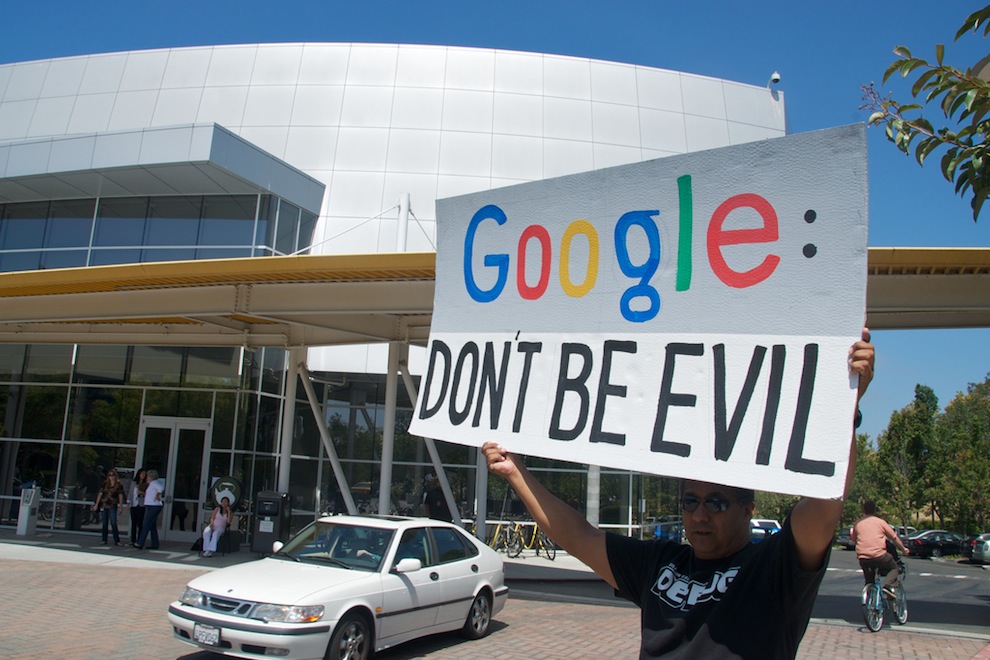
Have hackers made passwords obsolete?

Heather Adkins
Google manager of information security Heather Adkins

New startups looking for ways to keep their users secure should know one thing, a top Google security executive said Tuesday: “Passwords are dead.”

Speaking on a TechCrunch Disrupt panel called “Spies Like Us,” Heather Adkins, Google’s manager of information security, told moderator Greg Ferenstein that in the future, the “game is over for” any startup that relies on passwords as its chief method to secure users and their data.

Adkins, speaking alongside Kleiner Perkins Caufield & Byers managing partner Ted Schlein and author James Bamford, said that looking ahead, “our relationship with passwords are done,” and that “passwords are done at Google.”

She talked briefly about Google’s use of two-step authentication and the fact that the search giant has been working to innovate in the area of non-standard password security. As a result, she said, any startup that still relies on standard passwords needs to ensure that it has an abuse team set up to deal “with customers getting compromised.”

Although Adkins didn’t offer any real specifics on how Google will innovate beyond today’s security, she did say the company is experimenting with hardware-based tokens as well as a Motorola-created system that authenticates users by having them touch a device to something embedded, or held, in their own clothing. “A hacker can’t steal that from you,” she said.

Later in the conversation, which also touched on the NSA scandal, cybersecurity, and the weaponization of offensive cyber technologies, Adkins pointed out that hackers intent on making money from their bad acts had consistently found ways to exploit Google users who had yet to turn on two-factor authentication. Essentially, she explained, hackers were able to get into such users’ accounts, turn on two-factor authentication themselves, and lock the users out before utilizing those accounts to send spam. “They are finding new ways to make money off it,” she said. “Ways we hadn’t anticipated.”

Finally, Adkins argued, technology companies need to step up and build products that protect users so “they don’t rely on not getting fooled.” Ultimately, she said, anyone starting a new technology company should be sure that one person is designated to focus on security and privacy, and that one of the first 25 employees should work full time on security and privacy. – cnet.com

In The Plex: How Google Thinks, Works, and Shapes Our Lives by Steven Levy

Larry Page and Sergey Brin

Few companies in history have ever been as successful and as admired as Google, the company that has transformed the Internet and become an indispensable part of our lives. How has Google done it? Veteran technology reporter Steven Levy was granted unprecedented access to the company, and in this revelatory book he takes readers inside Google headquarters—the Googleplex—to show how Google works. Want to work at Google? Here’s how.

intheplexWhile they were still students at Stanford, Google cofounders Larry Page and Sergey Brin revolutionized Internet search. They followed this brilliant innovation with another, as two of Google’s earliest employees found a way to do what no one else had: make billions of dollars from Internet advertising. With this cash cow (until Google’s IPO nobody other than Google management had any idea how lucrative the company’s ad business was), Google was able to expand dramatically and take on other transformative projects: more efficient data centers, open-source cell phones, free Internet video (YouTube), cloud computing, digitizing books, and much more.

The key to Google’s success in all these businesses, Levy reveals, is its engineering mind-set and adoption of such Internet values as speed, openness, experimentation, and risk taking. After its unapologetically elitist approach to hiring, Google pampers its engineers—free food and dry cleaning, on-site doctors and masseuses—and gives them all the resources they need to succeed. Even today, with a workforce of more than 23,000, Larry Page signs off on every hire.

But has Google lost its innovative edge? It stumbled badly in China—Levy discloses what went wrong and how Brin disagreed with his peers on the China strategy—and now with its newest initiative, social networking, Google is chasing a successful competitor for the first time. Some employees are leaving the company for smaller, nimbler start-ups. Can the company that famously decided not to be evil still compete?

No other book has ever turned Google inside out as Levy does with In the Plex.

About the Author

Author Steven Levy
Author Steven Levy

Steven Levy is a senior writer at Wired, and was formerly senior editor and chief technology correspondent for Newsweek. He is the author of six previous books, including Hackers: Heroes of the Computer Revolution, which was voted the best sci-tech nonfiction book of the last twenty years by readers of PC magazine, and Insanely Great, the definitive account of the Macintosh computer. A native of Philadelphia, Levy lives in New York City with his wife, Pulitzer Prize-winning journalist and author Teresa Carpenter, and their son.

Google boss is a love rat

Planning to implant microchips into the brain

He is the billionaire Google boss under fire for not doing enough to protect children from internet porn.

Yet The Mail on Sunday revealed that 58-year-old Eric Schmidt, Google’s executive chairman, does fiercely protect one thing: his own private life, which is as colorful and complex as the ever-changing ‘Google doodle,’ which pops up each time the search engine is launched.

He is all for freedom when it comes to dodging corporate tax.

But there’s one place the freewheeling views of the billionaire Google boss fizzle out – his bedroom door.

Sexy Schmidt?
Sexy Schmidt?

Schmidt has had a string of affairs with younger women, including TV presenter Kate Bohner, PR executive Marcy Simon and Vietnamese concert pianist Chau- Giang Nguyen.

But the unlikely sex symbol with thinning hair and pockmarked skin who is worth $5.4 billion made at least one mistress sign a confidentiality deal.

Bohner, 46, had a three-year affair from 2007 with the married mogul, dubbing him Dr Strangelove. “As far as Kate was concerned it was true love,” a friend said. “The reason I am speaking out now is it is ironic that someone like him can be so free and easy discussing other people’s privacy issues online while using his vast wealth to protect his own image.”

Schmidt’s wife Wendy, 57, has reportedly accepted their open marriage. – The Standard

Mandela not a Google doodle… yet

Rembrandt
Rembrandt

A day seldom goes by without a visit to Google for millions of people.

And what a treat when the Google logo on the home page is altered to celebrate anything from ice-cream sundaes to Rembrandt van Rijn’s 407th birthday.

The modified logos are referred to as Google doodles.

The UN General Assembly in 2009 designated July 18 as Nelson Mandela International Day.

As the world celebrated South Africa’s most famous statesman’s birthday last week, the day, surprisingly, was not marked by the creation of a doodle.

The latest South African doodle was designed for Freedom Day this year and Miriam Makeba’s 81st birthday was celebrated in March.

Madiba might not have had a doodle but last year Google contributed R8.6-million to the Nelson Mandela Centre for Memory to digitise “thousands of archival documents, photographs and videos” dealing with Mandela.

According to Google, there is a team of illustrators and engineers that designs its doodles.

International demand has led to an increase in the amount of artwork generated- 1000 have been created for Google’s home page.

Not every occasion is doodled. A lot depends on demand: a group of Googlers might come together to suggest a doodle or the idea can come from the general public. – timeslive.co.za

France gives Google 3 months to adhere to French cyber privacy laws

google-evilFrance on Thursday threatened Google with a fine of up to 150,000 euros ($198,000) if it does not bring its privacy procedures into line with French law on data protection within three months.

In a move that France hopes will be followed by other European states, the national data protection agency Cnil said the US Internet giant had failed to provide it with sufficient assurances about the storing and use of data it obtains from users.

“The information received in respect to this have so far been too imprecise or vague,” Cnil President Isabelle Falque-Pierrotin told AFP.

She said that Google must set a clear limit on the length of time it can store the data obtained from web surfers and seek prior approval from them before installing cookies on their devices.

France’s move follows Google’s introduction last year of a new privacy policy which enables it to track users activity across its search engine, gmail, the Google+ social networking platform and other services it owns, which include YouTube.

The changes make it easier for Google to collect and process data that could be used by advertisers to target individuals with offers tailored to their specific interest, thereby increasing the company’s revenue potential.

The changes have been widely criticised because of the implications for privacy but the pressure on Google to change how it operates has been limited to date.

The 27-member European Union warned Google in October 2012 that its data protection procedures did not comply with an EU directive on the subject and gave the company four months to change them.

That deadline passed without any action, prompting France to set up a task force of individual member states interested in pursuing the issue that involved Britain, Germany, Italy, the Netherlands and Spain.

Cnil President Falque-Pierrotin noted that while the maximum fine Google could face under French law was relatively small, Spain has the capacity of impose a penalty of up to one million euros ($1.3m).

Google has defended the changes it made last year on the ground that they simplify and standardise its approach across its various services.

But critics argue that the policy, which offers no ability to opt out aside from refraining from signing into Google services, gives the operator of the world’s largest search engine unprecedented ability to monitor its users.

Google has repeatedly stated that its privacy policy respects European law. – AFP

Tech giants deny knowledge of PRISM spy operation

techgiantsAs the dust settles on the revelation that the U.S. government has been mining data from most of Silicon Valley’s largest companies in a program called “PRISM,” one question stands out: How did the NSA get access?

Apple, Google, Yahoo! and Microsoft, the largest companies involved in PRISM, the existence of which was revealed last night in a simultaneous Washington Post and Guardian scoop, have categorically denied knowledge of or participation in the program in a series of statements, while acknowledging that they do provide targeted access to the government when required to do so by law, generally according to court orders.

“We have never heard of PRISM,” says Apple’s spokesman. “If the government has a broader voluntary national security program to gather customer data we don’t participate in it,” says Microsoft’s. “We do not provide the government with direct access to our servers, systems, or network,” says Yahoo!’s. “Google does not have a ‘back door’ for the government to access private user data,” says Google’s.

Even unofficially, the tech companies seemed baffled by the allegations. The Guardian spoke with tech executives off the record, all of whom were “confused” by the documents published in the paper. None had ever heard of PRISM.

So what gives? Does the government have backdoor access so secret that not even their targets are aware? Are the tech companies lying? Or are they forbidden—as Verizon allegedly is with its NSA arrangement—from acknowledging its existence to an absurd extent? – gawker.com

Apple clashes with Amazon in e-book case

Apple attorneys in the US antitrust case on e-books went on the offensive Thursday, attacking the credibility of government witnesses and seeking to debunk key elements of the government’s case.

Apple attorneys grilled a trio of witnesses from Apple rival Amazon and undertook a bruising cross-examination of a Google executive.

Apple attorney Howard Heiss peppered Amazon executives during a series of contentious exchanges with skeptical questions on Amazon statements about its business profile and pointed out inconsistencies between Amazon testimony and documentary evidence.

Amazon is very “metrics-focused,” Heiss said to Amazon’s vice president for Kindle Russell Grandinetti during a cross examination.

Grandinetti had previously testified that he did not know Amazon’s market share of the e-books market.

“We were a very large seller of e-books,” Grandinetti said, while denying he could estimate Amazon’s market share.

Heiss then presented a news article quoting another Amazon executive estimating the company’s market share at 70-80 percent.

Amazon is a key witness in the government’s case, which maintains that Apple conspired with publishers to orchestrate a transformation of the e-book market in early 2010 that cost consumers hundreds of millions of dollars.

In entering the market, Apple signed a series of “agency” model contracts with publishers, in which publishers set the price and guaranteed Apple a 30 percent commission.

Prior to Apple’s entry, the e-book industry was dominated by Amazon and run on a “wholesale” model where retailers set the prices. Amazon charged $9.99 for bestsellers prior to Apple’s entry into the market.

Part of the government’s case is that Apple and publishers forced Amazon to switch to the agency model, resulting in higher prices.

Apple attorneys sought to show that Amazon faced an increasingly difficult market in late 2009 and early 2010 in which publishers were already planning hardball tactics — even before Apple’s entry.

Amazon’s pricing model was unpopular not only with publishers, but also with agents and authors who worried about the erosion of intellectual property.

Grandinetti confirmed that by the end of 2009 four of the “Big Six” publishers announced plans to “window” bestselling books, meaning they would delay release of the Amazon e-book for a period of months until after the release of the physical book.

As five of the major publishers signed agency models with Apple, they contacted Amazon to renegotiate terms.

The first negotiation was with MacMillan Chief Executive John Sargent, who presented Amazon with the choice of shifting to an agency model or accepting a wholesale model with windowing for seven months.

“We expressed quite strongly how unpalatable the choice was,” Grandinetti said of his encounter with Sargent. “The meeting was very tense.”

Amazon initially tried to punish MacMillan by removing the “buy” button from MacMillan titles.

But Amazon ultimately capitulated after three days and quickly negotiated the agency model with MacMillan.

Soon after that, Amazon negotiated similar contracts with the other four publishers.

Apple attorneys sought to show that Amazon’s shift to the agency model was its own decision and not orchestrated by Apple.

But Amazon officials testified that the publishers were forcing the change at Apple’s behest.

Laura Porco, who was director of Amazon’s Kindle Books at the time, told the court in a written declaration that the publishers informed Amazon that they were switching to agency “because that’s what Apple made them do.”

Porco told the court Thursday she was “alarmed” when the publishers demanded agency from Amazon.

“I felt like we were being pushed into something that was really terrible for consumers,” Porco said.

Following Porco’s testimony, Apple attorney Orin Snyder aggressively questioned Thomas Turvey, an executive in Google’s book selling division.

Turvey said in a written deposition that publishers told him that they could not accept wholesale terms with Google because of their terms with Apple.

During the testimony, Turvey was unable however to name a single publishing executive who said this. -AFP

Is your coffee shop a digital monastery? The rise of intangibles

Sixteen years ago, Clayton Christensen laid out his theory of ‘disruption’ in the book The Innovator’s Dilemma. From steel mills to floppy disk drives, he saw innovation led by small players trying, failing, trying again and eventually creating products that superseded the market leaders. The book became a bible of Silicon Valley. Last month, in an interview with Wired, he proposed that, having changed the way we shop and communicate, the internet is moving into a new phase – disrupting essential industries like education and healthcare.

Christensen’s right, but he’s missing a far deeper change. It is the disruption of some of our most fundamental notions: value, ownership, and attachment to place. In the past fortnight, we’ve seen the price of Bitcoin (a new online-only ‘cryptocurrency’) skyrocket while gold – traditionally a safe investment in times of crisis – hit a 30-year low. In the workplace, more and more people are shunning office-based roles in place of bespoke careers, requiring only a Wi-fi connection. And an increasing number of our assets  – music, films, documents – are not just intangible but notionally are not even in our possession, existing instead “in the cloud”.

The music industry is a prime victim of internet disruption. People now expect to pay close to nothing for content, and the old structures must adapt or implode. In response, many artists charge little for their music and make their money through expensive tour tickets; Prince gave away his 2007 album Planet Earth free in the Mail on Sunday and netted $18.8 million from 21 nights at the O2. This separation of ‘experiential’ from ownership is characteristic of the younger generation, known as ‘digital natives’. Marketers and forward-looking brands like Red Bull have been quick to capitalise on this, with an emphasis on sponsorship of gigs and extreme sports events.

Apple is in the docks with parents of digital natives, angry that their children have spent thousands on items in internet games – in one case £3,700 on digital gems. A highly cultivated avatar in these games can change hands for tens of thousands of dollars, while people have made millions selling digital goods, such as flowers and home furnishings, in MMO’s (Massively Multiplayer Online games). This may seem preposterous to many who grew up in a world of bricks, mortar, and solid investments, but for the natives this is serious – and very real – business.

A shifting sense of value could have contributed to the noughties seeing the first drop in home ownership and rise in rental of the last century. Property is the preserve of the pre-digital generation and the few that do find their way on to the ladder have their sense of ownership diluted by government-subsidised schemes and mortgages backed by parental equity. Meanwhile the internet has allowed us a more participatory relationship with property through couch surfing, air b’n’b and easy-to-access subletting.

And why tie yourself to one location, when your work doesn’t necessitate it? A series of articles in The Atlantic last year, looking at the US, compared the rise of the freelancer to the industrial revolution. The internet allows us to develop a range of skills and gives us a marketplace in which to monetize them. “We’re no longer simply lawyers, or photographers, or writers.” It read. “Instead, we’re part-time lawyers-cum-amateur photographers who write on the side.”

Every time you walk into a coffee shop full of caffeinated hipsters tapping away on Macs, you could well be looking at the future. Last year, Google opened Campus, a co-working space in Old Street, providing all the resources needed (ie. roof, internet connection, vending machines) to work online. With money pumping into ‘tech hubs’ across the UK, we’re sure to see more of the same. Where the States lead, we tend to follow; but when Google goes, we’re there.

Economics has always been a nebulous thing: a belief system rather than a science or even an art, based on notions of interest, loans, capital and deeper still on belief and trust. Much of this can be traced back to the advent of Protestantism and the removal of the sin of usury under Henry VIII, allowing money lending. Perhaps, decades from now, when the dust of this disruption has settled, we will look back and agree with Silicon Valley that The Innovator’s Dilemma was a book deserving of the highest possible reverence.

– Oscar Quine, The Independent

Google must pay Australian $200 000 for defamation

Google was ordered to pay Aus$200,000 (US$208,000) in damages to an Australian Monday after a jury found the Internet giant defamed him by publishing material linking him to mobsters.

Milorad Trkulja, an entertainment promoter who is now 62, was shot in the back in 2004 in a crime that was never solved.

He accused Google of defaming him with material which he said implied he was a major crime figure in Melbourne and had been the target of a professional hit.

Searches of his name brought up references to the city’s gangsters including crime boss Tony Mokbel and a now defunct site called “Melbourne Crime” chronicling gang-related incidents.

Google denied publication in the Supreme Court of Victoria, saying it had innocently disseminated material published by others. It also disputed that the material conveyed the defamatory implications claimed by Trkulja.

But a jury ruled in his favour, finding the Internet firm had been on notice and failed to act on the issue from October 2009, when Trkulja’s lawyers wrote to them demanding action over the “grossly defamatory” content.

Bond University media law expert Mark Pearson, who specialises in social media and legal issues, said it was a “groundbreaking” precedent in Australia and could have broader implications.

“What the court’s said here is that this isn’t just innocent architecture, what this is is a human-designed software to showcase information in a certain way,” Pearson told AFP.

“The judge has said that because you (Google) have designed (the search results) to appear in this way, you are the publisher of the material.”

Google, which is understood to be contemplating an appeal, stood by its arguments in court.

“Google’s search results are a reflection of the content and information that is available on the web,” a Google spokesman told AFP.

“The sites in Google’s search results are controlled by those sites’ webmasters, not by Google.”

Judge David Beach ordered Google to pay Trkulja Aus$200,000, likening their role in publication to a library or newsagent, which have “sometimes been held to be publishers for the purposes of defamation law” in Australia.

“Google Inc is like the newsagent that sells a newspaper containing a defamatory article,” Beach said in his judgement.

“While there might be no specific intention to publish defamatory material, there is a relevant intention by the newsagent to publish the newspaper for the purposes of the law of defamation.”

Beach said the jury was “entitled to conclude that Google Inc intended to publish the material that its automated systems produced, because that was what they were designed to do upon a search request”.

Trkulja argued that his reputation was central to his work and had been seriously damaged by the defamatory material. He had already won Aus$225,000 from Yahoo in an earlier case on the same matter. – AFP