The ANC Youth League must not apologise for calling for economic freedom and the nationalisation of mines, ANC national executive member Fikile Mbalula said on Wednesday.
“You are the only ones [ANCYL] who have opened the debate,” Mbalula told students at Wits University in Johannesburg. He was speaking at the ANCYL’s 68th anniversary lecture.
“Some of us in the movement are even afraid to utter the words economic freedom in our lifetime. What you must do comrades is to deepen your understanding of economic freedom.
“It’s the song everyone must sing about. Even the left in this country, the Communist Party, Cosatu, [and] some of your comrades are afraid to say economic freedom.”
This was because it was associated with individuals, Mbalula said -referring to expelled ANCYL leader Julius Malema.
He told the youth league that freedom was about them.
“It is about total liberation and if you are not going to talk about it who else will? Why shouldn’t the youth be obsessed with economic power?”
Mbalula said ANCYL must be careful because when the “second revolution” came it could be hijacked by opportunists.
“They will take it and tear us apart and run with the economic struggle.”
ANCYL has been critical of the second transition which was proposed and debated at the African National Congress’ policy conference in June.
Mbalula said the second transition could not be reduced to freedom songs and leadership.
“If you start singing you’ll never understand the debate,” he said.
“A transition is not an event, it’s a process and a journey.” He was referring to songs in support of ANC leaders.
Members of the party supporting President Jacob Zuma would show two fingers indicating a second term, while others would show the soccer sign for a change over.
These songs and signs were killing the debate, said Mbalula.
Mbalula said the voice of reason was being suppressed by who could sing the loudest.
“The politics of today is reduced to the politics of freedom songs. That is why we don’t know what our future and vision is,” said Mbalula.
[ad 1]
He told the ANCYL not to allow the organisation to be suppressed.
“Think comrades… then you will find allies [in the ANC].”
The ANCYL must not be scared to say that they were unhappy with the leadership elected at the ANC’s elective conference in Polokwane in 2007.
Mbalula said Mangaung was going to be different to Polokwane.
In Polokwane the youth league was fighting for political change not economic freedom.
“Elect people [at Mangaung] and give them a programme of action… Tie them to that,” he said.
Mbalula received a rousing welcome from the ANCYL members at Wits University.
The students sang songs in support of him, deputy president Kgalema Motlanthe and Malema.
The ANCYL is calling for Mbalula to be elected the ruling party’s secretary-general at the elective conference in December. It is also calling for President Jacob Zuma to be replaced by Motlanthe.
Nominations for the ANC leadership was expected to open next month. – Sapa
As outspoken supporter of striking miners in South Africa, Julius Malema, appeared in court on corruption charges, mining giant AngloGold was forced to stop operations due to work stoppages.
Malema was formally charged with money laundering on Wednesday.
Supporters of the populist firebrand say the high-profile corruption case is politically motivated and is a means to silence the fierce critic of President Jacob Zuma.
“This case is an abuse of power by Zuma against Malema,” supporter Sonett Masemola told Reuters news agency outside the provincial magistrates’ court in Polokwane, 250 kilometers (220 miles) north Johannesburg.
Supporters say Malema is being brought to trial in a bid to sideline him from an African National Congress (ANC) leadership vote which is due to take place in December and in which Zuma is seeking re-election as party head.
Prosecutors allege Malema “improperly received” 4.2 million rand ($514,000 or 399,400 euros) in a conspiracy involving government tenders.
Police forces erected razor wire to block more than 1,000 of Malema’s supporters from gaining access to the court house.
Malema was granted bail after the 10 minute hearing. A further court date was not set.
Strikes roll on
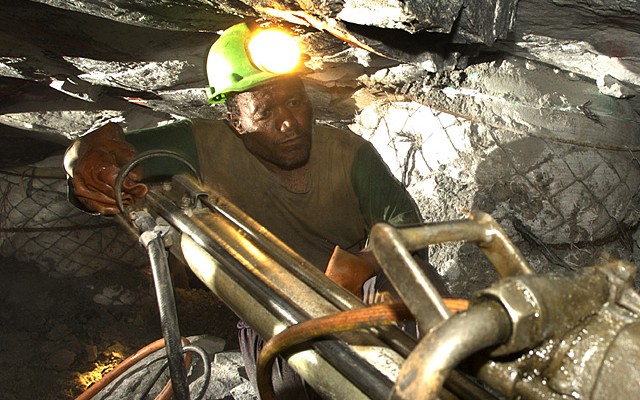
Meanwhile, AngloGold Ashanti has been forced to halt all its operations in South Africa as most of its 35,000 strong mining workforce went on strike, a company spokesperson said on Wednesday.
The unlawful strike, which began last week with several thousand workers laying down tools, now includes “a large majority” of the company’s mining employees, a spokesperson for the world’s third largest gold producer told news agency dpa.
“The strike is affecting all our six mines,” said Alan Fine, adding that workers were yet to formally present their demands to management.
“Obviously we will engage with our workforce, but the wages are negotiated centrally at the level of the Chamber of Mines and we don’t intend to change that.” But, he said, Anglo Gold would be willing to discuss other demands with the miners.
Unrest across the country’s vital minerals sector has spread in recent weeks as workers’ demand higher wages after employees at Lonmin’s Marikana platinum mine were granted an 11-12 percent wage rise.
The industrial action at Lonmin, which lasted for six weeks, left 46 people dead. Thirty-five were shot by police forces.
Malema has expressed his support for the striking miners. – DW
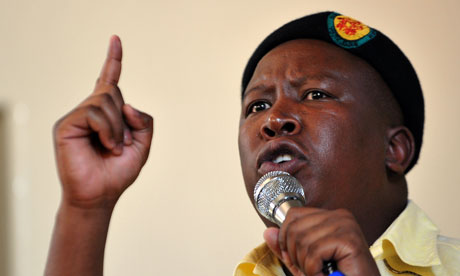
Expelled ANC Youth League president Julius Malema has likened critics of the nationalisation of mines to those who opposed the end of apartheid.
Malema was asked by Talk Radio 702 host John Robbie on Wednesday how the nationalisation of mines could take place and whether it was plausible.
“You sound like people who opposed our struggle for freedom,” answered Malema.
“You are arguing exactly like they argued, that we cannot run the economy… I am telling you that it can sound difficult until it is done.”
Malema said the government should “not necessarily” expropriate mines, but should instead use Botswana as a model, where the state owned 51 percent of mine shareholding.
“Why are you not having a problem with Botswana? [Mine companies] are more than willing to work with government in Botswana, but when they come here they are refusing,” Malema said.
“I’m not calling for wholesale, blanket nationalisation. We still encourage the involvement of the private sector. We’re talking about greater control and participation of the state in the economy.”
Malema also responded to questions about reports that the Hawks had concluded their corruption probe and he would soon be arrested.
He said he was not aware of any intention to arrest him.
“I hear that from you at the start of the programme. I hear that from papers,” Malema said.
“I’ve been ‘getting arrested’ since 2009,” he said.
Malema said that if the police wanted to arrest him, they would not have to “create an unnecessary scene”.
“Those that are looking for me, they don’t have to create an unnecessary scene, they just have to call me, ‘Mr. Malema, report to Polokwane police station at 9am’, and I’ll be there,” he said.
Malema also told Robbie that he would return to the ANC, regardless of the outcome of the party’s national elective conference in Mangaung.
Malema said he was expelled from the party because a “faction” in the ANC, which was led by President Jacob Zuma, was determined to be re-elected to positions.
“I was booted out by those who felt threatened by my presence in the organisation,” Malema said. “They thought my presence threatened their re-election at Mangaung.”
He said that once the pressure of the election contest was over, he would be welcomed back into the ANC.
“Once they get re-elected or not re-elected, we will still be welcomed back into the organisation, because they will be cool-headed and they will no longer be afraid of the unknown,” Malema said.
He said that as an expelled member, no administrative rules prevented him from rejoining the party.
“Being expelled from the ANC means that you can wake up tomorrow and apply to be a member of the ANC,” Malema said.
“I’m not rejoining the ANC, I’m joining as a new member of the ANC.”
Malema said he still had a good relationship with his branch and participated in its meetings.
“It’s my branch. I’ve never had bad blood in my mind. I’ve got a bad blood with those ones who have an ambition to be elected,” Malema said.
Robbie asked Malema about his continued commitment to the ANC and whether that commitment was reasonable following his expulsion.
“But you’re living in cuckoo land. You say you’ll die for the ANC, all that wonderful stuff, but the ANC has kicked you out, aren’t you living a dream?” asked Robbie.
“No, no, no,” answered Malema. “I would have walked away if I was an opportunist.” – Sapa
South Africa’s mines will be nationalised and land will be expropriated, ANC Youth League deputy president Ronald Lamola said on Monday.
“Leadership of the ANC might be afraid to say ‘nationalisation’ and ‘expropriation of land without compensation’, but the policy conference has clearly demonstrated the power and the mobility of the young lions,” Lamola said in Johannesburg.
“The policy conference [of the ANC held in June] had unanimously, clearly stated that the strategic mines of South Africa must be nationalised for the benefit of all South Africans.”
Lamola was reporting back on the ANC’s policy conference, the role of the youth league, and reflecting on former president Nelson Mandela’s contribution to the struggle.
“Comrades, we have won the debate on nationalisation,” he told the league’s Dr Mxolisi Majombozi branch at the University of the Witwatersrand.
“Even the African National Congress… they say we are at the point where we must look in terms of which minerals to nationalise.”
Lamola urged young professionals to play their part by suggesting which minerals needed to be placed in the state’s hands as part of the fight for “economic freedom”.
“We have stated with this opportunity that has been given to us that we must now identify strategic minerals to be nationalised,” he told the cheering crowd.
He said land should be given back to its rightful owners.
“The police conference has also stated clearly that the expropriation of illegally taken land by the Boers and the British colonies must be expropriated without compensation,” Lamola added.
“[We] should thank branches of the ANC that they have now taken it upon themselves to fight for economic freedom.”
Lamola said the Youth League should defend its views and ensure these were made policy at the ANC’s elective conference, to be held in Mangaung in December.
Earlier on Monday, ANC secretary-general Gwede Mantashe rejected wholesale nationalisation.
“Wholesale nationalisation is not an option, it’s costly it’s unsustainable.”
The party did however support state intervention in the economy. – SAPA
Zimbabwe’s central bank chief warned Friday the country’s fragile economy could grind to a halt if the government rushes its planned seizure of majority stakes in foreign-owned banks.
“The implementation of indigenisation and economic empowerment regulations in the banking sector should be done in a manner that preserves confidence since any adverse developments in the banking sector could grind economic activity to a screeching halt,” Gideon Gono said.
He was speaking to business executives at the annual congress of the Confederation of Zimbabwe Industries in the eastern resort town of Nyanga.
Zimbabwe passed in 2007 a law that forces all foreign-owned companies to hand over a majority stake of 51 percent to locals.
The law has forced mining firms, including the country’s biggest platinum mine Zimplats, a subsidiary of South Africa’s Impala Platinum, to submit schedules on how they will surrender a majority share.
“We are gratified to note that some aspects of the indigenisation and economic empowerment regulations are receiving attention with a view to harmonize and fine-tune pertinent issues,” Gono said.
Indigenisation Minister Saviour Kasukuwere, in a government notice made public earlier this month, gave foreign banks and other companies one year to cede a 51 percent stake to locals, as required under current laws.
Mugabe’s partner in a coalition government, Prime Minister Morgan Tsvangirai dismissed the ultimatum on the banks as illegal and a threat to the ailing economy’s recovery prospects.
Britain’s Standard Chartered Bank and Barclays Bank are among the major foreign banks with operations in this former British colony. – AFP
Kwadlangezwa – The SA Communist Party would like to see Sasol [JSE:SOL] nationalised, but if this could not be achieved immediately the petro-chemical giant should then be subjected to a windfall tax on extra profits.
SACP deputy general secretary Jeremy Cronin said this was one of the many draft resolutions that emerged from the party’s four-day long congress that wrapped up on Sunday at the University of Zululand near Empangeni on.
Speaking at a press briefing following the end of the 13th National Congress, Cronin said that while the party’s aim was for the total nationalisation of Sasol, there was “no reason why we should not propose a windfall tax”.
He said the SACP believed Sasol was raking in huge profits. It cost the company $40 (about R331) to produce the equivalent of a barrel and it was being paid at the going world market price for oil, which was close to $100 (about R826) a barrel.
Cronin said a resolution to call for the re-nationalisation of AcelorMittal SA [JSE:ACL] (formerly Iscor) was based on the fact that the SACP believed it was being stripped by its international parent company.
He said another draft resolution called for the transformation of the SA National Defence Force (SANDF).
Cronin said the colour composition of the SANDF was not at the centre of the call for transformation, but rather they way it was run and operated.
Media ownership was also an issue that was hotly debated by delegates, according to Cronin.
The role of the national broadcaster in particular received much attention with a draft resolution calling for 60 percent of the broadcaster’s budget to come from public funding.
Cronin said there was also a move against foreign ownership of media in the country and that there should be greater diversity.
General secretary Blade Nzimande’s failure to arrive at an SACP fundraising gala dinner was raised at the press conference – with Nzimande saying it was not a snub to deputy president Kgalema Motlanthe, who spoke at the event on Saturday night.
“I was simply exhausted. There was nothing else.”
During his closing address to the congress, Nzimande said others were laying claim to Nelson Mandela’s legacy and using it against the SA Communist Party and its allies.
“Our revolution is not for sale.”
Without making a direct reference to the Democratic Alliance, but referring to “those in the Western Cape”, he warned that the former president’s legacy was being used against the party to discredit it.
In his speech the long-serving party member again repeated calls for “tender-trepeneurs” to be flushed out of the party.
He also called on municipalities to stop outsourcing work, but instead to increase their own capacity and employ more people.
Referring to the African National Congress’ recent policy conference, Nzimande said he welcomed the resolutions from that conference.
The ANC had accepted that “it can no longer be business as usual”.
The SACP was more united than ever and a clear indication of this fact was that the party’s leadership had been elected by consensus, Nzimande said.
JOHANNESBURG – “If we have a weak resolution on the economy it would be flying in the face of what is intended in the second transition document, which is the second phase of our transition,” he said in an interview on SAFM.
“Then we will go strong… which means taking bold actions. [The] time has arrived for us to do something new and get in, [take] the plunge, take a decision, take a risk.”
The ANC policy conference in Midrand accepted a proposal on Thursday on a “second transition” for correcting economic imbalances after renaming it “the second phase of the transition”.
The conference ends on Friday with an address by Zuma.
Mantashe told SAFM the ANC had a long history of appreciating the importance of a balanced, mixed economy.
“We don’t give markets a free hand. We believe that the markets must have their role, but the state must [also] play a role,” he said.
“In this day and age, after this [economic] crisis, we are all convinced that the state must be more firm and provide the leadership in the economy.”
Mantashe said the state had the capacity to provide the leadership needed.
“Skills are never bought in any shop. You develop skills. You cannot develop skills unless you are involved,” he said.
Mantashe said the ANC would read all the documents from the policy conference together, for them to be finalised at the 53rd ANC national conference in Mangaung, in the Free State, in December.
If adopted, the policies will form the basis for the ANC government’s policies, new laws or amended laws.
On Friday, the commissions will report back on their discussions on gender, state intervention in the minerals sector, economic transformation, peace and stability, education and health, legislature and governance and land reform.
Asked about the ANC’s policy conference, political analyst Aubrey Matshiqi of the Helen Suzman Foundation told SAFM there had been many good decisions reported in the media briefings.
“I think the main challenge facing the ANC is that of aligning what it says… with state capacity, and its own capacity as a ruling party to deliver what it promises.” – Sapa
AP – Zimbabwe’s black empowerment minister said Wednesday he will proceed with a takeover of the country’s biggest platinum mine if the South African owners don’t comply with orders to hand over more stakes in the company to blacks.
Minister Saviour Kasukuwere said there is “no compromise” over the eventual handover of 51 percent of the company’s stock as is required by “indigenization” laws.
Last year, Zimplats became the first foreign-owned company to cede 10 percent of its holdings to a local community trust. Zimbabwe has ordered the company to hand over another 30 percent by mid-March. South African-based Implats owns 87 percent of existing shares in Zimplats.
Zimbabwe and South Africa are the world’s largest suppliers of platinum, a corrosion-resistant metal with a wide range of industrial uses that is priced higher than gold.
Kasukuwere told the Associated Press Wednesday that a proposed visit by Implats’ chief executive to discuss the matter would not change the government’s decision.
He said he has no plans to meet with Implats chief David Brown.
“I don’t need to meet them over anything. Why are they coming to see me? I’m not a zoo,” Kasukuwere told The AP. “I have nothing to discuss. They must respect the laws of this country,”
Parliament last year passed a law that calls for all foreign-controlled businesses to take on black partners as majority stockholders.
The former opposition party of Prime Minister Morgan Tsvangirai has voiced concerns that the prospect of hasty takeovers scares off much-needed investment. The party has called for accountability and careful implementation of the “indigenization” program that risks collapsing some viable businesses and mines.
President Robert Mugabe’s party – which is in a shaky three-year coalition with Tsvangirai – says China can provide new technical expertise in mining and manufacturing.
Foreign cash inflows have dwindled in recent months amid uncertainty over the security of possible investments.
This month, banks, including major international banks, have reported growing shortages of cash for day-to-day transactions in Zimbabwe. Executives say the liquidity crisis has been fueled by businesses that cannot repay bank loans because not enough money is coming in to service the loans.
Industrial production has remained stagnant after years of economic meltdown with many factories desperate for cash to replace aging equipment and machinery.
Last year, Kasukuwere announced that he had canceled the Zimplats mining license but backed down after Zimbabwe’s mining minister ruled the cancellation void.
Kasukuwere, 42, seen as a younger militant in the top ranks of Mugabe’s party – which is dominated by veteran politicians aged in their 70s and led by Mugabe, 88- is tasked with securing Zimbabwe’s resources for black control.
Critics of new business takeovers point to a possible repetition of land seizures since 2000 that have seen many of the best former white-owned farms allocated to politicians and Mugabe party loyalists who have left them to lie idle.
Yesterday NUMSA, the National Mineworkers Union of South Africa, issued a document replete with Marxist references to the class struggle, calling for the nationalisation of mines in South Africa. It based its policy position on two fundamental ANC documents: the Freedom Charter and the Morogoro Conference of 1969 when the ANC was still firmly tied to the old Soviet Union.
Here follows the whole statement by NUMSA:
White domination persists in South Africa – Irvin Jim
Irvin Jim
08 February 2012
NUMSA GS says without nationalisation black people doomed to remain at bottom of society
Press Statement on the Nationalisation Report of the ANC
“In our country – more than in any other part of the oppressed world – it is inconceivable for liberation to have meaning without a return of the wealth of the land to the people as a whole. It is therefore a fundamental feature of our strategy that victory must embrace more than formal political democracy. To allow the existing economic forces to retain their interests intact is to feed the root of racial supremacy and does not represent even the shadow of liberation.” (Morogoro Conference of the ANC, meeting at Morogoro, Tanzania, 25 April – 1 May 1969)
The National Union of Metal Workers of South Africa (NUMSA) is extremely disturbed and dismayed by the statements made by two ANC Ministers in the Mining Indaba during the course of this week, in Cape Town.
Numsa as part of a Cosatu delegation in the ANC Economic Transformation Committee (ETC) did have the opportunity to see the Nationalisation Report last week but we were not given copies as the Report was embargoed.
We were advised that the Report would be tabled in the ANC NEC and the NEC was to define the process on how the Report was to be circulated in the branches of the ANC and to components of the Alliance for debate in preparing for the coming ANC National Policy Conference.
WE find it very disturbing that the Report has been unofficially released to the media before the structures of the ANC and its Alliance could see it.
We further find it quite unfortunate that two ANC ministers have found it fit to use the Report in support of their private views against nationalisation of mines and other strategic economic sectors. As we show below, the ANC NGC in 2010 was unanimous in support of the nationalisation of mines and other strategic economic assets in the country.
Numsa takes the view that both Minister Susan Shabangu and Trevor Manuel have acted completely without any ANC mandate in deciding to speak for the ANC government and for the ANC and the Alliance that there will be no nationalization of mines and key strategic sectors in the economy. Their unilateral pronouncement goes completely against the ANC’s position which says – it is the ANC who leads government and not government leading the ANC. Numsa therefore reject with contempt their cheap manipulation of our democratic processes in the movement.
We have also noted that in the recent past right-wing global rating agencies have been doing the same in threatening our movement should nationalisation take place. These seek to make sure that there is no fundamental change in the vested Apartheid white monopoly economic interests, thus guaranteeing that black people in general and Africans in particular remain at the bottom of South Africa’s economy and society and detained forever in poverty, unemployment and inequality.
Below we restate in our view, the current and historic position of the ANC and its Alliance on this extremely important matter of nationalisation of mines and strategic economic assets of the country.
A. Nationalisation and ANC Policy
1. The basic revolutionary socio-economic programme of the ANC is the Freedom. The core tenet of the Freedom Charter states that:
“The national wealth of our country, the heritage of South Africans, shall be restored to the people; The mineral wealth beneath the soil, the Banks and monopoly industry shall be transferred to the ownership of the people as a whole; All other industry and trade shall be controlled to assist the well-being of the people; All people shall have equal rights to trade where they choose, to manufacture and to enter all trades, crafts and professions.”
In this regard we fail to understand the constant refrain that nationalisation is the ANC policy because in our understanding the representatives of our people who gathered in Kliptown in 1955 adopted this policy position of the ANC.
2. The restoration of the wealth of the country to the people is, has been, and will always be, at the heart of the struggle to liberate all South Africans, today and tomorrow.
3. The transferring to the ownership of the people as a whole of the mineral wealth beneath the soil, the banks and monopoly industry is the basic foundation and only basis upon which lasting peace and a common nationhood can be created in South Africa.
4. To reinforce these fundamentals of the liberation struggle, the ANC at its Morogoro Conference further stated that:
“In our country – more than in any other part of the oppressed world – it is inconceivable for liberation to have meaning without a return of the wealth of the land to the people as a whole. It is therefore a fundamental feature of our strategy that victory must embrace more than formal political democracy. To allow the existing economic forces to retain their interests intact is to feed the root of racial supremacy and does not represent even the shadow of liberation.”
5. The roots of South African racial supremacy would be well nourished if the existing economic forces were to be allowed to retain their interests intact. This is a very self-evident truth. In South Africa, real poverty is black and African, and wealth is white and European.
6. In the 2010 ANC National General Council – the policy forum of the ANC – the Economic Transformation Commission reported thus:
“There was greater consensus in the commission on the nationalisation of mines and other strategic sectors of the economy. The NGC therefore mandated the NEC to ensure further work be done, including research, study tours and discussions, and to report to the Policy Conference for decision at National Conference in 2012.”
7. We have quoted the documents above to show the centrality, the revolutionary significance, of the unchanging core demand of the liberation struggle in South Africa – to return the basic wealth of the country to the people as a whole.
8. All ANC Policy and other documents have always faithfully reiterated this demand. The demand to return the wealth of the country to the people as a whole, including by transferring this wealth into the hands of the people (nationalisation) is a central and defining feature of the ANC. To deviate from this is un-ANC.
B. Revisionism, distortion and vulgarisation of the main strategic objective of the struggle for liberation in South Africa
1. The restoration of the basic wealth of the country to the people was, and still is, the essence, the reason, the strategic objective, of the struggle for liberation in South Africa. Only this could end racial supremacy and Colonialism of a Special Type (CST). Only this could guarantee peace, equality and restore the dignity of all the people of South Africa.
2. It is now clear that long before the 1994 democratic breakthrough, elements of English, Afrikaner and African elites had begun to work very hard to dilute the essence of the struggle for liberation in South Africa, by peddling a version of freedom and democracy that would allow the essential existing economic forces to retain their interests intact.Thus the new South Africa after 1994 was handed down a constitution offering democratic freedoms but in essence made private property sacred in a country in which the majority had no property – to be more precise, the country’s constitution fails to address the land stolen from our people through the 1913 Land Act!
3. Since 1994, we have seen a progressive watering down, weakening and erosion of the essential and basic revolutionary demand of the liberation struggle – the returning of the wealth of the land into the hands of the people as a whole.
4. A very dangerous revisionist tendency is one that simply re-interprets the demand in narrow legalistic and technical terms, and thus attempts to convince us that some of the reforms (charters, taxation, and BBBEE) the ANC government has put in place since 1994 amount to “transferring the wealth of the land into the hands of the people”.
5. A further equally dangerous tendency is simply to vulgarise and distort the core revolutionary demand of the liberation struggle – the demand to transfer all the major wealth of the country into the hands of the people, thus restoring the country to all its people – by simply reducing it to the question of the nationalisation of mines, and even this is further mired in financial and technical obstacles!
6. The core revolutionary demand of the freedom struggle in South Africa is very clear: The national wealth of our country, the heritage of South Africans, shall be restored to the people!It is all the “national wealth” and not just the mines, which must be restored to the people. All other industries must be subordinated to the imperative to develop the people and provide for them. This distortion seeks to diminish and conceal the other wealth which must equally be restored and transferred to the people as a whole.
7. Implicit in the demand is not just the revolutionary need to uproot racial supremacy and restore the dignity of all our people, but also a very strong anti-imperialist demand.
8. A most vulgar postulation is one that simply says after 1994, we are all free to share in the country’s wealth, and it is now each person for themselves and all the government has to do is make the country business friendly. Thus all over the country we find business and enterprise promotion NGOs and sometimes these are assisted by monopoly industries.
C. The persistence of white monopoly capitalism in South Africa, post 1994
1. Anyone with the barest minimum of knowledge about the state of the South African economy and society, 17 years after “democracy” will not fail to notice the persistence of white domination of the economy and society, notwithstanding the small sprinkling of black and African capitalists.
2. The South African economy continues to be dominated by the Minerals/Energy/Finance Complex which is largely white owned. The white population continue to in fact grow their domination of social and cultural life of the country.
3. Poverty and unemployment are largely black, and African, with African females and youths faring the worst.
4. South Africa has become the most unequal place on Earth today. At the bottom, of course are black and African people, and at the top, are white people. The facts to illustrate this are there for all to see.
5. Black and African people are condemned to inferior public sector education and health facilities, while the white population enjoys first world schools, hospitals and shopping malls. Of course the trick today is that there is no Group Areas Act and you are simply told to get on with it as an individual and make your money and you will join the white population!
6. As a result of the lamentable failure to radically restore the basic wealth of the country to the people as a whole, 11 percent of the South African School system accounts for more than 70 percent of Matric passes.
7. An average white male in South African earns anything above R19 000, 00 per month while a black male earns just about R2 400, 00!
8. Ultimately of course, the life expectance of a white person in South Africa today stands at about 70 years, while that of a black person is at 48 years – some 22 years less!
D. The struggle continues, and it is a class struggle!
1. At Numsa we are not surprised that the 2010 ANC NGC Resolutions which clearly indicated that there was consensus on nationalisation are being manipulated and shoved into the dustbin.
2. At Numsa we are not surprised that rather than investigate what the most appropriate forms of nationalisation of mines and other strategic sectors of the economic would be, the ANC Report has done everything to confirm that nationalisation of the mines would be a “disaster” for South Africa. Knowing the dominance of white monopoly capital in general and white mining and financial capital in particular, our political and social life post 1994 we did not expect anything less than this distortion of the ANC NGC Resolutions.
3. Further, we at Numsa do not think that the struggle to restore the wealth of the country to the people as a whole will ever be won via research teams and Conference Resolutions. As a working class, and industrial working class formation our experience teaches us that capital concedes nothing without a fight!
4. Thus we are not surprised that elements deployed by the ANC in government to implement ANC policies have been very busy trying to assure capitalists that government in South Africa does not belong to the ANC and that it is not government policy to nationalise! Those ANC deployees who advocated the neo liberal macro economic framework in 1996 continues to champion a failed and discredited neo liberal policy framework which stands in direct opposition to the ANC’s progressive and revolutionary agenda as contained in the Freedom Charter.
5. The people who voted this government into office suddenly do not exist. This is as it should be, as the dominant class in this country is that of white monopoly capitalists!
6. At Numsa we must serve notice to the people of this country: the black and African working class are fast losing patience at the pace at which their conditions of extreme poverty are being dealt with.
7. The success and sustainability of the 1994 democratic breakthrough in this country rests on the extent and speed of restoration of the wealth of the country to the people as a whole, including transferring the national wealth to the people. Anything less than this is a recipe for disaster.
8. At Numsa we will continue to mobilise the working class and to demand in the revolutionary alliance for the speedy implementation of the entirety of the Freedom Charter.
9. In the ANC Policy Conference Numsa will demand for the restoration of the basic wealth of the country to all the people as a whole.
10. In the National Conference of the ANC this year Numsa will demand the transferring – nationalisation – of the mines and other strategic economic sectors into the hands of the people as a whole. This is what we understand the struggle for liberation, democracy and equality in South Africa to be all about. Anything short of this is a betrayal of all our 100 years of struggle and sacrifice against racist white monopoly capitalism.
Statement issued by Irvin Jim, NUMSA general secretary, February 8 2012
This website uses cookies to improve your experience. We'll assume you're ok with this, but you can opt-out if you wish. Cookie settingsACCEPT
Privacy & Cookies Policy
Privacy Overview
This website uses cookies to improve your experience while you navigate through the website. Out of these cookies, the cookies that are categorized as necessary are stored on your browser as they are essential for the working of basic functionalities of the website. We also use third-party cookies that help us analyze and understand how you use this website. These cookies will be stored in your browser only with your consent. You also have the option to opt-out of these cookies. But opting out of some of these cookies may have an effect on your browsing experience.
Necessary cookies are absolutely essential for the website to function properly. This category only includes cookies that ensures basic functionalities and security features of the website. These cookies do not store any personal information.
Any cookies that may not be particularly necessary for the website to function and is used specifically to collect user personal data via analytics, ads, other embedded contents are termed as non-necessary cookies. It is mandatory to procure user consent prior to running these cookies on your website.