Rising Africa, the hopeful continent

africacontinentIn May 2000, the respected international weekly magazine The Economist published a provocative lead article describing Africa as “the hopeless continent”.

To illustrate the hopelessness, the magazine picked several of Africa’s cities as case studies. Among those cities was Freetown, the capital of Sierra Leone, which, according to the magazine, symbolised Africa’s “failure and despair”.

Sierra Leone itself was described as being “of no great importance” because the country’s only relevance to the world was the sympathy needed for its people.

This beleaguered country, it was said, was nevertheless “a symbol of Africa”.

The article elicited condemnation from various quarters, including African government leaders, the academia and analysts. The magazine was reinforcing age-old negative perceptions of Africa, it was said.

The magazine would later atone for its pessimism – albeit 10 years later.

The cover page for the December 2011 edition labelled Africa “The Hopeful Continent”. And they had statistics to back it up.

Over the past decade, it was noted, “six of the world’s 10 fastest-growing countries were African”. In eight of the past 10 years, the magazine said “Africa had grown faster than East Asia, including Japan”.

It was as if there were two Africas: the one described in the May 2000 issue and the other as described in the December 2011 edition. And The Economist is not alone in having had to retract (although tacitly) its own coverage of developments in Africa.

Before South Africa’s successful hosting of the 2010 World Cup, the London-based Guardian newspaper carried an article in which one of their reporters warned potential tourists against visiting South Africa for the spectacle.

In “Why going to South Africa for the World Cup terrifies me”, Guardian journalist Louise Taylor claimed that South Africa was “more dangerous than Iraq and Afghanistan”.

Taylor added: “Deep down, there must be some VIPs pacing Fifa’s corridors of power who harbour nagging regrets that Egypt or Morocco did not pip South Africa and win the vote.”

Interestingly, Taylor had not visited the country before. Her article was based entirely on anecdotes and desktop information. The stereotypical view of Africa as a “dark continent” persists, despite evidence pointing to a continent on the rise.

Africa’s economy is growing at a rapid rate despite the global economic downturn that is adversely affecting some of the continent’s major trading partners, especially those in the euro zone.

The continent is also increasingly adhering to principles of good governance, which include regular democratic elections, adherence to the rule of law and the creation of a climate conducive for trade and investment.

Once a continent known for coups d’état, Africa now holds more elections than ever. In the 1960s and 1970s, according to a recent study, African countries held a total of 10 elections a decade.

This is on a continent of 54 countries.

Latest stats indicate that Africa now holds 41 elections every five years.

Of concern remains the ability of African countries to trade among themselves. Current trade among African countries stands at a paltry 10 percent, excluding trade in oil. Simply put, Africa trades with everyone except itself.

The overwhelming majority of African countries are single-commodity economies, exporting raw materials at a fraction of their value to markets in Asia, North America and Europe.

Together with other countries, South Africa has expressed its belief that integration and intra-trade at the level of regional economic communities will pave the way for greater continental economic integration. A lot of progress has been made regarding the establishment of a Tripartite Free Trade Agreement (T-FTA) between the Southern African Development Community (SADC), the Common Market for Eastern and Southern Africa (Comesa) and the East African Community (EAC). The T-FTA will combine the markets of 26 countries with a population of nearly 600 million people and a combined gross domestic product of $1 trillion (R9.8 trillion).

In summary, this key initiative will provide market scale that could launch a sizeable part of the continent onto a new industrialisation trajectory. The T-FTA will also form part of an Africa-wide FTA, which will create a market of $2.6 trillion.

Delivering the Department of Trade and Industry’s Budget Vote in Parliament recently, Minister Rob Davies said negotiations were proceeding, but that efforts in this regard had to be complemented by the promotion both of infrastructure development and co-operation to transform productive sectors and industrialise Africa.

The minister said investors had not been put off by challenges, but recognised Africa as the next growth frontier and the key strategic importance of South Africa as the most industrialised African country.

The 2013 Africa Competitiveness Survey by Ernst and Young says: “Africa’s rise over the past decade has been very real. While sceptics still abound, and there are people who still seek to debate the point, the evidence of the continent’s clear progress over the past decade is irrefutable.

“Over this period, a critical mass of African economies have grown at high and sustained rates; so much so that, despite the impact of the ongoing global economic situation, the size of the African economy has more than tripled since 2000.

“The outlook also appears positive, with many parts of the region forecast to continue experiencing relatively high growth rates and a number of African economies predicted to remain among the fastest growing in the world for the foreseeable future.

“At the same time, though, individual countries and the region as a whole still need to address significant challenges in order to sustain this progress, and to emulate the kind of developmental path we have seen in places like South East Asia over the past 30 to 40 years. We are of the view that Foreign Direct Investment (FDI) will play a key role in this process as both a source of capital, but, more importantly, as a catalyst for job creation, skills development, technology transfer, and ultimately, the longer-term diversification and transformation of key African economies.”

The growth in the African economy has increased the potential for FDI projects into Africa, as well as creating positive growth for investors in Africa. With South Africa being the single largest investor (2012 FDI projects) in Africa, there is ongoing confidence and interest among African countries regarding its potential growth and future.

The highest levels of growth have been found to originate in sub-Saharan Africa, with the lowest in north Africa. This stagnation in the north is mainly caused by the political instability within the region which has discouraged potential investors and caused certain levels of divestment.

The boom in the southern region is mainly due to the large levels of investment by South Africa in countries in the SADC region.

The role of South Africa as a strong investor has increased over the past decade as it is placed fifth on the list of top 20 countries that source FDI projects in Africa.

This makes it the largest African source of FDI projects with a compounded growth of 57 percent, in South African-originated projects into Africa, since 2007.

The pessimistic view of Africa as a dark, hopeless continent is being challenged by concrete stories of economic development and a general improvement in the standard of living of Africa’s people. – by Clayson Monyela. Monyela is the deputy director-general: public diplomacy in the Department of International Relations and Co-operation.

Oxfam: Inequality rises after Apartheid

The world’s 100 richest people earned a stunning total of $240 billion in 2012 – enough money to end extreme poverty worldwide four times over, Oxfam has revealed, adding that the global economic crisis is further enriching the super-rich.

“The richest 1 percent has increased its income by 60 percent in the last 20 years with the financial crisis accelerating rather than slowing the process,” while the income of the top 0.01 percent has seen even greater growth, a new Oxfam report said.

For example, the luxury goods market has seen double-digit growth every year since the crisis hit, the report stated. And while the world’s 100 richest people earned $240 billion last year, people in “extreme poverty” lived on less than $1.25 a day.

Oxfam is a leading international philanthropy organization. Its new report, ‘The Cost of Inequality: How Wealth and Income Extremes Hurt us All,’ argues that the extreme concentration of wealth actually hinders the world’s ability to reduce poverty.

The report was published before the World Economic Forum in Davos next week, and calls on world leaders to “end extreme wealth by 2025, and reverse the rapid increase in inequality seen in the majority of countries in the last 20 years.”

Oxfam’s report argues that extreme wealth is unethical, economically inefficient, politically corrosive, socially divisive and environmentally destructive.

The report proposes a new global deal to world leaders to curb extreme poverty to 1990s levels by:

– closing tax havens, yielding $189bn in additional tax revenues

– reversing regressive forms of taxation

– introducing a global minimum corporation tax rate

– boosting wages proportional to capital returns

– increasing investment in free public services

The problem is a global one, Oxfam said: “In the UK inequality is rapidly returning to levels not seen since the time of Charles Dickens. In China the top 10 percent now take home nearly 60 percent of the income. Chinese inequality levels are now similar to those in South Africa, which is now the most unequal country on Earth and significantly more [inequality] than at the end of apartheid.”

In the US, the richest 1 percent’s share of income has doubled since 1980 from 10 to 20 percent, according to the report. For the top 0.01 percent, their share of national income quadrupled, reaching levels never seen before.

“We can no longer pretend that the creation of wealth for a few will inevitably benefit the many – too often the reverse is true,” Executive Director of Oxfam International Jeremy Hobbs said.

Hobbs explained that concentration of wealth in the hands of the top few minimizes economic activity, making it harder for others to participate: “From tax havens to weak employment laws, the richest benefit from a global economic system which is rigged in their favor.”

The report highlights that even politics has become controlled by the super-wealthy, which leads to policies “benefitting the richest few and not the poor majority, even in democracies.”

“It is time our leaders reformed the system so that it works in the interests of the whole of humanity rather than a global elite,” the report said.

The four-day World Economic Forum will be held in Davos starting next Wednesday. World financial leaders will gather for an annual meeting that will focus on reviving the global economy, the eurozone crisis and the conflicts in Syria and Mali. – RT

Oxfam’s misguided messiah complex

Feeling good

The British charity Oxfam recently released an updated version of the Book of Lamentations. Something about how “the relentless focus on ongoing problems at the expense of a more nuanced portrait of [Africa], is obscuring the progress that is being made towards a more secure and prosperous future.”

That’s chief executive Barbara Stocking, as quoted by the BBC. Apparently the charity’s been doing some polling recently (in the UK), and coming up with interesting results. In one poll half of the respondents confessed that Africa conjured for them images of hunger, famine and poverty. In another poll, almost half of the 2,000 respondents thought Africa’s biggest challenge was hunger. Three out of four were suffering from ‘Africa-fatigue’ – that debilitating condition that afflicts well-meaning foreign philanthropists exposed to an endless stream of images of suffering and torment originating from the dark continent.

A distressed Oxfam has since gone ahead to launch its latest Africa campaign, in a desperate bid to shift the world’s attention from African Hunger, to African-Hunger-Backdropped-By-Stunning-African-Landscapes.

That’s, in a nutshell, the story. It left me a tad puzzled. A w-t-f puzzlement. As in: is Oxfam for real? Let’s even forget, for a moment, that Oxfam has probably done far more than any other organisation in propagating these images. Let’s focus on something else that struck me about the story: the way blame is being placed squarely on the shoulders of the Images.

Oxfam appears to be saying: Put All The Blame On The Images. Not the people hanging on stubbornly to those images in the face of alternative evidence. Am I alone in thinking Oxfam’s lamentations suggest a British public that is at the mercy of what they are fed. Helpless Brits who somehow cannot – despite all their efforts – rise beyond the bombardment of pity-evoking images of Africa,

One might as well rephrase Dame Stocking as follows: “Oh poor helpless people of Britain, all they’re being fed is harrowing, unhelpful images of Africa. We need to stop that. We need to feed them something different. We need to change their diet.”

In whose interest?

The whole set-up suggests that Britain is now guilty of the sort of intellectual laziness once associated (almost solely) with America (er, sorry). Clearly the surveys say far more about the British mind than they do about the African condition. Now we know, courtesy of Oxfam, that all along we’ve been depending on a bunch of wallet-opening puppets to deliver us from ourselves.

Now the puppets are growing weary, the strings fraying, the wallet-opening mechanisms aging. Now we have to refurbish the puppets, oil the creaking joints with a new, more positive type of ‘communication’. Landscapes, not Hunger!

A mindset that elevates what the British public thinks of Africa, over and above contemporary reality, and that suggests it is in Africa’s interest for that thinking to change, is not only faulty but dangerous as well.

To put it less mildly, who – apart from Oxfam, obviously – really cares, in 2013, what the British public thinks about a continent from which they fled in varying stages of undress? What’s that proverb about crying more than the bereaved? In the 21st century are people still allowed to be zombies gobbling up everything they’re fed by a collaboration of powerful media and NGOs?

I seriously doubt that it is in Africa’s interest for Brits to change their perception of Africa. Instead I think it is totally in Britain’s interests to change its perceptions of Africa. That problem, is Britain’s, and no one else’s. If the Brits insists on seeing Africa primarily through the lens of philanthropic intervention, good for them.

Let them stay thinking that way; let Oxfam, with its its Africa-emblazoned super-hero capes, stay convincing itself that it has a duty to alter global perceptions of Africa, while the Russians and Chinese – and diaspora Africans, who must have once assumed they’d left the continent for good – boldly head out to the continent to engage in potentially more useful ways.

Alternative images

Granted that those starving-children-and-dying-mothers images form a sizable part of African exports to the west. There may be little we can do about that, as long as we have a west obsessed with delivering Africa from itself. But what about the the tens of thousands of kwashiorkor-free, English-speaking, pocket-money-receiving African students who flock to the UK annually, to study (with a good number actually returning, to continue with the lives they left behind in Lagos and Nairobi and Accra and Freetown and Johannesburg etc).

How the British public fails to permit these alternative images to displace some of the “old stereotypes” (quoting Dame Stocking) should alarm many right-thinking people, and perhaps inspire an industry of academic theses on national delusions and epidemics of ostrich-in-sand-syndromes. If those flesh-and-blood representations of contemporary Africa somehow don’t succeed in serving as a useful counterbalance to the stereotypes, then nothing will.

“We want to make sure people have a really better balanced picture of what’s happening in Africa. Of course we have to show what the reality is in the situations in those countries. But we also need to show the other places where things are actually changing, where things are different,” Dame Stocking says.

I wish her and Oxfam the very best. Must be awful to have to take on that job of saving people from self-inflicted ignorance. In an age in which Google, Twitter and the news media lie at most fingertips, delivering, alongside stories of African suffering, narratives of determined recovery from tragedy and technology-driven change and emboldened youth and rising political awareness and growing intolerance for tyranny – is there still room for getting way with blaming with fixating on photos of begging bowls and the oxfamished children attached to them?

Stories also abound of the startling stupidities and failures of aid projects whose origins lie in a mentality belonging to a world that appears to have vanished. Misguided messiahs and their T-shirt donation and Shoe donation schemes, money-grabbing consultants, corrupt practices, high-profile-nil-value baby adoptions, etc etc.

It’s important that the Oxfams of this world do not allow themselves to get overly caught up in the myth of their impact. In the larger scheme of things, perhaps they’ve been over-estimating their messianic abilities. Consider this: In his posthumously published collection of essays pan-Africanist Tajudeen Abdul-Raheem says, of Nigeria’s 2006 debt relief deal: “What kind of success is debt relief that sees Nigeria paying back over three billion dollars to Britain alone, a figure more than the total aid budget of Britain in the same year?”

You could of course argue that that is oil-rich Nigeria, and choose instead to focus on the Rwandas and Malawis, where close to half the national budgets are donor-funded. And I could remind you of what the late Malawian president did with chunks of his country’s money. Or the mystery of the vanishing dollars in the Ugandan prime minister’s office.

I’m also somewhat surprised we’re still having this ‘African aid’ argument at the beginning of 2013, after the eloquent arguments of books like Dead Aid and The Fastest Billion. And after the Economist already publicly regretted its silliness.

Tolu Ogunlesi is black, lives in Lagos, Nigeria, where he works as Features Editor for NEXT, a daily newspaper. In 2009 he was awarded the Arts and Culture prize in the annual CNN Multichoice African Journalism Awards, as well as shortlisted for the inaugural PEN/Studzinski literary prize. He’s not part of Oxfam’s target market. Very few black poets press on the “donate now” button on the Oxfam website.

World Bank gives SA little chance

An education awaits as teacher gropes white doll

Inequalities in South Africa are threatening economic growth, with children born into poor families unlikely ever to escape poverty or reap the rewards of living in Africa’s largest economy.

The World Bank’s sobering assessment released last week found that a child’s gender and ethnicity at birth, combined with a lack of education, largely determine that person’s chances of success in life – even 18 years after the end of apartheid.

“South Africa, the continent’s largest economy by far and its only G-20 member, displays strikingly high and persistent inequality and marginalization for an upper middle-income country,” said the report.

Although South Africa has made great strides in transforming the economy, which has produced one of the continent’s fastest-growing black middle classes, poverty levels and unemployment remain high outside urban centres.

South Africa is often compared to Brazil, which also has a huge income gap, but while the Latin American country has narrowed the divide over the last decade, here the chasm is as deep as ever, the World Bank said.

The richest 10 per cent of South Africans account for 58 per cent of the nation’s income, while the bottom 10 per cent accounts for 0.5 per cent, the Bank said. The bottom half earns less than eight percent of the nation’s income.

The country will struggle to grow the economy until its riches are spread more evenly, the Bank said.

Sharp economic and social inequalities were especially visible along racial lines, said the report, with whites largely shielded from economic hardships thanks to privileges inherited from the fallen apartheid regime.

“Peering past the first-world living conditions of urban South Africa, it is not too hard to see the downcast situation of townships, informal settlements, and former homelands,” said Sandeep Mahajan, who headed the report.

“Our results show that a South African child not only has to work harder to overcome the disadvantages at birth due to circumstances, but having done so, finds that these reemerge when seeking employment as an adult,” he said.

The report said residents of these areas were usually unemployed or lacked the means to look for jobs, as they were disconnected from the job market.

Unemployment in the first quarter of 2012 rose to 25.2 per cent, up from 23.9 per cent in the previous quarter, and black people form the bulk of the jobless.

Modest economic growth, which averaged 3.2 per cent since 1995, had proved “insufficient to absorb the wave of new entrants to the labour market from dismantling apartheid’s barriers”, the report said.

Labour analyst Andrew Levy said challenges of inequality were “deep rooted and not unique to South Africa”.

“History has shown that societies that have emerged from any kind of unjust system of governance struggle with inequality,” said Levy. But he added that the new government “could have done better”.

Much of the blame is laid on the education system.

The World Bank found that black children from rural areas with parents who did not finish school were most likely not to finish school or have access to health care.

Children in some parts of the country are forced to learn in open spaces or under trees, even though education is the government’s single biggest expenditure.

This year education campaigners took the government to court after schools across the poor northern province of Limpopo were left without textbooks, months into the academic year. More than one month after a court order, government has not delivered books to all the schools.

“The only way to reverse the trend of inequality is to invest in education,” said economist Azar Jammine. – AFP

‘African Dream about to explode’

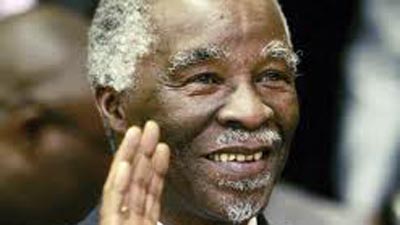
Thabo Mbeki

Former President Thabo Mbeki has warned of more Arab spring uprisings on the continent if African leaders continued to be “preoccupied” with enriching themselves and not being concerned about “the lives of the people”.

In an interview with The Sunday Independent, Mbeki said the patience of the youth and ordinary Africans was waning, and that their frustrations could explode.

He wrote in The Thinker magazine in September, quoting poet Langston Hughes, that if the African dream is deferred for much longer it will explode.

Asked this week if the explosion could amount to uprisings such as the Arab spring, Mbeki said: “If the African population continues to experience similar conditions as happened in Tunisia and Egypt, similar conditions of standards of living not improving, facing crises all the time, and a small elite which lives well and eats better every day, and flaunts its wealth… in the end these ordinary African people, like the ordinary African people of Tunisia, surely will say enough is enough, I think it is imperative of all our governments to clearly focus on this matter.”

Mbeki said he sensed some exasperation among African youth when he interacted with them throughout the continent.

“There is a level of impatience. And the determination to see things change for the better… It is the responsibility of government to respond to that voice and for the youth to understand their role, not rebellion, but to reconstruct the continent,” he said.

Mbeki wrote in The Thinker earlier that there were some African leaders, including some in SA, who came to power to accumulate wealth.

“You will see it in many parts of the continent where people assume positions of leadership… as an opportunity for self-enrichment.

“We’ve seen the same phenomenon here in South Africa, we are not immune… and somebody who is preoccupied with that is not about to be concerned about ‘what did I do wrong yesterday which has impacted negatively on the lives of the people’. [They are] not interested in that.”

He said this was partly why the AU failed to reflect on its successes and failures on its 10th anniversary this year. He told The Sunday Independent he hoped the 50th anniversary of the Organisation of African Unity, the AU’s predecessor, would provide an opportunity to review progress on continental issues.

“I think it is important not just to make speeches and say we celebrate. But say what has been our experience in the last 50 years, what has gone right and what has gone wrong.”

In The Thinker, he blasted the AU for being “consumed by the eminently subsidiary matter of who should chair the AU Commission, reflecting the malaise that is poisoning the African body politic”.