How Putin conquered South Africa

yellowcakeBy Marin Katusa via Casey Research.

In the global war for energy supremacy, Russia has won another victory over the United States.

This time, the battleground has been South Africa, where Russia’s state-owned nuclear power company, Rosatom, has just signed an agreement to build eight new reactors. Once all of them are operational, South Africa’s nuclear capacity will increase more than sixfold – from 1.8 gigawatts (GW) to 11.4 GW over the next 15 years.

This means that Russia will help develop the entirety of South Africa’s nuclear energy sector, including financing and training.

And just as importantly, South Africa will be using Russia’s nuclear fuel.

Rosatom has been busy signing these types of deals with other foreign countries as well—Finland, Turkey, Ukraine, even the United Kingdom—which guarantees that Russia will be able to keep a stranglehold on these countries’ nuclear industries.

The strategy is clear: Rosatom is aiming to become the world’s largest supplier of uranium in the coming years.

Remember what we said about the ongoing “Putinization” of Europe’s oil and gas; how Russia is planning to leverage its control over Europe’s energy to gain political and economic benefits?

The same thing is happening in uranium, except the stakes are even higher—because Putin is now looking to dominate the global nuclear market.

Russia and the former Soviet nations (colloquially called “the -stans”) already control nearly half of the world’s uranium supply:

Note that the United States only controls 3% of global uranium supply—and less than 15% of the enrichment capacity, despite the fact that it’s the largest consumer of uranium in the world.

While nuclear energy powers one out of every five homes in America, the US currently imports more than 90% of the uranium required for its nuclear reactors.

So what happens when one day Rosatom says “Nyet” to the American utilities? You can be sure that they’ll be scrambling to find any source of uranium they can get their hands on.

And they’ll pay far more than the current spot price of US$34.50/lb. You should know that the price of uranium accounts for just 3% of the total costs of a nuclear power plant, so whether the utilities pay $100 or even $200 per pound of yellowcake is irrelevant, as long as they can keep the reactors running and the lights on in America.

As the US and other countries scramble to get out from under Putin’s heavy thumb, for the right uranium producers outside of Russia’s sphere of influence, this will be a bonanza for the history books.

The new Silk Route

arabicChina’s likely sale of sophisticated missiles to Turkey over the objections of its NATO allies might have angered Washington and other capitals, but it should not have been a surprise.

Even as the U.S. has spent billions of dollars and lost hundreds of lives in Iraq and Afghanistan, Beijing has been quietly upping its presence in the Middle East.

Militarily, the U.S. – which maintains a permanent aircraft carrier presence near the Gulf as well as dozens of other warships and major bases in Turkey, Qatar and the United Arab Emirates – is by far the dominant regional power.

China has tended to follow Russia’s lead on the Middle East, sometimes appearing sidelined on issues such as Syria.

Beijing’s economic, political and diplomatic clout, however, is growing fast. China’s Ministry of Commerce said last month China-Arab nation trade now reaches $222 billion a year, 12 times its 2002 level. That would outstrip U.S.-Mideast trade, valued at $193 billion in 2011.

Militarily too, China’s footprint is rising. As well as maintaining a three-ship antipiracy task force in the Indian Ocean and occasionally sending ships to the Mediterranean, Beijing has deployed UN peacekeepers to Lebanon.

Turkey’s choice of a $3.4 billion deal to acquire the Chinese FD-2000 missile defence system rather than rival U.S. or European systems may be a sign of things to come.

“It is a wake-up call,” said Christina Lin, a former U.S. official and now fellow at the School for Advanced International Studies who last year briefed the Pentagon’s Joint Chiefs on the issue. “China is looking to get a lot more involved in the Middle East and is being increasingly accepted there.”

China’s interests in the region, she said, ranged from energy and investment to countering the spread of jihadist militancy, a major worry for Beijing in its Muslim provinces.

The firm that makes the missile system, China Precision Machinery Import and Export Corp (CPMIEC) is under US sanctions for violations of the Iran, North Korea and Syria Nonproliferation Act. While Turkish officials said the deal was not yet officially finalised, it was likely to go through.

U.S. and other NATO officials complain it may not be compatible with other NATO systems and may increase the risk of cyber attack or other interference across the alliance. The Chinese Foreign Ministry said Western states were overeacting to what was essentially simply a commercial decision.

Mixing commerce and geopolitics, experts say, is at the heart of Beijing’s approach. Chinese officials have become regular visitors to most Mideast states while a range of regional leaders including Turkey’s Tayyip Erdogan, Israel’s Benjamin Netanyahu, Palestinian leader Mahmoud Abbas and Jordan’s King Abdullah have all visited China.

The aftermath of the “Arab Spring” and Washington’s abandonment of longtime proxies such as Egypt’s Hosni Mubarak, some analysts say, has left some governments keen to find alternative allies. Even longtime U.S. partners feel the draw.

“I personally have close friendly relations with various Chinese leaders, current and former,” Jordan’s Abdullah told Chinese media last month. “We are interested in building on this relationship… because China plays a vital role in promoting world peace and stability and has an influential role in regional issues.”

Beijing has long been a major supplier of small arms to the region – the Stockholm International Peace Research Institute this month reported 2006-10 sales to Egypt, Jordan, Lebanon and Qatar. Still, the Turkish deal is seen as a major breakthrough for its advanced weapon sales.

China’s soaring energy needs are seen as a major motivator, coming just as the U.S. gets closer to energy independence and budget constraints and public reluctance hit its military presence.

The International Energy Agency expects China’s Mideast oil imports to grow from 2.9 million barrels per day in 2011 to 6.7 million in 2035, a projected 54 percent of total Chinese oil imports.

Already, Chinese national oil companies are amongst the biggest players in Iraq and Iran and Beijing is both Saudi Arabia’s largest trading partner and the biggest single purchaser of Iran’s crude.

That purchasing power has effectively allowed China and other Asian powers to determine how successful U.S. and European sanctions on Iran over its nuclear program can be.

In the long run, some analysts suggest Beijing’s oil needs could actually bring it closer to the West, particularly on Iran. The Stockholm International Peace Research Institute says Chinese defence sales to Tehran have already notably fallen.

“If Washington (were to) substantially reduce its military presence in the region, oil security concerns might compel Beijing to play a larger role in defusing the primary threat to the free flow of oil – the closure of the Strait of Hormuz,” former CIA energy analyst Erica Downs told a congressional probe into Chinese trade practices earlier this year.

“NEW SILK ROUTE”

China’s regional ambitions, however, go well beyond defence deals and oil. While some 75 percent of U.S.-Mideast trade remains energy-related, China has deliberately diversified and says more than half its regional trade is now non-energy.

Last month, China hosted a five-day China-Arab States Expo in Its north-west Ningxia Hui Autonomous region.

“Though the trade growth is fast, there is still room for improvement,” Zhu Weilie, director for the Centre for China-Arab States Co-Operation Forum Studies told Xinhua. “The two sides should enhance mutual trust to improve communications in political, economic and cultural fields.”

Infrastructure projects have been a major focus. Port operator Cosco owns part of Egypt’s Port Said container terminal. Rail ventures include Medina to Mecca in Saudi Arabia, Mediterranean to Red Sea in Israel and Ankara to Istanbul in Turkey.

In the longer term, there is also talk of linking Turkey and Central Asia to China by rail, providing Chinese goods access to Europe through what some analysts call “a new Silk Route”.

Ultimately, Chinese investment may prompt the kind of backlash already seen in Africa. Its attempts to befriend everybody may also prove unsustainable – its stance on Syria has already irritated some Gulf states and prompted an angry protest at its embassy in Libya.

For now, however, it remains broadly welcomed. In July, a Pew Centre survey showed China viewed more positively than the U.S. in every Mideast state except Israel.

“If you talk to diplomats in the Gulf, they are very impressed,” former U.S. official Lin said. “Chinese ambassadors in the region tend to speak very good, classical Arabic while the Americans still expect everyone to talk in English.” – Reuters

Turkey hires 6 000 trolls

trollsSay you’re a government that recently faced massive public opposition that organized through social media, bad enough you considered banning Twitter outright. What’s your next step?

If you’re Turkey, you start playing that game yourself.

The country’s ruling Justice and Development (AKP) party has announced plans to develop a 6,000-member team devoted to shaping public opinion through social media, the Wall Street Journal has reported.

The goal is to mostly hire young people, and will focus primarily on Twitter and Facebook, though Instagram and YouTube will get some attention too.

A senior party official quoted in the Journal described the project as “aim[ed] at developing a positive political language which we are teaching to our volunteers,” and that “when the opposing camp spreads disinformation about the party, we correct them with valid information, always using positive language.”

A handful of other countries officially employ similar propaganda tactics. Such countries are ranked far more harshly on Reporters Without Borders’ “Enemies of the Internet” index.

In May and June, the AKP received resounding international criticism for its violent crackdown of a popular uprising surrounding the government’s attempt to replace Istanbul’s Gezi Park. The party apparently was caught completely off guard with how protesters can organize through Twitter, especially as Turkey’s traditional media barely mentioned the protests.

At the time, Turkey arrested at least 29 people were for tweeting “misleading information” or “propaganda.” The head of AKP, Recep Tayyip Erdoğan, has yet to tweet the Turkish word for irony. – The Daily Dot

Islamophobia is a kind of racism: Turkish PM

Erdogan
Erdogan

Turkish Prime Minister Recep Tayyip Erdogan said on Thursday that Islamophobia was a kind of racism such as the other forms of discrimination by describing the term as a crime against humanity.

Releasing a message on International Conference on Islamophobia: Law and Media which is being held in Istanbul, Erdogan stated that the Islamic concepts were used as a negative way bringing defamatory, dismissive and alienating connotations in the western world.

“It must be known that Islamophobia is dangerous as much as racism, discrimination or anti-semitism. Because Islamophobia is a kind of racism such as the other forms of discrimination. It is a crime against humanity” Erdogan said.

Stating that Islamophobia was embittered via movies, soap operas, music, media, photographs even with unofficial articles and essays, Erdogan said 9/11 caused an enemy perception against “Islam” in the western world.

He added “No monotheistic religion adopts, supports, permits or leads terror.”

‘Hate ideology’

Turkish Deputy Prime Minister Bulent Arinc said, “Islamophobia as a hate ideology is also a tool of oppression.”

Speaking at the International Conference on Islamophobia: Law and Media in Istanbul on Thursday, Arinc said “The attitudes that cause cultures and civilizations confront each other build psychological barriers between people.”

The main aim of the pressure on Muslims was fed by “Islam and democracy are not compatible with each other” theory”, said Arinc and added, “I clearly express here in this meeting which Organization of Islamic Cooperation (OIC) co-organizes, Muslims are democrats in essence.”

He showed ruling Justice and Development (AK) Party as the most important example.

Arinc also said, “If Christianity and Judaism cannot be mentioned with terrorism, then our noble religion Islam cannot be deflamed this way either.”

“Islamophobia is also a version of racism and a crime against humanity like other kinds of discrimination,” said Arinc, adding that anyone with intelligence and conscience had to oppose this crime as a humanly duty.

Arinc called on the Islamic world to put effort for clearing the prejudices about Muslims, as well as adivising the west, especially the US and the EU to take measures against the fast and insidious spread of Islamophobia in their lands.

“Turkish government is ready to undertake its responsibility.”

The Conference is organized by the Directorate General of Press and Information (BYEGM) and the Organization of Islamic Cooperation (OIC) on September 12-13, 2013 with the participation of OIC Secretary General Ekmeleddin Ihsanoglu and several international scholars. – worldbulletin.net

Syrian rebels caught with sarin gas

Sergei Lavrov
Sergei Lavrov

Russia called on Turkey in June to share its findings in the case of Syrian rebels who were seized on the Turkish-Syrian border with a 2kg cylinder full of nerve gas sarin.

Russia’s top foreign official Sergei Lavrov said the Kremlin wanted to get clear on the issue of chemical weapons used in Syria, since the allegation had taken on the role of a trading card in the conflict, becoming a focus of constant provocations.

“I do not rule out that some force may want to use it [the rumour] to say that the “red line” has been crossed and a foreign intervention is needed,” the minister said.

“We are still waiting on a comprehensive report from our Turkish colleagues,” he added, citing the incident when a gang of terrorists carrying a canister with nerve gas sarin was arrested inside the Turkish territory about two weeks ago. – turkishweekly.net

Turkish PM: Israel behind Egypt coup

Erdogan
Turkish Prime Minister Recep Tayyip Erdogan

Turkish Prime Minister Recep Tayyip Erdogan claims Ankara has proof Israel was behind the July 3 military “coup” that toppled Egyptian president Mohamed Morsi, Turkish media report.

Erdogan said the West was beginning to redefine democracy as a process that is not solely determined at the ballot box, although the poll represents “the people’s will.”

“This is what has been implemented in Egypt. Who is behind this? Israel. We have evidence,” Erdogan said, as quoted by the Hurriyet daily, during a meeting with provincial chairs of his ruling Justice and Development Party (AKP).

Erdogan spoke of a meeting between Turkey’s justice minister and a “Jewish” intellectual in France before Egypt’s 2011 elections.

“The Muslim Brotherhood will not be in power even if they win the elections. Because democracy is not the ballot box’: This is what [the intellectual] said at that time,” the PM continued.

Erdogan did not clarify what connection the unidentified intellectual had to the Israeli government or how his alleged opinion proved Israel played any part in the recent ouster of Morsi.

The Israeli Foreign Ministry declined to respond to Erdogan’s accusation. “This is a statement well worth not commenting on,” said ministry spokesman Yigal Palmor.

In March, Israel attempted rapprochement with Turkey after Israeli Prime Minister Benjamin Netanyahu called Erdogan to apologize for the 2010 Gaza flotilla raid that resulted in the deaths of eight Turks and one Turkish-American.

Erdogan accepted the apology and both sides agreed to carry out further discussions. The PM, however, said that normalization of bilateral ties would take time, insinuating that Turkey wanted to ensure victims of the raid were compensated and that Israel remained committed to easing the restriction of goods to Gaza before restoring relations.

The Turkish PM, an outspoken supporter of Morsi and his Islamist government, lashed out at the West for failing to act in light of last week’s bloody crackdown against Muslim Brotherhood supporters. Having previously condemned the coup, Erdogan insisted that Morsi be reinstated through a democratic process.

Erdogan’s ruling AKP, which has Islamic roots, had developed ties with Egypt’s Muslim Brotherhood and aimed to boost Turkey’s regional clout by bolstering its relationship with the North African state. – RT

Turkey unrest simmering

Ready for another round...
Ready for another round…

Turkish riot police have fired rubber bullets to block demonstrators from entering an Istanbul park, the birthplace of deadly unrest in June.

Riot police on Monday fired rubber bullets, tear gas and water cannons to block demonstrators from entering the small Istanbul park.

Police moved after Turkish authorities reopened Gezi Park to public use earlier in the day.

“Four people died for this park. This park will reopen!” a young demonstrator shouted, while others were trying to convince the police that their action was unfair and they should stop emptying the park.

But later in the day after police sealed off access to the central Taksim Square and the adjacent park, the cat-and-mouse game with protesters ensued in the nearby thoroughfares.

At least one demonstrator was seriously wounded, with his left eye abundantly bleeding, an Agence France-Presse journalist reported.

“You should be ashamed of yourself. Go on, shoot me too!” one of the protesters yelled at a police officer on top of an armoured vehicle.

Some angry shopkeepers at a fish market close to Taksim square lashed out at police and anti-government demonstrators, accusing them of ruining their business.

Earlier on Monday when Turkish authorities reopened the park they warned that no further protests would be tolerated.

‘Occupation zone’
“Gezi Park has been reopened to public but there are many calls for unauthorised protests aimed at turning the park into an occupation zone,” Istanbul Governor Huseyin Avni Mutlu wrote on Twitter.

A brutal police crackdown on May 31 against a peaceful sit-in to prevent 600 trees from being cut down in a park redevelopment scheme sparked June’s nationwide protests against Turkish Prime Minister Recep Tayyip Erdoğan and his Islamic-rooted government.

Protesters occupied the small park and put up tents to remain around the clock before being evicted by police on June 15. Erdogan has become unpopular as a result of his backing for Islamic Syrian rebels

Since then, the park has been closed. But in the face of public anger, authorities planted additional trees and a Turkish court annulled a government decision to redevelop the park, saying locals had not been sufficiently consulted about the project.

Residents feared the redevelopment plan would turn the area into a shopping district, while urban planners and ecologists said the proposals did not respect the environment.

Nearly three weeks of protests in Turkey have left four people dead and some 8 000 injured. – AFP

Turkey blames Jews for protests

turkeyprotestsA Turkish deputy prime minister linked the “Jewish diaspora” to recent anti-government unrest, drawing condemnation from world Jewish leaders on Tuesday and concern among Turkey’s Jews the comments could make them targets of popular anger.

Deputy Prime Minister Besir Atalay’s office said his comments, made to reporters in the town of Kirikkale and published on the Cihan news agency website on Monday, were taken out of context.

Turkey was rocked by violent protests last month when a small effort to save Gezi Park in central Istanbul from redevelopment mushroomed into a mass demonstration by tens of thousands of people opposed to what they see as Prime Minister Tayyip Erdogan’s increasingly authoritarian rule.

Erdogan, in power for ten years, and other officials have cited conspiracies involving “foreign circles”, an “interest-rate lobby”, foreign media and terrorists engineering the protests to undermine Turkey’s economy and political clout. Atalay’s comments pointed the finger at the ‘Jewish diaspora”.

“There are those inside and outside the country who are envious about Turkey growing too much,” said Atalay, one of four deputy prime ministers.

“They are all uniting. On the one side you have the Jewish diaspora. You have seen the foreign media’s attitude over the Gezi Park events, how quickly they bought into it and how quickly and widely they started broadcasting before any assessment was made,” he said.

In a written statement to the media on Tuesday, Atalay’s office said some of the minister’s comments had been taken out of context and had been added to, resulting in articles stating Atalay had said the Jewish diaspora was behind the protests.

“There was no such statement or assessment made by our Deputy Prime Minister Besir Atalay,” the statement said.

“DESPICABLE”

The World Jewish Congress said it was shocked by what it said were “despicable” and “totally baseless slurs”.

“Mr. Atalay should have the decency to apologize. His remarks are an insult not only to the Jewish people but also to the many Turkish citizens who took part in the protests and who have real grievances,” it said in a written statement.

The Turkish Jewish Community, which represents most of Turkey’s estimated 23,000 Jewish faithful, said Atalay’s remarks could lead to reprisals against its members in a mostly Muslim country of 76 million.

“We are trying to obtain information about the meaning, the scope and details of Deputy Prime Minister Besir Atalay’s statement about the ‘Jewish Diaspora being behind Gezi protests,'” the Turkish Jewish Community and chief rabbinate said in a joint statement on the community’s website.

“(Because) Turkish Jewish citizens, as well as other Jewish people living all around the globe, may be affected and pointed (out) as a target of such a generalization, we wish to express our concerns and share our apprehension and worry of the consequences that such perceptions can cause.”

Turkey’s Jews, most of whom trace their roots to the 15th century when their ancestors found refuge in the Ottoman Empire from the Spanish Inquisition, have in recent years faced pressure as relations between Israel and Turkey soured.

Ties between the erstwhile military allies hit a low in May 2010 when Israeli commandoes killed nine Turkish activists in storming the Mavi Marmara, a ship in a Turkish-led convoy seeking to break a naval blockade of the Gaza Strip.

Earlier this year, Erdogan called Zionism “a crime against humanity”, prompting objections from U.S. Secretary of State John Kerry. President Barack Obama subsequently orchestrated an Israeli apology for the Mavi Marmara raid.

While at least one other member of Erdogan’s ruling party has suggested Jewish involvement in the Gezi protest, the remarks by Atalay appeared to be the first such public accusation by a senior member of the ruling AK Party, which traces its roots to a banned Islamist movement.

In a message on Twitter, the AK Party mayor of the Turkish capital Ankara, Melih Gokcek, said on June 16 the Gezi protests were a “a game of the Jewish lobby” and cited a Turkish newspaper report that a Washingon-based think tank linked to the American Israel Public Affairs Committee lobbying group had predicted the protests earlier in the year. – Reuters

Zombie democracy, or crass majoritarianism

Voting in South Africa

This opinion piece from the British Economist deals with the ‘zombie democracy’ of Turkey, but it might as well have been written about South Africa since 1994 where huge majorities entitle rulers to trample upon the basic rights of minorities, such as whites and Afrikaners.

“BUT I’ve won three elections!” Recep Tayyip Erdogan, Turkey’s embattled prime minister, growls at his critics. On the face of it, his case is compelling: surely, many people in Turkey and beyond would agree, popularly elected leaders can govern as they please? That’s what democracy means.

Well, no. Majoritarianism—the credo of an expanding group of elected but autocratic rulers around the world, which holds that electoral might always makes you right—is not true democracy, even if, on the face of it, the two things look alike. It is worth explaining why.

To begin with, democratic legitimacy isn’t merely a correlative of a ruler’s share of the vote. Few candidates in the West nowadays win more than half of the votes, still less a majority of the electorate. Most are obliged to govern with slim electoral mandates.

If broad support does not automatically qualify a leader as a democrat, nor does strong opposition disqualify him. Margaret Thatcher’s reforms were contentious, to say the least. The heat and vitriol of politics have intensified in the Fox News, shock-jock, bile-blogging era: Barack Obama is often lambasted as tyrannical or traitorous. Tough decisions, such as spending cuts or tax rises, can provoke widespread anger, as the past few years have demonstrated. Bold reforms, which The Economist applauds, often do the same. That doesn’t make the leaders who impose them undemocratic, either.

The issue is how the relationship between supporters and opponents is managed. In part this is a matter of rules and institutions to constrain a leader’s power and to allow the aggrieved to find redress. These should include a robust account of citizens’ basic rights, independent courts to enforce them and free media to monitor them.

Beyond documents and institutions, the difference between crass majoritarianism and democracy resides in the heads of the mighty. Democrats have a bedrock understanding that the minority (or often majority) who did not vote for them are as much citizens of their country as those who did, and are entitled to a respectful hearing; and that a leader’s job is to deliberate and act in the national interests, not just those of his supporters. Turkey’s protesters took to the streets because they believed Mr Erdogan was not just hostile to their interests but deaf to their complaints. By demonising them as terrorists and foreign agents, and pulverising them with tear gas and water cannon, he has vindicated this belief. The contrast with Brazil, where Dilma Rousseff has insisted that demonstrators have a right to protest, is striking.

Heartless

The basic idea of a democracy is that the voters should pick a government, which rules as it chooses until they see fit to chuck it out. But although voting is an important democratic right, it is not the only one. And winning an election does not entitle a leader to disregard all checks on his power. The majoritarian world view espoused by Mr Erdogan and leaders of his ilk is a kind of zombie democracy. It has the outward shape of the real thing, but it lacks the heart.

Read the whole article in The Economist.

British spying claims outrage Russia, Turkey and South Africa

Russian Prime Minister Dmitry Medvedev, also spied upon

Russia, Turkey and South Africa expressed outrage on Monday over revelations that Britain and the United States spied on foreign delegates at G20 meetings in London in 2009.

The Turkish government summoned Britain’s charge d’affaires to explain a newspaper report that London put Finance Minister Mehmet Simsek under surveillance during the talks.

Moscow meanwhile expressed concern that US spies had intercepted communications made by then president Dmitry Medvedev while he was in Britain, and some Russian lawmakers warned it could harm US-Russian ties.

British Prime Minister David Cameron said he would not comment on intelligence matters, but the revelations were likely to be embarrassing as he hosts G8 leaders at a summit in Northern Ireland.

The claims are based on documents leaked by former US spy Edward Snowden, who has already invoked the ire of Washington by lifting the lid last week on a massive US Internet surveillance system.

According to The Guardian newspaper, Britain’s GCHQ electronic eavesdropping agency used “ground-breaking intelligence capabilities” to monitor communications at two G20 meetings in April and September 2009.

Delegates were allegedly tricked into using specially prepared Internet cafes which allowed British spies to intercept and monitor email messages and phone calls through BlackBerry devices.

GCHQ was also able to track when delegates were contacting each other and the agency targeted certain officials, including the finance minister of NATO ally Turkey.

Ankara responded with outrage, contacting the British ambassador and summoning the deputy head of mission to demand an explanation, a foreign ministry diplomat said.

Earlier, the ministry said that if the report was true, “such an action by an ally country is unacceptable”.

“This will constitute a scandal in terms of relations between the two countries if any truth is found in the allegations,” it said.

The British Foreign Office confirmed that its deputy head of mission had met Turkey’s director general for intelligence and security at the foreign ministry in Ankara, but gave no details.

Officials travelling to Northern Ireland with Russian President Vladimir Putin meanwhile expressed concern over claims that US agents spied on his predecessor while he was in London.

“As a country which takes steps to protect its own information, we are worried,” said Russia’s G8 negotiator Alexei Kvasov.

The reaction in Moscow was less diplomatic.

“It’s a scandal!” fumed Alexei Pushkov, the head of the lower house of parliament’s foreign affairs committee, on Twitter.

Senator Igor Morozov, a member of the international affairs committee of the upper house of parliament, said it risked hurting ties with Washington.

“In this situation how can we trust the current announcements of US President Barack Obama, who is talking about a new ‘reset’ (of relations)?” he told the RIA Novosti news agency.

Cameron earlier told Sky News television: “We never comment on security or intelligence issues, and I am not about to start now.”

The Guardian said that South African computers were also singled out for special attention, prompting Pretoria to warn against the abuse of privacy and “basic human rights”.

“We have solid, strong and cordial relations with the United Kingdom and would call on their government to investigate this matter fully with a view to take strong and visible action against any perpetrators,” the foreign ministry said.

The leaked documents suggest that orders to gather intelligence on G20 delegates came from a senior level within the government of Britain’s then prime minister Gordon Brown.

A briefing paper prepared for GCHQ director Iain Lobban, dated January 9, 2009, said the agency’s remit was “to ensure that intelligence relevant to Her Majesty’s government’s desired outcomes for its presidency of the G20 reaches customers at the right time and in a form which allows them to make full use of it”.

Snowden, currently in hiding in Hong Kong, has vowed to fight any attempt by the United States to extradite him, as it pursues a criminal investigation into the Internet surveillance leaks.

In a live question-and-answer session on The Guardian’s website on Monday, he said there were more revelations to come about the US National Security Agency’s access to Internet data. – AFP

Turkey to probe ‘scandalous’ British spying

Turkish Finance Minister Mehmet Simsek

Turkey on Monday said it had contacted British authorities to inquire about “unacceptable” newspaper allegations that Britain spied on Finance Minister Mehmet Simsek’s emails and phone calls when he was in London in 2009.

Documents leaked by US former spy Edward Snowden appear to show that Britain spied on foreign delegates including fellow NATO member Turkey at G20 meetings at the time, British newspaper The Guardian reported Monday.

“It is clear that if the report is true, such an action by an ally country is unacceptable,” the foreign ministry said in a statement, stressing that it was waiting for “an official and satisfying statement from British authorities” on the matter.

“This will constitute a scandal in terms of relations between the two countries if any truth is found in the allegations,” it added.

As with the other G20 participants who were reportedly spied on, including South Africa, there is no suggestion that Simsek and his party were involved in any kind of criminal offence, according to the newspaper.

The newspaper said it had seen a document showing that Britain’s Government Communications Headquarters (GCHQ), its electronic eavesdropping agency, put Simsek under surveillance while in London, and possibly up to 15 members of his delegation as well.

The document stated that the objective was “to establish Turkey’s position on agreements from the April London summit” and their “willingness (or not) to co-operate with the rest of the G20 nations”.

According to the leaked files seen by the Guardian, British spies tricked delegates into using specially prepared Internet cafes. Those cafes allowed the spies to intercept communications and monitor email messages and phone calls through delegates’ BlackBerry devices. – AFP

Turkey: Police deploys tear gas on thousands

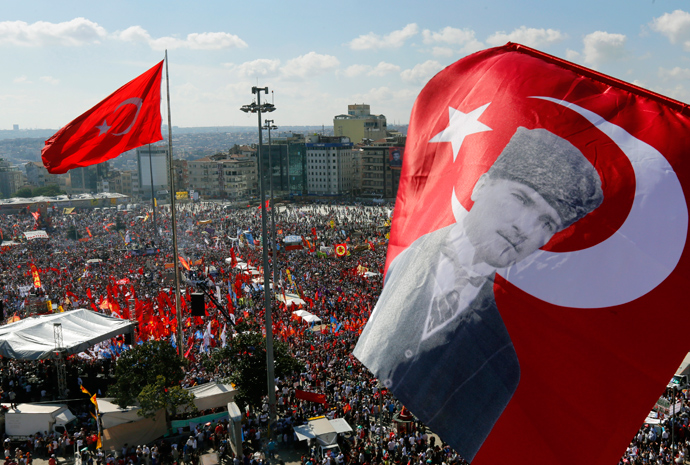
Turkish flag depicting Mustafa Kemal Ataturk as thousands gather in Istanbul's Taksim square June 9, 2013

Police again deployed tear gas and water cannons to quell more than thousands protesters that gathered in downtown Ankara. Just a few kilometers away, the Turkish PM was addressing his supporters after warning his patience with the demos “has a limit”.

At least two people were injured in fresh clashes in downtown Kizilay square in the Turkish capital, AFP reported.

Turkish Prime Minister Tayyip Erdogan, was meanwhile addressing supporters elsewhere in the city, calling on them to prepare for pro-government rallies next weekend in Istanbul and Ankara.

“On Saturday, are you ready for a big Ankara meeting? … The next day we will have the Istanbul meeting,” Erdogan said to cheering crowds in Ankara, as riot police moved in against protesters.

On Sunday, Erdogan held a string of pro-government rallies across the country.

Erdogan remained defiant over the ongoing protests, again calling the protesters “marauders” and urging the supporters of his Justice and Development Party (AKP) to “teach them a lesson” at the next local polls as he spoke in the southern Turkish city of Adana.

“Those now at Taksim, those who burn and destroy, those at various places across the country, I ask them, in the name of which freedom are you doing this?” Erdogan said in a speech at the Mediterranean Games in Mersin.

“There is an end to our patience,” Erdogan warned in Ankara airport, as the massive crowd of his supporters chanted slogans like “We are ready die for you, Tayyip!”

The Taksim protesters do not represent all the people of Turkey, the prime minister argued.

“Are the people only those at Gezi Park? Aren’t those who came to meet us at Istanbul airport people too? Those who are gathered now in Ankara; aren’t they people, too?” he exclaimed.

On Saturday night, a rally in the Turkish capital which started peacefully was also dispersed with tear gas and water cannons. According to witness reports on Twitter police were targeting and detaining “random” youths in the crowd. At least three arrests were reportedly made.

Authorities deployed over 4,000 riot police to quell the unrest, witnesses claim.

In Istanbul, a massive crowd packed the whole of Taksim Square was joined by the fans from rival football teams Fenerbahce, Besiktas and Galatasaray, AFP reports. Police kept away from the scene. In the city’s western Gazi neighborhood things did not go so peacefully as protesters hurled incendiary devices and taunted police, which resulted in fresh clashes.

Earlier, parliamentary Speaker Cemil Cicek said the mass protests that have been gripping the country are now “under control” and the process “is becoming normalized and increasingly in line with common sense.”

“We are ready to listen to all reasonable, legal and democratic demands,” he added.

At the same time, Istanbul’s mayor declared that Gezi Park would not be used as a venue to build a shopping mall, but the project to create a replica of Ottoman-era military barracks there would continue.

“We are definitely not thinking of building a shopping mall there, no hotel or residence either. It can be… a city museum or an exhibition center,” Istanbul mayor Kadir Topbas said as quoted by AFP. “The plan for the barracks was part of our election promises, the people gave us the authority to do it.”

The Turkish government dismissed press rumors of an early election on Saturday following the party meeting on the grounds it was unnecessary. Prime Minister Erdogan, who has been criticized by protesters for his overly authoritarian ruling style, returned to Turkey on Thursday night to a throng of supporters at Istanbul airport. A number of counter-demonstrations are said to be planned next week, as anti-government protests enter their 10th day.

Social upheaval began in Turkey last week when a demonstration against the demolition of a central park in Istanbul was brutally dispersed by police. In response, protesters occupied Istanbul’s Taksim Square and clashed with police repeatedly during the subsequent days. Many are calling for Prime Minister Erdogan’s resignation.

Turkey’s PM sees Twitter as problem

Turkey’s PM has vowed that development of Taksim Square will go ahead, despite ongoing protests. Tayyip Erdogan made the remark in Tunisia on his way back to Turkey. Erdogan is also under scrutiny, with opponents blasting him as authoritarian.

As the protests entered their seventh day, casualties have risen, with three people dead and more than 4,000 injured. What began as an environmental protest against the demolition of Taksim Gezi Park in Istanbul to build a mall has turned into Turkey’s biggest wave of anti-government protest in years.

“There is a problem called Twitter right now and you can find every kind of lie there. The thing that is called social media is the biggest trouble for society right now,” Erdogan said before leaving for North Africa. The Turkish prime minister also slammed the protests as undemocratic, and dismissed them as being organized by extremists.

In their list of demands issued to Erdogan, activists are calling for the firing of the chiefs responsible for the violent police crackdown, the release of protesters detained by police, and for a ban on the use of teargas. If these demands are fulfilled, protesters said they would end the riots.

The period of time after Erdogan returns Thursday from his three-day tour of North Africa is vital for Turkey, as public pressure may force the prime minister to reverse several of his own policies.

So far, Erdogan has only singled out scapegoats in the unrest, RT’s Irina Galushko reported from Istanbul.

He assailed the social networks used by demonstrators to organize protests and post updates; many demonstrators turned to Twitter and Facebook as a mobilization tool, as local media were largely silent during the initial stages of the protests.

However, Deputy Prime Minister Bulent Arinc, who is formally in charge while Erdogan is abroad, apologized on Tuesday for the police brutality against demonstrators. Turkish police have been roundly criticized for their widespread use of teargas and water cannons to disperse crowds of protesters.

Erdogan has been described as a man who rarely bows to opposition, and cannot handle criticism.

“He completely dislikes opposition to his ideas. He takes it as a personal offense. He’s used to having agreement from the country after having gained 50 percent of the votes. This time he didn’t assume the protest would be so big”, columnist and TV host Mutlu Tonbekci told RT.

Journalists Cengiz Candar told Reuters that “Erdogan takes things very personally and has developed a very authoritarian style.”

“Everybody here was being gassed, and people here were trying to resist and trying to keep this park, and he was telling that we are looters and there’s no project going on, and then he changed his mind, saying there’s of course a project and I will do what I want to do,” activist Nazan Ustundag said to RT.

“Our intelligence work is ongoing [to determine the foreign actors behind the protests],” Erdogan said on Monday. “It’s not possible to reveal their names. But we will have meetings with their bosses.”

Conservative Turkish newspaper Yeni Safak reported that foreign mercenaries were among the protesters, according to authorities: “750 to 1,000 people, agents, many of whom are foreign nationals, infiltrated the ranks of the demonstrators, and who are being paid by foreign intelligence.”

As clashes continue, some believe that Erdogan will go to great lengths to avoid embarrassment, as any sign of weakness could break up his party. “Erdogan cannot backtrack now. It would mean defeat,” car dealer Ali Aydin told Reuters. “Weakness would destroy the party.”

The prime minister may also be ill-equipped to dealing with the recent developments. “This is an unprecedented situation for Erdogan. Some people in [the ruling AKP party] think that his policies have to soften, but they remain loyal to party discipline and to Erdogan himself,” Reuters quoted a source close to the AKP as saying.

Many protesters believe that the prime minister has lost touched with reality, and is inflexible and unwilling to compromise.

Erdogan has alleged that hundreds of foreign agents are working to create unrest in the country. He maintains that these agents instigated the protests and are continuing to lurk among the crowds, encouraging dissent and turmoil.

Authorities have arrested some 15 foreign nationals across the country in connection with the protests, Today’s Zamaan newspaper quoted an unnamed governmental source as saying. Many were reportedly Iranian nationals, a country on Erdogan’s blacklist.

Despite the widespread protests, Erdogan remains a popular politician. He is known for his assertive leadership style, and his AK Party holds around two-thirds of the seats in parliament. But a key question remains: How will he handle the protests that are continuing to rock Turkey?

Erdogan is famous for his concrete human rights reforms, including granting rights to the country’s Kurdish minority, the opening of European Union entry talks, and a separation of the government and military. He has lately faced criticism for pressuring the media and for restrictions on alcohol sales.- RT

Turkish parliament votes for cross-border military operations in Syria

Turkey’s parliament has authorized cross-border military operations into Syria. The move follows a cross-border mortar-shelling into Turkey which Damascus has apologized for.

The Turkish parliament voted 320-129 in favor of the bill, though the government was quick to eliminate the perception they country preparing for a unilateral military assault.

Turkish Prime Minister Recep Tayyip Erdogan said Turkey “does not want to “start a war”  with Syria while speaking at a press conference on Thursday evening .

“All we want in this region is peace and security. We have no intention of starting war. We are aware of the outcome, consequences, of war in Iraq and Afghanistan…we see the same in Syria,” Al Jazeera cites him as saying. But Errdogan warned the country was capable of defending itself against threats after he claimed that new shells coming from Syria had landed on Turkish soil on Thursday.

“An accident can be called ‘an accident’ once, twice, three times, but four, five six times,” Errdogan continued.

His statements regarding the bills follow those made by Deputy Prime Minister Besir Atalay following the vote on Thursday.

“The bill is not for war… It has deterrent qualities,” he said.

Atlay stressed that Turkey’s priority was to act in conjunction with “international institutions” on Syria. He further said the Syrian government “has admitted what it did and apologized. The deputy premier added that Syria had given its assurances “such an incident would not be repeated.”

Following an exchange of fire at the Syrian-Turkish border, the US and NATO have condemned Syria and pledged to support Turkey. The White House has called for more pressure to be exerted on Damascus.

NATO’s North Atlantic Council has convened tonight for an urgent meeting upon the request of Turkey, to discuss the shelling of the town of Akcakale.

“The most recent shelling on 3 October 2012, which caused the death of five Turkish citizens and injured many, constitutes a cause of greatest concern for, and is strongly condemned by, all Allies,” NATO said in a statement.

“In the spirit of indivisibility of security and solidarity deriving from the Washington Treaty, the Alliance continues to stand by Turkey and demands the immediate cessation of such aggressive acts against an Ally, and urges the Syrian regime to put an end to flagrant violations of international law.”

According to officials the meeting has been held under article 4 of NATO’s code, concerning consultations when a member state feels territorial integrity is under threat.

Syria’s UN envoy said on Thursday that “Syrian authorities confirmed that they are seriously investigating the source of the [attack] that lead to the death of Turkish citizens.”

Ambassador Bashar Ja’afari read out a letter which had been delivered to the UN Security Council expressing Syria’s “deepest condolences” to the families of the victims which killed five civilians in southeast Turkey.

He called for both sides to act “wisely” and “rationally”, saying that “undisciplined, armed terrorists” operating on the countries’ shared border posed a threat not only to Syria, but the greater region. He further claimed the long Turkish-Syrian border had been used as a conduit for terrorists to smuggle arms into Syria.

Ja’afari insinuated the Turkish response to the incident had been disproportionate, however, saying that Turkey had shelled southern Syria for nearly 12 hours straight following Wednesday’s attack.

A document posted online by an al-Qaeda affiliated group called the al-Nusra Front claimed responsibilty for the multiple bombings.

US Secretary of State Hillary Clinton in contrast was quick to condemn Syria for Wedensday’s mortar attack in Turkey. “We are outraged that the Syrians have been shooting across the border. We are very regretful about the loss of life that has occurred on the Turkish side. We are working with our Turkish friends.”

­After the Turkish parliament approved military operations against Syria, thousands of anti-war protesters took to the streets of the biggest Turkish city, Istanbul. About 5,000 people joined an anti-war rally that finally turned into an anti-government demonstration against Turkey’s ruling Justice and Development Party, headed by Prime Minister Recep Tayyip Erdogan.

Anti-war protests near the parliament in the capital, Ankara, turned violent, with protesters clashing with police who tried to prevent demonstrators from moving around the capital.

­After a heated debate an urgent parliamentary session has opted to apply the new law.

Originally the bill targeted militants of the Kurdistan Workers Party (PKK) fighting for independent Kurd state for the last three decades. The Kurds have bases in northern Iraq, de-facto not controlled by the government in Baghdad. The Turkish military has conducted a number of air and ground assaults on Kurdish positions in Iraq, most of them considered successful.