BRICS to set up own IMF

bricsmapVery soon, the IMF will cease to be the world’s only organization capable of rendering international financial assistance. The BRICS countries are setting up alternative institutions, including a currency reserve pool and a development bank.

The BRICS countries (Brazil, Russia, India, China and South Africa) have made significant progress in setting up structures that would serve as an alternative to the International Monetary Fund and the World Bank, which are dominated by the U.S. and the EU. A currency reserve pool, as a replacement for the IMF, and a BRICS development bank, as a replacement for the World Bank, will begin operating as soon as in 2015, Russian Ambassador at Large Vadim Lukov has said.

Brazil has already drafted a charter for the BRICS Development Bank, while Russia is drawing up intergovernmental agreements on setting the bank up, he added.

In addition, the BRICS countries have already agreed on the amount of authorized capital for the new institutions: $100 billion each. “Talks are under way on the distribution of the initial capital of $50 billion between the partners and on the location for the headquarters of the bank. Each of the BRICS countries has expressed a considerable interest in having the headquarters on its territory,” Lukov said.

It is expected that contributions to the currency reserve pool will be as follows: China, $41 billion; Brazil, India, and Russia, $18 billion each; and South Africa, $5 billion. The amount of the contributions reflects the size of the countries’ economies.

Source: Vz.ru

BRICS rejects sanctions against Russia

Singh, Putin , Xi
Xi, Putin , Singh

The group of five major emerging national economies known as the BRICS has rejected the Western sanctions against Russia and the “hostile language” being directed at the country over the crisis in Ukraine.

“The escalation of hostile language, sanctions and counter-sanctions, and force does not contribute to a sustainable and peaceful solution, according to international law, including the principles and purposes of the United Nations Charter,” foreign ministers of the BRICS countries – Brazil, Russia, India, China and South Africa – said in a statement issued on Monday.

The group agreed that the challenges that exist within the regions of the BRICS countries must be addressed within the framework of the United Nations.

“BRICS countries agreed that the challenges that exist within the regions of the BRICS countries must be addressed within the fold of the United Nations in a calm and level-headed manner,” the statement added.

The White House said earlier on Monday that US President Barack Obama and the leaders of Britain, Canada, France, Germany, Italy and Japan decided to end Russia’s role in the G8 over the crisis in Ukraine and the status of Crimea.

Meanwhile, the G7 group of top economic powers has snubbed a planned meeting that Russian President Vladimir Putin was due to host in the Black Sea resort city of Sochi in June.

The G7 said they would hold a meeting in Brussels without Russia instead of the wider G8 summit, and threatened tougher sanctions against Russia.

Russia brushed off the Western threat to expel it from the G8 on the same day. The Autonomous Republic of Crimea declared independence from Ukraine on March 17 and formally applied to become part of Russia following a referendum a day earlier, in which nearly 97 percent of the participants voted in favor of the move.

On March 21, Putin signed into law the documents officially making Crimea part of the Russian territory. Putin said the move was carried out based on the international law.

Source: Press TV

BRICS puncture credit bubbles risking deflationary shock

bartdrunkHalf the world economy is one accident away from a deflation trap. The International Monetary Fund says the probability may now be as high as 20pc.

It is a remarkable state of affairs that the G2 monetary superpowers – the US and China – should both be tightening into such a 20pc risk, though no doubt they have concluded that asset bubbles are becoming an even bigger danger.

“We need to be extremely vigilant,” said the IMF’s Christine Lagarde in Davos. “The deflation risk is what would occur if there was a shock to those economies now at low inflation rates, way below target. I don’t think anyone can dispute that in the eurozone, inflation is way below target.”

It is not hard to imagine what that shock might be. It is already before us as Turkey, India and South Africa all slam on the brakes, forced to defend their currencies as global liquidity drains away.

The World Bank warns in its latest report – Capital Flows and Risks in Developing Countries – that the withdrawal of stimulus by the US Federal Reserve could throw a “curve ball” at the international system.

Source: The Telegraph

Citrus farmers will have to look to BRICS

lemoenSouth African citrus farmers may have to find markets other than the European Union (EU) for their citrus exports. This follows the EU’s decision to ban this season’s citrus crop as a result of fungal black spot.

AgriSA president, Johannes Moller, says the EU’s ban on local citrus is an artificial trade barrier imposed at the request of European farmers fighting for a bigger market share.

South Africa is the biggest citrus exporter to the EU ringing up R13 billion sales a year.

But this year EU inspectors were on the lookout for black spots, fearing that it might spread to Europe’s citrus groves, especially in Spain. Before the South African season ended last month, 36 shipments were turned back and on Thursday a ban was placed on further exports this year.

The European Food Safety Authority is to release a decision next month about future exports. Letsitele farmers say they have exported citrus to Europe for the past 80 years without transmitting black spot.

AgriSA meanwhile says farmers will have to look for new markets regardless of whether the ban is maintained in the New Year. These will include South Africa’s fellow BRICS nations – Brazil, India, China and Russia.

While harmless to humans, citrus black spot causes unsightly lesions on the fruit and leaves, reducing both harvest quality and quantity.

New BRICS cable a network free of US eavesdropping

bricscableBRICS countries are close to completing a brand new Internet backbone that would bypass the United States entirely and thereby protect both governments and citizens from NSA spying.

In light of revelations that the National Security Agency hacked German Chancellor Angela Merkel’s phone, in addition to recording information about 124 billion phone calls during a 30-day period earlier this year, the fallout against the NSA has accelerated.

Brazil is set to finalize a 34,000-kilometre undersea fiber-optic cable by 2015 that will run from Vladivostok, Russia to Fortaleza, Brazil, via Shantou, China, Chennai, India and Cape Town, South Africa.

According to the Hindu, the project will create, “a network free of US eavesdropping,” which via legislative mandates will also force the likes of Google, Facebook and Yahoo to store all data generated by BRICS nations locally, shielding it from NSA snooping.

“The BRICS countries have the muscle to pull this off,” notes Washington’s Blog. “Each of the BRICS countries are in the top 25 largest economies in the world. China has the world’s second largest economy, India is 3rd, Russia 6th, Brazil 7th, and South Africa 25th.”

However, some privacy experts fear that this will do little to stop the NSA, given that it has tapped undersea cables since the Cold War era. Others are more positive.

“Any alternative would be a positive thing, writes Michael Dorfman. “The more choice you have, the better. Yet no-one can say for sure whether this new Internet will be safer than its US counterpart and will be able to protect the rights of regular users, including the privacy of personal data and free access to resources, more effectively.”

The BRICS cable was already in development months before the revelations of whistleblower Edward Snowden first became public in June.

In September it emerged that the NSA had been spying on Brazilian government communications as well as Brazilian oil company Petrobras. Spooks hacked into the firm’s computer network to eavesdrop on conversations between CEOs.

The current Internet architecture is dominated by ICANN (the Internet Corporation for Assigned Names and Numbers), which is largely controlled by the United States.

Other entrepreneurs are also fighting back against NSA surveillance. Tech maverick John McAfee recently announced that he was to fund a $100 gadget named Decentral that would sync up with a modem to thwart NSA spying and provide total anonymity.

Asked what he would do if the US government banned the product, McAfee responded, “I’ll sell it in England, Japan, the Third World. This is coming and cannot be stopped.” – prisonplanet.com

Zuma attends G20 in St Petersburg

G20russiaPresident Jacob Zuma has arrived in St Petersburg, Russian Federation for the G20 Leaders’ Summit.

A meeting of BRICS Leaders was scheduled, giving leaders an opportunity to reflect on the progress made with regards to the implementation of the eThekwini Declaration, notably receiving progress reports in respect of the New Development Bank and the Contingent Reserve Arrangement.

President Zuma is accompanied by the Minister of Finance, Mr. Pravin Gordhan, and the Minister of International Relations and Cooperation, Ms. Maite Nkoana-Mashabane.

The primary objectives of the G20 are to facilitate policy coordination in order to achieve global economic stability and promote long-term sustainable growth.

South Africa’s participation in the G20 is guided by national interests and the primacy of the African Agenda. South Africa therefore seeks to use its participation in multilateral fora such as the G20 to promote and strengthen the interests of the African continent and those of the Southern hemisphere. In this regard, the G20 presents meaningful opportunities for advancing much-needed global governance reforms and orienting the international development agenda.

G20 countries account for 85 percent of global economic output, 80 percent of global trade, and two-thirds of the world’s population.

It is envisaged that the G20 Summit will focus on a set of measures aimed at boosting sustainable, inclusive and balanced global growth, including the creation of decent jobs. During its tenure as G20 President, Russia has focused its work on the interconnected issues on the G20 agenda around three priorities, which are intended to promote:

* Growth through quality jobs and investment;

* Growth through trust and transparency; and

* Growth through effective regulation.

Unemployment and ongoing problems and vulnerabilities in the global economy were discussed by Brics leaders on the margins of the G20 summit in Russia on Thursday, the presidency said.

“[We] believe that major economies, including the G20, could do more to boost global demand and market confidence,” said President Jacob Zuma, who chairs Brics — which consists of the Brazil, Russia, India, China, and South Africa group of emerging economies.

The leaders reiterated the concerns they expressed at the Durban Brics summit in March about the unintended negative spill-overs of the unconventional monetary policies of certain developed economies.

“[We] recalled the urgent need to implement the 2010 International Monetary Fund quota and governance reform, as well as to complete the next general quota review by January 2014, as agreed at the G20 Seoul summit in order to ensure the fund’s credibility, legitimacy, and effectiveness,” said Zuma.

Brics looked forward to the ninth World Trade Organisation ministerial conference, to be held in December.

“[We] expect that it will be a stepping stone to the successful and balanced conclusion of the Doha Development Round,” Zuma said.

The leaders also congratulated Russia on successfully hosting the G20 summit, which started on Thursday and runs until Friday. – Sapa

BRICS makes its presence felt

bricsTotal trade within the BRICS (Brazil, Russia, India, China, and South Africa) grouping amounted to $6.1 billion last year, President Jacob Zuma said on Tuesday.

“This represents 16.8 percent of global trade,” he told delegates at the BRICS business council meeting in Johannesburg.

“The presence and influence of the BRICS grouping continues to be felt.”

Zuma said the strength of BRICS was amplified by the fact that these countries accounted for 43 percent of the world’s population.

“Indeed, we are all gathered here because we see value in the BRICS partnership in many respects.”

In 2012, South Africa’s total trade with BRICS countries stood at R294bn, up from R264bn in 2011.

Total trade with Brazil grew from R18bn in 2011 to R20bn in 2012, and with Russia from R3bn in 2011 to R5bn in 2012.

Zuma said total trade with India, South Africa’s sixth largest trading partner, grew substantially from R53bn to R67bn.

Trade with China grew from R188bn in 2011 to R201bn in 2012.

“All these impressive statistics… should provide you with the determination and confidence to deliver on the imperatives…” he told delegates.

Trade and Industry Minister Rob Davies said the council meeting was intended to deepen the partnerships to enhance co-operation and development on the African continent.

BRICS council South African chairman Patrice Motsepe said it was crucial that the commitment to increase trade and investment was seen, and “quantifiable”.

“There’s a new sense of urgency,” Motsepe said.

He emphasised “value-added trade” and common objectives being sought.

“BRICS is not about excluding other countries,” said Motsepe.

“We want to see investments quantify… It is important to build on the BRICS partnership.” – Sapa

Russia to give SA nuclear training input

rosatomRussia’s State Nuclear Power Corporation, Rosatom, which is busy positioning itself in case South Africa decides to build new nuclear power plants, has signed an agreement with North West University that will see it getting involved in training nuclear industry specialists for the country.

Rusatom Overseas, a Rosatom branch that specialises in the promotion of the corporation’s projects abroad, last week signed a memorandum of cooperation with North West University, the only institution in South Africa that offers postgraduate degrees in nuclear engineering.

The memorandum envisions the development of collaboration programmes in research, exchanges of experts, joint seminars and the writing of textbooks. A joint working group is to draw up a list of projects for collaboration.

“We are pleased to announce the signing of the MoU with our Russian colleagues,” said Professor Herman van Schalkwyk, rector of the Potchefstroom Campus of North West University. “We recognise that nuclear energy remains an important option for South Africa.

“The intention is to explore the potential for future collaboration, ranging from education to specific technical projects in nuclear engineering, hydrogen technologies, energy, etc.”

Jomart Aliyev, director-general of Rusatom Overseas, said the memorandum would promote the development of technical education in South Africa, while giving local researchers and scientists the opportunity to find out more about modern Russian technologies.

Joint research and scientific developments, he said, would “provide a solid foundation for the development of Rosatom’s business relations in South Africa”.

Russian President Vladimir Putin said after a meeting with South African President Jacob Zuma in Sochi in May that Russia was ready to assist South Africa in building up a comprehensive nuclear power engineering industry.

South Africa’s Koeberg nuclear plant is the only nuclear power-generating facility on the African continent.

South Africa’s Integrated Resources Plan (IRP) for 2010 to 2030, a 20-year projection on the country’s electricity supply and demand, envisages 9 600 MW of additional nuclear capacity by 2030. The plan is due to be reviewed soon.

Speaking at the Africa Energy Indaba in Johannesburg in February, Energy Minister Dipuo Peters said South Africa planned to expand its use of nuclear power in a safe and secure way as a key part of the country’s move towards a diversified, low-carbon energy mix.

“If we are serious about diversification towards a low carbon economy, we cannot belittle the role that natural gas and nuclear power can play in the realisation of that 2030 low-carbon energy vision,” Peters said.

Rosatom is ranked fourth in the world for nuclear electricity generation, accounting for 17% of the world nuclear fuel market. It conducts 45% of the world’s uranium enrichment services, and is ranked the second in the world for uranium reserves and fourth for uranium production.

The company last year opened a marketing office in Johannesburg, only its third such office after Ukraine and Singapore, and sent a high-level delegation to Durban to take part in the 5th BRICS (Brazil, Russia, India, China and South Africa) summit in March-April. – gov.za-Itar-Tass, with additional reporting by SAinfo


SA’s nuclear war heats up

Koeberg
Koeberg

Government denied on Friday that a nuclear committee was restructured to remove Deputy President Kgalema Motlanthe.

“Government has noted misleading allegations by the Mail & Guardian on the restructuring of the National Nuclear Energy Executive Co-ordinating Committee (NNEECC), and dismisses the statements as devoid of truth,” acting government spokesperson Phumla Williams said.

According to a report in the publication President Jacob Zuma “quietly” replaced Motlanthe and took over as the body’s chair.

This was “further downgrading” Motlanthe after he lost his bid for the ANC presidency last year.

The article reads: “Zuma is now firmly directing what is expected to be the largest, most complex tender process in South African history. At stake is the development of new nuclear power plants, potentially worth up to a trillion rand.”

Zuma was “courting” the Russians with meetings where nuclear co-operation was high on the agenda, it said.

Williams said the NNEECC was set up in 2008 to lead, monitor, and ensure oversight of implementation of the country’s nuclear energy policy.

It had been restructured to improve effectiveness. In April Cabinet approved further restructuring, with the support of the Nuclear Energy Technical Committee.

The revised committee was chaired by Zuma and comprised the ministries of energy, public enterprises, finance, state security, defence, and international relations. The committee was reduced to strengthen its efficiency in decision-making.

“Government dismisses suggestions that the restructuring was an attempt to remove the deputy president from the structure,” she said.

It was mischievous to suggest that diplomatic relations between South Africa and Russia were linked to the country’s energy plans.

“Such an allegation is baseless, as South Africa is a member of the [Brazil, Russia, India, China, South Africa] bloc and is bound to have meetings with its counterparts as and when it is required,” Williams said.

The review of Cabinet committees was an ongoing process and attempts to read anything into them was “pure mischief”. – Sapa

Brazil claims South Africa is dumping tyres

tyresSouth African manufacturers of truck and bus tyres are the latest target of a Brazilian antidumping investigation against South Africa, following an application by the Brazilian body representing tyre manufacturers, ANIP.

This comes in the wake of another trade probe of South Africa, over allegations of Sasol dumping polypropylene products, launched in March this year. Meanwhile, the tiff between the two Brics (Brazil, Russia, India, China and South Africa) members about cheap chicken imports to South Africa has been continuing.

Brazil threatened legal action at the World Trade Organisation (WTO) last year when South Africa’s International Trade Administration Commission investigated the dumping of frozen Brazilian poultry in South Africa and introduced a provisional antidumping duty.

Brazil initiated an antidumping probe on June 10 into imports of new truck and bus tyres from South Africa, Russia and Asian countries, giving importers 40 days to respond. It alleged South Africa’s manufacturers were dumping at a 51.98% discount.

South African Tyre Manufacturers Conference CEO Etienne Human said the claim only recently came to its attention. “The (conference’s) members are in the process of obtaining technical advice on how to deal with the Brazil antidumping application.”

An industry expert on Wednesday said Brazil had been “quite aggressive” in protecting its manufacturing industry, and implied that the authorities did not always follow WTO rules diligently on the introduction of trade remedies.

International trade law firm Felsberg & Associates said Brazil had introduced five antidumping investigations within two months at the end of last year, ranging from seamless carbon steel pipe imports from China to tyres from South Korea, Thailand, Taiwan and the Ukraine.

Apparently requests by the South African Tyre Manufacturers Conference for discussions with the Brazilian authorities had been unsuccessful.

The tyre antidumping initiation document says that due to the lack of pricing data for the products probed, the normal value for all investigated countries was based on “estimates of production costs, operational expenses and profit margins”. – BDLive

China, Brazil drop Dollar

China and Brazil agreed to trade in each other’s currencies just hours ahead of the BRICS summit in South Africa.

The deal, which extends over a three-year period and amounts to an exchange of about $30 billion in trade per year, marks the latest effort among two of the world’s largest emerging economies to shift the dynamics of international trade that have long favored the U.S. dollar.

“Our interest is not to establish new relations with China, but to expand relations to be used in the case of turbulence in financial markets,” Brazilian Central Bank Governor Alexandre Tombini said, Reuters reported.

By shifting some trade away from the U.S. dollar, the world’s primary reserve currency, the two countries aim to buffer their commercial ties against another financial crisis like the one that resulted from the collapse of the U.S. housing market bubble in 2008.

“Trade ties between China and Brazil are of great importance to the two countries’ economies amid global woes and the member states’ economic stability is vital for the BRICS mechanism,” said Zhou Zhiwei, a researcher with the Chinese Academy of Social Sciences, Xinhua reported.

Trade between China and Brazil has exploded in recent years from $6.68 billion in 2003 to over $75 billion in 2012, and in 2009, China replaced the U.S. as Brazil’s main trading partner.

The trade deal comes before a summit of the BRICS nations (Brazil, Russia, India, China and South Africa) in Durban, where the group of five is expected to discuss the establishment of an international development bank.

“BRICS Development Bank will make the global financial sector more democratic,” said Brazil’s Minister for Development, Industry and Foreign Trade Fernando Pimentel, according to Xinhua.

China and has touted the proposed bank as an alternative to international financial institutions like the World Bank, which funds infrastructure and development projects in emerging economies around the world.

With a combined GDP of over $14 trillion, the BRICS is looking to expand its economic influence throughout African countries in particular.

“We are creating new axis of global development,” Anand Sharma, India’s Minister of Commerce, Industry and Textiles, Xinhua reported. “The global economic order created several decades ago is now undergoing change and we believe for the better to make it more representative.” – IBT

Russia seals energy, military cooperation with South Africa

The Russian-South African talks on the sidelines of the BRICS summit produced a wide range of agreements, including a joint declaration on strategic partnership, cooperation in communications and joint construction of nuclear power plants.

Russia is ready to provide credit support for South Africa to build nuclear power plants using Russian specialists. Development of cooperation with South Africa in the energy sector has a huge potential, according to the Russian leader.

“Russia is offering South Africa not only to help with construction of nuclear power reactors, but also with the creation of an advanced nuclear power industry, including the extraction of raw materials, construction of NPPs and research reactors, design and domestic production of nuclear power equipment with Russian credit support,”  RIA Novosti has quoted Putin as saying.

Besides the nuclear sphere, Putin and his counterpart Jacob Zuma also agreed on cooperation in the field of communication. In particular, South Africa will help Russia maintain the Global Navigation Satellite System (GLONASS).

“A quantum-optical system will be established in South Africa to increase the accuracy of GLONASS signal reception in the Southern Hemisphere,” Putin told journalists at the press-conference.

The Russian leader also added that the Space center in South Africa will be used to retrieve data from Russian satellites according to the “Radioastron” Project. The sides signed the essential document on Tuesday after the high-level talks.

Putin set a target to increase the trade turnover between the two states.

“Our countries have a good basis for increasing cooperation. In 2012, the turnover grew by a record 66.3 per cent, almost reaching $ 1 billion, which is almost twice more than in 2011. In the medium term we plan to increase the volume of bilateral trade by several times,” Putin said, adding that Russian companies “raised more than $ 1 billion in mutually beneficial projects in South Africa, invested this money in its economy.”

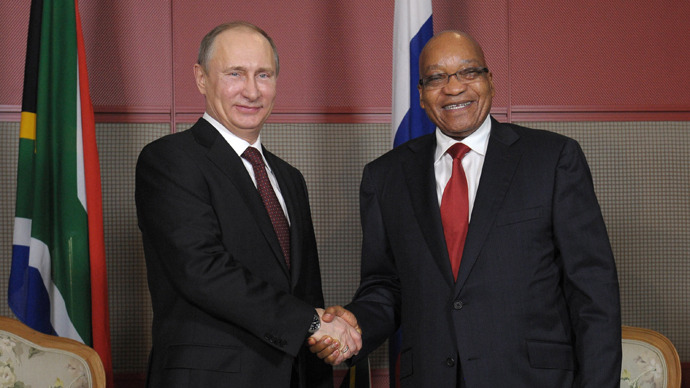
Russian President Vladimir Putin and President of South Africa Jacob Zuma (from right, background) during the signing of joint documents at a meeting in Durban. Foreground left – Russian Foreign Minister Sergei Lavrov on March 26, 2013. (RIA Novosti / Alexsey Druginyn)

Russia and South Africa have agreed to coordinate their actions for key global problems, including the current situation in Syria.

“Russia and South Africa share common approaches to key global issues. We cooperate in the UN, the BRICS and other international organizations. We agreed to further coordinate our actions, including for peaceful solutions to the Syrian crisis,” said Putin.

The Russian President also promised to think about the possibility of Russia’s support for a UN Security Council resolution on the cross-border provision of humanitarian assistance to Syria.

Russia and South Africa signed a declaration on a strategic partnership.

In particular, the document states the need to “enhance military cooperation, including military and military-technical cooperation on a long term basis and other forms of interaction between the armed forces of the two countries.”

The sides also agreed to cooperate in the fight against international terrorism, separatism, organized crime and drug trafficking. – RT

Four big Brics announcements awaited

Four concrete deliverables are expected at the 5th BRICS Summit at Durban March 26-26, 2013, that will take the process of the five-nation bloc forward to the next level, Indian officials said on Monday.

Prime Minister Manmohan Singh, who arrived here on Monday evening, will join the leaders from Brazil, Russia, China and South Africa for the summit, being held in the African continent for the first time.

The four deliverables expected at the summit are:

– The eThekwini Declaration, named after the alternate name for Durban to set the future agenda for the bloc

– The launch up of the BRICS Business Council on Wednesday at the breakfast meeting among leaders.

– A consortium of five think tanks from each of the five countries, with India represented by the Observer Research Foundation.

– Two pacts on BRICS Multilateral Infrastructure Co-financing Agreement for Africa and BRICS Multilateral Cooperation and Co-financing Agreement for Sustainable Development where India is represented by its Exim Bank.

Ahead of the summit, the prime minister had said in a statement that he looked forward to engaging with the other BRICS leaders on ways to spur global growth, sustain macroeconomic stability and push investments.

“At a time when the world is facing multiple challenges, the Durban Summit provides a useful and timely opportunity to consult and coordinate on a broad range of issues with our BRICS partners,” he said.

“We will discuss ways to revive global growth and ensure macro-economic stability, as well as mechanisms and measures to promote investment in infrastructure and sustainable development,” he said.

“India will also urge faster movement on reform of institutions of global political and economic governance. It is important that BRICS continue to consult closely on developments affecting global peace and security.” – ibnlive.in.com

Better governance will improve Brics growth

The world’s five emerging economic powerhouses will experience significantly slower growth if they delay in implementing key political reforms, according to a report released on Monday by Germany’s Bertelsmann foundation.

The report said the five Brics countries – Brazil, Russia, India, China and South Africa – must focus on creating competent and stable political institutions and improving their education, health and judicial systems in order to achieve sustainable growth.

Brazil, which the report says has halved incidences of extreme poverty and moved 20 million people into the middle class in the last decade, was called “the most promising of the Brics states” because of its institutional reforms and infrastructure improvements.

The “worst-performing” country in the comparative study was Russia, which suffers from “a unilateral economic strategy, patronage and the lack of involvement of civil society.” It said Russia must diversify its economy by overcoming its reliance on natural resources.

The Bertelsmann report, titled “Sustainable Governance in the Brics,” said the results for China were “ambivalent” as the country grapples with problems related to demography, social inequality and pollution. India too is plagued by “enormous regional and social imbalances,” as well as infrastructure shortfalls and widespread corruption, which hinder growth.

The report lauded South Africa for its economic stability, reduction of state debt and strengthening of social welfare policies, but said it held a “middling” position within the Brics, due in large part the poor performance of its education system and labour market. It has the highest level of social inequality in the grouping.

The five countries are home to 42% of the world population and make up some 18% of global gross domestic product (GDP). Goldman Sachs, the investment group that coined the Brics acronym in 2001, forecasts the countries to account for some 40% of global GDP by 2050. – Sapa