A restaurant in Sweden has been reported to the police for racism after calling one of its dishes “Gypsy Soup”, claiming as a joke that all the ingredients were stolen.
The prank was the idea of the Lundavägens Grill restaurant, in Malmo, southern Sweden. It’s daily menu offered a “zigenarsoppa”, stating in brackets that it had got its name only because everything in it was a result of robbery.
But one female diner failed to get the joke and reported the grill’s owner to police.
“This is not acceptable. Veiled racism in Malmö is dangerous,” she told Sweden’s Metro newspaper.
Apologetic restaurant owner Slavko Rasic said he had not meant to offend, but accepted that some people might find it upsetting.
“I’ll take it like a man,” he said.
“I don’t think I am specifically pointing the finger at any race when I call it ‘gypsy soup’,” he added before claiming the whole thing was a private joke.
Rasic also said that he could have called the dish “Elvis soup”, as his choice of name was nothing more than a word.
“It would be a different story if the soup was disgusting,” he added. New York Daily News
Two Swedish college students have apologized for showing up to a costume party in blackface in an attempt to impersonate reggae musicians.
The incident took place at a party thrown by the Lund University Technology Management student association, a group of about 80 masters students studying economics and technology, TheLocal.se reported Friday.
The incident raised eyebrows, particularly at Lund after students in 2011 staged a mock slave auction that drew international condemnation as being racist.
The students, whose names were not reported, said their intent was not to offend party-goers — one of whom snapped a picture and sent it to local media — but to pay tribute to reggae icon Bob Marley.
“We haven’t intentionally done something insulting or racist,” one of the students said. “But after the fact we’ve realized that painting our faces black offends some people.”
The group’s president said it was “unfortunate” that some people misinterpreted the students’ painted faces as racist.
“It was an innocent costume party,” Elin Wennerstroem, the group’s president said.
Other in attendance weren’t as forgiving.
Kalle Wigren, who lives near where the party took place, said he saw the incident and was offended.
“When a white person puts black makeup on their face to look like a black person and then proceeds to make fun of the situation, it can’t be anything other than racism,” he said. – UPI.COM
From spats over halal meat in Danish schools to asylum seekers in Sweden, anger about immigration has fuelled the march of populist parties across Nordic countries, leading one such group to the brink of government in prosperous Norway.
The anti-tax and anti-immigration Progress Party, which once had among its members mass killer Anders Behring Breivik, won 16 percent of votes on Monday and could be kingmaker in a new center-right coalition after eight years of center-left rule.
Its strength reflects both worries about an influx into the Nordics of asylum seekers from countries like Syria and economic migrants from Spain, as well as disenchantment with mainstream parties that have dominated the political landscape for decades.
“We’ll ensure a solid footprint in a new government,” Progress leader Siv Jensen said. “We have reason to celebrate.”
Even without entering government, right-wing populists have managed to toughen public policies ranging from immigration to euro zone bailouts, drag political debate to the right and become a permanent feature of the parliamentary landscape.
The backlash has surfaced even though Nordic economies have outperformed languishing southern European countries. Their success has attracted thousands of “euro refugees”, vying for scarce jobs as their home states endure grinding austerity.
Economic conditions may be different, but many voters around Europe share the same perception that the established parties are out of touch with ordinary people and their concerns.
From Greece to France and the Netherlands, unemployment and economic grievances have combined with suspicion of European integration, Islam and multiculturalism, to propel both the far right and far left.
In Italy, the grassroots 5-Star Movement, born of disgust at the entire political establishment, surged to prominence in a general election in February. Britain’s UK Independence Party has gained ground and spooked mainstream politicians by harnessing an anti-EU platform with hostility to immigration.
BACK FROM THE SIDELINES
Breivik’s killing of 77 people in Norway in 2011 initially set back hard right parties in the Nordics.
But the Danish People’s Party now has the support of nearly one in six voters. The anti-immigrant Sweden Democrats have almost doubled their support since the last general election to touch 10 percent, and Finland’s opposition Finns party stands second in opinion polls with 19 percent support.
Populist groups are nowhere near winning an election and the majority of Nordic voters still express tolerance to immigrants. But any of these parties could secure the balance of power and hold a coalition government hostage on issues like immigration.
Consensus around the post-war Nordic model of high taxes and generous welfare was long sustained by a homogenous society. But immigration, global competition and fear for jobs have put that ideal of equality based on civic trust under strain.
“There exist groups that don’t feel this trust,” said Swedish Prime Minister Fredrik Reinfeldt. “These people as voters are more easily seduced by populist forces seeking short-sighted answers and which often are more or less hostile to immigrants.”
Rising immigration has been coupled with economic troubles that have seen iconic Nordic companies such as Ericsson and Nokia shed jobs. Worries about the affordability of welfare have put the once taboo subject of immigration high on the agenda.
The nightmare for mainstream Nordic parties would be the experience of Denmark’s last government, when an anti-immigrant party held the balance of power and pushed for tighter border controls that fuelled tension with European neighbors.
Under Denmark’s current center-left government, immigration had faded as an issue until controversy surfaced when it was discovered that halal meat, slaughtered under Muslim dietary laws, was being served routinely at schools and hospitals – raising protests by anti-Islam groups.
Danish Prime Minister Helle Thorning-Schmidt waded into the debate – earning the nickname “meatball Helle’ after calling for voluntary labeling of halal meat but also urging that traditional Danish food including pork dishes be served.
The construction of a mosque in Copenhagen sparked accusations from the Danish People’s Party that it was being used for radical Islamist groups.
In Sweden, immigration has become part of the mainstream debate in a country where 15 percent of people are foreign-born, the highest rate in the Nordics. Riots in poor immigrant suburbs of Stockholm in May led to further debate about how Sweden was integrating its immigrants.
“Immigration is questioned by pretty considerable portions of the populace,” said Folke Johansson, a professor of political science at Sweden’s Gothenburg University. “It’s largely been taboo to discuss these issues, and therefore other mainstream parties haven’t been able to discuss it. It was really an open goal once they (anti-immigration parties) arrived on the scene.”
In Finland, the Finns party, whose anti-euro rhetoric struck a chord with voters in 2011, when they finished a close third in parliamentary elections, aims to join the next government.
Formerly known as True Finns, The Finns leapt to prominence during the euro zone debt crisis by opposing bailouts for troubled countries. They effectively forced the government to demand collateral in exchange for helping Greece and Spain.
Calling themselves a “nationalistic and center-left working class party”, the Finns would curb immigration by trimming immigrant social benefits and adjusting refugee quotas to Finland’s financial situation.
These parties have benefited from media-savvy leaders. The Sweden Democrats’ Jimmie Akesson, whose aim is to reduce immigration by 90 percent, wears a suit and as a lawmaker has changed the party’s former image of street ruffians.
Populists are expected to poll strongly in many countries in European Parliament elections next May, surfing a wave of Euroscepticism due to the financial and economic crisis.
But analysts say these Nordic parties may have hit a ceiling in national elections and are facing greater pushback even as they complicate coalition politics around the region.
Hundreds of Swedish women posted photographs of themselves with headscarves across social media this year to protest an attack on a Muslim woman in Stockholm who was wearing a veil.
Community leaders worry about aggressive rhetoric against migrants, and there have been other attacks. But violent incidents in Nordic countries have been isolated compared with, for example, far right attacks on migrants in Greece.
Reinfeldt’s government recently made headlines by giving Syrians an automatic right of residence.
Support for Norway’s Progress is actually down from 22 percent at the last election four years ago, although the parliamentary arithmetic gives it more leverage.
“The way Progress communicates is somewhat old fashioned and a bit cheesy,” said Daniel Gaim, 37, a teacher. “But when it comes to real policy, they don’t differ much from other parties. I’m not very concerned about giving them a bigger influence.” – yahoo.com
Music streaming companies now account for 70 percent of all music bought in Sweden, home of Spotify, the world leader in the field, official industry figures revealed on Sunday.
The Swedish Recording Industry Association (GLF) said physical sales of music now stood at just 25 percent, confirming the march of digital music in the pioneering country.
The remaining five percent of consumers downloaded music to own on a hard drive.
GLF said the percentage of streamed music, where songs are downloaded but not kept permanently on computers, had risen from 57 percent in 2012.
Sales of music overall grew by 12 percent in the first half of this year and have been increasing steadily since 2008, while not reaching the heights seen at the beginning of the last decade.
“The strong growth seen in 2012 continued in 2013, and the Swedish consumer’s preference for streaming is clearer than ever,” said Ludvig Werner, director in Sweden of the International Federation of the Phonographic Industry. – AFP
Former president Thabo Mbeki’s nephew died in Sweden last year under what now appears to have been suspicious circumstances.
Swedish police are facing accusations of brutality leading to his death. They have also been accused of attempting a cover-up.
Sunday World can reveal that Magnus Moerane (41), the son of Mbeki’s cousin Sophia Moerane, suffered fractures to his skull after being apprehended by the police in Stockholm in October.
It has emerged that Magnus was declared dead on arrival at a Stockholm hospital. But the police told Moerane that Magnus had been admitted to the intensive care unit of the hospital and could not be saved.
It took the intervention of the South African embassy in Sweden for Moerane to get full disclosure about her son’s death and access to the autopsy reports.
“The mission wrote a diplomatic note to the Swedish Foreign Ministry in which it was indicated that Moerane was not satisfied with the initial information provided, and that the embassy requested the authorities to provide a full disclosure around the circumstances of the death of Magnus Moerane.
“The Swedish authorities gave full co-operation to the SA embassy and provided the results of their investigations, including a second autopsy, to the embassy,” said Department of International Relations and Co-operation spokesman Clayson Monyela. He said the embassy could not interfere in the legal processes of a sovereign state.
Moerane believes her son was the victim of a racist assault by the police, similar to the shooting of a 69-year-old man of Portuguese origin in Stockholm last month, sparking riots.
A 73-year-old retired nurse, Moerane said she had known that her worst nightmare would soon become a reality when the police refused to show her the file on her son.
She reported Magnus missing a day after not hearing from him and after going to his flat.
Moerane last saw her son on October 30. He was dead the next day.
“The police told me to get an attorney because there was a problem,” she said.
Moerane’s ordeal worsened when she was told that she did not qualify for legal aid because she did not have home insurance.
She said her persistence in demanding answers from the police eventually led to them breaking the news of Magnus’s death to her and her youngest son, Vuyo (35).
“A man came into the room and said that, according to the report, the police had apprehended Magnus. They were forced to give him a bear-hug (tackle) to restrain him because he was big and tall.
“They said Magnus broke loose and fell on the concrete, which fractured his skull,” said Moerane.
Moerane phoned Mbeki a few weeks ago to tell him of the death of her son and the circumstances.
“I said: ‘Motswala (cousin), it’s bad.’ He went quiet and said: ‘I’m shocked,'” Moerane said.
Mbeki’s office was unavailable for comment at the time of publication.
Magnus was the eldest son of Mbeki’s cousin Moerane – the fifth child of Mbeki’s late uncle, Michael Moerane.
Michael Moerane was the elder brother of Mbeki’s mother, Epainette. He was a renowned music teacher and classical music composer.
The police said that after the 41-year-old fell he was put into a police car, then suffered seizures followed by heart failure .
The autopsy report said Magnus died from “the breaking of of the skull base and wounds in the brain tissues.
The report further said: “The injuries to the head have a look that can be the result of an unidentified blunt object.”
Swedish police commissioner Marianne Oman, who dealt with the case, was unavailable for comment.
Moerane said a three-paragraph letter from deputy chief district attorney Kay Engfeldt proved her theory that a cover-up was being attempted.
In the letter, Engfeldt said she had found “no reason for investigation” of Magnus’s death.
Engfeldt wrote: “Known facts: A man has died in connection with a police intervention. It gives no suggestion that a crime has been committed by someone from the police.”
Engfeldt’s decision came after a final autopsy report stated that Magnus died from “acute poisoning by Sertraline”.
Sertraline is an antidepressant used to treat depression, and obsessive-compulsive disorder, panic disorder and anxiety disorders.
But Moerane refuses to accept this version of events.
She believes her son was the victim of racial profiling – condoned by the Swedish government to rid its borders of illegal immigrants.
“Police brutality and racial profiling are common here,”Moerane said.
She added: “I am saddened that I had to bury my son in a country that didn’t want him. We might as well have remained in South Africa and have him die a noble death because he was fighting apartheid.”
Magnus worked at Arrow Nordic Components AB from 1998 to 2001.
He was diagnosed with Asperger syndrome, an autism spectrum disorder that results in difficulty with social interactions.
The Swedish embassy in Pretoria said it had not received any information from the Swedish Ministry of Justice concerning the Sunday World’s inquiry into the ambiguities surrounding the death of Magnus Moerane.- Sunday World
Sweden will next year introduce a total ban on bestiality, which until now has only been illegal if cruelty to the animal could be proven, the government said Thursday.
“The government is now tightening the rules surrounding bestiality so there will be no doubt about the fact that it is prohibited to inflict suffering on animals,” Minister for Rural Affairs Eskil Erlandsson said in a statement.
“The should be no doubt that bestiality is unacceptable.”
Until now, bestiality was illegal in Sweden only if it could be proven that the animal had subjected to suffering.
From January 1, any sexual act with an animal will be punishable by a fine, a maximum prison sentence of two years, or both, even if the animal shows no sign of injury or suffering.
“It’s very good that the law will be changed,” a spokesman for the Swedish Federation of Veterinarians, Johan Beck-Friis, told AFP.
“It’s very important that society makes a clear statement that it is unacceptable to use animals that way,” he said.
The ban will bring Sweden in line with a European Union directive.
Germany introduced a ban in December, following in the footsteps of Britain, France, and Switzerland among others.
The Swedish parliament is expected to pass the bill into law soon, as there is broad political consensus on the issue.
According to Beck-Friis, under the current law veterinarians may suspect that an animal has been sexually abused but they are generally unable to prove it.
As a result, there are no statistics available on how common bestiality is in the country.
In 2006, the latest year for which statistics are available, about 100 cases of animals suffering injuries suspected of being related to bestiality were brought to the authorities’ attention, Beck-Friis said. – AFP
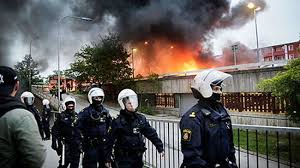
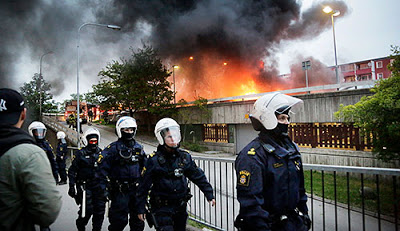
Automobiles were torched and police confronted stone-wielding youths in Stockholm’s suburbs early Sunday as riots, which erupted following reports that police had killed an elderly immigrant, enter their first week.
Pockets of violence and vandalism continue to pose a challenge to police in Stockholm, the Swedish capital that is home to an increasingly diverse 2 million residents. “When it comes to car fires, there have been a few, spread out in various locations, but not as many as in recent days,” Stockholm police spokesperson Lars Bystroem told Swedish Radio.
In Vaarberg, a suburb south of Stockholm, police were attacked by stone-throwing youths, while in Jordbro, another southern neighborhood, police resorted to teargas as they met resistance while attempting to arrest several individuals, AFP reported.
Violence has broken out in other parts of the country as well. In Orebro, a town in central Sweden, some two dozen masked youths set fire to three cars and a school and attempted to torch a police station, Reuters reported, citing police. About 200 km (124 miles) to the southwest in the city of Linkoping, several vehicles were set alight and youths tried to torch a school and a kindergarten.“With the strong presence on the streets of the good forces, and the police reinforcements, I think we are well on our way towards calmer times in the coming days.” The riots began one week ago in Husby, a predominantly immigrant suburb of Stockholm, following the fatal police shooting of an elderly man who police said was brandishing a machete in his home.
Analysts believe the shooting ignited deep-seated frustration among disenfranchised youths – many of whom have not assimilated into Swedish society and are unemployed – who claim to have suffered from police brutality and racism to the country due to its attractive social programs.
The Scandinavian country is ranked as one of Europe’s most popular destinations for immigrants, both in absolute numbers and relative to its size, but critics say the new arrivals are failing to learn even the basic language skills necessary to find employment, and despite free government assistance programs.
Ingrid Carlqvist, editor-in-chief of Dispatch International, told RT that Sweden is an attractive destination for immigrants because the government gives them “money for nothing.”
“For the last 20 years or so, we have seen so many immigrants coming to Sweden [who] really don’t like Sweden,” Carlqvist said. “They don’t want to integrate, they don’t want to live in this society – working and paying taxes, and so on – they come here because they know Sweden will give them money for nothing.
“[The police] could use water cannons, they could [enforce curfews]; there are so many things they could do within the law, but they don’t do it.” The change in Sweden’s domestic dynamics comes at a time when far-right groups are commanding attention across the EU, with many residents furious over austerity measures, high unemployment and the general consensus that the individuals most responsible for triggering the collapse of the global economy have escaped responsibility.
“We have tried harder than any other European country to integrate, spending billions on a welfare system that is designed to help jobless immigrants and guarantee them a good quality of life,” Marc Abramsson, leader of the National Democrats Party, told the Telegraph.
“Yet we have areas where there are ethnic groups that just don’t identify with Swedish society. They see the police and even the fire brigade as part of the state, and they attack them. Multiculturalism does not recognize how humans actually function, Abramsson added, emphasizing that such a stance should not be confused with racism.
According to the OECD, Sweden still ranks among the nine most equal member-states of the organization, but inequality rates surged by one-third between 1985 and 2008 – the largest increase among OECD countries, the organization said in a report released earlier this year. – RT
The scene of Sweden’s worst riots in years, Husby is on the surface at least a typically neat suburb of colorful playgrounds, manicured parks and low rise apartment buildings.
Conversations with residents of this immigrant neighborhood soon bring tales of fruitless job hunts, police harassment, racial taunts and a feeling of living at the margins that are at odds with Sweden’s reputation for openness and tolerance.
Riots that began in Husby have spread across Stockholm over the last four nights in scenes reminiscent of London in 2011 and Paris in 2005 – outbursts with their roots in segregation, neglect and poverty. The Swedish model of welfare – such as its 480 days of parental leave for each child – hides another side.
Some 15 percent of the population is foreign born, the highest in the Nordic region. The rise of the anti-immigrant Sweden Democrats party, which has called for a curfew in response to the violence, has polarized Swedes.
Metros and trains out of Stockholm center late at night are full of exhausted-looking Arabic or Spanish speaking immigrants returning home from menial jobs. Even second generation immigrants struggle to find white collar employment.
As one Asian diplomat puts it: “On the one hand Sweden has all these immigrants. On the other hand, where are they? It sometimes seems they are mostly selling hotdogs.”
In a further illustration of two very different worlds, the first riot happened as many Swedes celebrated winning the world ice hockey championship. Most immigrants play football – it is a common refrain that ice hockey kits are too expensive.
“The worst vandalism is not what we’ve experienced in recent days,” said community leader Arne Johansson at a protest rally in Husby. “It is the creeping, slow vandalism that this rightist government has exposed us to over the past seven years.”
Seven years of center-right Prime Minister Fredrik Reinfeldt – who has labeled the rioters hooligans – have lowered taxes and reduced state benefits. That has helped economic growth outpace most of Europe but Sweden also has the fastest growing inequality of any OECD nation.
Professor of criminology at Stockholm University Jerzy Sarnecki said society has become much more segregated, with a large, poor immigrant population living in areas of major cities where unemployment is dramatically higher than elsewhere.
Polls show a majority of Swedes still welcome immigration. Sweden has a reputation for treating new arrivals well – providing housing, Swedish lessons and allowing asylum seekers to live with relatives.
But the consensus is increasingly frayed.
“Those who, for whatever reason, don’t have work have not taken part in the general rise in prosperity,” said Ulf Bjereld, political science professor at Gothenburg University.
One recent government study showed up to a third of young people between 16-29 in some of the most deprived areas of Sweden’s big cities neither study nor have a job.
Sweden received 43,900 asylum seekers in 2012, a nearly 50 percent jump from 2011 and the second highest on record. Nearly half were from Syria, Afghanistan and Somalia. Many native Swedes worry welfare could become unaffordable if the trend continues.
Asylum seekers, in the short term, add a fiscal burden on the welfare state. OECD data show foreign-born unemployed rates, at 16 percent, compared with 6 percent for native Swedes. Sweden needs high employment levels to pay for its extensive welfare.
ANGRY, YOUNG MEN
The riots appeared organized. Cars were set alight near pedestrian bridges and youths hurled stones when police and emergency services arrived at the scene.
Witnesses said heavy handed policing made the situation worse. Locals in Husby said they were taunted by police who shouted “ape”.
“In the beginning it was just a bit of fun,” said one young man in his early 20s who did not wish to be named. He was one of a Husby group of 30-40 youths that battled with police.
“But then when I saw the police charging through here with batons, pushing women and children out of the way and swinging their batons, I got so damned angry.”
Police, who have called the rioters youth gangs and criminals, said accusations against the police were being investigated.
In interviews with youths in Husby, most were unemployed or interns. Many said they were bounced around intern schemes, seldom being offered full-time work, fostering resentment.
Local youths believe their Husby address is in part to blame for their lack of success. If they are lucky enough to be called to a job interview, many say they come from neighboring Kista – an IT hub symbolizing Sweden’s more modern, global image.
Many complained a conviction for a small amount of cannabis might stay on a teenager’s record for ten years, ruining job chances.
Stockholm has suffered riots and burning of cars before in recent years, although most fizzle out after one night. Other cities in the Nordic country have also experienced unrest.
Five years ago in Malmo, which has one of Sweden’s biggest immigrant populations, local youths threw home-made bombs and attacked emergency services to protest a police eviction.
In Husby, the shooting of a suspected machete wielding man by police earlier in the month was the spark. Local people – around 80 pct of whom have immigrant backgrounds – organized a peaceful protest for which more than 100 people turned up.
But their call for an inquiry into the death of the 69-year-old fell on deaf ears. Plugged in young locals complained about racist insults on Twitter, feeding anger.
“Young people wound each other up and started a small fire,” said Nefel, a beautician in her 20s. “I saw how the police came and treated them. I was in shock.”
“I was there and saw it happen. I wasn’t struck, but I did have a dog come at me. A police dog isn’t a nice little puppy.”
On the streets, resentment shows no signs of ebbing.
“My daughter comes home from school and says the kids say they can’t play with her because she’s dark,” said Maria Petersson, a 39 year old Ethiopan-born nurse. “I am both Ethiopian and Swedish but I will never be considered Swedish by the Swedes. To them, I am just another immigrant.” – Reuters
Youth gang riots in the Swedish capital Stockholm have entered fifth straight night. Hundreds of mostly immigrant teenagers tore through the suburbs, smashing windows and burning cars in the country’s worst outbreak of violence in years.
At least six vehicles were torched throughout the city late on Thursday while the police called for reinforcements from other Swedish cities bracing for further unrest.
Firefighters were putting out flames that engulfed several cars and a school in immigrant-dominated areas of Stockholm.
The night before, the fire brigades were called to some 90 different blazes. On the fourth night of violence, youths torched over 30 cars in 15 neighborhoods along with a restaurant in Skogas, south of Stockholm. Three law enforcement officers were injured, police spokesperson Kjell Lindgren reported.
Stockholm firefighters were busy throughout the night, saying they had “never before seen so many fires raging at the same time.” Some 90 blazes were reported in total, most of them reportedly caused by the rioters. Still, the fourth night of violence was relatively quiet compared to the previous three, RT’s Peter Oliver reported from Stockholm.
Leaders of immigrant communities were out on the streets in a bid to stop young people from rioting. Despite their efforts, as soon as the night fell, groups of arsonists took to the streets to set cars on fire. RT’s Peter Oliver witnessed rioters throwing stones at police and journalists alike.
Civil disorder in Stockholm started on Sunday, when police shot and killed a 69-old-man in his apartment after he confronted officers with a machete; the unrest has since continued throughout week.
Community leaders insist that a main reason for the violence is the high rate of unemployment in immigrant communities, particularly in the suburb of Husby near central Stockholm, one of the worst affected by the nighttime violence, Peter Oliver reported.
Although Sweden’s unemployment rate is below the EU average, joblessness among those under 25 has reached nearly 25 percent. The RT crew in Stockholm noted that a majority of those taking part in the violence are young.
Parents of the rampaging teenagers and community religious leaders are now spending sleepless nights on the street in an effort to prevent their children from wreaking havoc.
Meanwhile, the Swedish Prime Minister Fredrik Reinfeldt blamed the violence on “hooligans” and said they did not represent the majority in the rioting neighborhoods.
“I think it’s dangerous to draw a picture of Sweden with a capital separated from its suburbs. I don’t think that’s true. I think the dividing line runs straight through Husby, with a majority population and then a small group of troublemakers,” Reinfeldt said.
But the Husby youth taking part in riots told Reuters they are indeed divided from the rest of Stockholm, struggling to find a full-time job with their Husby address. Most of the interviewed rioters were reportedly unemployed.
The claims of social exclusion in immigrant-dominated suburbs have been partly conceded by Sweden’s Integration Minister Erik Ullenhag, who said the ministry is aware of “discrimination in these areas.” But the riots “don’t improve the image of these areas, where there is a lot of positive stuff going on,” he added.
For years, Sweden – one of Europe’s most tranquil countries, famous for its attractive immigration policies and generous welfare system – has been accepting an influx of immigrants, which now make up about 15 per cent of its population. These migrants have failed to integrate into Swedish society, and are only in the country to enjoy the country’s social benefits system, Swedish journalist Ingrid Carlqvist told RT.
“The problem is not from the Swedish government or from the Swedish people,” the editor in chief of Dispatch International said. “The last 20 years or so, we have seen so many immigrants coming to Sweden that really don’t like Sweden. They do not want to integrate, they do not want to live in [Swedish] society: Working, paying taxes and so on.”
“The people come here now because they know that Sweden will give them money for nothing. They don’t have to work, they don’t have to pay taxes – they can just stay here and get a lot of money. That is really a problem,” Carlqvist added.
“The police could do so much, [instead] they have told the public that they mean to do as little as possible. But they could go there and use water cannons, they could not let people out onto the streets at night. There are so many things they could do within the law – but they don’t do it,” she said.
Young Muslims who enjoy tolerance, social institutions and welfare while living in Sweden nevertheless refuse to integrate into the West, Gerolf Annemans told RT. Annemans is the parliamentary leader of Vlaams Belang (‘Flemish Interest’), a Belgian far-right nationalist political party.
“They [Muslim youths] have always sought excuse to show that they are not agreeing with the basic values of Western society,” Annemans said, pointing to the recent cases of the Boston Marathon bombing in the US and yesterday’s beheading of a British soldier in the UK.
“It’s always the same problem. There is a massive refusal by Muslim youngsters of the basics of Western society… and they take any excuse whatsoever to show that with violence – that is where the problem is,” he said. – RT
Firemen extinguish a burning car parked in an indoor garage in the Stockholm suburb of Tureberg after youths rioted in several different suburbs for a fourth consecutive night on May 24, 2013 (AFP Photo / Jonathan Nackstrand)The night before, the fire brigades were called to some 90 different blazes. On the fourth night of violence, youths torched over 30 cars in 15 neighborhoods along with a restaurant in Skogas, south of Stockholm. Three law enforcement officers were injured, police spokesperson Kjell Lindgren reportedStockholm firefighters were busy throughout the night, saying they had “never before seen so many fires raging at the same time.” Some 90 blazes were reported in total, most of them reportedly caused by the rioters. Still, the fourth night of violence was relatively quiet compared to the previous three, RT’s Peter Oliver reported from Stockholm.
Police officers on hand during the Husby riot in northern Stockholm stand accused of using racist language towards people on the ground, with one youth worker in the area claiming it is “not the last time” such scenes will occur.
The officers on the scene allegedly used words like “monkeys”, “rats”, and “niggers” to people in Husby on Sunday night, when at least one hundred cars were torched and three police officers were injured after stones were thrown at them.
A local youth leader, who along with a small group of teens was out on the street on Sunday, told local newspaper editor Rouzbeh Djalaie that he was called a nigger when he asked the police if they needed any help. The teens were called “monkeys”.
“I can understand the police officers were stressed, but this language is unacceptable, and unfortunately nothing new,” Rami al-Khamisi, law student and founder of youth organization Megafonen, told The Local.
Megafonen is a community-based organization in the area that aims to organize residents of Stockholm’s northern suburbs to fight for social justice. Al-Khamisi, the founder of the organization, said the riots were a “reaction to police brutality against citizens, our neighbours”.
“Last week, the police shot an old man who was holding a knife. How can they do this without taking responsibility? I can understand the reaction,” he said.
Last Monday, police officers stormed the home of a 69-year-old Husby man who was brandishing a machete and shot him dead.
“You have to see what happened from a wider point of view. It’s not the first time something like this has happened, and it’s not the last. This is the kind of reaction when there isn’t equality between people, which is the case in Sweden,” he added.
Al-Khamisi said that the crowd was reacting to a “growing marginalization and segregation in Sweden over the past ten, 20 years” from both a class and a race perspective.
“Out in the suburbs the majority of people aren’t white, and from a political perspective we’re seen as a problem that politicians want to solve by sending more police. This is not a solution we agree with,” he said.
Stockholm police, meanwhile, would not disclose whether any arrests had been made in relation to the incident, which continued from around 10pm on Sunday night until 5.30am on Monday morning.
“I cannot make a statement at present because the police investigation is under way,” western Stockholm police spokesman Daniel Mattsson told the Dagens Nyheter newspaper.
He said that the police were tipped off about potential vandalism by concerned Husby residents who saw people with masks carrying cans containing some kind of liquid, and that just minutes later a car was burning.
Police have, however, filed 18 reports, ranging from violent rioting, causing damages, aggravated damages, attempted arson, and assault of an official.
Stockholm police officer Jörgen Karlsson said the accusations of racial slurs were “unfortunate”.
“It’s unfortunate if someone perceives they have been called that. But people can either make a police report or contact the local police,” he told the TT news agency.
Al-Khamisi, meanwhile, said that it’s unlikely that rioting in Sweden will stop any time soon.
“This kind of thing isn’t only happening in Husby, it’s happening all over Sweden. People are tired of politics not working in our favour, they’re tired of the current situation,” he told The Local.
“These people feel they have to take matters into their own hands.” The Local
Gangs of youth angered by the police shooting death of an elderly man in a mainly immigrant neighborhood hurled rocks at police and set cars and buildings on fire in a Stockholm suburb early Monday, forcing the evacuation of an apartment block.
Around 50 youths were involved in the riots in the suburb of Husby, police spokesman Lars Bystrom said.
The youths set light to a parking garage, compelling police to evacuate residents from an adjacent apartment block, Bystrom said. Residents were allowed to return home after a couple of hours.
Around 80 percent of the roughly 11,000 people living in Husby – a drab, low-income neighborhood of apartment blocks west of Stockholm – are first or second generation immigrants.
“Youth” in European news stories is a euphemism for black hooligans. The euphemism “Asian” wasn’t used and is an indication that they are black Africans, probably Somalis. The area where this occurred is 80% non-Swedish.
Bystrom said police responded to calls of burning cars and were met by masked youths hurling rocks at them.
One policeman was attacked by youths kicking him and two others were injured by rocks, local police officer Jorgen Karlsson said. He added around 10 cars were set ablaze, and windows were smashed at two schools and several local businesses.
Karlsson said the dead man was “European,” but couldn’t specify his nationality.
Residents said they had gathered to protest against the shooting death and that police responded by sending in SWAT teams that cordoned off the area.
“I understand that people react like this,” said Rami Al-Khamisi from the organization Megafonen, which represents citizens in Stockholm’s suburbs.
The organization said police had used excessive violence against the youths and also attacked passers-by with batons and dogs.
Police have launched an internal probe to investigate the shooting death on May 13 of a 69-year-old man in Husby. They say they shot the man in self-defense because he had attacked police with a knife when they broke down the door to an apartment, where he had locked himself up with a woman.
However, Megafonen has criticized police for initially releasing a faulty report saying the man was taken to a hospital. The group said residents had seen his dead body being transported from the scene hours after the shooting in a hearse, which police later admitted was correct. SAPA/AP
One of the largest toy chains in Sweden published a gender-neutral Christmas catalogue, which pictured boys playing with dolls and girls holding toy machine guns. The move has reignited a debate in Sweden over the proper place of gender roles.
Top Toy has produced children’s Christmas catalogues in Denmark and Sweden for both Toys R Us and BR. Though the catalogues’ page layouts are the same in both countries, the gender of the pictured kids is reversed in the Swedish edition.
“With the new gender thinking, there is nothing that is right or wrong. It’s not a boy or a girl thing, it’s a toy for children,” Top Toy director of sales Jan Nyberg told TT news agency.
The Danish catalogue showed a boy wielding a toy machine gun, which was replaced by a girl in the Swedish version. The “Hello Kitty” page of the Swedish catalogue also replaced a girl with a boy, and a one girl’s pink t-shirt was turned into light blue.
The move is a profound shift in strategy for Top Toy. In 2008, the company was criticized by Swedish advertising watchdog Reklamombudsmannen (RO) for encouraging outdated gender roles with catalogues that featured boys dressed as superheroes and girls as princesses.
Since then, Top Toy has modified its strategy based on RO’s advice.
“We have produced the catalogues in a completely different way this year,” Nyberg said. “For several years, we have found that the gender debate has grown so strong in the Swedish market that we… have had to adjust.”
Sweden is the frontline for the gender debate.
Since 2008, the government has spent 110 million Swedish crowns ($16.3 million) on promoting gender equality in schools, including the introduction of laws requiring teachers to actively work to reverse gender stereotypes.
The country also proposed a new single gender-neutral pronoun – ‘hen’ – to replace ‘he’ and ‘she’ in order to minimize gender stereotyping.
In January 2012, children’s author Jesper Lundqvist’s release ‘Kivi and Monster Dog,’ a book that uses ‘hen.’ The move sparked debate in Sweden and worldwide about the proper place of gender roles.
Elise Claeson, a columnist and a former equality expert at the Swedish Confederation of Professions, claimed that the use of the word hen is an example of notions of gender equality going too far.
Claeson argues that mixed messages about their gender can be harmful for kids: “It is important to have your gender confirmed to you as a child. This does not limit children; it makes them confident about their identity,” she told the Christian Science Monitor.
A Swede of Rwandan origin went on trial Friday on charges of taking part in the killings of tens of thousands of people during the 1994 genocide in his homeland, the first such case in the Nordic country.
Stanislas Mbanenande, 54, an ethnic Hutu, is charged with genocide and crimes against international law and faces up to life in prison if convicted. He allegedly took part in massacres between April 12 and June 30, 1994 that left thousands dead.
The indictment describes Mbanenande as having taken an “informal role as a lower-level leader among young Hutus who sympathised with, or came to sympathise with, Hutu extremism.”
It also states that his leadership status was borne out by the fact that he possessed an automatic firearm, which he is said to have fired into crowds.
Mbanenande allegedly murdered or recruited young men to take part in massacres.
He was ordered to stand trial in Sweden after Stockholm was unable to comply with a request to extradite him to Rwanda, where he has been given a lifetime sentence in absentia, due to the fact that he obtained Swedish citizenship in 2008.
He has denied all charges following his arrest in December last year under an international arrest warrant.
Mbanenande has been in Sweden since 2007, when he joined his family and obtained a residency permit based on family reunification grounds.
The April 6, 1994 killing of Rwanda’s Hutu president Juvenal Habyarimana triggered a genocide in which 800,000 people, mostly from the Tutsi minority, were killed, according to UN figures.
The trial is expected to take several months and will move to Rwanda for a few weeks to hear witnesses. – AFP
Under a scheme organised by the local authorities in the town of Soderhamn and by Sweden’s national employment office, anyone aged between 18 and 28 can volunteer to take a “Job Journey” to Oslo and attempt track down gainful employment.
Those who sign up get a ticket to the Norwegian capital and are put up in an Oslo youth hostel for a month, with Soderhamn council picking up the £20 a night bill. The package also includes on-the-spot guidance on how to get a job in Sweden’s northern neighbour.
“We had an unemployment rate of over 25 per cent, so we had to find solutions,” Magus Nilsen, the man in charge of the project at Soderhamn council, told the Daily Telegraph. “Going to Norway to find work has always been quite popular with young people, but sometimes they want to go but don’t know how to find a job or accommodation so we thought we’d give them a bit of help with both.”
So far around 100 people have decided to leave Soderhamn, a town of 12,000, 250 kilometres due north of Stockholm, to try their luck in the bright lights of Oslo, and some, at least, have struck gold.
After two years on the doll in his hometown Andreas Larsson opted for a “Job Journey” to Norway and now works as a lorry driver in Oslo.
“I came here on a Thursday and on Monday morning I had a job, so it was fast,” he told Swedish Radio. “It almost felt a bit unreal, as if you have come to the promised land.”
Soderhamn and Port Shepstone in South Africa have a twinning partnership as part of the Sweden South Africa Formal Partnership.
This website uses cookies to improve your experience. We'll assume you're ok with this, but you can opt-out if you wish. Cookie settingsACCEPT
Privacy & Cookies Policy
Privacy Overview
This website uses cookies to improve your experience while you navigate through the website. Out of these cookies, the cookies that are categorized as necessary are stored on your browser as they are essential for the working of basic functionalities of the website. We also use third-party cookies that help us analyze and understand how you use this website. These cookies will be stored in your browser only with your consent. You also have the option to opt-out of these cookies. But opting out of some of these cookies may have an effect on your browsing experience.
Necessary cookies are absolutely essential for the website to function properly. This category only includes cookies that ensures basic functionalities and security features of the website. These cookies do not store any personal information.
Any cookies that may not be particularly necessary for the website to function and is used specifically to collect user personal data via analytics, ads, other embedded contents are termed as non-necessary cookies. It is mandatory to procure user consent prior to running these cookies on your website.


 A restaurant in Sweden has been reported to the police for racism after calling one of its dishes “Gypsy Soup”, claiming as a joke that all the ingredients were stolen.