Mugabe’s ban on Western poll observers

A younger Mugabe on the election poster

President Robert Mugabe on Thursday reiterated the Zimbabwe government’s position to bar Western observers from general elections set for Wednesday, insisting that only officials from friendly nations would be allowed to monitor the polls.

The veteran Zimbabwean leader said the United States, United Kingdom and other Western countries would never be invited to observe elections in Zimbabwe until they remove economic sanctions against top Harare officials.

“Our position is very clear. We will never allow the Americans and the British to come and observe our elections as long as their sanctions continue to burden our people,” he told supporters during a campaign rally in Chinhoyi farming town, about 100km northwest of Harare.

Zimbabwe has since 2002 refused to allow Western observers to witness the country’s general elections, accusing them of bias in favour of the opposition.

The Zimbabwe government however, said it has no problems welcoming election observers from the United Nations, Asia, the Southern African Development Community, the African Union and the BRICS group of countries comprising Brazil, Russia, India, China and South Africa.

Mugabe also said Thursday that the US and UK had no moral ground to lecture Zimbabwe on democracy when their own histories are tainted with cases of human rights abuses.

The US said earlier this week that it was concerned about the conditions prevailing in Zimbabwe ahead of general elections set for July 31.

A State Department spokesperson said Washington was wary about lack of transparency in electoral preparations and continued partisan behaviour by security organs, particularly the army and police. – APA

What international community?

UN Security Council
UN Security Council

By Richard Haass. Whenever something bad happens – Iran moving closer to acquiring nuclear weapons, North Korea firing another missile, civilian deaths reaching another grim milestone in Syria’s civil war, satellites revealing an alarming rate of polar-ice melt – some official or observer will call upon the international community to act. There is only one problem: there is no “international community.”

Part of the reason stems from the absence of any mechanism for “the world” to come together. The United Nations General Assembly comes closest, but little can be expected from an organization that equates the United States or China with, say, Fiji or Guinea-Bissau.

To be fair, those who founded the UN after World War II created the Security Council as the venue in which major powers would meet to determine the world’s fate. But even that has not worked out as planned, partly because the world of 2013 bears little resemblance to that of 1945. How else could one explain that Britain and France, but not Germany, Japan, or India, are permanent, veto-wielding members?

Alas, there is no agreement on how to update the Security Council. Efforts like the G-20 are welcome, but they lack authority and capacity, in addition to suffering from excessive size. The result is “multilateralism’s dilemma”:  the inclusion of more actors increases an organization’s legitimacy at the expense of its utility.

No amount of UN reform could make things fundamentally different. Today’s major powers do not agree on the rules that ought to govern the world, much less on the penalties for breaking them. Even where there is accord in principle, there is little agreement in practice. The result is a world that is messier and more dangerous than it should be.

Consider climate change. Burning fossil fuels is having a measurable impact on the earth’s temperature. But reducing carbon emissions has proved impossible, because such a commitment could constrain GDP growth (anathema to developed countries mired in economic malaise) and impede access to energy and electricity for billions of people in developing countries, which is unacceptable to China and India.

Stopping the spread of nuclear weapons would seem a more promising issue for global collaboration. The Nuclear Non-Proliferation Treaty (NPT) limits the right to possess nuclear weapons to the Security Council’s five permanent members, and then only temporarily.

But agreement is thinner than it appears. The NPT allows countries the right to develop nuclear energy for purposes such as electricity generation, a loophole that allows governments to build most of what is necessary to produce the fuel for a nuclear weapon.

The inspection regime created in 1957 under the International Atomic Energy Agency (IAEA) is a gentlemen’s agreement; inspectors can inspect only those facilities that are made known to them by the government in question. Governments (such as Iran’s) can and do carry out illegal nuclear activities in secret sites that international inspectors either do not know about or cannot enter. At least as important, there is no agreement on what to do when a country violates the NPT, as Iran and North Korea (which withdrew from the treaty in 2003) have done.

More international cooperation exists in the economic realm. There has been real progress toward reducing tariff barriers; the World Trade Organization has also established a dispute-resolution mechanism for its 159 members. But progress on expanding free trade at the global level has stalled, as many countries disagree on the treatment of agricultural goods, the elimination of subsidies, and trade in services.

Meanwhile, cooperation in the realm of cyberspace is just getting started – with difficulty. The US is most concerned about cyber security and the protection of intellectual property and infrastructure. Authoritarian governments are more concerned about information security – the ability to control what is available on the Internet in order to maintain political and social stability. There is no agreement on what, if anything, constitutes an appropriate target for espionage. The prevalence of non-state actors is further complicating efforts.

Another area where there is less international community than meets the eye is human suffering. Governments that attack their own people on a large scale, or allow such attacks to be carried out, expose themselves to the threat of outside intervention. This “Responsibility to Protect,” or R2P, was enshrined by the UN in 2005.

But many governments are concerned that R2P raises expectations that they will act, which could prove costly in terms of lives, military expenditure, and commercial priorities. Some governments are also worried that R2P could be turned on them. Russian and Chinese reticence about pressuring governments that deserve censure and sanction stems partly from such concerns; the absence of consensus on Syria is just one result.

In short, those looking to the international community to deal with the world’s problems will be disappointed. This is not reason for despair or grounds for acting unilaterally. But so long as “international community” is more hope than reality, multilateralism will have to become more varied.

In the trade area, this implies regional and bilateral accords. On climate change, it makes sense to seek “mini-agreements” that set minimum common standards for fuel efficiency, slow deforestation, or limit the largest economies’ carbon output.

In these and other areas, governments will need to rally around regional undertakings, form coalitions of the relevant or willing, or simply seek understandings among countries to do their best to adopt common policies. Such approaches may lack the reach and legitimacy of formal global undertakings, but they do have the advantage of getting something done.

Richard N. Haass is President of the Council on Foreign Relations

Indian school poisoning: Principal ‘forced kids to eat’ odd-looking food

indiaschoolfoodAfter 23 Indian children died from consuming poisoned school meals, it has emerged that victims refused the food before being made to eat it, according to the Times of India. Preliminary investigations indicate the cooking medium was laced with pesticide.

Police say that the latest case of poisoning, which claimed the lives of 23 children, was most probably caused by storing cooking oil in a used pesticide container.

Monocrotophos is an insecticide which is toxic to birds and humans. The World Health Organization describes it as highly hazardous and advises that its handling should only be undertaken by well trained and competently supervised users. All material contaminated with the chemical should be destroyed in a high-temperature chemical incinerator, according to the Food and Agriculture Organisation of the United Nations.

However, an anonymous HRD (Ministry of Human Resource Development) source told the Times of India that the cooking agent used for soyabean subzi may have played a role.

“Earlier it was thought oil was put in a pesticide container. But it seems that the lady cook used pesticide,” the source said.

The subzi looked black and smelt odd according to the source. “The school principal insisted the cooking medium cannot be bad since it had come from her husband’s shop,” he said. “When students refused to eat, the principal scolded and forced them to eat.”

“I can accept accidents can happen anywhere. But the scale of this incident and the carelessness, the sheer callousness of the response, the delay in treating the children, is shocking,” activist Dipa Sinha of the Right to Food Campaign told AFP.

The children died after eating lentils, potatoes and rice cooked with oil containing agricultural insecticide that was five times the strength sold in the market place, according to tests.

Forensic tests have shown that the oil contained a “highly toxic” form of insecticide which killed the children so quickly that some died in their parents’ arms while being taken to hospital.

The principal reportedly fled the school shortly after realizing the extent of the tragedy. “A crucial one and half to two hours were lost. Had these children been rushed to hospital immediately few lives could have been saved,” he said. – RT

Charges filed against deceased Hansie Cronjé by Indian police

by Abhaya SRIVASTAVA

Indian police filed charges on Monday over a match-fixing scandal involving the late South African captain Hansie Cronje, 13 years after the revelations sent shockwaves thr

Hansie Cronjé
Hansie Cronjé

ough the cricketing world.

Police filed the charges in a New Delhi court against bookmakers and Cronje himself, who died in a plane crash in 2002, over allegations of fixing dating back to South Africa’s tour of India in 2000.

The charges are the first by Indian police over the scandal, which revealed the shady world of Indian bookmakers in cricket.

“There are six accused in this case, three of them are on bail while two are abroad,” Inspector Keshav Kumar told the court.

“The sixth is Hansie Cronje, who is dead,” said Kumar, the investigating officer in the case.

Cronje, once the darling of South African cricket, was banned from the sport for life after admitting taking bribes from bookies in exchange for providing match information and influencing games during the 2000 tour.

Cronje admitted to a South African commission investigating the scandal to taking thousands of dollars in bribes from bookies to underperform, although he denied match-fixing itself.

Delhi police have alleged that Cronje persuaded some of his teammates, including Herschelle Gibbs, to agree to underperform in a one-day match in 2000, including by making fewer runs than he might otherwise have tallied.

Gibbs and bowler Henry Williams were both banned from playing for six-months and fined by South African authorities over their admissions in the scandal.

The scandal broke when New Delhi police, working on an unrelated extortion case, tapped a telephone conversation between Cronje and one of the bookies, Sanjeev Chawla.

Chawla is believed to be living in the UK and Indian police hope to seek his extradition now that the charge sheet has been placed before the court.

“We will now request the court to grant approval to seek extradition of Chawla from the UK to India,” Additional Commissioner of Police (Crime), Ravindra Yadav, told AFP.

“The UK government does not allow extradition without the charge cheet. We are almost sure Chawla is in England,” he said.

Yadav said the case was one of “criminal conspiracy” and has only now been filed in court after police finally received in January this year voice samples from tapped phone conversations.

“This is criminal conspiracy. People went to the ground to watch the games thinking they would be played in the true spirit. They did not know the outcome was fixed. That’s why we have filed the charges,” he said.

Police named the accused as bookmakers and gamblers Rajesh Kalra, Krishan Kumar and Sunil Dara — who are all on bail — and Chawla and Manmohan Khattar who are overseas.

Cronje died in June 2002 when a light plane in which he was travelling crashed in bad weather in South Africa.

Monday’s action came after Delhi police chief Neeraj Kumar told local media that he planned to file charges in the Cronje case and a separate Indian Premier League spot-fixing scandal, before the end of the month.

Kumar told the Hindustan Times newspaper on Saturday that he was working on tying up “some loose ends” before his retirement at the end of July, including in both cases.

The Indian Premier League (IPL) was rocked by allegations of spot-fixing in May this year, with some 29 people arrested including three Indian players. The cricketers, who have denied wrongdoing, are accused of deliberately bowling badly in exchange for tens of thousands of dollars from bookies.

Betting on sports is illegal in India except at horse races, but major betting syndicates have been in operation for many years. – AFP

India’s evil Apartheid

Why are South African Indians concerned about equal rights in this country, but seem to care little about an evil system back home?

In a uniquely Indian version of Romeo and Juliette, a teenage girl and boy were publicly lynched earlier this month in rural Uttar Pradesh. The girl’s parents and hundreds of villagers watched and applauded.

The crime? The girl was a Brahmin, Hinduism’s highest caste; the boy, a Jat, a somewhat lower, though still respectable, farming caste. The girl’s family had been ‘defiled’ by their daughter crossing the ‘pollution barrier’ to consort with a lower caste boy. The appropriate punishment was death.

At the end of August, India, a self-professed champion of human rights, will attend the UN’s conference on racism in Durban, South Africa. While the US is frantically trying to shield its protégé, Israel, from charges of racism at Durban, India is just as frantically trying to prevent its caste system, which is often called ‘hidden apartheid,’ from being put onto the conference’s agenda.

For decades, India loudly denounced discrimination against blacks in the US and South Africa. But hidden from the world’s gaze, India, according to many human rights groups, continues to practice and condone the world’s largest, most pernicious system of institutionalized racism and discrimination, the caste system.

Of India’s 1 billion people, 160 million are untouchables, or ‘Dalits’(meaning: ‘broken people’). Untouchables are at the bottom of the Hindu caste system of segregation; light-skinned Brahmins at the top. In between are a myriad of castes and sub-castes. Untouchables, India’s poorest people, are forced to perform society’s most menial, degrading tasks.

Untouchables are barred from sections of villages inhabited by higher caste Hindus. A Dalit’s ‘unclean’ shadow must never fall upon that of a Brahmin, lest he be defiled. Dalits may not draw water from higher caste wells, nor touch food implements of their betters. They may not enter higher caste temples, nor own land. Their children sit in the back of classrooms, or are simply denied schooling.

The ancient Hindu caste system dates back to 1500 BC when fair-skinned Aryan tribes invaded northern India. The newcomers conquered India’s dark-skinned indigenous Dravidian inhabitants. Though occupation and rank originally determined caste, over centuries caste came to be associated with skin color. Even in overseas Indian communities, including Canada, caste still reigns. Marriage solicitations routinely request ‘light-skinned’ boys or girls.

Fair-skinned Brahmins, 3.5% of the population, are India’s ruling elite, holding 78% of judicial positions and half parliament’s seats. In recent tests, Indian scientists discovered that high-caste Hindus, particularly Brahmins, are genetically closer to Europeans than they are to dark-skinned, Dravidian Indians. Caste became a rigid system whereby India’s fair-skinned ruling class kept lower and swarthier orders in their places – as laborers, landless peasants, and servants – exploiting them in the name of religion.

The Sikh religion and Islam both reject the Hindu caste system. Millions of low caste Indians found refuge from racial oppression as Sikhs, Muslims, and, more recently, Christians. All three religions have been and remain subject to varying forms of persecution by India’s Hindu majority.

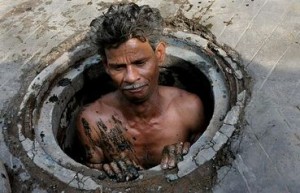
Dalits are forced to clean public toilettes and remove human feces, usually with their hands. They sweep up after Indians defecate in the streets and move dead animals. According to an extensive report on caste by the respected Human Rights Watch, large numbers of Dalit women are routinely raped and forced to become sex slaves for Hindu priests and land owners. Of India’s estimated 40 million indentured laborers – a modern form of slavery – most are Dalit children, often sold into lifelong servitude by starving parents.

When Dalits try to defend themselves from abuse and exploitation, they are attacked by higher-caste gangs and local police. Their shanties are burned and their women gang raped. Dalits, like Muslim Kashmiris, are frequently subjected to beatings, rape, torture and arson by India’s brutal police, says Human Rights Watch.

The recent case of India’s famed Bandit Queen, a Dalit woman who killed a score of higher caste men who had raped her, is but one dramatic example of the suffering inflicted by India’s cruel caste system, which makes South Africa’s former apartheid look benign by comparison.

Modern India’s father, the great Mohandas Gandhi, struggled against caste and called for liberation of Dalits. India outlawed discrimination against untouchables in the 1950′s, and has enacted affirmative action programs for Dalits in education, voting, and government jobs. Nepal just followed suit this summer. India’s president, a ceremonial post, is a Dalit, though most of its leaders, like PM Vajypee and Home Minster L.K. Advani, are high-caste, fair-skinned Hindus.

“The Indian government has been very successful at manufacturing an image as the world’s largest democracy,” says Smita Narula, author of the Human Rights Watch report,…”but none of its (anti-discrimination) laws are implemented and the Constitution is not enforced.”

Delhi simply winks at the widescale oppression of Dalits across India, remembering them only at election time. India appears unlikely to make a major national effort to root out the deeply ingrained caste system until worldwide outrage shames India’s elite into taking drastic action. Durban would be a good start. India won’t achieve the international respect and great power status it so craves until the evil of caste is ended for good. – Eric Margolis wrote this article before the start of the World Conference against Racism, Racial Discrimination, Xenophobia and Related Intolerance in August 2001. This conference was held under the auspices of the United Nations. Nothing much has changed since then.

How Britain plundered the globe for 300 years

by George Monbiot of The Guardian

Opium, famine and banks all played their part in Britain’s plundering of the globe.

Why now? It’s not as if this is the first time Britain’s representatives have been caught out. The history of governments in all countries is the history of scandal, as those who rise to the top are generally the most ambitious, ruthless and unscrupulous people politics can produce. Pushing their own interests to the limit, they teeter perennially on the brink of disgrace, except when they fly clean over the edge. So why does the current ballyhoo threaten to destroy not only the government but also our antediluvian political system?

The past 15 years have produced the cash-for-questions racket, the Hinduja and Ecclestone affairs, the lies and fabrications that led to the invasion of Iraq, the forced abandonment of the BAE corruption probe, the cash-for-honours caper and the cash-for-amendments scandal. By comparison to the outright subversion of the functions of government in some of these cases, the is small beer. Any one of them should have prompted the sweeping political reforms we are now debating. But they didn’t.

For the past 300 years, the revolutions and reforms experienced by almost all other developed countries have been averted in Britain by foreign remittances.

The social unrest that might have transformed our politics was instead outsourced to our colonies and unwilling trading partners. The rebellions in Ireland, India, China, the Caribbean, Egypt, South Africa, Malaya, Kenya, Iran and other places we subjugated were the price of political peace in Britain. After decolonisation, our plunder of other nations was sustained by the banks. Now, for the first time in three centuries, they can no longer deliver, and we must at last confront our problems.

There will probably never be a full account of the robbery this country organised, but there are a few snapshots. In his book Capitalism and Colonial Production, Hamza Alavi estimates that the resource flow from India to Britain between 1793 and 1803 was in the order of £2m a year, the equivalent of many billions today. The economic drain from India, he notes, “has not only been a major factor in India’s impoverishment … it has also been a very significant factor in the industrial revolution in Britain”. As Ralph Davis observes in The Industrial Revolution and British Overseas Trade, from the 1760s onwards India’s wealth “bought the national debt back from the Dutch and others … leaving Britain nearly free from overseas indebtedness when it came to face the great French wars from 1793”.

In France by contrast, as Eric Hobsbawm notes in The Age of Revolution, “the financial troubles of the monarchy brought matters to a head”. In 1788 half of France’s national expenditure was used to service its debt: the “American War and its debt broke the back of the monarchy”.

Even as the French were overthrowing the ancien regime, Britain’s landed classes were able to strengthen their economic power, seizing common property from the country’s poor by means of enclosure. Partly as a result of remittances from India and the Caribbean, the economy was booming and the state had the funds to ride out political crises. Later, after smashing India’s own industrial capacity, Britain forced that country to become a major export market for our manufactured goods, sustaining industrial employment here (and avoiding social unrest) long after our products and processes became uncompetitive.

Colonial plunder permitted the British state to balance its resource deficits as well. For some 200 years a river of food flowed into this country from such places as Ireland, India and the Caribbean. In The Blood Never Dried, John Newsinger reveals that in 1748 Jamaica alone sent 17,400 tons of sugar to Britain; by 1815 this had risen to 73,800. It was all produced by stolen labour.

Just as grain was sucked out of Ireland at the height of its great famine, so Britain continued to drain India of food during its catastrophic hungers. In Late Victorian Holocausts, Mike Davis shows that between 1876 and 1877 wheat exports to the UK from India doubled as subsistence there collapsed, and several million died of starvation. In the North-Western provinces famine was wholly engineered by British policy, as good harvests were exported to offset poor English production in 1876 and 1877.

Britain, in other words, outsourced famine as well as social unrest. There was terrible poverty in this country in the second half of the 19th century, but not mass starvation. The bad harvest of 1788 helped precipitate the French revolution, but the British state avoided such hazards. Others died on our behalf.

In the late 19th century, Davis shows, Britain’s vast deficits with the United States, Germany and its white dominions were balanced by huge annual surpluses with India and (as a result of the opium trade) China. For a generation “the starving Indian and Chinese peasantries … braced the entire system of international settlements, allowing England’s continued financial supremacy to temporarily co-exist with its relative industrial decline”. Britain’s trade surpluses with India allowed the City to become the world’s financial capital.

Its role in British colonisation was not a passive one. The bankruptcy, and subsequent British takeover, of Egypt in 1882 was hastened by a loan from Roths­child’s bank whose execution, Newsinger records, amounted to “fraud on a massive scale”. ­Jardine Matheson, once the biggest narco-trafficking outfit in history (it dominated the Chinese opium trade), later formed a major investment bank, Jardine Fleming. It was taken over by JP Morgan Chase in 2000.

We lost our colonies, but the plunder has continued by other means. As Joseph Stiglitz shows in Globalisation and its Discontents, the capital liberalisation forced on Asian economies by the IMF permitted northern traders to loot hundreds of billions of dollars, precipitating the Asian financial crisis of 1997-98. Poorer nations have also been strong-armed into a series of amazingly one-sided treaties and commitments, such as trade-related investment measures, bilateral investment agreements and the EU’s economic partnership agreements. If you have ever wondered how a small, densely populated country which produces very little supports itself, I would urge you to study these asymmetric arrangements.

But now, as John Lanchester demonstrates in a fascinating essay in the London Review of Books, the City could be fatally wounded. The nation that relied on financial services may take generations to recover from their collapse. The great British adventure – three centuries spent pillaging the labour, wealth and resources of other countries – is over. We cannot accept this, and seek gleeful revenge on a government that can no longer insulate us from reality.

Read the original article here.