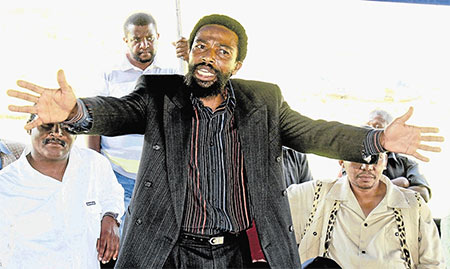
The ANC has filed papers in the High Court in Johannesburg against Potchefstroom mayor Maphetle Maphetle’s unseating, the party said on Monday.
“The speaker [Barei Mosiane], who is the speaker coming from the ANC… has actually filed the papers nullifying that meeting,” ANC North West acting secretary Gordon Kegakilwe said in Potchefstroom.
He was referring to a council meeting on Tuesday at which DA councillor Annette Combrink was voted in as mayor.
“For now, as the ANC, we don’t recognise that meeting, we don’t recognise Combrink.”
Kegakilwe was speaking at the taxi rank in Potchefstroom following an African National Congress provincial working committee (PWC) meeting in the town.
He, ANC North West chairman Supra Mahumapelo, and national executive committee deployee and Land Reform Minister Gugile Nkwinti were doing a walkabout at the taxi rank.
Combrink was voted in as the new mayor on Tuesday, the second time since November, unseating Maphetle. Democratic Alliance North West leader Chris Hattingh said at the time that 29 councillors of all parties, including the ANC, unanimously voted to return Combrink to the position of mayor.
On Wednesday, the North West ANC’s provincial disciplinary committee said 14 of its councillors who voted to unseat Maphetle, were expelled from the party. They would also be removed Potchefstroom councillors.
Kegakilwe said the councillors had to be expelled because they handed power to an opposition party.
“They can’t take power that the people have given to the ANC and give it to the DA, the DA which has never taken care of our people and will never take care of our people.
“We are here now in the taxi rank to tell the people that it’s only the African National Congress that can change their lives for the better.”
Kegakilwe said the PWC on Monday appointed six new proportional representation councillors for the municipality.
By-elections would be held soon to elect new ward councillors.
He said the ANC did not recognise Combrink as mayor and said Maphetle was still mayor.
“Combrink will never do anything for the people of Potchefstroom… she will never assist the people, she has never assisted them. They will keep on promising what they can’t achieve,” Kegakilwe said.
He said the ANC was confident it would win the court case to nullify the council’s decision.
“We are confident, we have studied all the documents and we are quite sure… Her [Combrink’s] mayorship is not recognised. Comrade Maphetle is the ANC mayor.”
The DA on Monday said Maphetle had failed to adhere to a legal notice forcing him to vacate his office at the municipality.
“During talks with DA councillors today, Mr Maphetle attempted to push for a political and not a legal resolution for the impasse,” Hattingh said.
“He also indicated that he has instructed his mayoral committee not to vacate their offices.”
Hattingh said the DA was consulting its lawyers on the issue.
Earlier, several Potchefstroom residents welcomed the DA taking over the municipality.
“What happened in the council is right,” PR Kali said at the town’s taxi rank.
“We think there will be change if the Democratic Alliance takes over.”
He said the ANC-dominated council had done nothing to eradicate poverty in the city or create jobs.
TB Masibi said he was expecting “huge change”.
“We expect a lot of change from the DA. They will combat crime and corruption.”
While the DA was in charge last year, it requested a forensic investigation into irregularities at the municipality. The probe found that the council had irregularly bought Maphetle a R736,000 customised Mercedes-Benz. Maphetle also allegedly abused the disaster management fund and poverty relief fund.
The report recommended that formal disciplinary action be taken against him and other officials.
In May, the DA laid criminal charges against Maphetle. In June Public Protector Thuli Madonsela said she would investigate the claims of corruption involving Maphetle.
Both Masibi and Kali complained about corruption and the lack of jobs.
Many of the fruit and vegetable vendors at the Potchefstroom taxi rank were from Lesotho.
Masibi said he used to have a shop but could not compete with the foreigners and the ANC had done nothing to create jobs for locals.
A woman who did not want to be named said she “felt good” about the DA taking over.
“I am happy… [The ANC] is not for me,” she said. – Sapa
Lindiwe Hani has came out in support of her mother, Limpho, as the fight for Chris Hani’s legacy escalates.
This follows an article by our sister publication, Sowetan this week, in which Vanessa Hani accused the ANC of betraying her father’s legacy and said this was the reason she was ditching it to join Mamphela Ramphele’s new party Agang SA.
Lindiwe lashed out at Vanessa in a Twitter campaign, saying she was not a Hani.
“I do not have a sister called Vanessa Hani. Vanessa is not a member of our family. I have only heard of her via the media like the rest of SAans (South Africans),” Lindiwe tweeted.
Responding to one of her followers who urged her not to disown Vanessa, she tweeted: “One has to be owned in order to [be] disowned. We do not know her.”
Apparently implying that Vanessa should take a DNA test, Lindiwe wrote: “Only one way to be sure.”
Vanessa refused to comment.
In a dramatic twist, Hani’s widow, Limpho, called Talk Radio 702 disputing Vanessa’s claims that she was the struggle hero’s daughter and challenged her to take a paternity test. Limpho said Vanessa and her sister Cleopatra were using her late husband’s name for “monetary gain” on Redi Tlhabi’s show on Friday.
She said she only got to know about Vanessa and other “kids who came from nowhere to claim Hani’s surname” from the media.
“I think they are taking it too far. Doing stupid things in my husband’s name, saying they are dumping the ANC. Who are they?
“You know Redi, as a married woman, how it would feel if a child, after years and years of marriage, came out to say they were Brian’s child..?” she asked the presenter, whose husband is called Brian.
Limpho also questioned why they were reluctant to reveal their mother’s identity.
Vanessa and Cleopatra first made the claims in 2009 saying they are Hani’s children from a relationship he had before he married Limpho. – Sunday World
The child was dumped in a field in Gabon, on June 27.
Spokesperson Capt Alfred Nakana said it is not clear whether the child was dead or alive when it was dumped.
The dog owner, who lives near the dump, became concerned when he noticed his dogs feeding on something on the dump.
“He went to investigate and saw that they were eating a baby,” said Nakana.
The police were called to the scene and found the dogs had already eaten the child’s upper body.
Nakana said they suspect the child was dumped at night, after its birth.
The police are searching for the mother of the child and have urged anyone with information to come forward.
The Daveyton police can be contacted on 011 845 9800.
Daveyton was also the place where a minibus taxi driver, allegedly at the hands of police, was killed recently in a barbaric act.
“What is happening is worrying…. It is a sign that we are a very angry nation and calls for something to be done,” said ANC heavyweight Gwede Mantashe.
“If you look at what happened in Daveyton, no normal person can do this.”
Mozambican Mido Macia, 27, was found dead in the Daveyton police station cells.
He was allegedly attacked by policemen and dragged behind a police van after being arrested for a traffic violation.
Eight policemen who were arrested in connection with the attack are expected to apply for bail in the Benoni Magistrate’s Court on Friday.
Xenophobic
According to the newspaper, Mantashe called Macia’s death a xenophobic killing.
“If you are a foreigner and killed in our country, it is xenophobic,” he was quoted as saying.
“What happened is barbaric…. Whether South African or Mozambican, this is terrible…. It is a human being who died in a most inhumane way.”
Mantashe said this was not a narrow issue.
“You can see it in the cases of police brutality, violence against women and children, and service delivery protests.”
“We need to look at what is the problem we as a society are facing. Are we traumatised?” he asked. – SAPA
Given a chance, fish and animals from the Kruger National Park would vote for the ANC.
The ANC enjoys mass support – even among animals – more than all opposition parties combined, according to the ANC’s national head of elections, Ngoako Ramatlhodi.
Addressing a rally in Polokwane on Sunday, Ramatlhodi – who is also deputy minister of correctional services – took a swipe at the DA, Cope and Agang SA, likening them to “a three-headed serpent”.
In reference to Julius Malema’s mooted political party, the Economic Freedom Fighters, the former Limpopo premier said the “stillborn” party would die a natural death like Cope had.
He implied that the DA was the home of apartheid government remnants. “In a sense we are managing a white man’s economy on behalf of white men who ran the economy under apartheid, but they have changed in form, not in politics.”
Ramatlhodi referred to this arrangement as “the system” that had become arrogant and confident after the ANC wrested power in 1994.
“And we see elements of that confidence played out by organisations such as the DA, claiming our history, expropriating our symbols, claiming to own our heroes, even our own Nelson Mandela,” said Ramatlhodi.
“Even the fish, I am told when the time comes, they vote for the ANC from the sea. If animals at Kruger National were allowed to vote, they would be voting the ANC,” he said.- IOL
The horror started just before midnight on Wednesday this week.
After listening to the latest television news about the health of Nelson Mandela, a South African family living not far from the former President’s hospital unit turned in for the night.
But Roelof and Laura du Plessis, a married couple with four children who live on a heavily fortified farm outside Pretoria, did not have a peaceful night’s rest.
In fact they were about to become the latest victims of what white pressure groups in this troubled nation say is nothing less than a savage war against them.
Hearing noises outside their home, Mr du Plessis, 46, got out of bed and ran outside.
To his horror, he found his 19-year-old son being held with a gun to his head by a gang of five armed black attackers.
Father and son were ordered to lie on the ground. The invaders did not ask for money or the keys to the expensive vehicles in the drive. They were there only to terrorise and kill.
Hearing voices outside, Laura, 44, came out of her bedroom to investigate — and her torch illuminated an awful scene as the gang pointed guns at her husband.
Her son managed to get up and sprint off into the darkness when the men were confused by the flashlight. But Du Plessis was not so lucky.
The intruders opened fire at once, shooting him six times through the throat, lungs and abdomen.
As he writhed on the ground in agony, the men ran off into the night leaving empty bullet cartridges littering the yard.
In the darkness, Laura attempted heart massage on her husband, who could still talk despite his appalling injuries, but to no avail.
When I arrived at the farm on Thursday and was invited in by Mrs du Plessis, I found her with blood still caked under her fingernails after she’d cradled her dying husband.
‘He was shot through the lungs and I was doing CPR,’ she told me, between huge sobs. ‘He said “please go and fetch the car and take me to hospital”. But he was too badly hurt and he died in my arms.’
In the morning, when white friends from neighbouring farms followed the trail of the raiders, they discovered the men had carefully cut through fences and skirted areas with security patrols — suggesting how closely they had planned their route of attack.
‘It is definitely coming down to a race thing,’ Laura du Plessis told me as she was comforted by her family. ‘They hate white people. We have never had a fight with any black people. I always stop and give others a lift. We employ black people.
‘My husband fought for me. I am grateful that he wasn’t tied up and forced to watch me being raped before he was killed. He was an amazing man. He was my life.’
A friend of the family, who asked not to be named, told me he was certain that the killings are part of a sinister, systematic bid to drive white people — and, in particular, farmers — out of South Africa.
‘If this was happening in any other country, the military would be deployed to protect us,’ said the friend. ‘There are gangs moving around the country targeting white people.’
Of course the violence and privations South Africa’s blacks faced under apartheid were just as unforgiveable. Certainly, there would have been more bloodletting after the white government fell in the Nineties were it not for Mandela’s message of reconciliation.
But now, as he nears death, fears are growing that a wave of violence will be unleashed against the white population.
The statistics — and the savagery of the killings — appear to support claims by these residents that white people, and farmers in particular, are being targeted by black criminals.
Little wonder that what unfolded on the Du Plessis homestead has sent tremors of fear through the three-million-strong white community.
Last month alone there were 25 murders of white landowners, and more than 100 attacks, while Afrikaner protest groups claim that more than 4,000 have been killed since Mandela came to power — twice as many as the number of policemen who have died.
It is not just the death toll, but the extreme violence that is often brought to bear, that causes the greatest fear in the white community.
Documented cases of farm killings make for gruesome reading, with children murdered along with their parents, one family suffocated with plastic bags and countless brutal rapes of elderly women and young children.
These horrors have prompted Genocide Watch — a respected American organisation which monitors violence around the world — to claim that the murders of ‘Afrikaner farmers and other whites is organised by racist communists determined to drive whites out of South Africa, nationalise farms and mines, and bring on all the horrors of a communist state’.
Indeed, a disturbing number of whites are terrified that Mandela’s passing will lead to an outpouring of violence from black South Africans, no longer contained by the sheer power of the great man’s presence, which endures today even though he stood down as president in 1999.
For its part, the ruling ANC party dismisses claims that such murders are part of any sinister agenda, pointing out that South Africans of all colours suffer violent crime, and that wealthy whites are simply more likely to be targeted.
Perhaps. But white nerves have not been soothed by the disturbing behaviour of Jacob Zuma, the ANC’s leader and the country’s third black president since Mandela.
There has been an increase in murders of white farmers in a country where there are already 60 murders each day
At a centenary gathering of the African National Congress last year, Zuma was filmed singing a so-called ‘struggle song’ called Kill The Boer (the old name for much of the white Afrikaner population).
As fellow senior ANC members clapped along, Zuma sang: ‘We are going to shoot them, they are going to run, Shoot the Boer, shoot them, they are going to run, Shoot the Boer, we are going to hit them, they are going to run, the Cabinet will shoot them, with the machine-gun, the Cabinet will shoot them, with the machine-gun . . .’
Alongside him was a notorious character called Julius ‘Juju’ Malema, a former leader of the ANC youth league, who is now Zuma’s bitter enemy and is reportedly planning to launch a new political party after Mandela’s death.
A bogeyman to white South Africans, Malema is popular among young blacks, and has also been an enthusiastic singer of Kill The Boer and another song called Bring Me My Machine-Gun.
Polls this week showed a huge surge in support among young black South Africans for his policies, which he says will ignore reconciliation, and fight for social justice in an ‘onslaught against [the] white male monopoly’.
With chilling echoes of neighbouring Zimbabwe, where dictator Robert Mugabe launched a murderous campaign to drive white farmers off the land in 2000, Malema wants all white-owned land to be seized without compensation, along with nationalisation of the country’s lucrative mines.
Ominously, Malema, 32, who wears a trademark beret and has a fondness for Rolex watches, this month promised his new party will take the land from white people without recompense and give it to blacks.
‘We need the land that was taken from our people, and we are not going to pay for it,’ he said. ‘We need a party that will say those who were victims of apartheid stand to benefit unashamedly, and those who perpetuated apartheid must show remorse and behave in a manner that says they regret their conduct.’
Enthusiastically backed by Winnie Mandela, Nelson’s second wife — who is still hugely popular in South Africa despite her suspected role in several murders — Malema is a charismatic figure who once threw a BBC correspondent out of a press conference for asking about his wealthy lifestyle.
His words have done nothing to allay the fears of white communities, some of which have taken extreme measures to protect themselves.
This week I visited Kleinfontein in Pretoria, a white-only community of 1,000 men, women and children who live behind high fences, with a gatehouse manned by men in military fatigues, who also carry out regular patrols of the grounds to prevent black intruders entering.
Anyone without an appointment with an official resident is refused entry. If they are black, they will not get in at all.
Inside, there is a shopping mall, while the town has its own water supply and sewage system. All manual work is carried out by white residents.
There is a rugby pitch, opulent homes overlooking miles of open countryside where antelope and zebra roam, and a hospital for the elderly residents.
Most crucially of all, in a country with 60 murders a day, there is no armed robbery, murder or rape in Kleinfontein. ‘An old lady can draw money here without any fear,’ says Marisa Haasbroek, a resident, mother of two teenage girls, and my guide for the morning.
‘It’s safe, quiet and peaceful. It’s not racist — it is about protecting our Afrikaner cultural identity.’
Like all the residents, she is descended from the first Afrikaners, the Dutch settlers who came to South Africa and were driven into the African interior on the famous Great Trek during the war with the British from 1899 to 1902.
Kleinfontein has been in existence since Mandela’s first presidency in 1994 — but its existence remained largely unknown until reports last year that black police officers had been barred from entry to the property.
To get round race laws, Kleinfontein insists its criteria for entry are not based on skin colour. It claims to exist to protect distinct Afrikaans-speaking people and culture, and that English-speaking white people are also banned, so the community is non-racist.
The Afrikaners, of course, were those who devised and presided over apartheid, a gruesome social experiment that did so much to divide the nation and subjugate the black population.
With Mandela on a life support machine, the founders of this community in the so-called ‘Rainbow Nation’ were this week being inundated with requests by other whites to join them.
‘I think there will be trouble,’ Anna, an elderly lady tending her garden inside the all-white compound, tells me.
‘There may be tribal warfare first between the black races. Then they might turn on us.’
Standing near a sign written in Afrikaans stating ‘ons is hier om te bly’ (we are here to stay), Marike, another resident, was convinced that there is a sinister plot to kill all whites.
‘You don’t attack farms and rape 80-year-old women with broken bottles and kill their husbands for a mobile phone,’ Marike says. ‘People say it’s not genocide — but it is.’ – Daily Mail
A ‘faeces protestor’ being arrested at Esplanade station, Cape Town
Human waste has been thrown at a Buffalo City ANC councillor’s house, the Eastern Cape local government department said on Sunday.
The incident last week was condemned by MuniMEC, a government co-ordination forum made up of all mayors and municipal managers who meet quarterly with MEC Mlibo Qoboshiyane.
It had noted the anger of some communities, and was committed to eradicating bucket toilets in the province, it said.
No amount of “splashing of human excrement” would help provide services to the people.
Only focused engagement would help deal with the underlying issues affecting delivery.
MuniMEC said the provincial government had so far provided sanitation to 1,275,204 people — about 74 percent of those needing it.
Earlier this month, human waste was dumped on the steps of the Western Cape legislature.
The next day a group of people in Khayelitsha threw human waste at a bus on which Western Cape premier Helen Zille and others had travelled to a green economy event.
A few days later, 184 people were arrested with buckets of human waste at the Esplanade railway station in Woodstock, Cape Town. They had allegedly planned to dump it in the city. – Sapa
Abathembu King Buyelekhaya Zwelibanzi Dalindyebo has described the ANC and President Jacob Zuma as “corrupt hooligans” in Qunu in the Eastern Cape, The Times reported on Monday.
At a prayer service for former president Nelson Mandela, Dalindyebo reportedly said the African National Congress had distorted the anti-apartheid icon’s legacy and behaved arrogantly.
“Zuma’s leadership is distorting Madiba’s leadership, it’s distorting the ANC’s leadership.”
ANC spokesman Jackson Mthembu told the newspaper the king’s remarks were “unfortunate”.
“He can’t insult a head of state and then demand to be respected in turn.”
Mthembu said the king should allow his “subjects” to decide for themselves who they would vote for in elections.
Dalindyebo said if the party remained in power for another 10 years, South Africans’ freedom would be compromised.
He said: “I will stop smoking dagga the day Zuma stops being corrupt”. – Sapa
Rare and historical material belonging prominent political figure Ronnie Kasrils, gathered during the liberation struggle and the transition to a democratic South Africa, will be handed over into the custody of Wits University tomorrow.
Kasrils was a member of the African National Congress (ANC), Umkhonto we Sizwe (MK) and secretary of the Congress of Democrats in the early 1960s. He was involved in MK military operations, and served as Deputy Minister of Defence from 1994 to 1999. Kasrils was also appointed Minister of Water Affairs and Forestry from 1999 to 2004; and Minister of Intelligence Services from 2004 to 2008.
The depositing of Kasrils’ annals to Wits University’s Historical Papers Research Archive will be marked with a seminar reflecting on the struggle veteran’s decision to deposit the documents and engage him on his personal narrative, and the current political era. The media is invited to the function taking place on Thursday, 20 June 2013 at 18:00 at the Wits Club, West Campus, Wits University. RSVP: buhle.zuma@wits.ac.za.
On display will be some of the exceptionally rare and unique items such as:
· Kasrils’ introduction to Marxism and his MK note books from the Soviet Union (Odessa)
· Lecture notes given in Angolan (including Quibaxe) camps in 1977 and 1978, including recordings of some of the lectures and class discussions
· Recordings of camp concerts and celebrations with live commentary and interviews
· The 1986 MPLA/FAPLA-MK Intelligence Agreement signed by the presidents of the two organisations, Oliver Tambo and José Dos Santos; Kasrils (as MK Military Intelligence Chief) and his Angolan counterpart
· Letters to his wife Eleanor from the Angolan camp
· Ronnie’s Apartheid surveillance file No. 1032 relating to his political activities from 1961-1990
· Financial documents for operations, underground cadres and Self Defence Units during Operation Vula.
A revised edition of Kasrils’ book Armed and Dangerous will also be on sale.
The Historical Papers Research Archive at Wits University was established in 1966. It is one of the largest and most comprehensive independent archives in Southern Africa housing over 3300 collections of historical, political and cultural importance, encompassing the mid-17th Century to the present.
The centenary of the 1913 Natives Land Act provides an opportunity for South Africa to evaluate progress made in land redistribution, the ANC said on Wednesday.
“The centenary… provides an opportune moment to evaluate how far we have come in our quest to realise the aspiration of the landless and dispossessed majority,” African National Congress spokesman Jackson Mthembu said.
Wednesday marked 100 years since the promulgation of the act, which dispossessed indigenous Africans of land.
Mthembu said ANC conferences had identified land reform and rural development as a priority for socio-economic transformation. The last national congress in Mangaung called for a radical and rapid break from the past.
It resolved to replace the willing seller, willing buyer principle with the “just and equitable” principle.
“Mangaung further resolved to expropriate land without compensation where such land is acquired through unlawful means or used for illegal purposes having due regard to section 25 of the Constitution,” Mthembu said.
Of the targeted 24.6 million hectares to be redistributed, only four million hectares had so far been transferred to black people and communities, he said.
The ANC Youth League condemned the slow pace of redistribution of land since 1994.
Earlier, the so-called Economic Freedom Fighters (EFF) said government had failed to redistribute land to previously disadvantaged groups.
“[The] government of South Africa has failed to use almost 20 years of democratic dispensation to address and redress the land question,” spokesman Floyd Shivambu said.
“Our people remain in squatter camps, informal settlements, and non-arable rural communities with no forms of subsistence because they do not have access to land.”
Shivambu said government had to pay particular attention to the country’s food economy.
“Food production, packaging, transportation, marketing, advertising, retail, and trade should constitute one of South Africa’s biggest economic sectors.”
South Africa needed to provide subsidies for small-scale farmers and open packaging and retail opportunities.
He said the EFF would demand expropriation of land without compensation.
The Food and Allied Workers’ Union (Fawu) called on all South Africans to observe a moment of silence in commemoration of the act.
“We will be calling on our government to give priority to a faster delivery of land reform and transformation of land ownership in the country,” said Fawu general secretary Katishi Masemola.
Democratic Alliance leader and Western Cape premier Helen Zille, said her province had prioritised the finalisation of land claims which had been unfinished under previous governments.
“We understand that justice delayed is justice denied. In the DA-governed Western Cape we are very happy that all but one of the land claims has been finalised and the one outstanding claim is on a clear path to resolution.” – Sapa
DA parliamentary leader Lindiwe Mazibuko, ‘a person of considerable weight but no stature’
Senior ANC MP John Jeffery formally withdrew his controversial remark about DA parliamentary leader Lindiwe Mazibuko’s weight and apologised to her on Tuesday.
He did so after deputy speaker Nomaindia Mfeketo ruled emphatically that the comment was unparliamentary.
“In the past, many rulings were made on remarks regarding members’ physical appearance, and these have always been found to be insensitive, offensive and a violation of a member’s dignity,” she said.
“I have no intention to depart from this precedent, and I accordingly find that remark not only insensitive, but unparliamentary. It is indeed the responsibility of every one of us to ensure that we exercise the right to freedom of speech in a considerate and responsible manner.”
ANC MP John Jeffery
Jeffery then rose and said: “I withdraw, and I would also like to take the opportunity to apologise. The statement was not intended to be sexist.”
Last week, during the debate on the presidency’s budget vote, Jeffery said: “While the honourable Mazibuko may be a person of substantial weight, her stature is questionable.”
The Democratic Alliance subsequently called on African National Congress chief whip Mathole Motshekga to discipline Jeffery, and fellow ANC MP Buti Manamela, who had criticised Mazibuko’s dress.
The ANC said Jeffery would withdraw his remark, but that Manamela would not be ordered to do the same as the party agreed she was dressed inappropriately.
Mfeketo’s ruling came after Speaker Max Sisulu ruled other recent remarks describing MPs as racist, “clowns” and “darkies” out of order, and appealed to members to choose their words carefully.
“Remarks of a personal, racist or sexist nature are out of order, completely out of order. I therefore appeal to members, as public representatives, to refrain from course, uncouth, or unbecoming language that detracts from the dignity or decorum of the house.” – Sapa
Gauteng province, or the PWV (Pretoria=Witwatersrand-Vereeniging
South Africa’s two main political parties are setting out their stalls for the 2014 election, with the country’s key province Gauteng shaping up to be a key battleground.
In recent days the African National Congress (ANC), in power for 19 years, and main opposition the Democratic Alliance (DA) have held town hall discussions and rallies in the region, which encompasses Johannesburg and Pretoria.
The country’s smallest and most populated province, it holds the seat of government and the economic heartland of Africa’s largest economy.
President Jacob Zuma, on the hunt for a second term in office, on Friday visited the suburb where Nelson Mandela used to live in the iconic Johannesburg township Soweto.
“Get well, Mandela, get well!” was a popular chant as he spoke to cheering students and schoolchildren, the day the global peace icon marked a week in hospital for a recurring lung infection.
Meanwhile DA leader Helen Zille was clear on her party’s target for parliamentary and presidential polls.
“The DA is marching towards victory in Gauteng next year,” she told a sea of supporters dressed in the party’s blue at a rally in Johannesburg on Saturday.
“South Africa stands or falls on Gauteng’s success because of its economic might. If South Africa is to succeed, Gauteng must succeed.”
This will be a key fight in upcoming polls, agreed political analyst Cherell Africa.
“Gauteng is a very strategic province. It is a very important province economically,” she told AFP.
“It is strategic in terms of if they want to damage the ANC,” said Africa, who heads the politics department at the University of the Western Cape.
The ANC won 2009 polls with 65.9 percent nationally, against the DA’s 16.7 percent.
But the opposition’s representation in Gauteng shot to over 33 percent in a municipal vote two years later.
Though the ANC still firmly controls the province, protests over poor electricity, water and sanitation services have increased.
A massive municipal mishap in the provincial capital Johannesburg provoked scandal as residents received erroneous utility bills amounting to thousands of rand (dollars, euros).
The DA, smelling blood, has thrown its weight and funds behind a mass civil society court battle against planned tolling on Gauteng’s main highway.
The party said it wanted to win another key province after taking the Western Cape — which includes Cape Town — in the previous elections.
Zuma has defended his track record, slamming critics such as the DA who point out sluggish economic growth and 25 percent unemployment as well as massive labour unrest in the mining sector during his four years in office.
“They’ve forgotten that this government is trying to fix problems that have been there for centuries,” he told students at the University of Johannesburg’s Soweto campus on Friday.
The ANC has drawn a lot of mileage from the DA’s image as a party for whites. Black DA supporters are “un-African”, the ANC has said.
Zuma launched a charm offensive in mixed-race communities in Gauteng, focusing on an anti-drug campaign.
Many commentators saw this as an attempt to lure them away from the DA, their likely voting choice.
Both parties promise a better future, but ironically the apartheid past is prominent in the debate.
Slogans in support of 94-year-old Mandela, the country’s first black president, are an open reminder of the ANC’s past as liberation movement.
It keeps referring to that history to appeal to voters.
But the DA has hit back with a campaign showing its own leaders’ role in fighting against the white-minority regime.
A big advertisement in Soweto recalls how Zille exposed the apartheid police killing of activist Steve Biko in 1977 when she was a young journalist.
But the DA stronghold the Western Cape is the only province where blacks are a minority.
Gauteng is majority black, and in a country where race-based politics is an important factor in votes, the party has a battle on its hands.
“I don’t see it will be likely the DA wins Gauteng,” said Africa.
“The trend has been that where people are dissatisfied with the ANC they tend to opt out of voting. It’s not that they would move to the DA.” – AFP
Today is 16 June, a public holiday (vacation to our American friends) commemorating the race riots of 1976 in Soweto. Every year I dread the arrival of 16 June, incongruously called “Youth Day”, because it represents the acme of the anti-white propaganda calendar in South Africa.
Even the country’s biggest beer company, SAB Miller, participates in the onslaught, with an “artistic” rendition of the dead Hector Pieterson’s famous photo which you can see lower down here. I will save you the real photo, either because you have seen it many times already, or because we are all aware of how images are debased through constant repetition. You needn’t have read any of the theories of Walter Benjamin or Jean Baudrillard about the loss of authenticity or receding reality to understand that.
US First Lady Michelle Obama visits Hector Pieterson Memorial, 22 June 2011
To South African leftists, black nationalists, radical theologians and persons of that ilk, Hector Pieterson or his image represents common currency. There is even now a Hector Pieterson Memorial which is touted to tourists. It has already been visited by Michelle Obama and will soon be inspected by her husband, Barack, whose first visit to South Africa is imminent. It seems that Chinese tourists go to the Voortrekker Monument while American tourists prefer the Hector Pieterson Memorial. Probably, it speaks to them of their own race riots, as well as the interminable arguments around them and how whites are always, in the final analysis, to blame for black violence and mayhem.
Now get this: Hector Pieterson was shot by a black policeman., not a white one. To the crazed, left-wing propagandists on their crusade against the last vestiges of white or Western civilization, the race of the policeman is immaterial. It suffices that the previous white South African government “made him pull the trigger”, like whites always “make blacks do things” or by some intricate racial dialectic cause them to commit crime, not to do well at school or undermine their value system so they end up taking bribes in positions of authority. According to eyewitness reports, Hector Pieterson, who was supposed to be at school that day but sauntered along to see some of the protest action, simply “wandered into the line of fire” between a large crowd of stone-throwing youths and a small group of policemen defending themselves after the mob had not responded to earlier warning shots fired over their heads.
South African Breweries (SAB Miller) has just published this version of the Hector Pieterson image, as a “positive” message to the multiracial youth of South Africa (Click to enlarge)
The photograph in question was taken by one Sam Nzima who worked for a black newspaper called The World at the time. It shows Hector Pieterson being carried by Mbuyisa Makhubo after being hit by a stray bullet not intended for him. The shooter being black, you could call it “friendly fire” or black-on-black violence. Hector’s sister, Antoinette Sithole, runs beside them and is obviously distressed. Here is the beer commercial version of the photograph which puts an entirely new “spin” on it, as being a message addressed to the multiracial youth of South Africa. Note also that Hector Pieterson has suddenly become white in SAB Miller’s “reworking” of Sam Nzima’s image.
SAB Miller became the second biggest beer company in the world as a result of two things:
The thirst of black South Africans for its products.
The fact that apartheid or white rule in the country placed enough buying power in the hands of blacks to afford so-called “clear beer”, as opposed to the African or “Bantu beer” traditionally consumed by blacks.
Not so long ago, I read someone’s Ph.D. thesis on the role of advertising in post-1994 South Africa and SAB, having the biggest “ad spend” in the country, also did the most “to shape our new identity”.
Until I saw SA Breweries’ appropriation of the Sam Nzima photograph, I had not been aware of how intimately the beer company had been involved in the whole Hector Pieterson cult! Apparently there exists a “shebeen route”, the Soweto equivalent of the Cape wine route, whereby one may visit “The world of beer”, showing a traditional (and in those days, illegal) black tavern or “shebeen”, and then move onto the Hector Pieterson Memorial and Winnie Mandela’s garage museum. After reading Rian Malan’s article in the latest Noseweek, one could safely say that Winnie Mandela has so many skeletons in her cupboard that she needs a garage to put them in. Unfortunately, the article is not available online, but perhaps someone needs to scan and OCR it to make a bootleg or “shebeen copy” available to enlighten the public on the real Winnie Mandela. Nelson Mandela’s wife (they have since been divorced) had 14-year old Stompie Moeketsi murdered but was protected by both the ANC and the dying National Party government from prosecution. Why? Because she was famous. And black, no doubt.
But let’s not digress and keep to our main topic, which is the 1976 race riot, flatteringly referred to by journalists and academics as an “uprising”. An article in the New Age newspaper, written by Zwelinzima L Sizani, an ANC official, is subtitled: “How we lost our fear of the regime in the days leading to June 16 1976 and the events that changed history.” Like SA Breweries, Sizani is also busy appropriating the riot for his party which played a very marginal, if any, role at the time.
Within the mythology of the New South Africa – why our country’s name has not been changed during all the other name changes I do not know – the Soweto riots were the “turning point”. On 16 June blacks “rose up against the white regime” which was “forcing Afrikaans down the throats of black schoolchildren”. In response – or so we are told – the rioters went on the rampage, killed a Jewish doctor caring for their sick, looted some beer halls and burned down government buildings, including some of their own schools.
‘The recent slogan of “Kill a Boer, kill a farmer” represents a prolongation of the Jew-killing, school-burning mentality of 37 years ago.’
I know that in South Africa there exists a certain inversion of values, at least among our ubiquitous leftist commentators and historians. They consider terrorism, which is decried elsewhere in the world, as the apotheosis of virtue. Every time Afrikaans street names are changed, they ransack the lists of past terrorists and killers of civilians for “heroes” to name streets in Pretoria after, such as Solomon Mahlangu. Within this mindset it is perhaps understandable that killing a philanthropic Jew, Dr. Melville Edelstein, and burning schools are considered exemplary acts which we should celebrate every year on a national holiday. With SAB Miller and other big companies tossing in some ad spend to keep the propaganda going.
The recent slogan of “Kill a Boer, kill a farmer” represents a prolongation of the Jew-killing, school-burning mentality of 37 years ago. If the Gauteng education department under Mrs. Barbara Creecy could burn down a few schools, especially Afrikaans schools, they would consider it a great contribution to this country’s intellectual development. No functional school must be left alone, is the revamped version of the slogan of yore: “Liberation before education.”
The Soweto riots of 1976 are used retroactively to justify the extremist racism and chauvinism meted out to Afrikaners today. In 1976, only a small minority of blacks and white English leftists were anti-Afrikaans. Thanks to the constant stream of ethnic hatred and propaganda, a real hatred against Afrikaans exists at present, fuelling farm murders and ethnic attacks.
The notion that anybody in the history of South Africa – or Azania as the Left calls it – has ever been forced to learn Afrikaans or learn in Afrikaans is so preposterous, it is almost laughable. Yet it suits a lot of people to repeat this fallacy mindlessly every year, including the adherents to the creed that Azania is really a British colony that should speak English only. The multiculturalist, anti-Western British Council probably loves it. For 200 years Afrikaans has survived against all odds, being suppressed under the British Empire and now under its successor, the Bantu Empire.
The denial of language rights to Afrikaners is even more pervasive in the twenty-first century than in the nineteenth in the Cape Colony. English has always been “rammed down our throats”, together with the sickening propaganda that our children are forced to learn for exams at school. It includes history, which means ANC history and the biography of Nelson Mendala, and an idiotic subject called “Life Orientation”. Given the preponderance of English in business and in the media, Afrikaans has never been the dominant language in South Africa. Yet in the Life Orientation handbook at school it is stated: “Under apartheid Afrikaans was the dominant language in South Africa.” I suppose we wrote more books than anybody else in this country, which must have been a crime.
One of those prolific Afrikaans writers is Jaap Steyn, a retired professor of linguistics and one of the greatest minds to come out of South Africa. He wrote a 500–page tome on Afrikaans entitled Tuiste in eie taal (At home in one’s own language). The section on the Soweto riots contains some interesting facts:
In only one of the seven Soweto schools protesting against Afrikaans as a medium of instruction in 1976 was the language used as such, and then only in one subject, History;
the English Academy of South Africa was waging a major campaign in black schools to get them to use English, whereas there was no such campaign by any Afrikaans organisation;
unlike a small coterie of white English leftists in Cape Town, Johannesburg and Durban, blacks did not hate Afrikaans. During a competition for school choirs in Soweto, twelve of the sixteen choirs in the senior division sang in Afrikaans and only four in English.
According to Steyn, the economic damage of the riots included the following:
More than 100 buildings of the West Rand Bantu Administration Council were damaged or destroyed;
250 liquor stores and beer halls were looted or destroyed;
170 shops were looted or destroyed;
25 health clinics were burnt down;
8 banks were destroyed;
a number of libraries, post offices, hotels, churches, community halls, magistrate’s courts and gas stations were burnt down;
several 100 vehicles were burnt and up to a third of the 926 buses belonging to the Public Utility Transport Corporation (Putco) were attacked.
While liberals and leftists consider such acts of arson and wanton destruction as “heroic”, the question has to be asked: Why? After all, the ANC government announced only recently that from next year all children in the country will have to learn an African language at school, including white children. No predominantly white and Afrikaans school is preparing to riot and their teachers are not encouraging them to do so.
On 27 June 1976 the editor of the Zulu newspaper, Ilanga, Obed Kunene, wrote in the Sunday Tribune: “Blacks do not destroy facilities… They destroy symbols of the entire system devised by Whites for them… When riots come… all the institutions and services that bear the stamp of White authority become prime targets…”
By the same token, Afrikaners should now be burning every government building in sight, as the reverse holds true: Thanks to their demographic superiority, blacks enjoy political power over us at all levels and decide what is good for us, including what our children should learn at school and in what language they may study at university.
But seeing the Soweto riots as a merely black-white affair, as did the editor of Ilanga in 1976, is simplistic. For long periods white and black have been able to coexist more or less peacefully, but separately, in South Africa. Whenever there was outside interference or incitement of blacks, mayhem broke loose. A deeper analysis of the Soweto riots would reveal the role played by the British Churches such as the Anglican Church and by the so-called Christian Institute, funded by the German churches. They organised and encouraged the Soweto pupils, many of whom were in their twenties as blacks in those days started school at a higher age than whites, to protest and oppose even the study of Afrikaans literature.
‘Affirmative shopping’ as theft is euphemistically called in South Africa, takes place openly in a supermarket in Sasolburg
The problem with the riot-as-revolt theory is that since the advent of black rule in South Africa, we have had as many, if not more, riots than ever before! When someone had stolen cables along the railroad tracks, making trains late, the historic Pretoria statioin was set alight by blacks. Other trains were burnt out too. Not a day goes by when one does not read about “service delivery protests”. Tyres are burnt and vehicles stoned, similarly to the riots of 1976. Blacks seem to be revolting against their own government and municipalities, which they themselves had voted in. They also burn the same “symbols of oppression” as before: councillors’ homes, community centres, municipal offices, libraries, cars and still loot shops and liquor stores. In January this year, black South Africans exercised their right to loot in Sasolburg, south of Johannesburg and pictures again show burnt-out vechicles and a liquor store being ransacked.
In the United States too, race riots have been a feature of that country’s political life. When the four policemen who had assaulted Rodney King were acquitted in 1992, the Los Angeles riots ensued. During those riots, 53 people were killed and more than 2000 injured. In Britain, France, Sweden and elsewhere, burning and looting have become a way for their immigrant communities to express themselvesA recent modish term in South Africa has been the “grammar of blackness” on which I commented a few days ago in White guilt, Coloured faith. Perhaps riots are the grammar of blackness, as they often seem incomprehensible to the white mind. Winnie Mandela famously said: “With our boxes of matches and our necklaces we shall liberate this country”, the “necklace” being placing a petrol-filled tyre around the victim’s neck and igniting it.
The point to understand is that the burning has never stopped and “liberation” continues to this day.
In the Johannesburg Sunday Times I discovered the following amazing pronouncement this week, on the subject of a name change for Pretoria, our capital: “What we should accept is that victors always rewrite history and ensure their dominance is not only felt but seen.”
I may be alone in this, but I refuse to accept that because we have been conquered by propaganda, we should perpetuate the disinformation ourselves. None of the leftist fairy tale of South African history, including the Soweto riots, will stand up to closer scrutiny. There is no continuous “march to freedom” performed by South African blacks. Between the Rivonia trial where Mandela and his comrades were jailed and the Soweto riots, we discern a discontinuity or “epistemological break”. The Soweto riots must be seen as a more or less isolated event.
Neither is there continuity between the riots and the National Party’s ultimate capitulation and absorption by the ANC. FW de Klerk and Roelf Meyer betrayed their own electorate and supporters in all but surrendering to the ANC. Perhaps they were bribed or influenced by foreign powers, but they took that decision by themselves and for peculiarly idiosyncratic and personal reasons.
Like schoolchildren are fond of saying: “It’s random!” There is nothing in South Africa’s past that made the present nightmare a necessity. The Soweto riots could have been triggered by some other event that may have had nothing to do with Afrikaans at all. Like a Rodney King or soccer violence or the presence of foreign Africans in Soweto. Currently, we are seeing a lot of looting and killing around so-called xenophobia. The shops of Somali traders in black areas are regularly attacked, looted and their proprietors assaulted or murdered. So “liberation” continues.
Michelle Obama has already reaffirmed the myth of Soweto by visiting the Hector Pieterson memorial and no doubt her husband Barack will do the same during his coming visit to South Africa. He has already booked a visit to Mandela’s prison cell on Robben island, off Cape Town.
As in the dystopian novels of George Orwell, we are living through a powerful artificial consciousness, a pseudo-reality fabricated by the mass media, academia and the advertising industry. In this story the rioters are the heroes and Dr. Melville Edelstein or the Afrikaner education officials of Soweto are the villains
It constitutes rule by propaganda, domination by (dis)information. We have seen how Tony Blair lied to the world about weapons of mass destruction in Irak. The truth is what you can get away with. Or as it is bluntly put by the Sunday Times:
“What we should accept is that victors always rewrite history and ensure their dominance is not only felt but seen.”
I wonder what Orwell would have thought about that axiom.
South African youth must commit themselves to the struggle for economic emancipation, the ANC said on Saturday.
“The struggle for economic emancipation and economic freedom in this lifetime is undoubtedly the struggle that this generation of young people must commit their collective energies to,” African National Congress spokesman Jackson Mthembu said in a statement.
“It is young people that must drive the charge within the ANC and society in general to achieve a society based on universal human rights, equality and prosperity,” he said.
Mthembu said the ANC together with the rest of South African public would celebrate Youth Day on Sunday remembering the efforts of the youth of 1976.
“The gallant fighting spirit of young people on that day, will forever remain a reminder of the determination… and unrelenting stance taken by young people to forever change the course of the struggle of African people in South Africa,” he said.
He said the nation was forever indebted to generations of youth who fought the “tyranny” of apartheid during the darkest times of South African history.
Mthembu also praised the generations which preceded that of 1976, which included Walter Sisulu, Nelson Mandela, Oliver Tambo and Anton Lembede. He described them as “midwives” of the ANC Youth League.
Mthembu said since the dawn of democracy in South Africa, the ANC had developed policies which were “unambiguously pro-poor” to lift people from poverty and unemployment.
“Young people, the future of our country, are free to belong to a trade union, political party or any other organised formation of their choice,” Mthembu said.
While much had been achieved, there still remained much more to be done, he said.
Mthembu also wished former president Mandela a speedy recovery in hospital.
“We …wish Madiba well whilst he is in hospital and call upon South Africans…to continue to keep him in their thoughts and prayers,” he said.
Mandela was admitted to a hospital in Pretoria last Saturday, for a recurring lung infection.
The presidency described Mandela’s condition as “serious, but stable”.
President Jacob Zuma, accompanied by ANC treasurer general Zweli Mkhize, visited the former president on Thursday.
“Madiba’s health continues to improve but his condition remains serious,” Zuma said in a statement issued afterwards. – Sapa
ANC Youth League protest a few days ago, telling DA leader Helen Zille to go back to her country, Germany
The African National Congress (ANC) in the Western Cape has threatened to bring Cape Town to a standstill in what it refers to as a bid to get the ear of Premier Helen Zille so the Democratic Alliance (DA) can deliver “better services” to poor people in the province.
In what could be seen as a drive by the provincial ANC to pile pressure on the DA ahead of the 2014 national elections, the party on Thursday led hundreds of protesters in a march to the provincial legislature and demanded that Ms Zille collect their memorandum of grievances.
Among other things, the protesters demanded better sanitation, housing and “more comfort”. They said the controversial portable flush toilets that were being rolled out in some Cape Town townships showed that the DA did not care about black people.
It was the second day in a row that the ANC had protested outside the provincial legislature against the DA, although Wednesday’s protest by ANC members of the legislature against “DA power abuse” was minor in comparison to Thursday’s march.
Addressing the crowd outside the legislature on Thursday, ANC provincial secretary Songezo Mjongile said Ms Zille’s “refusal” to come out and collect the memorandum showed that she was “scared of the people”. DA provincial leader and cultural affairs and sport MEC Ivan Meyer was sent out to collect the memorandum but Mr Mjongile said the document would only be handed to Ms Zille.
“The next time (when we come to hand over the document), we will bring Cape Town to a standstill … we will bring a crowd of 10,000,” he said.
ANC provincial leader Marius Fransman said that communities “can march all they want but Zille will never listen”.
“She does not even accept our memorandums … the only way is by voting,” he said. “We have to vote for transformation in this province … come 2014, Zille will be a refugee.”
While the Cabinet on Thursday condemned the dumping of human waste in Cape Town by protesters opposing portable flush toilets, Mr Fransman said the protests had actually raised “real issues” around service delivery in the Western Cape.
Earlier in the day during a press conference, ANC Youth League national task team co-ordinator Magasela Mzobe said the Western Cape government had failed to ensure “the very rudimentary levels of sanitation for the people (in township areas such as) Philippi and Kosovo”.
“This speaks to the DA’s total disregard of the dignity of the poor and black majority in the province,” he said. “Poor people in the Western Cape remain of a lesser status and not entitled to the very basic rights to sanitation that today accrue to those in the leafy suburbs of Rondebosch, Camps Bay and many others.”
Ms Zille’s spokesman, Zak Mbhele, said on Thursday that the premier had not been available to collect the memorandum and that is why Mr Meyer was sent to receive it on her behalf. He also said the ANC had nothing “of substance or truth to say”.
“While it’s clear that the ANC has good grassroots machinery to mobilise lots of people for marches and demonstrations, it’s also the case that it has nothing of substance or truth to say,” Mr Mbhele said.
“It’s all a great spectacle and lots of rhetoric but there is no basis for the accusations they make against the Western Cape government. Undoubtedly there is more to come in the run-up to the 2014 elections.” – BDLive
This website uses cookies to improve your experience. We'll assume you're ok with this, but you can opt-out if you wish. Cookie settingsACCEPT
Privacy & Cookies Policy
Privacy Overview
This website uses cookies to improve your experience while you navigate through the website. Out of these cookies, the cookies that are categorized as necessary are stored on your browser as they are essential for the working of basic functionalities of the website. We also use third-party cookies that help us analyze and understand how you use this website. These cookies will be stored in your browser only with your consent. You also have the option to opt-out of these cookies. But opting out of some of these cookies may have an effect on your browsing experience.
Necessary cookies are absolutely essential for the website to function properly. This category only includes cookies that ensures basic functionalities and security features of the website. These cookies do not store any personal information.
Any cookies that may not be particularly necessary for the website to function and is used specifically to collect user personal data via analytics, ads, other embedded contents are termed as non-necessary cookies. It is mandatory to procure user consent prior to running these cookies on your website.


 The ANC has filed papers in the High Court in Johannesburg against Potchefstroom mayor Maphetle Maphetle’s unseating, the party said on Monday.