A controversial “data retention” scheme that would have required Australians’ internet and telephone activities to be stored for up to two years for law enforcement purposes has been shelved by the federal government after an inquiry that did not recommend the scheme go ahead.
The committee looking into the proposal – the most controversial among more than 40 others – as part of an inquiry into national security delivered its report on Monday.
After the report’s release, Attorney-General Mark Dreyfus said the government would not pursue data retention legislation “at this time”.
The government would now await further advice from the relevant agencies and a comprehensive consultation before proceeding further, he said. – Sydney Morning Herald
Executives at the Anglo Irish Bank were recorded joking about how they lied to Dublin about the bank’s financial future in 2008, convincing lawmakers to invest in the failing bank with figures “picked out of my arse” – with no plans to pay them back.
John Bowe, the head of capital markets for Anglo Irish, was recorded laughing as he explained to Peter Fitzgerald, the former head of banking, how Anglo Irish had fleeced the Irish government into providing billions of euro to keep the bank solvent.
The 2008 conversation was captured by the bank’s internal recording system and published by the Irish Independent. Ireland still has yet to fully recover from the financial crisis, despite attempts to bring the country back to normalcy by way of a drastic austerity program set in motion in the four years since.
In the September 2008 conversation caught on the tape, Bowe admits he knew the €7 billion he initially asked for would not be enough to spare the bank, which was within mere days of a complete meltdown. When asked about the origin of that figure, Bowe referred to then-Anglo Irish CEO David Drumm.
“Just as Drummer would say, ‘picked it out of my arse,’ you know,” he said. “I mean, look, what we did was we basically said: ‘What is the amount we can securitize over the next six months? And basically say to them: ‘Look our problem here is time, it’s not our ability to create the liquidity, the enemy is time here.’”
Both Bowe and Fitzgerald can be heard laughing through the discussion. The tapes’ release also confirms the long-held suspicion that Irish bankers knew the initial government investments were far too small.
“Yeah and that number is seven, but the reality is that actually we need more than that,” Bowe said. “But you know, the strategy here is you pull them in, you get them to write a big check and they have to keep – they have to support their money.”
Anglo Irish has since been renamed the Irish Bank Resolution Corporation, and is still in the process of being liquidated, as the austerity-hit country awaits a high-profile court case into the collapse of the bank.
Recent estimates indicate that, all told, Irish taxpayers will have supplied Anglo Irish Bank alone with €30 billion – a massive sum for the small island nation of just over 4.5 million people.
“If they (the Central Bank) saw the enormity of it up front, they might decide they have a choice. You know what I mean? They might say the cost to the taxpayer is too high,” Bowe went on. “If it doesn’t look too big at the outset – if it looks big enough to be important, but not too big that it kind of spoils everything, then, I think you have a chance.”
“So, so it’s bridged until we can pay you back. Which is never.”
Fitzgerald is heard saying, “Yeah. They’ve got skin in the game and that is the key.”
In statements to national broadcaster RTE, the two executives denied any wrongdoing and any “strategy or intention on the part of Anglo Irish Bank to mislead the authorities.” The two men did not deny the conversation in the excerpts of the statements that RTE read out, Reuters reports.
Bowe excused his comments as “off-the-cuff” when questioned by reporters over the weekend.
Irish opposition parties called for a new probe into the banking crisis, calling the conversation “shocking to the core.”
Government officials have previously blamed an inability to establish a parliamentary committee as the reason for Dublin’s failure to hold a public inquiry.
“Any suggestion that the taxpayer was lured into bailing out Anglo Irish Bank under a false impression about the state of the bank’s financial condition is deeply disturbing and has to be fully investigated by the authorities,” said Michael McGrath, finance spokesman of Fianna Fail (The Republican Party).
Ireland has yet to criminally prosecute a single banker who helped gamble the country into an economic tailspin. Pearse Doherty, a finance spokesman for the Irish party Sinn Fein, told the Financial Times the new revelations are a perfect opportunity to reverse that trend.
“They prove conclusively that an investigation is needed into the events surrounding the bank guarantee and subsequently that the people must be prosecuted for their roles in collapsing the Irish economy,” he said. – RT
Prince Charles has warned that Britain was suffering from an “apparent rise in antisemitism, along with other poisonous and debilitating forms of intolerance”, according to . He made the comments in a speech that praised the work of Lord Sacks, the outgoing chief rabbi, in promoting tolerance
Charles said: “Running throughout your time as chief rabbi has been that all-important principle of which this country has long been an exponent – the principle of tolerance.
“I sometimes fear not enough recognition is given to the role of the faith communities in the life of our country in promoting such a critical principle, and I join with you, in mounting anxiety, at the apparent rise in antisemitism, along with other poisonous and debilitating forms of intolerance.”
During his speech at the Grosvenor House hotel in central London, the prince said both he and Sacks had reached the official age of retirement, and joked: “I do hope yours is going to be a bit more realistic than mine.”
Recorded tributes from David Cameron and some of his predecessors in No 10 were played on a large screen at the tribute dinner. The archbishop of Canterbury, Justin Welby, praised his “phenomenal contribution” to public life.
In his speech Sacks was due to describe his 22 years as chief rabbi as the most exciting and fulfilling of his life. But he was also expected to issue a warning over the number of Jews who do not have a Jewish marriage, and the growth of so-called ultra-orthodoxy. – The Guardian
Doctors in South Korea are reporting a surge in “digital dementia” among young people who have become so reliant on electronic devices that they can no longer remember everyday details like their phone numbers.
South Korea is one of the most digitally connected nations in the world and the problem of internet addiction among both adults and children was recognised as far back as the late 1990s.
That is now developing into the early onset of digital dementia – a term coined in South Korea – meaning a deterioration in cognitive abilities that is more commonly seen in people who have suffered a head injury or psychiatric illness.
“Over-use of smartphones and game devices hampers the balanced development of the brain,” Byun Gi-won, a doctor at the Balance Brain Centre in Seoul, told the JoongAng Daily newspaper.
“Heavy users are likely to develop the left side of their brains, leaving the right side untapped or underdeveloped,” he said.
The right side of the brain is linked with concentration and its failure to develop will affect attention and memory span, which could in as many as 15 per cent of cases lead to the early onset of dementia.
Sufferers are also reported to suffer emotional underdevelopment, with children more at risk than adults because their brains are still growing.
The situation appears to be worsening, doctors report, with the percentage of people aged between 10 and 19 who use their smartphones for more than seven hours every day leaping to 18.4 per cent, an increase of seven per cent from last year.
More than 67 per cent of South Koreans have a smartphone, the highest in the world, with that figure standing at more than 64 per cent in teenagers, up from 21.4 per cent in 2011, according to the Ministry of Science, ICT and Future Planning.
Dr Manfred Spitzer, a German neuroscientist, published a book titled “Digital Dementia” in 2012 that warned parents and teachers of the dangers of allowing children to spend too much time on a laptop, mobile phone or other electronic devices.
Dr Spitzer warned that the deficits in brain development are irreversible and called for digital media to be banned from German classrooms before children become “addicted.” – The Telegraph
An Idaho ammunition manufacturer has developed a new line of pork-laced bullets they hope will fight against Islamic terrorists – and keep them from going to heaven.
South Fork Industries of Dalton Gardens, Idaho, took traditional bullets and coated them in pork-infused paint to make them “haram,” or unclean, under Islamic law. The company’s website labels the “Jihawg Ammo” bullets as “Peace Through Pork” and a “peaceful and natural deterrent to radical Islam.”
“With Jihawg Ammo, you don’t just kill an Islamist terrorist, you also send him to hell. That should give would-be martyrs something to think about before they launch an attack. If it ever becomes necessary to defend yourself and those around you our ammo works on two levels,” the company said in a press release earlier this month.
The pink and black box bills the bullets as “Freedom’s first choice in defensive ammunition,” and says, “There’s Pig in the Paint.” There’s a related line of gear that feature slogans like “Put Some Ham in MoHAMed” and a target poster that says “Give Em a Spankin with some Bacon.”
But some religious experts debate the theory that the bullets would prevent a Muslim from attaining salvation should they be shot with the pork-laced ammunition.
“There is no penalty for coming into contact with pork given by the Quran,’ said Shannon Dunn, assistant professor of religious studies at Gonzaga University, in an interview with Religion News Service. “To my knowledge, Muslims, especially unknowingly, would not be banned from heaven for eating or getting hit by pork. There are some interpreters who suggest that Muslims should eat pork than starve, if faced with that alternative.”
The “Jihawg Ammo” Facebook page has amassed nearly 6,000 likes and hundreds of comments discussing the controversial ammunition. – http://seattle.cbslocal.com
The eldest daughter of Nelson Mandela summoned the clan to Qunu to discuss ‘sensitive matters’.
In African tradition it means the end is near and relatives have to discuss if the ailing patient is ready to be “released”.
Yesterday, for the first time since Mandela was admitted to hospital, the pool of visitors went beyond just family members with senior politicians and government ministers visiting.
Among them were Defence and Military Veterans Minister Nosiviwe Mapisa-Nqakula and United Democratic Movement leader Bantu Holomisa, who is a family friend. Holomisa arrived and left the hospital with Makaziwe.
Madiba’s grandson Ndaba, granddaughters Zoleka and Zaziwe and her husband David Manaway also spent time with him.
Security remained tight at the Mediclinic Heart Hospital. Handmade cards with get well messages, balloons and flowers continued to fill the security wall at one of the hospital.
This came as Mandela, whose condition was described as critical by the presidency on Sunday night, spent his 16th night in hospital.
Activity in Mthatha was also starting to grow, and yesterday two airlines, one which does not fly even to East London, expressed interest in flying to the newly refurbished Mthatha Airport.
Some residents were preparing to turn their homes into home-stay accommodation, as they said there might not be enough place in the village should the ailing icon die, according to the report.
Villagers, who did not want to be named, told the newspaper there were only three bed and breakfasts (B&B) in the village.
An employee at one of the residences said the house had been converted into a 10-room B&B and had previously accommodated many foreigners who came to the village to see Mandela’s home.
Nowinothi Geledwana, 63, told the newspaper she had previously rented out some rooms in her house and expected to do so again, should there be a demand.
“I have about three to four rooms that are available and can be rented out should people prefer home-stay accommodation in Qunu,” Geledwana was quoted as saying.
“I really don’t know how much I will charge for them, but I’m sure I will make some profit.”
Apart from accommodation provided by residents, the Nelson Mandela Museum in the village also had accommodation for 60 people, while there was a plush guesthouse less than 10km from Qunu. – The Sowetan
A few vehicles were entering and exiting the Pretoria hospital on Tuesday morning where ailing former president Nelson Mandela is in a critical condition.
Hospital security staff attended to the infrequent motorists at the facility’s entrance on Park Street.
The main entrance on Celliers Street was still closed after 3am on Tuesday.
Reporters and technical staff, camping on Celliers Street sidewalks, packed and departed after midnight.
Vehicles belonging to media personnel were left parked near the hospital’s entrance. Private security guards kept an eye on the broadcast equipment.
The usually busy Park Streets, where there is another entrance, was almost deserted. Patrolling police cars with flashing lights were seen at intervals.
Several police officers could be seen inside the hospital.
At midnight, several news crews made up of mainly international broadcasters, were doing live crossings near the Celliers Street entrance.
Several generators for back-up power were running through the night and broadcasting equipment including huge lights and cameras had been set up.
Numerous Mandela family members, politicians and government officials have been visiting the anti apartheid icon.
Public Service and Administration Minister Lindiwe Sisulu and Madiba’s daughter Makaziwe, left the hospital on Monday night.
Sisulu arrived at the hospital just after 6pm in a black Mercedes with blue flashing police lights. She and Makaziwe Mandela left just before 8pm.
Some of Mandela’s relatives left the hospital earlier in the day.
First seen leaving on Monday after a visit was grandson Ndaba Mandela, who arrived shortly after Mandela’s ex-wife Winnie Madikizela-Mandela and daughter Zindzi Mandela-Motlhajwa.
Earlier in the day, Defence and Military Veterans Minister Nosiviwe Mapisa-Nqakula and United Democratic Movement leader Bantu Holomisa arrived separately at the hospital.
On Sunday night presidential spokesman Mac Maharaj said in a statement that Mandela’s condition had turned critical.
Addressing the media in a briefing, which was initially scheduled as an off-the-record editors’ briefing, on Monday, President Jacob Zuma said Mandela’s condition had not changed.
“Mandela remains in a critical condition in hospital and doctors are doing everything possible to ensure his well-being and comfort,” Zuma said in Johannesburg.
He and deputy African National Congress president Cyril Ramaphosa visited Mandela at the hospital on Sunday night. – Sapa
The U.S. assumes National Security Agency leaker Edward Snowden remains in Russia, and officials are working with Moscow in hopes he will be expelled and returned to America to face criminal charges, President Barack Obama’s spokesman said Monday. He declared that a decision by Hong Kong not to detain Snowden has “unquestionably” hurt relations between the United States and China.
Snowden left Hong Kong, where he has been in hiding, and flew to Moscow but then apparently did not board a plane bound for Cuba as had been expected. His whereabouts were a mystery. The founder of the WikiLeaks secret-spilling organization, Julian Assange, said he wouldn’t go into details about where Snowden was but said he was safe.
Snowden has applied for asylum in Ecuador, Iceland and possibly other countries, Assange said.
At the White House, spokesman Jay Carney said the U.S. was expecting the Russians “to look at the options available to them to expel Mr. Snowden back to the United States to face justice for the crimes with which he is charged.”
“The Chinese have emphasized the importance of building mutual trust,” he added. “And we think that they have dealt that effort a serious setback. If we cannot count on them to honor their legal extradition obligations, then there is a problem. And that is a point we are making to them very directly.”
Snowden has given highly classified documents to The Guardian and The Washington Post newspapers disclosing U.S. surveillance programs that collect vast amounts of phone records and online data in the name of foreign intelligence, often sweeping up information on American citizens. He also told the South China Morning Post that “the NSA does all kinds of things like hack Chinese cellphone companies to steal all of your SMS data.”
Snowden still has perhaps more than 200 sensitive documents, Sen. Dianne Feinstein, chairwoman of the Senate Intelligence Committee, said over the weekend.
He had been in hiding in Hong Kong, a former British colony with a degree of autonomy from mainland China. The United States formally sought Snowden’s extradition but was rebuffed by Hong Kong officials who said the U.S. request did not fully comply with their laws. The Justice Department rejected that claim, saying its request met all of the requirements of the extradition treaty between the U.S. and Hong Kong.
Said Carney: “We are just not buying that this was a technical decision by a Hong Kong immigration official. This was a deliberate choice by the government to release a fugitive despite a valid arrest warrant, and that decision unquestionably has a negative impact on the U.S.-China relationship.”
The dual lines of diplomacy — harsh with China, hopeful with the Russians — came just days after Obama met separately with leaders of both countries in an effort to close gaps on some of the major disputes facing them.
Snowden arrived in Moscow on Sunday, but his whereabouts were thrown into question Monday when a plane took off from Moscow for Cuba with an empty seat booked in his name. The U.S. has revoked his passport.
In Washington, U.S. Secretary of State John Kerry said it would be “deeply troubling” if Russia or Hong Kong had adequate notice about Snowden’s plans to flee to a country that would grant him asylum and still allowed him leave.
“We don’t know, specifically, where he may head, or what his intended destination may be,” Kerry said, responding to a question during a news conference in New Delhi where he was discussing bilateral issues between the U.S. and India.
U.S. officials pointed to improved cooperation with the Russians in the aftermath of the Boston Marathon bombing and to assistance the U.S. has given Russia on law enforcement cases.
“We continue to hope that the Russians will do the right thing,” Kerry told NBC News. “We think it’s very important in terms of our relationship. We think it’s very important in terms of rule of law. These are important standards. We have returned seven criminals that they requested for extradition from the United States over the last two years. So we really hope that the right choice will be made here.”
“We don’t know, specifically, where he may head, or what his intended destination may be,” Kerry said during a news conference in New Delhi.
Carney said the U.S. was in touch through diplomatic and law enforcement channels with countries through which Snowden might travel or where he might end up.
“The U.S. is advising these governments that Mr. Snowden is wanted on felony charges and as such should not be allowed to proceed in any further international travel, other than is necessary to return him here to the United States,” Carney said.
An Aeroflot representative who wouldn’t give her name told The Associated Press that Snowden wasn’t on flight SU150 to Havana, which was filled with journalists trying to track him down.
In Moscow, security around the aircraft was heavy prior to boarding and guards tried to prevent the scrum of photographers and cameramen from taking pictures of the plane, heightening the speculation that Snowden might have been secretly escorted on board.
After spending a night in Moscow’s Sheremetyevo Airport, Snowden had been expected to fly to Cuba and Venezuela en route to possible asylum in Ecuador.
Some analysts said it was likely that the Russians were questioning Snowden, interested in what he knew about U.S. electronic espionage against Moscow.
“If Russian special services hadn’t shown interest in Snowden, they would have been utterly unprofessional,” Igor Korotchenko, a former colonel in Russia’s top military command turned security analyst, said on state Rossiya 24 television.
The White House’s tough response to Hong Kong’s decision to let Snowden leave came just two weeks after Obama met with Chinese President Xi Jinping for two days of personal diplomacy in a desert retreat in California.
Carney said that after the U.S. sought Snowden’s extradition from Hong Kong, authorities there requested additional information from the U.S.
“The U.S. had been in communication with Hong Kong about these inquiries and we were in the process of responding to the request when we learned that Hong Kong authorities had allowed the fugitive to leave Hong Kong,” Carney said.
Ecuador’s foreign minister, Ricardo Patino, said his government had received an asylum request, adding Monday that the decision “has to do with freedom of expression and with the security of citizens around the world.”
Ecuador has rejected some previous U.S. efforts at cooperation and has been helping Assange avoid prosecution by allowing him to stay at its embassy in London.
But Assange’s comments that Snowden had applied in multiple places opened other possibilities of where he might try to go.
WikiLeaks has said it is providing legal help to Snowden at his request and that he was being escorted by diplomats and legal advisers from the group.
Icelandic officials have confirmed receiving an informal request for asylum conveyed by WikiLeaks, which has strong links to the tiny North Atlantic nation. But authorities there have insisted that Snowden must be on Icelandic soil before making a formal request. – AP
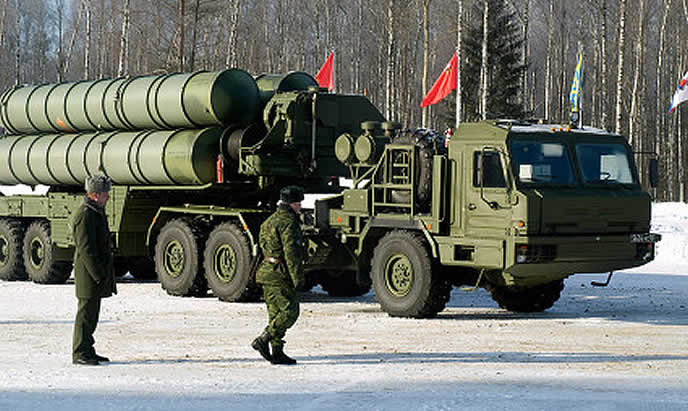
Russian S400 missile system photographed near Moscow
During his recent visit to London and meeting with British Prime Minister Cameron, President Putin passed on a message to the US and France in response to their recent announcement that they
will arm the [Al Nusrah] fighters in Syria.
As Russia is a sovereign nation dealing with the sovereign, legitimate government of Syria, some new arms which have never left Russia before [never previously deployed in Syria] will be delivered to the Syrian military.
The Patriot Missiles will be hit and repealed with S300 SAM [already installed in Syria]. Putin also threatened to deliver the more advanced S400 anti-aircraft missiles (see image above) far superior to the Patriot missiles and ranked as the World’s most advanced air defense system.
He added that Russia will also supply Syria with state-of –the-art 24-Barrell rocket launchers which have a range of 60 km ranked as the most developed artillery weapon of its kind.
He added that Russia will supply 400 of these launchers which will be able to destroy all targets around Syria’s borders.
Barrel 24 Launchers
A British intelligence report stated that Putin went to London bringing his own Russian cooked food and did not consume anything from Britain including water as he even brought his own water with him reportedly because he had concerns of being poisoned.
The British intelligence site stated that Putin threatened to send other secret Russian made weapons to Syria which would tip the balance of power even further in favour of Syria and re-iterated that these weapons will not be used against Israel on condition that Israel will not participate in the war within Syria and neighbouring countries.
{Lebanon, Jordan]
Reportedly, the British PM’s response was very weak in relation to Putin’s threats.
Putin’s response came just over 24 hours after Obama’s statement on Saturday that he was going to arm the Syrian resistance.
Putin clearly stated that the Middle East is going to witness a significant change. Syria will be armed with weapons that have never been seen before [in the Middle East] including computer guided smart missiles that never miss their target.
He also added that Russia will supply Syria with Skean 5 ground -to-sea missiles that are capable of hitting and sinking any target up to 250 km off the Syrian coast.
This article was originally published at Global Research
Seven-time Wimbledon champion Roger Federer hailed ailing Nelson Mandela as “influential and amazing” on Monday as the anti-apartheid icon remained in a critical condition in a Pretoria hospital
“He’s been very influential, an amazing personality, you know, believed in something, had to pay a big price for it,” said Federer.
“Someone you can definitely look up to and that’s very important for me. Clearly there’s many that come and go, but he has been there for a very long time.
“And he’s very much respected and loved. So we hope he does well here now in this process.”
Federer was speaking after reaching the Wimbledon second round on Monday with a 6-3, 6-2, 6-0 win over Romania’s Victor Hanescu.
The Swiss star has been a regular visitor to South Africa over the years where he has a charitable foundation.
The country is also the birthplace of his mother, Lynnette.
In 2011, Federer was voted second to Mandela in an international survey to find the world’s most respected, admired and trusted personality. – AFP
South Africa can become one of the fastest-growing economic hubs in the world if it exploits its natural resources, Deputy President Kgalema Motlanthe said on Monday.
“Fortunately for South Africa, we have among the best solar energy resources in the world, in addition to coal, which makes it logical for us to pursue the exploitation of photovoltaic technologies,” he said.
“In addition, we have abundant shale gas resources, the commercial exploitation of which we have to investigate and pursue.”
Speaking at the Green Economy National Youth Summit in Cape Town, Motlanthe said the country’s uranium deposits were too sizeable to ignore from a beneficiation perspective.
“If this is coupled with the potential for regional interconnection within the Southern African Development Community sub-region, we have the potential to be one of the fastest-growing economic hubs in the world.”
He said the focus would be on environmentally balanced and sustainable energy resources.
Motlanthe listed some of the options available to ensure the country’s energy security while adding economic benefits.
One of these was solar power, which held “enormous potential” for regional development in the Northern Cape.
There was also potential for “positive economic spin-offs” from the accelerated exploration of shale gas in the Karoo, as well as from diplomatic efforts to harness the natural gas discoveries in Mozambique and Tanzania.
Another option was the pursuit of a knowledge economy through the beneficiation of uranium, and a nuclear programme.
He said heavy reliance in the past on coal as an energy source had resulted in limited rural development.
“[It has resulted in] skewed economic development, with the urban areas and the coalfield areas enjoying better infrastructure, while other rural areas have yet to attain access to modern energy carriers,” he said.
The country had since adjusted its energy objectives to ensure diversified sources, security, cost minimisation, increased access, reduced emissions, water conservation and localisation of energy value chains.
“Accordingly, our energy planning framework seeks to maximise the economic benefits of our electricity, gas and liquid fuels infrastructure development programmes, [while] at the same time… meeting the other set objectives.” – SAPA
WASHINGTON — The U.S. Supreme Court today issued its long-awaited ruling on affirmative action — but didn’t offer a definitive opinion on whether colleges may consider the use of race in admissions.
Ruling 7-1, the court found that the U.S. Court of Appeals for the Fifth Circuit erred in not applying “strict scrutiny” to the policies of the University of Texas at Austin. The case is Fisher v. University of Texas at Austin, in which Abigail Fisher, a white woman rejected for admission by the university, said that her rights were violated by UT-Austin’s consideration of race and ethnicity in admissions decisions. Fisher’s lawyers argued that the University of Texas need not consider race because it has found another way to assure diversity in the student body.
The decision said that “good faith” by the university would not be enough to justify the consideration of race. But the decision — by Justice Anthony Kennedy — does not offer an opinion on whether the University of Texas can produce sufficient evidence. Rather, it faults the appeals court for not reviewing that question using the high bar of “strict scrutiny” for the consideration of race.
The Supreme Court did not — as some thought it might — reverse past decisions that allowed colleges to consider race. In fact, the conclusion of the decision states that colleges must meet the requirements previously given by the court to justify the use of race. Quoting from the landmark 1978 Bakke decision, today’s ruling says: “In order for judicial review to be meaningful, a university must make a showing that its plan is narrowly tailored to achieve the only interest that this Court has approved in this context: the benefits of a student body diversity that ‘encompasses a . . . broa[d] array of qualifications and characteristics of which racial or ethnic origin is but a single though important element.'”
It is likely that today’s ruling could mean that — after another round at the Fifth Circuit — the case could return to the Supreme Court.
Moments after the decision was handed down, Michael Olivas, an expert on higher education law (and a defender of affirmative action) e-mailed: “Affirmative action lives on by a thread, and demography will start to assert itself.” Olivas is director of the Institute for Higher Education Law and Governance at the University of Houston and author of Suing Alma Mater: Higher Education and the Courts (Johns Hopkins University Press).
The Record So Far
This website, maintained by the University of Texas at Austin, includes briefs and prior rulings in the case ofFisher v. University of Texas at Austin, in which Abigail Fisher, a white woman rejected for admission by the university, said that her rights were violated by UT-Austin’s consideration of race and ethnicity in admissions decisions.
Fisher’s argument was that past Supreme Court decisions have allowed colleges and universities to consider race and ethnicity only if diversity could not be achieved in race-neutral ways, so the University of Texas had no legal need to consider race. The university in turn said that the percent plan provided it with only a limited level of diversity and that it had the right to take additional measures to assure a greater level of diversity. Most major college associations backed the University of Texas, as did many civil rights organizations. Asian-American groups split on the case. – Inside Higher Ed. Read the full article here.
TV-personality Glenn Beck shows video of rebel eating human flesh
Broad majorities continue to oppose the U.S. and its allies sending arms and military supplies to anti-government groups in Syria. Last Thursday’s announcement that the U.S. would aid the rebels has not increased public support for action, and majorities of all partisan groups are opposed.
Overall, 70% oppose the U.S. and its allies sending arms and military supplies to anti-government groups in Syria; just 20% favor this. Opinion is little changed from December of last year (24% favor) and support is down slightly from March, 2012 (29% favor).
The latest national survey by the Pew Research Center, conducted June 12-16 among 1,512 adults, finds a major factor in overall attitudes about Syria is the impression that the U.S. military is already stretched thin. About two-thirds (68%) say the U.S. is too overcommitted to get involved in another conflict, and just 27% disagree. The public also has questions about the opposition groups in Syria: 60% say that they may be no better than the current government.
There is very little partisan divide in attitudes about the conflict in Syria. Majorities of independents (74%), Republicans (71%) and Democrats (66%) oppose the U.S. and its allies sending arms and military supplies to anti-government groups in Syria.
Nearly identical majorities of Democrats (69%), independents (69%) and Republicans (68%) also believe that U.S. military forces are too overcommitted to get involved in another conflict.
Independents (66%) and Republicans (64%) are most concerned that the opposition groups in Syria may be no better than the current government, but 52% of Democrats also agree with this statement.
By a 58%-38% margin, more Democrats agree than disagree that the U.S. has a moral obligation to do what it can to stop the violence in Syria. Republicans are split with 49% saying the U.S. has a moral obligation to do what it can to stop the violence, and 48% saying it does not have this responsibility. Most independents (53%) disagree that the U.S. has a moral obligation to stop the violence in Syria.
The survey, conducted from Wednesday, June 12 through Sunday, June 16, found no significant trend in opinion about Syria over the course of the five nights of fieldwork. In the first two nights of interviewing 69% opposed arming Syrian rebels, in the final three nights of fieldwork 71% were opposed.
Even amidst developments on the ground in Syria and the announcement of U.S. plans to aid anti-government groups there, the public continues to pay very little attention to news about Syria. In a separate survey conducted Thursday through Sunday, just 15% say they are following news about charges that Syria has used chemical weapons against anti-government groups very closely, far fewer than are following other stories such as the government’s collection of communication information (35%) and news about the national economy (30%). In fact, 33% say they are following news about Syria not at all closely.
Partisans express similarly low levels of interest in the conflict in Syria. Just 12% of Democrats, 14% of Republicans and 17% of independents say they are following charges that Syria used chemical weapons very closely.
The 20% of the public that favors arming anti-government groups in Syria also expresses concerns about the U.S. getting involved. More than half (56%) of those who favor arming rebels agree with the statement that U.S. military forces are too overcommitted to get involved in another conflict, and 55% agree that the opposition groups in Syria may be no better than the current government. However, far larger majorities agree that it is important for the U.S. to support people who oppose authoritarian regimes (76%) and that the U.S. has a moral obligation to do what it can to stop the violence in Syria (75%).
To a lesser extent, those who oppose arming the rebels are sympathetic to some arguments for greater U.S. involvement in Syria. About half of those who oppose arming rebels (48%) agree that it is important for the U.S. to support people who oppose authoritarian regimes; 41% say the U.S. has a moral obligation to do what it can to stop the violence in Syria. – PEW
The decision by the United States and its allies to arm rebel groups in Syria is “very dangerous” and will prolong the violence and killing on the ground, Syria’s foreign minister said Monday.
Walid al-Moallem said sending more weapons to the opposition will also hinder efforts to bring both sides to the table in a planned peace conference in Geneva. He said his country remains ready and willing to take part but added President Bashar Assad will not step down.
Al-Moallem’s comments came two days after an 11-nation group that includes the U.S. met in the Qatari capital of Doha and agreed to step up military and other assistance to the Syrian rebels. He said all those who met in Doha “have Syrian blood on their hands.”
U.S. Secretary of States John Kerry, who took part in the conference, would not disclose details of the aid, saying only that it would re-balance the fight between the rebels and the government. Assad’s better-equipped forces are increasingly backed by fighters from Lebanon’s Hezbollah militant group.
“We are not scared,” al-Moallem said of the decision. “If they dream or are delusional about achieving a balance with the Syrian Arab Army, I think they need to wait years and this won’t be achieved.”
“They will not be victorious no matter how much they conspire,” al-Moallem added. He said arming the rebels “is a dangerous decision because it aims at prolonging the crisis, prolonging the violence and killing and encouraging terrorism.”
The Friends of Syria gathering in Doha was Kerry’s first meeting with his counterparts on the practicalities of assisting the Syrian rebels since President Barack Obama announced that the U.S. would send lethal aid to the opposition. The decision came despite concerns that the weapons could fall into the hands of Islamic extremists in the rebel coalition.
Obama’s change of policy was partly based on a U.S. intelligence assessment that Assad had used chemical weapons, but Kerry expressed deeper concern about Damascus’ foreign support. He said that Iranian as well as Hezbollah fighters had joined the war.
Al-Moallem denied categorically that any Iranian fighters were in Syria. Damascus admits that Hezbollah is assisting government troops.
The foreign minister said his regime was willing to take part in any peace conference, but will go to Geneva not to hand over power to the other side but rather to establish “a real partnership” and a national unity government that includes representatives of all Syrian society.
“President Bashar Assad will not step down,” he said. “If anyone has such illusions on the other side, my advice to them is not to go to Geneva,” he said. He nonetheless called the conference an “opportunity that should not be missed.”
He defiantly said Syria will not accept any solutions or even ideas dictates from the outside.
More than 93,000 people have been killed in Syrian conflict that started in March 2011 as largely peaceful protest against Assad’s rule. The uprising turned into a bloody insurgency in response to a military crackdown by regime forces on the protest movement. In the past year, the war has taken on increasingly sectarian overtones. – AP
This website uses cookies to improve your experience. We'll assume you're ok with this, but you can opt-out if you wish. Cookie settingsACCEPT
Privacy & Cookies Policy
Privacy Overview
This website uses cookies to improve your experience while you navigate through the website. Out of these cookies, the cookies that are categorized as necessary are stored on your browser as they are essential for the working of basic functionalities of the website. We also use third-party cookies that help us analyze and understand how you use this website. These cookies will be stored in your browser only with your consent. You also have the option to opt-out of these cookies. But opting out of some of these cookies may have an effect on your browsing experience.
Necessary cookies are absolutely essential for the website to function properly. This category only includes cookies that ensures basic functionalities and security features of the website. These cookies do not store any personal information.
Any cookies that may not be particularly necessary for the website to function and is used specifically to collect user personal data via analytics, ads, other embedded contents are termed as non-necessary cookies. It is mandatory to procure user consent prior to running these cookies on your website.